Proceedings of the 2019 Conference on Empirical Methods in Natural Language Processing 3419
Towards Debiasing Fact Verification Models
Tal Schuster*,1, Darsh J Shah*,1, Yun Jie Serene Yeo2,
Daniel Filizzola1, Enrico Santus1, Regina Barzilay1
1Computer Science and Artificial Intelligence Lab, MIT 2DSO National Laboratories, Singapore
{tals, darsh, yeoyjs, danifili, esantus, regina}@csail.mit.edu
Abstract
Fact verification requires validating a claim in the context of evidence. We show, however, that in the popular FEVER dataset this might not necessarily be the case. Claim-only classi-fiers perform competitively with top evidence-aware models. In this paper, we investigate the cause of this phenomenon, identifying strong cues for predicting labels solely based on the claim, without considering any evidence. We create an evaluation set that avoids those id-iosyncrasies. The performance of FEVER-trained models significantly drops when evalu-ated on this test set. Therefore, we introduce a regularization method which alleviates the ef-fect of bias in the training data, obtaining im-provements on the newly created test set. This work is a step towards a more sound evalua-tion of reasoning capabilities in fact verifica-tion models.1
1 Introduction
Creating quality datasets is essential for expand-ing NLP functionalities to new tasks. Today, such datasets are often constructed using crowdsourc-ing mechanisms. Prior research has demonstrated that artifacts of this data collection method often introduce idiosyncratic biases that impact perfor-mance in unexpected ways (Poliak et al., 2018;
Gururangan et al.,2018). In this paper, we explore this issue using the FEVER dataset, designed for fact verification (Thorne et al.,2018).
The task of fact verification involves assessing claim validity in the context of evidence, which can either support, refute or contain not enough information. Figure 1(A) shows an example of a FEVER claim and evidence. While validity of some claims may be asserted in isolation (e.g.
Asterisk (*) denotes equal contribution.
1Data and code: https://github.com/
TalSchuster/FeverSymmetric
Claim Refutes Evidence
New Claim Refutes New Evidence
Supports
(A)ORIGINALpair from the FEVER dataset
Claim:
Stanley Williams stayed in Cuba his whole life.
Evidence:
Stanley [...] was part of the West Side Crips, a street gang which has its roots in South Central Los Angeles.
(B)Manually GENERATEDpair
Claim:
Stanley Williams moved from Cuba to California when he was 15 years old.
Evidence:
[image:1.595.307.525.224.478.2]Stanley [...] was born in Havana and didn’t leave the country until he died.
Figure 1: An illustration of a REFUTESclaim-evidence
pair from the FEVER dataset (A) that is used to gener-ate a new pair (B). From the combination of the ORIGI -NALand manually GENERATEDpairs, we obtain a total of four pairs creating symmetry.
through common sense knowledge), contextual verification is key for a fact-checking task ( Al-hindi et al.,2018). Datasets should ideally eval-uate this ability. To assess whether this is the case for FEVER, we train a claim-only BERT (Devlin et al., 2019) model that classifies each claim on its own, without associated evidence. The result-ing system achieves 61.7%, far above the majority baseline (33.3%).
Our analysis of the data demonstrates that this unexpectedly high performance is due to idiosyn-crasies of the dataset construction. For instance, in
§2we show that the presence of negation phrasing
highly correlates with the REFUTES label,
inde-pendently of provided evidence.
mecha-nism for avoiding bias in the test set construction. We create a SYMMETRIC TEST SET where, for
each claim-evidence pair, we manually generate a synthetic pair that holds the same relation (e.g. SUPPORTS or REFUTES) but expressing a
differ-ent, contrary, fact. In addition, we ensure that in the new pair, each sentence satisfies the inverse re-lation with the original pair’s sentence. This pro-cess is illustrated in Figure 1, where an original REFUTES pair is extended with a synthetic RE -FUTES pair. The new evidence is constrained to
support the original claim, and the new claim is supported by the original evidence. In this way, we arrive at three new pairs that complete the sym-metry.
Determining veracity with the claim alone in this setting would be equivalent to a ran-dom guess. Unsurprisingly, the performance of FEVER-trained models drop significantly on this test set, despite having complete vocabulary over-lap with the original dataset. For instance, the leading evidence-aware system in the FEVER Shared Task, the NSMN classifier by Nie et al.
(2019)2, achieves only 58.7% accuracy on the
symmetric test set compared to 81.8% on the orig-inal dataset.
While this new test set highlights the afore-mentioned problem, other studies have shown that FEVER is not the only biased dataset (Poliak et al.,
2018;Gururangan et al.,2018). A potential solu-tion which may be applied also in other tasks is therefore to develop an algorithm that alleviates such bias in the training data. We introduce a new regularization procedure to downweigh the give-away phrases that cause the bias.
The contributions of this paper are threefold:
•We show that inherent bias in FEVER dataset
interferes with context-based fact-checking.
•We introduce a method for constructing an
eval-uation set that explicitly tests a model’s ability to validate claims in context.
•We propose a new regularization mechanism that improves generalization in the presence of the aforementioned bias.
2 Motivation and Analysis
In this section, we quantify the observed bias and explore the factors causing it.
2https://github.com/easonnie/
combine-FEVER-NSMN
Train Development Bigram LMI·10−6 p(l|w) LMI·10−6 p(l|w)
did not 1478 0.83 1038 0.90
yet to 721 0.90 743 0.96
does not 680 0.78 243 0.68
refused to 638 0.87 679 0.97
failed to 613 0.88 220 0.96
only ever 526 0.86 350 0.82
incapable being 511 0.89 732 0.96
to be 438 0.50 454 0.65
unable to 369 0.88 346 0.95
not have 352 0.78 211 0.92
Table 1: Top 10 LMI-ranked bigrams in the train set of FEVER for REFUTESwith itsp(l|w). The
correspond-ing figures for the development set are also provided. Statistics for other labels are in AppendixB.2.
Claim-only Classification Claim-only aware classifiers can significantly outperform all base-lines described by Thorne et al. (2018).3 BERT,
for instance, attains an accuracy of 61.7%, which is just 8% behind NSMN. We hypothesize that these results are due to two factors: (1) idiosyn-crasies distorting performance and (2) word em-beddings revealing world knowledge.
Idiosyncrasies Distorting Performance We in-vestigate the correlation between phrases in the claims and the labels. In particular, we look at the n-gram distribution in the training set. We use Local Mutual Information (LMI) (Evert,2005) to capture high frequency n-grams that are highly correlated with a particular label, as opposed to
p(l|w) that is biased towards low frequency
n-grams. LMI betweenwandlis defined as follows:
LM I(w, l) =p(w, l)·log !
p(l|w)
p(l) "
, (1)
where p(l|w) is estimated by count(count(w,lw)), p(l) by
count(l)
|D| ,p(w, l)by
count(w,l)
|D| and|D|is the
num-ber of occurrences of all n-grams in the dataset. Table1shows that the top LMI-ranked n-grams that are highly correlated with the REFUTESclass
in the training set exhibit a similar correlation in the development set. Most of the n-grams express strong negations, which, in hindsight, is not sur-prising as these idiosyncrasies are induced by the way annotators altered the original claims to gen-erate fake claims.
3We evaluate on the development set as the test set is
World Knowledge Word embeddings encom-pass world knowledge, which might augment the performance of claim-only classifiers. To fac-tor out the contribution of world knowledge, we trained two versions of claim-only InferSent ( Po-liak et al.,2018) on the FEVER claims: one with GloVe embeddings (Pennington et al.,2014) and the other with random embeddings.4 The
perfor-mance with random embeddings was 54.1%, com-pared to 57.3% with GloVe, which is still far above the majority baseline (33.3%). We conjecture that world knowledge is not the main reason for the success of the claim-only classifier.
3 Towards Unbiased Evaluation
Based on the analysis above, we conclude that an unbiased verification dataset should exclude ‘give-away’ phrases in one of its inputs and also not al-low the system to solely rely on world knowledge. The dataset should enforce models to validate the claim with respect to the retrieved evidence. Par-ticularly, the truth of some claims might change as the evidence varies over time.
For example, the claim “Halep failed to ever win a Wimbledon title”was correct until July 19. A fact-checking system that retrieves information from Halep’s Wikipedia page should modify its answer to “false” after the update that includes in-formation about her 2019 win.
Towards this goal, we create a SYMMETRIC
TEST SET. For an original claim-evidence pair,
we manually generate a synthetic pair that holds the same relation (i.e. SUPPORTS or REFUTES)
while expressing a fact that contradicts the original sentences. Combining the ORIGINAL and GEN -ERATEDpairs, we obtain two new cross pairs that
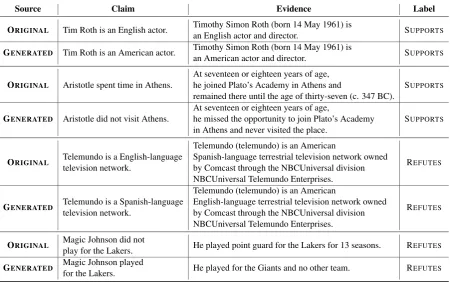
hold the inverse relations (see Figure 1). Exam-ples of generated sentences are provided in Table
2.
This new test set completely eliminates the abil-ity of models to rely on cues from claims. Consid-ering the two labels of this test set5, the probability
of a label given the existence of any n-gram in the claim or in the evidence isp(l|w) = 0.5, by
con-struction.
Also, as the example in Figure1demonstrates, in order to perform well on this dataset, a fact veri-fication classifier may still take advantage of world 4We use InferSent because BERT, being pretrained on
Wikipedia, comprises world knowledge (Talmor et al.,2019).
5NOTENOUGH INFO cases are easy to generate so we
focus on the two other labels.
knowledge (e.g. geographical locations), but rea-soning should only be with respect to the context.
4 Towards Unbiased Training
Creating a large symmetric dataset for training is outside the scope of this paper as it would be too expensive. Instead, we propose an algorith-mic solution to alleviate the bias introduced by ‘give-away’ n-grams present in the claims. We re-weight the instances in the dataset to flatten the correlation of claim n-grams with respect to the la-bels. Specifically, for ‘give-away’ phrases of a par-ticular label, we increase the importance of claims with different labels containing those phrases.
We assign an additional (positive) balancing weightα(i) to each training example {x(i), y(i)}, determined by the words in the claim.
Bias in the Re-Weighted Dataset For each n-gram wj in the vocabulary V of the claims, we define the bias towards classcto be of the form:
bcj = #n
i=1I[w(i) j ]
(1 +α(i))I[y(i)=c] #n
i=1I[wj(i)](1 +α(i))
, (2)
whereI
[w(ji)]andI[y(i)=c]are the indicators forwj being present in the claim fromx(i) and labely(i)
being of classc, respectively.
Optimization of the Overall Bias Finding theα
values which minimize the bias leads us to solving the following objective:
min $ %
|V| &
j=1
max
c (b c
j) +λ!#α!2
'
(. (3)
Re-Weighted Training Objective We calculate theαvalues separately from the model
optimiza-tion, as a pre-processing step, by optimizing Eq.3. Using these values, the training objective is re-weighted from the standard#n
i=1L(x(i), y(i)) to
n
&
i=1
(1 +α(i))L(x(i), y(i)). (4)
Source Claim Evidence Label
ORIGINAL Tim Roth is an English actor. Timothy Simon Roth (born 14 May 1961) is
an English actor and director. SUPPORTS
GENERATED Tim Roth is an American actor. Timothy Simon Roth (born 14 May 1961) is
an American actor and director. SUPPORTS
ORIGINAL Aristotle spent time in Athens.
At seventeen or eighteen years of age, he joined Plato’s Academy in Athens and
remained there until the age of thirty-seven (c. 347 BC).
SUPPORTS
GENERATED Aristotle did not visit Athens. At seventeen or eighteen years of age,he missed the opportunity to join Plato’s Academy in Athens and never visited the place.
SUPPORTS
ORIGINAL Telemundo is a English-languagetelevision network.
Telemundo (telemundo) is an American
Spanish-language terrestrial television network owned by Comcast through the NBCUniversal division NBCUniversal Telemundo Enterprises.
REFUTES
GENERATED Telemundo is a Spanish-languagetelevision network.
Telemundo (telemundo) is an American
English-language terrestrial television network owned by Comcast through the NBCUniversal division NBCUniversal Telemundo Enterprises.
REFUTES
ORIGINAL Magic Johnson did notplay for the Lakers. He played point guard for the Lakers for 13 seasons. REFUTES
[image:4.595.74.525.59.341.2]GENERATED Magic Johnson playedfor the Lakers. He played for the Giants and no other team. REFUTES
Table 2: Examples of pairs from the Symmetric Dataset. Each generated claim-evidence pair holds the relation described in the right column. Crossing the generated sentences with the original ones creates two additional cases with an opposite label (see Figure1).
5 Experiments
We use the SYMMETRIC TEST SET to (1)
inves-tigate whether top performing sequence classifica-tion models trained on the FEVER dataset are ac-tually verifying claims in the context of evidence; and (2) measure the impact of the re-weighting method described in§4over a classifier.
To achieve the first goal, we use three classi-fiers. The first is a pre-trained, current FEVER state-of-the-art classifier,NSMN(Nie et al.,2019) which is a variation of the ESIM (Chen et al.,
2017) model, with a number of additional features, such as contextual word embeddings (Peters et al.,
2018). In addition, we train our ownESIMmodel with GloVe embeddings, using the available code fromGardner et al.(2017). The third is aBERT
classifier6 that we fine-tune for 3 epochs to
clas-sify the relation based on the concatenation of the claim and evidence (with a delimiter token). To measure the impact of our regularization method, we also train the ESIM and BERT models with the re-weighting method.
6https://github.com/huggingface/
pytorch-pretrained-BERT
Symmetric Test Set The full SYMMETRIC
TEST SET consists of 956 claim-evidence pairs,
created following the procedure described in §3. The new pairs originated from 99 SUPPORTSand
140 REFUTES pairs that were randomly picked
from the cases which NSMN correctly predicts.7
After its generation, we asked two subjects to annotate randomly sampled 285 claim-evidence pairs (i.e. 30% of the total pairs in SYMMET -RIC TESTSET) with one label among SUPPORTS,
REFUTES or NOT ENOUGH INFO, flagging
non-grammatical cases. They agreed with the dataset labels in 94% of cases, attaining a Cohenκof 0.88
(Cohen,1960). Typos and small grammatical er-rors were reported in 2% of the cases. Given the small size of this dataset, we only use it as a test set.
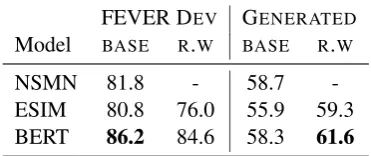
Results Table3summarizes the performance of the three models on the SUPPORTSand REFUTES
pairs from the FEVER DEVset and on the created
SYMMETRIC TEST SET pairs. All models
per-form relatively well on FEVER DEV but achieve
less than 60% accuracy on the synthetic ones. We 7Due to our focus on the performance drop with respect
FEVER DEV GENERATED
Model BASE R.W BASE R.W
NSMN 81.8 - 58.7
[image:5.595.88.274.64.142.2]-ESIM 80.8 76.0 55.9 59.3 BERT 86.2 84.6 58.3 61.6
Table 3: Classifiers’ accuracy on the SUPPORTS and
REFUTEScases from the FEVER DEVset and on the GENERATEDpairs for the SYMMETRICTESTSET in the setting of without (BASE) and with (R.W) re-weight.
conjecture that the drop in performance is due to training data bias that is also observed in the devel-opment set (see§2) but not in the generated sym-metric cases.
Our re-weighting method (§4) helps to reduce
the bias in the claims. In Table 4, we revisit the give-away bigrams from Table 1. Applying the weights obtained by optimizing Eq. 3, the weighted distribution of these phrases being asso-ciated with a specific label in the training set is now roughly uniform.
The re-weighting method increases the accu-racy of the ESIM and BERT models by an abso-lute 3.4% and 3.3% respectively. One can notice that this improvement comes at a cost in the ac-curacy over the FEVER DEV pairs. Again, this
can be explained by the bias in the training data that translates to the development set, allowing FEVER-trained models to leverage it. Applying the regularization method, using the same training data, helps to train a more robust model that per-forms better on our test set, where verification in context is a key requirement.
6 Related Work
Large scale datasets are fraught with give-away phrases (McCoy et al., 2019; Niven and Kao,
2019). Crowd workers tend to adopt heuristics when creating examples, introducing bias in the dataset. In SNLI (Stanford Natural Language In-ference) (Bowman et al.,2015), entailment based solely on the hypothesis forms a very strong base-line (Poliak et al.,2018;Gururangan et al.,2018). Similarly, as shown by Kaushik and Lipton
(2018), reading comprehension models that rely only on the question (or only on the passage re-ferred to by the question) perform exceedingly well on several popular datasets (Weston et al.,
2016;Onishi et al., 2016; Hill et al., 2016). To address deficiencies in the SQuAD dataset (Jia
Bigram R.WLMI·10−6 R.Wp(l|w)
did not 144 0.35
yet to 30 0.33
does not 67 0.35
refused to 55 0.35
failed to 31 0.33
only ever 9 0.31
incapable being 32 0.33
to be 8 0.30
unable to 10 0.32
not have 41 0.35
Table 4: Re-weighted statistics (l =REFUTES) for the
bigrams from Table1. The weights were obtained fol-lowing the optimization of Eq. 3 on the training set which contains three labels.
and Liang, 2017), researchers have proposed ap-proaches for augmenting the existing dataset ( Ra-jpurkar et al.,2018). In most cases, these augmen-tations are done manually, and involve construct-ing challengconstruct-ing examples for existconstruct-ing systems.
7 Conclusion
This paper demonstrates that the FEVER dataset contains idiosyncrasies that can be easily ex-ploited by fact-checking classifiers to obtain high classification accuracies. Evaluating the claim-evidence reasoning of these models necessitates unbiased datasets. Therefore, we suggest a way to turn the evaluation FEVER pairs into sym-metric combinations for which a decision that is solely based on the claim is equivalent to a random guess. Tested on these pairs, FEVER-trained mod-els show degraded performance. To address this problem, we propose a simple method that sup-ports a more robust generalization in the presence of bias.
Moving forward, we suggest using our symmet-ric dataset in addition to the current retrieval-based FEVER evaluation pipeline. This way, models could be tested both for their evidence retrieval and classification accuracy and for performing the reasoning with respect to the evidence.
8 Acknowledgments
References
Tariq Alhindi, Savvas Petridis, and Smaranda Mure-san. 2018. Where is your evidence: Improving fact-checking by justification modeling. InProceedings of the First Workshop on Fact Extraction and VERi-fication (FEVER), pages 85–90, Brussels, Belgium. Association for Computational Linguistics.
Samuel R. Bowman, Gabor Angeli, Christopher Potts, and Christopher D. Manning. 2015. A large anno-tated corpus for learning natural language inference. In Proceedings of the 2015 Conference on Empiri-cal Methods in Natural Language Processing, pages 632–642. Association for Computational Linguis-tics.
Qian Chen, Xiaodan Zhu, Zhen-Hua Ling, Si Wei, Hui Jiang, and Diana Inkpen. 2017. Enhanced lstm for natural language inference. InProceedings of the 55th Annual Meeting of the Association for Compu-tational Linguistics (Volume 1: Long Papers), pages 1657–1668.
Jacob Cohen. 1960. A coefficient of agreement for nominal scales. Educational and psychological measurement, 20(1):37–46.
Jacob Devlin, Ming-Wei Chang, Kenton Lee, and Kristina Toutanova. 2019. BERT: Pre-training of deep bidirectional transformers for language under-standing. In Proceedings of the 2019 Conference of the North American Chapter of the Association for Computational Linguistics: Human Language Technologies, Volume 1 (Long and Short Papers), pages 4171–4186, Minneapolis, Minnesota. Associ-ation for ComputAssoci-ational Linguistics.
Stefan Evert. 2005. The statistics of word cooccur-rences: word pairs and collocations.
Matt Gardner, Joel Grus, Mark Neumann, Oyvind Tafjord, Pradeep Dasigi, Nelson F. Liu, Matthew Peters, Michael Schmitz, and Luke S. Zettlemoyer. 2017. Allennlp: A deep semantic natural language processing platform.
Suchin Gururangan, Swabha Swayamdipta, Omer Levy, Roy Schwartz, Samuel Bowman, and Noah A. Smith. 2018. Annotation artifacts in natural lan-guage inference data. InProceedings of the 2018 Conference of the North American Chapter of the Association for Computational Linguistics: Human Language Technologies, Volume 2 (Short Papers), pages 107–112. Association for Computational Lin-guistics.
Felix Hill, Antoine Bordes, Sumit Chopra, and Jason Weston. 2016. The goldilocks principle: Reading children’s books with explicit memory representa-tions. InInternational Conference on Learning Rep-resentations 2016.
Robin Jia and Percy Liang. 2017. Adversarial exam-ples for evaluating reading comprehension systems.
In Proceedings of the 2017 Conference on Empiri-cal Methods in Natural Language Processing, pages 2021–2031. Association for Computational Linguis-tics.
Heinrich Jiang and Ofir Nachum. 2019. Identifying and correcting label bias in machine learning.arXiv preprint arXiv:1901.04966.
Divyansh Kaushik and Zachary C. Lipton. 2018. How much reading does reading comprehension require? a critical investigation of popular benchmarks. In Proceedings of the 2018 Conference on Empirical Methods in Natural Language Processing, pages 5010–5015. Association for Computational Linguis-tics.
Tom McCoy, Ellie Pavlick, and Tal Linzen. 2019.
Right for the wrong reasons: Diagnosing syntactic heuristics in natural language inference. In Proceed-ings of the 57th Annual Meeting of the Association for Computational Linguistics, pages 3428–3448, Florence, Italy. Association for Computational Lin-guistics.
Yixin Nie, Haonan Chen, and Mohit Bansal. 2019.
Combining fact extraction and verification with neu-ral semantic matching networks. InAssociation for the Advancement of Artificial Intelligence.
Timothy Niven and Hung-Yu Kao. 2019. Probing neu-ral network comprehension of natuneu-ral language ar-guments. InProceedings of the 57th Annual Meet-ing of the Association for Computational LMeet-inguis- Linguis-tics, pages 4658–4664, Florence, Italy. Association for Computational Linguistics.
Takeshi Onishi, Hai Wang, Mohit Bansal, Kevin Gim-pel, and David A. McAllester. 2016.Who did what: A large-scale person-centered cloze dataset. In Pro-ceedings of the 2016 Conference on Empirical Meth-ods in Natural Language Processing, pages 2230– 2235. The Association for Computational Linguis-tics.
Jeffrey Pennington, Richard Socher, and Christopher Manning. 2014. Glove: Global vectors for word representation. InProceedings of the 2014 confer-ence on empirical methods in natural language pro-cessing, pages 1532–1543.
Matthew Peters, Mark Neumann, Mohit Iyyer, Matt Gardner, Christopher Clark, Kenton Lee, and Luke Zettlemoyer. 2018. Deep contextualized word rep-resentations. In Proceedings of the 2018 Confer-ence of the North American Chapter of the Associ-ation for ComputAssoci-ational Linguistics: Human Lan-guage Technologies, Volume 1 (Long Papers), pages 2227–2237.
Adam Poliak, Jason Naradowsky, Aparajita Haldar, Rachel Rudinger, and Benjamin Van Durme. 2018.
pages 180–191, New Orleans, Louisiana. Associa-tion for ComputaAssocia-tional Linguistics.
Pranav Rajpurkar, Robin Jia, and Percy Liang. 2018.
Know what you don’t know: Unanswerable ques-tions for squad. InProceedings of the 56th Annual Meeting of the Association for Computational Lin-guistics (Volume 2: Short Papers), pages 784–789. Association for Computational Linguistics.
Alon Talmor, Jonathan Herzig, Nicholas Lourie, and Jonathan Berant. 2019. CommonsenseQA: A ques-tion answering challenge targeting commonsense knowledge. InProceedings of the 2019 Conference of the North American Chapter of the Association for Computational Linguistics: Human Language Technologies, Volume 1 (Long and Short Papers), pages 4149–4158, Minneapolis, Minnesota. Associ-ation for ComputAssoci-ational Linguistics.
James Thorne, Andreas Vlachos, Christos Christodoulopoulos, and Arpit Mittal. 2018.
Fever: a large-scale dataset for fact extraction and verification. InProceedings of the 2018 Conference of the North American Chapter of the Association for Computational Linguistics: Human Language Technologies, Volume 1 (Long Papers), pages 809–819.