Dynamic Shear Properties of Alloy 718 over Wide Temperature Range
Woei-Shyan Lee
1,+, Chi-Feng Lin
2, Tao-Hsing Chen
3and Chi-Sheng Huang
11Department of Mechanical Engineering, National Cheng Kung University, Tainan 701, Taiwan, R. O. China 2National Center for High-Performance Computing, National Applied Research Laboratories,
Hsin-Shi Dist., Tainan City 744, Taiwan, R. O. China
3Department of Mechanical Engineering, National Kaohsiung University of Applied Sciences, Kaohsiung 807, Taiwan, R. O. China
In this study, a split Hopkinson torsional bar was utilised to study the dynamic shear deformation behaviour of Alloy 718 at shear strain rates of 1000, 1500 and 3200 s¹1and temperatures of¹150, 25 and 300°C. It was found that the mechanical behaviour of Alloy 718 is sensitive to both the strain rate and the temperature. The yield shear stress and work hardening coefficient increased with increasing strain rate, but decreased with increasing temperature. In addition, the fracture shear strain increased with increasing strain rate and temperature. The strain rate sensitivity and temperature sensitivity increased with increasing strain and strain rate, but decreased with increasing temperature. It was found that the high strain rate plastic deformation of Alloy 718 alloy can be adequately described using the Kobayashi and Dodd constitutive equation. Finally, the fracture surfaces were found to contain multiple dimple-like features. The dimple density increased with increasing strain rate and temperature. Thus, it was inferred that the ductility of Alloy 718 increases at higher strain rates and temperatures.
[doi:10.2320/matertrans.M2012073]
(Received February 27, 2012; Accepted July 11, 2012; Published August 29, 2012)
Keywords: Alloy 718, shear, strain rate and temperature effect, activation energy
1. Introduction
Alloy 718 is well suited to environments characterised by dramatic temperature change and corrosion, and is therefore used for a wide variety of applications, ranging from the International Space Station to cryogenic storage tanks, nuclear reactors and pollution control equipment. The literature contains many investigations into the static proper-ties of Alloy 718.14)However, the interactive effects of strain
rate and temperature on the mechanical properties of metals and alloys under high speed loading are much stronger than those under static loading.57)Thus, while the static proper-ties of Alloy 718 are well understood, the dynamic properproper-ties require further investigation.
In Refs. 2, 813), the mechanical properties of Alloy 718 were investigated under high strain rate loading conditions and/or a high temperature. However, in many applications (e.g., aerospace components and cryogenic storage tanks), Alloy 718 structures are subjected to both a high strain rate and a cryogenic temperature. Therefore, in designing robust Alloy 718 components, it is necessary to develop a thorough understanding of the dynamic shear deformation behaviour of Alloy 718 over a wide range of temperatures and strain rates. Although the high temperature deformation behaviour of Alloy 718 is well understood, its shear deformation behaviour and microstructural evolution at low temperatures are less clear. Accordingly, in the present study, the effects of shear loading on the mechanical properties and micro-structural evolution of Alloy 718 are investigated over a wide temperature range extending from¹150 to 300°C.
The split Hopkinson pressure bar (SHPB)14)is one of the most commonly used systems for clarifying the effects of strain rate and temperature on the mechanical behaviour of alloys,1517) plastics,18) composites19,20) and sintered
materi-als.21,22) In general, the results show that for most materials the flow stress increases slowly with increasing strain rate over the range of 1 to 103s¹1, but then increases rapidly
as the strain rate is further increased from 103 to 104s¹1.
In addition to the strain rate, the temperature also has a significant effect on the mechanical properties of deformed materials. For example, a higher temperature reduces the internal resistance to dislocation movement and results in plastic flow. However, due to the combined effects of work hardening and work softening caused by impact loading and high deformation temperatures, respectively, predicting the actual plastic deformation of common engineering materials is highly challenging.
In the present study, the dynamic shear deformation behaviour of Alloy 718 was investigated using a torsional SHPB system at shear strain rates of 10003200 s¹1 and
temperatures of ¹150300°C. The fracture surfaces were examined via optical microscopy (OM) and scanning electron microscopy (SEM). Finally, the correlation between the dynamic shear response of the Alloy 718 specimens and the fracture features was systematically explored.
2. Experimental
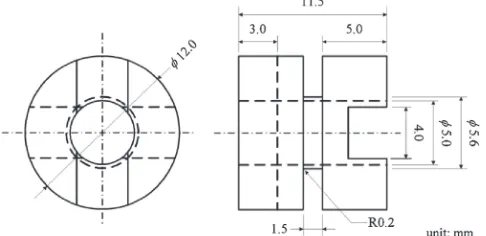
Alloy 718 (AISI A2 Grade) with a composition of 18.29% Cr, 18.23% Fe, 4.8% Nb, 5.15% Mo, 0.97% Ti, 0.54% Al, 0.12% Co, 0.078%Si, 0.065% Mn, 0.065% Cu, 0.051%C, 0.028%W, and a balance of Ni (mass) was purchased from Gloria Material Technology Corp., Taiwan, R.O.C. The material was received in the form of hot-rolled bars with a diameter of 13 mm. The bars were solution heat treated at 1050°C for one hour, air cooled, and then aged at 775°C for 8 h. Twin-flanged thin-walled tubular specimens with an outer diameter (OD) of 12 mm and a length of 11.5 mm were then machined from the aged bars. A gauge section was produced in the centre of each specimen by reducing the OD +Corresponding author, E-mail: wslee@mail.ncku.edu.tw
of the tube to 5.6 mm over a length of 1.5 mm. Finally, circular flanges were machined at either end of the gauge section in order to mount the specimen in the SHPB system. Figure 1 presents a schematic illustration of thefinal tubular specimen.
Dynamic shear tests were performed at strain rates of 1000, 1500 and 3200 s¹1, respectively, and temperatures of¹150, 25 and 300°C. The test temperature of 300°C was achieved using a clamped shell radiant heating furnace with an internal diameter of 20 mm and a heating element of length 21 mm. Meanwhile, the test temperature of ¹150°C was obtained using a refrigeration system positioned around the specimen and filled with liquid nitrogen and alcohol. In all of the shear tests, the deformation temperature was monitored by attaching a K-type (Chromel/Alumel) thermocouple with an accuracy of«2°C to the specimen surface.
In performing the tests, the specimens were mounted between the incident bar and the transmitted bar of the SHPB system. The two bars had a diameter of 12.7 mm and a length of 1000 mm, and were both machined from 7075-T6 aluminum alloy. Note that the full details of the experimental procedure and analytical technique used to evaluate the dynamic mechanical response of the shear specimens are presented in a previous study23) and are therefore omitted here. After dynamic shear testing, the deformed specimens were sectioned parallel to the longitudinal axis. The sections were ground and polished using conventional techniques and were then etched in an acidic solution of 3 mL HNO3,
2 mL HF and 95 mL H2O. Finally, the fracture surfaces were
observed using an MeF3 optical microscope. The detailed characteristics of the fracture surfaces were identified using a Philip’s XL-40 FEG scanning electron microscope (SEM) with an accelerating voltage of 15 kV.
3. Results and Discussion
3.1 Shear stressstrain curves
Figure 2(a) shows the shear stressstrain curves of the Alloy 718 specimens deformed at different strain rates and temperatures. The results show that theflow stress increased with increasing strain rate but decreased with increasing temperature. In addition, the difference in the stress induced at strain rates of 1000 and 3200 s¹1, respectively, was greater
at a lower temperature (¹150°C) than at a higher temperature (300°C). Finally, the fracture strain varied as a function of both the strain rate and the temperature. In other words,
the ductility of Alloy 718 is both strain rate-sensitive and temperature-sensitive. Figure 2(b) shows the effects of the strain rate and temperature on the fracture strain of the Alloy 718 specimens. It is seen that for a constant temperature, the fracture shear strain increased with increasing strain rate. Meanwhile, for a constant strain rate, the fracture shear strain increased with increasing temperature. In other words, the ductility of Alloy 718 increases under high strain rate and temperature loading conditions. It is thought that the ductility enhancement is the result of a deformation-induced temper-ature rise prompted by the interaction between the high strain rate and the high temperature.
3.2 Effects of strain rate on deformation behaviour
To clarify the effect of the strain rate on the shear response of Alloy 718, Fig. 3(a) plots the variation of the shear stress with the strain rate as a function of the temperature and shear strain. It is seen that theflow stress increased with increasing strain rate. The effect of the strain rate on the shear stress can be quantified via the strain rate sensitivity parameter ¢ (equivalent to the gradient of the¸vs. log£_ plot),24)i.e.,
¢¼ ð¸2¸1Þ=lnð£_2=£_1Þ; ð1Þ
Fig. 1 Geometric design of test specimens.
0
Shear strain, γ
0 200 400 600 800 1000
Shear str
ess,
τ
/MP
a
3200 s-1
1500 s-1
1000 s-1
25o
C
-150o
C
300o
C
Fracture (a)
0.2
Fracture shear strain, γf 400
600 800 1000 1200
Fractur
e shear str
ess,
σf
/MP
a
25o
C
300oC
-150oC
3200 s-1
1500 s-1
1000 s-1
(b)
0.4 0.36 0.32 0.28 0.24
0.5 0.4 0.3 0.2 0.1
[image:2.595.49.292.73.191.2] [image:2.595.324.524.74.455.2]where the shear stresses ¸2 and ¸1 are obtained from shear
tests conducted at average strain rates of £_2 and £_1, respectively, and are calculated at the same value of the shear strain. Figure 3(b) plots the strain rate sensitivity of the Alloy 718 specimens against the shear strain as a function of the strain rate and deformation temperature. It can be seen that for a given temperature, the strain rate sensitivity increased with increasing strain rate. In addition, it is observed that the strain rate sensitivity increased relatively slowly with increasing shear strain at 300°C, but increased more rapidly at ¹150°C. In other words, for a given strain and strain rate, the effect of the strain rate on the degree of work hardening increased with a reducing deformation temperature.
The stressstrain curves presented in Fig. 2(a) reflect the change in the microstructure of the Alloy 718 specimens during the dynamic deformation process. Some studies have shown that the rate of dislocation multiplication increases with an increasing strain rate and leads to an enhanced material strength.2527) Furthermore, a higher deformation
temperature increases the energy of the mobile dislocations and therefore improves their ability to overcome barriers (e.g., grain boundaries, tangled dislocations and precipita-tions) during the plastic deformation process. The higher strain rate sensitivity observed in the present specimens under high strain rate and low temperature conditions (Figs. 3(a) and 3(b)) implies that the mobile dislocations in Alloy 718 require a greater driving force to overcome obstacles when deformation occurs at a high strain rate or a low temperature.
3.3 Effects of temperature on deformation behaviour
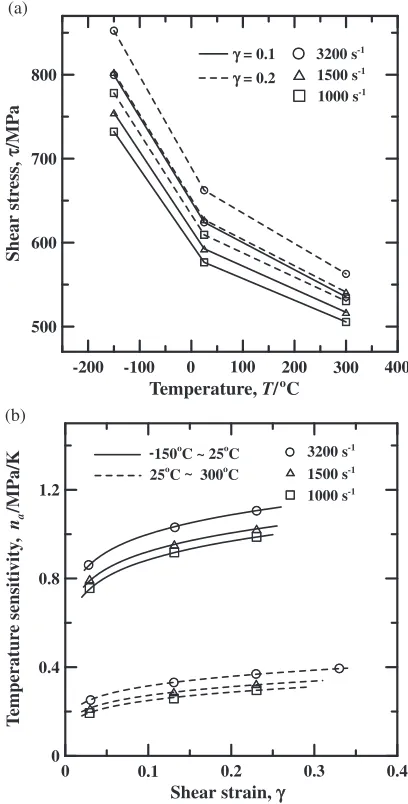
To clarify the effect of the temperature on the mechanical behaviour of Alloy 718, Fig. 4(a) illustrates the variation of the shear stress with the deformation temperature as a function of the strain rate at true strains of 0.1 and 0.2, respectively. The results show that the shear stress reduced with increasing temperature. In general, the thermal softening effect induced under dynamic shear loading can be quantified via the following temperature sensitivity parameter:
na¼ jð¸2¸1Þ=ðT2T1Þj; ð2Þ
1x10³ 2x10³ 3x10³ Shear strain rate, γ/s-1
400 600 800 1000 Shear str ess, τ /MP a
-150oC
25oC
300oC
γ = 0.2
γ = 0.1
(a)
0
Shear strain, γ
0.5 0.4 0.3 0.2 0.1 0 20 40 60 80
Strain rate sensiti
vity
,
β
/MP
a
1000 - 1500 s-1
1500 - 3200 s-1
25o C 300o C -150o C (b)
Fig. 3 (a) Variation of shear stress with logarithmic strain rate as function of temperature for constant shear strains of 0.1 and 0.2. (b) Variation of strain rate sensitivity with shear strain as function of temperature and strain rate.
-200
Temperature, T/oC
500 600 700 800 Shear str ess, τ /MP a
γ = 0.1
γ = 0.2
3200 s-1
1500 s-1
1000 s-1
(a)
0
Shear strain, γ
0.4 0.3 0.2 0.1 0 0.4 0.8 1.2 T emperatur e sensiti vity , na /MP a/K -150o
C ~ 25o
C
25oC ~ 300oC
3200 s-1
1500 s-1
1000 s-1
(b)
300 200
-100 0 100 400
[image:3.595.69.272.66.476.2] [image:3.595.324.528.72.474.2]where the shear stresses ¸2 and ¸1 are obtained from tests
conducted at temperatures of T2 and T1, respectively.
Figure 4(b) shows the temperature sensitivity of the present Alloy 718 as a function of the shear strain, strain rate and temperature. It is seen that the temperature sensitivity increased with increasing strain and strain rate, but reduced with increasing temperature. In other words, Alloy 718 has a greater resistance to thermal softening at higher temperatures (e.g., 300°C) than at lower temperatures (e.g., ¹150°C). Previous studies11,28)have shown that precipitations play an important role in preserving the high-temperature strength of Alloy 718 under static loading conditions. This finding is consistent with the results presented in Figs. 4(a) and 4(b) which show that Alloy 718 has a high softening resistance when deformed under high temperatures and high strain rates.
3.4 Deformation constitutive equation
As shown in Fig. 2(a), the shear stressstrain response of the present Alloy 718 specimens depends strongly on the strain rate and temperature. Many different constitutive models have been proposed for describing the dynamic behaviour of materials with different material constants.2932) In the present study, the shear flow response of Alloy 718 was modeled using the constitutive equation proposed by Kobayashi and Dodd,33)i.e.,
¸¼¢£n£_mð1cTÞ; ð3Þ
where¸is the shear stress,£is the shear strain,nis the work hardening coefficient,£_ is the strain rate, mis the strain rate sensitivity index, T is the temperature, and ¢ and c are material constants. Note that in eq. (3),¢£n£_mrepresents the
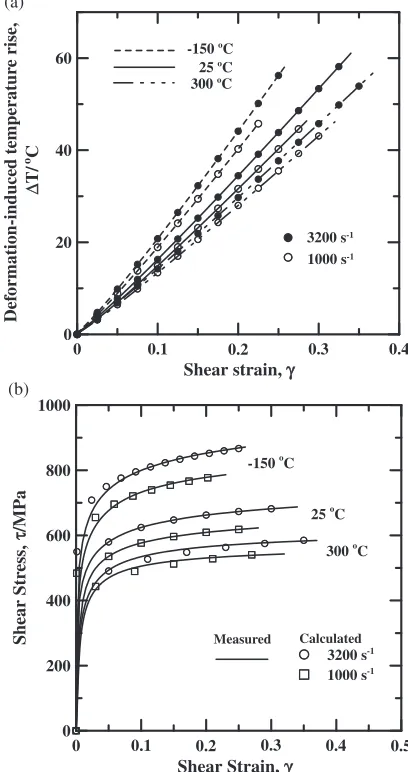
combined effects of strain and strain rate hardening on the shear stress, while (1¹cT) represents the effects of thermal softening. In the present study, the best fit parameters in eq. (4) were obtained by applying a regression analysis technique to the experimental data in Fig. 2(a). To reflect the actual temperature state of the specimen during deformation, the temperature rise caused by the conversion of plastic work into heat must be taken into account. Thus, the deformation-induced temperature rise was calculated as34)
T ¼ µ© cp
Z£
0 ¸dr; ð4Þ
where µ is the density (8.19 g/cm3),c
p is the heat capacity
(435 J/kg·K), ¸ is the stress, d£ is the strain interval, and
©=1 when the heat loss is assumed to be zero (i.e., all of the plastic work is converted to heat). Figure 3(a) shows that the deformation-induced temperature rise increased with increas-ing strain and strain rate, but decreased with increasincreas-ing temperature. According to the constitutive equation presented in eq. (3), the three material parameters of Alloy 718 were found to have values of ¢=690.94 MPa·s, n=0.09 and c=0.048, respectively. (Note that in computing the values of the material parameters, the initial temperature in eq. (3) was replaced by the current temperature for each strain interval considered in the regression analysis procedure.)
Figure 5(b) presents the results obtained for the shear stressstrain response of the present Alloy 718 specimens by substituting the material parameter values given above into
eq. (3) together with the strain rate and temperature data shown in Fig. 2(a). It is observed that a good agreement exists between the predicted stressstrain response of Alloy 718 and the experimental results (reproduced directly from Fig. 2(a)). In other words, the values obtained in this study for the material parameters of Alloy 718 provide a suitable basis for engineering design and simulation purposes.
3.5 Fracture behaviour of Alloy 718
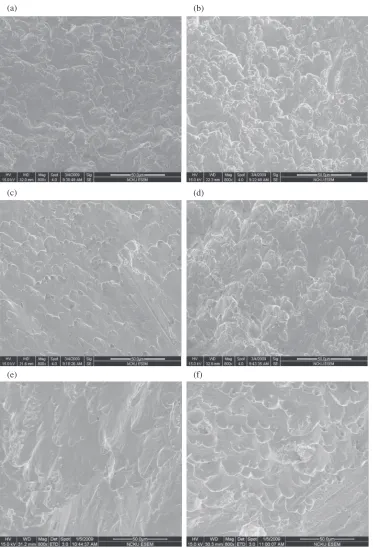
Variations in the strain rate and temperature affect not only the stressstrain response of the Alloy 718 specimens, but also their fracture behaviour. Figures 6(a) and 6(b) present SEM images of the fracture surfaces of the specimens deformed at a temperature of 300°C under strain rates of 1000 and 3200 s¹1, respectively. The images show that both fracture surfaces contained dimple-like features aligned along the shear direction, which suggests a ductile fracture mode. In addition, it is seen that the density of the dimple-like features increased with an increasing strain rate. In other words, the ductility of Alloy 718 improves under high strain rate loading conditions. Figures 6(c) and 6(d) show the fracture surfaces of the specimens deformed at a temperature of 25°C under
0
Shear strain, γ
0.4 0.3
0.2 0.1
0 20 40 60
Def
ormation-induced temperatur
e rise,
Δ
T/
o C
-150oC
25 oC
300 oC
3200 s-1
1000 s-1
(a)
0
Shear Strain, γ
0 200 400 600 800 1000
Shear Str
ess,
τ
/MP
a
Measured Calculated
3200 s-1
1000 s-1
-150 oC
25o
C
300 oC
(b)
0.2
0.1 0.3 0.4 0.5
[image:4.595.324.528.75.461.2]strain rates of 1000 and 3200 s¹1, respectively. Comparing the fracture surfaces shown in Figs. 6(c) and 6(d) with those shown in Figs. 6(a) and 6(b), respectively, it is seen that the density of the dimples increased with increasing temperature. In other words, the ductility of Alloy 718 increases with an increasing deformation temperature. Figures 6(e) and 6(f ) show the fracture surfaces of the specimens deformed at a temperature of ¹150°C under strain rates of 1000 and 3200 s¹1, respectively. It is observed that the fracture surfaces
are smoother than those of the specimens deformed at a
higher temperature. Moreover, they contain only a small number of dimples. In other words, the fracture resistance of Alloy 718 reduces under low deformation temperature conditions.
In general, the SEM fractographs presented in Figs. 6(a) 6(f ) reveal that the fracture mode of Alloy 718 is highly sensitive to the strain rate and temperature. The greater dimple density observed at higher strain rates and temperatures leads to a greater amount of plastic deformation, and therefore enhances the ductile response of the material. Meanwhile, the
(a) (b)
(c) (d)
(e) (f)
[image:5.595.114.487.68.616.2]lower dimple density observed at lower strain rates and temperatures indicates a more brittle response. In general, the variation in the fracture features is consistent with the tendencies of the stressstrain curves presented in Fig. 2(a), and accounts for the higher fracture strain observed in the specimens tested at higher strain rates and temperatures.
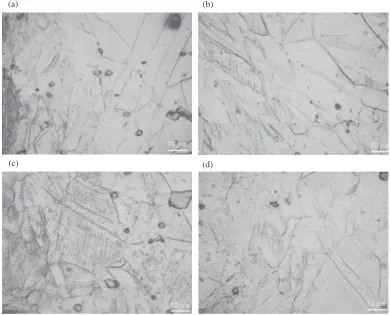
Under dynamic shear loading conditions, extensive plastic deformation takes place before fracture occurs. As a result, the grains located near the major shear planes deform catastrophically; resulting in the formation of well-defined micro-shear bands. Figure 7 presents optical micrographs of the micro-shear bands formed in the present Alloy 718 specimens under various temperatures and strain rates. Figures 7(a) and 7(b), corresponding to a deformation temperature of 25°C and strain rates of 1000 and 3200 s¹1,
respectively, reveal that the number of micro-shear bands increased with an increasing strain rate at a constant temperature. In other words, the ductility of Alloy 718 improves under high strain rate loading conditions. (Note that a similar strain-rate dependency of the micro-shear bands was observed in the specimens tested at ¹150 and 300°C, respectively.) Comparing Figs. 7(b), 7(c) and 7(d), corre-sponding to a strain rate of 3200 s¹1 and deformation temperatures of 25, 300 and¹150°C, respectively, it is seen that the number of micro-shear bands increased with an increasing temperature at a constant strain rate. In other words, the ductility of Alloy 718 improves not only under higher strain rates, but also under higher deformation temperatures.
4. Conclusions
This study has examined the dynamic shear deformation behaviour of Alloy 718 at shear strain rates of 1000, 1500 and 3200 s¹1and temperatures of¹150, 25 and 300°C. The results have shown that the dynamic shear response of Alloy 718 is significantly dependent on both the strain rate and the temperature. The shear stress increases with increasing strain rate, but decreases with increasing temperature. Meanwhile, the fracture strain reduces with reducing temperature, but increases with increasing strain rate. The strain rate sensitivity increases with increasing strain rate and decreas-ing temperature. In addition, the temperature sensitivity reduces with decreasing strain rate and increasing temper-ature. It has been shown that the predictions of the Kobayashi and Dodd constitutive equation for the dynamic stressstrain response of Alloy 718 are in good agreement with the experimental results. Finally, OM and SEM observations have shown that the Alloy 718 samples fail in a predom-inantly ductile mode and exhibit a greater ductility under elevated strain rates and temperatures.
Acknowledgment
The authors gratefully acknowledge thefinancial support provided to this study by the National Science Council of the Republic of China under Grant No. NSC98-2221-E-006-035.
(a) (b)
(c) (d)
[image:6.595.103.494.72.387.2]REFERENCES
1) K. Prasad, R. Sarkar, P. Ghosal and V. Kumar:Mater. Design31(2010) 45024507.
2) H. Xue, W. Lijun, X. Hui, L. Runguang, W. Shaogang and C. Zhonglin: J. Mater. Process. Tech.137(2003) 1720.
3) Y. Wang, W. Z. Shao, L. Zhen, L. Yang and X. M. Zhang:Mater. Sci. Eng. A497(2008) 479486.
4) M. Urdanpilleta, J. M. Martinez-Esnaola and J. G. Sevillano:Mater. Trans.46(2005) 17111719.
5) K. G. Hoge and A. K. Mukherjee:J. Mater. Sci.12(1977) 16661672. 6) A. M. Eleiche and J. Duffy:Int. J. Mech. Sci.17(1975) 8590, IN1
IN2, 9195.
7) W. S. Lee and G. W. Yeh:J. Mater. Process. Tech.71(1997) 224234. 8) J. H. Song and H. Huhk:Key Eng. Mater.340341(2007) 283288. 9) D. H. Ping, Y. F. Gu, C. Y. Cui and H. Harada:Mater. Sci. Eng. A456
(2007) 99102.
10) U. Krupp, W. M. Kane, C. Laird and C. J. McMahon:Mater. Sci. Eng. A387389(2004) 409413.
11) A. Thomas, M. El-Wahabi, J. M. Cabrera and J. M. Prado:J. Mater. Process. Tech.177(2006) 469472.
12) L. Geng, Y. S. Na and N. K. Park:Mater. Design28(2007) 978981. 13) J. M. Zhang, Z. Y. Gao, J. Y. Zhuang, Z. Y. Zhong and P. Janschek:
J. Mater. Process. Tech.70(1997) 252257. 14) L. Martin:Proc. Phys. Soc. B62(1949) 713.
15) M. Nabil Bassim and N. Panic:J. Mater. Process. Tech.9293(1999) 481485.
16) R. Kapoor, J. B. Singh and J. K. Chakravartty:Mater. Sci. Eng. A496 (2008) 308315.
17) W. S. Lee, T. H. Chen and H.-H. Hwang:Metall. Mater. Trans. A39 (2008) 14351448.
18) W. S. Lee and H. C. Shen:Mater. Sci. Technol.20(2004) 815. 19) W. S. Lee, W. C. Sue and C. F. Lin:Compos. Sci. Technol.60(2000)
19751983.
20) W. S. Lee, G. L. Xiea and C. F. Lin:Mater. Sci. Eng. A257(1998) 256267.
21) W. S. Lee and C. H. Hsu:Mater. Sci. Technol.22(2006) 14311443. 22) W. S. Lee, C. F. Lin and T. J. Liu:Mater. Charact.58(2007) 363370. 23) W. S. Lee, T. H. Chen and Q. J. Gong:Mater. Trans.48(2007) 500
509.
24) S. S. Ezz, Y. Q. Sun and P. B. Hirsch:Mater. Sci. Eng. A192193 (1995) 4552.
25) J. D. Campbell:Mater. Sci. Eng.12(1973) 321.
26) L. E. Murr:Shock Waves and High-Strain-Rate Phenomena in Metals: Concepts and Applications, ed. by M. A. Meyers and L. E. Murr, (Plenum Press, New York, 1981) pp. 607673, (chapter 37). 27) P. S. Follansbee and G. T. Gray, III: Metall. Trans. A20(1989) 863
874.
28) G. A. Rao, M. Kumar, M. Srinivas and D. S. Sarma:Mater. Sci. Eng. A 355(2003) 114125.
29) J. R. Klepaczko and C. Y. Chiem:J. Mech. Phys. Solids34(1986) 2954.
30) M. Zhou, A. Needleman and R. J. Clifton:J. Mech. Phys. Solids42 (1994) 423458.
31) B. Powers, J. Vinson, M. Wardle and B. Scott: Proc. ASME Aerospace Division Board AD48(1995) 179189.