An Affect-Enriched Dialogue Act Classification Model
for Task-Oriented Dialogue
Kristy
Elizabeth
Boyer
Joseph F.
Grafsgaard
Eun Young
Ha
Phillips
Robert
*James C.
Lester
Department of Computer Science North Carolina State University
Raleigh, NC, USA
* Dual Affiliation with Applied Research Associates, Inc. Raleigh, NC, USA
{
keboyer, jfgrafsg, eha, rphilli, lester}@ncsu.eduAbstract
Dialogue act classification is a central chal-lenge for dialogue systems. Although the im-portance of emotion in human dialogue is widely recognized, most dialogue act classifi-cation models make limited or no use of affec-tive channels in dialogue act classification. This paper presents a novel affect-enriched dialogue act classifier for task-oriented dia-logue that models facial expressions of users, in particular, facial expressions related to con-fusion. The findings indicate that the affect-enriched classifiers perform significantly bet-ter for distinguishing user requests for feed-back and grounding dialogue acts within textual dialogue. The results point to ways in which dialogue systems can effectively lever-age affective channels to improve dialogue act classification.
1
Introduction
Dialogue systems aim to engage users in rich, adaptive natural language conversation. For these systems, understanding the role of a user’s utter-ance in the broader context of the dialogue is a key challenge (Sridhar, Bangalore, & Narayanan, 2009). Central to this endeavor is dialogue act classification, which categorizes the intention be-hind the user’s move (e.g., asking a question, providing declarative information). Automatic dia-logue act classification has been the focus of a
large body of research, and a variety of approach-es, including sequential models (Stolcke et al., 2000), vector-based models (Sridhar, Bangalore, & Narayanan, 2009), and most recently, feature-enhanced latent semantic analysis (Di Eugenio, Xie, & Serafin, 2010), have shown promise. These models may be further improved by leveraging regularities of the dialogue from both linguistic and extra-linguistic sources. Users’ expressions of emotion are one such source.
Human interaction has long been understood to include rich phenomena consisting of verbal and nonverbal cues, with facial expressions playing a vital role (Knapp & Hall, 2006; McNeill, 1992; Mehrabian, 2007; Russell, Bachorowski, & Fernandez-Dols, 2003; Schmidt & Cohn, 2001). While the importance of emotional expressions in dialogue is widely recognized, the majority of dia-logue act classification projects have focused either peripherally (or not at all) on emotion, such as by leveraging acoustic and prosodic features of spo-ken utterances to aid in online dialogue act classi-fication (Sridhar, Bangalore, & Narayanan, 2009). Other research on emotion in dialogue has in-volved detecting affect and adapting to it within a dialogue system (Forbes-Riley, Rotaru, Litman, & Tetreault, 2009; López-Cózar, Silovsky, & Griol, 2010), but this work has not explored leveraging affect information for automatic user dialogue act classification. Outside of dialogue, sentiment anal-ysis within discourse is an active area of research (López-Cózar et al., 2010), but it is generally
ited to modeling textual features and not multi-modal expressions of emotion such as facial ac-tions. Such multimodal expressions have only just begun to be explored within corpus-based dialogue research (Calvo & D'Mello, 2010; Cavicchio, 2009).
This paper presents a novel affect-enriched dia-logue act classification approach that leverages knowledge of users’ facial expressions during computer-mediated textual human-human dia-logue. Intuitively, the user’s affective state is a promising source of information that may help to distinguish between particular dialogue acts (e.g., a
confused user may be more likely to ask a ques-tion). We focus specifically on occurrences of stu-dents’ confusion-related facial actions during task-oriented tutorial dialogue.
Confusion was selected as the focus of this work for several reasons. First, confusion is known to be prevalent within tutoring, and its implications for student learning are thought to run deep (Graesser, Lu, Olde, Cooper-Pye, & Whitten, 2005). Second, while identifying the “ground truth” of emotion based on any external display by a user presents challenges, prior research has demonstrated a correlation between particular faci-al action units and confusion during learning (Craig, D'Mello, Witherspoon, Sullins, & Graesser, 2004; D'Mello, Craig, Sullins, & Graesser, 2006; McDaniel et al., 2007). Finally, automatic facial action recognition technologies are developing rap-idly, and confusion-related facial action events are among those that can be reliably recognized auto-matically (Bartlett et al., 2006; Cohn, Reed, Ambadar, Xiao, & Moriyama, 2004; Pantic & Bartlett, 2007; Zeng, Pantic, Roisman, & Huang, 2009). This promising development bodes well for the feasibility of automatic real-time confusion detection within dialogue systems.
2
Background and Related Work
2.1
Dialogue Act ClassificationBecause of the importance of dialogue act classifi-cation within dialogue systems, it has been an ac-tive area of research for some time. Early work on automatic dialogue act classification modeled dis-course structure with hidden Markov models, ex-perimenting with lexical and prosodic features, and applying the dialogue act model as a constraint to
aid in automatic speech recognition (Stolcke et al., 2000). In contrast to this sequential modeling ap-proach, which is best suited to offline processing, recent work has explored how lexical, syntactic, and prosodic features perform for online dialogue act tagging (when only partial dialogue sequences are available) within a maximum entropy frame-work (Sridhar, Bangalore, & Narayanan, 2009). A recently proposed alternative approach involves treating dialogue utterances as documents within a latent semantic analysis framework, and applying feature enhancements that incorporate such infor-mation as speaker and utterance duration (Di Eugenio et al., 2010). Of the approaches noted above, the modeling framework presented in this paper is most similar to the vector-based maximum entropy approach of Sridhar et al. (2009). Howev-er, it takes a step beyond the previous work by in-cluding multimodal affective displays, specifically facial expressions, as features available to an af-fect-enriched dialogue act classification model.
2.2
Detecting Emotions in DialogueDetecting emotional states during spoken dialogue is an active area of research, much of which focus-es on detecting frustration so that a user can be automatically transferred to a human dialogue agent (López-Cózar et al., 2010). Research on spo-ken dialogue has leveraged lexical features along with discourse cues and acoustic information to classify user emotion, sometimes at a coarse grain along a positive/negative axis (Lee & Narayanan, 2005). Recent work on an affective companion agent has examined user emotion classification within conversational speech (Cavazza et al., 2010). In contrast to that spoken dialogue research, the work in this paper is situated within textual dialogue, a widely used modality of communica-tion for which a deeper understanding of user af-fect may substantially improve system performance.
which promising automatic technologies exist (Bartlett et al., 2006; Pantic & Bartlett, 2007; Zeng, Pantic, Roisman, & Huang, 2009). However, we leverage the recognized expressions of emotion for the task of dialogue act classification.
2.3
Categorizing Emotions within Dialogue and DiscourseSets of emotion taxonomies for discourse and dia-logue are often application-specific, for example, focusing on the frustration of users who are inter-acting with a spoken dialogue system (López-Cózar et al., 2010), or on uncertainty expressed by students while interacting with a tutor (Forbes-Riley, Rotaru, Litman, & Tetreault, 2007). In con-trast, the most widely utilized emotion frameworks are not application-specific; for example, Ekman’s Facial Action Coding System (FACS) has been widely used as a rigorous technique for coding fa-cial movements based on human fafa-cial anatomy (Ekman & Friesen, 1978). Within this framework, facial movements are categorized into facial action units, which represent discrete movements of mus-cle groups. Additionally, facial action descriptors (for movements not derived from facial muscles) and movement and visibility codes are included. Ekman’s basic emotions (Ekman, 1999) have been used in recent work on classifying emotion ex-pressed within blog text (Das & Bandyopadhyay, 2009), while other recent work (Nguyen, 2010) utilizes Russell’s core affect model (Russell, 2003) for a similar task.
During tutorial dialogue, students may not fre-quently experience Ekman’s basic emotions of
happiness, sadness, anger, fear, surprise, and dis-gust. Instead, students appear to more frequently experience cognitive-affective states such as flow
and confusion (Calvo & D'Mello, 2010). Our work leverages Ekman’s facial tagging scheme to identi-fy a particular facial action unit, Action Unit 4 (AU4), that has been observed to correlate with confusion (Craig, D'Mello, Witherspoon, Sullins, & Graesser, 2004; D'Mello, Craig, Sullins, & Graesser, 2006; McDaniel et al., 2007).
2.4
Importance of Confusion in Tutorial Dia-logueAmong the affective states that students experience during tutorial dialogue, confusion is prevalent, and its implications for student learning are
signif-icant. Confusion is associated with cognitive dise-quilibrium, a state in which students’ existing knowledge is inconsistent with a novel learning experience (Graesser, Lu, Olde, Cooper-Pye, & Whitten, 2005). Students may express such confu-sion within dialogue as uncertainty, to which hu-man tutors often adapt in a context-dependent fashion (Forbes-Riley et al., 2007). Moreover, im-plementing adaptations to student uncertainty with-in a dialogue system can improve the effectiveness of the system (Forbes-Riley et al., 2009).
For tutorial dialogue, the importance of under-standing student utterances is paramount for a sys-tem to positively impact student learning (Dzikovska, Moore, Steinhauser, & Campbell, 2010). The importance of frustration as a cogni-tive-affective state during learning suggests that the presence of student confusion may serve as a useful constraining feature for dialogue act classi-fication of student utterances. This paper explores the use of facial expression features in this way.
3
Task-Oriented Dialogue Corpus
The corpus was collected during a textual human-human tutorial dialogue study in the domain of introductory computer science (Boyer, Phillips, et al., 2010). Students solved an introductory com-puter programming problem and carried on textual dialogue with tutors, who viewed a synchronized version of the students’ problem-solving work-space. The original corpus consists of 48 dia-logues, one per student. Each student interacted with one of two tutors. Facial videos of students were collected using built-in webcams, but were not shown to the tutors. Video quality was ranked based on factors such as obscured foreheads due to hats or hair, and improper camera position result-ing in students’ faces not beresult-ing fully captured on the video. The highest-quality set contained 14 videos, and these videos were used in this analysis. They have a total running time of 11 hours and 55 minutes, and include dialogues with three female subjects and eleven male subjects.
3.1
Dialogue act annotationTable 1. Dialogue act tags and relative frequencies across fourteen dialogues in video corpus Student Dialogue
Act Example
Rel. Freq. EXTRA-DOMAIN
(EX)
Little sleep deprived
today .08
GROUNDING (G) Ok or Thanks .21 NEGATIVE
FEEDBACK WITH ELABORATION (NE)
I’m still confused on what this next for loop
is doing.
.02
NEGATIVE
FEEDBACK (N) I don’t see the diff. .04
POSITIVE FEEDBACK WITH ELABORATION (PE)
It makes sense now that you explained it, but I never used an
else if in any of my other programs
.04
POSITIVE
FEEDBACK (P) Second part complete. .11
QUESTION (Q) Why couldn’t I have said if (i<5) .11 STATEMENT (S) i is my only index .07
REQUEST FOR FEEDBACK (RF)
So I need to create a new method that sees
how many elements are in my array?
.16
RESPONSE (RSP) You mean not the
length but the contents .14 UNCERTAIN
FEEDBACK WITH ELABORATION (UE)
I’m trying to remember how to copy arrays .008
UNCERTAIN
FEEDBACK (U) Not quite yet .008
3.2
Task action annotationThe tutoring sessions were task-oriented, focusing on a computer programming exercise. The task had several subtasks consisting of programming mod-ules to be implemented by the student. Each of those subtasks also had numerous fine-grained goals, and student task actions either contributed or did not contribute to the goals. Therefore, to obtain a rich representation of the task, a manual annota-tion along two dimensions was conducted (Boyer, Phillips, et al., 2010). First, the subtask structure was annotated hierarchically, and then each task action was labeled for correctness according to the requirements of the assignment. Inter-annotator agreement was computed on 20% of the corpus at the leaves of the subtask tagging scheme, and
re-sulted in a simple kappa of κ=.56. However, the leaves of the annotation scheme feature an implicit ordering (subtasks were completed in order, and adjacent subtasks are semantically more similar than subtasks at a greater distance); therefore, a weighted kappa is also meaningful to consider for this annotation. The weighted kappa is κweighted=.80.
An annotated excerpt of the corpus is displayed in Table 2.
Table 2. Excerpt from corpus illustrating annota-tions and interplay between dialogue and task 13:38:09 Student: How do I know where to
end? [RF]
13:38:26 Tutor: Well you told me how to get how many elements in an array by using .length right? 13:38:26 Student: [Task action:
Subtask 1-a-iv, Buggy]
13:38:56 Tutor: Great
13:38:56 Student: [Task action:
Subtask 1-a-v, Correct] 13:39:35 Student: Well is it "array.length"?
[RF]
**Facial Expression: AU4 13:39:46 Tutor: You just need to use the
correct array name 13:39:46 Student: [Task action:
Subtask 1-a-iv, Buggy]
3.3
Lexical and Syntactic Features4
Facial Action Tagging
An annotator who was certified in the Facial Ac-tion Coding System (FACS) (Ekman, Friesen, & Hager, 2002) tagged the video corpus consisting of fourteen dialogues. The FACS certification process requires annotators to pass a test designed to ana-lyze their agreement with reference coders on a set of spontaneous facial expressions (Ekman & Rosenberg, 2005). This annotator viewed the vide-os continuously and paused the playback whenever notable facial displays of Action Unit 4 (AU4: Brow Lowerer) were seen. This action unit was chosen for this study based on its correlations with confusion in prior research (Craig, D'Mello, Witherspoon, Sullins, & Graesser, 2004; D'Mello, Craig, Sullins, & Graesser, 2006; McDaniel et al., 2007).
[image:5.612.313.540.114.361.2]To establish reliability of the annotation, a se-cond FACS-certified annotator independently an-notated 36% of the video corpus (5 of 14 dialogues), chosen randomly after stratification by gender and tutor. This annotator followed the same method as the first annotator, pausing the video at any point to tag facial action events. At any given time in the video, the coder was first identifying whether an action unit event existed, and then de-scribing the facial movements that were present. The annotators also specified the beginning and ending time of each event. In this way, the action unit event tags spanned discrete durations of vary-ing length, as specified by the coders. Because the two coders were not required to tag at the same point in time, but rather were permitted the free-dom to stop the video at any point where they felt a notable facial action event occurred, calculating agreement between annotators required discretiz-ing the continuous facial action time windows across the tutoring sessions. This discretization was performed at granularities of 1/4, 1/2, 3/4, and 1 second, and inter-rater reliability was calculated at each level of granularity (Table 3). Windows in which both annotators agreed that no facial action event was present were tagged by default as neu-tral. Figure 1 illustrates facial expressions that dis-play facial Action Unit 4.
Table 3. Kappa values for inter-annotator agree-ment on facial action events
Granularity
¼ sec ½ sec ¾ sec 1 sec Presence of AU4
(Brow Lowerer) .84 .87 .86 .86
Figure 1. Facial expressions displaying AU4 (Brow Lowerer)
Figure 2. Other facial expressions from the corpus
5
Models
The goal of the modeling experiment was to de-termine whether the addition of confusion-related facial expression features significantly boosts dia-logue act classification accuracy for student utter-ances.
5.1
FeaturesWe take a vector-based approach, in which the fea-tures consist of the following:
Utterance Features
• Dialogue act features: Manually annotated
dialogue act for the past three utterances. These features include tutor dialogue acts, annotated with a scheme analogous to that used to annotate student utterances (Boyer et al., 2009).
• Speaker: Speaker for past three utterances • Lexical features: Word unigrams
• Syntactic features: Top-most syntactic
node and its first two children
Task-based Features
• Subtask: Hierarchical subtask structure for
past three task actions (semantic pro-gramming actions taken by student)
• Correctness: Correctness of past three task
actions taken by student
• Preceded by task: Indicator for whether the
most recent task action immediately pre-ceded the target utterance, or whether it
was immediately preceded by the last dia-logue move
Facial Expression Features
• AU4_1sec: Indicator for the display of the
brow lowerer within 1 second prior to this utterance being sent, for the most recent three utterances
• AU4_5sec: Indicator for the display of the
brow lowerer within 5 seconds prior to this utterance being sent, for the most recent three utterances
• AU4_10sec: Indicator for the display of
the brow lowerer within 10 seconds prior to this utterance being sent, for the most recent three utterances
5.2
Modeling ApproachA logistic regression approach was used to classify the dialogue acts based on the above feature vec-tors. The Weka machine learning toolkit (Hall et al., 2009) was used to learn the models and to first perform feature selection in a best-first search. Lo-gistic regression is a generalized maximum likeli-hood model that discriminates between pairs of output values by calculating a feature weight vec-tor over the predicvec-tors.
The goal of this work is to explore the utility of confusion-related facial features in the context of particular dialogue act types. For this reason, a specialized classifier was learned by dialogue act.
5.3
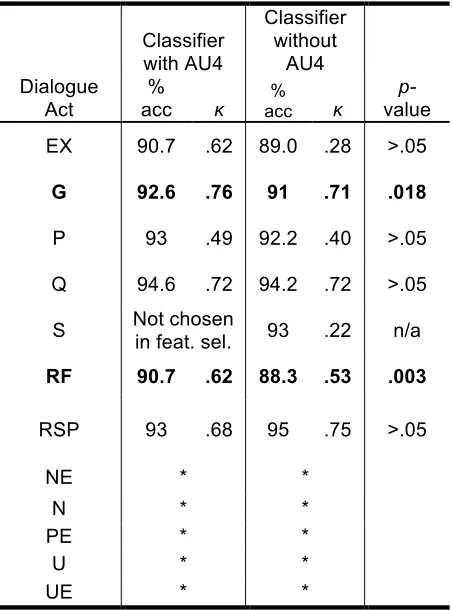
Classification Resultsimproved the classification accuracy compared to a model that was learned without affective features.
6
Discussion
[image:7.612.68.294.354.659.2]Dialogue act classification is an essential task for dialogue systems, and it has been addressed with a variety of modeling approaches and feature sets. We have presented a novel approach that treats facial expressions of students as constraining fea-tures for an affect-enriched dialogue act classifica-tion model in task-oriented tutorial dialogue. The results suggest that knowledge of the student’s confusion-related facial expressions can signifi-cantly enhance dialogue act classification for two types of dialogue acts, GROUNDING and REQUEST FOR FEEDBACK.
Table 4. Classification accuracy and kappa for spe-cialized DA classifiers. Statistically significant differences (across ten folds, one-tailed t-test) are
shown in bold.
Classifier with AU4
Classifier without
AU4 Dialogue
Act
%
acc κ acc % κ
p-value
EX 90.7 .62 89.0 .28 >.05
G 92.6 .76 91 .71 .018
P 93 .49 92.2 .40 >.05
Q 94.6 .72 94.2 .72 >.05
S Not chosen
in feat. sel. 93 .22 n/a RF 90.7 .62 88.3 .53 .003
RSP 93 .68 95 .75 >.05
NE * *
N * *
PE * *
U * *
UE * *
*Too few instances for ten-fold cross-validation.
6.1
Features Selected for ClassificationOut of more than 1500 features available during feature selection, each of the specialized dialogue act classifiers selected between 30 and 50 features in each condition (with and without affect fea-tures). To gain insight into the specific features that were useful for classifying these dialogue acts, it is useful to examine which of the AU4 history features were chosen during feature selection.
For GROUNDING, features that indicated the presence of absence of AU4 in the immediately preceding utterance, either at the 1 second or 5 se-cond granularity, were selected. Absence of this confusion-related facial action unit was associated with a higher probability of a grounding act, such as an acknowledgement. This finding is consistent with our understanding of how students and tutors interacted in this corpus; when a student experi-enced confusion, she would be unlikely to then make a simple grounding dialogue move, but in-stead would tend to inspect her computer program, ask a question, or wait for the tutor to explain more.
For REQUEST FOR FEEDBACK, the predictive features were presence or absence of AU4 within ten seconds of the longest available history (three turns in the past), as well as the presence of AU4 within five seconds of the current utterance (the utterance whose dialogue act is being classified). This finding suggests that there may be some lag between the student experiencing confusion and then choosing to make a request for feedback, and that the confusion-related facial expressions may re-emerge as the student is making a request for feedback, since the five-second window prior to the student sending the textual dialogue message would overlap with the student’s construction of the message itself.
Table 5. Number of features, and AU4 features selected, for specialized DA classifiers
Dialogue Act
# fea-tures
selected AU4 features selected
G 43 One utterance ago:
AU4_1sec, AU4_5sec
RF 37
Three utterances ago: AU4_10sec Target utterance:
AU4_5sec
EX 50 Three utterances ago: AU4_1sec
P 36 Current utterance: AU4_10sec
Q 30 One utterance ago: AU4_5sec
6.2
ImplicationsThe results presented here demonstrate that lever-aging knowledge of user affect, in particular of spontaneous facial expressions, may improve the performance of dialogue act classification models. Perhaps most interestingly, displays of confusion-related facial actions prior to a student dialogue move enabled an affect-enriched classifier to rec-ognize requests for feedback with significantly greater accuracy than a classifier that did not have access to the facial action features. Feedback is known to be a key component of effective tutorial dialogue, through which tutors provide adaptive help (Shute, 2008). Requesting feedback also seems to be an important behavior of students, characteristically engaged in more frequently by women than men, and more frequently by students with lower incoming knowledge than by students with higher incoming knowledge (Boyer, Vouk, & Lester, 2007).
6.3
LimitationsThe experiments reported here have several nota-ble limitations. First, the time-consuming nature of manual facial action tagging restricted the number of dialogues that could be tagged. Although the highest quality videos were selected for annotation, other medium quality videos would have been suf-ficiently clear to permit tagging, which would have increased the sample size and likely revealed sta-tistically significant trends. For example, the
per-formance of the affect-enriched classifier was bet-ter for dialogue acts of inbet-terest such as positive feedback and questions, but this difference was not statistically reliable.
An additional limitation stems from the more fundamental question of which affective states are indicated by particular external displays. The field is only just beginning to understand facial expres-sions during learning and to correlate these facial actions with emotions. Additional research into the “ground truth” of emotion expression will shed additional light on this area. Finally, the results of manual facial action annotation may constitute up-per-bound findings for applying automatic facial expression analysis to dialogue act classification.
7
Conclusions and Future Work
Emotion plays a vital role in human interactions. In particular, the role of facial expressions in human-human dialogue is widely recognized. Facial ex-pressions offer a promising channel for under-standing the emotions experienced by users of dialogue systems, particularly given the ubiquity of webcam technologies and the increasing number of dialogue systems that are deployed on webcam-enabled devices. This paper has reported on a first step toward using knowledge of user facial expres-sions to improve a dialogue act classification mod-el for tutorial dialogue, and the results demonstrate that facial expressions hold great promise for dis-tinguishing the pedagogically relevant dialogue act REQUEST FOR FEEDBACK, and the conversational moves of GROUNDING.
Acknowledgments
This work is supported in part by the North Caroli-na State University Department of Computer Sci-ence and by the National SciSci-ence Foundation through Grants REC-0632450, IIS-0812291, DRL-1007962 and the STARS Alliance Grant CNS-0739216. Any opinions, findings, conclusions, or recommendations expressed in this report are those of the participants, and do not necessarily represent the official views, opinions, or policy of the Na-tional Science Foundation.
References
A. Andreevskaia and S. Bergler. 2008. When specialists and generalists work together: Overcoming do-main dependence in sentiment tagging. Proceed-ings of the Annual Meeting of the Association for Computational Linguistics and Human Language Technologies (ACL HLT), 290-298.
M.S. Bartlett, G. Littlewort, M. Frank, C. Lainscsek, I. Fasel, and J. Movellan. 2006. Fully Automatic Facial Action Recognition in Spontaneous Behav-ior. 7th International Conference on Automatic Face and Gesture Recognition (FGR06), 223-230. K.E. Boyer, M. Vouk, and J.C. Lester. 2007. The
influ-ence of learner characteristics on task-oriented tu-torial dialogue. Proceedings of the International Conference on Artificial Intelligence in Educa-tion, 365–372.
K.E. Boyer, E.Y. Ha, R. Phillips, M.D. Wallis, M. Vouk, and J.C. Lester. 2010. Dialogue act model-ing in a complex task-oriented domain. Proceed-ings of the 11th Annual Meeting of the Special Interest Group on Discourse and Dialogue (SIGDIAL), 297-305.
K.E. Boyer, R. Phillips, E.Y. Ha, M.D. Wallis, M.A. Vouk, and J.C. Lester. 2009. Modeling dialogue structure with adjacency pair analysis and hidden Markov models. Proceedings of the Annual Con-ference of the North American Chapter of the As-sociation for Computational Linguistics: Short Papers, 49-52.
K.E. Boyer, R. Phillips, E.Y. Ha, M.D. Wallis, M.A. Vouk, and J.C. Lester. 2010. Leveraging hidden dialogue state to select tutorial moves. Proceed-ings of the NAACL HLT 2010 Fifth Workshop on Innovative Use of NLP for Building Educational Applications, 66-73.
R.A. Calvo and S. D’Mello. 2010. Affect Detection: An Interdisciplinary Review of Models, Methods, and Their Applications. IEEE Transactions on Affec-tive Computing, 1(1): 18-37.
M. Cavazza, R.S.D.L. Cámara, M. Turunen, J. Gil, J. Hakulinen, N. Crook, et al. 2010. How was your day? An affective companion ECA prototype. Proceedings of the 11th Annual Meeting of the Special Interest Group on Discourse and Dialogue (SIGDIAL), 277-280.
F. Cavicchio. 2009. The modulation of cooperation and emotion in dialogue: the REC Corpus. Proceed-ings of the ACL-IJCNLP 2009 Student Research Workshop, 43-48.
J.F. Cohn, L.I. Reed, Z. Ambadar, J. Xiao, and T. Mori-yama. 2004. Automatic Analysis and Recognition of Brow Actions and Head Motion in Spontaneous Facial Behavior. IEEE International Conference on Systems, Man and Cybernetics, 610-616. S.D. Craig, S. D’Mello, A. Witherspoon, J. Sullins, and
A.C. Graesser. 2004. Emotions during learning: The first steps toward an affect sensitive intelli-gent tutoring system. In J. Nall and R. Robson (Eds.), learn 2004: World conference on E-learning in Corporate, Government, Healthcare, & Higher Education, 241-250.
D. Das and S. Bandyopadhyay. 2009. Word to sentence level emotion tagging for Bengali blogs. Proceed-ings of the ACL-IJCNLP Conference, Short Pa-pers, 149-152.
S. Dasgupta and V. Ng. 2009. Mine the easy, classify the hard: a semi-supervised approach to automatic sentiment classification. Proceedings of the 46th Annual Meeting of the ACL and the 4th IJCNLP, 701-709.
B. Di Eugenio, Z. Xie, and R. Serafin. 2010. Dialogue Act Classification, Higher Order Dialogue Struc-ture, and Instance-Based Learning. Dialogue & Discourse, 1(2): 1-24.
M. Dzikovska, J.D. Moore, N. Steinhauser, and G. Campbell. 2010. The impact of interpretation problems on tutorial dialogue. Proceedings of the 48th Annual Meeting of the Association for Com-putational Linguistics, Short Papers, 43-48. S. D’Mello, S.D. Craig, J. Sullins, and A.C. Graesser.
2006. Predicting Affective States expressed through an Emote-Aloud Procedure from AutoTu-tor’s Mixed- Initiative Dialogue. International Journal of Artificial Intelligence in Education, 16(1): 3-28.
P. Ekman. 1999. Basic Emotions. In T. Dalgleish and M. J. Power (Eds.), Handbook of Cognition and Emotion. New York: Wiley.
P. Ekman, W.V. Friesen. 1978. Facial Action Coding System. Palo Alto, CA: Consulting Psychologists Press.
P. Ekman and E.L. Rosenberg (Eds.). 2005. What the Face Reveals: Basic and Applied Studies of Spon-taneous Expression Using the Facial Action Cod-ing System (FACS) (2nd ed.). New York: Oxford University Press.
K. Forbes-Riley, M. Rotaru, D.J. Litman, and J. Tetreault. 2007. Exploring affect-context depend-encies for adaptive system development. The Con-ference of the North American Chapter of the Association for Computational Linguistics and Human Language Technologies (NAACL HLT), Short Papers, 41-44.
K. Forbes-Riley, M. Rotaru, D.J. Litman, and J. Tetreault. 2009. Adapting to student uncertainty improves tutoring dialogues. Proceedings of the 14th International Conference on Artificial Intelli-gence in Education (AIED), 33-40.
A.C. Graesser, S. Lu, B. Olde, E. Cooper-Pye, and S. Whitten. 2005. Question asking and eye tracking during cognitive disequilibrium: comprehending illustrated texts on devices when the devices break down. Memory & Cognition, 33(7): 1235-1247. S. Greene and P. Resnik. 2009. More than words:
Syn-tactic packaging and implicit sentiment. Proceed-ings of the 2009 Annual Conference of the North American Chapter of the ACL and Human Lan-guage Technologies (NAACL HLT), 503-511. M. Hall, E. Frank, G. Holmes, B. Pfahringer, P.
Reute-mann, and I.H. Witten. 2009. The WEKA data mining software: An update. SIGKDD Explora-tions, 11(1): 10–18.
R. Iida, S. Kobayashi, and T. Tokunaga. 2010. Incorpo-rating extra-linguistic information into reference resolution in collaborative task dialogue. Proceed-ings of the 48th Annual Meeting of the Associa-tion for ComputaAssocia-tional Linguistics, 1259-1267. M.L. Knapp and J.A. Hall. 2006. Nonverbal
Communi-cation in Human Interaction (6th ed.). Belmont, CA: Wadsworth/Thomson Learning.
C.M. Lee, S.S. Narayanan. 2005. Toward detecting emotions in spoken dialogs. IEEE Transactions on Speech and Audio Processing, 13(2): 293-303. R. López-Cózar, J. Silovsky, and D. Griol. 2010. F2–
New Technique for Recognition of User Emotion-al States in Spoken DiEmotion-alogue Systems. Proceed-ings of the 11th Annual Meeting of the Special Interest Group on Discourse and Dialogue (SIGDIAL), 281-288.
B.T. McDaniel, S. D’Mello, B.G. King, P. Chipman, K. Tapp, and A.C. Graesser. 2007. Facial Features for Affective State Detection in Learning Envi-ronments. Proceedings of the 29th Annual Cogni-tive Science Society, 467-472.
D. McNeill. 1992. Hand and mind: What gestures reveal about thought. Chicago: University of Chicago Press.
A. Mehrabian. 2007. Nonverbal Communication. New Brunswick, NJ: Aldine Transaction.
T. Nguyen. 2010. Mood patterns and affective lexicon access in weblogs. Proceedings of the ACL 2010 Student Research Workshop, 43-48.
M. Pantic and M.S. Bartlett. 2007. Machine Analysis of Facial Expressions. In K. Delac and M. Grgic (Eds.), Face Recognition, 377-416. Vienna, Aus-tria: I-Tech Education and Publishing.
J.A. Russell. 2003. Core affect and the psychological construction of emotion. Psychological Review, 110(1): 145-172.
J.A. Russell, J.A. Bachorowski, and J.M. Fernandez-Dols. 2003. Facial and vocal expressions of emo-tion. Annual Review of Psychology, 54, 329-49. K.L. Schmidt and J.F. Cohn. 2001. Human Facial
Ex-pressions as Adaptations: Evolutionary Questions in Facial Expression Research. Am J Phys An-thropol, 33: 3-24.
V.J. Shute. 2008. Focus on Formative Feedback. Re-view of Educational Research, 78(1): 153-189. V.K.R Sridar, S. Bangalore, and S.S. Narayanan. 2009.
Combining lexical, syntactic and prosodic cues for improved online dialog act tagging. Computer Speech & Language, 23(4): 407-422. Elsevier Ltd. A. Stolcke, K. Ries, N. Coccaro, E. Shriberg, R. Bates,
D. Jurafsky, et al. 2000. Dialogue Act Modeling for Automatic Tagging and Recognition of Con-versational Speech. Computational Linguistics, 26(3): 339-373.
C. Toprak, N. Jakob, and I. Gurevych. 2010. Sentence and expression level annotation of opinions in us-er-generated discourse. Proceedings of the 48th Annual Meeting of the Association for Computa-tional Linguistics, 575-584.
T. Wilson, J. Wiebe, and P. Hoffmann. 2009. Recogniz-ing Contextual Polarity: An Exploration of Fea-tures for Phrase-Level Sentiment Analysis. Computational Linguistics, 35(3): 399-433. Z. Zeng, M. Pantic, G.I. Roisman, and T.S. Huang.