Supervised and Unsupervised Learning for Sentence Compression
Jenine Turner and Eugene Charniak Department of Computer Science
Brown Laboratory for Linguistic Information Processing (BLLIP) Brown University
Providence, RI 02912
{jenine|ec}@cs.brown.edu
Abstract
In Statistics-Based Summarization - Step
One: Sentence Compression, Knight and
Marcu (Knight and Marcu, 2000) (K&M) present a noisy-channel model for sen-tence compression. The main difficulty in using this method is the lack of data; Knight and Marcu use a corpus of 1035 training sentences. More data is not easily available, so in addition to improving the original K&M noisy-channel model, we create unsupervised and semi-supervised models of the task. Finally, we point out problems with modeling the task in this way. They suggest areas for future re-search.
1 Introduction
Summarization in general, and sentence compres-sion in particular, are popular topics. Knight and Marcu (henceforth K&M) introduce the task of statistical sentence compression in Statistics-Based
Summarization - Step One: Sentence Compression
(Knight and Marcu, 2000). The appeal of this prob-lem is that it produces summarizations on a small scale. It simplifies general compression problems, such as text-to-abstract conversion, by eliminating the need for coherency between sentences. The model is further simplified by being constrained to word deletion: no rearranging of words takes place. Others have performed the sentence compres-sion task using syntactic approaches to this problem
(Mani et al., 1999) (Zajic et al., 2004), but we fo-cus exclusively on the K&M formulation. Though the problem is simpler, it is still pertinent to cur-rent needs; generation of captions for television and audio scanning services for the blind (Grefenstette, 1998), as well as compressing chosen sentences for headline generation (Angheluta et al., 2004) are ex-amples of uses for sentence compression. In addi-tion to simplifying the task, K&M’s noisy-channel formulation is also appealing.
In the following sections, we discuss the K&M noisy-channel model. We then present our cleaned up, and slightly improved noisy-channel model. We also develop unsupervised and semi-supervised (our term for a combination of supervised and unsuper-vised) methods of sentence compression with inspi-ration from the K&M model, and create additional constraints to improve the compressions. We con-clude with the problems inherent in both models.
2 The Noisy-Channel Model
2.1 The K&M Model
P(s|l). By Bayes Rule,
P(s|l) = P(l|s)P(s)
P(l) (1)
The probability of the long sentence,P(l)can be ig-nored when finding the maximum, because the long sentence is the same in every case.
P(s) is the source model: the probability thats is the original sentence. P(l | s) is the channel model: the probability the long sentence is the ex-panded version of the short. This framework in-dependently models the grammaticality of s (with P(s)) and whether s is a good compression of l (P(l|s)).
The K&M model uses parse trees for the sen-tences. These allow it to better determine the proba-bility of the short sentence and to obtain alignments from the training data. In the K&M model, the sentence probability is determined by combining a probabilistic context free grammar (PCFG) with a word-bigram score. The joint rules used to create the compressions are generated by aligning the nodes of the short and long trees in the training data to deter-mine expansion probabilities (P(l|s)).
Recall that the channel model tries to find the probability of the long string with respect to the short string. It obtains these probabilities by align-ing nodes in the parsed parallel trainalign-ing corpus, and counting the nodes that align as “joint events.” For example, there might be S→NP VP PP in the long
sentence and S→NP VP in the short sentence; we
count this as one joint event. Non-compressions, where the long version is the same as the short, are also counted. The expansion probability, as used in the channel model, is given by
Pexpand(l|s) = count(joint(l, s))
count(s) (2)
wherecount(joint(l, s))is the count of alignments of the long rule and the short. Many compressions do not align exactly. Sometimes the parses do not match, and sometimes there are deletions that are too complex to be modeled in this way. In these cases sentence pairs, or sections of them, are ignored.
The K&M model creates a packed parse forest of all possible compressions that are grammatical with respect to the Penn Treebank (Marcus et al., 1993).
Any compression given a zero expansion probability according to the training data is instead assigned a very small probability. A tree extractor (Langkilde, 2000) collects the short sentences with the highest score forP(s|l).
2.2 Our Noisy-Channel Model
Our starting implementation is intended to follow the K&M model fairly closely. We use the same 1067 pairs of sentences from the Ziff-Davis cor-pus, with 32 used as testing and the rest as train-ing. The main difference between their model and ours is that instead of using the rather ad-hoc K&M language model, we substitute the syntax-based lan-guage model described in (Charniak, 2001).
We slightly modify the channel model equation to beP(l|s) =Pexpand(l|s)Pdeleted, wherePdeleted is the probability of adding the deleted subtrees back into sto get l. We determine this probability also using the Charniak language model.
We require an extra parameter to encourage com-pression. We create a development corpus of 25 sen-tences from the training data in order to adjust this parameter. That we require a parameter to encourage compression is odd as K&M required a parameter to discourage compression, but we address this point in the penultimate section.
Another difference is that we only generate short versions for which we have rules. If we have never before seen the long version, we leave it alone, and in the rare case when we never see the long version as an expansion of itself, we allow only the short version. We do not use a packed tree structure, be-cause we make far fewer sentences. Additionally, as we are traversing the list of rules to compress the sentences, we keep the list capped at the 100 com-pressions with the highestPexpand(l |s). We even-tually truncate the list to the best 25, still based upon Pexpand(l|s).
2.3 Special Rules
One difficulty in the use of training data is that so many compressions cannot be modeled by our sim-ple method. The rules it does model, immediate constituent deletion, as in taking out the ADVP , of
S → ADVP , NP VP ., are certainly common, but
many good deletions are more structurally compli-cated. One particular type of rule, such as NP(1)→
NP(2) CC NP(3), where the parent has at least one
child with the same label as itself, and the resulting compression is one of the matching children, such as, here, NP(2). There are several hundred rules of this type, and it is very simple to incorporate into our model.
There are other structures that may be common enough to merit adding, but we limit this experiment to the original rules and our new “special rules.”
3 Unsupervised Compression
One of the biggest problems with this model of sen-tence compression is the lack of appropriate train-ing data. Typically, abstracts do not seem to con-tain short sentences matching long ones elsewhere in a paper, and we would prefer a much larger cor-pus. Despite this lack of training data, very good results were obtained both by the K&M model and by our variant. We create a way to compress sen-tences without parallel training data, while sticking as closely to the K&M model as possible.
The source model stays the same, and we still pay a probability cost in the channel model for ev-ery subtree deleted. However, the way we determine Pexpand(l|s)changes because we no longer have a parallel text. We create joint rules using only the first section (0.mrg) of the Penn Treebank. We count all probabilistic context free grammar (PCFG) expan-sions, and then match up similar rules as unsuper-vised joint events.
We change Equation 2 to calculatePexpand(s|l) without parallel data. First, let us definesvo(shorter version of) to be: r1 svo r2 iff the righthand side of
r1is a subsequence of the righthand side ofr2. Then define
Pexpand(l|s) = P count(l)
l0s.t. s svo l0count(l0)
(3)
This is best illustrated by a toy example. Consider a corpus with just 7 rules: 3 instances of NP→DT JJ NN and 4 instances of NP→DT NN.
P(NP →DT JJ NN |NP→DT JJ NN)= 1. To determine this, you divide the count of NP→DT JJ NN = 3by all the possible long versions of NP→
DT JJ NN = 3.
P(NP→DT JJ NN|NP→DT NN)= 3/7. The count of NP→DT JJ NN= 3, and the possible long
versions of NP→DT NN are itself (with count of 3)
and NP→DT JJ NN (with count of 4), yielding a
sum of 7.
Finally, P(NP→DT NN|NP→DT NN)= 4/7. The count of NP→DT NN= 4, and since the short (NP→ DT NN) is the same as above, the count of
the possible long versions is again 7.
In this way, we approximate Pexpand(l |s) with-out parallel data.
Since some of these “training” pairs are likely to be fairly poor compressions, due to the artifi-ciality of the construction, we restrict generation of short sentences to not allow deletion of the head of any subtree. None of the special rules are ap-plied. Other than the above changes, the unsuper-vised model matches our superunsuper-vised version. As will be shown, this rule is not constraining enough and allows some poor compressions, but it is remarkable that any sort of compression can be achieved with-out training data. Later, we will describe additional constraints that help even more.
4 Semi-Supervised Compression
Because the supervised version tends to do quite well, and its main problem is that the model tends to pick longer compressions than a human would, it seems reasonable to incorporate the unsupervised version into our supervised model, in the hope of getting more rules to use. In generating new short sentences, if we have compression probabilities in the supervised version, we use those, including the special rules. The only time we use an unsupervised compression probability is when there is no super-vised version of the unsupersuper-vised rule.
5 Additional Constraints
be deleted are not labeled with their syntactic role, we add another constraint that disallows deletion of NPs.
6 Evaluation
As with Knight and Marcu’s (2000) original work, we use the same 32 sentence pairs as our Test Cor-pus, leaving us with 1035 training pairs. After ad-justing the supervised weighting parameter, we fold the development set back into the training data.
We presented four judges with nine compressed versions of each of the 32 long sentences: A human-generated short version, the K&M version, our first supervised version, our supervised version with our special rules, our supervised version with special rules and additional constraints, our unsupervised version, our supervised version with additional con-straints, our supervised version, and our semi-supervised version with additional constraints. The judges were asked to rate the sentences in two ways: the grammaticality of the short sentences on a scale from 1 to 5, and the importance of the short sen-tence, or how well the compressed version retained the important words from the original, also on a scale from 1 to 5. The short sentences were ran-domly shuffled across test cases.
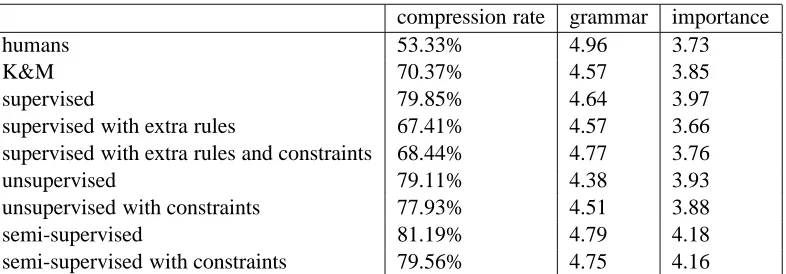
The results in Table 1 show compression rates, as well as average grammar and importance scores across judges.
There are two main ideas to take away from these results. First, we can get good compressions without paired training data. Second, we achieved a good boost by adding our additional constraints in two of the three versions.
Note that importance is a somewhat arbitrary dis-tinction, since according to our judges, all of the computer-generated versions do as well in impor-tance as the human-generated versions.
6.1 Examples of Results
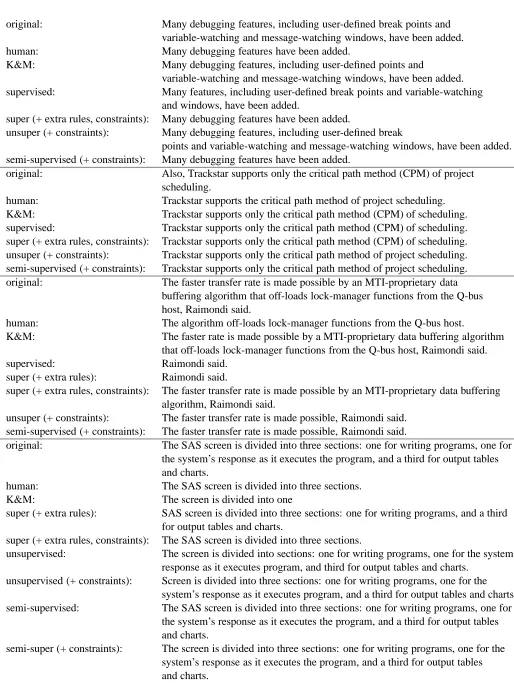
In Figure 1, we give four examples of most compres-sion techniques in order to show the range of perfor-mance that each technique spans. In the first two ex-amples, we give only the versions with constraints, because there is little or no difference between the versions with and without constraints.
Example 1 shows the additional compression
ob-tained by using our special rules. Figure 2 shows the parse trees of the original pair of short and long versions. The relevant expansion is NP → NP1 , PP in the long version and simply NP1 in the short
version. The supervised version that includes the special rules learned this particular common special joint rule from the training data and could apply it to the example case. This supervised version com-presses better than either version of the supervised noisy-channel model that lacks these rules. The un-supervised version does not compress at all, whereas the semi-supervised version is identical with the bet-ter supervised version.
Example 2 shows how unsupervised and semi-supervised techniques can be used to improve com-pression. Although the final length of the sentences is roughly the same, the unsupervised and semi-supervised versions are able to take the action of deleting the parenthetical. Deleting parentheses was never seen in the training data, so it would be ex-tremely unlikely to occur in this case. The unsuper-vised version, on the other hand, sees both PRN →
lrb NP rrb and PRN→NP in its training data, and
the semi-supervised version capitalizes on this par-ticular unsupervised rule.
Example 3 shows an instance of our initial super-vised versions performing far worse than the K&M model. The reason is that currently our supervised model only generates compressions that it has seen before, unlike the K&M model, which generates all possible compressions. S→S , NP VP . never occurs
in the training data, and so a good compression does not exist. The unsupervised and semi-supervised versions do better in this case, and the supervised version with the added constraints does even better.
Example 4 gives an example of the K&M model being outperformed by all of our other models.
7 Problems with Noisy Channel Models of Sentence Compression
To this point our presentation has been rather nor-mal; we draw inspiration from a previous paper, and work at improving on it in various ways. We now deviate from the usual by claiming that while the K&M model works very well, there is a technical problem with formulating the task in this way.
We start by making our noisy channel notation a
original: Many debugging features, including user-defined break points and variable-watching and message-watching windows, have been added.
human: Many debugging features have been added.
K&M: Many debugging features, including user-defined points and
variable-watching and message-watching windows, have been added. supervised: Many features, including user-defined break points and variable-watching
and windows, have been added.
super (+ extra rules, constraints): Many debugging features have been added.
unsuper (+ constraints): Many debugging features, including user-defined break
points and variable-watching and message-watching windows, have been added. semi-supervised (+ constraints): Many debugging features have been added.
original: Also, Trackstar supports only the critical path method (CPM) of project scheduling.
human: Trackstar supports the critical path method of project scheduling. K&M: Trackstar supports only the critical path method (CPM) of scheduling. supervised: Trackstar supports only the critical path method (CPM) of scheduling. super (+ extra rules, constraints): Trackstar supports only the critical path method (CPM) of scheduling. unsuper (+ constraints): Trackstar supports only the critical path method of project scheduling. semi-supervised (+ constraints): Trackstar supports only the critical path method of project scheduling. original: The faster transfer rate is made possible by an MTI-proprietary data
buffering algorithm that off-loads lock-manager functions from the Q-bus host, Raimondi said.
human: The algorithm off-loads lock-manager functions from the Q-bus host.
K&M: The faster rate is made possible by a MTI-proprietary data buffering algorithm that off-loads lock-manager functions from the Q-bus host, Raimondi said.
supervised: Raimondi said.
super (+ extra rules): Raimondi said.
super (+ extra rules, constraints): The faster transfer rate is made possible by an MTI-proprietary data buffering algorithm, Raimondi said.
unsuper (+ constraints): The faster transfer rate is made possible, Raimondi said. semi-supervised (+ constraints): The faster transfer rate is made possible, Raimondi said.
original: The SAS screen is divided into three sections: one for writing programs, one for the system’s response as it executes the program, and a third for output tables and charts.
human: The SAS screen is divided into three sections.
K&M: The screen is divided into one
super (+ extra rules): SAS screen is divided into three sections: one for writing programs, and a third for output tables and charts.
super (+ extra rules, constraints): The SAS screen is divided into three sections.
unsupervised: The screen is divided into sections: one for writing programs, one for the system’s response as it executes program, and third for output tables and charts.
unsupervised (+ constraints): Screen is divided into three sections: one for writing programs, one for the system’s response as it executes program, and a third for output tables and charts. semi-supervised: The SAS screen is divided into three sections: one for writing programs, one for
the system’s response as it executes the program, and a third for output tables and charts.
[image:5.612.72.586.37.720.2]compression rate grammar importance
humans 53.33% 4.96 3.73
K&M 70.37% 4.57 3.85
supervised 79.85% 4.64 3.97
supervised with extra rules 67.41% 4.57 3.66
supervised with extra rules and constraints 68.44% 4.77 3.76
unsupervised 79.11% 4.38 3.93
unsupervised with constraints 77.93% 4.51 3.88
semi-supervised 81.19% 4.79 4.18
[image:6.612.113.506.53.190.2]semi-supervised with constraints 79.56% 4.75 4.16
Table 1: Experimental Results
short: (S (NP (JJ Many) (JJ debugging) (NNS features))
(VP (VBP have) (VP (VBN been) (VP (VBN added))))(. .)) long: (S (NP (NP (JJ Many) (JJ debugging) (NNS features))(, ,)
(PP (VBG including) (NP (NP (JJ user-defined)(NN break)(NNS points) (CC and)(NN variable-watching))
[image:6.612.363.493.372.473.2](CC and)(NP (JJ message-watching) (NNS windows))))(, ,)) (VP (VBP have) (VP (VBN been) (VP (VBN added))))(. .))
Figure 2: Joint Trees for special rules
bit more explicit:
argmaxsp(s, L=s|l, L=l) = (4)
argmaxsp(s, L=s)p(l, L=l|s, L=s)
Here we have introduced explicit conditioning eventsL = l and L = sto state that that the sen-tence in question is either the long version or the short version. We do this because in order to get the equation that K&M (and ourselves) start with, it is necessary to assume the following
p(s, L=s) = p(s) (5) p(l, L=l|s, L=s) = p(l|s) (6)
This means we assume that the probability of, say,s as a short (compressed) sentence is simply its prob-ability as a sentence. This will be, in general, false. One would hope that real compressed sentences are more probable as a member of the set of compressed sentences than they are as simply a member of all English sentences. However, neither K&M, nor we, have a large enough body of compressed and origi-nal sentences from which to create useful language models, so we both make this simplifying assump-tion. At this point it seems like a reasonable choice
root
vp
vb
buy np
nns
toys
root
vp
vb
buy np
jj
large nns
toys
Figure 3: A compression example — trees A and B respectively
to make. In fact, it compromises the entire enter-prise. To see this, however, we must descend into more details.
Let us consider a simplified version of a K&M example, but as reinterpreted for our model: how the noisy channel model assigns a probability of the compressed tree (A) in Figure 3 given the original treeB.
We compute the probabilitiesp(A)andp(B |A)
as follows (Figure 4): We have divided the probabil-ities up according to whether they are contributed by the source or channel models. Those from the source
p(A) p(B |A)
p(s→vp|H(s)) p(s→vp|s→vp)
p(vp→vb np|H(vp)) p(vp→vb np|vp→vb np)
p(np→nns|H(np)) p(np→jj nns|np→nns)
p(vb→buy|H(vb)) p(vb→buy|vb→buy) p(nns→toys|H(nns)) p(nns→toys|nns→toys)
p(jj→large|H(jj))
Figure 4: Source and channel probabilities for com-pressingBintoA
p(B) p(B |B)
p(s→vp|H(s)) p(s→vp|s→vp)
p(vp→vb np|H(vp)) p(vp→vb np|vp→vb np)
p(np→jj nns|H(np)) p(np→jj nns|np→jj nns)
p(vb→buy|H(vb)) p(vb→buy|vb→buy) p(nns→toys|H(nns)) p(nns→toys|nns→toys) p(jj→large|H(jj)) p(jj→large|jj→large)
Figure 5: Source and channel probabilities for leav-ingBasB
model are conditioned on, e.g. H(np)the history in terms of the tree structure around the noun-phrase. In a pure PCFG this would only include the label of the node. In our language model it includes much more, such as parent and grandparent heads.
Again, following K&M, contrast this with the probabilities assigned when the compressed tree is identical to the original (Figure 5).
Expressed like this it is somewhat daunting, but notice that if all we want is to see which probability is higher (the compressed being the same as the orig-inal or truly compressed) then most of these terms cancel, and we get the rule, prefer the truly com-pressed if and only if the following ratio is greater than one.
p(np→nns|H(np))
p(np→jj nns|H(np))
p(np→jj nns|np→nns)
p(np→jj nns|np→jj nns) (7)
1
p(jj→large|jj→large)
In the numerator are the unmatched probabilities that go into the compressed sentence noisy chan-nel probability, and in the denominator are those for when the sentence does not undergo any change. We can make this even simpler by noting that because
tree-bank pre-terminals can only expand into words p(jj → large|jj → large) = 1. Thus the last fraction in Equation 7 is equal to one and can be ignored.
For a compression to occur, it needs to be less de-sirable to add an adjective in the channel model than in the source model. In fact, the opposite occurs. The likelihood of almost any constituent deletion is far lower than the probability of the constituents all being left in. This seems surprising, considering that the model we are using has had some success, but it makes intuitive sense. There are far fewer com-pression alignments than total alignments: identical parts of sentences are almost sure to align. So the most probable short sentence should be very barely compressed. Thus we add a weighting factor to compress our supervised version further.
K&M also, in effect, weight shorter sentences more strongly than longer ones based upon their lan-guage model. In their papers on sentence compres-sion, they give an example similar to our “buy large toys” example. The equation they get for the channel probabilities in their example is similar to the chan-nel probabilities we give in Figures 3 and 4. How-ever their source probabilities are different. K&M did not have a true syntax-based language model to use as we have. Thus they divided the language model into two parts. Part one assigns probabilities to the grammar rules using a probabilistic context-free grammar, while part two assigns probabilities to the words using a bi-gram model. As they ac-knowledge in (Knight and Marcu, 2002), the word bigram probabilities are also included in the PCFG probabilities. So in their versions of Figures 3 and 4 they have both p(toys | nns) (from the PCFG) and p(toys | buy) for the bigram probability. In this model, the probabilities do not sum to one, be-cause they pay the probabilistic price for guessing the word “toys” twice, based upon two different con-ditioning events. Based upon this language model, they prefer shorter sentences.
in which shorter sentences are more useful. Our term giving preference to shorter sentences can be thought of as a crude approximation to such a utility. However, this is clearly an area for future research.
8 Conclusion
We have created a supervised version of the noisy-channel model with some improvements over the K&M model. In particular, we learned that adding an additional rule type improved compression, and that enforcing some deletion constraints improves grammaticality. We also show that it is possible to perform an unsupervised version of the compression task, which performs remarkably well. Our semi-supervised version, which we hoped would have good compression rates and grammaticality, had good grammaticality but lower compression than de-sired.
We would like to come up with a better utility function than a simple weighting parameter for our supervised version. The unsupervised version prob-ably can also be further improved. We achieved much success using syntactic labels to constrain compressions, and there are surely other constraints that can be added.
However, more training data is always the easi-est cure to statistical problems. If we can find much larger quantities of training data we could allow for much richer rule paradigms that relate compressed to original sentences. One example of a rule we would like to automatically discover would allow us to compress all of our design goals or
(NP (NP (DT all)) (PP (IN of)
(NP (PRP$ our) (NN design) (NNS goals))))}
to all design goals or
(NP (DT all) (NN design) (NNS goals))
In the limit such rules blur the distinction between compression and paraphrase.
9 Acknowledgements
This work was supported by NSF grant IIS-0112435. We would like to thank Kevin Knight and Daniel Marcu for their clarification and test sen-tences, and Mark Johnson for his comments.
References
Roxana Angheluta, Rudradeb Mitra, Xiuli Jing, and Francine-Marie Moens. 2004. K.U.Leuven summa-rization system at DUC 2004. In Document Under-standing Conference.
Don Blaheta and Eugene Charniak. 2000. Assigning function tags to parsed text. In The Proceedings of the North American Chapter of the Association for Com-putational Linguistics, pages 234–240.
Eugene Charniak. 2001. Immediate-head parsing for language models. In Proceedings of the 39th Annual Meeting of the Association for Computational Linguis-tics. The Association for Computational LinguisLinguis-tics.
Michael Collins. 1997. Three generative, lexicalised
models for statistical parsing. In The Proceedings of the 35th Annual Meeting of the Association for Com-putational Linguistics, San Francisco. Morgan Kauf-mann.
Gregory Grefenstette. 1998. Producing intelligent tele-graphic text reduction to provide an audio scanning service for the blind. In Working Notes of the AAAI Spring Symposium on Intelligent Text Summarization, pages 111–118.
Kevin Knight and Daniel Marcu. 2000. Statistics-based summarization - step one: sentence compression. In Proceedings of the 17th National Conference on Arti-ficial Intelligence, pages 703–71.
Kevin Knight and Daniel Marcu. 2002. Summariza-tion beyond sentence extracSummariza-tion: A probabilistic ap-proach to sentence compression. In Artificial Intelli-gence, 139(1): 91-107.
Irene Langkilde. 2000. Forest-based statistical sentence generation. In Proceedings of the 1st Annual Meeting of the North American Chapter of the Association for Computationl Linguistics.
Inderjeet Mani, Barbara Gates, and Eric Bloedorn. 1999. Improving summaries by revising them. In The Pro-ceedings of the 38th Annual Meeting of the Associa-tion for ComputaAssocia-tional Linguistics. The AssociaAssocia-tion for Computational Linguistics.
Michell P. Marcus, Beatrice Santorini, and Mary Ann Marcinkiewicz. 1993. Building a large annotated cor-pus of English: The Penn Treebank. Computational Linguistics, 19(2):313–330.
David Zajic, Bonnie Dorr, and Richard Schwartz. 2004. BBN/UMD at DUC 2004: Topiary. In Document Un-derstanding Conference.