A N A L G O R I T H M
F O R F I N D I N G
N O U N
P H R A S E
C O R R E S P O N D E N C E S
I N B I L I N G U A L
C O R P O R A
J u l i a n K u p i e cX e r o x P a l o A l t o R e s e a r c h C e n t e r 3333 C o y o t e Hill R o a d , P a l o A l t o , C A
k u p i e c @ p a r c . x e r o x . c o m
94304
A b s t r a c t
The paper describes an algorithm that employs English and French text taggers to associate noun phrases in an aligned bilingual corpus. The tag- gets provide part-of-speech categories which are used by finite-state recognizers to extract simple noun phrases for both languages. Noun phrases are then mapped to each other using an iterative re-estimation algorithm that bears similarities to the Baum-Welch algorithm which is used for train- ing the taggers. The algorithm provides an alter- native to other approaches for finding word cor- respondences, with the advantage that linguistic structure is incorporated. Improvements to the basic algorithm are described, which enable con- text to be accounted for when constructing the noun phrase mappings.
INTRODUCTION
Areas of investigation using bilingual corpora have included the following:
• Automatic sentence alignment [Kay and RSscheisen, 1988, Brown eL
al.,
1991a, Gale and Church, 1991b].• Word-sense disambiguation [Dagan el
al.,
1991, Brown etai.,
1991b, Church and Gale, 1991].• Extracting word correspondences [Gale and Church, 1991a].
• Finding bilingual collocations [Smadja, 1992].
• Estimating parameters for statistically-based machine translation [Brown
et al.,
1992].The work described here makes use of the aligned Canadian Hansards [Gale and Church, 1991b] to obtain noun phrase correspondences be- tween the English and French text.
The term "correspondence" is used here to sig- nify a mapping between words in two aligned sen- tences. Consider an English sentence Ei and a French sentence Fi which are assumed to be ap- proximate translations of each other. The sub- script i denotes the i'th alignment of sentences in
both languages. A word sequence in E / i s defined here as the correspondence of another sequence in Fi if the words of one sequence are considered to represent the words in the other.
Single word correspondences have been investi- gated [Gale and Church, 1991a] using a statistic operating on contingency tables. An algorithm for producing collocational correspondences has also been described [Smadja, 1992]. The algorithm in- volves several steps. English collocations are first extracted from the English side of the corpus. In- stances of the English collocation are found and the mutual information is calculated between the instances and various single word candidates in aligned French sentences. The highest ranking candidates are then extended by another word and the procedure is repeated until a corresponding French collocation having the highest mutual in- formation is found.
An alternative approach is described here, which employs simple iterative re-estimation. It is used to make correspondences between simple noun phrases that have been isolated in corre- sponding sentences of each language using finite- state recognizers. The algorithm is applicable for finding single or multiple word correspondences and can accommodate additional kinds of phrases. In contrast to the other methods that have been mentioned, the algorithm can be extended in a straightforward way to enable correct correspon- dences to be made in circumstances where numer- ous low frequency phrases are involved. This is important consideration because in large text cor- pora roughly a third of the word types only occur once.
Several applications for bilingual correspon- dence information have been suggested. They can be used in bilingual concordances, for automat- ically constructing bilingual lexicons, and proba- bilistically quantified correspondences may be use- ful for statistical translation methods.
C O M P O N E N T S
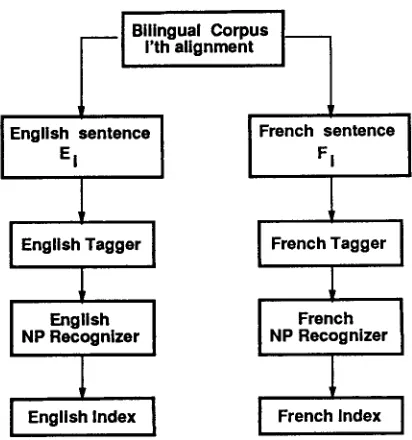
corresponding part-of-speech categories. Each tagger contains a hidden Markov model (HMM), which is trained using samples of raw text from the Hansards for each language. The taggers are robust and operate with a low error rate [Ku- piec, 1992]. Simple noun phrases (excluding pro- nouns and digits) are then extracted from the sen- tences by finite-state recognizers t h a t are specified by regular expressions defined in terms of part-of- speech categories. Simple noun phrases are iden- tified because they are most reliably recognized; it is also assumed t h a t they can be identified un- ambiguously. The only embedding t h a t is allowed is by prepositional phrases involving "of" in En- glish and "de" in French, as noun phrases involv- ing them can be identified with relatively low error (revisions to this restriction are considered later). Noun phrases are placed in an index to associate a unique identifier with each one.
A noun phrase is defined by its word sequence, excluding any leading determiners. Singular and plural forms of common nouns are thus distinct and assigned different positions in the index. For each sentence corresponding to an alignment, the index positions of all noun phrases in the sentence are recorded in a separate d a t a structure, provid- ing a compact representation of the corpus.
So far it has been assumed (for the sake of sim- plicity) t h a t there is always a one-to-one mapping between English and French sentences. In prac- tice, if an alignment program produces blocks of several sentences in one or both languages, this can be accommodated by treating the block in- stead as a single bigger "compound sentence" in which noun phrases have a higher number of pos- sible correspondences.
T H E M A P P I N G A L G O R I T H M
Some terminology is necessary to describe the al- gorithm concisely. Let there be L total alignments in the corpus; then
Ei
is the English sentence for alignment i. Let the function ¢(Ei) be the num- ber of noun phrases identified in the sentence. If there are k of them, k = ¢(Ei), and they can be referenced by j = 1...k. Considering the j ' t h noun phrase in sentence Ei, the functionI~(Ei, j)
produces an identifier for the phrase, which is the position of the phrase in the English index. If this phrase is at position s, then
I~(Ei,j) = s.
In turn, the French sentence
Fi
will contain ¢(Fi) noun phrases and given the p'th one, its po- sition in the French index will be given by/~(Fi, p). It will also be assumed t h a t there are a total of VE and Vr phrases in the English and French in- dexes respectively. Finally, the indicator function I 0 has the value unity if its argument is true, and zero otherwise.Assuming these definitions, the algorithm is
I English sentence
E i
1
I English Tagger I
I English
NP Recognizer I
I n0.sh'o ex I
I Bilingual Corpus I
rth alignment
I
French FTntence I
French Tagger I
I French I
NP Recognizer
I Frenchlndex I
Figure 1: Component Layout
stated in Figure 2. The equations assume a direc- tionality: finding French "target" correspondences for English "source" phrases. The algorithm is re- versible, by swapping E with F .
The model for correspondence is t h a t a source noun phrase in Ei is responsible for producing the various different target noun phrases in Fi with correspondingly different probabilities. Two quan- tities are calculated;
Cr(s, t)
andPr(s, t).
Compu- tation proceeds by evaluating Equation (1), Equa- tion (2) and then iteratively applying Equations (3) and (2); r increasing with each successive iter- ation. The argument s refers to the English noun phrasenps(s)
having position s in the English index, and the argument t refers to the French noun phrasenpF(t)
at position t in the French index. Equation (1) assumes t h a t each English noun phrase inEi
is initially equally likely to cor- respond to each French noun phrase inFi.
All cor- respondences are thus equally weighted, reflecting a state of ignorance. Weights are summed over the corpus, so noun phrases t h a t co-occur in sev- eral sentences will have larger sums. The weights C0(s, t) can be interpreted as the mean number of times thatnpF(t)
corresponds t oapE(s)
given the corpus and the initial assumption of equiprobable correspondences.These weights can be used to form a new esti- mate of the probability t h a t
npF(t)
corresponds tonpE(s),
by considering the mean number of timesnpF(t)
corresponds toapE(s)
as a fraction of the total mean number of correspondences forapE(s),
[image:2.612.333.539.56.276.2]Co( ,t) =
=
cr( ,t) =
r > O
V E > s > I
V v > t > l
L ¢(E~) ¢(F0 1
E E
E I(tt(Ei' J) = s)l(tt(Fi' k) = t)
¢(F,)i = 1 j = l k = l
Cr-l(S,t)
vF
Eq=l Cr-l(s, q)
L ¢(E0 ¢(F0
E E
E I(#(Ei,j) = s)I(tt(Fi,k) = t)Pr_l(s,t)
i = I j = l k = l
(1)
(2)
(3)
Figure 2: The Algorithm
ability t h a t
ripE(t)
corresponds toripE(s).
The probability of correspondences can be used as a m e t h o d of ranking them (occurrence counts can be taken into account as an indication of the re- liability of a correspondence). Although Figure 2 defines the coefficients simply, the algorithm is not implemented literally from it. T h e algorithm em- ploys a compact representation of the correspon- dences for efficient operation. An arbitrarily large corpus can be a c c o m m o d a t e d by segmenting it ap- propriately.T h e algorithm described here is an instance of a general approach to statistical estimation, rep- resented by the EM algorithm [Dempster
et al.,
1977]. In contrast to reservations that have been expressed [Gale and Church, 1991a] about us- ing the EM algorithm to provide word correspon- dences, there have been no indications that pro- hibitive amounts of m e m o r y might be required, or that the approach lacks robustness. Unlike the other methods t h a t have been mentioned, the ap- proach has the capability to a c c o m m o d a t e more context to improve performance.R E S U L T S
A sample of the aligned corpus comprising 2,600 alignments was used for testing the algorithm (not all of the alignments contained sentences). 4,900 distinct English noun phrases and 5,100 distinct French noun phrases were extracted from the sam- ple.
When forming correspondences involving long sentences with m a n y clauses, it was observed t h a t the position at which a noun phrase occurred in El was very roughly proportional to the correspond- ing noun phrase in Fi. In such cases it was not necessary to form correspondences with all noun phrases in Fi for each noun phrase in Ei. Instead, the location of a phrase in Ei was m a p p e d lin- early to a position in Fi and correspondences were
formed for noun phrases occurring in a window around t h a t position. This resulted in a total of 34,000 correspondences. T h e mappings are stable within a few (2-4) iterations.
In discussing results, a selection of examples will be presented t h a t demonstrates the strengths and weaknesses of the algorithm. To give an indication of noun phrase frequency counts in the sample, the highest ranking correspondences are shown in Ta- ble 1. T h e figures in columns (1) and (3) indicate the number of instances of the noun phrase to their right.
185 Mr. Speaker 187 M. Le PrSsident 128 Government 141 gouvernement 60 Prime Minister 65 Premier Ministre 63 Hon. Member 66 d6put6
67 House 68 Chambre
Table 1: C o m m o n correspondences
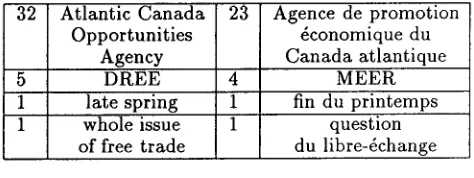
To give an informal impression of overall per- formance, the hundred highest ranking correspon- dences were inspected and of these, ninety were completely correct. Less frequently occurring noun phrases are also of interest for purposes of evaluation; some of these are shown in Table 2.
32 Atlantic C a n a d a Opportunities
Agency 5 D R E E 1 late spring 1 whole issue
of free trade
23 Agence de promotion 6conomique du C a n a d a atlantique
4 M E E R
1 fin du printemps
1 question
du libre-~change
Table 2: Other correspondences
[image:3.612.144.536.65.217.2] [image:3.612.314.551.572.661.2]phrases in its French correspondent. Organiza- tional acronyms (which m a y be not be available in general-purpose dictionaries) are also extracted, as the taggers are robust. Even when a noun phrase only occurs once, a correct correspondence can be found if there are only single noun phrases in each sentence of the alignment. This is demonstrated in the last row of Table 2, which is the result of the following alignment:
Ei: "The whole issue of free trade has been men- tioned."
Fi: "On a mentionn~ la question du libre- ~change."
Table 3 shows some incorrect correspondences produced by the algorithm (in the table, "usine" means "factory").
11 r ° tho obtraining I 01 asia0 I
1 mix of on-the-job 6 usineTable 3
T h e sentences t h a t are responsible for these cor- respondences illustrate some of the problems asso- ciated with the correspondence model:
Ei: " T h e y use what is known as the dual system in which there is a mix of on-the-job and off- the-job training."
Fi: "Ils ont recours £ une formation mixte, partie en usine et partie hors usine."
T h e first problem is that the conjunctive modifiers in the English sentence cannot be a c c o m m o d a t e d by the noun phrase recognizer. T h e tagger also assigned "on-the-job" as a noun when adjectival use would be preferred. If verb correspondences were included, there is a mismatch between the three t h a t exist in the English sentence and the single one in the French. If the English were to reflect the French for the correspondence model to be appropriate, the noun phrases would per- haps be "part in the factory" and "part out of the factory". Considered as a translation, this is lame. T h e m a j o r i t y of errors t h a t occur are not the result of incorrect tagging or noun phrase recognition, but are the result of the approximate nature of the correspondence model. T h e corre- spondences in Table 4 are likewise flawed (in the table, "souris" means "mouse" and "tigre de pa- pier" means "paper tiger"):
1 toothless tiger 1 souris 1 toothless tiger 1 tigre de papier 1 roaring rabbit 1 souris 1 roaring rabbit 1 tigre de papier
Table 4
These correspondences are the result of the fol- lowing sentences:
Ei: "It is a roaring rabbit, a toothless tiger."
Fi: "C' est un tigre de papier, un souris qui rugit."
In the case of the alliterative English phrase "roar- ing rabbit", the (presumably) rhetorical aspect is preserved as a rhyme in "souris qui rugit"; the re- sult being t h a t "rabbit" corresponds to "souris" (mouse). Here again, even if the best correspon- dence were made the result would be wrong be- cause of the relatively sophisticated considerations involved in the translation.
E X T E N S I O N S
As regards future possibilities, the algorithm lends itself to a range of improvements and applications, which are outlined next.
F i n d i n g W o r d C o r r e s p o n d e n c e s : T h e algo- r i t h m finds corresponding noun phrases but pro- vides no information a b o u t word-level correspon- dences within them. One possibility is simply to eliminate the tagger and noun phrase recognizer (treating all words as individual phrases of length unity and having a larger number of correspon- dences). Alternatively, the following strategy can be adopted, which involves fewer total correspon- dences. First, the algorithm is used to build noun phrase correspondences, then the phrase pairs that are produced are themselves treated as a bilingual noun phrase corpus. T h e algorithm is then em- ployed again on this corpus, treating all words as individual phrases. This results in a set of sin- gle word correspondences for the internal words in noun phrases.
R e d u c i n g A m b i g u i t y : T h e basic algorithm assumes that noun phrases can be uniquely identi- fied in both languages, which is only true for sim- ple noun phrases. T h e problem of prepositional phrase a t t a c h m e n t is exemplified by the following corresp on den ces:
16 Secretary 20 secrdtaire d' E t a t of State
16 Secretary 19 Affaires extdrieures of State
16 External Affairs 19 Affaires extdrieures 16 External Affairs 20 secrdtaire d' Etat
Table 5
identified; however many other adverbial preposi- tional phrases would also be incorrectly attached to noun phrases.
If all embedded prepositional phrases were per- mitted by the noun phrase recognizer, the algo- rithm could be used to reduce the degree of ambi- guity between alternatives. Consider a sequence
np~ppe of an unembedded English noun phrase
npe followed by a prepositional phrase PPe, and likewise a corresponding French sequence nplpp I.
Possible interpretations of this are:
1. The prepositional phrase attaches to the noun phrase in both languages.
2. The prepositional phrase attaches to the noun phrase in one language and does not in the other.
3. The prepositional phrase does not attach to the noun phrase in either language.
If the prepositional phrases attach to the noun phrases in both languages, they are likely to be repeated in most instances of the noun phrase; it is less likely that the same prepositional phrase will be used adverbially with each instance of the noun phrase. This provides a heuristic method for reducing ambiguity in noun phrases that oc- cur several times. The only modifications required to the algorithm are that the additional possible noun phrases and correspondences between them must be included. Given thresholds on the num- ber of occurrences and the probability of the cor- respondence, the most likely correspondence can be predicted.
I n c l u d i n g C o n t e x t : In the algorithm, cor- respondences between source and target noun phrases are considered irrespectively of other cor- respondences in an alignment. This does not make the best use of the information available, and can be improved upon. For example, consider the fol- lowing alignment:
El: "The Bill was introduced just before Christmas."
Fi: "Le projet de lot a ~t~ present~ juste avant le cong~ des F~tes."
Here it is assumed that there are many instances of the correspondence "Bill" and "projet de lot", but only one instance of "Christmas" and "cong~ des F~tes". This suggests that "Bill" corresponds to "projet de lot" with a high probability and that "Christmas" likewise corresponds strongly to "cong~ des F~tes". However, the model will assert that "Christmas" corresponds to "projet de lot" and to "cong~ des F~tes" with equal probability, no matter how likely the correspondence between
"Bill" and "projet de lot".
The model can be refined to reflect this situ- ation by considering the joint probability that a
target npr(t) corresponds to a source ripE(s) and all the other possible correspondences in the align- ment are produced. This situation is very similar to that involved in training HMM text taggers, where joint probabilities are computed that a par- ticular word corresponds to a particular part-of- speech, and the rest of the words in the sentence are also generated (e.g. [Cutting et al., 1992]).
C O N C L U S I O N
The algorithm described in this paper provides a practical means for obtaining correspondences be- tween noun phrases in a bilingual corpus. Lin- guistic structure is used in the form of noun phrase recognizers to select phrases for a stochastic model which serves as a means of minimizing errors due to the approximations inherent in the correspon- dence model. The algorithm is robust, and exten- sible in several ways.
R e f e r e n c e s
[Brown et al., 1991a] P. F. Brown, J. C. Lai, and R. L. Mercer. Aligning sentences in parallel cor- pora. In Proceedings of the 29th Annual Meeting of the Association of Computational Linguis- tics, pages 169-176, Berkeley, CA., June 1991.
[Brown et al., 1991b] P. F. Brown, S. A. Della Pietra, V. J. Della Pietra, and R. L. Mer- cer. Word sense disambiguation using statisti- cal methods. In Proceedings of the 29th Annual Meeting of the Association of Computational Linguistics, pages 264-270, Berkeley, CA., June 1991.
[Brown et al., 1992] P. F. Brown, S. A. Della Pietra, V. J. Della Pietra, J. D. Lafferty, and R. L. Mercer. Analysis, statistical transfer, and synthesis in machine translation. In Proceedings of the Fourth International Conference on The- oretical and Methodological Issues in Machine Translation, pages 83-100, Montreal, Canada., June 1992.
[Church and Gale, 1991] K. W. Church and W. A. Gale. Concordances for parallel text. In
Proceedings of the Seventh Annual Conference of the UW Center for the New OED and Text Research, pages 40-62, September 1991.
[Cutting et at., 1992] D. Cutting, J. Kupiec, J. Pedersen, and P. Sibun. A practical part- of-speech tagger. In Proceedings of the Third Conference on Applied Natural Language Pro- cessing, Trento, Italy, April 1992. ACL.
Linguistics, pages 130-137, Berkeley, CA., June 1991.
[Dempster et ai., 1977]
A.P. Dempster, N.M. Laird, and D.B. Rubin. Maximum likelihood from incomplete data via the EM algorithm. Journal of the Royal Statis- tical Society, B39:1-38, 1977.
[Gale and Church, 1991a] W. A. Gale and K. W. Church. Identifying word correspondences in parallel texts. In Proceedings of the Fourth DARPA Speech and Natural Language Work- shop, pages 152-157, Pacific Grove, CA., Febru- ary 1991. Morgan Kaufmann.
[Gale and Church, 1991b] W. A. Gale and K. W. Church. A program for aligning sentences in bilingual corpora. In Proceedings of the 29th Annual Meeting of the Association of Compu- tational Linguistics, pages 177-184, Berkeley, CA., June 1991.
[Kay and RSscheisen, 1988]
M. Kay and M. RSscheisen. Text-translation alignment. Technical Report P90-00143, Xerox Palo Alto Research Center, 3333 Coyote Hill Rd., Palo Alto, CA 94304, June 1988.
[Kupiec, 1992] J. M. Kupiec. Robust part-of- speech tagging using a hidden markov model.
Computer Speech and Language, 6:225-242, 1992.