Source Error-Projection for Sample Selection in Phrase-Based SMT for
Resource-Poor Languages
Sankaranarayanan Ananthakrishnan, Shiv Vitaladevuni, Rohit Prasad, and Prem Natarajan
Raytheon BBN Technologies 10 Moulton Street Cambridge, MA 02138, U.S.A.
{sanantha,svitalad,rprasad,pnataraj}@bbn.com
Abstract
The unavailability of parallel training cor-pora in resource-poor languages is a ma-jor bottleneck in cost-effective and rapid deployment of statistical machine transla-tion (SMT) technology. This has spurred significant interest in active learning for SMT to select the most informative sam-ples from a large candidate pool. This is especially challenging when irrelevant outliers dominate the pool. We propose two supervised sample selection methods, viz. greedy selection and integer lin-ear programming (ILP), based on a novel measure of benefit derived from error anal-ysis. These methods support the selec-tion of diverse and high-impact, yet rel-evant batches of source sentences. Com-parative experiments on multiple test sets across two resource-poor language pairs (English-Pashto and English-Dari) reveal that the proposed approaches achieve BLEU scores comparable to the full sys-tem using a very small fraction of all avail-able training data (ca. 6% for E-P and 13% for E-D). We further demonstrate that the ILP method supports global constraints of significant practical value.
1 Introduction
The laborious and time-consuming nature of pro-ducing parallel training corpora for the develop-ment of high-quality SMT systems cannot be over-stated. Barring a few mainstream languages, the vast majority of language pairs can be classified
This paper is based upon work supported by the DARPA TRANSTAC Program. The views expressed are those of the author and do not reflect the official policy or position of the Department of Defense or the U.S. Government.
as “resource-poor” as far as availability of a usable SMT system is concerned. Active learning can re-duce human labor, turn-around time and monetary cost of developing SMT systems with little or no loss in translation accuracy.
In its simplest form, active learning for building parallel corpora involves selecting “high-value” samples from a large monolingual corpus of source sentences (the candidate pool) for transla-tion by a bilingual human expert. The notransla-tion of “value” depends on the selection method, and can be derived using unsupervised, semi-supervised, or supervised techniques. For instance, Eck et al. (2005) define high-value source sentences as those that contain a large number of previously unseen n-grams. While it aims to increase coverage of the training set, the main deficiency of this approach is its tendency to pick irrelevant outliers if the can-didate pool contains data from unrelated regimes.
Haffari et al. (2009) propose a number of fea-tures, such as similarity to the seed corpus, trans-lation probability, n-gram and phrase coverage as unsupervised measures of the value of candidate samples. Additionally, a linear combination of these features is proposed as a supervised measure of value for ranking candidate sentences. The pa-rameters of this model are optimized on two sep-arate held-out bilingual development sets. The disadvantage of this approach is that it relies on the candidate pool having the same distributional characteristics as the development sets used for pa-rameter estimation. Haffari and Sarkar (2009) ex-plore active learning in a multilingual setting (dif-ferent source languages fd to be translated to a
single target language e) using disagreement be-tween target hypotheses generated by each of the SMT systems. For single language active
learn-Distribution Statement “A” (Approved for Public Release, learn-Distribution Unlimited)
ing, they use OOV phrases, i.e. source n-grams without translation choices.
Ananthakrishnan et al. (2010) propose an error-driven approach that identifies translation errors on a held-out development set, and uses this to train a discriminative pairwise comparator func-tion that preferentially selects candidate sentences with constructs that are incorrectly translated in the development set. The chosen sentences pro-vide maximum potential reduction in translation error. The advantage of this method over other un-supervised and semi-un-supervised selection strate-gies is that it favors domain-relevant sentences that are difficult to translate. However, its granular-ity is low, because it considers errors only at the sentence level. Further, the diversity constraint is implemented in a non-optimal, ad-hoc manner by deleting feature functions from the pairwise clas-sification model.
Bloodgood and Callison-Burch (2010) explored active learning to augment training data for high resource language pairs. They experimented with random, shortest, and longest sentence selection, as well as a technique they refer to as Vocab-Growth. The latter prefers a candidate sentence that contains the most frequentn-gram not seen in the labeled training data. Again, this approach is unsuitable if the pool contains a lot of irrelevant sentences. Moreover, their system is based en-tirely on source language statistics, and does not use any feedback from the SMT system. As one of their examples indicates, this makes it suscepti-ble to selecting sentences containingn-grams that were already correctly translatable.
This paper introduces a novel, fine-grained, error-driven measure of value for candidate sen-tences obtained by translation error analysis on a domain-relevant held-out development set. Er-rors identified in translation hypotheses are pro-jected back on to the corresponding source sen-tences through phrase derivations from the SMT decoder. This projected error is used to obtain a “benefit value” for each sourcen-gram that serves as a measure of its translation difficulty. Sentence selection is posed as the problem of choosing K sentences from the candidate pool that maximize the sum of the benefit values ofn-grams covered by the choice. This is a generalization of the set-covering problem, known to be NP-Complete. We present two approximate solutions: (a) an ef-ficient greedy algorithm and (b) an integer
lin-ear programming (ILP) formulation. We compare these two methods and demonstrate their superi-ority to numerous competing selection strategies described in the literature.
2 Translation Error Projection
The principal advantage of error-driven sample se-lection (Cohn et al., 1996; Meng and Lee, 2008) over traditional unsupervised or semi-supervised active learning (Hwa, 2004; Tang et al., 2002; Shen et al., 2004) is its ability to choose instances, which, when annotated, potentially maximize er-ror reduction of the learner on a reference set.
We assume the following data configuration for error-driven sample selection for SMT. A seed par-allel corpus S is required to bootstrap an initial translation system. However, we do not require that this corpus be drawn from the same distribu-tion as the testing condidistribu-tion. This relaxed assump-tion is particularly useful for developing SMT sys-tems for resource-poor language pairs for which in-domain parallel training data may not be read-ily available, but a (low quality) translation sys-tem may be built using data from other domains, genres or dialects. We also assume a phrase-based SMT architecture (Koehn et al., 2003).
A held-out development (tuning) setD is used for optimizing the parameters of the SMT system using MERT (Och, 2003), as well as for error-analysis in guiding the proposed sample selection algorithms. System performance is evaluated on a fair test set T. We assume that the tuning set is derived from the same distribution as the test set. The selection algorithms operate on a large pool of monolingual source sentencesPto extract high-value samples for translation by a human ex-pert. The candidate pool may contain any mixture of relevant and irrelevant sentences, and may also possess significant redundancy.
2.1 Error Analysis
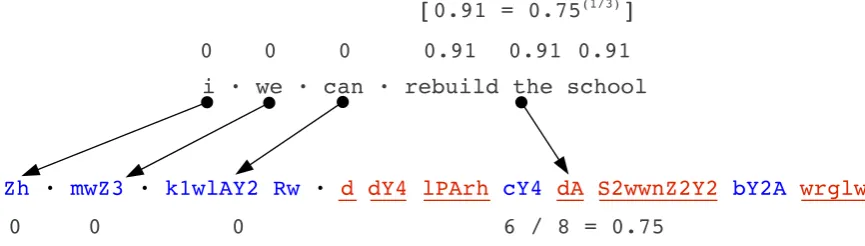
dis-Figure 1: Example illustrating evaluation of back-projected error for a source sentence given phrase derivations and error analysis of its translation hypothesis (English-Pashto). Incorrectly hypothesized words are underlined in red.
similarity between hypotheses and references, cor-responding to poor translations.
An individual target word in the hypothesis is deemed “correct” if it aligns to itself in the TER alignment. Conversely, hypothesized words cor-responding to substitution or insertion errors are considered “incorrect” translations, while deletion errors are ignored. Thus, each hypothesized word can be labeled “correct” or “incorrect” based on the TER alignment, providing a fine-grained view of translation difficulty on the held-out set.
2.2 Benefit/Objective Function
TER analysis enables us to label errors at the word level for each SMT hypothesis. However, it is the knowledge of which source words were translated incorrectly that is useful for sample selection. As-suming there is a way to attach a label (or real value) to each source word in the held-out set D
indicating whether it was correctly translated (or to what degree it was translated), we can compute a benefit value over each sourcen-gram. The sum of benefit values over all source n-grams can be used as an objective function that must be maxi-mized by selecting suitable samples from the can-didate pool.
The SMT decoder produces phrase derivations specifying the origin of each target phrase in a hy-pothesis, providing a convenient mechanism for approximate projection of target error labels back on to the source words. We refer to this as er-ror back-projection. We compute, for each target phrase in the phrase derivations, the target phrase error as a ratio of the number of words labeled “in-correct” to the total number of words within that phrase. This quantity is then equally distributed among constituent source words using the
geomet-ric mean with respect to the number of words in the containing source phrase (obtained from the phrase derivation), to give us a back-projected er-ror at the level of individual source words. Since the phrase derivations form a mutually exclusive partition over the source sentence, we can com-pute an unambiguous back-projected error value for each source word in the held-out setD. Figure 1 illustrates this procedure with an example.
We then compute a benefit value for each source n-gram as the sum of back-projected error of the constituent source words. The set of source phrases in the SMT decoder derivations is typi-cally a very small subset of the set of all pos-sible n-grams of equal length. By distributing back-projected phrase error over individual target words, we are able to compute benefit values for n-grams not covered by the phrase table inven-tory. Finally, we sum the benefit values of source n-grams that occur multiple times inDto generate a table of benefit values hashed by the correspond-ingn-grams.
3 Sentence Selection Problem
Given a set ofn-gramsN ={ni}mi=1from source
sentences inDand associated benefit valuesbi ≥
0 computed by error back-projection, the goal of sample selection is to choose a batch of K sen-tences that maximizes the cumulative benefit value ofn-grams covered by the chosen sentences. The contribution of each sentence towards the objec-tive function is equal to the sum of benefit values of all uniquen-grams it contains.
seminal paper on reducibility (Karp, 1972). The decision version of set covering is as follows: given a set of elements T and a set of subsets within T, say T = {Tj ⊆ T}, is it possible to
selectksubsets such that their union is the super-setT? This problem is known to be NP-Complete.
To visualize the similarity of set covering to the sentence selection problem, note that the elements ofTare akin ton-grams, and the subsetsTj’s
cor-respond to sentences. It is easy to show that the set covering problem can be reduced to the sen-tence selection problem. Thus, there does not exist a polynomial time algorithm for optimal sentence selection unlessP =N P.
There is a standard greedy approximation algo-rithm for the minimum set covering problem (Cor-men et al., 2001): at each iteration, choose the sub-setTj that has the largest number of as yet
uncov-ered elements ofT. The procedure is repeated un-til all elements inTare covered. We next present a variant of this algorithm for the sentence selection problem. Our algorithm address two differences between sentence selection and set covering: (a) each n-gram provides a distinct benefit value on covering, and (b) we must select onlyKsentences and maximize the cumulative benefit.
4 Greedy Sample Selection
The greedy solution constructs batches iteratively by choosing, at each step, the sentence whose total current benefit is the largest. Each sentence in the candidate pool is decomposed into its constituent n-grams, and the sum of benefit values of thesen -grams is computed. The sentence that scores high-est on this criterion is chosen. Resetting the benefit values ofn-grams in previously chosen sentences ensures diversity. The greedy selection technique is illustrated in Algorithm 1. Each iteration of the master loop selects one sentence based on the local maximum of the objective function. The indicator functionIi(·)returns unity ifn-gramniis present
in the argument sentence, and zero otherwise.
The greedy algorithm provides a highly-scalable approximation to the solution and can be applied to systems with millions of n-grams and candidate sentences. It is, however, sub-optimal in general; potentially better solutions can be ob-tained by casting it in an integer linear program-ming (ILP) framework, as discussed below.
Algorithm 1 Greedy Sample Selection
B←()
fork= 1toKdo
p∗ ←arg maxp∈PPmi=1biIi(p)
B(k)←p∗
P←P− {p∗}
bi ←0 ∀ {i| Ii(p∗) = 1}
end for return B
5 Integer Linear Programming (ILP)
We define a set of indicator variables, xj, for the
sentences, xj = 1if sentences pj is selected and
0otherwise. Similarly, there are a set of indicator variables,yi, for then-grams,yi= 1ifn-gramni
is covered by some selected sentence and0 other-wise. Sentence selection can be expressed as the following integer linear program (ILP):
max : X
i
biyi
subj.to.: yi ≤
X
j|Ii(pj)=1
xj ∀i
X
j
xj ≤K
0≤yi ≤1 ∀i , xj ∈ {0,1} ∀j
(1)
Notice that sincebi ≥0, in order to maximize
the optimization function eachyi will be set to1
whenever at least one of the sentence covering its n-gram is selected,xj = 1.
In general, exact optimization of ILP is NP-Hard. However, there are several publicly avail-able solvers for ILPs with thousands of variavail-ables. For instance, the open-source lp-solve program uses the Branch-and-Bound technique to solve ILPs and in our experiments handles systems with thousands of sentences.
5.1 Including Application Constraints
can put a bound on the total length of the cho-sen cho-sentences. Let lj be the length of sentence
pj. We can put a bound Pjljxj ≤ L.
Impos-ing such a bound is similar to the Knapsack prob-lem, a standard NP-Complete problem (Cormen et al., 2001). We can also incorporate prior infor-mation on the goodness of sentences by including sentence costs (e.g. syntactic well-formedness, length, etc.), cj’s, within the optimization
func-tion:Pibiyi+Pjcjxj. In contrast to the greedy
algorithm, ILP provides a natural framework to perform joint optimization over multiple types of constraints.
5.2 Solving the ILP for Practical Problems
Even moderate size SMT applications involve tens of thousands of n-grams and sentences, e.g., one of our test conditions has approximately 79,000 n-grams and 100,000 sentences. Each sentence would result in an integer variable in the ILP. State-of-the-art solvers have difficulty handling such large problems, e.g., lp-solve was unable to solve the ILP for a system with 100,000 sen-tences. We propose a two-step solution to achieve scalability. If k sentences must be selected in a given active learning iteration, we use the greedy algorithm to prune the problem by choosingk0 > k sentences from the corpus, and subsequently construct the ILP on this smaller problem to select the required k sentences. While ILP is optimal, greedily pruning the problem for ILP may result in sub-optimality.
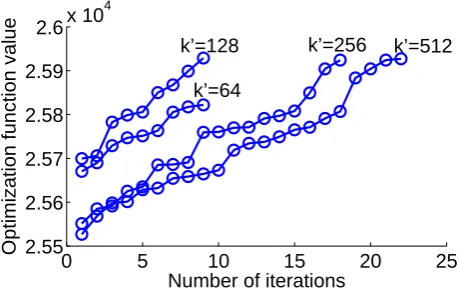
We observed the run time and optimization value computed by ILP for different k0, keeping k constant at 16. We chose smaller (k0, k) for these simulations to allow ILP to run to comple-tion. Figure 2 summarizes our findings. Note that the optimum improves with larger prune size and requires more iterations. Larger prune sizes allow the ILP to choose from a larger pool of sentences, and are therefore likely to improve the optimum. However, these typically require more iterations. In this paper, we used the greedy algorithm to prune the problem to K0 = 1000 sentences, and then selectK = 400sentences using ILP (we re-stricted ILP run-time to 20 minutes per batch).
6 Experimental Results
We demonstrate the effectiveness of greedy and ILP-based sample selection by conducting sim-ulation experiments on two resource-poor
lan-0 5 10 15 20 25
Figure 2: Optimization function value for different iterations of ILP branch-and-bound, for different sizes of pruned problems (k0 = 64,128,256,512) for constant choice cardinality,k= 16.
guage pairs commissioned under the DARPA Transtac speech-to-speech translation initiative, viz. English-Pashto (E2P) and English-Dari (E2D). In both cases, only a small fraction of the available training data is pertinent to the transla-tion task. This simulates a conditransla-tion where a large source language corpus (e.g. English) is harvested from the Web, of which only a small fraction is relevant to the target SMT system.
We simulate low-resource conditions by seques-tering the majority of available parallel training data. A seed translation model is bootstrapped with a very small subset of the training corpus; source sentences of the remainder constitute the candidate pool. Because obtaining monolingual text in the target language is usually not a con-straint, we train the target language model (LM) from all available target language sentences in the training corpus.
We then apply the proposed selection algo-rithms to choose fixed-size batches from the pool. Translations for the selected sentences are ob-tained from the sequestered parallel corpus (thus simulating a human oracle). The chosen batch and its translation is appended to the seed corpus S
for retraining the SMT. At each iteration, we in-dependently decode the test set and evaluate trans-lation accuracy in order to compare the trajectory of BLEU for these and other competing selection strategies:
• Random: Source sentences are uniformly sam-pled from the candidate poolP.
(Eck et al., 2005; Haffari et al., 2009).
• Longest: Pick the longest sentences from the candidate poolP.
• Discriminative: Choose sentences that po-tentially minimize translation error using a maximum-entropy pairwise comparator (Ananthakrishnan et al., 2010).
• Greedy: Simple greedy selection with pro-posed error-projection benefit objective.
• ILP: Integer linear programming optimization with error-projection benefit objective.
English-to-Pashto Simulation: The E2P data originates from a two-way collection of spoken di-alogues, and consists of two parallel sub-corpora: a directional E2P corpus and a directional Pashto-English (P2E) corpus. Each sub-corpus has its own independent training, development, and test partitions. The directional E2P training, develop-ment, and test sets consist of 33.9k, 2.4k, and 1.1k sentence pairs, respectively. The directional P2E training set consists of 76.5k sentence pairs. In ad-dition, DARPA has made available to all Transtac participants an open 564-sentence E2P test set with four target references for each input.
We trained a baseline E2P SMT system from all available E2P and reversed P2E data. The full-system BLEU scores on the single-reference in-ternal test set and on the multi-reference DARPA evaluation test set were 10.8 and 24.4, respec-tively. We set up active learning simulation by ran-domly sampling 1,000 sentence pairs from the di-rectional E2P training partition to obtain the seed training corpus. The remainder of this set, and the entire reversed P2E training partition were com-bined to create the pool. The reversed directional P2E data is considered irrelevant as far as the E2P test sets are concerned. The pool thus consists of 30% in-domain and 70% irrelevant sentence pairs. We simulated 35 iterations with batches of 400 sentences each; the seed corpus grows to 15,000 sentence pairs at the end of the simulation.
English-to-Dari Simulation: The E2D data is also derived from a two-way collection of spoken dialogues. The directional E2D training, develop-ment, and test sets consist of 11.6k, 3.2k, and 2.8k sentence pairs, respectively. The directional D2E training set consists of 52.9k sentence pairs. The full-system BLEU on the E2D test set was 15.1.
As with E2P, the seed training corpus was ob-tained by randomly sampling 1,000 sentence pairs
from the directional E2D training partition. All re-maining parallel training data were designated as the candidate pool. Thus, only about 17% of the candidate pool is considered relevant with respect to the E2D test set. Again, we simulated 35 itera-tions with batches of 400 sentences each.
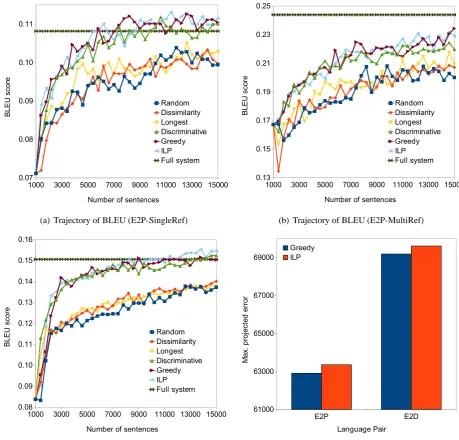
BLEU Trajectories: The trajectories of BLEU scores for the E2P and E2D test sets are shown in Figures 3(a), 3(b), and 3(c), respectively. The horizontal line near the top of each plot represents the corresponding full-system BLEU score. The following observations are noteworthy:
• BLEU scores using the proposed greedy and ILP-based selection methods ramp up very quickly to the full-system level using a small fraction of available training data. On the E2P single-reference test set, the top-line BLEU score of 10.8 is attained after just 12 iterations (5.8k sentence pairs), as against 100k sentence pairs for the full system (6% of the corpus). Likewise for E2D, the full-system BLEU score of 15.1 is attained after only 18 iterations (8.2k sentence pairs), as opposed to 65k sentence pairs for the full system (13% of the corpus).
• In some cases, BLEU scores with training cor-pora constructed using active learning exceed those obtained with the full system. This is because our selection algorithms are biased to choose relevant, in-domain sentences from the candidate pool. Initially, the training corpus is kept free of outliers that cause performance degradation in the full system. With more it-erations of selection, the latter eventually find their way into the training set, causing transla-tion performance to settle around the top-line BLEU scores.
• Under identical initial conditions at the first it-eration of active learning, the ILP benefit op-timum exceeds the greedy opop-timum by 444.5 units for E2P, and by 420.3 units for E2D. This confirms the theoretical superiority of ILP over greedy selection.
We computed total area under the BLEU curves for the various selection techniques as a single fig-ure of merit. Summarized in Table 1, the BLEU-Iteration product shows source error-projection with the ILP selection algorithm outperforming all competing techniques, including discriminative sample selection (Ananthakrishnan et al., 2010).
simula-(a) Trajectory of BLEU (E2P-SingleRef) (b) Trajectory of BLEU (E2P-MultiRef)
(c) Trajectory of BLEU (E2D-SingleRef) (d) Maximum benefit for greedy and ILP selection
Figure 3: Simulation results for E2P and E2D.
Method E2P-SR E2P-MR E2D-SR Random 83.03 78.76 144.65 Dissim. 82.34 81.18 154.17 Longest 89.89 93.65 155.72 Discrim. 113.54 145.32 205.56 Greedy 120.83 155.64 204.95 ILP 121.16 156.70 210.51
Table 1: Area under the BLEU curve with respect to 0-th iteration baseline.
tions choose a fixed number of sentences at each iteration. However, the ILP optimization frame-work also permits the integration of global
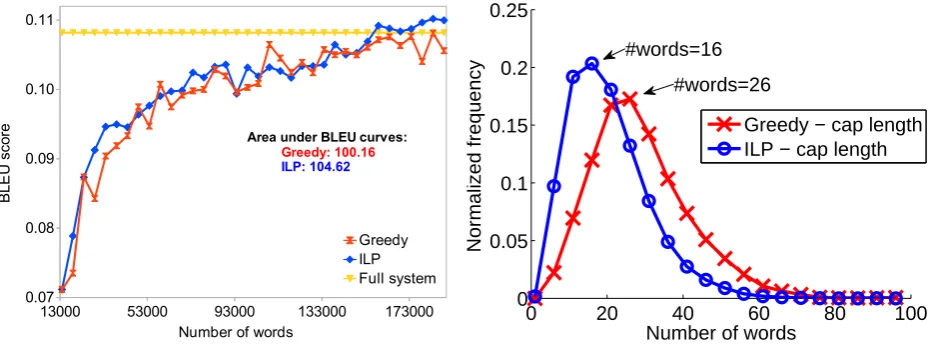
(a) Length-capped BLEU trajectory (E2P-SingleRef). Full system training data contains 1.46M source words.
0 20 40 60 80 100
0 0.05 0.1 0.15 0.2 0.25
Number of words
Normalized frequency
Greedy − cap length ILP − cap length #words=26
#words=16
(b) Normalized histogram of sentence length
Figure 4: Comparison of greedy and ILP with global length constraint of 5,000 words per batch.
Moreover, the overall sentence length distribu-tion shown in Figure 4(b) indicates that the greedy algorithm prefers a smaller number of very long sentences, whereas ILP prefers a larger number of shorter sentences. The latter is an important practical benefit for applications such as crowd-sourcing, because annotators often find it difficult to translate long sentences. Secondly, automatic word alignment quality for long sentence pairs is often poor. Finally, larger number of sentences in the training pool is likely to increase diversity.
7 Discussion and Future Work
Active learning provides a useful framework for alleviating the significant costs associated with de-veloping SMT systems for resource-poor language pairs. In this paper, we introduced a novel criterion for active sample selection, viz. back-projected translation error. Candidate instances that score well on this criterion are chosen for translation by a bilingual human expert. We showed that the problem of maximizing the error-projection objec-tive function is closely related to the set-covering problem, known to be NP-complete.
We used a simple greedy selection algorithm as a first approximation to the solution. BLEU trajec-tories from simulation experiments demonstrated the superiority of this scheme to competing ac-tive learning algorithms. We then proposed an op-timization framework to maximize the objective function for sample selection, and provided a so-lution via ILP. The ILP-based selection algorithm
also supports global constraints on the optimiza-tion problem, e.g. overall corpus size in words, which neither greedy selection nor other compet-ing strategies can implement in a principled fash-ion. We also showed that ILP was superior to the greedy approach when constraining selected batches by total number of words, rather than by number of sentences.
The proposed approach is shown to outper-form competing active learning strategies when the candidate pool contains a small number of high-impact samples buried within a large corpus of mostly irrelevant text. Guided by an in-domain development set, our approach always selects rel-evant samples that are likely to provide maximal benefit to the SMT system. Pilot experiments suggest that this approach may not be as effec-tive when the candidate pool is completely task-relevant. Another weakness of our technique is the reliance on a relatively small development set to guide selection. Performance may saturate once all sentences in the development set can be trans-lated accurately. Generally, a large, rich develop-ment set will tend to give better results. In the fu-ture, we plan to experiment with random sampling to vary the development set at each active learning iteration.
References
Sankaranarayanan Ananthakrishnan, Rohit Prasad, David Stallard, and Prem Natarajan. 2010. Dis-criminative sample selection for statistical machine translation. In Proceedings of the 2010 Conference on Empirical Methods in Natural Language Pro-cessing, EMNLP ’10, pages 626–635, Morristown, NJ, USA. Association for Computational Linguis-tics.
Michael Bloodgood and Chris Callison-Burch. 2010. Bucking the trend: large-scale cost-focused active learning for statistical machine translation. In Pro-ceedings of the 48th Annual Meeting of the Associa-tion for ComputaAssocia-tional Linguistics, ACL ’10, pages 854–864, Stroudsburg, PA, USA. Association for Computational Linguistics.
David A. Cohn, Zoubin Ghahramani, and Michael I. Jordan. 1996. Active learning with statistical mod-els. Journal of Artificial Intelligence Research, 4(1):129–145.
Thomas H. Cormen, Charles E. Lerserson, and Ronald L. Rivest. 2001. Introduction to Algorithms. Prentice Hall of India.
Matthias Eck, Stephan Vogel, and Alex Waibel. 2005. Low cost portability for statistical machine transla-tion based in N-gram frequency and TF-IDF. In Proceedings of IWSLT, Pittsburgh, PA, October.
Gholamreza Haffari and Anoop Sarkar. 2009. Active learning for multilingual statistical machine transla-tion. In Proceedings of the Joint Conference of the 47th Annual Meeting of the ACL and the 4th Interna-tional Joint Conference on Natural Language Pro-cessing of the AFNLP: Volume 1 - Volume 1, ACL ’09, pages 181–189, Stroudsburg, PA, USA. Associ-ation for ComputAssoci-ational Linguistics.
Gholamreza Haffari, Maxim Roy, and Anoop Sarkar. 2009. Active learning for statistical phrase-based machine translation. In NAACL ’09: Proceedings of Human Language Technologies: The 2009 An-nual Conference of the North American Chapter of the Association for Computational Linguistics, pages 415–423, Morristown, NJ, USA. Association for Computational Linguistics.
Rebecca Hwa. 2004. Sample selection for statistical parsing. Computational Linguistics, 30:253–276.
Richard M. Karp. 1972. Reducibility among com-binatorial problems. In R. E. Miller and J. W. Thatcher, editors, Complexity of Computer Compu-tations, pages 85–103. Plenum.
Philipp Koehn, Franz Josef Och, and Daniel Marcu. 2003. Statistical phrase-based translation. In NAACL ’03: Proceedings of the 2003 Conference of the North American Chapter of the Association for Computational Linguistics on Human Language Technology, pages 48–54, Morristown, NJ, USA. Association for Computational Linguistics.
Qinggang Meng and Mark Lee. 2008. Error-driven active learning in growing radial basis function net-works for early robot learning. Neurocomputing, 71(7-9):1449–1461.
Franz Josef Och. 2003. Minimum error rate train-ing in statistical machine translation. In ACL ’03: Proceedings of the 41st Annual Meeting on Asso-ciation for Computational Linguistics, pages 160– 167, Morristown, NJ, USA. Association for Compu-tational Linguistics.
Dan Shen, Jie Zhang, Jian Su, Guodong Zhou, and Chew-Lim Tan. 2004. Multi-criteria-based active learning for named entity recognition. In ACL ’04: Proceedings of the 42nd Annual Meeting on Associ-ation for ComputAssoci-ational Linguistics, page 589, Mor-ristown, NJ, USA. Association for Computational Linguistics.
Matthew Snover, Bonnie Dorr, Richard Schwartz, Lin-nea Micciulla, and John Makhoul. 2006. A study of translation edit rate with targeted human annotation. In Proceedings AMTA, pages 223–231, August.