Full Terms & Conditions of access and use can be found at
http://www.tandfonline.com/action/journalInformation?journalCode=cshe20
Studies in Higher Education
ISSN: 0307-5079 (Print) 1470-174X (Online) Journal homepage: http://www.tandfonline.com/loi/cshe20
Do non-academic professionals enhance
universities’ performance? Reputation vs.
organisation
Roxana-Diana Baltaru
To cite this article: Roxana-Diana Baltaru (2018): Do non-academic professionals enhance universities’ performance? Reputation vs. organisation, Studies in Higher Education, DOI: 10.1080/03075079.2017.1421156
To link to this article: https://doi.org/10.1080/03075079.2017.1421156
© 2018 The Author(s). Published by Informa UK Limited, trading as Taylor & Francis Group
Published online: 07 Jan 2018.
Submit your article to this journal
Article views: 1476
View Crossmark data
Do non-academic professionals enhance universities
’
performance? Reputation vs. organisation
Roxana-Diana Baltaru
Department of Sociology, University of Essex, Colchester, Essex, UK
ABSTRACT
Universities are increasingly engaging with non-academic professionals in facilitating performance outcomes, reaffirming themselves as purposive organisations, i.e. institutions with the ability to organise strategically in the pursuit of goals and standards. However, there is little empirical evidence for the impact of professional staff on university performance. Drawing on a sample of 100 British universities, the author assesses whether the changes in the ratio of professional staff to students (from 2003 to 2011) influence subsequent university performance. The author finds that universities that are moderately increasing their share of professional staff display higher levels of degree completion, but no significant differences can be observed in terms of research quality, good honours degrees and graduate employability. University performance is largely determined by reputation, prestigious universities performing higher in all dimensions. The findings contribute to the emerging empirical research assessing the impact of professional staff in higher education.
KEYWORDS
University performance; non-academic professionals; reputation; purposive organisational action; UK
Introduction
Since the 1970s/1980s, scholars have documented a ‘managerial revolution’ signalled by the accelerated increase in the number of non-academic professionals working in managerial and service-oriented areas of university administration (e.g. Blau 1973 in the US; Visakorpi 1996 in Finland; Gornitzka and Larsen 2004in Norway; Gordon and Whitchurch 2007in the UK; Krücken, Blümel, and Kloke2013in Germany; for elaborate reviews of the literature see Leslie and Rhoades
1995; Schneijderberg and Merkator2013).
The ongoing debate surrounding the increase in the number of non-academic professionals mirrors wider concerns about the nature of universities. The managerial revolution is often invoked to illustrate the controversial transition from the traditional collegial system of decision-making and professorial self-governance (in most European countries) to a performance-oriented model welcoming the contribution of an increasingly professionalised body of administrative staff (Clark1998; Deem1998; Hamlin and Patel2015; Kehm2015). More recently, numerous institutional studies emphasise the lack of empirical research for the effectiveness of managerial revolution and the capacity of individual institutions to enhance their outputs through developing organisational strategies (e.g. tightening entry standards, consolidating strategic leadership) (Keith2001; Bryman
2007; Hamlin and Patel2015). Concomitantly, a wide body of literature originating in the neo-insti-tutional tradition, points towards the diffusion of ‘instrumental rationality’ as a gold standard of
© 2018 The Author(s). Published by Informa UK Limited, trading as Taylor & Francis Group
This is an Open Access article distributed under the terms of the Creative Commons Attribution License (http://creativecommons.org/licenses/by/4.0/), which permits unrestricted use, distribution, and reproduction in any medium, provided the original work is properly cited.
CONTACT Roxana-Diana Baltaru [email protected] Department of Sociology, University of Essex, Wivenhoe Park, Col-chester, Essex CO43SQ, UK
institutional identity and purpose (Meyer2000; Ramirez and Christensen2013). The proliferation of non-academic professionals is argued to be symptomatic of the university increasingly articulating its identity as a purposive organisational actor i.e.‘an integrated, goal-oriented entity that is deliber-ately choosing its own actions and that can thus be held responsible for what it does’(Krücken2011, 4, see also Baltaru and Soysal2017).
Do non-academic professionals enhance performance in higher education? Or is the engagement with strategically oriented personnel a mere artefact of universities trying to sustain the image of goal-oriented entities, capable of effective self-management? The author addresses this question for the UK by drawing on longitudinal organisational data from 100 British universities in order to assess whether the increase in professional staff in the early 2000s had any impact on subsequent university performance.
The UK context
The UK is among the countries where the performance culture has had the most impact in higher education policy (Teichler1988). In the late 1970s/1980s, the Conservative government under Mar-garet Thatcher pushed for more public service accountability. For higher education (HE), seen as indispensable for national growth, this meant that the internal organisation of universities could no longer be left to academic staff alone. Yokoyama (2006) argues that the introduction of the Research Assessment Exercise (RAE), in particular, has encouraged a perception of managerial approaches as indispensable to universities’performance.1
The emergence of new areas of expertise (e.g. research impact, new learning technologies, equal-ity and diversequal-ity standards in student admissions and staff recruitment) has prompted the develop-ment of an increasingly professionalised body of non-academic staff. Whitchurch (2004) argues that the openness to new roles became a tool of adaptation for universities as one could‘redefine and push the boundaries’ of administrative sub-sections (internally) as well as easily engage with partner institutions (externally). As an example, in the biggest report commissioned by the UK Gov-ernment since the 1960s (Dearing Report1997), non-academic professionals are acknowledged as strategic in enabling HEIs to cater for the student body and for external stakeholders. The UK case aligns with the European trend, where universities increasingly engage with professional staff in the development and delivery of educational activities and research (Schneijderberg and Merkator
2013).
An underexplored area of higher education practice
The existing literature exploring university performance as a function of personnel resources typically focuses on top executives and offers a rather descriptive overview of attitudes towards institutional efficiency rather than an assessment of behavioural performance and effectiveness. A range of quali-tative studies have documented the perceived characteristics and behaviours associated with the effectiveness of personnel such as pro-vice chancellors (Spendlove 2007), academic programme directors (Ladyshewsky and Vilkinas2012) and heads of departments (Trocchia and Andrus2003; Hamlin and Patel2015).
higher credit to graduates from prestigious universities, and last but not least, reputable universities continue to benefit from the historical networks and affiliations with other high performing HEIs. As an example, Keith (2001) explores the relationship between organisational attributes underlying per-formance (e.g. lowering the student staff ratio, increasing entry standards) and institutional repu-tation (operationalised based on aggregated departmental level ratings and national level ratings) on 138 US universities, while considering the impact of past ratings. The results show that insti-tutional status is rather stable over time (the 1982 score explains 99.7% of the variance in the 1996 score), the changes in universities’ organisational attributes (e.g. percentage change in the student/faculty ratio, percentage change in the undergraduate student acceptance rate) being unre-lated to the corresponding changes in institutional ratings.
Even fewer studies focus specifically on the relationship between non-academic professionals and university performance. Graham and Regan (2016) provide a qualitative investigation into the contri-bution of professional staff to student outcomes. The inquiry is based on semi-structured interviews conducted with professional personnel (administration, management, learner support and facilities) from a UK and an Australian institution, in order to draw a list of key factors that enable or limit the contribution of such personnel to institutional outcomes. The results reveal three dimensions associ-ated with the performance of professional staff in both contexts (staff knowledge, attitudes of col-leagues and supervisors and job satisfaction) but little can be inferred about the relative impact of professional services on the performance of their respective institutions. Dundar and Lewis (1998) propose a series of institutional features as potential predictors of research productivity within 3600 doctoral programmes in the US, one of which is the availability of support oriented services and facilities. Although the results confirm a positive relationship between such facilities and research productivity, inferences cannot be made about the wider share of professional resources as the indi-cator solely relies on library expenditures.
The scarcity of evidence concerning the impact of professional staff on institutional outputs pro-vides the impetus for larger scale empirical research into the possibilities and limitations of purposive and strategic organisational action.
Functionalist and cultural perspectives on purposive organisational action
Universities’capacity to act strategically towards enhancing performance can be studied from two perspectives (functionalist and cultural). Each perspective yields very different predictions regarding the relationship between professional staff and university performance.
The promise of purposive organisational action
The taken-for-granted assumption (to be referred here as‘functionalist’) is that professional staff can use their expertise to help HEIs transform inputs (personnel and non-personnel resources) into
The indicators most frequently invoked in the existing literature on university performance are research output, student attainment and employability (e.g. Bazeley2010; Grotkowska, Wincenciak, and Gajderowicz2015; Graham and Regan2016). While acknowledging the role of academic staff in enhancing performance, many of these studies emphasise the importance of drawing on a more diverse pool of professional resources and of acting strategically in bridging universities with the external stakeholders such as industry (Grotkowska, Wincenciak, and Gajderowicz2015).
The limitations of purposive organisational action
From a neo-institutionalist point of view, the spread of functionalist approaches is symptomatic of institutions seeking legitimacy by adhering to taken-for-granted models of institutional identity and purpose (DiMaggio and Powell1991; Meyer2000; Krücken, Blümel, and Kloke2013). Within a cultural climate prioritising the rationalisation of action through the articulation of clearly defined means and goals, institutions of all types and from all over the world are being reinvented as‘ organ-isational actors’(Meyer and Bromley2013). While the engagement with professional staff may reaf-firm universities’ identity as purposive organisations, the impact of this strategy on subsequent performance risks being overestimated, given the taken-for-granted-legitimacy of professionalised approaches to organisation. This may explain why, despite HEIs’increasing engagement with pro-fessional staff, very few studies have examined the actual impact of this type of personnel on univer-sity performance. In this sense, Edgar and Geare (2013, 775) point out that‘changes in managerial practices in higher education settings have been significant and far-reaching’ nevertheless ‘few studies have sought to examine their efficacy’(see also Deem1998).
The cultural, neo-institutionalist critique questions the very rationale underlying the promise of purposive organisational action. This perspective is echoed by various institutional studies suggesting that the culture of a company and the broader environmental factors limit the potential of change coming from strategic organisational decisions. Keith (2001) illustrates the underlying mechanism. The differential allocation of institutional status (via ratings) is delivered as a meritocratic process based on demonstrable outcomes. In order to allow for comparable outcomes (an essential condition for institutional legitimacy), universities are becoming increasingly isomorphic in their structures (Meyer and Rowan1977; DiMaggio and Powell 1983). This trend is clearly reflected in the UK HE sector where virtually all universities engage with strategies such as articulating research impact or offering a wide range of employability and academic support. From a neo-institutionalist perspective, institutional status‘is only loosely coupled with these ceremonial structures and activities’as‘ organ-izations within an institutional environment become increasingly homogenous over time’ (Keith
2001, 496, see also Meyer and Rowan1977; Steiner, Sundstrom, and Sammalisto2013). This entails the emergence of institutional reputation (as opposed to rankings) as the main factor differentiating between universities. As an example, the recent successes of a HEI may not feed into employers’ atti-tudes to the same extent as its reputation, delaying the impact of institutional efforts to enhance sub-sequent performance in terms of graduate employability. In other words, universities’reputation stemming from the historical ratings may overshadow their current performance in moving up and down the rankings.
Hypotheses
governments and global markets (Clark1998). With regards to the UK context, Whitchurch (2004) shows that universities increasingly engage with professional staff as a way of pursuing institutional innovation and development (e.g. student services, human resources and research enterprise). From such a perspective, universities having increased their share of professional staff are expected to display higher levels of subsequent performance (H1).
From a cultural perspective, the potential of purposive organisational action is rather limited as universities are deeply immersed in an institutional environment where reputation overshadows the current successes or failures of individual HEIs. Despite universities’ efforts to become more entrepreneurial, external stakeholders such as: prospective students, employers and other univer-sities, may continue to largely inform their choices based on reputation (O’Loughlin, MacPhail, and Msetfi 2015). In line with the neo-institutionalist argument, this paper assesses the claim that organisations and their outputs‘are not only the result of conscious design but are also influ-enced by institutional preferences and culture’ (Steiner, Sundstrom, and Sammalisto 2013, 410). That is, reputable universities are expected to display higher levels of university performance (H2A). Furthermore, Steiner, Sundstrom, and Sammalisto (2013) argue that universities are devel-oping in an institutionalised environment that fosters increased homogeneity between structures and activities (see also Meyer and Rowan 1977). As universities are engaging with increasingly similar strategies of facilitating performance (e.g. learning support structures, student placements and internships, professional development courses), reputation grows in importance as a differen-tiating factor between HEIs (Keith2001). Accordingly, the author hypothesises that reputation is a stronger predictor of university performance compared to an increase in the share of professional staff (H2B).
Methodology
Sample and timeline
The current paper draws on 100 universities for which data are available in both The Complete Uni-versity Guide (CUG) and Higher Education Statistics Agency (HESA). CUG (providing ranking tables compiled by Mayfield Consultants) was first published in 2007 in The Daily Telegraph. CUG has been chosen over other available rankings (e.g.The Guardian, Times Higher Education) as it provides detailed performance criteria available over an extended period of time. The CUG indicators are adjusted to take account of the subject mix at the university where applicable. In addition, CUG relies extensively on HESA data which enhance comparability with the HESA indicators used to oper-ationalise the share of academic and professional staff. This sample amounts to approximately 80% of the UK HEIs with a university status (see Government UK [2017] for a full list of officially recognised HEIs) covering every UK region (England, Wales, Scotland and Northern Ireland). The sample includes universities of various sizes from universities of under 5000 students (e.g. University of Abertay Dundee) to universities of over 30,000 students (e.g. University of Leeds), the average number of stu-dents being of approximatively 16,000.
HESA data on professional staff were extracted from the earliest available time-point (2003) and the latest available time-point with comparable data (2011), as from 2012 the definitional change in the Standard Occupational Classification (SOC) has entailed the merging of non-academic pro-fessionals with academic propro-fessionals as one category of‘higher education professionals’. For com-parability purposes, information for all other predictors was collected for 2003 and 2011. The two time points were used to compute percentage changes in the predictor variables in order to assess whether different organisational strategies (e.g. increasing the proportion of professional staff to students from 2003 to 2011) can be related to university performance in the short run (2011) and in the long run (2017).
by using the changes in the ratio of professional staff to students from 2003 to 2011 to predict uni-versity performance in 2017, thus accounting for potential time lags in institutional level planning. Such an analysis is possible as the SOC definitional change only affects the way in which HESA counts professional and academic staff. Across the university sector professional contracts continue to be classified as academic and non-academic in their own right, consistent with the occupational structure prior to 2012.
Definitions and variables
University performancehas been operationalised based on indicators collected from the CUG League Tables. Among the performance criteria that CUG uses to determine universities’ratings, the author utilises in this paper those that have also been considered by the Higher Education Funding Council for England (HEFCE) in setting quality benchmarks for the UK HE sector (i.e. student attainment and graduate employability). Research quality will also be considered following the engagement of HEIs with the Research Excellence Framework (REF) process.
Student attainmentis operationalised based on degree completion and good honours degree. Degree Completion (ranging from 0 to 100) has been derived by CUG from the HESA calculation of anticipated outcomes for a cohort of students i.e. the percentage of students expected to com-plete their course or transfer to another HEI. Good Honours (ranging from 0 to 100) has been derived by CUG from HESA and it captures the percentage of graduates achieving first or upper second class degrees in the total number of graduates with classified degrees.Employabilityis indi-cated by graduate prospects. Graduate Prospects (ranging from 0 to 100) has been derived by CUG from HESA, operationalised as the percentage of graduates who engage in employment or further study in the total number of graduates with a known destination (first degree graduates only).
Research Quality(ranging from 1 –nationally recognised quality to 4–world leading quality) has been derived by CUG from the REF. Research quality is assessed in terms of originality, significance and rigour with regards to outputs, impact and environment.
Professional staffis the main predictor of interest. It has been operationalised based on HESA staff data which capture the number of staff full-person or equivalent excluding atypical staff whose con-tracts last less than four consecutive weeks (e.g. guest lecturers, temporary staff contracted for short-term projects).2 Although HESA recommends merging the managerial, professional and technical staff in order to distinguish non-academic professionals from the clerical and manual staff, the author applies the technique suggested by Gornitzka and Larsen (2004) and excludes the technical staff. In this paper, professional staff include: managers, senior administrators, planning and support personnel (e.g. student welfare workers, careers advisers, personnel and planning officers), services personnel (e.g. artistic, media, public relations and marketing occupations) and other professional administrators (e.g. academic standards officers). The number of personnel has been considered rela-tive to the total number of students (i.e. the ratio of professional staff to students) in order to account for the challenges of management associated with larger student numbers. Moreover, professional staff has been operationalised as the percentage change in the ratio of non-academic professionals to students (from 2003 to 2011). The indicator was derived by subtracting the ratio of non-academic professionals to students in 2003 from the ratio of non-academic professionals to students in 2011 then transforming the difference in percentages relative to the initial 2003 ratio.
% change in the ratio of non - academic professionals to students=T2011−T2003
T2003 .
the highest ranked universities based on an evaluation of 3 retrospective factors dating back to the 1990s: the number of appearances in subject tables, the number of times in top 10, and percentage of appearances in top 10. This group of universities will be referred here as‘prestigious universities’.
Organisational controls
The relationships of interest have been assessed while taking into account a series of organisational attributes (other than the share of professional staff), that are also likely to make a difference in terms of university performance. First, the model controls for institution specific personnel (academic staff) primarily responsible for delivering the teaching and research functions of the university thus a widely used indicator in understanding university performance (Grunig1997; Walker2016).Academic staffis operationalised as the percentage change in the ratio of academic staff to students (from 2003 to 2011). Second, the effects of the staff to student ratios are estimated while controlling for the mode of employment, in order to account for the rise of part-time teaching staff in UK universities (Associ-ation of University Teachers2005). The indicator has been operationalised as the percentage change in the proportion ofpart-time staff(from 2003 to 2011). Third, the model controls forinstitutional size
as another institutional characteristic closely associated with university performance (Grunig1997). Larger universities may display higher levels of subsequent performance as they can draw on a larger pool of human and financial resources, whereby more academic staff cater for larger student numbers and higher income levels allow for higher levels of expenditure. An exploratory factor analysis confirms this expectation empirically, as total expenditure, total students, total staff and total income are highly correlated and they explain approximately 87% of variance in the under-lying construct (Cronbach’s alpha = .71). The generated variable is measured at the earliest time-point in the analysis (2003), and it has been used as an indicator of institutional size. Fourth, the model con-trols for whether the university is located in Scotland (as opposed to England, Northern Ireland and Wales), Johnes and Taylor (1990) arguing that Scottish universities may display lower completion rates due to students embarking in longer courses as well as enrolling at an earlier age. Fifth, the foundation period is considered, as age may represent an asset in terms of institutional resources and reputation (O’Loughlin, MacPhail, and Msetfi2015). A binary indicator is utilised to distinguish older universities from the universities founded in the post-1960 period characterised by great HE expansion.3 Sixth, the model accounts for potential diseconomies of scale (postulating that large scale organisations may encounter a decrease in efficiency after a certain point due to growing costs) by including a squared term for institutional size. A non-linear relationship may also character-ise the impact of professional staff as formal organisational structures initially implemented as a response to structural pressures may continue to perpetuate as a legitimising model of institutional action instead (DiMaggio and Powell1983). In order to account for this dynamic, the model will also include a squared term for professional staff.
from the 2008–2011 time interval. The CUG indicator is based on the average UCAS tariff score for new undergraduate students, converting students’ examination results in a numerical score (A levelA= 120,B= 100, etc.; Scottish HighersA= 80,B= 65, etc). Students in their introductory year were excluded.
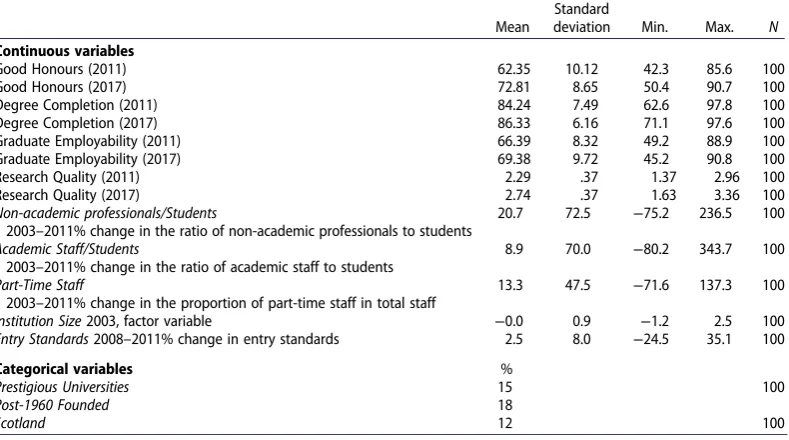
Table 1illustrates the descriptive analysis of the indicators outlined above.
Analytical strategy
An ordinary least square regression (OLS) technique has been used in order to assess the relationship between universities’performance (the dependent variable) and the independent variables and con-trols outlined above.
Two OLS models have been run in order to enable the detection of immediate effects (university performance measured in 2011) and long-term effects (university performance measured in 2017). Extreme outliers have been removed from the analysis. The sample of 100 universities was kept unchanged across the two regression models (2011 and 2017) based on the sample size in 2011.
Results and discussion
Table 2illustrates the results from the models predicting universities’performance. The models show how changes in the professional staff to students ratio over a period of time of approximatively one decade (2003–2011) may have affected performance on the short term (in 2011) and on the long term (in 2017), while considering the potential impact of prestige/reputation. The relationships are estimated while controlling for the percentage change in: the ratio of academic staff to students, part-time staff, entry standards, as well as for cross-sectional measures of institutional size (2003), foundation period and geographical region.
We can see that universities that have increased their ratio of non-academic professionals to students display slightly higher shares of degree completion both in the short run (2011:B= .038,p< .05) and in the long run (2017:B= .038,p< .01) (H1 partly confirmed). This association may point towards the role Table 1.Descriptive statistics.
Mean
Standard
deviation Min. Max. N
Continuous variables
Good Honours (2011) 62.35 10.12 42.3 85.6 100
Good Honours (2017) 72.81 8.65 50.4 90.7 100
Degree Completion (2011) 84.24 7.49 62.6 97.8 100
Degree Completion (2017) 86.33 6.16 71.1 97.6 100
Graduate Employability (2011) 66.39 8.32 49.2 88.9 100
Graduate Employability (2017) 69.38 9.72 45.2 90.8 100
Research Quality (2011) 2.29 .37 1.37 2.96 100
Research Quality (2017) 2.74 .37 1.63 3.36 100
Non-academic professionals/Students
2003–2011% change in the ratio of non-academic professionals to students
20.7 72.5 −75.2 236.5 100
Academic Staff/Students
2003–2011% change in the ratio of academic staff to students
8.9 70.0 −80.2 343.7 100
Part-Time Staff
2003–2011% change in the proportion of part-time staff in total staff
13.3 47.5 −71.6 137.3 100
Institution Size2003, factor variable −0.0 0.9 −1.2 2.5 100
Entry Standards2008–2011% change in entry standards 2.5 8.0 −24.5 35.1 100
Categorical variables %
Prestigious Universities 15 100
Post-1960 Founded 18
Scotland 12 100
Variables Good honours Degree completion Graduate prospects Research quality
2011 2017 2011 2017 2011 2017 2011 2017
Constant 61.29*** (1.114) 71.44*** (1.091) 83.96*** (.941) 85.97*** (.809) 65.79*** (1.127) 69.56*** (1.249) 2.340*** (.035) 2.788*** (.038) 2003–2011% change in the ratio of non-academic
professionals to students
.038+(.019) .013 (.019) .038* (.017) .038** (.014) .018 (.018) .022 (.023) .001 (.001) .001 (.001)
Square term (2003–2011% change in the ratio of non-academic professionals to students) −
.000** (.000) −.000 (.000) −.000** (.000) −.000** (.000) −.000 (.000) −.000 (.000) −.000+(.000) −.000 (.000)
Prestigious universities 9.382** (2.789) 7.845** (2.231) 6.533** (2.151) 4.839** (1.549) 6.725** (1.970) 4.921* (2.403) .293*** (.081) .234** (.080) 2003–2011% change in the ratio of academic
staff to students
.031+(.017) .033* (.015) .014 (.012) .013 (.010) .026+(.014) .037* (.017) .001* (.000) .001 (.001)
2008–2011% change in entry standards .128 (.154) −.000 (.079) −.028 (.136) −.026 (.059) .013 (.115) .070 (.095) −.003 (.007) −.009* (.003)
F-test 18.95*** 12.04*** 13.25*** 17.91*** 19.47*** 14.65*** 13.10*** 16.00***
N 100 100 100 100 100 100 100 100
R2 .51 .45 .40 .47 .53 .50 .48 .48
Notes:+p< .10, *p< .05, **p< .01, ***p< .001. Robust standard errors in the parentheses. Coefficients and standard errors rounded at the third decimal. The models control for 2003–2011% change in part-time staff, institution size in 2003 (including squared term), geographical region and foundation period.
STUD
IES
IN
HIGHER
E
D
U
CATIO
N
[image:10.493.40.679.175.312.2]that non-academic staff increasingly plays in supporting academic activities such as teaching and tutor-ing (Whitchurch2008; Schneijderberg and Merkator2013; Graham and Regan2016).
However, the significance of the squared term for degree completion (2011:B=−.000, p< .01; 2017:B=−.000, p< .01), as well as good honours (2011:B=−.000, p< .01) reveals a tendency for student attainment to increase and then decrease at higher levels of non-academic professionals to students. The findings echo neo-institutionalist studies showing that initial adoption of new organ-isational forms may be related to structural needs, while later adoption no longer responds to such needs‘but is related to institutional definitions of the legitimate structural form’(Zucker and Tolbert
1981; Meyer1981, cited in DiMaggio and Powell1983, 149).
Both graduate prospects and research quality are independent from the increase in the ratio of professional staff to students. The absence of significant associations for the two dimensions of uni-versity performance disconfirms the wide-spread expectation that universities’ engagement with professional and institutional resources and expertise beyond the traditional academic staff would benefit graduate employability (Grotkowska, Wincenciak, and Gajderowicz 2015) and research activity (Dundar and Lewis 1998). By comparison, universities increasing their ratio of academic staff to students display higher research quality in the short run (2011:B= .001,p< .05), while in the long run they exhibit improved graduate prospects (2017:B= .037,p< .05) and good honours degrees (2017: B= .033, p< .05). The positive association with graduate prospects and good honours degrees is also observable in the short run, but at a lower level of significance (Graduate Pro-spects/2011:B= .026,p< .10; Good Honours/2011:B= .031,p< .10).
Reputation is, by far, the main determinant of university performance. Regardless of the changes in staff to student ratios, part-time staff, entry standards, institutional size, foundation period and region, universities consistently ranking highest in the 1990s/early 2000s are on average performing better than their less prestigious counterparts across all dimensions, both in the short run (2011: Good Honours = 9.382, p< .01; Degree Completion = 6.533, p< .01; Graduate Prospects = 6.725, p
< .01; Research Quality = .293, p< .001), and in the long run (2017: Good Honours = 7.845,p< .01; Degree Completion = 4.839,p< .01; Graduate Prospects = 4.921,p< .05; Research Activity = .234, p
< .01) (H2A and H2B confirmed). Notice also that the positive association weakens over time (from 2011 to 2017) across all dimensions of university performance. Finally, we can see that universities that have been raising their entry standards do not distinguish themselves through improved sub-sequent performance. On the contrary, a negative association with subsub-sequent research quality can be observed (2017:B=−.009,p< .05).4It is possible that the negative relationship reflects the precarious state of universities ultimately attempting to improve performance by tightening entry standards and for whom this strategy was unsuccessful in reducing the downward performance spiral.
The findings clearly show that despite universities’efforts to improve subsequent performance via purposive organisational action and strategy, the social perceptions surrounding the value of univer-sities’credentials is shaped by earlier accounts of performance consolidated as reputation. All models explain at least 40% variance in university performance (R2≥.40) which is indicative of a good fit.
Reputation and university performance
continue to be significant while the actual change in university rank will have little to no effect on the dependent variables.
Table 3displays the results. We can clearly see that reputation is the main determinant of sub-sequent university performance as opposed to universities’recent success in the ranking tables. The findings illustrate the limited role of purposive organisational action and merit, a core assumption within the functionalist argument. Interestingly, the only dimension of performance that is responsive to the incremental changes in universities’position in the ranking tables is graduate prospects (B= .042,
p< .01). This may show that among the stakeholders in the higher education sector, employers are the most responsive to universities’recent successes in moving up the league tables. Nevertheless, the role of prestige remains dominant also in the case of graduate prospects (B= 5.012,p< .05).
Reputation vs organisation
Understanding the limitations of purposive organisational action is especially important in a time when universities are enacting taken-for-granted functionalist assumptions by behaving as goal-oriented entities with the ability to make purposive choices and be accountable for their actions (Krücken2011, 4 see also Ramirez and Christensen2013). The current aggregate level study provides a point of reference for individual HEIs by illustrating the cross-institutional experience of organising for performance (generally), and of engaging with non-academic professionals (particularly).
The results show that universities that have increased their ratios of non-academic professionals to students display higher levels of subsequent performance solely in terms of degree completion, the relationship being rather weak and inconsistent/non-linear. Taking into account the changes in a wider range of institutional features that universities can manipulate in order to increase performance (ratio of academic staff to students, entry standards, etc.), reputation emerges as the strongest deter-minant of performance. The results are supportive for the institutionalist studies finding that univer-sities’reputation is the main determinant of subsequent performance, which leaves little space for strategic organisational change (Keith1994,1999, 2001; Keith and Babchuk 1998). This is largely related to the slow changes in the public perceptions about the merit of individual HEIs (Keith
2001), whereby reputation feeds into research funding and research networks, shapes employers’ perceptions of graduate employability and influences students’ choice of university. The findings are equally relevant for the wider neo-institutional literature documenting the diffusion of organis-ation as a model of institutional identity and purpose (Meyer 2000; Meyer and Bromley 2013; Baltaru and Soysal 2017). In this sense, universities are increasingly behaving as strategic actors, despite there being little evidence for the capacity of individual institutions to produce outputs via purposive organisational action. On a positive note, the current study shows that the impact of reputation tends to decrease over time. Moreover, universities’efforts to improve their performance attainment are not futile, but longer periods of time may be needed for performance attainment to consolidate as reputation. In this sense, O’Loughlin, MacPhail, and Msetfi (2015) suggest that beyond strategic branding and marketing, it is important that HEIs are aware of the subjective nature of insti-tutional reputation which is informally and historically determined.
Table 3.Linear regression model predicting university performance in 2017.
Variables Good honours Degree completion Graduate prospects Research quality
Constant 71.53*** (1.112) 86.11*** (.827) 70.02*** (1.224) 2.785*** (.039)
Prestigious universities 7.863** (2.269) 4.864** (1.554) 5.012* (2.317) .233** (.081) 2008–2017% change in university rank .007 (.016) .012 (.011) .042** (.015) −.000 (.001)
F-test 10.98*** 15.48*** 15.19*** 14.16***
N 100 100 100 100
R2 .45 .48 .54 .49
Notes:+
Finally, lessons can be derived about the external environment in which universities operate. Policy-makers may consider the implementation of alternative league tables that rank universities based on their improvements relative to their previous performance, as opposed to the classic approach providing a cross-sectional comparison of performance scores. This measure may encou-rage the responsiveness of external stakeholders (e.g. prospective students, employers and funding councils) to universities moving up the ranking tables, while providing a challenge to already prestigious universities.
Notes
1. The RAE started being conducted by the UK funding councils every five years since 1986 as a tool of evaluating research quality in British higher education institutions. In 2008 it was followed by the REF.
2. According to the HESA Guidelines for Staff,
Individuals can hold more than one contract with a provider and each contract may involve more than one activity. In analyses staff counts have been divided amongst the activities in proportion to the declared FTE [full-time equivalent] for each activity. This results in counts of full person equivalents (FPE). Staff FPE counts are calculated on the basis of contract activities that were active on 1 December of the reporting period (using the HESA staff contract population). (HESA Website, Definitions: Staff, accessed on 10 November 2017)
3. Examples include the‘plateglass universities’and the former Colleges of Advanced Technology achieving univer-sity status after the Robbins Report in 1963.
4. A sensitivity analysis was conducted in order to address the limited timespan for the change in entry standards. The model was re-run to predict university performance in 2017 based on the percentage change in entry stan-dards from 2008 to 2017. The negative and significant relationship between the change in entry stanstan-dards and university performance was replicated, this time for all dimensions of university performance. The finding sup-ports the possibility that the existence of a positive relationship between entry standards and university perform-ance solely at the cross-sectional level is an artifact of reputation, whereby performant students self-select into prestigious universities.
Disclosure statement
No potential conflict of interest was reported by the authors.
Funding
This work was supported by Economic and Social Research Council [grant number ES/J500045/1].
References
Association of University Teachers.2005.The Rise of Teaching-only Academics: Changes in the Employment of UK Academic Staff. http://www.ucu.org.uk/media/853/The-rise-of-teaching-only-academics-changes-in-the-employment-of-UK-academic-staff-.pdf/pdf/teachingonly_jun06.pdf.
Baltaru, R. D., and N. Y. Soysal.2017.“Administrators in Higher Education: Organizational Expansion in a Transforming Institution.”Higher Education, 1–17.doi:10.1007/s10734-017-0204-3.
Bazeley, P.2010.“Conceptualizing Research Performance.”Studies in Higher Education35 (8): 889–903.doi:10.1080/ 03075070903348404.
Blau, P. M.1973.The Organization of Academic Work. New York: Wiley.
Brennan, J., and T. Shah. 2000. Managing Quality in Higher Education: An International Perspective on Institutional Assessment and Change. Buckingham: OECD, SRHE and Open University Press.
Bryman, A.2007.“Effective Leadership in Higher Education: A Literature Review.”Studies in Higher Education32 (6): 693– 710.doi:10.1080/03075070701685114.
Clark, R. B.1998.Creating Entrepreneurial Universities. Wagon Lane: Emerald Group.
Dearing Report. 1997. Higher Education in the Learning Society. http://www.educationengland.org.uk/documents/ dearing1997/dearing1997.html.
DiMaggio, P. J., and W. W. Powell.1983.“The Iron Cage Revisited: Institutional Isomorphism and Collective Rationality in Organizational Fields.”American Sociological Review48 (2): 147–60. www.jstor.org/stable/2095101.
DiMaggio, P. J., and W. W. Powell, eds.1991.The New Institutionalism in Organizational Analysis. Chicago, IL: University of Chicago Press.
Dundar, H., and D. R. Lewis.1998.“Determinants of Research Productivity in Higher Education.”Research in Higher Education39 (6): 607–31.doi:10.1023/A%3A1018705823763.
Edgar, F., and A. Geare.2013.“Factors Influencing Research Performance.”Studies in Higher Education38 (5): 774–92. doi:10.1080/03075079.2011.601811.
Eicher, J. C.1988.“The Costs and Financing of Higher Education in Europe.”European Journal of Education33: 31–33. https://eric.ed.gov/?id=EJ564123.
Etzkowitz, H., A. Webster, C. Gebhardt, and B. R. C. Terra.2000.“The Future of the University and the University of the Future: Evolution of the Ivory Tower to the Entrepreneurial Paradigm.”Research Policy29 (2): 109–23.doi:10.1016/ S0048–7333(99)00069-4.
Gordon, G., and C. Whitchurch.2007.“Managing Human Resources in Higher Education: The Implications of a Diversifying Workforce.”Higher Education Management and Policy19 (2): 135–55.doi:10.1787/hemp-v19-art14-en.
Gornitzka, Å, and I. M. Larsen. 2004. “Towards Professionalisation? Restructuring of Administrative Work Force in Universities.”Higher Education47 (4): 455–71.doi:10.1023/B:HIGH.0000020870.06667.f1.
Graham, C., and J.-A. Regan.2016.“Exploring the Contribution of Professional Staff to Student Outcomes: A Comparative Study of Australian and UK Case Studies.”Journal of Higher Education Policy and Management38 (6): 595–609.doi:10. 1080/1360080X.2016.1211935.
Grotkowska, G., L. Wincenciak, and T. Gajderowicz.2015.“Ivory-tower or Market Oriented Enterprise: The Role of Higher Education Institutions in Shaping Graduate Employability in the Domain of Science.”Higher Education Research and Development34 (5): 869–82.doi:10.1080/07294360.2015.1011090.
Grunig, S. D.1997.“Research, Reputation and Resources: The Effect of Research Activity on Perceptions of Undergraduate Education and Institutional Resource Allocation.”The Journal of Higher Education68 (1): 17–52. http://www.jstor.org/ stable/2959935?seq=1#page_scan_tab_contents.
Hamlin, R., and T. Patel.2015.“Perceived Managerial and Leadership Effectiveness Within Higher Education in France.”
Studies in Higher Education42 (2): 292–314.doi:10.1080/03075079.2015.1045480.
Johnes, J., and J. Taylor.1990.Performance Indicators in Higher Education. Buckingham: SRHE & Open University Press. Kehm, B. M.2015.“The Influence of New Higher Education Professionals on Academic Work.”InForming, Recruiting and
Managing the Academic Profession. The Changing Academy– The Changing Academic Profession in International Comparative Perspective, edited by U. Teichler, and W. Cummings, Vol 14, 101–11. Cham: Springer.
Keith, B. 1994. “The Institutional Structure of Eminence: Alignment of Prestige Among Intra-University Academic Departments.”Sociological Focus27 (4): 363–80.doi:10.1080/00380237.1994.10571032.
Keith, B.1999.“The Institutional Context of Departmental Prestige in American Higher Education.”American Educational Research Journal36 (3): 409–45.doi:10.3102/00028312036003409.
Keith, B.2001.“Organizational Contexts and University Performance Outcomes: The Limited Role of Purposive Action in the Management of Institutions.”Research in Higher Education42 (5): 493–516.doi:10.1023/A%3A1011065225763. Keith, B., and N. Babchuk.1998.“The Quest for Institutional Recognition: A Longitudinal Analysis of Scholarly Productivity
and Academic Prestige Among Sociology Departments.”Social Forces76 (4): 1495–533. http://www.jstor.org/stable/ 3005843.
Krücken, G.2011.“A European Perspective on New Modes of University Governance and Actorhood.”Research and Occasional Paper Series: CHSE.17.11.http://files.eric.ed.gov/fulltext/ED529727.pdf.
Krücken, G., A. Blümel, and K. Kloke.2013.“The Managerial Turn in Higher Education? On the Interplay of Organizational and Occupational Change in German Academia.”Minerva51 (4): 417–42.doi:10.1007/s11024-013-9240-z.
Ladyshewsky, R. K., and T. Vilkinas.2012.“Leadership Behaviour and Effectiveness of Academic Programme Directors in Australian Universities.” Educational Management Administration & Leadership 40 (1): 109–26. doi:10.1177/ 1741143211420613.
Leslie, L. L., and G. Rhoades.1995.“Rising Administrative Costs. Seeking Explanations.”The Journal of Higher Education66 (2): 187–212.doi:10.1023/A:1017973006062.
Meyer, M. 1981. “Persistence and Change in Bureaucratic Structures.” Paper presented at American Sociological Association Annual Meeting, Toronto, Canada.
Meyer, J. W.2000.“Globalization: Sources and Effects on National States and Societies.”International Sociology15 (2): 233–48.doi:10.1177/0268580900015002006.
Meyer, J. W., and P. Bromley.2013.“The Worldwide Expansion of Organization.”Sociological Theory31 (4): 366–89.doi:10. 1177/0735275113513264.
Meyer, J. W., and B. Rowan.1977.“Institutionalized Organisations: Formal Structure as Myth and Ceremony.”American Journal of Sociology83 (2): 340–63.http://www.jstor.org/stable/2778293?seq=1#page_scan_tab_contents.
O’Leary, J., A. Hindmarsh, and B. Kingston, eds.2002.The Times Good University Guide 2002. London: Times Books. O’Loughlin, D., A. MacPhail, and R. Msetfi.2015.“The Rhetoric and Reality of Research Reputation:‘Fur Coat and No
Ramirez, O. F., and T. Christensen.2013.“The Formalization of the University: Rules, Roots, and Routes.”Higher Education
65 (6): 695–708.doi:10.1007/s10734-012-9571-y.
Schneijderberg, C., and N. Merkator.2013.“The New Higher Education Professionals.”InAcademic Profession in Europe: New Tasks and New Challenges, edited by B. M. Kehm, and U. Teichler, 53–87. London: Springer.
Spendlove, M.2007.“Competencies for Effective Leadership in Higher Education.”International Journal of Educational Management21 (5): 407–17.doi:10.1108/09513540710760183.
Steiner, L., A. Sundstrom, and K. Sammalisto.2013.“An Analytical Model for University Identity and Reputation Strategy Work.”Higher Education65 (4): 401–15. www.jstor.org/stable/23470829.
Talbot, C.2007.“Performance Management.”InThe Oxford Handbook of Public Management, edited by E. Ferlie, J. L. E. Lynn, and C. Politt, 491–517. Oxford: Oxford University Press.
Teichler, U.1988.Changing Patterns of the Higher Education System: The Experience of Three Decades. London: Jessica Kingsley.
Tolofari, S.2005.“New Public Management and Education.”Policy Futures in Education3 (1): 75–89.doi:10.2304/pfie.2005. 3.1.11.
Trocchia, P. J., and D. M. Andrus.2003.“Perceived Characteristics and Abilities of an Effective Marketing Department Head.”Journal of Marketing Education25 (1): 5–15.doi:10.1177/0273475302250567.
Visakorpi, J. K.1996.“Academic and Administrative Interface: Application to National Circumstances.”Higher Education Management and Policy8 (2): 37–41. https://eric.ed.gov/?id=EJ530926.
Walker, E. G.2016.“Predicting Higher Education Outcomes and Implications for a Postsecondary Institution Ratings System.”Journal of Higher Education Policy and Management38 (4): 422–33.
Whitchurch, C.2004.“Administrative Managers–A Critical Link.”Higher Education Quarterly58 (4): 280–98.http://people. exeter.ac.uk/hlr206/administrative%20managers.pdf.
Whitchurch, C.2008.“Shifting Identities and Blurring Boundaries: The Emergence of Third Space Professionals in UK Higher Education.”Higher Education Quarterly62: 377–96.doi:10.1111/j.1468-2273.2008.00387.x.
Yokoyama, K.2006.“The Effect of the Research Assessment Exercise on Organisational Culture in English Universities: Collegiality Versus Managerialism.” Tertiary Education and Management 12 (4): 311–22. doi:10.1007/s11233-006-9007-2.