© 2019, IRJET | Impact Factor value: 7.211 | ISO 9001:2008 Certified Journal | Page 5173
A REVIEW ON RESPONSE SPECTRUM ANALYSIS OVER FLAT
SLAB-SHEAR WALL INTERFACE
Markanday Giri
1, Sagar Jamle
2,
1
M.tech. Scholar, Department of Civil Engineering, Oriental University, Indore (M.P.), India
2Assistant Professor, Department of Civil Engineering, Oriental University, Indore (M.P.), India
---***---Abstract
-The necessity of large head room are now theessential point of view for any architecture and for that, the only way to solve this as per structural point of view is to be provide flat slab. The elimination of beam could show the drastic effect in different component of the structure. In this work the literature survey has been carried out to find the work done on flat slab and having drop also. By the help of response spectrum method the lateral forces imposed on the structure. During earthquake is taken for analysis. The interaction with shear wall is also mentioned in this paper. The cases evolved during review of literature are mentioned at the end of the paper.
Key Words: Column Head, Drop, Equivalent Frame
Method, Flat Slab, Response Spectrum Analysis, Shear Wall.
1. INTRODUCTION
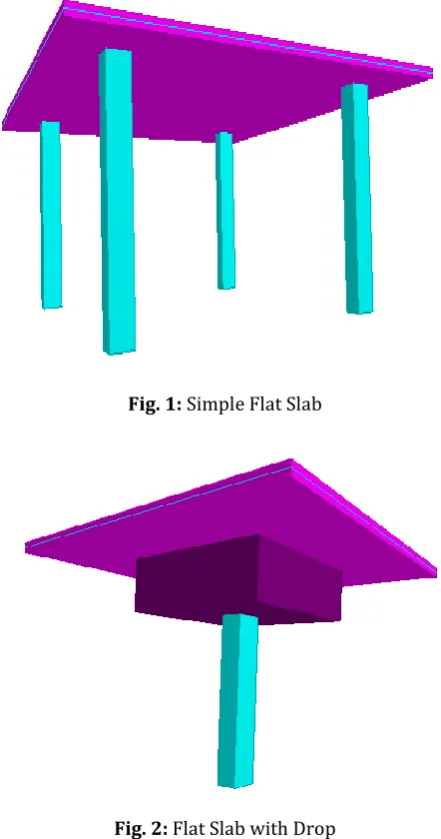
The present era of multistoried building construction technology is so advanced as compared to its past construction technology. In the multistoried building there are various options to construct the building components with the help of beam-column frame structure or flat slab. For economical point of view in the multistoried building, flat slab can be used. All the multistoried buildings should be design for lateral loading for safe purpose. In a multistoried building if in the absence of beam, the slab which is directly transfers the static and dynamic load through the column is called flat slab. This type of slab based construction is used when the headroom is more required. Drop panel and column head is an important add on member of flat slab. Drop panel is given in the bottom face of the slab. The size of drop panel is totally depend on the effective span between columns in each direction. The position of column head or column capital is placed at the junction of slab and column. Construction of plate slab is much uncomplicated as compared to R.C.C. slab. The classification of flat slab on the basis of drop and column head, they are:-
Simple Flat Slab
Flat Slab Additional Drop Flat Slab with Column Head
Flat Slab Added Drop with Column Head
Flat slab construction has been observed easier as compared to R.C.C. slab construction, using of flat slab in
the multistoried building the overall weight of the structure will reduced.
[image:1.595.321.542.267.687.2]Fig. 1: Simple Flat Slab
© 2019, IRJET | Impact Factor value: 7.211 | ISO 9001:2008 Certified Journal | Page 5174
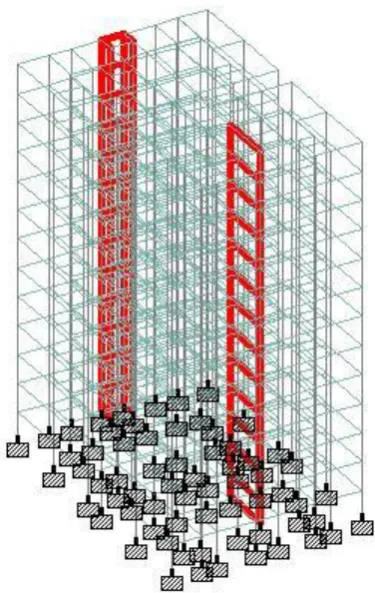
Fig. 3: Building B1 Flat Slab with Shear WallFig. 4: Building B1 Flat Slab with Shear Wall at Maximum Stress Location
Fig. 5: Front View of Building B1
2. LITERATURE SURVEY
After surveying various research papers which has been related to flat slab analysis, the short explanation about its approach, methodology and conclusions has discussed.
In this analytical work, the researcher obtained the most inexpensive slab among flat slab without drop, flat slab inclusive drop and grid slab on the basis of manual analysis as well as software analysis. They used direct design method and equivalent frame method to analyze the flat slab. The approximate method and plate theory method were used to analyze grid slab, since manual analysis process and software analysis were being finished by using STAAD Pro. In the grid slab system, the quantity of concrete required is more as compared to flat slab. Steel quantity seems to be more required in the flat slab exclusive of drop panel as compared to flat slab added inclusive of drop and grid slab. As per economy, the flat slab added with drop panel is better as compared to Grid slab and flat slab exclusive of drop [1].
[image:2.595.69.257.432.729.2]© 2019, IRJET | Impact Factor value: 7.211 | ISO 9001:2008 Certified Journal | Page 5175
slab with non parallel shear wall along periphery. After theanalysis of result, comparing the seismic response is 3.08% which is more in exclusive of shear wall case. The structure inclusive shear wall has minimum displacement along periphery which is 29.13%and 10.06%. It was also analyzed that in L type shear wall and structure with non parallel shear wall the length of periphery had less displacement. In all the cases, storey drift are found to be in permissible limit. Building with shear wall is preeminent for seismic and wind loading condition [2].
In this proposed work to compare the flat slab inclusive drop attached shear wall and exclusive of shear wall in earthquake loading condition for Zone 3, 4 and 5 using STAAD Pro software. For this work they took six models which are as follows:
Table 1: Different Cases for Shear Wall
plan area (16x24) m2 with 7 storey with shear walls at
plinth floor only
plan area (16x24) m2 with 9 storey with shear walls at
plinth floor only
plan area (20x30) m2 with 7 storey with shear walls at
plinth floor only
plan area (20x30) m2 with 9 storey with shear walls at
plinth floor only
plan area (20x30) m2 with 11 storey with shear walls at
plinth floor and 1st floor
plan area (20x30) m2 with 13 storey with shear walls at
plinth floor only
After result comparison the storey drift values are high at mid height of the structure. In flat slab added with drop has more drift values for short span and are lesser in longer span. There are not any effects on storey drifts with or without shear wall added in building. For shorter span, master slave option could be used but for longer span realistic approach adopted [3].
The analysis and design of flat slab for different shape such as rectangular and square with and without drop, pushover analysis (statics analysis) and earthquake analysis (seismic co-efficient method) with the help of ETABS software. After the evaluation of the result, the maximum strip moment was almost same for rectangular and square slab and the value of base shear was higher in square flat slab without drop .The storey displacement seems to be higher in rectangular slab and the storey drift value for rectangular and square was also same, natural period value was almost same for both shapes [4].
In this study, for strengthening of slab not in favor of punching shear, the use of post installed shear reinforcement after the completion of construction work. It is also known as post shear reinforcement, used to improvement of punching shear strength of flat slab. Critical shear crack theory has used to design the post
installed shear reinforcement. The main conclusion of this work was that the inclined shear reinforcement was more effective to improve punching shear strength [5].
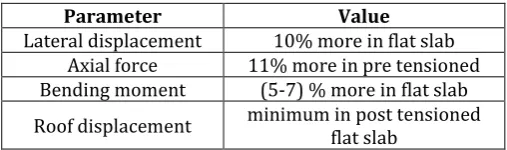
[image:3.595.307.561.256.331.2]In this proposed work, comparison between flat slab and post tensioned flat slab for seismic Zone 2, 3 with taking various types of multistoried building like G+9, G+11, G+14. The different model cases have different geometry along with different material properties. To analyze the different model cases using liner time history analysis method in Staad Pro, some conclusions drawn are shown below:
Table 2: Parametric values
Parameter Value
Lateral displacement 10% more in flat slab Axial force 11% more in pre tensioned Bending moment (5-7) % more in flat slab Roof displacement minimum in post tensioned flat slab
Post tensioned flat slab was more effective under seismic loading [6].
In this work, to analyze and model of G+3 regular frame structure inclusive of shear wall and G+3 flat slab inclusive of shear wall in Seismic Zone 3 done with SAP-2000. The plan area is (24 x 24) m, height of plinth 1.8m and floor height is 3.6m. After the result comparison regular frame building has better performance as compare to plate slab. To enhance the performance of flat slab building, shear wall can be provided [7].
In this approach, to improve the punching shear strength using shear band reinforcement which was divided in 5 groups. First, investigate the consequence of installing the shear band is hanged upon top grid; tie the top and bottom grid simultaneously. 2nd group investigate the effect of installing the shear band with perpendicular strut, with bended strut at 450, 3rd group investigate the consequence
© 2019, IRJET | Impact Factor value: 7.211 | ISO 9001:2008 Certified Journal | Page 5176
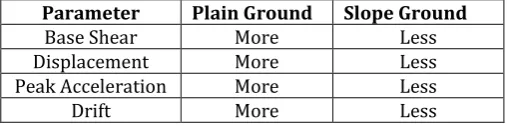
In this proposed work, the discovery in the earthquakeanalysis of multistoried flat slab building rested on plain and sloping ground are conducted by the researchers. For plain ground and sloping ground, linear analysis method is used in ETABS software. There are four cases which were considered in 10 storey building resting on plain ground and the rest of three cases on oblique ground at angle of 100,200,300 were also discussed. After the evaluation and
[image:4.595.35.289.246.309.2]comparison of result, the following values of different parameters are given below:
Table 3: Parametric Result on Plain and Sloping Ground
Parameter Plain Ground Slope Ground
Base Shear More Less
Displacement More Less
Peak Acceleration More Less
Drift More Less
Storey drift in flat slab is more in plain ground as compared to sloping ground [9].
In this work, the discovery of actual performance of R.C.C. flat slab building under earthquake loading has been done. It was determined that due to seismic loading, the effect on the flat slab in terms of storey displacement, frequency, base shear, storey stage acceleration and also the effect of punching shear in all types of flat slab i.e. flat slab not including drop, flat slab with drop, flat slab with only shear wall, flat slab with drop and shear wall have also concluded. The R.S.M is used with the help of ETABS software. After the result was compared, fundamental mode of frequency is 20% increased in flat slab with drop and to enhance stiffness property with shear wall the value was increased with 96%. The value of fundamental frequency was high at bottom floor and less at the top floor and the value of fundamental time period increased at top floor to bottom floor. The storey shear value seems comparatively high at bottom floor and less at top floor. Hence concluding this, the flat slab inclusive of drop and shear wall is superior option to overcome the displacement in X direction, also base shear increased when weight increases. If drop has provided in interior panel then punching shear gets reduced by 25% [10].
The work done in this kind of approach, the analysis of flat slab in earthquake loading condition has drawn out. In this research, flat slab is designed with the help of D.D.M, E.F.M and finite element method (for irregular geometry and irregular layout). Contrasting the result, it has been found that in IS Code 456-2000, there aren’t any provisions related to flat slab for seismic loading, it is only based on the gravity loading conditions. If the designing has not done properly, then cracks are evolved near the support which concluding the drastic results when any structure considered during construction [11].
3. CONCLUSIONS
After reviewing a lot of research papers which are based on the flat slab and shear wall, and various applied loading conditions. For the further work in this direction flat slab with the various locations of shear wall would create and when using the response spectrum method to analyze, to decide various cases, find the most optimum case along with economical too.
The conclusion for the further work related to the flat slab with shear wall are shown below:-
1. A lot of work has seen in various research papers, but none of the papers can show the manual approach, fixed the parameters first before doing the earthquake analysis.
2. For analysis, structural tool such as Staad Pro could be used.
3. Various cases which are not shown by various researchers such as plain flat slab, flat slab inclusive of drop panel and shear wall as a stiffness parameter with its interaction to flat slab could be used for further technical work.
4. Response spectrum method could be used in these cases for determining the seismic response over the structural parts.
5. Correlation with analysis by software with these above building cases could be used.
6. Determination of the major stress part in the flat slab building and reducing it by applying shear wall. 7. After performing the response spectrum analysis,
comparing all the result parametric values and find the economical case
ACKNOWLEDGEMENT
I take the opportunity to express my heartly gratitude to Mr. Sagar Jamle, Assistant Professor, Department of Civil Engineering, Oriental University, Indore (M.P.) for the valuable guidance and inspiration throughout the dissertation work. I feel thankful for his innovative ideas, which led to successful completion of the work.
REFERENCES
[1] Amit A Sathawane and R. S. Deotale (2012), “Analysis
of Flat Slab and Grid Slab and Their Cost Comparison”, International Journal of Advanced Technology in Civil Engineering, ISSN: 2231-5721, Vol. 01, Issue 02, pp.122-126.
[2] Anuja Walvekar, H.S Jadhav (2015), “Parametric Study
of Flat Slab Building Without or With Shear Wall to Seismic Performance”, International Journal of Research In Engineering, ISSN: 2319-1163, Vol. 04, Issue 04, pp. 601-607.
[3] Dr. Uttamasha Gupta, Shruti Ratnaparkhe, (2012),
© 2019, IRJET | Impact Factor value: 7.211 | ISO 9001:2008 Certified Journal | Page 5177
Drop”, International Journal of Emerging Technologyand Advanced Engineering, ISSN: 2250-2459, Vol. 02, Issue 10, pp. 416-421.
[4] Kaulkhere R.V, Prof. G.N Shete, (2017), “Analysis and
Design of Flat Slab with Various Shape”, International Journal of Scientific Research and Development, ISSN: 2455- 2631, Vol. 02, Issue 05, pp. 538-544.
[5] Miguel Fernandez, Aurelio Muttoni and Jakab Kunz,
(2010), “Strengthening of Flat Slab against Punching Shear using Post Installed Shear Reinforced”, ACI Structural Journal, Title No.107-S43,Vol.107, Issue 4, pp. 434-442.
[6] Moh. Imran, M.Visweswara, Dr. Jammi Ashok (2017),
“A Comparative Study of Flat Slab Vs Post Tensioned Flat Slab”, International Journal of Scientific Research and Development, ISSN: 2321-0613, Vol. 05, Issue 09, pp. 979-982.
[7] Mk Devtale , S.S Sayyed , Y.U Kulkurni, P.G
Chandak, (2016),“Comparison of Seismic Response Between Flat Slab vs. Regular Frame Building” International Journal of Advancement In Engineering Technology, Management and Applied Science, ISSN: 2349- 3224, Vol. 03, Issue 06, pp. 104-111.
[8] Nasr. Z. Hussan, Mostafa A. Osman (2017),
“Enhancement of Punching Shear Strength of Flat Slab Using Shear Bond Reinforcement” Housing and Building National Research Center, pp. 1-7.
[9] P. Manjunath, Yogendra R. Holebsgilu (2016), “Seismic
Analysis of Multi Storied Building With Flat Slab Resting On Plain and Sloping Ground”, Bonfring International Journal of Machine Interface, ISSN: 2277-5064, Vol. 4, Special Issue, pp.20-25.
[10]P. Sriniwasulu and A. Dattatreya Kumar (2015),
“Behavior Of R.C.C Flat Slab Under Earthquake Loading”, International Journal Of Science And Research, ISSN: 2277-2685, Vol. 05, Issue 07, pp. 821-829.
[11] R. S More and V. S. Sawant (2015), “Analysis of Flat