using look-ahead maintenance constraints
Stephen J Maher
∗1,2, Guy Desaulniers
3, and Fran¸cois Soumis
31Department of Optimization, Zuse Institute Berlin, Takustr. 7, 14195 Berlin, Germany.
2Department of Management Science, Lancaster University, Bailrigg, Lancaster LA1 4YX, UK
3Ecole Polytechnique de Montr´´ eal and GERAD, Department of Mathematics and Industrial
Engineering, Montr´eal Qu´ebec H3C 3A7, Canada.
Abstract
The tail assignment problem is a critical part of the airline planning process that assigns specific
aircraft to sequences of flights, called lines-of-flight, to satisfy operational constraints. The aim of
this paper is to develop an operationally flexible method, based upon the one-day routes business
model, to compute tail assignments that satisfy short-range—within the next three days—aircraft
maintenance requirements. While maintenance plans commonly span multiple days, the methods
used to compute tail assignments for the given plans can be overly complex and provide little recourse
in the event of schedule perturbations. The presented approach addresses operational uncertainty by
using solutions from the one-day routes aircraft maintenance routing approach as input. The daily
tail assignment problem is solved with an objective to satisfy maintenance requirements explicitly for
the current day and implicitly for the subsequent two days. A computational study will be performed
to assess the performance of exact and heuristic solution algorithms that modify the input
lines-of-flight to reduce maintenance misalignments. The daily tail assignment problem and the developed
algorithms are demonstrated to compute solutions that effectively satisfy maintenance requirements
when evaluated using input data collected from three different airlines.
Key words: transportation, tail assignment, maintenance planning, branch-and-price, iterative
algo-rithm
1
Introduction
The tail assignment problem (TAP) is a component of the airline planning process—separated by aircraft
type—that involves the assignment of tasks to aircraft to satisfy operational constraints. A task within
∗Corresponding author: [email protected]
the TAP is defined as a sequence of flights that can be performed by a single aircraft, which is termed
a line-of-flight (LOF). Operational constraints include: ensuring each flight is operated by an aircraft,
satisfying aircraft maintenance requirements and planning through flights (matching high valued
in-bound and out-in-bound flights with the same aircraft).
The planning of LOFs typically occurs months in advance of operations. The planning stage involves
solving an aircraft routing problem that constructs LOFs, which are expected to satisfy operational
constraints. Fixing the LOFs in advance of operations is valuable for the construction of crew schedules—
given the cost benefit of crew following aircraft—and organising ground services. Unfortunately, schedule
perturbations are highly prevalent in daily operations. Such schedule perturbations can significantly
impact the operational advantages derived from using fixed LOFs by causing infeasibilities in the planned
aircraft routings and crew pairings.
Many different business models are employed by airlines for the construction and assignment of
aircraft LOFs [14]. Traditional business models involve the construction of LOFs that span multiple
days, in some cases up to a month. By spanning many days, such LOFs are highly susceptible to
disruption. It is typical that many aircraft do not finish on their originally assigned LOFs. Also, at the
end of an operational period, the performed LOFs may look vastly different to those constructed during
the planning stage. Thus, constructing LOFs to span shorter time periods and then performing the
aircraft assignment each night is expected to have significant advantages over the traditional business
models in handling schedule perturbations.
A recent business model developed to address the disruption caused by schedule perturbations uses
one-day routes—LOFs that span a single day and ensure the current days maintenance requirements
are satisfied. The planning optimisation problem developed for the one-day routes business model is
presented by Maher et al. [18]. In this paper, the suite of optimisation problems for this business model
will be completed with the development of a complementary operational optimisation problem. This
problem concerns the overnight assignment of aircraft to one-day routes LOFs to satisfy maintenance
requirements. The maintenance requirements for the following two days are satisfied through the
devel-opment of look-ahead maintenance constraints. Further, to address unavoidable schedule perturbations
an adjustment procedure is employed that minimally modifies the input LOFs. A computational study
will show the effectiveness of the one-day routes business model for satisfying daily maintenance
require-ments.
1.1
Literature review
Different business models for LOF construction in the aircraft routing problem (ARP)—string,big-cycle
and one-day routes approaches—are reviewed by Lacasse-Guay et al. [14]. The string and big-cycle
approaches are commonly solved over a number of days to provide a maintenance plan for the complete
span only a single day. Maintenance planning is performed by only considering the aircraft requiring
maintenance at the end of the current day. Alternative approaches draw upon and combine concepts
from the three categories presented by Lacasse-Guay [14]. Such approaches construct aircraft routes
that span time periods ranging from one day to multiple weeks without the restrictions of the string or
big-cycle methods. It is important to note that all of these approaches can be solved many months in
advance of the day of operations.
The string maintenance planning approach constructs a set of generic flight sequences, each to be
performed by a single aircraft, that originate and terminate at maintenance opportunities. An individual
flight sequence, termed a flight route, is constructed to be maintenance feasible. As such, the solution to
a set partitioning problem, selecting a set of flight routes that covers all flights within a given time period,
satisfies a fleet’s maintenance requirements. Examples of the string maintenance planning approach are
presented by Barnhart et al. [3] and Sriram and Haghani [21]. The big-cycle approach to maintenance
planning involves the construction of a single route spanning multiple days that covers every flight in
the schedule. Equal utilisation motivates this approach. This is achieved by constructing a single cycle
that includes all flights to be operated by all aircraft. Examples of the big-cycle approach are presented
by Feo and Bard [7], Clarke et al. [5], Gopalan and Talluri [10] and Talluri [22]. It is important to note
that Feo and Bard [7], Gopalan and Talluri [10] and Talluri [22] construct big-cycle solutions using sets
of LOFs that span a single day.
An approach that lies at the intersection of the string and big cycle approaches is the weekly aircraft
maintenance routing problem presented by Liang and Chaovalitwongse [16]. The developed formulation
is solved to provide a weekly rotation tour that satisfies aircraft maintenance requirements. An extension
to the weekly aircraft maintenance routing problem presented by Liang, Feng et al. [17] aims to minimise
delay propagation. The formulation of Liang, Feng et al. [17] draws upon concepts from one-day routes
with the construction of single day LOFs that are concatenated to form weekly aircraft routing solutions.
The one-day routes approach is vastly different from the two previously discussed. This approach is
applied to identify flight routes that span a single day. The objective of the one-day routes approach is
to ensure that a sufficient number of flight routes from each airport terminate at a maintenance station
so that the maintenance critical aircraft can receive maintenance that night. The one-day routes ARP
is inherently stochastic since it assumes operations from previous days will perturb the maintenance
plan. Examples of the one-day routes approach are presented by Heinhold [13], Lapp and Cohn [15] and
Maher et al. [18].
While the ARP approaches presented above involve the generation of LOFs for input to the TAP,
alternative methods have been proposed that combine the ARP and TAP. One of the most detailed
investigations of the TAP developed in this manner is presented by Gr¨onkvist [11]. The TAP proposed
by Gr¨onkvist [11] is solved a month at a time and comprises features from the fleet assignment, aircraft
TAP to minimise a robustness measure is presented by Bornd¨orfer et al. [4]. Additionally, Bornd¨orfer
et al. [4] construct LOFs to adjust for any perturbations from preceding days that may have affected
the maintenance plan. Only an approximate solution is given by Bornd¨orfer et al. [4], since the integer
solution is given by a rounding heuristics applied to the optimal LP solution. Finally, flexibility in the
construction of LOFs is achieved by Ruther [19] by considering the TAP as a component of an integrated
airline planning problem. The problem presented by Ruther [19] is posed to be solved approximately four
days before the day of operations to adjust the planned solutions in response to schedule perturbations.
A compact formulation for the single day maintenance routing problem is presented by Haouari et
al. [12] that identifies a tail assignment solution without the explicit construction of LOFs. The authors
develop a formulation that is polynomial in size and present effective solution methods based upon the
reformulation-linearisation technique. Due to the deterministic focus of Haouari et al. [12], the presented
formulation of the single day aircraft maintenance routing problem is vastly different to other one-day
routes approaches by Heinhold [13], Lapp and Cohn [15] and Maher et al. [18]. Finally, Ba¸sdere and
Bilge [2] presents a compact formulation for the aircraft maintenance routing problem with an objective
to maximise the aircraft utilisation. Similar to Haouari et al. [12], LOFs are not explicitly constructed,
but the routes are implicitly defined by the assignment of flight connections to aircraft.
Many variants of the TAP have been developed in response to different airline business practices and
planning horizons. The longest planning horizon proposed for the TAP is a month, which is used by
Gr¨onkvist [11]; however, it is suggested that any planning period could be used. One week, or seven
days, is a common planning horizon that guided the development of TAP variants presented by Ba¸sdere
and Bilge [2], Liang and Chaovalitwongse [16], Liang, Feng et al. [17], Ruther [19], and Sriram and
Haghani [21]. Regular planning horizons are not a requirement of the TAP and there are many instances
where the horizon is determined by business practices or planning restrictions. Variants employing
irregular planning horizons include Barnhart [3] with flight strings spanning a maintenance interval,
Clarke et al. [5] with a big cycle that spans a number of days equal to the number of aircraft, Feo and
Bard [7] where the time horizon is dictated by the inputs, and the three- and four-day maintenance
planning problems by Gopalan and Talluri [10] and Talluri [22] respectively. The shortest planning
horizon for the TAP is a single day. Variants of the TAP spanning a single day are presented by
B¨orndorfer et al. [4], Froyland et al. [8], Haouari et al. [12], Heinhold [13] and Lapp and Cohn [15]. The
focus of this paper is a variant of the TAP that assigns daily LOFs to aircraft. The developed approach
aims to complement one-day route LOF planning approaches while providing an alternative to TAP
variants formulated with time horizons that span multiple days.
In practice, the input LOFs are generally not suitable for satisfying aircraft operational
require-ments. In such cases, a process that modifies the input LOFs is required. One of the most common
LOF adjustment processes, and possibly the most simple, is aircraft swapping [1]. By identifying two
and the other not requiring maintenance but assigned to an LOF terminating at a maintenance base,
that are located at the same airport at the same time during the day, maintenance requirements can
be satisfied by performing an aircraft swap. This approach is considered by Lapp and Cohn [15] by
performing a simple splicing of two LOFs to improve maintenance reachability. While aircraft swapping
is easily implemented in practice, a more sophisticated rerouting approach may be required to satisfy
all maintenance requirements. A more involved approach that performs multiple flight changes for an
aircraft LOF is presented in this paper.
Various solution approaches have been applied to solve the tail assignment and maintenance planning
problems. Branch-and-price is popular for problem formulations where aircraft routes are not provided a
priori. This is a feature of the TAP developed by Gr¨onkvist [11], Bornd¨orfer et al. [4] and Ruther [19] and
the maintenance planning approaches by Barnhart et al. [3] and Maher et al. [18]. Alternatively, network
based approaches are presented by Liang and Chaovalitwongse [16] and Liang, Feng et al. [17] that
generate LOFs spanning from a single day up to a one week. There are many cases where the LOFs are
generated by an ARP and provided as input to the TAP. For such problem formulations, solution methods
including Lagrangian relaxation and subgradient algorithms [5], problem specific heuristics [2,7,10,21,22]
or general-purpose mixed-integer programming solvers [2, 12, 15] have been employed. Observations
suggest that exact solution algorithms, such as branch-and-price, can be overly time-consuming and
not suitable for the practical implementation of algorithms. However, the high solution quality that is
achievable using exact solution algorithms is desired.
A compromise between the exact solution algorithm of branch-and-price and problem-specific
heuris-tics is presented in the form of iterative solution algorithms [6, 23]. Iterative algorithms have previously
been employed to solve integrated airline planning problems, whereby the solution to one stage can
be fixed prior to solving the alternate stage and then iterating between the two problems. This paper
aims to extend this technique with the development of an iterative solution algorithm to improve the
solution of the TAP using a set of input LOFs. The algorithm involves i) solving the TAP to identify
any infeasibilities in the maintenance plan, and ii) solving the TAP using branch-and-price to generate
flight routes for a subset of aircraft to address these infeasibilities. The algorithm executes in run times
that are better or competitive with exact approaches while still achieving high-quality solutions.
1.2
Contributions
The mathematical model developed in this paper draws upon many concepts from the literature. The
assignment of fixed LOFs to aircraft that are adjusted to satisfy maintenance requirements is presented
by Gopalan and Talluri [10] and Talluri [22]. Focusing on the work of Talluri [22], the main limitations
are the requirement of an Euler tour and the use of heuristics to repair maintenance infeasibilities. In
particular, the Euler tour requirement is overly restrictive. This paper significantly extends the work
the maintenance requirements of the aircraft. Without the construction of an Euler tour and by only
providing an assignment for a single day the solution of the TAP developed in this paper provides a
maintenance plan that is robust to schedule perturbations. Further, the developed solution approaches
for the TAP are exact and heuristic in nature. As such, provable optimality bounds are available for the
considered problem instances.
In contrast to the work of Gopalan and Talluri [10] and Talluri [22], fully flexible approaches
com-bining the aircraft routing and tail assignment problems are presented by Gr¨onkvist [11], B¨orndorfer
et al. [4] and Ruther [19]. Flexibility in the TAP allows the generation of aircraft routes for the tail
assignment to satisfy operational constraints, such as maintenance requirements. However, maintenance
planning beyond the day-of-operations is not considered. The TAP presented in this paper provides
both full planning flexibility and a heuristic approach for practical application. Additionally, look-ahead
maintenance constraints have been developed to complement LOF construction approaches by providing
an effective method to implicitly satisfy future maintenance requirements.
The contributions of this paper focus on the analysis of the new business model employing the one-day
routes approach. The contributions include
• the development of a tail assignment problem using one-day routes as input that is solved each
day—the daily tail assignment problem (DTAP)
• the evaluation of the use of one-day routes, as produced by the approaches of Heinhold [13], Lapp
and Cohn [15] and Maher et al. [18], as a fixed input for the DTAP,
• the formulation of look-ahead constraints that implicitly satisfy day-two and day-three maintenance
requirements,
• the presentation of a branch-and-price algorithm that reconstructs LOFs to improve the
mainte-nance planning achieved by the DTAP,
• the development of an iterative algorithm that reduces the computational effort of the LOFs
reconstruction process and
• a detailed computational study demonstrating the strengths and weaknesses of solution approaches
for the DTAP.
1.3
Paper structure
The problem description and formulation is presented in Section 2. The discussion in Section 2 involves
two parts, the first presenting the DTAP to satisfy maintenance requirements for day one using one-day
routes as input and the second introducing the look-ahead constraints that implicitly satisfy day-two and
exact branch-and-price algorithm and a heuristic iterative algorithm. The branch-and-price algorithm
presented in Section 3.1 resolves the DTAP, using the input LOFs as a starting solution, to eliminate
the unsatisfied maintenance requirements arising from solving the DTAP using a fixed set of input
LOFs. An iterative algorithm is developed in Section 3.2 that aims to improve upon the computational
performance of the exact branch-and-price algorithm. Section 4 describes the data used to evaluate
the DTAP developed in this paper. The computational results involving various flight schedules are
presented in Section 5. Finally, Section 6 provides some concluding comments.
2
The daily tail assignment problem
The DTAP is solved immediately prior to the day of operations to aid the recovery of planned assignments
that are disrupted as a result of schedule perturbations. Two critical features of aircraft routing that
are highly susceptible to schedule perturbations are addressed by the DTAP: the assignment of LOFs to
aircraft and maintenance requirements. The DTAP is solved at an arbitrary time when it is expected
that most aircraft are located on the ground. The fleets considered for the DTAP are short-haul and
medium-haul fleets, hence there are no overnight flights. However, airlines may operate in multiple time
zones. Thus, all flights departing between midnight and midnight (local time) on consecutive days are
considered to belong to the same one-day schedule. It is possible for aircraft to be operating flights
while the DTAP is being solved, requiring an estimated arrival time to be used in this problem for such
aircraft. Finally, to satisfy regulatory requirements aircraft are expected to receive maintenance once
every six days.
This paper presents the DTAP defined as: Given a set of input LOFs that span the next day of
operations, assign to each aircraft exactly one LOF that originates from the current aircraft location.
The LOF assignment minimises the number of day-one maintenance-critical aircraftnot terminating at
a maintenance base at the end of the next day. A further aspect unique to this paper is the consideration
of day-two and day-three maintenance requirements. Two additional sets of LOFs—one each for days
two and three—that span a single day are provided as input. All three sets of input LOFs are not
required to be identical. The number of available maintenance routes from the end of day one to the
end of days two and three are computed from the day-two and day-three LOFs. Using the number of
available maintenance routes as input, the DTAP minimises—as a secondary objective—the number of
day-two and day-three maintenance critical aircraft unable to receive maintenance on the respective days
without the explicit assignment of LOFs.
Explicit maintenance planning is only modelled in the DTAP for the forthcoming day of operation.
However, aircraft requiring maintenance on days two and three are still considered. This is supported
by the addition of constraints that ensure a sufficient number of maintenance routes depart from each
considera-tion of maintenance requirements is a novel approach that has not been previously investigated. For ease
of exposition Section 2.1 presents the DTAP that only considers the day-one maintenance planning. The
unique implicit enforcement of the day-two and day-three maintenance requirements using look-ahead
maintenance constraints is presented in Section 2.2.
The above problem description considers the case where the LOFs are provided as input to the DTAP.
This is common in practice, since the LOFs from the aircraft routing solution are typically provided
as input. It is also common that as a result of schedule perturbation the aircraft routing LOFs do
not provide sufficient opportunities to satisfy maintenance requirements. Thereby, modifications to the
LOFs are necessary to satisfy all operational requirements. In this paper, the discussion of the solution
algorithm involves three parts. First, Sections 2.1 and 2.2 present the basic model where the LOFs are
provided as input. Second, the modification of the mathematical model to permit changes to the input
LOFs is presented in Section 2.3. Finally, the solution algorithms developed to respond to schedule
perturbations are described in Section 3.
2.1
The daily tail assignment problem without look-ahead constraints
There exist three key components of the DTAP, namely the overnight airports, aircraft and the LOFs.
Let B be the set of overnight airports. A set of aircraft Rb, all of the same type, are located at
each overnight airport b ∈B to commence the forthcoming day of operation. The LOFs available for
assignment to an aircraftr∈Rb are given by the set Pr, which is indexed byp. Pr is populated with
LOFs that are identical for allr∈Rb originating for the same overnight airportb.
The LOF assignment is modelled using the binary variablesyr
p that equal one if aircraftris assigned
to LOFp, and zero otherwise. The origination and termination locations of the LOF and the contained
flights are directly considered in the DTAP model. All flights of an airline schedule, which belong to the
set denoted byN, are each included in exactly one input LOF. The parameteraf p is defined to equal
one if flight f is included in LOFp. Each LOFporiginates and terminates at an overnight airport. A
subset of overnight airports, ˆB⊂B, are identified as maintenance stations.
The day-one maintenance requirements are addressed by attempting to assign each maintenance
critical aircraft to an LOF terminating at a maintenance station. The parameters op are defined to
equal one if the LOF p terminates at a maintenance station, and zero otherwise. A given aircraft
r ∈ Rb, b ∈ B is identified as maintenance critical—defined as requiring maintenance at the end of
the current day—by the parameter θr
1 = 1. Otherwise θ1r = 0. Since disruptions from preceding days may prohibit aircraft from entering a maintenance station, the slack variables sr
1, r ∈ Rb, b ∈ B, are introduced, with the objective coefficientcr
1, to penalise any infeasibility of the maintenance plan.
integer program:
min X
b∈B
X
r∈Rb
cr1sr1, (1)
s.t. X
b∈B
X
r∈Rb X
p∈Pr
af pyrp= 1 ∀f ∈N, (2)
X
p∈Pr
yrp≤1 ∀b∈B,∀r∈Rb, (3)
X
p∈Pr
opypr+s r
1≥θ
r
1 ∀b∈B,∀r∈R
b, (4)
ypr∈ {0,1} ∀r∈R,∀p∈P, (5)
sr1≥0 ∀r∈R. (6)
The problem defined by (1)-(6) assigns LOF to aircraft and minimises the violation of maintenance
requirements. While it is possible to formulate the tail assignment as a set partitioning of input LOFs,
it is more convenient to formulate this problem as a set partitioning of flights in the network. The
latter formulation aids the development of a re-optimisation method that modifies LOFs when (1)-(6)
is maintenance infeasible. The proposed re-optimisation method is presented in Section 3. The set
partitioning of flights is given by constraints (2) that ensure every flightf ∈N is assigned to exactly one
aircraft. Each aircraft must operate exactly one LOF, which is given by constraints (3). The day-one
maintenance requirements for the maintenance critical aircraft are enforced with constraints (4). These
constraints include a slack variablesr
1to penalise any maintenance violations.
2.2
Modelling the look-ahead maintenance constraints
The termination locations of each aircraft can be used by the look-ahead maintenance constraints to
implicitly satisfy day-two and day-three maintenance requirements. In particular, the maintenance LOFs
and maintenance paths, Definitions 2.2.1 and 2.2.2 respectively, are used to implicitly assign LOFs to
aircraft. Since the look-ahead constraints rely on LOFs originating from overnight airports on different
days, for conveniencebi is used to denote overnight airportbat the start of dayi.
Definition 2.2.1 (Maintenance LOF). A maintenance LOF (MLOF) is an LOF that terminates at a
maintenance station at the end of the day.
Definition 2.2.2 (Maintenance path). A maintenance path is the concatenation of an LOF from dayi
and an MLOF from day i+ 1, where the origination overnight airport for the MLOF, bi+1, is identical to the termination overnight airport for the LOF.
As a result of schedule perturbations, the number of maintenance critical aircraft at each overnight
airport is uncertain. Additionally, in the response to disruptions, LOFs are modified before and during
Thus, by focusing only on the identification of termination locations and the number of MLOFs,
stochas-tic and robust approaches can be effectively employed. While robust formulations of this problem are
possible, this paper will focus only on the deterministic form.
The key parameters for the maintenance look-ahead constraints are the number of LOF and MLOFs
from each airport and the number of maintenance paths. The number of LOFs originating from overnight
airportiand terminating at overnight airportjis given byLij. The parameterMbiis the number of LOFs that can be used to satisfy the maintenance requirements for maintenance critical aircraft originating
from overnight airport bi, i.e., the number of MLOFs. A maintenance critical aircraft at overnight
airport bi can only use MLOFs originating from bi. Hence, the number of maintenance critical aircraft
atbi that can receive maintenance at the end of dayiis bounded byMbi.
An example of the number of LOFs from each overnight airport is given in Figure 1a. The first
level of the tree in Figure 1a are all LOFs departing from SYD on day 2. The second level shows all
LOFs departing from BNE, MEL and SYD on day 3. For convenience, we will focus only on the LOFs
departing from SYD. On day two, Figure 1a shows that there are 7 LOFs departing SYD. Since MEL is
the only maintenance station, there only exists 3 MLOFs departing from SYD, which meansMSY D2 = 3. Similarly, on day three the total number of LOFs departing from SYD is 7 and the number of MLOFs
is 3. As such, the parameterMSY D3 is set to 3. It can also be observed in Figure 1a thatMBN E3 = 1 andMM EL3= 3.
Given two overnight airports, one at the start of dayiand one at the start of dayi+ 1, denoted bybi
andbi+1respectively, thenumber of maintenance pathsconstructed by concatenating an LOF departing frombi and an MLOF departing frombi+1 is given by
Nbibi+1= min{Lbibi+1, Mbi+1}. (7) The parameters Nb2b3 identify any routing bottlenecks that can prevent the day-three maintenance critical aircraft receiving maintenance as required. As demonstrated in the example in Figure 1c,
NSY D,BN E = 1 (indicating a bottleneck on day three), NSY D,M EL = 3 (indicating no bottleneck)
andNSY D,SY D = 2 (indicating a bottleneck on day two).
S
B M S
B M S B M S
B M S
S
B M S
B M S B M S
B M S
S
B M S
B M S B M S
B M S
a) b) c)
EOD 1
EOD 2
EOD 3
Airports B M S
- BNE - MEL (Maint) - SYD Num of LOFs
[image:10.595.74.522.599.682.2]- 1 LOF - 2 LOFs - 3 LOFs
Figure 1: Available LOFs and maintenance routes from SYD at the end of day 1. a) All available LOFs.
b) Routes from SYD terminating at the maintenance station (MEL) at end of day two. c) Routes from
Day-two maintenance requirements The day-two maintenance requirements are satisfied by simply
counting the number of maintenance critical aircraft terminating at each airport at the end of day one.
The parameterθ2requals one if aircraftrrequires maintenance at the end of day two, and zero otherwise. The total number of maintenance routes departing from airportbon day two is given by the parameter
Mb2. The difference between the number of day-two maintenance critical aircraft and Mb2 indicates the feasibility of the day-one tail assignment. Any over demand for maintenance routes on day two
is minimised with a set of penalty terms in the objective function, given by the variables sb2
2 , b2 ∈ Bˆ.
The termination location of LOF p at the end of day one is given by the parameter term(p). The
addition of the following constraints evaluate the satisfaction of maintenance requirements for the
day-two maintenance critical aircraft:
X
b1∈B X
r∈Rb1 X
p∈Pb1|
term(p)=b2
θr2yrp−sb2 2 ≤M
2
b2 ∀b2∈B, (8)
sb2
2 ≥0 ∀b2∈B. (9)
Constraints (8) count the number of day-two maintenance critical aircraft located at b2 and sets the
slack variablesb2
2 to penalise any maintenance misalignments.
Day-three maintenance requirements Satisfying the day-three maintenance requirements involves
counting the number of day-three maintenance critical aircraft and assigning a day-two termination
location to each. The parametersθr3equal one to identify whether aircraftrrequires maintenance at the end of day three, and zero otherwise. The variables ξb2b3 count the number of day-three maintenance critical aircraft located atb2arriving at airportb3at the end of day two. Similar to days one and two, the
number of maintenance routes departing from overnight airportb3 is given by the parameterMb33. The additional constraints to evaluate maintenance feasibility for the day-three maintenance critical aircraft
are given by
X
b1∈B X
r∈Rb1 X
p∈Pb1|
term(p)=b2
θr3ypr−sb2 3 =
X
b3∈B
ξb2b3 ∀b2∈B, (10)
X
b3∈Bˆ ξb2b3+
X
b1∈B X
r∈Rb1 X
p∈Pb1|
term(p)=b2
θ2rypr−s b2 2 ≤M
2
b2 ∀b2∈B, (11)
X
b2∈B
ξb2b3 ≤M 3
b3 ∀b3∈B, (12) ξb2b3 ∈[0, N
b2b3] ∀b
2, b3∈B, (13)
sb2
3 ≥0 ∀b2∈B. (14)
Constraints (10) count the number of day-three maintenance critical aircraft located at b2 at the end
route fromb2 passing throughb3 using the variablesξb2b3. Since the LOFs are provided as input, it is possible that the number of day-three maintenance critical aircraft arriving atb2is greater thanNb2b3— causing an infeasibility. The slack variablesb2
3 is introduced to measure the extent of this infeasibility,
which is penalised in the objective function. Settingξb2b3 by constraint (10) determines the number of maintenance critical aircraft originating from b3 at the start of day three. Since day-two maintenance
critical aircraft require a maintenance route departing fromb2, this reduces the number of maintenance
routes passing through b3 that are available for day-three maintenance critical aircraft, whereb3 ∈Bˆ.
Hence, (11) constrains the number of day-two and day-three maintenance critical aircraft terminating
at maintenance bases at the end of day two to at most M2
b2. To ensure that at most N
b2b3 day-three maintenance critical aircraft arrive at b3 from b2 an upper bound is imposed on the variables ξb2b3 as indicated by constraints (13).
Including both the day-two and day-three look-ahead maintenance constraints introduces dominated
inequalities. Specifically, constraints (8) are completely dominated by constraints (11). As such, only
constraints (11) are required in the implementation of the DTAP with day-two and day-three
mainte-nance look-ahead.
The addition of constraints (9) and (10)-(14) to the DTAP requires the modification of the objective
function (1). This modification involves adding for each overnight airport b ∈ B the slack variables
sb
2 and sb3, which count the number of day-two and day-three maintenance misalignments, along with the cost parameterscb
2 andcb3 respectively. The objective function used for the DTAP with look-ahead maintenance constraints is given by
X
b∈B
X
r∈Rb
cr1sr1+X
b∈B
cb2sb2+cb3sb3 . (15)
2.3
Responding to schedule perturbations
Schedule perturbations regularly affect daily operations and as a result aircraft terminate at locations
different to what is planned. To address the impact of schedule perturbations, the operational model
of the DTAP requires a set of LOFs, in addition to the input LOFs, that can reduce the number
of maintenance misalignments. The original formulation of the DTAP—with and without look-ahead
maintenance constraints—considers only the input LOFs, which are contained in the setsPr, r∈Rb, b∈
B. In response to schedule perturbations, the DTAP is solved with the additional sets ¯Pr, r∈Rb, b∈B
that describe all possible LOFs, not including the input LOFs, for the given flight schedule.
It is important to ensure that any LOF selected from ¯Pr, r ∈ Rb, b ∈ B does not exhibit large deviation from the input LOFs. To achieve this, the set ¯C is defined to contain all connections (i, j)
that are used by the input LOFs. Additionally, the cost term
cp=
X
(i,j)∈p\C¯
is defined for all LOFs p ∈ P¯r, r ∈ Rb, b ∈ B, where c
ij is a positive weight to penalise the use of
each connection (i, j) in p that is not used by any input LOFs. The DTAP to respond to schedule
perturbations is then given by replacingPr withPr∪P¯r in constraints (2)-(14) and adding the term X
b∈B
X
r∈Rb X
p∈P¯r
cpypr (17)
to objective function (15).
The set of all possible LOFs is prohibitively large to directly solve the DTAP as a mixed integer
program. As such, a branch-and-price approach is developed to dynamically construct and add LOFs
to the DTAP. The details of exact and heuristic branch-and-price approaches employed to solve the
operational model of the DTAP are described in Section 3.
3
Solution algorithms
An exact and a heuristic algorithm that dynamically generate LOFs and find solutions better than those
obtained with fixed LOFs are developed. Both algorithms are based on column generation, where the
heuristic algorithm generates LOFs only for a subset of aircraft. The exact branch-and-price algorithm
is presented in Section 3.1 and the heuristic iterative algorithm is described in Section 3.2.
In practical applications of the DTAP, it is most critical to ensure that aircraft requiring maintenance
on day one must be assigned an LOF terminating at a maintenance base. As such, the route adjustment
process focuses on the modification of day-one LOFs. Through the use of look-ahead maintenance
constraints, the adjustment of day-one LOFs will also reduce maintenance misalignments on subsequent
days. It is possible to additionally modify day-two and day-three LOFs. However, this work would
be redundant as it is expected that further route adjustments will be required at the start of each
subsequent day in response to schedule perturbations—thereby the modified LOFs would require further
modifications. As such, the solution algorithms presented here modify only the day-one input LOFs.
While the input LOFs are not expected to satisfy all operational constraints, their use is valuable
from an algorithmic point of view. First, the aircraft operational requirements are typically similar on
the day of operations compared to when the aircraft routing problem is solved. As such, only a small
number of modifications to the LOFs should be required in any LOF adjustment process. Second, the
input LOFs provide a good initial solution for the DTAP. It is expected that by using a good initial
solution, the runtime required for the LOF adjustment procedure should be greatly reduced. The benefit
from using a good initial solution will be shown in Section 5.2.2
3.1
Branch-and-price
Branch-and-price is a solution technique commonly used to solve aircraft routing and tail assignment
in the branch-and-bound tree. Special branching rules, such as the Ryan-Foster branching scheme [20],
are required by this algorithm to ensure that the subproblem structure is not destroyed by branching
decisions. While branch-and-price is a commonly applied solution technique, its use to solve the DTAP
deviates from the traditional sequential solution approach where modification to the input LOFs is
traditionally forbidden. This restriction arises because the modification of LOFs can have an impact on
many of the interrelated airline resources, most importantly crew.
The branch-and-price algorithm solves the DTAP by dynamically generating LOFs that minimise
the number of day-one maintenance misalignments and number of expected misalignments on day-two
and day-three. This is achieved by defining the restricted master problem (RMP) as a minimisation
problem with the objective function (15) and constraints given by (2)-(14). Additionally, only the LOFs
contained in Pr, r ∈ Rb, b ∈ B are initially included in the RMP. The branch-and-price algorithm
dynamically generates LOFs from the sets ¯Pr, r∈Rb, b∈B.
3.1.1 Column generation subproblem
A column generation subproblem is formed for each aircraft r ∈ Rb, b ∈ B. The objective of each
subproblem is to identify the aircraft routing variable with the minimum reduced cost. To facilitate
the description of the column generation subproblem, the dual variables related to the constraints of
the DTAP that appear in aircraft route variables reduced cost function will be presented. The dual
variables for the flight coverage constraints (2) are defined asρ={ρj,∀j∈N}. For the LOF assignment
constraints (3), the dual variables are defined as δ={δbr,∀b∈B,∀r∈Rb}. The dual variables for the day-one maintenance enforcement constraints (4) are defined as α = {αrb,∀b ∈B,∀r ∈Rb}. For the day-two maintenance enforcement constraints (11), the dual variables are defined as β={βb,∀b∈B}.
Finally, the dual variables for the day-three maintenance critical count constraints (10) are defined as
γ={γb,∀b∈B}.
The column generation subproblem is a shortest path problem: Identifying a minimum cost path
through a network from a single source to one of multiple sink nodes. The network is defined by a set of
nodes given byN and a set of edges given by the feasible connections between the flights contained inN.
A connection between flightsiandj contained inN, (i, j), is deemed feasible if i) the destination ofiis
the same as the origin ofj, and ii) the departure time ofjoccurs after the minimum turn time following
the arrival ofi. All feasible connections are contained in the setC. To describe the minimum cost path,
the binary variables wijr equal one to indicate aircraft r uses connection (i, j) or zero otherwise. The objective coefficient ofwr
ij, denoted by cij, equals one if connection (i, j) is not observed in any input
LOFs and zero otherwise. Aircraft must originate from an overnight airportband may terminate at any
overnight airportb0 ∈B, describing the source and sink nodes respectively. The binary parameters ¯ob
definitions, the column generation subproblem is given by
Cr= min X (i,j)∈C
cijwrij−
X
i∈N∪B
X
j∈N
ρjwijr −δ r b−
X
i∈N
X
b0∈B
wrib0
¯
ob0αrb0+θr2βb0 +θr3γb0 , (18)
s.t. X
i∈N
wijr −X
k∈N
wrjk= 0 ∀j∈N, (19)
X
j∈N
wrbj= 1, (20)
X
j∈N
X
b0∈B
wrjb0 = 1, (21)
wrij∈ {0,1} ∀(i, j)∈C. (22)
The objective function (18) is the reduced cost function of the routing variables for aircraftr∈Rb, b∈B. The flow balance at each node (flight) in the network is maintained by (19). The origin and destination
of a flight route is enforced through constraints (20) and (21) respectively.
A consideration of the LOF reconstruction is the impact that the alternative connections contained
in the newly generated routes has on crew. A feasible connection for a crew requires a minimum sit time,
generally longer than the minimum turn time for aircraft, between the arrival of i and the departure
of j. However, crew may use the connection (i, j) with a ground time less than the minimum sit time
but greater than the minimum turn time if an aircraft also uses this connection. Such connections are
calledshort connections. These connections are important for the crew scheduling solution and must be
protected in the generation of aircraft routes. This is achieved in the column generation subproblem by
ensuring that any short connections existing in the input LOFs are used in any solution to the DTAP.
3.1.2 Integer optimality
Two different branching rules are implemented to derive integer solutions and prove optimality—both
variations of the Ryan-Foster branching scheme [20]. The first rule implemented is similar to the
follow-on branching described by Froyland et al. [8]. Cfollow-onsider two flights i and j with the connection (i, j).
From the values of the variables ypr, r ∈R, p∈Pr∪P¯r in the LP relaxation solution, it is possible to
deduce the values of the connection variablesxr
ij in the compact formulation. If
P
r∈Rx r
ij is fractional,
then a branching is performed by enforcing the use of connections (i, j) on the left branch if ior j are
present in the generated flight routes and forbidding the use of the connection (i, j) on the right branch.
The second branching rule is a variation of the Ryan-Foster branching that enforces or forbids the use
of individual flights by particular aircraft. Given flight i and aircraftr, if P
j∈Nx r
ij is fractional then
the left branch enforces the use of exactly one copy of flight iin all routes generated for aircraft rand
on the right branch all routes generated for aircraft rmust not contain flighti. In the implementation
of branch-and-price for the DTAP, the follow-on branching is performed with a higher priority than the
3.2
Iterative algorithm
The iterative algorithm for the LOF adjustment process involves evaluation and update stages. The
evaluation stage determines whether the maintenance plan can be satisfied with a fixed set of LOFs by
directly solving the DTAP—using a general purpose MIP solver. Theupdate stage identifies alternative
day-one LOFs for a subset of aircraft. This stage employs a branch-and-price algorithm.
3.2.1 Identify aircraft for route adjustment
The solution to the evaluation stage is used to identify a subset of aircraft that require the generation
of LOFs in the update stage. The aircraft selection is based upon maintenance requirements and the
assignment of LOFs. The set of selected aircraft is given by ˆR. Only a subset of flights are used to
generate LOFs in the route adjustment problem. This subset of flights, denoted by ˆN, is given by those
appearing in LOFs assigned in the evaluation stage to aircraft in ˆR. Throughout the algorithm, updates
to ˆR induce updates to ˆN.
Following the first execution of the evaluation stage two different types of aircraft are identified
for inclusion in ˆR. The first are day-one maintenance critical aircraft assigned to an LOF that does
not terminate at a maintenance station. The second are the aircraft assigned LOFs terminating at
maintenance stations that do not require maintenance at the end of day one.
Subsequent iterations of the algorithm augment ˆR using the solution to the evaluation stage. The
augmentation involves identifying intersecting LOFs. Two LOFs intersect if there exists a flight in one
LOF that departs within an intersection window commencing after the arrival of a flight in the other
LOF at the same airport. The intersection window has a duration that is given by the sum of the
minimum time aircraft require between two connecting flights, called the turn time, and a small buffer.
Aircraft are selected for inclusion in ˆR if they are assigned LOFs intersecting with LOFs assigned to
aircraft in ˆR.
3.2.2 Route adjustment problem
The main focus of the route adjustment problem (RAP) is to identify day-one LOFs for aircraft in ˆR
that minimise the maintenance misalignments for the whole fleet. Thus, the restriction of the aircraft in
ˆ
R to a fixed set of LOFs is relaxed. The LOFs provided as input for the DTAP are used to define the
initial set of variables for the RAP. The variables, or columns, defined by the input LOFs are a subset
of all possible aircraft routes for the given flight schedule. Hence, this problem represents the RMP for
the branch-and-price algorithm used to solve the RAP.
The column generation subproblem for the RAP is identical to that presented in Section 3.1.1. One
goal of the iterative algorithm is to reduce the computational time while still decreasing maintenance
the sets of aircraft, flights and connections used to define the column generation subproblem. In
partic-ular, a column generation subproblem is only formed for each aircraftr∈Rb∩R, bˆ ∈B. Additionally, the set of all connections between flights contained in ˆN is given by ˆC ={(i, j)∈C|i ∈Nˆ ∧j ∈ Nˆ}.
Replacing N and C with ˆN and ˆC greatly reduces the time required to solve the column generation
subproblem in each iteration.
Branch-and-price is used to solve the RAP to integer optimality. The resulting column generation
master problem solution minimises the number of maintenance misalignments given a fixed set of LOFs
for aircraftr∈R\Rˆ. Since LOFs are generated only for a subset of aircraft, it is likely that the solution
to the RAP is not optimal for the DTAP. As such, the set ˆR must be updated following an evaluation
of current best solution to the DTAP.
3.2.3 Update the variables of the DTAP
The day-one LOFs identified by solving the RAP will reduce the maintenance misalignments in the
solution of the DTAP. All columns generated in the RAP are added to the DTAP to re-evaluate the
number of maintenance misalignments. Since the column generation master problem is identical to the
DTAP, the optimal solution from the RAP is provided to the MIP solver prior to resolving the DTAP.
The solution to the DTAP is then used to identify the additional aircraft and flights to add to ˆRand ˆN
respectively.
3.2.4 Algorithm termination
The algorithm terminates when no further improvement in the maintenance misalignments can be
achieved by adding variables to the DTAP. This is identified using various stopping criteria. First,
if the number of aircraft contained in ˆR equals the total number of aircraft, then the algorithm is
ter-minated. Second, anupdated flag, which istrue only if between iterations the DTAP objective function
value decreases or the number of aircraft contained in ˆR increases, is used to identify whether the
al-gorithm has stalled. The alal-gorithm terminates ifupdated is false for two consecutive iterations. If no
columns are added while solving the RAP then the intersection window is increased, the set ˆRis updated
and the RAP is resolved. This situation is treated as another iteration of the algorithm and ifupdated
isfalse the failure count increases and the algorithm will terminate when this count is equal to three.
4
Model data
The data required to define the DTAP has been collected from previously performed research, estimates
from literature or generated for this study. In regards to the data generated for this study, repeated
F267-A49 F1165-A289 F3370-A526
Flights 267 1165 3370
Aircraft 49 289 526
Overnight bases 12 67 73
Maintenance bases 1 5 10
Initial LOFs 49 289 526
Total flight times (min) 32 040 173 833 394 155 Avg flight time per aircraft (min) 653.88 601.5 749.34
Avg flights per aircraft 5.4 4.0 6.4
[image:18.595.147.446.97.246.2]Length of day (min) 1 440 1 440 1 080
Table 1: The single day flight schedules used as input for the DTAP.
Three single-day flight schedules of vastly different sizes–to be operated by one fleet type—are used
for the computational experiments. The details describing the size of the flight schedules, including
the number of aircraft, overnight bases and maintenance bases, are presented in Table 1. The flight
schedules used in the current experiments have been collected from the study of Maher et al. [18]. In
Table 1 the number flights are those operated on a single day by the airline. It is assumed that each
airline is operating a cyclic schedule. As such, the input LOFs are said to be repeated on each day of
interest. It is trivial to relax this assumption with little change to the difficulty of the problem. Three
difficulty measures are provided in Table 1: the total flight times, the average flight time per aircraft and
the average number of flights per aircraft. For all flight schedules, each aircraft must perform at least 10
hours of flying during a single day on average. The largest average flight times per aircraft occurs for the
F3370-A526 schedule—almost 13 hours per day for each aircraft. For the F3370-A526 flight schedule,
the aircraft must also perform 6.4 flights per day, which involves 5.4 turns per day. Assuming that the
aircraft turn times are 30 minutes, this means that an aircraft will be busy for 13 + 5.4×0.5 = 15.7 hours
in the day. Given the day length of 18 hours for the F3370-A526 schedule, it is expected that finding a
feasible solution to the DTAP will be difficult. Using these metrics, it is believed that the F3370-A526
schedule, which is also the largest schedule, will yield a DTAP that is most difficult to solve. In fact,
the difficulty in solving an aircraft routing problem using the F3370-A526 flight schedule is observed in
the computational experiments of Maher et al. [18]. Specifically, the solution to the SDAMRP for the
F3370-A526 schedule required significantly more runtime than the F267-A49 and F1165-A289 schedules.
The LOFs provided as input to the DTAP are constructed using the one-day routes approach and
a classical aircraft routing problem. Both sets of LOFs are collected from the study by Maher et
al. [18]. Two different models for generating one-day routes are presented by Maher et al. [18], original
(SDAMRP) and recoverable robust formulations (SDAMRP-RR). Only the routes generated from the
SDAMRP are used for the current computational experiments. The classical aircraft routing problem
used to generate LOFs in Maher et al. [18] is given by a simple modification to the SDAMRP: eliminating
models presented in Maher et al. [18] is exactly one LOF for each aircraft used to operate the flight
schedule. This is indicated in Table 1 where the initial number of LOFs is equal to the number of
aircraft.
In the performed experiments the maintenance plan is randomly generated: Assigning each aircraft
to receive maintenance exactly once in a six-day period. The six-day maintenance period has been
adopted from the work of Heinhold [13] and Maher et al. [18]. The work of Heinhold [13] introduced the
one-day routes approach and Maher et al. [18] developed an exact solution approach. Since the input
LOFs have been collected from the work of Maher et al. [18] the six-day maintenance period has been
used for this study.
To perform an extensive review of the DTAP, 100 different randomly generated maintenance plans
have been used as input. A maintenance plan for the DTAP is a six-day schedule that specifies the day
each aircraft requires maintenance. Such a schedule can be generated by randomly assigning aircraft to
one of the next six days for a maintenance check. To achieve this, the C++ standardrand()function
is called to generate a sequence of random integers. Starting from day one, an individual aircraft is
selected by computing a random numberrbetween 0 andnumAircraf t−1, wherenumAircraf tis the
number of available aircraft. The selected aircraftr is assigned to receive maintenance on the current
day of focus. In the case that aircraft ris already assigned to a maintenance check, the next random
integerris selected. WhendnumAircraf t/6eaircraft are assigned to day one for maintenance, then the
process continues for day two. The process terminates when all aircraft are assigned a day to receive
maintenance.
It is important to note that the random assignment of maintenance checks is not the method of
scheduling maintenance in practice. Maintenance scheduling depends on the work performed by each
aircraft prior to solving the DTAP. The random maintenance scheduling in the presented experiments
is used to produce a wide range of initial conditions for the DTAP.
The maintenance misalignments are penalised in objective (15) using the cost parameters cr1 = 10 000∀b∈B,∀r∈Rb, cb
2= 7000∀b∈B andcb3= 4000∀b∈B. The cost parameters are set to weight the importance of the individual maintenance checks. Since an expected maintenance misalignment
on day-one has an immediate impact, the penalty parameter is set much higher than the penalty for
maintenance misalignments on days two and three. The proposed penalty weights are designed to avoid
trade-off between misalignments on day-one and those on subsequent days. In practice, the penalty
parameters will be set to suit the preferences of the airline.
Another important objective for an airline is to minimise fuel costs. This is driven by fuel incurring a
large proportion of all operational costs. For the presented computational experiments, the input flight
schedules are operated by a single fleet type. Making the assumption that aircraft of the same fleet
have a similar fuel consumption, all tail assignment solutions are near equal with respect to fuel costs.
investigate the impact of relaxing this assumption of equal fuel consumption when solving the DTAP.
5
Computational experiments
A computational study has been performed to demonstrate the operational performance of the one-day
routes business model. In addition, the conducted experiments assess the feasibility of the DTAP with
respect to maintenance requirements using fixed inputs and route adjustment approaches. Section 5.1
presents experiments using different fixed LOF inputs and maintenance schedules. Section 5.2
demon-strates the reduction in the maintenance misalignments achieved using the exact and heuristic algorithms
for the route adjustment process. Since the iterative algorithm is a novel development of this paper, the
performance of this algorithm will guide the discussion in this section. Comparisons and evaluations of
the number of maintenance misalignments are made between the standard DTAP formulation, iterative
algorithm and branch-and-price algorithm. The evaluation of the route adjustment process is performed
with a comparison between the branch-and-price and iterative algorithms in regards to run time and the
impact on the input LOFs.
The experiments are performed using the SCIP Optimisation Suite 3.2.0, which includes SCIP 3.2.0
and SoPlex 2.2.0 [9]. The computing infrastructure used for the experiments consists of a cluster of
Intel Xeon X5672 CPUs with 3.20 GHz and 48 GB RAM, running Ubuntu 14.04. Each experiment was
performed on a single thread exclusively on one node.
5.1
Analysing the improved maintenance planning
Experiments are conducted on the DTAP to assess the number of maintenance misalignments when
using the two different LOF inputs described in Section 4. The results of Maher et al. [18] suggest that
the use of the aircraft routing LOFs should cause maintenance misalignments in the DTAP solution. In
contrast, the SDAMRP LOFs are constructed by Maher et al. [18] to significantly reduce—or completely
eliminate—the maintenance misalignments.
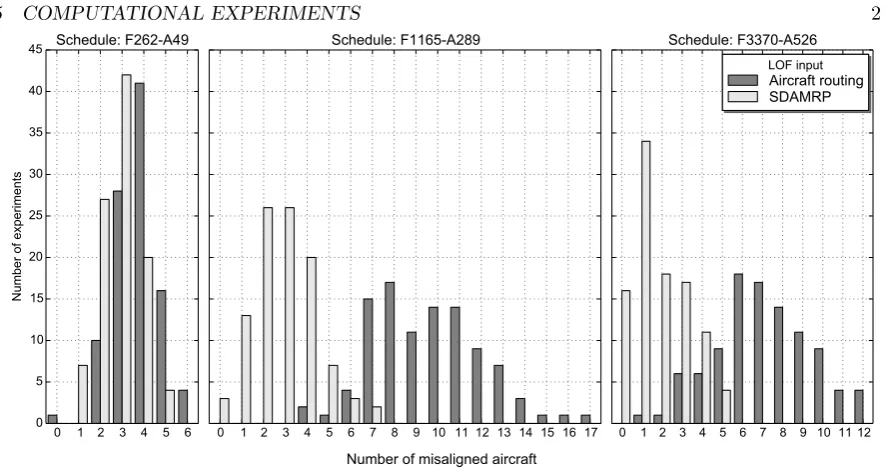
The results presented in Figure 2 demonstrate a decrease in the number of maintenance misalignments
as a result of using the SDAMRP LOFs compared to the aircraft routing LOFs. Surprisingly, in practice
many maintenance misalignments still exist when using the SDAMRP LOFs. This is shown by the light
grey bars in Figure 2 in the columns representing at least one misaligned aircraft. This highlights the
limitation of using fixed LOFs and the need for the development of a route adjustment process.
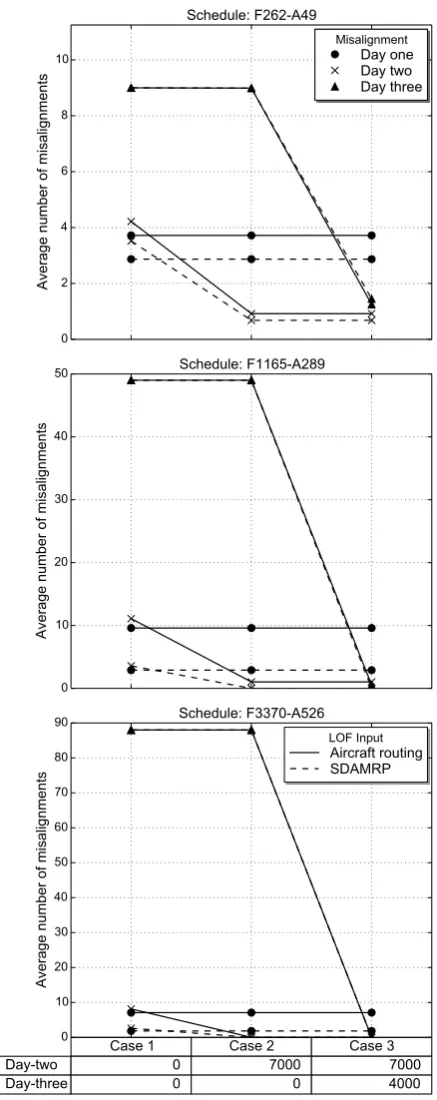
A summary of the number of maintenance misalignments on days one, two and three after solving
the DTAP is presented in Figure 3. These results aim to demonstrate the influence of key features of
the DTAP—the day-two and day-three look-ahead maintenance constraints—on maintenance
misalign-ments. The first column of Figure 3 represents the solution to a model that only minimises day-one
mis-0 1 2 3 4 5 6 0
5 10 15 20 25 30 35 40 45
Number of experiments
Schedule: F262-A49
0 1 2 3 4 5 6 7 8 9 10 11 12 13 14 15 16 17
Schedule: F1165-A289
0 1 2 3 4 5 6 7 8 9 10 11 12
Schedule: F3370-A526
LOF input
Aircraft routing SDAMRP
LOF input
Aircraft routing SDAMRP
[image:21.595.76.518.69.303.2]Number of misaligned aircraft
Figure 2: Histogram presenting the number of maintenance misaligned aircraft at the end of day-one
over a set of 100 experiments solving the DTAP with fixed LOFs.
alignments. Finally, the third presents the results from solving the DTAP by additionally penalising
day-three maintenance misalignments.
A striking observation from Figure 3 is the little interaction between the different features of the
DTAP. The increase in the penalty values only impacts the feature directly affected. For example, it is
only possible to reduce the day-two or day-three maintenance misalignments through the direct
consid-eration with look-ahead constraints. As such, solving the DTAP to only minimise day-one maintenance
misalignments will result in infeasibilities of the maintenance plan on subsequent days. This result
sug-gests that the developed DTAP is valuable for reducing the number of day-one, day-two and day-three
maintenance misalignments.
The selection of LOF input is observed to be critical across all metrics presented in Figure 3. The
SDAMRP LOFs outperform the aircraft routing LOFs in all metrics except the day-three maintenance
misalignments in Case 1 for the F3370-A526 schedule and Case 3 for the F267-A49 schedule. Importantly,
the number of day-one maintenance misalignments is significantly reduced using the SDAMRP LOFs
compared to the aircraft routing LOFs. Solving the DTAP with the SDAMRP LOFs achieves a reduction
in the average number of day-one maintenance misalignments of 22.85%, 69.79% and 73.94% for the
F267-A49, F1165-A289 and F3370-A526 flight schedules respectively.
Figure 3 presents a large decrease in the number of day-two and day-three maintenance
misalign-ments when solving the DTAP using the standard settings (Case 3). The average number of day-three
maintenance misalignments using the aircraft routing and SDAMRP LOF input decreases from (9, 9),
(49, 49), (88, 88) in Case 1 to (1.25, 1.45), (0.54, 0) and (0, 0) in Case 3 for the F267-A49, F1165-A289
0 2 4 6 8 10
Average number of misalignments
Schedule: F262-A49
Misalignment Day one Day two Day three
0 10 20 30 40 50
Average number of misalignments
Schedule: F1165-A289
Case 1 Case 2 Case 3
Day-two 0 7000 7000
Day-three 0 0 4000
0 10 20 30 40 50 60 70 80 90
Average number of misalignments
Schedule: F3370-A526
Misalignment Day one Day two Day three
[image:22.595.187.406.123.674.2]LOF Input Aircraft routing SDAMRP
Figure 3: Average maintenance misalignments on days one, two and three using various penalty settings
misalignments. However, the decrease is not as significant. These results suggest the need to consider
subsequent days maintenance requirements when using one-day routes as input for the tail assignment.
5.2
Evaluating the route adjustment process
The performance of the route adjustment process is assessed with comparisons between the DTAP,
branch-and-price and iterative algorithms. A comparison of the day-one maintenance misalignments
resulting from the use of each algorithm is presented in Section 5.2.1. The computational performance
of the solution algorithms is assessed in regards to the solution run time. The run time comparison is
presented in Section 5.2.2. Finally, a comparison of the changes made to the input LOFs when using
the iterative algorithm and branch-and-price is presented in Section 5.2.3.
5.2.1 Maintenance misalignments
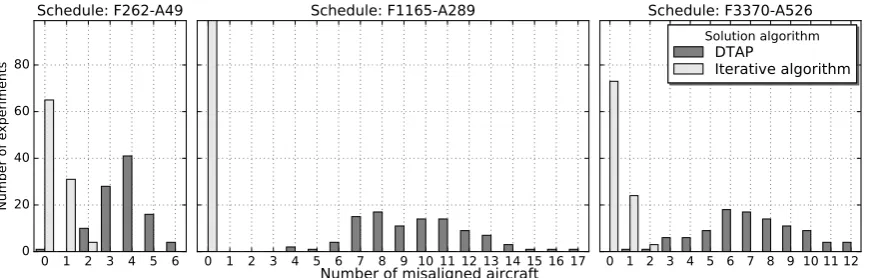
The comparison of the iterative algorithm and the DTAP in regards to the day-one maintenance
mis-alignments is presented in Figures 4 and 5. These figures show a significant decrease in the number of
day-one maintenance misalignments by using the iterative algorithm. This effect is particularly evident
for the F1165-A289 flight schedule using the aircraft routing LOF input. Solving the DTAP using the
F1165-A289 flight schedule results in four to seventeen day-one maintenance misalignments. These
mis-alignments are completely eliminated in all experiments when the iterative algorithm is employed. While
this result is also observed when using the SDAMRP LOF input, the decrease in day-one maintenance
misalignments is not as great. This is a consequence of the DTAP solution using SDAMRP LOF input
exhibiting less day-one maintenance misalignments compared to the aircraft routing LOF input for all
flight schedules.
The success of the iterative algorithm is evident in the maximum number of day-one maintenance
misalignments across the 100 experiments. For the aircraft routing LOF input the iterative algorithm
achieves a maximum of 2, 0 and 2 maintenance misalignments for the F267-A49, F1165-A289 and
0 1 2 3 4 5 6 0
20 40 60 80
Number of experiments
Schedule: F262-A49
0 1 2 3 4 5 6 7 8 9 10 11 12 13 14 15 16 17
Schedule: F1165-A289
0 1 2 3 4 5 6 7 8 9 10 11 12
Schedule: F3370-A526
Solution algorithm
DTAP
Iterative algorithm
Solution algorithmDTAP
Iterative algorithm
[image:23.595.82.518.559.698.2]Number of misaligned aircraft
Figure 4: Comparing the DTAP and iterative algorithm with histograms of the number of maintenance
0 1 2 3 4 5 6 0
20 40 60 80
Number of experiments
Schedule: F262-A49
0 1 2 3 4 5 6 7 8 9 10 11 12 13 14 15 16 17
Schedule: F1165-A289
0 1 2 3 4 5 6 7 8 9 10 11 12
Schedule: F3370-A526
Solution algorithm
DTAP
Iterative algorithm
Solution algorithmDTAP
Iterative algorithm
[image:24.595.74.517.76.229.2]Number of misaligned aircraft
Figure 5: Comparing the DTAP and iterative algorithm with histograms of the number of maintenance
misaligned aircraft at the end of day-one over a set of 100 experiments using the SDAMRP LOFs.
F3370-A526 flight schedules respectively. Similarly, for the SDAMRP LOF input the maximum number
of maintenance misalignments is 2, 0 and 1 respectively. While the maintenance misalignments are
not completely eliminated in all experiments, the decrease is practically significant. Performing one or
two over-the-day swaps is much simpler for the airline than rerouting the large number of misaligned
maintenance critical aircraft given by the DTAP solution.
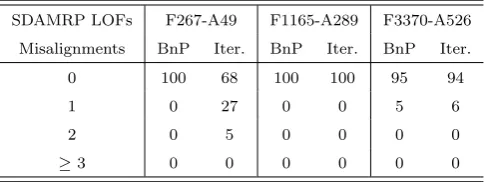
Similar to the preceding discussion, Tables 2 and 3 present a comparison of the day-one maintenance
misalignments when using the iterative algorithm and a branch-and-price algorithm. The first
observa-tion from Tables 2 and 3 is that employing branch-and-price for the F267-A49 flight schedule results in
less maintenance misalignments compared to when the iterative algorithm is used. This result
demon-strates that the exact algorithm outperforms the heuristic on small instances. Since small instances
are typically easy to solve, a heuristic is not required to find good solutions. While the
branch-and-price algorithm achieves a better average day-one maintenance misalignment result, the small number
of misalignments achieved by both algorithms is acceptable for the tail assignment application.
Contrary to the results for the F267-A49 flight schedule, there is little difference between the
per-formance of the iterative and branch-and-price algorithms for the F1165-A289 and F3370-A526 flight
schedules in regards to day-one maintenance misalignments. All instances for the F1165-A289 and
F3370-A526 flight schedules are solved within the maximum run time of 7200 seconds for both
algo-rithms. The reduction of all maintenance misalignments for the F1165-A289 flight schedule is a positive
Aircraft routing LOFs F267-A49 F1165-A289 F3370-A526 Misalignments BnP Iter. BnP Iter. BnP Iter.
0 88 65 100 100 76 73
1 12 31 0 0 21 24
2 0 4 0 0 3 3
≥3 0 0 0 0 0 0
Table 2: Number of experiments exhibiting a given level of maintenance misalignments when using the
[image:24.595.166.428.625.714.2]SDAMRP LOFs F267-A49 F1165-A289 F3370-A526 Misalignments BnP Iter. BnP Iter. BnP Iter.
0 100 68 100 100 95 94
1 0 27 0 0 5 6
2 0 5 0 0 0 0
[image:25.595.176.419.97.188.2]≥3 0 0 0 0 0 0
Table 3: Number of experiments exhibiting a given level of maintenance misalignments when using the
branch-and-price and iterative algorithms with the SDAMRP LOFs.
result for both algorithms. This demonstrates that optimal maintenance planning solutions exist for a
wide range of maintenance schedules. The results presented for the F3370-A526 flight schedule show the
difficulty in satisfying the maintenance requirements for all aircraft. However, since a the reduction in
maintenance misalignments is achieved, the effort required on the day of operations to perform further
aircraft swaps is reduced. The results presented in Tables 2 and 3 indicate that the iterative algorithm
is a very competitive heuristic for the route adjustment DTAP compared to the exact branch-and-price
algorithm.
5.2.2 Run time comparison
The run times for the 100 experiments with the DTAP, iterative and branch-and-price algorithms using
the aircraft routing and SDAMRP LOF inputs are presented in Figure 6. An important observation from
Figure 6 is the very short run times for each of the algorithms across the majority of experiments. All
experiments for the DTAP algorithm using the F267-A49, F1165-A289 and F3370-A526 flight schedule
terminate in a maximum of, respectively, 0.2, 1.44 and 76.78 seconds for the aircraft routing LOF input
and 0.14, 5.54 and 76.8 seconds for the SDAMRP LOF input. Comparatively, the iterative algorithm
requires much longer run times but still very small in magnitude. The iterative algorithm requires at
most 1.91, 53.34 and 133.31 seconds for the F267-A49, F1165-A289 and F3370-A526 flight schedules
respectively. While this represents a significant increase in run times, it is acceptable given the observed
decrease in the number of maintenance misalignments achieved by the iterative algorithm as presented
in Figures 4 and 5.
The benefit of the iterative algorithm is evident when comparing the run times with that of the
branch-and-price algorithm. Figure 6 shows the iterative algorithm achieves a smaller run time on
average compared to branch-and-price for the F267-A49 and F1165-A289 flight schedules. The same
benefit is not observed for the F3370-A526 flight schedule where the branch-and-price approach achieves
a better run time performance for some instances. The iterative algorithm achieves a better average
run time when the aircraft routing flight schedule is used, specifically 42.67 seconds compared to 50.44
seconds. Conversely, the average run time when the SDAMRP input is used is worse for the iterative