May 2014 – September 2015
Professor Ted Fuller, Dr Gary Bosworth, Dr Jane Deville
Collaboration
Contents Page
1. Introduction
2. Literature Review
- The Business Case for Improving Broadband in Lincolnshire
- Developing Business models for a Digital Age
3. Methodology
4. Business Summaries
5. Findings
- Summarising the impacts of business interventions
- Addressing key challenges & opportunities
- Overall learning from the programme
6.
Looking Ahead…
References
Appendices:
Appendix A: Promotional material for workshop 1
Appendix B: Promotional material for workshop 2
Appendix C: Detailed Case Studies
Executive Summary
Introduction
This report outlines the Onlincolnshire Knowledge Base Collaboration project undertaken by Lincoln Business School between May 2014 and September 2015. Onlincolnshire is a Lincolnshire County Council-run project which is part-funded by the East Midlands European Regional Development Fund (ERDF) Programme 2007 to 2013. As well as improving the broadband infrastructure, Onlincolnshire delivered a range of support to Lincolnshire’s Small and Medium Sized Enterprises (SMEs) through the “Business Connectivity in Lincolnshire and Rutland” (BCLR) strand of activities. This included short courses and one to one assistance covering topic areas such as social media, online marketing and web security. However a need was identified to enhance this provision to provide businesses with the opportunity to explore how digital know-how and ICT
technology could be used to deliver significant growth benefits by working in collaboration with the University’s knowledge base on a tailored project.
The University of Lincoln was felt to be uniquely positioned to carry out this initiative due to its access to staff with a range of expertise and knowledge of relevance to
Lincolnshire’s businesses and economy. During April 2014 it was therefore
commissioned to design and deliver collaborative projects to 8 SMEs across Lincolnshire focusing on their exploitation of broadband to generate wealth and to promote the potential economic impact that enhanced broadband provision can generate. The specific outcomes required include 3 detailed cases studies of enhanced business activities facilitiated by Internet applications and 15 hours of consultancy with a minimum of 8 SMEs.
The remainder of this report provides some background on the importance of broadband for business development, outlines the methodology used to select and work with the chosen businesses and sets out an analysis of the main impacts and learning points from the overall project. Additionally, detailed case studies about each businesses are
included in the appendices; these set out the business background, the aims, the collaborative activities and the observed and anticipated benefits from collaboration.
Literature Review
Introduction
Based on the principle that all regions and communities should have access to high-quality Internet connectivity, significant public investment has been made to upgrade telephone networks (Cambini and Jiang, 2009; Holt and Galligan, 2013). Today, accessing the Internet through telephone lines is only one of several technologies
available. Cable Internet, fibre-optics, and mobile broadband are now all widely available. However, there remains a disparity with rural areas generally receiving poorer
connectivity (Whitacre and Mills, 2010; Townsend et al., 2013; Salemink et al, 2015). Paradoxically, the problem of physical remoteness and the inadequate service provision could for a large part be solved by promoting digital connectivity as a substitute for many of those services (LaRose et al., 2007; 2011).
Opportunity: Rural firms can overcome problems of remoteness through Internet-enabled innovations and communication
The uneven spread of Internet technology applies across Europe where rural areas are dominated by “grey areas” (with at least one provider but limited competition) and “white areas” (with no market competition) as defined by the European Commission (2013). Even though government support is legally permitted in white and grey areas,
improvements in digital connectivity in European rural areas continue to lag behind urban regions (Sadowski et al., 2009: 585).
More recent technologies which go beyond telephone lines have not (yet) been regarded as “utilities” in the same way that telephone lines have been and the roll out of
infrastructure has been strongly market-led. Therefore, governments have not been able to promote their universal provision in the same way, and considerable investments are needed if this is to change (Ragoobar et al., 2011). Furthermore, in terms of speed and reliability, these forms of Next Generation Access are now rapidly developing in the areas where they are already available. Differences between the well-served, largely urban areas and the underserved, mainly rural areas are therefore growing, resulting in a spatial digital divide (Townsend et al., 2013). Linking this to a general lack of service provision in rural areas as compared to urban areas we see a “rural penalty” Malecki (2003: 201) where people in rural areas pay a price for living in remote areas. This in turn has wider economic and social impacts relating to accessing healthcare and government services, participating in digital entertainment and social networks, participating in on-line
education activities and having access to key business information, networks and trading platforms (Woods, 2005; Stockdale and MacLeod, 2013).
It is not just the technologies that are rapidly changing. In addition to the material issues that rural communities face in the digital age, there are also issues of a social nature (Salemink et al, 2015). The adoption and use of the Internet and associated applications are becoming increasingly diverse, and digital inclusion is no longer regarded as a binary issue. In other words, the debate is no longer about “haves” and “have nots” (Kilpeläinen
and Seppänen, 2014; Mariën and Prodnik, 2014); instead, it has started to focus on the degree of usage and different usage patterns. There is increasing recognition of the complexity of digital inclusion (see also Gilbert, 2010; Helsper, 2012). In order to
understand the impact of digital connectivity, one must also understand the actual usage. Providing the connectivity and technology is just one aspect of keeping up with
developments; adoption and actual usage are the next steps that need to be taken in order for digital connectivity to have an impact (Hage et al., 2013).
CHALLENGE: Adoption of (faster) Internet technologies has been slower in more rural areas like Lincolnshire
The Business Case for Improving Broadband in Lincolnshire
Urban and rural areas are increasingly viewed as interconnected parts of networks in which both production and consumption takes place (Lichter and Brown, 2011). The flow of information is becoming increasingly important within these networks (O’Hara and Stevens, 2006; Malecki, 2010), making all forms of connections and communications increasingly valuable. From an economic development perspective, access to ICTs and the possibility to quickly produce and receive knowledge is regarded as a key factor for a competitive, knowledge based economy (Castells, 2000; Malecki, 2010). Information is increasingly being transmitted in digital forms. People, businesses and institutions are therefore become increasingly dependent on digital data infrastructure and internet connections are the common example of such data infrastructure (Castells, 2000). Economic and social developments are under pressure due to a lack of digital connectivity, impeding innovation of production processes and certain forms of consumption, and in essence excluding less well connected, especially rural,
communities from fully participating in the contemporary information society (Velaga et al., 2012; Kilpeläinen and Seppänen, 2014; Roberts and Townsend, 2015). Other inequalities have been identified including a lower proclivity for women, older people, ethnic minorities and disabled people to use the Internet as a source of information (Devins et al, 2008). In Lincolnshire, connectivity to SFB has increased to 80% coverage in 2015 and an anticipated 90% in 2016 highlighting the progress that has been made through the wider activities of BCLR but also highlighting the growing inequality experienced by the remaining 10-20% that are less well served.
Academic literature continues to show that economic differences between well-connected and poorly connected regions are growing, mainly due to a lack of (instant) access to information and the limited possibility for proactively taking part in the production of information. This is true at different scales from the national to the global and, in poorer regions, inequalities can be exacerbated by cumulative causality through the economic impacts of poor connectivity. These regions suffer from a lack of connections,
constraining regional development and widening regional disparities (Lera-López and Billón-Currás, 2005). Thus, ICT is championed as a potential solution, connecting rural economies more strongly to urban centres and providing productivity advantages for rural businesses (European Commission, 2013). Furthermore, improved digital connectivity
can help attracting human capital into these rural areas as this is an increasingly important feature influencing housing choices among the professional classes who can contribute skilled labour and potentially launch new enterprises to boost local economies in the future (see also Roberts and Townsend, 2015). For example, websites like “Rightmove” are already listing broadband speeds among the key criteria to inform people’s hosuing searches.
OPPORTUNITY: Firms can access the latest knowledge and innovations via the Internet
Literature concerning the measurable economic impact of digital connectivity indicates that advanced telecommunication technologies contribute to GDP growth through investment in the infrastructure itself and through productivity improvement (Ford and Koutsky, 2005; Van Gaasbeck, 2008; Capello et al., 2011; Greenstein and McDevitt, 2011; Forman et al., 2012; Kolko, 2012; Prieger, 2013). However, this growth is unevenly distributed between core and peripheral regions (Kirschner, 2005; Tu and Sui, 2011). Even if digital connectivity in rural areas improves and GDP grows, this does not automatically mean that economic cohesion is taking place; rural areas need to grow faster than urban areas in order for the gap to close.
In the case of entrepreneurial activity, the literature is inconclusive. Some argue that investments in broadband lead to more entrepreneurial activity in a region (Ford and Koutsky, 2005), benefiting traditional as well as hi-tec or creative sectors (Gallardo and Scammahorn, 2011). Additionally, the attractiveness of a local area to entrepreneurial in-migrants has also been found to increase with improved broadband connectivity
(Mahasuweerachai et al., 2010) – good for the local economy but potentially a threat to established local businesses.
Cumming and Johan (2009) identify new external web-based competition as a threat to local entrepreneurs, reinforcing the need to stimulate entrepreneurs to continue to pursue new innovations to strengthen their businesses and their wider local economies.
Galloway et al (2011) also argue that the extended markets and service rationale has been overstated as a benefit of internet adoption for rural firms. Dissociation form local linkages can be particularly detrimental if too much emphasis is placed on Internet capabilities.
Internationalisation: Earlier research into the value of the Internet for SMEs identified that access to information about international competitors as well as the potential to build international networks were both positive (Loane and Bell, 2006). Even without significant changes in activity, the broader horizons that are opened up simply through the
awareness of such opportunities can be a valuable stimulus for entrepreneurs. SMEs in high-tech sectors and those that used technology in other aspects of their business were found to be more capable of using the Internet to increase their internationalisation (Tseng and Johnsen, 2011).
CHALLENGE: Competition is increased from outside and local competitors are rapidly adopting new technologies to offer new goods and services in new ways
Not all businesses can be the most competitive in their sectors so in many cases alternative approaches will be required. Nevertheless, it is essential to understand the competitive environment in order to identify niche opportunities. For example, internet-based business opens up the possibility for different approaches to branding and identity creation (Galloway and Mochrie, 2005) but maximising face-to-face customer service in an increasingly digital world offers the potential for alternative entrepreneurial responses that will continue to suit a certain market.
OPPORTUNITY: Firms can take advantage of new on-line options to maximise their differentiation and marketing strategies
Therefore, in considering the requirements for SMEs to develop business models for the digital age, we cannot simply assume that everything will be done on-line, everywhere and some firms will be able to prosper through employing more traditional production and communications methods. Rather, we know that a lot of things will be done electronically and this will change the nature of information, competition and supply chains that shape the business environment. The rapid growth of mobile broadband, apps and the 24/7 world of cyberspace is already pointing towards a future where fixed line broadband could itself become obsolete – the vital investments in today’s technology drive forward the innovations of tomorrow. For example, Kellerman (2010) explains: “These and other
innovations and applications will encourage further adoption of mobile Internet devices, culminating in an inability to lead personal and house-hold lives without the use of those devices. Early trends, notably among younger people, show that the focus of life, notably social life and service provision, may move from physical space to virtual cyberspace as the most obvious arena for their operation. The blurring of physical space into
cyberspace”. What does this mean for businesses over the coming decade as these young people become tomorrow’s employees and consumers?
Developing Business models for a Digital Age
The challenge for SMEs in today’s global economy is to develop new business models that fully engage with international opportunities. The growth of new economic
superpowers and the opportunities associated with outsourcing, supply chain innovations and information availability will be transformational (Friedman, 2006). Friedman
continues to note that the rapid expansion in PC ownership was slow to make an impact on productivity statistics but so too was the invention of the light-bulb because it took time to introduce new electrical motors, replace steam engines and transform the whole way of doing manufacturing (Friedman, 2006, p206). This is a factor that we must take into account with the evaluation of short term collaborations within this project.
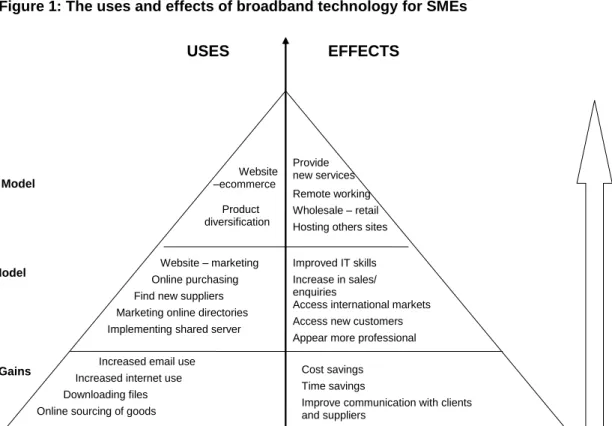
Earlier research in Lincolnshire highlighted that the adoption of new technology in a business can have different levels of impact, from efficiency gains at the basic level
through to the enhancement of activities and the transformation of business activities as illustrated in Figure 1 (Price et al., 2008).
Figure 1: The uses and effects of broadband technology for SMEs
Not all business owners are so pro-active that they are seeking to climb the pyramid, often taking a more pragmatic approach to business investments. Jones et al. (2014) observed that among sole proprietor micro-enterprises, attitudes towards ICT adoption were dependent on its perceived value in providing business solutions. They suggest that this “short-termism” reflects the survivalist attitude of many SMEs, particularly microbusinesses, for whom a long-term growth strategy is consider to be either unrealistic or simply not part of their life-plans.
CHALLENGE: To identify where businesses are on the pyramid, how they can move up the pyramid and how they can develop more long-term planning
In order to develop new approaches to advise and inspire Lincolnshire’s businesses, and to inform wider academic debates about the impact of broadband communications upon contemporary business models, a conference paper was presented at the Institute of Small Business and Entrepreneurship (ISBE) annual conference in Glasgow in November (attached as Appendix 4).
Website – marketing Online purchasing Find new suppliers Marketing online directories Implementing shared server
USES EFFECTS
Increased email use Increased internet use Downloading files Online sourcing of goods Online research
Transform Model
Efficiency Gains Cost savings
Time savings
Improve communication with clients and suppliers
Improved IT skills Increase in sales/ enquiries
Access international markets Access new customers Appear more professional Website –ecommerce Product diversification Provide new services Remote working Wholesale – retail Hosting others sites
The paper uses a conceptual framework to carry out empirical analysis of the effects on rural enterprises of “the digital economy” linked to the imperative of sustainable
development. Specifically, the aim is to identify ways in which rural enterprises are sustained in a digital age, for example by innovation. The focal point of the research is the notion of the ‘business model’ and the related influences that rural contexts and broadband may have on the capacity of an SME to sustain itself, either through competitiveness or in value captured (Chesbrough & Rosenbloom, 2002). The ISBE paper suggests that some profound changes are taking place in the
environment of rural enterprises, over which they have limited power. Opportunities for global contributions to sustainable development can be created but that the development of the agential anticipatory capacity should be at the heart of entrepreneurship education and business support. The framework is offered as a tool for researchers in this field in order to expand their analytical capacity. The concept of anticipatory capacity is
introduced to link the informational aspects of the digital economy with the sense making and entrepreneurial behaviour of rural enterprise management.
Innovating the business model is about creating value from the inter-connectedness in innovation ecologies rather than just offering products and services more efficiently, and hence moves on from the ‘pyramid model of the last generation of broadband policy (Figure 1). While the efficiency/enhance/transform model is appropriate, the way that internet technologies and online communications can be used to bring about
improvements has increased. The changes in value creation are increasingly based on globally based networks of businesses and customers. The interchange and
relationships between these organisations and people is largely internet based with value being more contained in electronic form, such as designs, printing instructions, service advice, and access to know-how. The business model approach reflects the ecological metaphor for business structures.
This changing world is challenging the core business of each of the firms interviewed. It is not simply about the products or services, but having to rethink and re-imagine the very nature of the business in which they are engaged. The evidence from our work with the SMEs indicates they in general they aware of this, but in some cases have difficulty in re-assessing their ways to create value and in other cases having insufficient knowledge to be able to explore possibilities or to implement their ideas. Online technologies are complex. Engaging with online activities is time-consuming. Larger companies employ technical teams and invest heavily in technologies and digital resources. In technology intensive locations, smaller enterprises have access to a wide variety of know-how. Although business is often done online, trusted relationships through personal
connections are still important to business owners. In rural areas, there is less intensity. We observed from the case studies that access to the university increased this intensity of available technological and business expertise.
Summary
Through the review of existing policies and research, a number of challenges and opportunities have been identified and listed again below.
Opportunity: Rural firms can overcome problems of remoteness through Internet-enabled innovations and communication
Challenge: Adoption of (faster) Internet technologies has been slower in more rural areas like Lincolnshire
Opportunity: Firms can access the latest knowledge and innovations via the Internet
Challenge: Competition is increased from outside and local competitors are rapidly adopting new technologies to offer new goods and services in new ways
Opportunity: helping business leaders to identify forms of business model innovation in specific industries to create value and to design these using online systems and services
Challenge: To identify where businesses are on the pyramid, how they can move up the pyramid and how they can develop more long-term planning
Opportunity: Firms can take advantage of new on-line options to maximise their differentiation and marketing strategies
These are incorporated into our strategies for working with businesses and inform the design of initial “strategic conversations” as well as influencing the publicity events that we stage throughout the project
With evidence indicating that Lincolnshire, as a predominantly rural county, is
experiencing a number of the problems outlined in the review, this project is important for raising awareness of the potential of broadband and as a basis for business and policy groups to campaign for better broadband on economic grounds.
The Go-on.co.uk heat-map (http://www.go-on.co.uk/resources/heatmap/) illustrates that all parts of Lincolnshire are at a medium risk of digital exclusion, even the City of Lincoln district, thus, more action to raise digital inclusion – through the provision of infrastructure AND the upskilling of individuals to adopt the technology is clearly important. As part of this, we now set out the details of our OKBC project working with 12 businesses in the County.
Methodology
The project was initially promoted to as many businesses as possible. In order to achieve this a flyer was produced (Appendix A) and distributed via academic staff and business support networks, for example Chamber of Commerce, local business clubs and incubator units. These organisations, along with other members of the Onlincolnshire project team, were also asked to identify Small and Medium Sized Enterprises (SMEs) already using broadband which would be ready to make further developments to help
transform their business. Business events and conferences were attended and presentations were given including to the Institute of Directors and at a SUSTAIN Lincolnshire workshop.
A morning workshop entitled ‘Creating Opportunities from Superfast Broadband’ was also organised which aimed to provide SMEs with further information about how they could use broadband and the opportunity for joint working with the University (Appendix B). A total of 17 businesses signed up to attend the event along with 16 academics keen to work with businesses and to maintain a core “knowledge base” within the University. This “knowledge base” met 3 times during the project, initially with 13 members, but the diverse and changing nature of collaborative projects meant that the internal, academic members of the group also evolved as the business needs shifted. In the end, 11 staff members participated in different aspects of collaboration. We also had a closing workshop to showcase some of the local case studies as well as bringing in guest speakers with insights from other parts of the UK.
As businesses came forward to take part in the project their eligibility for the ERDF funding was assessed, including a de minimis check. If eligible, they were then offered access to 15 hours of funded support from an academic staff member within the
University of Lincoln to help develop their use of broadband or associated technologies. In some cases these have been extended with additional student projects too.
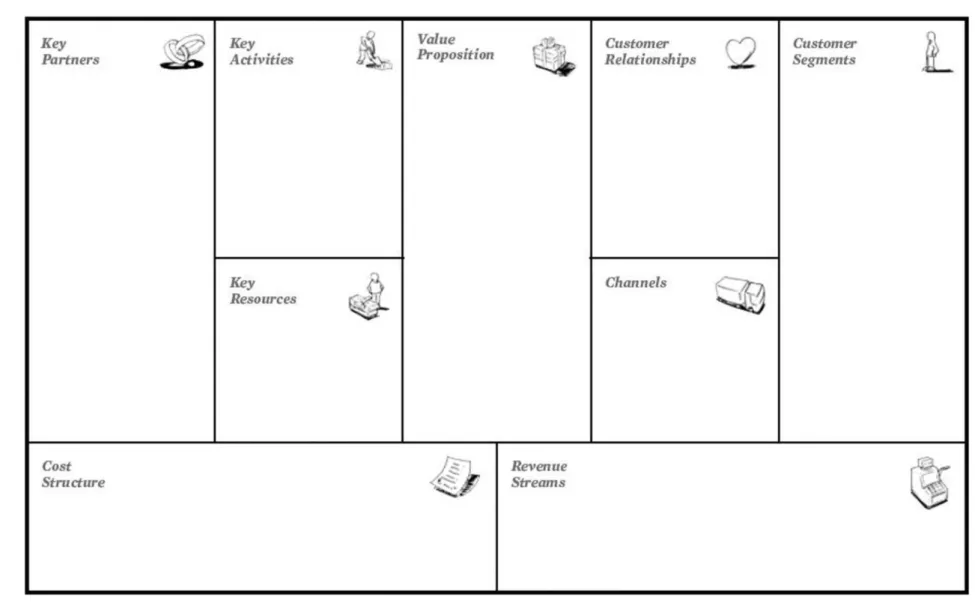
Each business was visited and a face to face interview conducted with the SME owner or member of staff assigned responsibility for the project. During these in-depth interviews a range of baseline descriptor data for the company were obtained including business size, sector, location and GVA. The interview then followed a semi-structured format with a range of questions centred around a number of key business areas based on the business model of Osterwalder and Pigneur (2010) illustrated in Figure 3. These key areas were discussed with particular emphasis on the current use of
broadband and associated technologies. A total of 10 businesses participated. These are shown in Figure 2.
Following these initial discussions areas of the business where broadband technology could be used to make a difference to business performance, assist with key challenges, or provide competitive advantage were identified. A member of academic staff was then sought to assist the business to develop these areas further. These staff members undertook a range of consultancy or development work with the business for at least 15 hours. At the end of the project it is anticipated that the businesses will be visited again and a second semi structured interview conducted to examine what changes had been undertaken in the business and the impact of these interventions.
It is worth noting here that attracting businesses to participate was challenging as those that already felt confident with broadband-enabled technologies were not attending promotional events and others were more likely to cite poor Internet availability and thus feel that the programme could not help them. This is reinforced by a recent studies from
the CLA (2015) and Go-On.UK (2015), each indicating that Lincolnshire was more digitally excluded that many counties, based on a combination of infrastructure-based and socio-economic statistics.
It was also challenging to engage with the larger SMEs because they had different departments with different applications of faster broadband and different decision makers that each had to agree to participate in the scheme.
Figure 2: Key information about businesses
*This is not an SME under ERDF criteria due to Venture Capital ownership and therefore excluded from ERDF reporting. It is included as a valuable case nonetheless.
Business name Sector Location No. of FTE employees
A Little Luxury Processing and
preserving fruit Sleaford 1
Caistor Arts and
Heritage Centre Multi use centre Caistor 4
Friends of Chain Bridge Forge Operation of historical site Spalding 0 Copywriting Ltd (Sarah Lamballe) Business support activities Tealby 3
Fairy Glam Wholesale trade Lincoln 10
Growing Opportunities Landscape services Navenby 1.5
Hall Farm Conservation Holiday and business
accommodation Thorganby 1
HK Timbers* Manufacture of wooden
containers Gainsborough 23
Safelincs Wholesale of equipment Alford 28
Woldmarsh Cooperative buying
Business Summaries
This section provides a summary of each of the businesses involved in the project including background information, the challenges the business faced and the project proposal taken from the memorandum of understanding outlining how the university can help. We then present a tabulated summary of the diverse project aims that resulted from the collaboration activities.
A Little Luxury
A Little Luxury is a home based business specialising in jams and chutneys. They prepare an extensive range of preserves with the majority of produce being sourced locally from farmers and allotment holders. They supply to delis, farm shops and cafes and also catering tubs to tea rooms. In addition to this a large proportion of their stock is sold at local shows. During the past 4 years they have gradually gown in size and recently received their first order from English Heritage.
It is this growth which has led them to look at ways to manage their stock. They currently keep track of availability using an Excel spreadsheet which is updated each time an order is placed. However, with a vast range of preserves all available in 3 jar sizes this is becoming increasingly difficult. Their jar labels already include a barcode and they would therefore like to look at the possibility of using a wireless scanner and associated software to update their stock list.
Caistor Arts and Heritage Centre
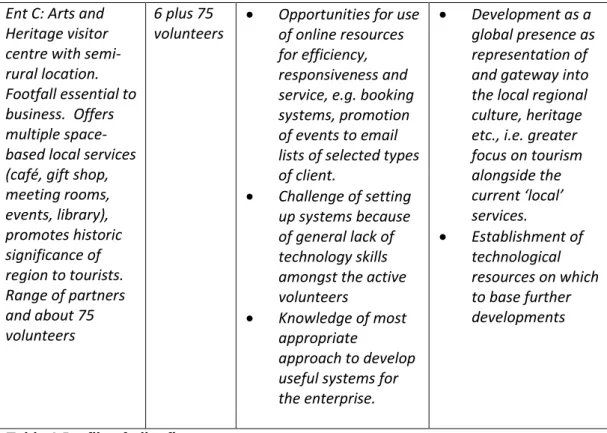
Caistor Arts and Heritage Centre was developed 4 years ago using National Lottery funding and support from the Village SOS scheme. It offers a range of services to Caistor, and the surrounding villages, including library, café, meeting space, IT support, workshops and trips. The centre employs a Centre Manager, Café Manager, 6 part time café staff in addition to a number of volunteers.
The centre is constantly trying to improve its use of resources and has highlighted the need for improved use of digital technology. They currently have a static website, but feel more use could be made of this to increase footfall and ultimately increase income to ensure the centre remains sustainable. The Centre would therefore like support with a number of issues around their digital strategy.
Chain Bridge Forge
Chain bridge Forge is a small living museum based in Spalding, South Holland. They offer visitors the chance to learn more about being a blacksmith both through a small exhibition area and by demonstrating blacksmithing skills and techniques. Visitors, and local schools, can also experience taster days where they are able to use the forge.
In addition to blacksmithing the forge also has an Innovation Centre which offers 3D printing and scanning within the forge. This equipment is vital to their Virtual Craft Simulation project which uses virtual reality to give young people a taste of the craft of blacksmithing using 21st century technology. However, in addition to using the equipment
for their own purposes, the forge has also identified a possible source of income by offering use of this equipment to local businesses. The forge were therefore looking for advice on identifying uses for this new equipment both to businesses and the local community.
Copywriting Ltd (Sarah Lamballe)
Sarah Lamballe runs a copywriting business partly from home and partly from new office space within her other business, Bricktree Gallery. She is keen to develop her web presence to market both sides of her business. In particular, the Gallery offers attached accommodation with training space and an en-suite bedroom with views over the Lincolnshire Wolds countryside. Marketing this outside of the region with online video-content requires faster broadband connections and the expectations of guests and training event organisers for faster broadband make this an essential utility for her business.
Fairy Glam
Fairy Glam supply children’s toys, primarily aimed at girls aged 3-7. They have approximately 500 products, ranging from dressing up to music boxes and tea sets to fairy doors. They have traditionally traded business to business (B2B) with their goods being sold in high end department stores. However the internet is changing their selling patterns and currently about half of their trading is direct to the customer (B2C) both from their own website and through trading platforms such as Amazon. As direct selling increases it will become increasingly important for the business to ensure they have the right stock in the right place at the right time.
Fairy Glam currently use their ERP software to organise stock, demand and purchasing. This works most accurately with their dressing up items which have a short lead in time and are ordered in low volume. However, the majority of their toy products come from China and, as well as needing to be ordered in high volume, have a long lead in time. Fairy Glam therefore wanted to analyse their sales data to try and identify patterns of demand which could inform their sales planning. It is anticipated that this will help not only with stock control, but will enable them to more efficiently manage their warehousing. Growing Opportunities
Growing opportunities provide independent grain market evaluation to help farmers achieve the best return on their grain. Traditionally virtually all grain trading is done via relationships built over a long period of time and farmers may be unaware that they are being offered is lower than that offered elsewhere. Grain prices also have a large
movement in price from season to season so it is important for farmers to have access to the most up to date information so they can get the best price. Growing Opportunities’ online portal, XFarm, therefore uses real time data to provide farmers with up to the minute prices for rapeseed and wheat to ensure farmers can sell knowing the price they should be able to achieve.
The site currently has about 500 members across Lincolnshire, but needs more to ensure it is sustainable. The business is therefore looking for assistance to understand its current customers and to help with a targeted marketing campaign aimed at increasing
subscribers as well as looking at other ways the business can make more use of broadband technology.
Hall Farm Conservation
Hall Farm Conservation is a farm diversification which runs and manages four self catering properties. These properties are aimed at a number of customer groups including families, large groups looking for retreat weekends and business people working in the local area. The properties are currently advertised on their own website and Facebook page, plus a range of pay per listing third party websites. Although occupancy levels are reasonably high the business is looking to increase this further using special offers, ensuring their reviews are visible on relevant sites such as Trip Advisor and making better use of other booking websites. Hall Farm Conservation
therefore required some advice and guidance on the use of digital marketing and how this could be optimised to maximise occupancy.
HK Timbers
HK Timbers are already an interesting case study having developed their on-line
presence over recent years and recognised new niche markets for the sale of their potato boxes outside of their traditional local agricultural markets. They are keen to strengthen their online database of clients and build new ways to communicate online with their community. Additionally, they are seeking support for some research into their core business sector –the potato industry which could provide a case study for a student dissertation.
Safelincs
Safelincs specialise in fire safety products and services. The majority of their business is done online and they have outlets across Europe (Germany, France, Ireland and Italy). They supply to some domestic customers either directly or through Amazon, but their primary market is to businesses including facilities management, nursing homes, schools etc.
One of their core aims is to ensure their customers have a positive experience as they believe this is key for getting repeat business. As part of this commitment to improving
customer service they would like to enhance their website by developing online video content through a YouTube Channel. This may be demonstrations of their products, step-by-step help guides or expert advice and tips on fire safety. New Media Lincs have therefore been engaged to work with Safelincs to discuss their requirements and film an initial short video clip as a tester, before potentially filming further products.
Woldmarsh Producers
Woldmarsh Producers are a non-profit making cooperative supporting those associated with the farming industry. They purchase goods on behalf of their 1,000 members and pass on the benefits of negotiated discounts to them.
During 2014/15 Woldmarsh moved to an online accounts system. Invoices from suppliers are now scanned into their accounts system using an OCR scanner and, following the initial set up the software automatically reads the information from the invoice. Members receive a statement each month which enables them to view their real time spend as well as past statements and invoices via their online account. For Woldmarsh this has led to a reduction in both costs and time.
However, there are a number of suppliers who provide data as either EDI or CSV files which can be imported into the accounts software, but Woldmarsh do not then have the ability to produce a picture (pdf) file for farmers’ records. Woldmarsh would therefore like to explore the possibility of automating this process.
Aggregated summary of project aims drawn from the Memorandums of Understanding agreed with each of the partners
Provide guidance on the use of digital and online technology for stock control
Offer guidance to [partner business] on their digital strategy, including redevelopment of their current website, to help them increase their customer base and income. This may include guidance on:-
Choosing the right platform and website specification
Improving and streamlining administrative processes online
Integrating online booking and donating
To support [partner business] in identifying and realising opportunities through its recent investments in digital projects
Provide support in the marketing of the [partner business’] and associated
accommodation through advanced e-marketing and the development of video content for their new website.
Provide support to develop their use of online marketing tools to raise the profile of Lincolnshire’s corporate accommodation offering and establish a local cluster with the potential to develop through future personal, and on-line, collaboration.
Analyse sales data for 2 key products and channels to identify patterns of demand that can inform sales forecasting and planning
Provide guidance on approaches to sales forecasting by the business based on the results of the above analysis
Provide support in the development of new product innovation which relies on broadband technology for real-time spectroscopy testing. This support includes advice on the engineering process, logistics and bid-writing as well as the specifics of how broadband can be used to maximise the viability of the business idea.
A market research project to understand the user-base of the existing business to facilitate a targeted marketing campaign to boost subscribers. The results will also be used to provide information about the most important content on the site and the purposes for which visitors are accessing the company’s website. This will all guide future business strategies.
Offer guidance on digital strategy and the use of social media
To provide support in the development of new video content for the [partner business] website to include product video filming and editing
Look at the viability of importing Electronic Data Interchange (EDI) files from suppliers into the [partner business] accounting system. Offer guidance on how to achieve this.
Look at the viability of producing electronic invoices (pdf files) after importing EDI files to enable [partner business] to continue to provide invoices to their members. Offer guidance on how to achieve this.
RESULTS AND FINDINGS
We present a summary of the key business-related outcomes from our interventions with case study partners and then move to a discussion of our overall findings from the project in relation to the key opportunities and challenges drawn from the earlier literature review. These are then followed by some more general learning points that emerged from the project as a whole along with suggestions for future actions to continue to support the digital development of Lincolnshire and Rutland’s economies.
Summarising the impacts of business interventions
The detailed case studies are set out in Appendix C, and with additional personalised content, these are available for use by Onlincolnshire to promote the potential for businesses adopting new broadband-led innovations.
The requirement to identify a specific project for business collaboration forced business owners to think hard about the potential values and uses of faster broadband in their businesses. This made the initial part of the engagement – the strategic conversation – very important as the academic’s role was partly to foster new perspectives on business models, delivery mechanisms and marketing approaches that were made possible by faster broadband. Combined with the support of the wider BCLR activities to raise the profile of broadband technology for businesses, this has undoubtedly generated value for the business community – albeit hard to quantify.
Some of the projects were clearly self-contained and related to specific applications around financial management systems, stock control, online booking systems and QR codes. While these may not always be particularly innovative in themselves, the collaboration with the research base and the experience of introducing new web-based technologies all signified an important step for small business owners who gained confidence and knowledge, hopefully to support future innovations.
Marketing and customer-communications were also major areas where businesses recognised the potential that short-term projects could offer. Introducing video-content to websites, re-designing websites and making better use of client databases for digital communications were all areas where the project has delivered value to individual businesses. In the case of the potato box manufacturers, the ability to engage with different market segments where considerably higher values could be obtained for the same product, offers the scope for a significant re-focusing of the business and certainly adds resilience in the face of a declining market for the core product – potatoes.
Beyond this, once businesses are engaged in new web-based marketing activities, they become aware of new ways in which collaboration can offer benefits and this has initiated conversations to develop a new network of rural tourism businesses. Within the scope of the short project, this has not developed beyond the initial idea but, in drawing together link-minded businesses, it provides the platform for business-led innovations in their collaborative marketing, supported by web-based platforms.
Other examples of how the project has been a stepping stone for larger scale activities include the collaborative funding bid (Growing Opportunities), the continuing analysis of global supply chains (Fairy Glam) and the ongoing collaboration to help develop a small museum (Chain Bridge Forge). In each case, the 15 hours of consultancy have created personal connections between SME owners and academic researchers that make the research base of the University more accessible.
Addressing key challenges & opportunities
Opportunity: Rural firms can overcome problems of remoteness through Internet-enabled innovations and communication
From the businesses involved in this project, remoteness was not a significant problem. In fact, for serial touristic firms, it was an asset and faster Internet speeds provided the opportunity to showcase this with improved marketing approaches. Working with New Media Lincs to provide video content on website and starting to develop a network of “business tourism” firms in the Wolds are two examples of this in action.
For “Growing Opportunities” the rural location was not a problem for regular activities but exploring the potential for faster broadband links highlighted how the ability to work “real-time” with scientific laboratories on product testing and quality control is no longer limited by distance.
Challenge: Adoption of (faster) Internet technologies has been slower in more rural areas like Lincolnshire
The take up of Internet has been slower due to, often accurate, perceptions that provision in Lincolnshire is lagging behind other parts of the country. As a result, engagement in training programmes and more advanced collaborations such as this, have also been seen limited enthusiasm. This highlights the need for lobbying to improve infrastructure in conjunction with efforts to increase skills and innovative thinking across the economy. In one example, the lagging use of new technology such as 3-D printing and scanning, has encouraged the business to establish a community hub allowing others to share the technology. The same business is introduce new technology into education through the use of “virtual reality” devices to showcase the history of blacksmithing so this too will help others to become more aspirational towards the use of technologies in the future.
Opportunity: Are firms accessing the latest knowledge and innovations via the Internet?
We have seen new approaches to providing information with the development of videos to showcase new products and services. We are also working on one project where a business owner is able to use the Internet as a means to gather more sophisticated customer details and feedback. Processing of information through new Internet-enabled
technologies has added to efficiencies within one business but we have not identified examples of businesses sourcing new ideas and developing innovations as a result of web-based knowledge accumulation. It is likely that firms are gathering this information through everyday on-line activities and where they have been carrying out strategic searches or building strategic on-line networks, these would have fallen outside of the ambit of the particular projects on which the University, through Onlincolnshire, have been working.
At Thorganby Hall, one of the aims of the collaboration was to review the different platforms available to tourism businesses for marketing. The growth of comparison sites and social media usage, especially where reviews and photographic content can be provided by guests, requires additional expertise to access the most suitable options.
Challenge: Competition is increased from outside and local competitors are rapidly adopting new technologies to offer new goods and services in new ways
We did not observe the threats among our projects but we did observe measures that businesses were taking to widen their own market reach and increase capacity to service wider areas. These spanned from a home-based firm using cloud technology to improve stock control – something that was essential to meet a national company order – to a global exporter developing a new logistics strategy to service growing demand.
Opportunity: helping business leaders to identify forms of business model innovation in specific industries to create value and to design these using online systems and services.
An analysis of the memoranda of understanding from all the projects indicates that the projects are relatively operational. The desire to have useful practical projects is
understandable and the ‘University as Resource’ relationship is useful in this regard. The 2015 “ISBE” paper (appended) considered three of the 12 enterprises in more depth; what these enterprises were doing to anticipate the changing environment and adapt to these changes. The business model ‘canvas’ was used to focus the discussions with the owners. None of the three enterprises was aware of this particular approach and none of them was thinking in terms of ‘business model innovation’ as a concept. However, in practice they were working out innovations to their business model. Generally they were working on their business at two levels. Firstly at a day to day competitive level,
concerned with pricing, efficiencies and reaching customers (similar to the pyramid approach), which the MOU projects reflect. Secondly at a more strategic level
discussions about the business model revealed that they were able to articulate strong notions of what they would like their business to become with respect to the digital economy. Reflecting more widely on all 12 cases, sometimes it was only through addressing the explicit short-term requests that the more strategic challenges were revealed.
We conclude from the analysis of the cases included in the ISBE paper that the changes to the business model linked with a greater use of technology were emergent and
dynamic. Innovation in these business models emerge from ‘what works’ through trial and error experimentation rather a clear blueprint or design of a (different) business model. The enterprises understand themselves as being embedded in a system of relationships and understand their role as providing (and exchanging) value. What they needed was exposure to a wider set of relationships; both in terms of markets and in terms of knowledge and know-how. The lack of available skills to implement their ideas, or even to experiment with the ideas, was a limiting factor.
Opportunity: Are firms using on-line options to maximise their differentiation and marketing strategies?
We saw a number of examples of diversification enabled by the Internet. One is provided by the manufacturer of potato boxes who, in the face of a declining demand from the agricultural sector, has been able to explore new retail outlets for wooden crates, largely facilitated through the on-line market. Alongside the expansion of local tourism networks that are positioning themselves to attract wider audiences and an innovative on-line platform for the trading of cereals, this has proven to be one of the more positive areas of activity among our examples.
Challenge: Where is your business on the broadband adoption pyramid? What are the long term implications of short-term planning?
The majority of businesses began their involvement with Onlincolnshire at the bottom level of the pyramid with technology seen as a potential driver of effficiecy rather than as a creator of new market opportunities – with some exceptions in the ambitions to expand their marketing activities. Through the project, some remained at this level, focusing on
Website – marketing Online purchasing Find new suppliers Marketing online directories Implementing shared server
USES EFFECTS
Increased email use Increased internet use Downloading files Online sourcing of goods Online research
Transform Model
Efficiency Gains Cost savings
Time savings
Improve communication with clients and suppliers
Improved IT skills Increase in sales/ enquiries
Access international markets Access new customers Appear more professional Website –ecommerce Product diversification Provide new services Remote working Wholesale – retail Hosting others sites
changes to stock-taking or accounting systems. However, through working with appropriate experts, the activity showcased the potential for growth and the initial, efficiency-saving adaptation enables the business to increase their capacity and to embrace future opportunities for change with added confidence provided by their increased knowledge and networks.
In a number of cases though, we have seen the top level reached with products being adapted for new markets and whole new business models being scoped for potential investment. Re-designing a small museum and re-thinking the way that people access the educational content is perhaps the most exciting of these examples.
POTENTIAL FOR SELF-DIAGNOSIS SYSTEM FOR BUSINESSES – in realtion to training needs?
Overall learning from the programme
“Selling” the programme to businesses was challenging as those with knowledge about the potential of superfast broadband felt they didn’t need it while those without
knowledge, or access, to faster broadband speeds did not see the value of participation. If consultancy were more clearly aligned to the visible roll-out of faster broadband, this could have attracted greater interest. We also learned from our events and marketing that the term “superfast broadband” was less attractive in relation to business support for SMEs. Branding our final event around “competitiveness for the digital era” appeared to resonate more closely to the everyday business needs across the local economy. For very small businesses, it takes a lot of time to build a strategy for maximising the value of superfast broadband. As the outcomes are not definite at the outset, it is also viewed as a risky investment of time and/or money compared to other proven actions. The closing event further highlighted the ongoing problem of unequal access to
broadband, and to the speeds required for commercial activities. Positive case studies from this project, and from our guest speakers, can boost the appetite among businesses but if this is hampered by poor service provision, the frustration can be severely
detrimental.
Looking Ahead...
Given that the drive for faster and more reliable ICT will continue, and with the likelihood that market-led developments will occur in urban areas first, it is essential to that
Lincolnshire and Rutland’s businesses have access to both business and innovation support as well as to the requisite infrastructure if the local economy is to keep pace with other regions.
Here we see the potential for the University to provide additional training and support as part of its ongoing commitment to the local economy. However, we also recognise that
the complexity of the change towards a “superfast” digital economy requires expertise from business, telecommunications and policy to come together. Therefore, we recommend that we maintain an expert network from the breadth of Onlincolnshire and beyond to reinforce the support offered to businesses. Such an organisation would have stronger lobbying power for the region, provide a forum for the exchange fo knowledge and best practice and support businesses to continue their digital developments through ongoing collaborations. Increasing the overall intensity of expertise and
inter-communications will, it is suggested, provide a stronger overall resource to Linconshire’s smaller enterprises to support growth and innovation.
Following Dr Leanne Townsend’s contribution to the closing workshop, meetings have continued to explore new funding options including an Interreg “North Sea Region” opportunity relating to technology-driven regional innovation and growth, requiring continuing collaboration between public, private and University sector institutions: (http://www.northsearegion.eu/thinking-growth/ ). As part of the University’s commitment to this agenda, activities are underway to build on the Knoweldge Base and develop closer links with the University’s of Aberdeen and Groningen (Netherlands) who have a considerable track record of research into rural broadband.
References
Cambini, C., Jiang, Y. 2009, "Broadband investment and regulation: A literature review", Telecommunications Policy, vol. 33, no. 10–11, pp. 559-574.
Capello, R., Caragliu, A., Nijkamp, P. 2011, "Territorial Capital and Regional Growth: Increasing Returns in Knowledge Use", Tijdschrift voor economische en sociale geografie, vol. 102, no. 4, pp. 385-405.
Castells, M. 2000, "Materials for an exploratory theory of the network society", British Journal of Sociology, vol. 51, no. 1, pp. 5-24.
Chesbrough, H., Rosenbloom, R. S. 2002. The role of the business model in capturing value from innovation: evidence from Xerox Corporation's technology spin-off companies.
Industrial & Corporate Change, Vol. 11, No. 3, pp. 529-555.
Cumming, D., Johan, S. 2010, "The Differential Impact of the Internet on Spurring Regional Entrepreneurship", Entrepreneurship Theory and Practice, vol. 34, no. 5, pp. 857-883.
Devins, D, Darlow, A., Webber, D. 2008, Beyond ‘Access’: Internet Use and Take-up of Online Services by Adults Living in Disadvantaged Areas in England. Local Eonomy vol. 23, no. 1, pp. 47-57
European Commission. 2013, Communication from the Commission. EU Guidelines for the application
of State aid rules in relation to the rapid deployment of broadband networks , 26-1-2013, Brussels.
Friedman, T L. 2006, The World is Flat: The globalized world in the twenty-first century. Penguin Books, London.
Ford, G.S., Koutsky, T.M. 2005, "Broadband and Economic Development: A Municipal Case Study from Florida", Review of Urban & Regional Development Studies, vol. 17, no. 3, pp. 216-229.
Forman, C., Goldfarb, A., Greenstein, S. 2012, "The Internet and Local Wages: A Puzzle", American Economic Review, vol. 102, no. 1, pp. 556-575
Gallardo, R., Scammahorn, R. 2011, "Determinants of Innovative Versus Non-Innovative Entrepreneurs in Three Southern States", The Review of Regional Studies, vol. 41, no. 2, pp. 103-117.
Galloway, L., Mochrie, R. 2005, "The use of ICT in rural firms: a policy-oriented literature review", Info, vol. 7, no. 3, pp. 33-46.
Galloway, L., Sanders, J., Deakins, D. 2011, Rural small firms’ use of the internet: From global to local. Journal of Rural Studies, Vol. 27, pp.254-262.
Gilbert, M. 2010, "Theorizing Digital and Urban Inequalities: critical geographies of 'race', gender and technological capital", Information, Communication & Society, vol. 13, no. 7, pp. 1000-1018.
Greenstein, S., McDevitt, R.C. 2011, "The broadband bonus: Estimating broadband Internet's economic value", Telecommunications Policy, vol. 35, no. 7, pp. 617-632 Hage, E., Roo, J., Van Offenbeek, M., Boonstra, A. 2013, "Implementation factors and their effect on e-Health service adoption in rural communities: a systematic literature review", BMC Health Services Research, vol. 13, no. 19, pp. 1-16.
Helsper, E. J. 2012, “A Corresponding Fields Model for the Links Between Social and Digital Exclusion”, Communication Theory, vol. 22, no. 4, pp. 403-426.
Holt, L., Galligan, M. 2013, “Mapping the field: Retrospective of the federal universal service programs”, Telecommunications Policy, vol. 37, no. 9, pp. 773-793.
Jones, P., Simmons, G., Packham, G., Benyon-Davies, P., Pickernell, D. 2014, An exploration of the attitudes and strategic responses of sole-proprietor micro-enterprises in adopting information and communication technology. International Small Business Journal, Vol. 32, No. 3, pp 285-306
Kellerman, A. 2010, Mobile broadband services and the availability of instant access to cyberspace. Environment and Planning A, Vol.42, pp. 2990-3005
Kilpeläinen, A., Seppänen, M. 2014, ”Information technology and everyday life in ageing rural villages”, Journal of Rural Studies, vol. 33, pp. 1-8
Kirschner, A.R. 2005, "Computer services and the development of rural areas: Trends in the Pacific Northwest in the 1990s", The Social Science Journal, vol. 42, no. 4, pp. 541-554.
Kolko, J. 2012, "Broadband and local growth", Journal of Urban Economics, vol. 71, no. 1, pp. 100-113.
LaRose, R., Gregg, J.L., Strover, S., Straubhaar, J., Carpenter, S. 2007, "Closing the rural broadband gap: Promoting adoption of the Internet in rural America",
Telecommunications Policy, vol. 31, no. 6–7, pp. 359-373.
LaRose, R., Strover, S., Gregg, J.L., Straubhaar, J. 2011, "The impact of rural broadband development: Lessons from a natural field experiment", Government Information
Quarterly, vol. 28, no. 1, pp. 91-100.
Lera-López, F., Billón-Currás, M. 2005, "Shortfalls and inequalities in the development of E-Economy in the E.U.-15", Communications and Strategies, vol. 60, no. 4, pp. 181-200. Lichter, D.T., Brown, D.L. 2011, “Rural America in an Urban Society: Changing Spatial and Social Boundaries”, Annual Review of Sociology, vol. 37, pp. 565-592.
Loane, S., Bell, J. 2006, Rapid internationalisation among entrepreneurial firms in Australia, Canada, Ireland and New Zealand: An extension to the network approach.
International Marketing Review, Vol. 23, No. 5, pp. 467-485
Mahasuweerachai, P., Whitacre, B.E., Shideler, D.W. 2010, "Does Broadband Access Impact Migration in America? Examining Differences between Rural and Urban Areas", The Review of Regional Studies, vol. 40, no. 1, pp. 5-26.
Malecki, E.J. 2003, "Digital development in rural areas: potentials and pitfalls", Journal of Rural Studies, vol. 19, no. 2, pp. 201-214.
Malecki, E.J. 2010, “Everywhere? The Geography of Knowledge”, Journal of Regional Science, vol. 50, no. 1, pp. 493-513.
Mariën, I., Prodnik, J. 2014, ” Digital inclusion and user (dis)empowerment: a critical perspective", info, vol. 16, no. 6, pp. 35-47
O'Hara, K., Stevens, D. 2006, Inequality.com, Oxford: Oneworld Oxford.
Osterwalder, A.; Pigneur, Y. (2010): Business Model Generation: A Handbook for Visionaries, Game Changers, and Challengers. Hoboken NJ: John Wiley & Sons. Price, L., Shutt, J., Atherton, A. and Noake, H. (2008) An evaluation of the economic impact of broadband in Lincolnshire: updated final report. Evaluation report for onlincolnshire accessed 21st October 2015 at: http://eprints.lincoln.ac.uk/11751/
Prieger, J.E. 2013, "The broadband digital divide and the economic benefits of mobile broadband for rural areas", Telecommunications Policy, vol. 37, no. 6–7, pp. 483-502. Ragoobar, T., Whalley, J., Harle, D. 2011, "Public and private intervention for next-generation access deployment: Possibilities for three European countries", Telecommunications Policy, vol. 35, no. 9–10, pp. 827-841.
Roberts, E., Townseand, L. (2015) “The Contribution of the Creative Economy to the Resilience of Rural Communities: Exploring Cultural and Digital Capital,” Sociologia Ruralis, Advance online publication. doi: 10.1111/soru.12075
Sadowski, B.M., Nucciarelli, A., de Rooij, M. 2009, "Providing incentives for private investment in municipal broadband networks: Evidence from the Netherlands", Telecommunications Policy, vol. 33, no. 10–11, pp. 582-595.
Salemink, K., Strijker, D., Bosworth, G. 2015, Rural Development in the Digital Age: a systematic literature review on unequal ICT availability, adoption, and use in rural areas.
Journal of Rural Studies, forthcoming
Stockdale, A., MacLeod, M. 2013, “Pre-retirement age migration to remote rural areas”,
Townsend, L., Sathiaseelan, A., Fairhurst, G., Wallace, C. 2013, “Enhanced broadband access as a solution to the social and economic problems of the rural digital divide”, Local Economy, vol. 28, no. 6, pp. 580-595.
Tseng, K.K., Johnsen, R. 2011, Internationalisation and the internet in UK manufacturing SMEs. Journal of Small Business and Enterprise Development, Vol. 18, No. 3, pp. 571-593.
Tu, W. , Sui, D.Z. 2011, "A State Transformed by Information: Texas Regional Economy in the 1990s", Regional Studies, vol. 45, no. 4, pp. 525-543
Van Gaasbeck, K.A. 2008, "A rising tide: Measuring the economic effects of broadband use across California", The Social Science Journal, vol. 45, no. 4, pp. 691-699.
Velaga, N.R., Beecroft, M., Nelson, J.D., Corsar, D., Edwards, P. 2012, "Transport poverty meets the digital divide: accessibility and connectivity in rural communities",
Journal of Transport Geography, vol. 21, pp. 102-112.
Whitacre, B.E., Mills, B.F. 2010, "A need for speed? Rural internet connectivity and the no access/dial-up/high-speed decision", Applied Economics, vol. 42, no. 15, pp. 1889-1905.
Appendix C – Case Studies
Chain Bridge Forge
Dr Chris Phelan, Lincoln Business School
Summary of the business
Chain Bridge Forge (CBF) is a former Blacksmith workshop in the market town of Spalding, Lincolnshire. Built in the early 1800’s it sits on the banks of the River [name] and was in commercial operation up to the 1980’s. On closing, the site was purchased by South Holland District Council, to be preserved for the community and as an important aspect of local heritage. However, after remaining vacant for many years and with declining public sector budgets it was unlikely to be restored or brought back to full use as either a working Forge of a community venue or heritage tourism attraction.
In 2012, a group of local business and community stakeholders came together to help realise this ambition and to restore the Forge to active use. These individuals reopened CBF as a ‘Company Limited by Guarantee’ and it now operates as a working forge, living museum and tourist attraction; offering a community digital hub, educational trips to see the forge in action, as well as taking on an increasing number of private metalworking and smithing commissions.
Challenges identified at the outset and reasons for participation
As a recently opened museum and attraction, CBF is competing with a range of established museum and heritage providers in the East Midlands region, articular in the education and school visits market. Moreover, the footprint of the forge itself is relatively small with only limited space within the main workshop in which to house visitors. This space poses obvious limitations for an atypical school visit. In addition the site needs to secure other target segments in order to operate as a sustainable business and further, as a community oriented business, would hope that footfall and venue use was reflective of the diverse community of South Holland. Thus, as outlined below, a range of digital technologies have been employed, both to engage with new audiences and to enhance the overall visitor experience.
Existing use of broadband, ICT and digital technologies
As outlined above, CBF has employed a number of digital technologies to increase visitor numbers and to help realise the site as a local community heritage and tourism asset. These developments include:
Digital Storytelling and Heritage Database: Having reopened, CBF recorded and catalogued its collection of tools and artifacts. This was important, both to record the history of CBF but also as an essential milestone in securing accredited museum status. Having achieved this milestone it was then possible to collate and present this information digitally, which in turn evolved into the collation and presentation of the wider geographic area, with the both CBF and South Holland history now recorded. This site archives images, maps, oral histories and archived copies of original documents.
Community Digital Hub: In seeking new community users and to further support education visits and align with national curriculum content, CBF has reinstated a mezzanine floor in the workshop that now serves as a community digital hub. This space is equipped with PCs, as well as 3D printers and scanners. A team of volunteers is on hand to support community users with the use of these technologies.
Virtual Reality (VR) Application: Having recognised the space limitations of the Forge in respect to school visits, CBF assembled and now operate a mobile Forge which can be transported by trailer to local schools and events. However, this still offers limitations and in 2014 they began development of a virtual Forge experience that they have labelled the ‘Heritage Craft Simulator’. Developed in partnership with the School of Computer Science at the University of Lincoln, the VR application is fully immersive and utilises elements of gaming technology. Participants don an Oculus Rift headset, as well as bracelets that measure the position / angle / tilt of their hands. Through the headset, the user sees a full replication of the CBF environment and are presented with a virtual anvil and hammer. Actions by the user to work the metal in the virtual forge will see the item shaped and even the flame is presented at different colours, which to a trained Blacksmith’s eye would indicate the heat of the furnace. The item worked or generated, within the virtual forge space can then be sent to one of CBF’s 3D printers. The full virtual reality package is now in the final testing phase and will be on site at CBF in Autumn 2015.
Each of the digital technologies and projects highlighted above is dependent on a reliable Broadband access at the CBF site.