Computation and Neural Systems Program California Institute of Technology
Abstract
This thesis examines the role of interpersonal spacing in determining the visual appearance and emotional response to images of faces. We present new methods for isolating the distance-dependent perspective projection as a visual feature, while controlling for confounding variables such as emotional expression. In behavioral experiments, we demonstrate the relevance of viewing distance to implicit social
Table of Contents
Chapter 1: Background and Introduction ………...4
1.1 Rapid Visual Inference From Faces………...4
1.2 Facial Inference Theories………6
1.3 Interpersonal Distances………...8
1.4 Face Vision………..11
1.5 Proxemics………13
1.5.1 Proxemics and Trust………...15
1.5.2 Distance Cues………..17
1.6 Economics………...18
1.7 Face Trait Inferences of Interest………..20
1.8 Computer Vision………22
1.9 Neural Substrates………...25
1.10 Summary………...28
Chapter 2. Stimulus Acquisition and Behavioral Testing Methods ……...……..…..29
2.1 Stimulus Acquisition……...………...………...………...………...………...29
2.1.1. Horizontal Spacing…....………...………...………...………...…29
2.1.2. Vertical Spacing……...………...………...………...………….…32
2.2 Behavioral Testing Methods……...………...………...………...………...33
2.2.1. Participants……...………...………...………...………...………..33
Chapter 3. Behavioral Impact ………..……… 47 3.1 Introduction……...………...………...………...………...………...………..47 3.2 Influence of Interpersonal Distance……...………...………...………...….48
Chapter 1: Background and Introduction
The visual world is full of human faces: some you know, but most you don't. How do you decide which faces to pursue further interaction with, and which to avoid?
Without detailed information about every person's past behavior, it is nearly impossible to sift through the many faces in a crowd -- yet we do. The growing literature about how we process faces has evolved from asking whether or not faces are “special” (Diamond & Carey, 1986) to where in the brain face processing occurs (Kanwisher, McDermott, Chun, 1997; Haxby, Gobbini, Furey Ishai, Schouten, and Pietrini, 2001; Gauthier, Skudlarski, Gore, & Anderson, 2000), to how face processing influences social
inferences and interaction (Todorov, Mandisodza, Goren, and Hall, 2005; Duarte, 2009). This thesis focuses on this most recent evolution, linking the visual processing of face information to the biologically primitive regulation of approach and avoidance behavior.
1.1 Rapid Visual Inference From Faces
The emerging research indicates that rapid and spontaneous visual computations may have a profound influence on the behavioral choices we make regarding other people. It has been found that very brief exposures (39ms) to face images results in consistent evaluations of threat (Bar, Neta, and Linz, 2006). Similarly brief (100ms) evaluations of face images results in consistent evaluations of trustworthiness (Willis & Todorov, 2006). Do rapid evaluations of this kind influence real world decision-making?
exposures to images of the candidates’ faces. These viewers then were asked to evaluate their first impressions of these faces along a variety of socially relevant dimensions, such as competence, age, attractiveness, and familiarity. It was found that perceived
competence, but not the other traits, was a reliable indicator of the election outcome. More recent work has replicated the finding that perceived competence is predictive of vote garnering, and has also demonstrated that such effects are sensitive to the conditions of the race, such as whether or not the candidate is the incumbent or the challenger, and whether the voter is partisan or independent (Atkinson, Enos, and Hill, 2009). Another study found that even the competence judgments of children could be used to predict election results, and that such judgments were indistinguishable from those made by adults (Antonakis & Dalgas, 2009). In a brain scanning experiment, it was shown that faces of the losing candidate, but not the winning candidate, caused reliable activations in brain regions such as the insula (Spezio, Rangel, Alvarez, O’Doherty, Mattes, Todorov, Kim, and Adolphs, 2008; however, cf. Rule, Freeman, Moran, Gabrieli, Adams, and Ambady, 2010). This result implies the use of negative information from first impressions may be more influential than positive information, a result that has been replicated in a behavioral task (Mattes, Spezio, Kim, Todorov, Adolphs, and Alvarez, 2010). This thesis supports the idea that negative information can exert a significant influence on interpersonal attributions.
trustworthiness, attractiveness, wealth, and ethnicity. It was found that perceived trustworthiness, but not the other traits, was a reliable indicator of whether the loan request would be fulfilled and how favorable the interest rate would be.
Are there physical cues in the appearance of a face that contain reliable
information about a person's intentions and attitudes? This question has been dealt with throughout history in various forms (including the proto-sciences physiognomy,
phrenology and craniometry) and has remained controversial throughout. It seems uncontroversial to say, at a minimum, that there is a real human tendency to make quick judgments about other people based simply on their visual appearance, and that it is important to uncover the basis of these judgments.
1.2 Facial Inference Theories
A useful division of the theoretical work so far on face attributions is to focus on the morphable face features independently of the static face features. The changeable face features relate primarily to systems subserving the representation of expression, while the static face features relate primarily to structural properties of the face shape (Oosterhof & Todorov, 2008). Trustworthiness inferences correspond to the perception of harmful intentions and dominance inferences correspond to perception of the capacity to carry them out. In the computerized implementation of this model, morphing a face along the dimension of trustworthiness resulted in the percept of a change in the valence of the expression, and morphing a face along the dimension of dominance resulted in the percept of a change in the babyfacedness and masculinity of the face.
the openness of the eyes, may interact with the perception of trustworthiness (Oosterhof & Todorov, 2009). Participants who viewed the animation of a face image to wear either a happy or an angry expression were more likely to rate trustworthy looking faces as more happy and untrustworthy looking faces as more angry. The appearance of these features is highly dependent on the muscle tone of the underlying tissue, and therefore has a direct connection a person's intentional state at a particular moment in time. Even if the face muscles are all fully relaxed, a naive observer may perceive a slightly
downturned mouth to be an indication of unhappiness or bad intentions. In another study, it was shown that the output of a computer vision system trained to classify facial
expression could then be used to predict the personality traits of even neutral faces (Said, Sebe, and Todorov, 2009). This result demonstrates a computational basis for believing that a system designed to evaluate expression may also underlie perceptions of
personality traits.
The perception of structural face features, such as babyfacedness and masculinity, also interact with the evaluation of trustworthiness. Adult faces that retain the proportions and shape of youthful faces are seen as more trustworthy (Zebrowitz, 1997). The
overgeneralization of traits associated with infants, such as harmlessness, to individuals with facial proportions resembling infants (large eyes, round cheeks, high forehead, and thin eyebrows) holds across a variety of age ranges and is independent of perceived attractiveness (Zebrowitz & Montpare, 1992).
relates to prenatal testosterone and has also been linked with a variety of physical and behavioral traits, such as finger digit ratios and sexual orientation (Williams, Pepitone, Christensen, Cooke, Huberman, Breedlove, Breedlove, Jordan, & Breedlove, 2000). Interestingly, it is also reported that CEOs whose faces have a greater width-to-height ratio also achieve superior financial performance (Wong, Ormiston, and Haselhuhn, 2011).
Finally, it should be remembered that average faces are commonly reported as being more attractive (Zebrowitz & Montepare, 2008). Faces that are atypical, by contrast, are more likely to activate the amygdala, a brain region associated with threat perception (Said, Dotsch, and Todorov, 2010).
All of these avenues of study shed light and open up inquiry on factors that may influence people's selection between two different faces; for example, they imply that you are more likely to trust a less masculine familiar face with youthful features and a more than average upturned mouth. These inferences are rooted in physiologically plausible behavioral mechanisms, such as hormones and expressions.
1.3 Interpersonal Distances
the appearance of the face as well.
It is easy to see the visual effect of the vertical spacing between people: just adjust the tilt of your head up or down as you look in the mirror. In the absence of head tilt, however, the relative height of an observer to a face will determine the face's appearance in a similar manner. Height is an important variable in assessing threat and physical dominance, and a growing literature points to ways in which even modern society is sensitive to it (Judge, & Cable, 2004; Pawlowski, Dunbart, & Lipowicz, 2000). For an example, see Chapter 3, section 3, figure 1.
What is perhaps less easy to see is that the horizontal spacing between people also influences facial appearance. Obviously the greater the distance that separates an
observer from the face, the smaller the face will appear. Even controlling for the change in size, there are subtle, but noticeable, differences in facial appearance. The changes due to viewing distance arise from the fact that the three-dimensional structure of the head will cast a different 2-D perspective projection at different viewing distances. The parts of the face that are closest to the observer, such as the nose, appear relatively larger when viewed at a closer distance as compared to the parts of the face that are farthest from the observer, such as the ears. The sides of the face also become less visible at closer
distances, giving faces the appearance of a lesser width. For an example, please see Chapter 3, section 2, figure 1.
and all comparisons will be made between different images of the same individual. This leaves little explanatory room for the aforementioned theoretical mechanism related to facial expression. In the case of horizontal distance, we noted that the face appears narrower as the distance is reduced, giving it a reduced height ratio. If width-to-height ratio is the predominant theory, this implies that closer faces should be seen as less masculine, and therefore more trustworthy. As we will see in Chapter 3, this is not the case, suggesting that an alternative theoretical mechanism may be more explanatory. In the case of vertical distance, the face appears narrowest at a direct viewing angle,
resulting in an increased width-to-height ratio for shorter and taller faces. As we will see in Chapter 3, the direct viewing angle is seen as the most trustworthy, opening the door for a contributory role for width-to-height ratio to play in explaining vertically mediated changes in trust behavior.
1.4 Face Vision
It's obvious why cognitive sciences have discussed the "special" status of faces at length (Diamond & Carey, 1986). Our exponentially growing population inundates the senses with social information, most prevalently images of other people. That our visual cortex is so dominant in surface area mirrors the experiential saliency of the presence of other people in our environment. Humans are able to extract an enormous amount of information from an instant of visual exposure to the world, and a significant proportion of the images we are likely to encounter contain faces. Faces are extremely important predictors of future events, and contain information critical to our survival and wellbeing.
The branch of perceptual science that has come to be known as high-level vision concerns itself with processing of important classes of objects that project 2-D images in a complex and context-sensitive way; that is to say, almost all objects. Most of the time, the term high-level vision refers to object centered coordinates, as proposed by David Marr (Marr D., 1982). This is the sense that I use the phrase in the thesis. Object-centered coordinates are considered "high-level" because they rest on more basic information about the location of the object in the image. As a face moves across the visual field, the positions of the facial features may remain constant relative to each other, but they move relative to the surround. In other words, the perceived identity of the face doesn't change as it changes positions, although the neurons in the first layers of processing them are constantly changing.
work of Marr's collaborator Thomas Poggio, who has provided a detailed and
biologically inspired model of how successive layers of a neural network can give rise to position invariant representations (Serre, Wolf, Bileschi, Riesenhuber & Poggio, 2007). The model has become a standard because it can be trained to mirror the behavior of neurons in ventral temporal cortex that neurophysiologists have shown to be responsive to high-level features, like those forming faces (Gross & Schonen, 1992). The model is limited in important ways, such as the lack of feedback connections or reciprocating connections with the amygdala (Adolphs, 2004), but it provides a tractable framework for thinking about high-level features.
Face processing has been an important and active area within high-level vision. There are many open controversies on the representational scheme used by the mind to store and process face information, as well as questions about the anatomical substrate in the brain. We will focus on the open questions about mental representations and leave aside, at least for now, how these questions may in the future bear on issues of anatomical specialization.
The dominant cognitive model of face representation proposes that faces occupy points in a high dimensional metric space with the average face located at the origin (Valentine, 1991). Many times assumptions about the viewing conditions of face images determine an interesting part the result. For example, faces must be registered to a common frontal view template under common lighting conditions. To these assumptions we will add the necessity that face images must also be captured at the same
theory of the three dimensional structure of the face and the viewing distance.
A face can provide information about distant and unseen objects, but it can also provide direct evidence about the future behavior of the most complex stimuli in our sensory environment, other people. The informative content and immediate relevance of a particular facial image become magnified the closer the person stands who reflects it. Perhaps the most intimate and consequential human exchanges have taken place at whisper distances.
1.5 Proxemics
The scientific study of interpersonal distance, called proxemics by the anthropologist Edward Hall, developed in parallel to the development of cognitive science in the 1960s. Hall proposed a quantitative theory of interpersonal attraction roughly analogous to gravitational attraction. He also specified a specific set of threshold distances that delineate qualitatively different kinds of social interaction. The distances chosen to test in this thesis work is motivated by Hall's qualitative threshold separating ‘social space’ from ‘personal space.’ We build on his energetic formulation with notions of high-level visual representations of the three-dimensional shape of the human face.
Verhoff (2008) showed that human perception depends on viewing distance, and suggested that computer face recognition algorithms could benefit from explicitly modeling perspective projection. It is one goal of this thesis to provide support for the notion that human vision is sensitive to this cue, even in the absence of overt knowledge.
proposed a context dependent model of physiological arousal as a response to interpersonal intimacy, which was defined to include interpersonal distance, gaze direction, posture, expression, and verbal information. Patterson offered the arousal model primarily as a modification of Equilibrium Theory (Argyle & Dean, 1965), which failed to explain participants’ occasional increases in affiliative behavior in response to greater interpersonal intimacy displayed by a confederate. Patterson describes a number of changes associated with decreases in interpersonal distance, including galvanic skin response, negative affect, and fidgeting. According to Patterson’s model, changes in intimacy that result in negative emotion lead to compensation reactions, while those that lead to positive emotion lead to reciprocity. An example of a change in intimacy that results in positive emotion, and therefore reciprocity, is an increase in eye contact, which reportedly leads people to display more positive facial expressions.
In order to apply Patterson’s model to the present experiments, it is important to distinguish the contexts in which a decrease in personal space is likely to result in a negative emotion. The example given by Patterson himself (page 240) is a personal space violation of a stranger, which is predicted to result in distancing behavior. In a negative context such as this, Patterson’s model agrees with Argyle and Dean’s Equilibrium Theory. A recent corroboration of this prediction is provided by analysis of stress reactions of mass transit passengers during different crowding conditions: passengers who experienced decreases in interpersonal distance secreted more cortisol, reported greater stress, and afterwards exhibited poorer performance on a cognitive task (Evans & Wener, 2007).
in the distancing behavior displayed by abused children (Vranic, 2003). Vranic employed a stop distance methodology in which a confederate slowly approached the participant from one of four directions until told to stop. Children who were the victims of physical abuse displayed significantly greater stopping distances than those who were not, especially when the confederate was male. These results may be interpreted within a framework that treats personal space as a self-protection mechanism (Dosey & Meisel, 1969). In this experiment, a similar stop distance paradigm revealed that participants in a high-stress condition were more likely to display a need for greater personal space. It has also been shown that music rated as having a negative affect causes participants to exhibit greater stopping distances in this task (Tajadura-Jiméne, Pantelidou, Rebacz, Västfjäll, Tsakiris, 2011). Another, related, proposed function of personal space is to manage stress and aggression (Evans & Howard, 1973).
1.5.1 Proxemics and Trust
Finally, it should be noted that there is an observed relationship between
associated behaviors. As the level of immediacy increased, the investigators found that the female participants (N=8), but not the males (N=8), showed a significant reduction in the length of their vocal responses. This finding shows a first hint that the stress and the self-protective responses associated with decreases in interpersonal distance may manifest as a decrease in interpersonal trust.
The results obtained by Jourard & Friedman suggest a positive relationship between distance and trust in the context of self-disclosure to an unknown individual. They further investigate this relationship by attempting to manipulate the familiarity with the investigator, but our interest lies primarily in the relationship between distance and trust in the original context of a lack of familiarity.
This thread of investigation was continued by Johnson & Dabbs (1976), who more systematically controlled the distance between the participant and the experimenter. In their experiment, subjects were divided into three groups, each of which sat at a
different distance to the experimenter: 18” (close), 36” (middle), or 54” (far). The paradigm used was very similar to Jourard & Friedman, with the main dependent
1.5.2 Distance Cues
In all of these studies of proxemics, distance is manipulated by actually physically placing the experimenter at different intervals from the subject. Naturally, there are many sensory factors that correlate with interpersonal distance. With the methodologies used in these studies, it is impossible to weigh the relative contribution of any single factor, or to know with certainty if a factor is necessary or sufficient to produce the measured effect.
The most obvious cue relating to interpersonal distance is the field of view of the percept. As the experimenter gets farther away, a greater extent of their body is visible. Similarly, as the experimenter approaches, their face and body become larger and they can be seen at a higher resolution. Unless the experimenter is highly trained, it is also possible that they will wear slightly different facial expressions, maintain different levels of eye contact, or otherwise dynamically interact and respond to feedback from the subject. Other sensory cues may contribute as well. They are more audible at closer distances, which may affect the pitch and tone of their voice as they attempt to communicate. They may be easier to smell, which may affect the valence of the interaction in an unpredictable way. All of these variables point to the necessity for a more controlled paradigm. In addition, many of these variables are easy to consciously perceive. When the size of the face image varies, we are aware of the change, but other features of the face remain constant, such as the identity and expression. This invariance to size is a hallmark of high-level features (similar to invariance to position) and provides us with a robust representation in a highly variable environment. In face-centered
coordinates, the size of a face image is not relevant to computing its identity or
image is relevant for computing the distance, but if that size cue is removed (as it often is in modern media representations), then the role of the remaining cues may be more significant.
The studies described in this thesis will not investigate any of the manifold cues to interpersonal distance that may be imagined, but instead will focus on the distance
dependent warping due to perspective projection. Compared to the multiple cues at play in previous research, this cue is completely isolated, so we can be confident that it is causally responsible for any effects we observe. Moreover, as the cue is subtler and more difficult to distinguish, it also opens the door to the possibility that it may be processed implicitly, without conscious awareness. Although people are often not aware of the differences in visible facial proportions as they vary with distance, it is still possible that they may influence behavior. Such an automatic sensitivity to perspective projection may perhaps be an adaptive response against exploitation by people too eager to enter our personal space.
Given these many emotionally relevant correlates of interpersonal distance, we predict that trust will be influenced by the visual percept of personal space violation, even if that visual percept contains only a subtle, possibly implicit cue. In order to demonstrate this, our study will require more controlled testing conditions, many more participants, and an updated behavioral testing paradigm borrowed from economics.
1.6 Economics
economics. Since then, psychological and economic sciences have been merging into a compromise discipline that attempts to describe the nuanced ways in which people assign value to objects in their environment. Face perception is relevant to this enterprise since economic activity may be affected by the inferences that people make about each other based solely on information contained in a person's appearance. Often this is as seen as evidence for the influence of a separate emotional system that operates in parallel to and competes with the rational system. I prefer to think of emotional processing as
embodying a rational system that operates over a different set of factors than classical economic theory takes into account. This thesis examines the role of one such factor, interpersonal distance. We ask how might interpersonal distance influence downstream psychological processes related to decisions about economic activity.
Trust is one very important mediating variable in the psychology of economics. Trust is the foundation of cooperative activity and what allows us to lower our defenses in the face of the temptation to exploit one another. Trust has been operationalized in economics (Berg, Dickhaut & McCabe, 1995; Camerer, 2003; Houser, 2006) to demonstrate a wide variety of influences upon it, including visual cues from faces
(Duarte 2009). A typical economic trust game goes something like this: imagine that you have an opportunity to triple an investment of up to $100. The only catch is that once your investment becomes tripled, it is up to another person to decide how much will be returned to you, and how much will be kept by them. As you might suspect, not all people will be equally trustworthy in terms of returning your fair share of the investment. Maximizing your return in this game requires a leap of trust in another person's
at the expense of the opportunity to triple your money. This game is a schematized and simplified version of economic exchange in the real world, but it captures critical dynamics about trust and cooperation. Can we predict people's behavior in this game based solely on visual cues from facial appearance? Is sensitivity to three dimensional vision cues about interpersonal distance one such cue?
According to Hall's proxemic thresholds, there is a critical cut off between what is considered social distance (greater than 4') and personal distance (1.5' to 4'). Violations of personal space often cause discomfort, distress, and sympathetic arousal (Patterson, 1976). It stands to reason that in the face of such discomfort, sensitivity to risk and/or loss may be heightened. Such sensitivity to loss would be rational given that violation of personal space may be a prelude to exploitation. In the general theory of proxemics as applied to animals, critical distances are defined in terms of risk of attack, based on the speed of a typical predator (attack zone) and the visual awareness of the animal (flight zone). Most ethologists believe these survival instincts play a diminished role in the human brain, but it may be the case that we have a heightened sensitivity to the social and personal spaces to accompany the increased neural resources dedicated to processing social information. It may be that the greatest risks we take now involve interactions at the handshake distance.
1.7 Face Trait Inferences of Interest
The rationale for studying how camera distance may influence attributions of trust is based in the previously surveyed literatures of personal space and behavioral
of perceived threat, which we hypothesize negatively influences the socially and economically important attribution of trustworthiness.
Attributions of competence are included as a complementary personality dimension due to its relevance to voting behavior (eg. Todorov 2005). As the second factor in the two-factor model described in Todorov (2008), we felt it was important to include ratings of competence, although prior studies often included only one or the other. Additionally, there seems to be a theoretically connection between competence and distance in the sense that highly competent individuals such as leaders exhibit greater personal space, and people with less social competence may inadvertently violate personal space and make others feel uncomfortable. Therefore, if there is an effect on competence, we hypothesize that faces viewed from a greater distance will be seen as more competent.
Attractiveness is included a trait grounded in physical appearance, so may be more easily accessible for participants to give quick impressions. There is an enormous literature surveying the determinants of attractiveness, but our interest is primarily in observing an additional measure of valenced trait inference.
Heaviness is included based on the observation that the farther photographed faces reveal more of face surface area, and therefore appear wider. This is a trait grounded in physical appearance, so it serves as a test of the subjects’ ability to
perceptually distinguish the close and far faces and correctly interpret the instructions of the task.
battery as a comparison to show that not every trait is influenced by perspective projection.
Averageness is included as a control question to determine if the distortions introduced by perspective projection primarily influence judgments by making the faces appear atypical. There is a large literature on the role of typicality and averageness in face processing generally, and specifically as it relates to perception of attractiveness and trust. We expect that faces photographed closer will appear less average, but we also expect that this perception will not entirely explain the results of our experiment.
We also ask about camera distance to test if participants are able to tell which images are close and which are far. The results of this question will address the issue of whether or not these attributions are being made consciously or unconsciously.
In addition to these traits, we will also control the conscious awareness of interpersonal distance with explicit cues, such as verbal information or size. The motivation behind this manipulation is to determine if even the mere suggestion of interpersonal closeness, without the accompanying change in perspective projection, is sufficient to influence attributions of trust.
1.8 Computer Vision
lower dimensional space by projecting that data onto the linear combination of
dimensions guaranteed to capture the most variance. This algorithm is called Eigenfaces due to its use of the eigenvectors of the covariance matrix. The technique cleverly saves computational power by analyzing the smaller of the two possible square matrices that can be produced from multiplication of the input rectangular matrix and its transpose. The technique was an important advance, but the calculation of eigenvectors is an unnecessary computational expense that can be sidestepped using the more sophisticated technique of singular value decomposition.
Size-invariant face detection has been implemented using a boosting algorithm that cascades over a novel image representation (Viola & Jones, 2004). This technique opened the door for very fast face detection, a problem of central importance to
registering image datasets into the rigid template necessitated by techniques that operate over face-centered coordinates. Any automated method that wishes to be robust to changes in the location of the face within an image will benefit from having a front-end face detector such as that produced by Viola & Jones. The method employs an image basis set similar to wavelets, but restricts its attention to regions most likely to contain a face after a fast initial scan of the image. An iterative multi-scale cascade results in very good performance, though, like Eigenfaces, is somewhat limited in its robustness to viewing angle.
the image in terms of a configuration of anatomical locations, which comports nicely to notions of holistic processing popular in the cognitive literature. Additionally, changes in viewing angle are accommodated through flexibility in the expected distances between adjacent anatomical keypoints. As the face rotates, some distances expand while others contract. This technique is similar to the method presented in chapter 4 in the sense that it takes advantage of changes in the location of anatomical locations due to changes in viewing position.
Discrimination between sub-classes of faces has been achieved with modern machine learning algorithms, such as support vectors (Moghaddam & Yang, 2002) or multi-level neural networks (Phung & Bouzerdom, 2007). These techniques offer an advance over systems such as Eigenfaces by considering that the subspace containing the important face information is likely not to be linear. In the case of support vector
machines, complex nonlinear functions are better modeled by considering more heavily the margins between classes in image space. Multi-level neural networks also offer the capacity to model arbitrarily complex functions, though in both cases there is a danger of over-fitting noisy data.
plausibility. This task is left for future work.
These algorithms each attempt to model a specific sub-problem within the vast field of face processing, from the detection to the recognition of the face. To these modular units, this thesis adds one more: the classification of a face according to the viewing distance. Given the behavioral importance of viewing distance described in the thesis, it seems only complete to suggest a computational basis by which it may be estimated from images.
1.9 Neural Substrates
Much of the preceding discussion is illuminated by reference to the neural structures thought to be involved. The new data presented in this thesis are behavioral, but it is important to note the implications for our understanding of the brain.
overlap in their functionally defined regions that are responsive to faces (Sabuncu, M., Singer, B., Conroy, B., Bryan, R., Ramadge, P., and Haxby, J., 2010). Perhaps some combination of these approaches will be able to distinguish between the subtly different appearances presented by the close and far faces described in this thesis.
In case the ventral temporal cortex is not the locus of representation of the visual basis of interpersonal distance, there is another sense of the word “distributed” as it used to describe face processing in the brain: rather than considering a pattern in one region, it is important to note that many areas of the brain work together to process faces (Haxby, Hoffman, and Gobbini, 2002). In some sense, this view is also consistent with the more recent “face patch” discoveries (Tsao, Moeller, and Freiwald, 2008), in that several regions are implicated in being face responsive, including: inferior occipital, inferior temporal, superior temporal, amygdala, and anterior temporal. It may be that the visual warping associated with interpersonal distance may be computed within such a
distributed network of face regions. The response profiles of these face patches seems to indicate a division of labor processing different configural features associated with changes in appearance due to identity or face direction (Freiwald, Tsao, and Livingstone, 2009).
changes in the facial appearance as well as biological motion, it stands to reason that this region may be expected to respond to the changes in interpersonal distance described in this thesis. According to one model of the area (Giese & Poggio, 2003), optic flow detectors from area MT may provide STS with the inputs necessary to recognize biological motion. The detection of optic flow and biological would be a critical component of any biologically realistic model of interpersonal distance perception. Moreover, STS’s involvement with expression makes it a candidate for trustworthiness judgements, according to the overgeneralization hypothesis (Engell, Todorov, and Haxby, 2010). However, brain scanning studies do not seem to find that the STS is responsive to the trustworthiness of faces (Said, Haxby, and Todorov, 2011).
The amygdala is another area responsive to emotionally salient stimuli (Haxby et al, 2002), and one that has a well-documented response to trustworthiness (Winston, Strange, O’Doherty, and Dolan, 2002; Said et al 2011). Greater activation in the
1.10 Summary
Chapter 2. Stimulus Acquisition and Behavioral Testing Methods
2.1 Stimulus Methods
2.1.1 Horizontal Spacing
The appearance of a three dimensional object depends on the viewing distance. Most people have an intuitive understanding of this by considering that distance causes objects to appear smaller, but when different parts of the same object are at different distances to the viewer, the effects are somewhat harder to visualize. In particular, for faces, the nose is closer to the camera than the ears. For a certain range of distances, this has a strong effect on the 2-D projection made, and thus the appearance of the face (see figures 1 & 2).
In order to study the role of perspective distortion due to viewing distance, it is possible to acquire stimuli in a number of ways. The first round of stimuli were collected by Professor Pietro Perona, who took photographs of volunteers outside at various distances. An example of these stimuli are shown in the figure, but there remained an outstanding question: did people make subtly different facial expressions when they saw that the camera was closer compared to farther? If so, would these differences influence the results of behavioral experiments? While these questions remain interesting to
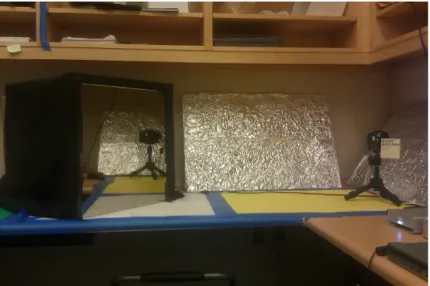
far photographs (see figure 3). Camera Set up
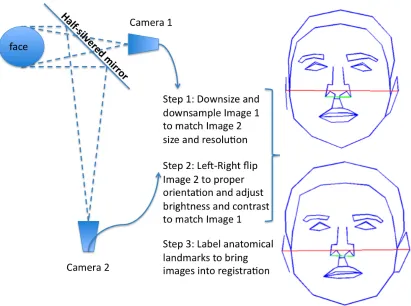
Our apparatus uses a half-silvered mirror to reflect and transmit the face image into two cameras that are aligned to the same optical axis. One camera was placed behind the mirror, and the other placed a distance off to the side at a right angle. As can be seen from the figure, the total distance the light traveled to reach the camera behind the mirror is 1.5 feet, and the total distance light traveled to reach the far camera is 4.5 feet. To ensure the cameras were aligned correctly, we used a digital laser measurer to measure the distance to each side of the lens to millimeter precision. To calibrate the alignment, we pointed a level-lined laser into the first camera while monitoring the output the camera through the computer. When the camera is aligned to the horizontal, the entire image is filled with the color of the laser. We performed the same procedure on both cameras simultaneously to ensure they were aligned to the same optical axis.
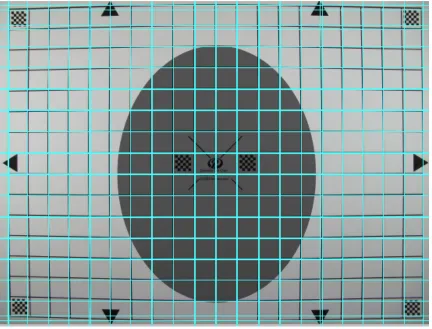
Since each camera was set to a different focal length, there is the possibility that optical distortion might influence the appearance of the images. Short focal length distortion (sometimes called wide angle lens distortion) mostly affects images in the periphery and does so according to a predictable pattern known as barrel distortion. We photographed a checkerboard image to check the degree of image distortion for the focal length used. We found that the amount of distortion was negligible in the central area in which faces were photographed (see figure 4). Additionally, independent analysis (http://www.imaging-resource.com/PRODS/G10/G10A4.HTM) confirms that the
so it cannot possibly account for the large physiognomic differences in a face-centered portrait image.
Image Normalization
After acquiring the images, we then had to normalize them to keep any overt cues from distinguishing them. The far image, captured after reflection on the mirror, was left-right flipped to restore the original orientation. The close image was downsampled and resized to match the resolution and dimensions of the far image. Both images were converted to grayscale and set to the same luminance and contrast (for schematic of the process, see figure 5). The resultant images had the same intra-ocular distance,
luminance, resolution, contrast, and expression. Each image was also rotated so that the eyes are aligned horizontally and are placed at the vertical center of the image. After processing, the only difference that remained was the geometrical warping due to perspective projection, and subtle differences in focus, resolution and highlighting.
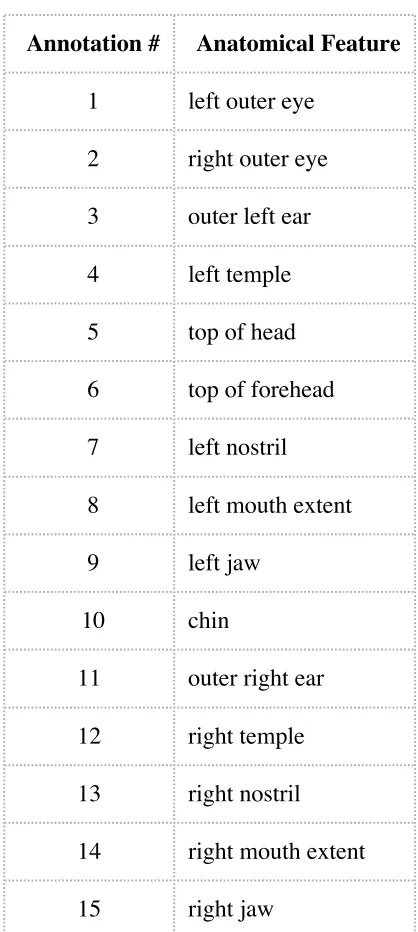
In order to eliminate the subtle lighting differences, we devised a way to warp the far image so that it matched the shape of the close image, but retained its original lighting information. By annotating each face on 115 anatomically important locations, we could calculate a warp field to apply to the image so that these important keypoints would be in the configuration of the close face, but the pixel information would come from the far face. This final control step ensured that the only difference between the far and close image was the geometrical difference due to perspective projection (see figure 6). Such a transformation of the image is only possible when both the near and far faces are
2.1.2 Vertical Spacing
The appearance of a three dimensional object also depends on the vertical viewing angle. Objects viewing from slightly above or below will cast a different 2-D image. Since there exists a good deal of variation in the heights at which people stand, it stands to reason that learning algorithms in the brain have picked up on this statistical regularity as well.
In order to test the likely hypothesis that vertical viewing angle influences social perceptions, it is possible to capture stimuli in a number of ways. The easiest way is to take a series of photographs at different vertical elevations with respect to the portrait subject. This method, however, suffers from the same confound as taking a series of photographs at different horizontal displacements: the portrait subject is liable to alter their emotional expression as a response to their explicit knowledge of the camera
position. Therefore, as it was before, it is necessary to design a photographic apparatus to simultaneously take photographs at multiple viewing angles.
three simultaneously recorded images from a single acquisition. This combination of simultaneous photographs and digital manipulation ensured that all the images displayed the same expression and the same gaze direction.
We collected two datasets using this technique: one with 6 Caucasian male faces and one with 9 Caucasian male faces. These images are used for an experiment described in Chapter 3.
For both photographic methods, we recruited volunteers from the pool of subjects that also participated in behavioral testing. These subjects, therefore, were familiar with the rules of the economic trust game and were able to tell us what their own responses would be as the trustee. They were instructed to wear a completely neutral expression, devoid of any emotional information. However, given that we can capture emotional expression from multiple perspectives simultaneously and that expression is very likely to influence social perceptions, we opted to collect positively and negatively valenced stimuli for use in future studies. Therefore, the end result of the stimulus acquisition portion of this work is a large body of facial images that contain simultaneously captured emotional expressions from different viewing positions. For a table of stimuli available for future research, see table 1.
2.2 Behavioral Testing Methods
2.2.1 Participants
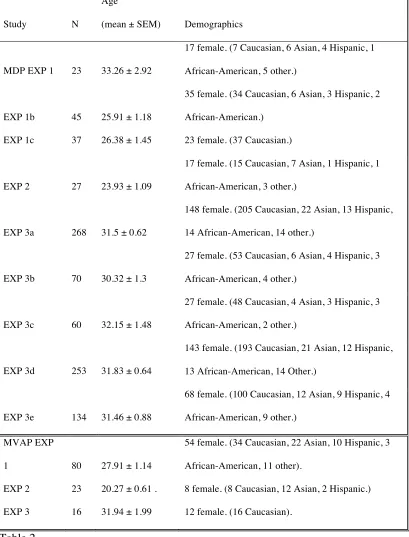
advertisement on Craigslist, brainscience.caltech.edu, through posted flyers throughout the Pasadena area, and through Amazon Mechanical Turk, which allowed people to participate from their personal computers. Eligible participants were between the ages of 18 and 55, had no history of neurological or psychiatric illness, and had not previously participated in the study. See Table 2 for detailed demographic information for each experiment.
The reason for replicating the experimental results in three separate testing conditions is that it provides broader support for the relevance of perspective projection in everyday life. Subjects who came to the lab participated under very controlled conditions, with their heads resting in a chinrest at a fixed distance to the screen. They were the only subjects in the room and received individualized verbal instruction from the experimenters. These conditions ensured that all subjects had roughly the same
experience. At the opposite end of the experimental control / ecological validity trade-off, subjects who participated through Amazon Mechanical Turk did so under a wide variety of testing conditions. We had no experimental control over the size of the display, their proximity to the display from trial to trial, or any personal assurance that they even understood the instructions. To gauge their ability to follow instructions, we had to rely on their ability to successfully complete a series of surveys before receiving
compensation.
2.2.2. Experimental Design
simply asked participants to rate the stimuli on a 1-7 scale on a variety of characteristics, including Attractiveness, Competence, Trustworthiness, Age and Weight. We also included a block where participants made explicit judgments about the distance to the camera. Second, we asked an independent group of participants to play an economic trust game imagining the people depicted in the stimuli as partners. Thus we sought a direct and an indirect way to ask participants about trust, and received data concerning both explicit judgments and real-world behavior.
All of the paradigms used are “Within-Subject” for the purposes of maximizing statistical power. In other words, each participant views each stimulus face in both the far and the close condition. The possibility of order effects are addressed through
counterbalancing: for each participant, a randomly chosen half of the stimulus faces (9 faces) are shown in the close condition for the first half of the study, followed by the far condition for the second half. The other half of the faces (9 faces) is shown in the opposite presentation order (first seen as far, then as close). Thus each half of the
experiment contains an equal number of close and far faces, and an equal number of faces are seen first close then far as are seen first far then close. This design allows us to
calculate an difference score for each participant, and to perform group level statistics over those scores, while avoiding the possibility that the order of presentation can drive the effect.
The counterbalancing design also helps avoid experimental transparency by ensuring that no face is seen in both conditions consecutively or in the same half of the experiment.
design of the experiment was the same. However, the trait rating design included 3 rating scales, so this portion of the study took 3 times as long to complete. The order of trait rating was counterbalanced such that each trait occurred in first, middle, and last an equal proportion of times across participants.
Participants were instructed to rate the faces according to their first impression, immediate gut reaction, and to make their decision quickly. They were told that faces would appear more than once, that we were interested only in how the facial appearance struck them at that particular moment in time, and that it was okay to change their minds over the course of the study. They were also told that all the faces would be Caucasian males because we wished to avoid the complicating effects of race or gender and that all responses should be made relative to their experience with this particular demographic group.
Each participant rated each face in both conditions, separated in time. For each experiment, analysis proceeded by examining the difference between their CLOSE and FAR ratings using a 2x2 mixed ANOVA, with factors viewing distance (within subject factor) and gender (between subjects factor). A post-hoc t-test was then used to examine the difference in the CLOSE and FAR means. In all cases, the data were normalized to a 100-point scale for ease of interpretation as a percentage of the range. However, the analyses were also performed in parallel on the z-transformed data to ensure that the results were the same for data adjusted to meet the Gaussian distribution assumptions of the ANOVA test.
Stimulus
Set Number of Faces Viewpoint Expression
Gaze
Direction Studies
MDP1 18 males Frontal Neutral Direct Chapter 3
18 males Frontal Smiling Direct -
18 males Frontal Angry Direct -
18 males Frontal Neutral Averted
18 males Frontal Smiling Averted
18 males Frontal Angry Averted
18 males 3/4 Neutral Direct
18 males 3/4 Smiling Direct
18 males 3/4 Angry Direct
18 males 3/4 Neutral Averted
18 males 3/4 Smiling Averted
18 males 3/4 Angry Averted
MVAP1 15 males Frontal Neutral Direct Chapter 3
15 males Frontal Smiling Direct
15 males Frontal Angry Direct
Table1.
Study N
Age
(mean ± SEM) Demographics
MDP EXP 1 23 33.26 ± 2.92
17 female. (7 Caucasian, 6 Asian, 4 Hispanic, 1
African-American, 5 other.)
EXP 1b 45 25.91 ± 1.18
35 female. (34 Caucasian, 6 Asian, 3 Hispanic, 2
African-American.)
EXP 1c 37 26.38 ± 1.45 23 female. (37 Caucasian.)
EXP 2 27 23.93 ± 1.09
17 female. (15 Caucasian, 7 Asian, 1 Hispanic, 1
African-American, 3 other.)
EXP 3a 268 31.5 ± 0.62
148 female. (205 Caucasian, 22 Asian, 13 Hispanic,
14 African-American, 14 other.)
EXP 3b 70 30.32 ± 1.3
27 female. (53 Caucasian, 6 Asian, 4 Hispanic, 3
African-American, 4 other.)
EXP 3c 60 32.15 ± 1.48
27 female. (48 Caucasian, 4 Asian, 3 Hispanic, 3
African-American, 2 other.)
EXP 3d 253 31.83 ± 0.64
143 female. (193 Caucasian, 21 Asian, 12 Hispanic,
13 African-American, 14 Other.)
EXP 3e 134 31.46 ± 0.88
68 female. (100 Caucasian, 12 Asian, 9 Hispanic, 4
African-American, 9 other.)
MVAP EXP
1 80 27.91 ± 1.14
54 female. (34 Caucasian, 22 Asian, 10 Hispanic, 3
African-American, 11 other).
EXP 2 23 20.27 ± 0.61 . 8 female. (8 Caucasian, 12 Asian, 2 Hispanic.)
[image:39.612.91.500.107.644.2]EXP 3 16 31.94 ± 1.99 12 female. (16 Caucasian).
Table 2.
Figures
Figure 2. Illustration of geometry behind differences in facial appearance. The
Figure 6. Digital manipulation of images according to photographic distance. The
Chapter 3. Behavioral Impact
3.1 Introduction
In this chapter I will introduce several initial results we have found using the stimuli discussed in Chapter 2. We use two basic paradigms: ratings of personality traits and a behavioral economics game. We use both behavioral testing methods in order to find converging evidence that the viewing distance and vertical viewing angle to a face image impacts the psychological processes underlying interpersonal inferences, especially those related to trust decisions.
3.2 Influence of Interpersonal Distance
Perspective distortion from interpersonal distance: an implicit visual cue for social judgments of faces
Ronnie Bryan1
, Pietro Perona1,2
, Ralph Adolphs1,2
1
Computation and Neural Systems Program
2
Division of Biology
California Institute of Technology
Pasadena, CA 91125
Correspondence to:
1200 E California Blvd M/C 136-93, Pasadena, CA, 91125
The basis of social judgments, such as trust, derived from visual information in faces remains an open problem in social cognitive science. Many explanations relating to facial appearance have been proposed, suggesting a basis for inferring why some faces are viewed as more trustworthy than others. Here we investigated the contribution of a novel cue: the change of appearance due to the perspective distortion that results from viewing distance. We found that photographs of faces taken from within personal space elicit investment in an economic trust game and lower ratings of trustworthiness, competence, and attractiveness, compared to photographs taken from a greater distance. This effect was replicated across multiple studies controlling for facial image size, facial expression and lighting, and was not explained by face width-to-height ratio, explicit knowledge of the camera distance, or how average the faces are perceived. These results demonstrate a novel facial cue influencing social judgments as a function of interpersonal distance, and moreover one likely to be processed implicitly.
Introduction
We glean a wealth of socially relevant information from faces in the blink of an eye: a person’s attractiveness, competence, threat, identity, gender, emotion, and trustworthiness, to mention a few. For example, reliable judgments of trustworthiness can be made from faces viewed for 100ms (1). Multiple factors influence such
judgments. The perceived valence of the neutral face, for example, is thought to influence trait attributions by activating brain systems tuned to facial expression (2). The structural width-to-height ratio of a face has been shown to be a reliable indicator of the
the cheeks and the apparent size of the eyes, termed babyfacedness, may influence trust by activating representations related to the perception of age (4). These avenues of investigation all attempt to explain why some individuals are perceived as more or less trustworthy than others on first glance. Yet there is one important ecological cue that, to our knowledge, has not received such intensive study: the perspective distortion as a function of physical distance. The change of appearance of an individual with viewing distance is studied here as independent of other factors such as facial expression and is demonstrated to be sufficient in itself for influencing behavior relating to trust and other inferred personality traits. Our approach expands investigation from analysis of the appearance of a face to analysis of the relationship between a viewer and the stimulus.
Three-dimensional objects, such as the human face, produce on the retina a two-dimensional image via perspective projection. The image varies with distance from the center of projection, even when equated for size (see Figure 2a); e.g., the nose looks relatively larger and the ears smaller as the distance decreases (5). Such differences may be modeled as a distance-dependent image warp or distortion (see Figure 1). This effect may have been utilized in portrait paintings not only to induce distance percepts but also to manipulate how viewers feel about the face (6).
Ever since Edward Hall’s seminal book on the topic (7), interpersonal distance and personal space have been highlighted as ubiquitous and potent determinants of a wide variety of social behavior (8). Notably, interpersonal distance is associated with arousal (9), self-protective behavior (10), privacy (11), emotional valence (12, 13), management of stress and aggression (14), and interpersonal trust (15). In each of these studies,
observed reacting to a confederate standing at an experimentally determined distance. The result is that the observed changes may result from any or all of the many multi-modal perceptions that accompany a change in interpersonal distance. For example, the size of the face is smaller and the visibility of the body is greater at greater distances. These studies demonstrate the efficacy of interpersonal distance at eliciting a variety of emotional responses relevant to trust.
Reading faces for socially relevant traits such as trust may occur automatically and may elicit reliable ratings after a very brief exposure (16, 1). These findings imply that there may be a system that implicitly evaluates trustworthiness. Interpersonal distance is a potent variable influencing social behavior (7, 8, 17), and is related to activity in the amygdala: even the knowledge of interpersonal closeness causes an increase of activity in this brain structure (18). The amygdala is also a critical structure for the automatic
evaluation of threat (19; 20), facial valence information (21), and trustworthiness of faces (22; 23; 24). Therefore, we hypothesized that the distance-dependent perspective
projection of a face might be a cue for social judgments, especially those related to trust. Since interpersonal distance is known to influence a variety of traits, we
investigated a broad set of questions in these experiments. Participants not only
performed a trust game, but also rated faces on dimensions of apparent trustworthiness, competence, attractiveness, age, weight, averageness, and animal-likeness. These traits were selected because of they have been shown to be important to social decision-making (trust, competence, attractiveness, and age) or might vary with distance in a predictable way (weight, averageness, and animal-likeness).
experiments that obtained social judgments (ratings) as well as measured trust behavior in terms of the amount of money participants were willing to invest in a person whose face they saw (see Table 1 for summary of experiments). The first experiment used
photographs taken from different distances, while controlling the size and facial
expression of the stimuli; the second used synthetically warped face images to eliminate possible confounds in highlights and focus; the third explored a number of follow-up questions with a larger subject sample tested over the internet. All effects are reported as the difference of the behavioral response to far and close face stimuli. Although
participant gender was not a factor of interest in our study, all findings were followed up with exploratory ANOVAs that included participant gender as a possible factor.
Experiment 1
Results: In Experiment 1a, faces photographed at the far distance elicited higher investments than those photographed at the close distance: mean investment difference (far faces - close faces) was 3.2±2.1 (95% CI), t(22)=3.2, p<0.01 (paired t-tests, 2-tailed). Similarly, in Experiment 1b the far faces elicited higher ratings of attractiveness (5.1±1.5, t(34)=6.8, p<0.001), competence (2.7±1.8, t(33)=3.0, p<0.01), and trustworthiness
with competence ratings (r=0.90, p<0.001) and attractiveness ratings (r=0.82, p<0.001). Competence and Attractiveness ratings were likewise correlated (r=0.74, p<0.001). The correlations are so high that the residual trust ratings after regressing out the ratings of attractiveness and competence do not display a significant preference for far faces on their own.
Between the participants of Experiment 1a and Experiment 1b, investments in the trust game were correlated with ratings of trust (r=0.84, p<0.001), competence (r=0.86, p<0.001), and attractiveness (r=0.65, p<0.001). Again, residual investments after regressing out these independent face ratings do not a display statistically significant preference for far faces on their own.
In Experiment 1c, ratings of age and camera distance showed no statistically
significant effects of distance (respectively, 0.1±1.2, -3.1±4.3), although ratings of weight revealed that faces photographed farther away appeared heavier (3.9±1.4, t(35)=5.47, p<0.001). Experiment 1a investment residuals after regressing these ratings out do display a statistically significant preference for faces (regressing out age: mean investment difference = 3.24, p<0.02; regressing out distance: mean investment difference = 4.63, p<0.01; regressing out weight: mean investment difference = 3.97, p<0.01).
Post-experiment debriefing confirmed that none of the participants noticed that face distance was manipulated. Finally, to explore possible gender effects, a 2x2 (participant gender x viewing distance) ANOVA on the trustworthiness ratings confirmed a
Discussion
Faces photographed from within personal space elicited lower monetary investments and lower ratings of trustworthiness, attractiveness and competence than did simultaneously photographed faces from outside of personal space. All three ratings were highly
correlated, suggesting that the influence of personal space on social judgments may not be limited to trustworthiness alone.
The finding that the faces appear heavier is consistent with the vertically oblong shape of the human head, which will produce the greatest perspective distortion at the sides. The effect is that the width-to-height ratio is smaller for closer faces, making them appear thinner. The fact that participants rated far faces as heavier confirms they were able to physically distinguish the far faces from the close faces, but when asked explicitly about camera distance, they were not able to answer correctly. When investment amount residuals after regressing out weight ratings continue to display a preference for far faces, indicating that the change in the perception of a face’s weight does not fully account for the change in investment that face receives. By contrast, trait ratings of trustworthiness, competence, and attractiveness are candidate mediating variables for investment.
Experiment 2
More closely photographed faces exhibit a greater sheen on the highlights than do farther faces. Although the global contrast may be equalized by adjusting the dynamic range of the image, the local contrast in face areas that receive more direct illumination may still contain luminance based cues. Similarly, closer facial features such as the nose may be photographed with a slightly different sharpness than the farther features such as the ears due to the varying distance to the lens. We did not notice any differences in focus between these face regions, but Experiment 2 was conducted as safeguard measure anyway.
To completely isolate perspective warp as the factor against these possible confounding variables, we repeated the experiment with synthetically warped faces.
Results: The mean investment difference (far-close faces) was 4.2±2.1 (95%CI), t(24)=4.2, p<0.001, confirming the effect observed in Experiment 1. Post-experiment debriefing again verified that none of the participants noticed that face distance was manipulated. To explore possible gender effects, a 2x2 (participant gender x viewing distance) ANOVA showed a significant effect of viewing distance: F(1)=15.76, p<0.001, but no effects of participant gender or interaction with gender (F<1.3; n.s.).
Discussion
factors, but does show that they are not necessary to obtain the effect we observe. It should be noted as well that the stimuli in Experiment 1 are more ecologically valid than the synthetically produced stimuli in Experiment 2.
The results of Experiment 2 demonstrate that perspective projection warping is sufficient to influence trust behavior, opening the door for the manipulation of images even in the absence of the simultaneous photographic set-up we devised for these experiments.
Experiment 3
Can the effect measured in Experiments 1 and 2 be obtained with explicit distance cues, such as mere verbal information or image size? Might the effect be due to how average (typical) the images appear? Is the effect sufficiently robust to appear outside the laboratory? We explored these questions in Experiment 3.
Experiment 3 addresses underlying issues in the mechanism by which the
there may be a subconscious system for social regulation that automatically processes this information. Experiment 3 provides participants with explicit information about
interpersonal distance decoupled from the perspective warp: 3b provides verbal information and 3c provides size information.
Another potentially mediating variable that could explain the results of Experiment 1 and 2 is the typicality of the face. Averageness of faces is known to influence a host of cognitive functions (28), including the perception of attractiveness (29), so it is possible that the close faces of Experiment 1 and 2 were seen as less trustworthy simply because they were seen as less average. If participants do in fact view the faces as less average, they should be able to report this perception, as they do in other experiments (30).
Experiment 3 obtains averageness ratings to determine if this perception accounts entirely for the effect of viewing distance. Experiment 3 also obtains ratings of animal-likeness as another avenue for participants to indicate that they find the faces to appear unusual.
As with Experiment 1, we examined the correlation between the trait ratings and the investments. Investment amounts were highly correlated with these independent ratings of trustworthiness (r=0.86, p<0.001), competence (r=0.88, r<0.001), and
attractiveness (r=0.66, p<0.001). Once again, the investment residuals after regressing out each of these ratings did not display a statistically significant preference for face faces.
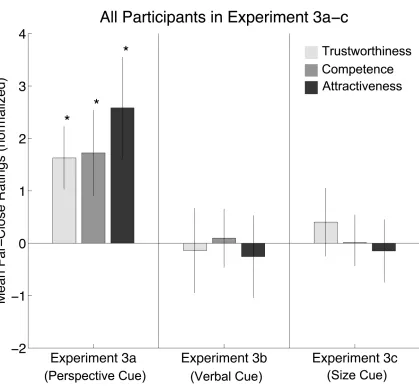
Experiment 3b showed no effect of explicit verbal information about distance on any rating: trust: -0.2±1.6, t(65) = -0.22; competence: 0.2±1.1, (t(62) = 0.30;
attractiveness: -0.3±1.5, t(64) = -0.34, all n.s.
Experiment 3c showed no effect of image size: trust: 0.4± 1.0, t(53) = 0.78; competence: -0.1±1.1, t(56) = -0.12; attractiveness: -0.2±0.9, t(53) = -0.38, all n.s.
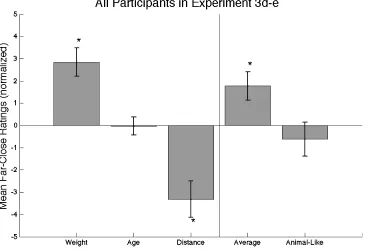
Experiment 3d replicated Experiment 1c (heaviness: 2.9±0.6, t(224) = 9.8, p < 0.001; age: -0.1±0.5, t(232) = -0.27, n.s.), although ratings of camera distance now reached statistical significance, likely due to the increased sample size (-3.3±1.3, t(225) = -5.10, p < 0.001). See Figure 4 for a summary of the results of Experiment 3d-e.
Experiment 3e showed that “far” faces were rated as more Average (1.8±0.5, t(111) = 3.63, p < 0.001), but not more or less Animal-like (-0.7±1.1, t(116) = -1.29, n.s.).
Athough averageness and trustworthiness ratings across all 36 faces (the 18 close and 18 far versions of each of the 18 individuals) were negatively correlated (r=-0.36, p<0.05), the residualized trustworthiness ratings, partialling out averageness, still showed a significant effect of distance as before (2.3 +/- 0.72 (SEM), t(17)=3.3, p<0.01)
Discussion
Experiment 3 demonstrated that the influence of perspective distortion is robust even when administered over the internet, where display size and distance to the display are not controlled. Explicit manipulation of perceived distance to the face stimulus through image size or verbal instruction failed to show any effects, indicating that perspective distortion operates through separate processes.
Perceptions of averageness were also influenced by perspective distortion,
suggesting the possibility that these might in part mediate the effect on trustworthiness. However, across all of the 36 faces (close and far ones), averageness ratings were in fact anticorrelated with trustworthiness ratings, with the result that partialling out the effect of averageness actually increased the significant of the effect of distance on trustworthiness judgments. We thus conclude that the effect of distance on trustworthiness judgments is not a result of manipulating the averageness of the faces.
narrower aspect ratio, participants in Experiment 3 reliably reported that these stimuli were less heavy. This demonstrates that when asked to judge a purely physical trait, participants can demonstrate accurate discrimination on this task.
General Discussion
We report a reliable novel effect, replicated across several different experiments and in separate subject samples: viewers trust faces photographed at 135cm more than those photographed at 45cm. The effect was found in an economic trust game with real money, and in ratings gathered under laboratory conditions as well as over the internet. Geometric warping of the face alone (modeling perspective distortion due to distance) accounted for the effect while controlling for size, expression, resolution, highlights, focus, and explicit knowledge of camera distance.
Faces photographed at the far distance (135cm) were also rated as more average, as well as more competent and attractive. Given that all these ratings are intercorrelated to some extent, it is difficult to determine which of these judgments might possibly be mediating any of the others; for instance, it is plausible that the perceived averageness of the faces in part drives the differences in trustworthiness that we report. However, when controlling for averageness, the effect of distance on trustworthiness judgments in fact increased (Experiment 3), indicating that our distance manipulation does not influence trustworthiness judgments derivatively merely by altering perceived averageness.