NOVEMBER
1959
•
VOL.
8 -
NO. 11
A New Magnetic Device for Memory and Logic
The Demand for College Training in Digital Computing
"Our engineering
'unit costs
.<
dropped drastic,ally'
afte,r
installing'
the Bendix 6-15
dig-ital computer."
~10.~
NORMAN W. RIMMU, CHIEF PRODUCTS ENGINua. RUltDINGS DIVISION, '. BIJTlER MANUFACTURING COMI'ANY, .
CITY, MI~SOURI
Butler's progressive engineering program requires a fast, versatile, and low-cost computer.
I t must handle complex structural problems and still be simple enough to be used by
engi-neers with no programming experience. The computer's mission: cut engineering" unit
costs. "Our own survey proved that the Bendix G-15 digital computer could best do this
job,"
says Mr. Rimmer, "and it does."
For Butler, part of the cost-cutting
versa-tility of the G-15 stems from the variety
of programming methods they can use.
For the solution of repetitive problems at
highest speeds, they use the machine
lan-guage system. With the simplified
Inter-com 1000 system, the entire staff uses the
computer for structural design problems.
This versatility also means the G-15 can
be used for business data processing as
well as scientific and
de-sign calculations.
Butler is also pleased with
the expandability of the
G-15. They know that as
their computing
require-ments grow, they can add
magnetic tape units, punched card
equip-ment, digital differential analyzers,
plot-ters, and other accessories. Remember,
however, that the basic G-15, which
in-cludes a unique photo-electric tape
reader-punch and alphanumeric typewriter, is
more than adequate for most problems.
Find out more about this computer -
the
onlymedium-scale computer in the
low-price field. Inquiries regarding specific
applications are welcomed.
DIVISION OF BENDIX AVIATION CORPORATION
Dept. D-16
COMPUTERS
and
AUTOMATION
DATA PROCESSING
•
CYBERNETICS
•
ROBOTS
Volume 8
Number 11
NOVEMBER, 1959
Established September 1951
EDM UND C. BERKELEY Editor
H. JEFFERSON MILLS, JR. Assistant Editor
NBIL D. MACDONALD Assistant Edilor
SERVICE AND SALES DIRECTOR MILTON L. KAYE
H~ Fifth Ave.
MUrray Hill 2-4194 New York 17, N.Y. CONTRIBUTING EDITORS ANDREW D. BOOTH
NED CHAPIN JOHN W. CARR, III
ALSTON S. HoUSEHOLDER ADVISORY COMMITTEE MORTON M. ASTRAHAN
HOWARD T. ENGSTROM GEORGE E. FORSYTHE
RICHARD W. HAMMING ALSTON S. HOUSEHOLDER
HERBERT F. MITCHELL, JR. SAMUEL B. WILLIAMS
ADVERTISING REPRESENTATIVES
Midd/e AI/anlic Slates MILTON L. KAYB
~35 Fifth Ave. New York 17, N.Y. MUrray Hill 2-4194
Washington 6, D.C.
1519 Connecticut Ave.
San Francisco 5
605 . Market St.
Los Ange/es 5
439 S. Western Ave.
Elsewhere'
ROBERT CADEL COlumbia 5-9727 A. S. BABCOCK YUkon 2-3954 W. F. GREEN DUnkirk 7-8135 THE PUBLISHER Berkeley Enterprises, Inc. 815 Washington St., Newtonville 60, Mass.
DEcatur 2-5453 or 2-3928
COMPUTERS and AUTOMATION is published monthly at 815 Washington St., Newtonville 60, Mass., by Berkeley Enterprises, Inc. Printed in U.S.A.
SUBSCRIPTION RATES: (United States) $5.50 for 1 year, $10.50 for 2 years; (Canada) $6.00 for 1 year, $11.50 for 2 years; (Foreign) $6.50 for 1 year, $12.50 for 2 years. Address all Editorial and Subscription Mail to Berkeley Enterprises, Inc., 815 Washington St., Newtonville 60, Mass.
ENTERED AS SECOND CLASS MATTER at the Post Office at Boston, Mass.
POSTMASTER: Please send all Forms 3579 to Berkeley Enterprises, Inc., 815 Washingtor. St., Newtonville 60, Mass.
Copyright © 1959, by Berkeley Enterprises, Inc. CHANGE OF ADDRESS: If your address changes, please send us both your new address and your old address (as it appears on the magazine address imprint), and allow three weeks for the change to be made.
4
FRONT COVER
A New Magnetic Device for Memory and Logic : .1, 9
ARTICLES
The Demand for College Training in Digital
Comput-ing, F. R. HARTMAN 11
Research, Instrumentation, Automatic Analysis, and
Response, A. V. ASTIN . 15
Some Computer Developments in Sweden, MORTIMER
DATZ
16
Automatic Searching of Chemical Literature . 24
Computers and Automation in the U.S.S.R., E.
J.
HAGA 26READERS' AND EDITOR'S FORUM
"Operation Will be Controlled" from a Distance of About 230,000 Miles by a "Coordination and Computing
Center on Earth" 6
Calf for Algorithms for an International Handbook for
Automatic Computation, A. S. HOUSEHOLDER 6
Calendar of Coming Events . 22
REFERENCE INFORMATION
Computer Applications: Missile Tracking, Full-Time Use 14
Survey of Recent Articles, M. M. BERLIN . 29
Who's Who in the Computer Field (Supplement) 32
New Patents, R. R. SKOLNICK. 34
INDEX OF NOTICES
Advertising Index . Back Copies
34
see Oct., page
39
Bu'ik Subscriptions. see Oct., page
39
Computer Directory and Buyers' Guide, 1959 . 31
Manuscripts see August, page 28
Reference and Survey Information. see August, page 29
Statement of Ownership and Management . 22
Who's Who Entry Form . see August, page 32
omputer
Programmers:
Seen any new horizons
lately?
Do you sometimes feel that you're adrift in a sea of sameness ... that beyond your present horizon is another just like it? If so, it's important that you know what's going on in computer programming at System Development Corporation.
In addition to developing large computerized control systems for SAGE, SAC, and other. important operations - SOC is engaged in a number of long-range research projects. They include: automatic coding and problem-oriented languages; development of a language to automate transition from one computer to another;, study of the organization of large systems; investigation ot~computer design from a standpoint of programabiHty rather than engineering; information retrieval and medical data processing.
POSITIONS NOW OPEN AT ALL LEVELS
(at Santa MOllica, California and Lodi, New Jersey)
The extension of SOC's programming activities into new areas has created openings for Programmers at various levels ,of experience, including senior status. Please send your inquiry to Mr. E. A. Shaw, SOC, 2406 Colorado Avenue, Santa Monica, California.
"Project CLIP-The Design of a Compiler and Language for Information Processing," a paper by Harvey Bratman of SOC's Data Processing Research staff, is available upon request. Send request to Mr. Bratman at SOC.
Readers' and
Editor's Forum
"OPERATION WILL BE CONTROLLED" FROM A DISTANCE OF ABOUT 230,000 MILES BY A "COORDINATION AND COMPUTING CENTER ON
EARTH"
Following is the text of the Soviet News Agency's an-nouncement of the circum-lunar satellite launched on Oc-tober 4, 1959:
Under the program of outer space exploration and prep-aration for interplanetary flights, a third cosmic rocket has been successfully launched in the Soviet Union on Oct. 4, 1959. The rocket carries on board an automatic
interplane-tary station. .
The launching was effected by means of a multistage cocket. The last stage of the rocket after it attained the necessary speed put the automatic interplanetary station into the required orbit.
The orbit for the automatic interplanetary station will ensure the passage of the station near the moon and its
flight around the moon. .
The automatic interplanetary station will pass at a dIS-tance of about 10,000 kilometers from the moon and after flying around the moon will continue its movement to the area of the earth. The chosen orbit makes it possible to observe the station from the earth's northern hemisphere. The last stage of the third Soviet cosmic rocket weighs 1,553 kilograms without fuel [3,323 pounds].
The automatic interplanetary station was installed on the last stage of the rocket. After orbiting the station was dis-engaged from the rocket. The last stage of the rocket is moving over an orbit closely approximating the orbit of the station. The automatic interplanetary station is de-signed for a broad range of scientific studies in outer space. The station carries scientific and radio equipment, also a system for automatic temperature control. The scientific and radio equipment is powered by solar batteries and chemical sources of electricity.
The station weighs a total of 278.5 kilograms [601 pounds].
Moreover, the last stage of the rocket carries measuring equipment with power sources weighing 156.5 kilograms [343 pounds]. Thus the aggregate payload amounts to 435 kilograms [958 pounds].
The scientific information and the results of the mea-surement of the parameters of the movement of the auto-matic interplanetary station will be transmitted by means of two radio transmitters operating on frequencies of 39.986 megacycles and 183.6 megacycles.
At the same time the 183.6 megacycles radioIine will be used to control the elements of the orbit of the interplan-etary station.
The signals of the transmitter operating on the frequency of 39.986 megacycles represent pulses of a duration vary-ing from 0.28 of a second.
Information from the board of the automatic
interplane-tary station will be transmitted at definite intervals for two to four hours a day in conformity with the program of ob-servations.
The operation of the equipment of the automatic inter-planetary station will be controlled from a coordination and computing center on the earth.
The measurement of the rocket parameters is effected automatically by a measuring complex whose monitoring stations are situated at various points of the Soviet Union. All radio stations of the Soviet Union will broadcast reports on the movement of the third cosmic rocket.
On Oct. 4 the radio technical equipment will start oper-ating at 1 P.M. Moscow Time.
At that time the rocket will be over a point in the Indian Ocean 80 degrees Eastern longitude and 5 degrees Southern latitude at a distance of 108,000 kilometers from the earth. The radio-technical equipment will operate for two hours.
Radio observations of the rocket can be conducted from the territory of Europe, Asia, Africa and Australia.
The launching of the third Soviet cosmic rocket and the development of an automatic interplanetary station will supply new data on outer space and represent another con-tribution of the Soviet people to international cooperation in outer space exploration.
CALL FOR ALGORITHMS FOR AN INTERNATIONAL HANDBOOK FOR
AUTOMATIC COMPUTATION
Alston S. Householder
Oak Ridge National laboratory Oak Ridge, Tenn.
Preparation of a handbook for automatic comp~tati~n,
in five or more volumes, is now under way for pubhcatlon by Springer-Verlag, Germany. It will appear in F. K. Schmidt's series, "Grundlehren der Mathematischen Wis-senschaften." Editors are: F. 1. Bauer, Mainz; A. S. Householder, Oak Ridge; F. W.
J.
Olver, Teddington; H. Rutishauser, Zurich; K. Samelson, Mainz; R. Sauer, Mun-ich; and E. Stiefel, Zurich.The purpose of the handbook is to provide a collection of tested algorithms for mathematical computations of all sorts. These include the solution of finite and of func-tional equations, methods of approximating functions, the evaluation of special functions, etc. These algorithms are to be written in the programming language Algol, and hence will be usable on any machine for which a suitable translator is available, and even without a translator can be used as a model for programming.
It is evident that such a collection could have no general utility unless written in some common descriptive language. The descriptive language will be English.
[Please turn to page 10]
Radar Tracking Computers
~
!~r:1
1- . . . I 1':3m
p."fj' • • • I
~
High Speed Repetitive
Display
MC·5900 Process Master Analog Computer
Some people can prove man and mouse aTe identical
MC-3302 Transistorized
Data Plotting Board
It's all according to the points of similarity you choose. Differences are what really prove the superiority of man over mouse. Computers have differences, too. In fact, it's in these differences that the CSI-designed MC-S800 obsoletes every other Analog Computer. The best proof lies in
cold hard Specifications
• Exclusive dynamic memory makes automatic iterative solution of statistical or optimization problems a reality.
• Stable amplifier operation over the entire feed·back range from zero to infinity.
• Lowest amplifier grid-current <10-!) ampere.
• Amplifiers provide lowest noise level output-less than one milli-
~
A N
volt at unity gain.• Amplifier frequency response-flat to 10,000 cps and only 3 db down at 28 kc.
• Real-time precision @ speeds to 60 solutions/sec.
• Exclusive electronic generators of the function of two-or-more variables may be programmed at patch·board in same time required for setup of single-variable generators.
• Will program 134 amplifiers, 30 electronic multipliers, 18 diode function generators, 2 time·delay generators, 8 relay amplifiers, and 6 servos from one 2128-hole patchboard.
• Highest performance electronic multiplier-flat to 10,000 cps and only 3 db down at 20 kc.
• Dynamic memory
+
high-speed quick-reset rep-op provide practi-cal approach to solution of simultaneous partial differential equations. • Dynamic memory with time-base accuracy of ± 10 ILsec provides automatic parameter searching by iteration-an exclusive capability. • Solution of problems with up to IS amplifiers in closed loops. • Plug-in dynamic components ease maintenance.• Lowest computer cross-talk-rejection greater than 2,000 to l.
• Selection of real-time, expanded-time or high-speed compressed-time without reprogramming.
• Passive networks stabilized at < 1°C above room ambient-no oven required.
• EVERY SPECIFICATION IS GUARANTEED TO BE TRUE PERFORMANCE STANDARD-IN SUSTAINED OPERATION.
• Only diode function generators utilizing resistors, potentiometers, and diodes of equal quality to those in computing networks. • Only diode function generators with individual hi·lo gain positions for each segment.
• Lowest function generator drift < S mv/8 hrs. • Lowest servo step·function overshoot-less than 1%. • DC tachometer feedback on all servos.
• Complete control of all amplifiers, multipliers, dividers, and non-linear equipment at patchboard. " , • Exclusive equipment-door packaging for free access and quick maintenance without shutdown.
• Insulated patchboard prevents costly shorting accidents. • Power supplies eliminated from console-lowest, most stable operating temperatures-rise < 3°C.
• Field expandable without mechanical rework or rewiring. There are many more differences (over a hundred, in fact) . Before you buy or lease your next analog computer, compare them all ... and we think you'll agree with us when we say: The MC-S800 obso-letes every other analog computer made.
Computer Systems, Inc . ....::. designers and manufacturers of the
high-est precision analog computers and computer accessories.
MC-70t Electronic
Multiplier Linear Programming Computer
~
COMPUTER SYSTEMS, INC., 611 BROADWAY. NEW YORK 12, N. Y.· SP 7 - 4 0 1 6ROYAL PRECISION
•
Your
greatest
computer
value
on
the
market •••
•
-
-61
Ins/ue ...
The world's largest-selling engineering
and scientific computer, the compact, mobile LGP-30 is also
the lowest-priced complete computing system you can buy or
lease.
Itgives you the largest memory (4096 words) and
ca-pacity in its class. Internal components have been greatly
reduced to insure highest operating reliability. The logic
circuit and few etched circuit cards are easily removed for
checkout and maintenance.
and ...
The LGP-30
oper-ates from any wall outlet, requires no site preparation. With
its simplified command structure, the LGP-30 is the easiest
computer to program and operate.
Itis delivered complete
with tape typewriter for alpha-numeric input-output. An
ex-tensive library of programs and sub-routines is available. Sold
and serviced coast-to-coast, in Canada and abroad by Royal
McBee, it's your greatest computer value inside and
out.
Royal Precision Corporation
Royal Precision is jointly owned by the Royal McBee and General Precision Equipment Corporations. LGP-30 sales and service are available coast-to-coast, in Canada and abroad through Royal McBee Data Processing offices. For complete information write
ROYAL MCBEE CORPORATION, data processing division, Port Chester, New York
A New Magnetic Device for
Memory and Logic
Aeronutronic
Newport Beach, Calif.
The front cover shows several hundred of tiny, ferrite, computer elements called Biax, compared for size with an ordinary nickel. The element can be used for both memory and logic circuits. It was developed by Aeronutronic, a Division of Ford Motor Co., Newport Beach, Calif., and is now in mass production. Complete memory systems and computers using the Biax element are currently being marketed for special commercial and military applications.
The Biax element is a small rectangular bar of ferrite magnetic material measuring 50 x 50 x 85 mils. The ele-ments are so small that 310,000 will fit into a quart milk carton.
The basic concept employed by Biax is that of flux in-terference between orthogonal magnetic fields. This is ac-complished by means of two 20-mil orthogonal holes through the element. The flux interference takes place in the magnetic material between the holes. Because of the orthogonality, no normal magnetic coupling occurs between conductors associated with the two holes in the materials.
By controlling the spacing between the holes, the flux interference techniques can be made either destructive or non-destructive. Memory applications employ the
The relative size of a Biax element is shown here.
and AUTOMATION for November, 1959
This enlarged microscopic photograph of a Biax memory element shows details of wiring in the tiny, new computer component
developed by Aeronutronic.
non-destructive element whereas logical circuitry makes use of the destructive element.
In the memory element, one of the orthogonal holes acts as the storage axis while the other hole acts as the nondes-tructive interrogate axis. In the logical element, the ortho-gonal holes are placed extremely close together.
The elements have been interrogated over one hundred billion times at a ten megacycle rate with no loss in output signal, indicating reliable non-destructive readout and low heating.
The memory element may also be operated under ex-treme environmental conditions. A memory array has been successfully operated for a number of hours at
260° F. and also at 0° F. Tests indicate that arrays can be fabricated which will operate in the vicinity of the Curie temperature of the ferrite used in their manu-facture.
This is a typical Biax array for an electronic digital computer memory unit. The printed circuit card contains more than 300 Biax elements. Multiples of such printed circuit cards, containing Biax, are mounted adjacent to one another in a computer to provide
large memJry capacity.
High speed DperatiDn up to 20 megacycles Df iSDlated elements has been achieved. OperatiDnal memDry circuitry and IDgical circuitry have been Dperated at 2 megacycles.
When mass-produced, Biax computing equipment is cDnsiderably cheaper than much Dther current equipment. Present estimates indicate the CDst saving in IDgical devices will be at least a factDr Df 10.
The new elements may be densely packed: 200 flip-flDps and 3000 gates - the equivalent of 15,000 to 20,000 semi-cDnductors - can be packed in 1110 Df a cubic fDDt.
The application Df Biax techniques will reduce the number Df sDlder connections in a typical CDmputer by a
Readers' and Editor'
sForum
[Continued from page 6]As plans now stand, the DrganizatiDn Df the series will be as follows: Volume 1a will contain a description of the use Df Algol, and Volume 1b a descriptiDn Df the struc-ture of translatDrs. These introductory vDlumes are the only ones that will nDt be made up primarily of actual al-gorithms. Volume 2 will be devoted to the solution Df
finite equations, linear and nonlinear, including the de-termination Df characteristic values and vectors of matrices. VDlume 3 will be on functional equatiDns, especially dif-ferential equations, ordinary and partial, and integral equa-tions. Volume 4 is concerned with methods Df apprDxima-tiDn, and Volume 5 the evaluation Df particular functions.
It is pDssible that certain algorithms, such as those fDr solving inequalities, fDr mathematical programming, for statistical cDmputations, and the like, that do not seem to fall naturally in any of these areas, may be reserved for a sixth volume. Each algorithm is to be accDmpanied by enough explanatory information to make it understandable, along with whatever informatiDn is available on speed, accuracy, range, Dr, mDre generally, fDr judging the
ef-fectiveness of the algorithm fDr a given type of problem. In any event, Dnly pretested algDrithms will be published.
Before the appearance Df the vDlumes themselves, the
al-factDr Df 10 to 100, because many Biax elements may be linked by a single wire, thus avoiding the large number Df
sDlder joints necessary when semicDnductor devices are used. The number Df CDnnectDrs will alsO' be reduced by a factor ten Dr mDre.
Because of the smaller currents required to' Dperate this
type Df memDry, the total power required to achieve a given computational speed is materially reduced.
Biax techniques are currently being applied to a number Df airbDrne and ground-based military projects where multi-megacycle data prDcessing is required.
gorithms will be prepublished in a series Df supplements
to' the jDurnal, "Numerische Mathematik." This is partly
to make each algorithm generally available at the earliest pDssible time. But in addition to this, such pre-publication makes it pDssible to include in the handbook itself additional information, and even corrections, that might
CDme in from users.
ContributiDns are earnestly sDlicited. For the present, at least, these must necessarily be in the form of actual algDrithms, along with information as to the extent and mode Df testing the algDrithm, estimates of accuracy, and experience in using it. Untested algorithms will not neces-sarily be rejected ipsO' facto, but their inclusion must necessarily await actual test. As algorithms are published, information relating to published algorithms also will be welcomed. Contributions may be sent to any of the editors named above.
THE DEMAND FOR COLLEGE TRAINING
IN DIGITAL COMPUTING
Frank R. Hartman
Pennsylvania State University University Park, Pa.
The history of electronic digital computing is so re-cent that it can hardly be called history. Digital com-puting was born barely yesterday, and the picture result-ing from its flourishresult-ing and phenomenal growth is of an infant of giant proportions. We need to make some plans for the child's future education, but the present major problem is an army of teachers.
To get some measurements on its own computer teach-ing problem, the Pennsylvania State University recently undertook to determine the extent to which computing facilities had become a necessity to (1) its research-minded faculty and (2) a stable part of the commercial and industrial environment into which the University could expect to send its graduates. The information re-ported here deals exclusively with the second portion of the Penn State study. The study seeks to ascertain how computing facilities are distributed in industry and to assess the resulting need for computer training of col-lege graduates. The method of obtaining the informa-tion was a mail survey, based on the assumpinforma-tion that business, itself, could make the most accurate estimate of its own needs.
The Survey Method
The survey population was established as the group of commercial and industrial recruiters who regularly visit Pennsylvania State University to interview prospec-tive graduates and who are listed with the University Placement Division. This population includes most of the nationally known firms that are of sufficient size to make use of a college-recruiting team, and also a selec-tion of smaller firms that contact Penn State because of their nearness.
The questionnaire asked a commercial concern essen-tiall y three questions: (1) What is the nature of your present or contemplated computing facilities if any? (2) What is your present demand for graduates in a specific curriculum possessing various levels of com-puter knowledge and experience? (3) By what factor would you multiply your figures to estimate your com-puter usage and demand for comcom-puter-trained employees in 1970?
The questionnaire was sent to 640 industrial and com-mercial concerns, which can be reduced to an effective 600 because of overlap among the corporations. 325 re-plies were received, 54
%
of the number polled. Anes-timate for the remaining 46
%
was made by an arbitrary increase of the obtained figures by 25% .
It should be remarked that random sampling, whether of the original population or of the non-responding firms, would have constituted a more adequate sampling design. Unfortunately time and resources were not avail-able to insure the close approximation to 100
%
return which such designs require. To make some ~stimate for the non-responding firms which constitute almost half of the original population it was argued that firms pos-sessing a computing facility were much more likely to respond to the questionnaire than those which did not. The addition of 25%
to extrapolate to the total popu-lation therefore seemed conservative and reasonable. Both the original and extrapolated results of the survey will be presented and the reader may choose for himself whether or not to accept the extrapolation.The Survey Results
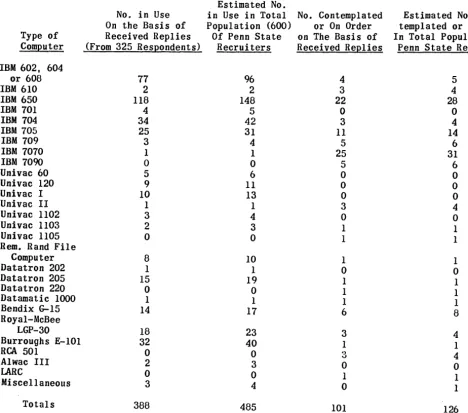
The distribution of computers by models in the 325 companies that responded is given in Table 1. 388 ma-chines have been installed and 101 are contemplated or on order. 35 respondents indicated that their companies had computer facilities, several very extensive, but gave no details. Another 17 are seriously considering the in-stallation of a computing facility, and 3 respondents re-port access to service bureaus. These additional cate-gories are not included in Table 1.
Of the 325 firms replying to the questionnaire, 229 or 70
%
have computing facilities. If these figures are aug-mented by the 17 firms seriously considering new com-puting facilities, a total of 246 or 76%
will be utilizing computer-oriented personnel. Adding 25%
to this last figure and divided by 600 rather than 325, the estimated proportion of the total population of Penn State recruit-ers using computrecruit-ers is 51% .
The next part of the information derived from the survey relates to the demand by the Penn State recruiters for graduates with collegiate training in computers or computing. This information is predominantly supplied by the recruiters who had experience with a computing facility, although a number of firms who had considered the feasibility of such a facility also expressed their opinions.
TABLE 1
FREQUENCY DISTRIBUTION OF COMPUTERS IN USE, CONTEMPLATED, OR ON ORDER,
AS REPORTED BY 325 RESPONDENTS AND EXTRAPOLATED
Estimated No.
No. in Use
in Use in Total No. Contemplated
Estimated No.
Con-On the Basis of
Population (600)
or On Order
temp1ated or on Order
Type of
Received Replies
Of Penn State
on The Basis of
In Total Population of
Com~uter
(From 325
Res~ondents)Recruiters
Received
Re~liesPenn State Recruiters
IBM 602, 604
or 608
77
96
IBM 610
2
2
IBM 650
118
148
IBM 701
4
5
IBM 704
34
42
IBM 705
25
31
IBM 709
3
4
IBM 7070
1
1
IBM 7090
0
0
Univac 60
5
6
Univac 120
9
11
Univac I
10
13
Univac II
1
1
Univac 1102
3
4
Univac 1103
2
3
Univac 1105
0
0
Rem. Rand File
Computer
8
10
Datatron 202
1
1
Datatron 205
15
19
Datatron 220
0
0
Datamatic 1000
1
1
Bendix G-15
14
17
Royal-McBee
LGP-30
18
23
Burroughs E-I0l
32
40
RCA 501
0
0
Alwac III
2
3
rARC
0
0
Miscellaneous
3
4
Totals
388
485
a knowledge of computing become a critical factor in training? (2) What level of knowledge about com-puters is required? (3) What increase in the demand for computer training is likely in the next decade?
To obtain answers to these questions the respondents were asked to examine a list of approximately 30 cur-, ricula in which Penn State seniors are graduated and to
consider what kind of computing training was desirable for a graduate in a particular curriculum. It was further requested that for each curriculum the number of per-sons previously hired who possessed a particular level of proficiency be specified and estimates be made of the probable number of vacancies in the following year.
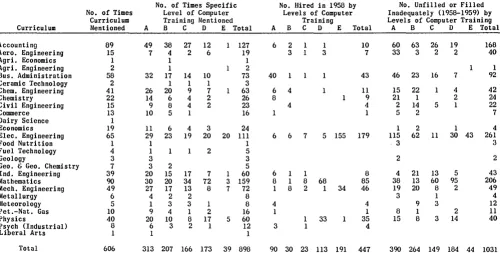
Table 2 lists those Penn State curricula which received at least one mention as needing computer training for their graduates. For each curriculum, the following in-formation is given: (1) the number of times the cur-riculum has been mentioned as requiring computer train-ing of its graduates; (2) the number of times a
particu-4
5
3
4
22
28
0
0
3
4
11
14
5
6
25
31
5
6
0
0
0
0
0
0
3
4
0
0
1
1
1
1
1
1
0
0
1
1
1
1
1
1
6
8
3
4
1
1
<)
oJ
4
0
0
1
1
0
1
101
126
lar proficiency level of training was mentioned for gradu-ates of the curriculum; (3) the number of gradugradu-ates in a curriculum of a particular proficiency level hired in 1958; the number of unfilled or inadequately filled posi-tions for the coming year (1958-1959).
The proficiency levels for computer training (A, B, C, D and E) were defined, as follows:
A. General acquaintance with electronic' computers; their principles of operation, problems applicable, cost, general types of programs, etc.
B. Knowledge of capabilities of computers relative to specific problems; preparation of these problems for programming; interpreting output directly with computers.
C. Preparation of internally stored programs for sci-entific and data processing problems and experience in computer operation using these programs. D. Knowledge of mathematics (numerical methods,
symbolic logic, etc.) necessary for advancing
[image:12.602.40.530.89.504.2] [image:12.602.41.509.92.505.2]puter applications, planning and development. E. Background in the engineering problems
associ-ated wi th computers (maintenance, modification, design, etc.).
The most useful information concerning any given curriculum is the number of times it has been mentioned by the respondents as requiring computer training of its graduates and at what levels. The outstanding curricula are accounting and mathematics. Next in importance are physics, business administration, electrical, industrial and chemical engineering. In part, these figures reflect the relative number of graduates of a particular curriculum in the business and industrial world, but in general this is a reflection of the use to which business computing in-stallations are currently being put. The most common application is bookkeeping and accounting; engineering design problems are a large but secondary common ap-plication. Mathematicians are a special case. They are a necessary intermediary between the problem and the ma-chine and are in such short supply that some plan which will allocate many of their responsibilities to other per-sonnel seems necessary if the application of computing to industrial and commercial problems is to proceed at reasonable speed.
It should be noted that the predominant level of pro-ficiency specified is quite variable among the different curricula. In accounting and business administration the need seems to be for personnel who are familiar with computers and what they can do and perhaps formulate their problems in a logical order amenable to the skills of a programmer. Engineers with all levels of computing training are useful, although chemical engineering at present seems to require training of the same level as business and accounting. Mathematicians are, again, an exception. Their necessary training consists of those
spe-cial branches of mathematics that are particularly appli-cable to computing although, a thorough grounding in machine logic is an obviously necessary adjunct to their training. The desired proficiency level for the physics graduate is apparently either very high or very low; that is, he needs, either a nodding acquaintanceship or one that is comparable to that of the mathematician. This latter level of specification may simply reflect the prevail-ing close relation between physics and mathematics. Training in computer design is at present deemed to be almost entirely the prerogative of the electrical engineers. Considering the totals over all curricula, the heavy de-mand is for training at a level of easy familiarity with computers but not of specialized sophistication.
The figures dealing with the vacancies to be filled by computer-trained college graduates and the number pre-viously hired must be taken lightly. Graduates with prop-er training have not been available because of the recency of the entrance of the colleges into instruction in the computing field so that industry has not concentrated on their recruitment for the simple reason that there were none to be had. Secondly, the respondents themselves, were extremely loath to make such estimates, and in many cases refused to do so.
Thus, although it would be very desirable that we could estimate the demand for computer-trained person-nel in solid figures representing vacant positions, the field has not yet reached such stable patterns of growth and planning as to make this possible.
However, this does not mean that no estimate can be made. The responding firms were asked to estimate the factor by which their figures could be multiplied to obtain estimates for 1970. The average of the estimates of this factor is 3.6.
TABLE 2
CURRICULAR BREAKDOWN OF FREQUENCIES OF POSITIONS REQUIRING COMPUTER TRAINING
No. of Times Specific No. Hired in 1958 by No. Unfilled or Filled No. of Times Level of Computer Levels of Computer Inadequately (1958-1959) by
Curriculum Training Mentioned Training Levels of Computer Training Curriculum Mentioned A B C D E Total A B C D E Total A B C D E Total
Accounting 89 49 38 27 12 127 6 2 1 1 10 60 63 26 19 168
Aero. Engineering 15 7 4 2 6 19 3 1 3 7 33 3 2 2 40
Agri. Economics 1 1 1
Agri. Engineering 2 1 2 1
Bus. Administration 58 32 17 14 10 73 40 43 46 23 16 7 92
'Ceramic Technology 2 1 1 1 3
Chem. Engineering 41 26 20 9 7 63 6 4 11 15 22 4 42
Chemistry 22 14 6 4 2 26 8 9 21 1 2 24
Civil Engineering 15 9 8 4 2 23 4 4 2 14 5 1 22
Commerce 13 10 5 1 16 1 5 2 7
Dairy Science 1
Economics 19 11 6 4 3 24 1 2 1 4
E1ec. Engineering 65 29 23 19 20 20 111 6 6 7 5 155 179 115 62 11 30 43 261
Food Nutrition 1 1 1 3 3
Fuel Technology 4 1 2 5
Geology 3 3 3 2 2
Geo. & Geo. Chemistry 7 3 2 5
Ind. Engineering 39 20 15 17 7 1 60 6 1 1 8 4 21 13 5 43
Mathematics 90 30 20 34 72 3 159 8 1 8 68 85 38 13 60 95 206
Mech. Engineering 49 27 17 13 8 7 72 1 8 2 1 34 46 19 20 8 2 49
Metallurgy 6 4 2 2 8 3 1 4
Meteorology 5 1 3 3 1 8 4 4 9 3 12
Pet .-Nat. Gas 10 9 4 1 2 16 1 1 8 1 2 11
Physics 40 20 10 8 17 5 60 1 33 35 15 8 3 14 40
PStCh (Industrial) 8 6 3 2 1 12 3 1 4
Li era 1 Arts 1 1 1
[image:13.595.55.555.482.735.2]A Look at the Future
For the year of 1970 it is estimated that there will be
4,641 vacancies or approximately 8 positions in each of the 600 companies. 2 of these positions will be for elec-trical engineers. It must be stressed that while precision can not be claimed for the extrapolations presented, the sources of error are predominantly distortions in the di-rection of underestimating.
It has been pointed out that many business concerns did not make estimates because of the size of their organ-ization or because of a felt lack of experience with their computer facility, and that others indicated their prefer-ence for in-service computer training either at the com-puting facility or on the premises of the manufacturer.
The preference for in-service computer training is probably based on the nonexistence of adequate numbers of computer-trained college graduates, and the general success of open-shop policies at the computing facilities. However, there are several objections to the assumption of the adequacy of in-service training for 1970.
First, the colleges are probably now in position to as-sume a responsibility for computer education for which they were previously not ready.
Second, in regard to research applications, there has
. been an immense and continuing adaptation of quantita-tive data-handling techniques to all of the basic and ap-plied fields of knowledge since the end of World War II. These quantitative methods have not as yet nearly reached the saturation possible in these various fields of knowl-edge. Therefore, there may be expected to provide a con-tinually expanding impetus to data processing in the next decade. At the same time, digital computing has only touched a fraction of the data processing areas to which it is applicable, and the natural expansion of these ap-plications should accelerate the use of computers at least over the next ten years. This expansion will have an
ef-fect which is two fold, a demand for the computation specialist and the creation of a generation of students for whom computing facilities are as familiar as slide rules. Under such conditions it is not probable that in-service training will prove adequate as the primary source of
computer instruction.
-One fact seems certain. The colleges and universities are going to require many of their students to take con-siderable computer training in the future. It is the re-sponsibility of commerce and industry, as the most inter-ested parties among the public served by these educational institutions, to make known their considered opinions as to the form which this training should take.
COMPUTER APPLICATIONS
MISSILE TRACKING
During every rocket launching at Cape Canaveral an ultra-high speed IBM 709 electronic digital computer - fed by "radar sightings or radio measurements - be-gins to monitor, compute and predict the flight of the rocket. With pin pomt. accuracy the 709 begins pouring out predictions in real time at the rate of 10 per second forecasting for the Air Force Range Safety Officer the point . where the rocket will fall either at burnout or from some
malfunction.
At Canaveral's central control the RSO has a plotting board with a map overlay on which he can view the 709's predictions and watch the rocket's flight at all times from take-off to point of impact.
If the RSO watching the computer's predictions from central control sees that the vehicle is heading out of pre-determined safety boundaries, he can destroy the rocket in the air before any harm can be done. The IBM 709
is able to digest in a fraction of a second all the forces acting on a newly launched rocket and from them pre-dict its trajectory; and this ability gives United States rocketry a much desired margin of safety.
In the case of the Vanguard rocket, for example, the
709 performs an additional important function. While the rocket is coasting up to the altitude where it will fire its last stage driving its satellite to a horizontal speed sufficient to put it into orbit, the Cape Canaveral IBM 709 transmits preliminary data on the rocket's posi-tion and velocity to the IBM 704 at the Vanguard Com-puting Center in Washington, D.C. There the
Van-14
guard Center's IBM 704 combines the coasting informa-tion with data on the expected performance of the rocket's last stage. From these it produces the first com-putations of whether the satellite has a chance of orbit-ing and if so what the orbit will look like. These
cal-cul~tions
are~oming
from the IBM 704 within minutes after launching the satellite - just after the rocket's third stage has burned itself out high over the Atlantic Ocean .FULL-TIME USE
I(4FJ
~
o
0 00 0 0 . " . 0 0 0
,." 0 0 (.) 00
"This one thinks up the questions for the other to answer."
Research, Instrumentation,
Automatic Analysis, and Response
Allen V. Astin
National Bureau of Standards Washington, D.C.
(Based on a talk Sept. 18, 1959, at the Research and Development Center of Leeds & Northrup Co., Pennsylvania)
Scientific instrumentation has a profound effect upon technical advancement and discovery. It is sometimes not fully appreciated that each advance or refinement in in-strument manufacture brings with it important benefits
to industry and thereby to society. Similarly, we often un-derestimate the role of instrumentation as a part of the general process of scientific research.
Instrumentation has become a recognized branch of science and technology. This is not merely because of the vastly increased number of instruments and their multi-plied applications in science, industry and military tech-nology, but because of underlying and unifying relation-ships. In other words, instrumentation is more than just a totality of measuring instruments. It involves: systems and methods of use; the theory of response characteristics of physical systems; the theoretical and practical study of the generation and handling of signals; the concept of feed-back; automatic analysis and control; automatic data pro-cessing; and other functions. In broad and general terms, instrumentation is the science and art of providing de-vices and techniques for physical measurements and for processing the results thereof.
Instrumentation, Observation, and Experiment
Instrumentation is clearly fundamental to the process of physical measurement, and hence to observation and ex-perimentation. But observation and experimentation in science often start a cycle of further observation and ex-perimentation. Dr. James B. Conant has pointed out that science differs from other progressive activities of man "to the extent that new concepts arise from experiments and observations, and the new concepts in turn lead to fur-ther experiments and observations." This regenerative nature of scientific research revolves around continual refinement and extension of the methods and devices for experimenting and observing. An instrument possessing increased accuracy, or a new method of using an instru-ment so as to reduce systematic errors, can give rise to new concepts. Likewise, completely new instruments or instrument techniques can generate revolutionary con-cepts. In turn, the new concepts continually create de-mands for new or improved instruments and techniques. The process is reciprocal and energizing. Thus scientific advancement and instrument progress are linked.
Still another way of appreciating the underlying force of instrumentation is to consider that instruments generate the information which is ultimately communicated from one laboratory to another, from one scientist to another,
and from research and development to production. Care-fully calibrated instruments, compared through well-defined chains to national and international standards, make it possible for all scientists to express their results with com-mon meaning tn the universal language of measurement and numbers.
Communication
To pursue this communicative aspect a little further, I believe that many of us pass over the critical role which instrumentation carries in bridging the so-called gaps be-tween research and technology. Devices for measurement have a persevering way about them of serving many dis-ciplines and of disregarding sophisticated distinctions created between research and technology. Instrumenta-tion is the common denominator.
Consider, for example, the current emphasis on elec-tronic instrumentation. Because of the great versatility and increased sensitivity of electronic recording and con-trol instruments, they have been applied to a variety of experimental problems, process testing, and control of production. Electronic instruments have come to be of service both in experimental laboratories where careful observation and adjustment are necessary and also in in-dustrial plants where continuous observation and control are important. Electronic instrumentation clearly demon-strates the closeness of research and technology.
For another example, one which demonstrates how tech-nology may turn about and have a significant effect on re-search, the demands of the radio and television industry have resulted in the making available of a variety of com-ponents which are indispensable to the instrument indus-try and to research. Radar developments made possible the scientific field of microwave spectroscopy. Telemetry is the basic instrumentation technique around which space and satellite research is built.
Automation
This brings us to the modern importance and applica-tion of electronic instrumentaapplica-tion, to automation. I be-lieve the bright prospects for automating various industrial processes are a direct result of the phenomenal advances in the field of electronics which have been made in the past thirty years. Improved and simple sensing devices have now come into being which make it most practical
the full use of "feedback" as a practical principle in auto-matic control. Feedback, as now conceived, is a modern extension of the notion of communication - communica-tion between man and machine, and, as some might say, between machine and machine. Electronic devices are be-coming message centers, analytic centers, and control cen-ters of production. Through these devices, a physical mea-surement can be made, communicated, analyzed, computed, compared to standards, and then transmitted to alter or con-trol an operation at another stage in the production pro-cess.
Two examples will partially describe how feedback can serve the cause of automating industry. The first example may be found in petroleum production where measure-ment, refinemeasure-ment, and processing control and modification are accomplished automatically with electronic instruments. Think of crude oil Rowing through the cracking plant with instruments gauging and controlling the refining pro-cess. This is truly a technological advance. Similarly, in the milling of flour we find one of the oldest examples of automatic controls used to measure and modify a product while in process. Today's version of milling makes extensive use of electronic instruments.
Delegation of Decisions
Automation is more than the substitution of machine power for muscle power. It carries with it the profound notion that man may delegate to machines certain limited types of decisions, including the technique of continuous sampling by sensing devices. This promises to provide the flexibility to change any or all phases of a process as a result .of machine analysis and control. Eventually we will find that automatic electronic devices will link production and marketing. There are today a number of examples
in which automatic electronic data-processing equipment ties plant production to the problems of marketing and management. Unfortunately these examples are as much characteristic of small and halting advances as they are of substantial progress. The road to automation is not auto-matic. It will take considerable scientific effort.
Automatic devices in industry are apparently coming into increasing use. To the extent that this is true this is good for technology. But automation, it must be remem-bered, is still in its infancy. There is still a great deal of instrumentation research, development, and application which has to be done. We still have a long way to go before we will have completely integrated and automated industry. We still need considerable understanding of the communication systems between devices. There is still a large philosophical problem to be worked out. We must come to a better understanding of how the high-speed arbitrary world of machines can logically deal with the real world of production and marketing. We must link technology to communications theory through advanced control instruments.
Summary
Instrumentation is a really important factor in techno-logical research. First, instrumentation is the key to all experimental research. Second, it provides a cardinally important link between research and technology. Third, it can be the basis for business and technological growth. Fourth, it can be important to the future of both big and little business. And fifth, quality instrument manufac-turers in the United States have a record of doing much to strengthen this nation's instrumentation capability and to advance our technical potential.
Some Computer Developments In
Sweden
Mortimer Datz
International Institute of Meteorology Stockholm, Sweden
Swedish Board for Computing Machinery
T
HE major impetus in the fields of computer design and application both here in Sweden as well as throughout the rest of Scandinavia has come from the Swedish Board for Computing Machinery (Matematik-maskinnamnden or MMN). The organization dates back to the early part of 1949. Industry and government had found the increase in business and scientific prob-lems associated with a growing economy becoming bur-densome when handled in the time honored way. The need for more efficient methods was recognized. An in-tensive survey was made and automation appeared to be the most promising solution to the vexing problem.16
The Swedish State thereupon appointed a panel of ex-perts, i.e. the MMN, to conduct a feasibility study into the matter of design and construction of a general pur-pose digital computer. A thorough investigation in-dicated the need to implement their findings and it was through this that the Board's Working Group was es-tablished (Matematikmaskinnamnden Arbetsgrupp or MNA).
Binary Automatic Relay Calculator
pro-new
impro ed
n
Memo.Scope~'
scill
pe
For complete information on the new improved Hughes "Memo-Scope"
oscilloscope (ModeI104E), detailed data sheets and application analysis of your transient measurement problems, write or wire: HUGHES PRODUCTS
Industrial Systems Division, International Airport Station, Los Angeles 45, California
r---,
Still using "old.fashioned"
methods for measuring non-recurring
transients? If so, now is the time to
investigate the easy way to solve your
most difficult transient measurement
problems with the latest model Hughes
"Memo-Scope" oscilloscope.
Why? Because new features, new
advanced circuitry, new panel layout
and new mechanical design now
assure maximum accuracy in all your
transient measurements-pIus higher performance, greater dependability
and easier operation I
1---The Hughes "Memo-Scope" oscilloscope (Model 104E) stores non repetitive events for an indefinite period-hours, or days-keeping them available for thorough study until intentionally erased_
new improved features • Simplified panel layout,' redesigned
trigger circuit ... assure easier operation,
• Advanced mechanical design gives: • Better cooling for longer
component life,
• Far greater accessibility for maintenance,
• Increased ruggedness; resistance to vibration,
• Built-in single-sweep circuit ("1-shot" trigger) at no extra cost,
• Available for either 110 v. or 220 v. operation.
applications • Data reduction equipment
trouble-shooting
• Physical testing: shock, stress, strain • Ultrasonic flaw detection
• Semiconductor testing
• Ballistics and explosives research ... and many others.
I
I I
1---1
INDUSTRIAL SYSTEMS DIVISIONI I I
;-
--
--
- --
--
- - - ---
- -
-
- - - -...
- -
-
--:
I I
I I
I HUGHES PRODUCTS I
I I
I I
~ _______________________________ J
© 19~9. HUGHES AIRCRAFT COMPANY
SEMICONDUCTOR DEVICES' STORAGE TUBES AND DEVICES· MICROWAVE TUBES' VACUUM TUBES AND COMPONENTS' CRYSTAL FILTERS' MEMO·SCOPE® OSCILLOSCOPES. INDUSTRIAL CONTROL SYSTEMr
gram of research culminated in the machine known as BARK (Binar Automatisk ReHi-Kalkylator). The ac-tual construction was handled by the Board's technical staff in its own machine shop and electronics labora-tory. The BARK was installed on February 1, 1950. The preliminary checkout extended through March 31 and served not only to train the operating personnel but also to disclose several points at which improvements could profitably be applied. These were successfully incorporated prior to the start of its operational sched-ule.
This machine had a total of some 5200 relays with an electrostatic memory of 90 data words (32 bits/word = 7 decimal digits and an exponent) together with 8 registers of 6 binary digits each. Summarizing some average speeds for complete (i.e., with access times in-cluded) arithmetic operations, one had an addition or subtraction ip. 120 ms, a multiplication in 160 ms, and a transfer in 80 ms.
Input-output was accomplished through use of a five channel perforated paper tape. The tape could move in but a single direction. It was, however, possible to punch the tape in one place and read simultaneously 'somewhat farther on using an input-output buffer stor-'age. Punching of a single data word in the binary no-,tation took approximately 1.3 seconds with the corres-ponding inreading of somewhat shorter duration. Out-put could be in either octal, binary, and/or decimal, though input was confined to binary and/or decimal words. Translation from th'e binary to its decimal equivalent or vice versa was not a built in feature of the BARK and thereby required use of subroutines. A single data word could be put into the specified form in about 2 or 3 seconds including reading or punching.
In general, a computation required wiring a plug board prior to its actual running. If the job was to be rerun at some later date, the board had to be wired anew. Though this was an obvious drawback the ex-tensive list of 1200 instructions, permitted the simul-taneous set up of three or four different problems. Effi-cient operation was based on this and in practice very little time was actually lost.
The display panel with its indicator lights, switches, and meters of one sort and another provided a means whereby the operator could follow the progress of the computation. The console's keyboard gave access to any cell within the electrostatic memory. Corrections and/or changes could therefore be keyed in so that one could, at least temporarily, avoid a rewiring job.
Problems Handled
During the following years the BARK most certainly justified the Board's optimistic expectations. The ma-chine's normal operating efficiency stood above the 65% mark. At this time such reliability was noteworthy.
The MNA programming group has handled prob-lems of wide diversity for governmental agencies, re-search institutions, and private concerns. In addition, they. provide trained personnel to all who are inter-ested in obtaining information on the possible applica-tion of computer techniques to their own particular needs. This service has illustrated in a most forceful manner what a computer can do' and how its proper utilization results in a more efficient operation. A fuller
1&
understanding of these potentialities has led to ever-widening acceptance in business and scientific circles.
Binary Electronic Calculator
Developments within the field of computer technolo-gy both here and abroad continued at an accelerated pace. By the fall of 1950 so many important advances had been made that the Board felt it imperative to con-sider design of a machine embodying these latest prin-ciples. Just prior to the close of 1950 a research and de-velopment project was set up to work out the plan in detail. It was decided that the fast memory would be of the Williams' type supplemented by a slower mag-netic drum storage. The advantages of parallel opera-tion had become clear and so was to be exploited to its fullest. The machine was to be known as BESK (Binar Elektronisk Siffer-Kalkylator). Like BARK its design and construction were handled directly by the Board's technical facilities. BESK was put into operation in December of 1953. At that time it was prophesied that a machine so fast as BESK would solve all the numeri-cal work in Sweden in a matter of two weeks. This has been proven quite incorrect due primarily to the fact that the balance between experimental and intuitive methods 'on the one hand and numerical calculations on the other did entirely change when if became possible to execute large computations both rapidly and economi-cally. The advent of the digital computer soon neces-sitated organizational changes in some fields, e.g., the aircraft industry and the meteorological services, though in others interest has fallen below expectations due mainly to difficulty in introducing new methods in some quarters. By 1955 the superiority of BESK over the BARK was so firmly established that few of the cus-tomers found it worthwhile to put their jobs on the latter. BESK'S already crowded work schedule was made even more so. This together with the urgent need of space led the Board to dismantle the BARK in Oc-tober, 1955.
Initially, BESK was equipped with a 512 word (40 bits/word) CRT memory and a magnetic drum unit having but a single drum with a 4096 word capacity. However, during August and September of 1956 a num-ber of important modifications and improvements were incorporated into its design. The electrostatic storage was replaced by a ferrite core having a 1024 word ca-pacity. Though this promoted greater efficiency the ma-chine speed was not increased. An addition, subtraction, or transfer took 56 us, a multiplication 364 us, and a di-vision 700 us. Later, however, the microorder scheme for the whole of the instruction list was revised so that 14 us were cut from the basic operations. An addition, subtraction, or transfer now take 42 us, a multiplication 273 us, and a division 525 us. A further increase has been planned through raising the basic clock pulse fre-quency which as it stands is rated at 143 kilocycles. The magnetic drum unit was doubled; there are now two physical drums each of which has 128 32 word (40 bits/ word) data bands. Corresponding to each of these channels is a ferrite-core reading head arranged in such a manner as to permit transfer of a block of informa-tion between the drum and the core, or vice versa via the arithmetic unit, in twenty to forty milliseconds. The block is normally the whole track, i.e. 32 words, though
~,""""""""""""""""""""""""'""""""""""""""""""""""""'l
~
~l
P
~~
~
~
~
~
~
~
~
~
THE
~
I
~
MITRE
~
' ... ·I;;'4·'.w·.".I:.
~
~
~
~
~
~
L
~
~
nvites
~
~
~
I
COMPUTER PROGRAMMERS
~
~
~
~
00
Join Its r=xpanJing
~
~
ScientiCic Communitl1
~
~
JI
J
~
~
~
~
~~
MITRE is a non-profit organization formed under the sponsorship of the ~
~
Massachusetts Institute of Technology. Its nucleus is a Technical Staff~
~
of scientists and engineers with established reputations in the design and~
~ ~
:;if! development of computer-based systems. ~
~
The organization's task is to provide the technical solutions to problems~
~
in the design, development and integration of large-scale, real-time control~
~ air defense systems. Ranging in scope from the practical problems of ~~
improving present systems through the design of future systems, MITRE~
~
assignments provide a unique multi-discipline environment in which~
;iI!! significant contributions can be made. ~
~
System-oriented programmers with experience on large-scale computers~
~
will find opportunities to define problems and formulate solutions in:~
~ ~
;iI!! ~
~ • REAL TIME SIMULATION • MACHINE DESIGN ~
~
• SYSTEM PROGRAMMING • INFORMATION STORAGE and RETRIEVAL~
~ • MATHEMATICAL MODEL MANIPULATION • CODING TECHNIQUES ~
~ • COMPUTER APPLICATIONS • SUBSYSTEM SIMULATION ~
~
• AUTOMATIC PROGRAMMING RESEARCH~
;iI!! ~
~
These positions are available at MITRE's modern facilities in suburban~
~ Boston, Massachusetts, Fort Walton Beach, Florida, and Montgomery, Alabama. ~
~ ~ ~ ~
;iI!! ~
~ ~
;iI!! To arrange an immediate confidential interview, ~
~
please direct your inquiry to:~
~ Dana N. Burdette, Personnel Director ~
~ ~
~ ~
~
THE
MITRE CORPORATION
~
~
244 WOOD STREET -LEXINGTON~73,
MASSACHUSETTS~
~
~
~
~
~
.A brochure more fully describing ?rt11RE and its activities is available on request.
~
~ ~
~
~..
.
~
~