
warwick.ac.uk/lib-publications
Original citation:Kita, Sotaro, Alibali, M. W. and Chu, Mingyuan. (2017) How do gestures influence thinking and speaking? The gesture-for-conceptualization hypothesis. Psychological Review, 124 (3). pp. 245-266.
Permanent WRAP URL:
http://wrap.warwick.ac.uk/84187 Copyright and reuse:
The Warwick Research Archive Portal (WRAP) makes this work by researchers of the University of Warwick available open access under the following conditions. Copyright © and all moral rights to the version of the paper presented here belong to the individual author(s) and/or other copyright owners. To the extent reasonable and practicable the material made available in WRAP has been checked for eligibility before being made available.
Copies of full items can be used for personal research or study, educational, or not-for-profit purposes without prior permission or charge. Provided that the authors, title and full
bibliographic details are credited, a hyperlink and/or URL is given for the original metadata page and the content is not changed in any way.
Publisher’s statement:
© 2017, American Psychological Association. This paper is not the copy of record and may not exactly replicate the final, authoritative version of the article. Please do not copy or cite without authors permission. The final article will be available, upon publication, via its DOI: 10.1037/rev0000059
A note on versions:
The version presented here may differ from the published version or, version of record, if you wish to cite this item you are advised to consult the publisher’s version. Please see the ‘permanent WRAP URL’ above for details on accessing the published version and note that access may require a subscription.
A version accepted by Psychological Review (Nov. 2016)
Kita, S., Alibali, M.W., Chu, M. (accepted). How Do Gestures Influence Thinking and Speaking? The Gesture-for-Conceptualization Hypothesis. Psychological Review.
How Do Gestures Influence Thinking and Speaking? The Gesture-for-Conceptualization Hypothesis
Sotaro Kita Martha W. Alibali University of Warwick University of Wisconsin—Madison
Mingyuan Chu University of Aberdeen
Max Planck Institute for Psycholinguistics
Key words: gesture, embodied cognition, speech production, spatial representation, spatial cognition, problem solving
Author Note: Sotaro Kita, Department of Psychology, University of Warwick, Coventry, UK; Martha W. Alibali, Department of Psychology, University of Wisconsin—Madison, Madison, Wisconsin, USA; Mingyuan Chu, School of Psychology, University of
Aberdeen, Aberdeen, UK; Max Plank Institute for Psycholinguistics, Nijmegen, The Netherlands.
Abstract
People spontaneously produce gestures during speaking and thinking. We focus here on gestures that depict or indicate information related to the contents of concurrent speech or thought (i.e., representational gestures). Previous research indicates that such gestures have not only communicative functions, but also self-oriented cognitive functions. In this paper, we propose a new theoretical framework, the Gesture-for-Conceptualization Hypothesis, which explains the self-oriented functions of
representational gestures. According to this framework, representational gestures affect cognitive processes in four main ways: gestures activate, manipulate, package and explore spatio-motoric representations for speaking and thinking. These four functions are shaped by gesture’s ability to schematize information, that is, to focus on a small subset of available information that is potentially relevant to the task at hand. The framework is based on the assumption that gestures are generated from the same system that generates practical actions, such as object manipulation; however, gestures are distinct from practical actions in that they represent information. The framework provides a novel, parsimonious and comprehensive account of the self-oriented
functions of gestures. We discuss how the framework accounts for gestures that depict abstract or metaphoric content, and we consider implications for the relations between self-oriented and communicative functions of gestures.
Disclosure and Acknowledgement
All authors contributed to developing the theory and writing the manuscript. MC and SK carried out the re-analysis of the data from Chu and Kita (2008).
How Do Gestures Influence Thinking and Speaking? The Gesture-for-Conceptualization Hypothesis
People spontaneously produce gestures during speaking and thinking. Gestures play an important role in communication (Hostetter, 2011; Kendon, 1994), as speech and gesture jointly express the speaker’s message in a coordinated way (Kendon, 2004; Streeck, 2009). Thus, gesture production is partly motivated by speakers’ desire to enhance communication. However, a growing body of evidence shows that gesture production also affects gesturers’ own cognitive processes and representations; that is, gestures also have self-oriented functions. The goal of this article is to outline a theoretical account of the self-oriented functions of gestures.
Theories of embodied cognition argue that human cognitive processes are rooted in the actions of human bodies in the physical world (Shapiro, 2014; Wilson, 2002). According to this perspective, cognitive processes are rooted in perception and action. We argue here that gestures are closely linked to practical actions, as they are generated from the same system. Moreover, gestures are physical actions of a special type, that is, representational actions. As such, gesture is involved in cognitive processes in important ways, which we describe herein.
There is wide agreement in the literature that gestures can be categorized into several subtypes (Efron, 1941; Ekman & Friesen, 1969; McNeill, 1992; 2005). Most research on the self-oriented functions of gestures focuses on representational gestures (though see Krahmer & Swerts, 2007, on beat gestures). Representational gestures are generally defined as gestures that depict action, motion or shape, or that indicate location or trajectory. For example, as a speaker says, "she throws a ball", she might enact a throwing motion with her hand, or as she says, “the ball hit the wall and bounced back", she might trace the trajectory of the ball with her finger. Representational gestures may also metaphorically represent abstract concepts. For example, while saying “an opinion", a speaker might make a cup-like shape with his palm facing upward as if to hold an object, thus metaphorically representing an opinion as a graspable object.
to pantomimes, physiographic, ideographic, and deictic gestures in the system described by Efron (1941). Throughout this paper, we use the term “gesture” to refer specifically to representational gestures.
Gesture for Conceptualization
What function do gestures serve for the person who produces them? Existing hypotheses regarding the self-oriented functions of gestures focus on how gestures facilitate speaking. Several distinct hypotheses have been proposed. First, the Lexical Retrieval Hypothesis holds that speakers’ gestures serve to increase activation on items in their mental lexicons, therefore facilitating lexical access (Hadar & Butterworth, 1997; Krauss, Chen, & Gottesman, 2000; Rauscher, Krauss, & Chen, 1996). According to this view, a gesture may activate spatial features that are a part of the semantic representation of a lexical item, and in so doing, prime retrieval of that lexical item. Second, the Image Activation Hypothesis (de Ruiter, 1998; Freedman, 1977; Hadar & Butterworth, 1997) holds that gesture maintains visuo-spatial imagery. Because gesture prevents imagery from decaying, the speech production process has better quality information to inspect. Third, the Information Packaging Hypothesis holds that gesture helps speakers package spatio-motoric information into units appropriate for verbal encoding (Kita, 2000). When communicating complex information, one needs to break the information down into chunks of a size manageable for the speech production process. One important planning unit for speech production is the clause (Bock & Cutting, 1992); thus, gestures help chunk information into units that can be encoded in a clause. Fourth, the Cognitive Load ReductionHypothesis (Goldin-Meadow, Nusbaum, Kelly, & Wagner, 2001; Wagner, Nusbaum, & Goldin-Meadow, 2004) holds that gesture reduces the amount of cognitive resources needed for formulating speech. The scope of all of these theories is limited to speech production; however, a growing body of literature suggests that gesture’s function in cognition goes beyond speaking.
Spencer, Knox, & Kita, 2011). Gestures can introduce new strategies into people's repertoires of strategies (Goldin-Meadow, Cook, & Mitchell, 2009), bring out implicit knowledge in problem solving (Broaders, Cook, Mitchell, & Goldin-Meadow, 2007), and lead to lasting learning (Cook, Mitchell & Goldin-Meadow, 2008). Some researchers have argued that gesture facilitates learning by reducing learners’ cognitive load (Goldin-Meadow & Wagner, 2005).
People spontaneously gesture not only when they talk about their problem-solving processes (co-speech gestures), but also when they solve problems silently (co-thought gestures) (Schwartz & Black, 1996; Hegarty, Mayer, Kriz, & Keehener, 2005)1. Similar to co-speech gestures, these self-oriented co-thought gestures can reflect problem solving strategies (Alibali, Spencer et al., 2011) and enhance problem solving performance (Chu & Kita, 2011). Moreover, there is evidence that co-speech and co-thought gestures are produced from the same underlying mechanism (Chu & Kita, 2015). Here, we propose that both co-speech and co-thought gestures have the same self-oriented functions.
We present a new theoretical framework, the Gesture-for-Conceptualization Hypothesis, which proposes a role for gesture in both speaking and thinking. This new account places gesture in a more central position in human cognition, in contrast to accounts that focus only on the role of gesture in either language production or problem solving. We propose that gesture shapes the way people conceptualize information through four functions. The key theses of the Gesture-for-Conceptualization Hypothesis are (1) gesture activates, manipulates, packages and explores spatio-motoric
representations for the purposes of speaking and thinking, (2) gesture schematizes information, and this schematization process shapes these four functions.
According to the Gesture-for-Conceptualization Hypothesis, gesture influences conceptualization in the sense that it affects the contents of thought in four ways. First, people use gestures to activate spatio-motoric representations (e.g., Alibali & Kita, 2010). When there is a choice between using spatio-motoric representations vs. other more
1 “Co-thought” gestures do not include “silent gestures” (Goldin-Meadow &
abstract representations for speaking or thinking, producing gestures encourages people to rely more on spatio-motoric representations. Second, people use gestures to
manipulate spatio-motoric representations (e.g., Chu & Kita, 2011). Just as people use actions to manipulate objects, people can use gestures to manipulate spatio-motoric representations. Third, people use gesture to package spatio-motoric information into units useful for other cognitive operations. For example, when verbally expressing complex ideas, information needs to be linearized into small chunks, each of which can be verbally encoded in a clause. Gesture facilitates this process (e.g., Mol & Kita, 2012). Fourth, people use gesture to explore various possibilities for what information to focus on in activities that involve rich or complex spatio-motoric information. Finally, we maintain that four functions depend on gestures being schematic representations, which focus on a small subset of information that is potentially relevant to the task at hand (Chu & Kita, 2008; de Ruiter, 2000; Goldin-Meadow, 2015; Novack, Congdon, Hemani-Lopez, & Goldin-Meadow, 2014).
The Gesture-for-Conceptualization Hypothesis is based on our view of how gestures are generated—that is, the mechanism that gives rise to gestures. Unlike some theories that embed gesture generation within speech production processes (e.g., de Ruiter, 2000; McNeill, 2005), we propose that gestures are generated from the processes that also generate practical actions (e.g., grasping a cup to drink; Hostetter & Alibali, 2008; Kita, 2000; Kita & Özyürek, 2003; Kita, 2014), and therefore, gestures share some properties with practical actions (Chu & Kita, 2015). Because thinking in terms of action has different properties from propositional or verbal thinking, gesture offers possibilities and perspectives that propositional or verbal thinking cannot, and therefore, gesture affects thinking in particular ways.
In the following sections, we describe the evidence for each of the four functions. We then consider how these functions are shaped by gesture schematizing information.
Havlíček, 2013, for discussion). The most direct evidence for self-oriented functions of gestures comes from studies that demonstrate cognitive consequences of gesture by experimentally manipulating gesture production (e.g., by encouraging or prohibiting gesture). Less direct evidence comes from studies of the mechanisms that give rise to gestures. For example, some studies experimentally manipulate the difficulty of cognitive processes, and demonstrate that specific types of difficulty give rise to more gestures. Such findings suggest that gestures may be produced to facilitate the cognitive processes under study. Though indirect, this type of evidence is important because it can disconfirm hypotheses about self-oriented functions of gesture and inform us about what processes may benefit from gesture, complementing findings from studies that experimentally manipulate gesture production. In the following sections on the four functions of
gestures, we first briefly present indirect evidence from studies on mechanism, and then present more direct evidence from studies that manipulated gesture production.
Gesture Activates Spatio-motoric Representations
According to the Gesture-for-Conceptualization Hypothesis, producing gestures increases the activation level of spatio-motoric representations during speaking and thinking. This can occur in two ways. First, gestures can help maintain the activation of spatio-motoric representations that are already active, so that these representations do not decay during speaking or thinking (de Ruiter, 1998; Hadar & Butterworth, 1997; Wesp, Hesse, Keutmann, & Wheaton, 2001). Second, gestures can activate new spatio-motoric representations—ones that were not previously active—and this can, in turn, change the content of speech or thought (see also Hostetter & Boncoddo, in press). Two lines of evidence, which we review below, support these claims. First, people produce more gestures when maintaining pre-existing spatio-motoric representations is
challenging. Such findings provide suggestive but not definitive evidence that gesture activates spatio-motoric representations. Second, as shown in studies that
experimentally manipulate gesture production, producing gestures promotes the
Difficulty in Maintaining Spatio-motoric Representations Triggers Gesture Several studies have shown that people produce more gestures when it is more difficult to maintain pre-existing spatio-motoric representations. For example, adults produce more gestures when describing line drawings or paintings from memory than when describing them with the stimuli visible (de Ruiter, 1998; Morsella & Krauss, 2004; Wesp et al., 2001). Along similar lines, children gesture more when they need to maintain spatial information in memory, such as when asked to remember the location of a toy (Delgado, Gomez, & Sarria, 2011).
Gesture Production Promotes Activation of Spatio-Motoric Representations Experiments in which gesture production is manipulated—for example, by prohibiting gesture—provide strong evidence that gesture activates spatio-motoric representations. Two types of effects have been reported: gesture maintains pre-existing spatio-motoric representations (i.e., helps them resist decay) and gesture activates new spatio-motoric representations that were not previously active. We review evidence for each of these effects, in turn.
Producing gestures maintains activation of pre-existing spatio-motoric
representations. So and colleagues (2014) asked participants to remember a route on a diagram representing streets. During the retention period, participants rehearsed the route by silently gesturing or by visualizing it while holding a softball in each hand (prohibiting hand movements). Participants recalled the route better when they gestured than when they visualized without moving their hands. Thus, gesture helped maintain their pre-existing representation of the route.
Producing gestures also activates new spatio-motoric representations. When people have a choice between using spatio-motoric vs. non-spatio-motoric
they are not (Rime, Shiaratura, Hupet & Ghysselinckx,1984); people choose to talk about spatio-motoric content when they are free to gesture.
In problem solving, people also rely more on spatio-motoric information when allowed to gesture. For example, in explaining Piagetian conservation tasks, children who are allowed to gesture tend to invoke perceptual features of the tasks (such as the heights, widths, or shapes of the task objects), whereas those who are not allowed to gesture often focus on non-perceptually-present aspects of the situation, such as the initial equality of the quantities (Alibali & Kita, 2010). As a second example, when adults predict which direction a specific gear in a gear configuration will move, people who are allowed to gesture often rely on a strategy that involves simulating the
movements of the gears, whereas those prohibited from gesturing are more likely to rely on an abstract strategy, based on the number of gears (e.g., if the number of gears is odd, the final gear in the row will turn in the same direction as the first gear; Alibali, Spencer, et al, 2011). Thus, gesture helps participants to generate simulations of the gears’ movements. Taken together, these findings suggest that gesture activates new spatio-motoric representations, leading people to focus on spatio-motoric information in their explanations and their solution strategies.
Gesture can also activate new spatio-motoric information when people talk about abstract ideas, such as metaphors. Many metaphors are grounded in physical actions or spatial relationships (Lakoff & Johnson, 1980), and gesture facilitates the mapping between these spatio-motoric concepts and their metaphorical meanings. For example, when asked to explain the metaphorical mappings underlying phrases such as "spill the beans" (e.g., beans represent secrets, spilling represents dispersion of
information), participants described the mappings for more components of the metaphor and in more detail when encouraged to gesture than when prohibited from gesturing (Argyriou & Kita, 2013; Argyriou, Mohr & Kita, in press). Producing gestures generated spatio-motoric information based on the literal meanings (e.g., “spilling”), and facilitated participants’ mappings between the literal concepts and the abstract meanings (e.g., “dispersion [of information]”).
and Goldin-Meadow (2014) asked fifth graders to judge which of two choices in moral dilemmas (e.g., cheating vs. stealing) was worse. During their responses to probe questions, children were either encouraged to gesture, prohibited from gesturing, or allowed to gesture spontaneously. Children sometimes expressed multiple perspectives in gestures, using two-handed gestures that located two individuals in different locations in gesture space, and they did so especially frequently in the gesture-encouraged
condition. Crucially, children in the gesture-encouraged condition also expressed multiple perspectives most often in their speech, followed by children in the gesture-allowed group and then those in the gesture-prohibited group2. Thus, when multiple perspectives could be simultaneously “spatialized” in gesture, it was easier for children to incorporate multiple perspectives in their verbal statements about moral issues. Thus, activating spatio-motoric representations for abstract concepts via gesture led to a shift in participants’ reasoning.
Taken together, these findings make a strong case that producing gestures activates both pre-existing and new spatio-motoric representations, which are in turn used in speaking and thinking. In this way, gesture can change the course of speaking and thinking.
Gesture Manipulates Spatio-motoric Information
When speaking or solving problems, people often need to mentally manipulate spatio-motoric information. For example, one might need to rearrange, translate, rotate, invert, or take a new perspective on the objects one is speaking or thinking about. According to the Gesture-for-Conceptualization Hypothesis, people can use gesture to manipulate spatio-motoric representations. There are two lines of evidence for this view. The first, suggestive line of evidence shows that when manipulation is difficult, people produce more gestures. The second, more direct line of evidence indicates that producing gestures improves manipulation performance.
2 The study has three phases, pre-test, manipulation, post-test, but here we focus
Difficulty in Manipulating Spatio-Motoric Representations Triggers Gesture Suggestive evidence that gesture manipulates spatio-motoric representations comes from people’s behavior in solving spatial transformation problems, such as mental rotation tasks (for an example, see Figure 1). People spontaneously produce gestures when they solve such problems, both when solving while talking aloud and when solving silently (Chu & Kita, 2008, 2011; Ehrlich, Levine, & Goldin-Meadow, 2006), and they gesture more when the problems are more difficult (Chu & Kita, 2011). Along similar lines, people gesture at a higher rate when describing a figure that they must mentally rotate than when describing that same figure without rotation (Hostetter, Alibali, & Bartholomew, 2011).
Another source of suggestive evidence comes from people skilled at using the abacus for calculation. When calculating without an abacus, skilled abacus users often produce hand movements resembling abacus manipulation (Hatano, Miyake, & Binks, 1977), and they do so more often for more difficult problems (Brooks, Barner, Frank, & Goldin-Meadow, 2014).
Gesture Production Affects Manipulation of Spatio-Motoric Information
Studies in which the availability of gesture is manipulated experimentally provide more direct evidence that gesture functions to manipulate spatio-motoric representations. Several studies have provided evidence of this sort.
explaining. Thus, gesture improved participants’ internal computation of the spatial transformations involved in creating the structures depicted in the diagrams.
Encouraging people to produce co-thought gestures improves their performance in mental rotation tasks. Chu and Kita (2011) instructed participants to solve two blocks of identical mental rotation problems while alone in a room, and without speaking. In each problem, participants judged whether the lower object was rotated from the upper left or the upper right object (see Figure 1). The availability of gesture during problem solving was manipulated in the first block of trials. Participants who were encouraged to gesture produced more gestures and solved more problems correctly than participants who did not receive any instructions about gesture (and who therefore produced fewer gestures) or participants who were prohibited from gesturing. Thus, gesture enhanced participants’ abilities to perform spatial transformations involved in mental rotation.
In the second block, all participants were prohibited from gesturing while solving the same mental rotation problems. Participants who had been encouraged to gesture in the first block still solved more problems correctly than participants in the other
conditions. Thus, gesture did not simply offload the intermediate representation of the stimulus objects in working memory to the hands—instead, gesture had a lasting impact, improving how people mentally transformed spatial information. Based on their rich experience of hand-object interaction and gestural representation of such interaction, participants could effectively simulate the rotation of an object and the visual
consequences of the rotation, making the judgment more accurate.
Gesture also helps skilled abacus users to manipulate an imaginary abacus when they calculate without a physical abacus (Hatano et al., 1977). When hand movements of skilled abacus users were prohibited during mental calculation (without the abacus), they were less accurate in their calculations. These co-thought gestures helped abacus users mentally simulate abacus calculation, and prohibiting such gestures made the simulation less effective.
Gesture Packages Spatio-motoric Information
When verbally expressing complex information, a single utterance or clause is often insufficient; information may need to be distributed across multiple utterances or multiple clauses. The information has to be packaged into units that can readily be processed within a single processing cycle for speech production (Kita, 2000; Alibali, Yeo, Hostetter, & Kita, in press; termed "conceptualization" for speaking in Levelt's [1989] speech production model). In thinking and problem solving, information may need to be packaged into units for cognitive processing, as well.
According to the Gesture-for-Conceptualization Hypothesis, gesture helps people package spatio-motoric representations into units that are appropriate and useful for the task at hand. When complex information (e.g., the shape of a vase) is gesturally
expressed, a single gesture may not be able to express all relevant aspects of the
information, and each gesture may then focus on a particular aspect (e.g., the shape of the opening, the contour outline from a particular viewpoint). What is expressed by a gesture may be determined by affordances (Gibson, 1979) of the referent (Chu & Kita, 2015; Masson-Carro, Goudbeek & Krahmer, 2015) or by other top-down factors (e.g., an experimental manipulation of what to express in gestures, Goldin-Meadow, Cook, & Mitchell, 2009). When gesture selects a particular aspect of complex information, this information chunk can be used as a unit for utterance planning or for other forms of cognitive processing.
There are two lines of evidence that gesture helps people package spatio-motoric information. The first, suggestive line of evidence shows that when information
packaging is difficult, people produce more gestures. The second, more direct line of evidence is that producing gestures affects how information is packaged for speaking and thinking.
Difficulty in Information Packaging Triggers Gesture
Piagetian conservation tasks. In the description condition, children described how the two task objects looked different. In the explanation condition, children judged whether the quantities were the same, and explained that judgment. Information packaging was more difficult in the explanation task because the information expressed needed to align with the quantity judgement. Children produced verbal utterances with comparable content in the two conditions (e.g., "this one is tall, and this one is short"). However, they produced gestures that represented properties of the task objects more often in the explanation condition than in the description condition. Thus, more difficult information packaging triggered more gestures, even when the verbal utterances were comparable.
Similar effects of information packaging difficulty on gesture production have been observed in adults as well as children (Hostetter, Alibali, & Kita, 2007; Kita & Davies, 2009; Melinger & Kita, 2007). In each of these studies, participants described visually presented figures, and information packaging difficulty was manipulated by varying characteristics of the figures (see Figure 2). In each study, it was easier for participants to decide what information to encode in each utterance for easy figures than for hard figures. Across all three studies, participants produced comparable utterances for both types of figures, but they gestured more for the hard figures than for the easy
figures. Thus, more challenging information packaging triggers gestures.
Gesture Production Affects Information Packaging in Speaking and Thinking Studies in which gestures are manipulated experimentally provide more direct evidence that gesture functions to package spatio-motoric representations into units appropriate for speaking and thinking. Two studies have provided such evidence.
When the information encoded in gestureis manipulated, information packaging
in the concurrent speech changes accordingly. To study this issue, Mol and Kita (2012)
asked participants to describe motion events (e.g., an object rolls down the hill) that
involve both manner (e.g., roll) and path (e.g., down). In the separate gesture condition,
participants were told to produce a gesture that depicted manner (e.g., to rotate the hand
repeatedly in one location) and a separate gesture that depicted path (e.g., to sweep the
hand diagonally downward) during the description. In the conflated gesture condition,
in a single movement (e.g., to move the hand diagonally downward, while rotating the
hand repeatedly). Participants produced single-clause descriptions (e.g., "it rolled down
the hill") more often in the conflated-gesture condition than in the separate-gesture
condition, and they produced two-clause descriptions (e.g., "it went down / as it rolled")
more often in the separate-gesture condition than in the conflated-gesture condition.
Thus, changing the way gestures packaged information changed how the information was
packaged into clauses, which are planning units in speech production (Bock & Cutting,
1992). This finding indicates that gestural packaging of information shapes what
information is encoded in each planning cycle for speech production (see also Kita & Özyürek, 2003).
One other study suggests that the content of gesture shapes information
packaging for thinking. Goldin-Meadow, Cook and Mitchell (2009) asked children to
solve math equations such as 2 + 3 + 7 = _ + 7, and instructed them to produce gestures
that encoded either a correct problem-solving strategy (a V-shaped two-finger point at 2
and 3, and then an index finger point at the blank) or a partially correct strategy (a
V-shaped point at 3 and 7, and then an index finger point at the blank). At posttest,
children in the correct strategy condition performed better than those in the partially
correct strategy condition, and this effect was mediated by the extent to which strategies
were expressed in speech at posttest. That is, gesturally expressing a particular solution
strategy during the lesson helped participants to package relevant pieces of information
about equations, which they verbally expressed inthe posttest and used in solving the
problems correctly.
Taken together, this experimental evidence supports the claim that gesture functions to package spatio-motoric information, both for speaking and for thinking.
Gesture Explores Spatio-Motoric Information
When solving a problem, one often needs to find information that leads to a
solution. The challenge is to find relevant information among the many pieces of
information that may or may not be useful. This challenge is similar when verbally
expressing complex information; one needs to find the optimal way to encode and
According to the Gesture-for-Conceptualization Hypothesis, people can use
gesture to explore spatio-motoric information that may be useful for the task at hand
(Alibali et al., 2000; Kita, 2000). Four lines of evidence converge to build a case for this
function of gesture. The first, suggestive line of evidence shows that difficult tasks trigger
gestural exploration. The second, more direct line of evidence shows that people display
a wider range of conceptualizations for problems when gesture is allowed than when it is
prohibited, suggesting that gesture helps them to explore a wider range of options. The
third line of evidence indicates that trial and error processes, which are a form of
exploration, can take place in gesture. Speakers sometimes abandon gestures that they
initiate, and the distribution of these abandoned gestures suggests that they are used for
“trying out” ideas. The fourth line of evidence comes from qualitative case studies
demonstrating how ideas develop in gestural “trial and error.” Speakers sometimes try
out ideas in gesture that they do not express in speech; as their utterances unfold,
speakers eventually find or create a gestural representation that they then express in
speech.
Difficult Tasks Trigger Exploration in Gesture
When exploring optimal ideas for solving a problem, the search is more effective
when covering a wider range of ideas. Gesture can do so by "casting its net" in a different
part of the conceptual space than verbal or propositional thinking (Kita, 2000). People,
indeed, often express some information uniquely in gesture (i.e., not in the accompanying
speech) when explaining solutions to difficult problems. Such “gesture-speech
mismatches” can occur when children explain their solutions to equations such as 2 + 3 +
7 = __ + 7 (Perry, Church, & Goldin-Meadow, 1988). A child might express an incorrect
"add all" strategy in speech ("2 plus 3 plus 7 plus 7 is 19"), and at the same time, a
correct "make both sides equal" strategy in gesture (sweeping across the left side of the
equation while saying “2 plus 3 plus 7”, and then sweeping across the right side while
saying “plus 7 is 19”; the gestures make the same movement on both sides, expressing
equality). Such mismatches appear to reflect gestural exploration of information—in this
case, the fact that equations have two “sides”. Gesture-speech mismatches also occur
and other sorts of problem-solving tasks (e.g., Pine, Lufkin & Messer, 2004). Children
produce gesture-speech mismatches especially often when learners are in a transition
phase towards a more advanced understanding (Alibali & Goldin-Meadow, 1993; Church
& Goldin-Meadow, 1986; Perry et al., 1988; Pine, Lufkin, & Messer, 2004).
Furthermore, during transitional knowledge states, children express a wider range of
solution strategies in gesture than in speech (Goldin-Meadow, Alibali, & Church, 1993),
suggesting gestural exploration of solution strategies.
Speakers explore in gestures, as manifested in gesture-speech mismatches, more frequently when it is difficult for them to decide what to say. As described in the previous section, Alibali, Kita and Young (2000) manipulated difficulty in what information to express with an explanation task (more difficult) and a description task (less difficult). Children produced more speech-gesture mismatches in the explanation task than in the description task. Thus, when it is difficult to decide exactly what information to verbally express, people use gesture to seek potentially relevant information.
Gesture Production Facilitates Exploration of Ideas
One way to measure how much information people explore is to measure the number of relevant ideas that people generate when solving problems. Studies that manipulate the availability of gesture have shown that people generate a wider range of conceptualizations when they produce gestures than when they do not. For example, Broaders and colleagues (2007) investigated whether gesturing leads to generation of more solution strategies for mathematical equations such as 2 + 3 + 7 = __ + 7. Children explained how they would solve such problems, first in a set of “baseline” problems in which gesture was not manipulated, and then in second set of problems in which gesture was manipulated. Relative to the baseline phase, children who were encouraged to gesture added more new solution strategies during the second set of problems than children who were prohibited from gesturing, and these new strategies were almost always expressed in gesture and not in speech. That is, gestures explored a wide range of conceptual possibilities.
nonconventional uses of newspaper”, Guilford, 1967) when gesturing. When free to
move their hands, the more children gestured, the greater the number of valid solutions
they generated. Furthermore, encouraging children to move their hands substantially
increased the number of novel uses that they generated. These findings suggest that
people used gesture to explore possible affordances of the objects, and this exploration allowed them to find more solutions.
Abandoned Gestures Indicate Unsuccessful Exploration
People sometimes change their minds about their gestures and abandon them prematurely, as if exploring via trial and error in gesture. For example, when participants described their solutions to mental rotation problems (Figure 3) in Chu and Kita (2008), they sometimes stopped their gestural movements suddenly, as if they changed their minds about what information to explore. These stoppages occurred during the stroke phase of the gesture, which is the expressive part of the movement, or during the preparation phase, in which the speaker brings the hand to the starting position for the stroke (see McNeill, 1992, and Kita, van Gijn, & van der Hulst, 1998).
If abandoned gestures are a sign of unsuccessful exploration, two predictions follow. First, these gestures should occur before gestures that reflect successful
exploration, i.e., non-abandoned gestures. Second, they should occur more often on hard problems than on easy ones, because people are more likely to explore possibilities on hard problems. A reanalysis of data from Experiment 1 in Chu and Kita (2008) supported both predictions3.
First, participants usually produced abandoned gestures prior to non-abandoned gestures within individual trials. For trials with at least one abandoned and one non-abandoned gesture, we gave a score to each gesture according to its position in the trial (e.g., for a trial with three gestures, the first gesture received a score of 1 and the third gesture received a score of 3). The mean position score for abandoned gestures (M =
3 This study was conducted under the ethical approval for the project
1.73, SD = 0.80) was significantly lower than that for non-abandoned gestures (M = 2.96, SD = 1.22), t (18) = -4.97, p < .001, d = -1.19.
Second, participants produced abandoned gestures more frequently on harder mental rotation problems (i.e., 120 º and 240 º rotation angles; M = 0.92 per minute, SD = 0.98) than on easier problems (i.e., 60 º and 300 º rotation angles; M = 0.57 per minute, SD = 0.60), t (18) = -2.58, p = .019, d = 0.43. Thus, task difficulty elicits gestural exploration of information. Further analyses excluded the possibility that these abandoned gestures were a consequence of abandoned speech, in which participants corrected or repeated their own speech (for these analyses, see the Supplemental material).
Microgenesis of New Ideas in Gesture
If gesture functions to explore spatio-motoric information, as we suggest, this should be reflected in the microgenesis of ideas in gestures. That is, trial and error processes should be evident in gesture as speakers generate utterances or approaches to solving problems, and these processes should sometimes lead to ideas that are expressed in speech or offered as problem solutions. Here we discuss two examples in which gestures explore various related ideas, until eventually the speaker finds an idea that is appropriate for the task.
The first example (Figure 4) comes from a speaker narrating an animated cartoon she had just seen (data from McNeill, 1992). She is describing a scene in which Sylvester (a cat) is running away as he holds Tweety (a bird) in his hand, but a heavy weight, which had been catapulted up in the air earlier, comes down on him and crushes him. This crushing is important as it allows the story to move forward; it makes Sylvester release Tweety, and she escapes.
uhm” while producing this gesture, presumably because the depicted information was too complex to be verbally expressed in a single clause. In the second gesture (right panel), she “recycled” the final part of the first gesture, and depicted solely the hitting event. This time, she produced a full-fledged verbal description: "he gets clobbered by the weight". Her two gestures explored different ways to conceptualize the scene. It appears that a relatively small change in the gestural representation led her to focus on the crucial hitting event, allowing the discourse to move forward.
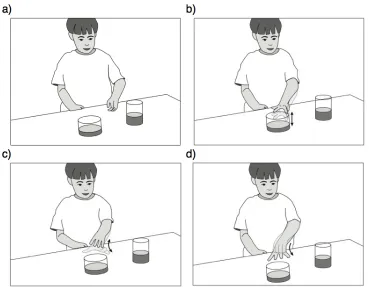
As a second example, consider a boy explaining his judgment to a Piagetian task in which the experimenter poured one of two identical, tall glasses of sand into a short, wide dish (Figure 5; example from the dataset described in Alibali, et al., 2000). The boy claimed that the tall glass now contained more sand than the short dish. In explaining this judgment, he began by saying “Cause, um…” and pointed toward the taller glass (Figure 5, Panel a). However, he quickly abandoned this thought about the tall glass, and shifted his attention to the short dish, saying, “the bowl is wi- —cause the bowl is wider.” With this utterance, he made a V-shaped gesture with the index and middle fingers of his left hand, and moved it down and up repeatedly at the side of the dish, representing its width and height (Panel b). As he completed this utterance, while saying the word “wider”, he moved his hand into a claw shape over the dish, and spread and closed his fingers (twice), representing the area of the top of the dish (Panel c). Notably, the idea of spreading or area that he expressed in this gesture goes beyond the notion of width which he said in the accompanying speech. He then pulled his hand back into a point toward the dish and ultimately back to his body while saying “and it needs um…”. He then concluded, “it needs to fill out.” With this final utterance, he repeated the spreading gesture, with his hand again moving from a claw shape to a flat hand with fingers spread (Panel d). With this gesture he depicted the sand “filling out” a wider area, which occurred when the experimenter poured the sand from the glass to the dish.
ever (in the course of this explanation) lexicalize height (thus producing a gesture-speech mismatch). Finally, he explored the area of the dish and the spreading of the sand, using a spreading gesture over the dish. He repeated this gesture a total of three times, eventually lexicalizing it using the verb “fill out”, on the third iteration of the gesture. Most relevant to our point here, many of the features that he eventually lexicalized were expressed first in gestures, and only later in speech. We suggest that his gestural exploration of the task objects helped him generate the idea that the sand fills out a larger area in the dish than in the glass.
Of course, in both of these examples, one cannot infer that the change in gesture caused the change in the speaker’s focus; it remains possible that the gestures simply reflect rather than caused that change. Nevertheless, these examples are important in illustrating how gestural exploration can unfold over time and can influence verbally expressed conceptualizations of events or objects.
Summary of the Evidence for the Exploration Function
more diverse ways of conceptualizing information or framing the problem become available.
Relationship among the Four Functions
We argue that the four proposed functions are distinct from one another; however, they can also work together to enhance performance. The four functions can operate simultaneously; for example, when a speaker talks and gestures about an object that is no longer present, a gesture may both activate and explore spatio-motoric information about the object at the same time. Furthermore, the exploration function may be triggered by the need for better packaging of information or by the need to manipulate spatio-motoric information (e.g., to describe something from the listener’s perspective).
We argue that all four functions may operate every time people produce gestures. However, the dominant function at any given moment may depend on what is required for the task at hand. For example, gesture may be used to explore when novel
conceptualizations are useful (Kita, 2000)—and gestures that manifest this exploration are most frequent when conceptual exploration is useful. In support of this claim, several studies have shown that children produce gesture-speech mismatches most frequently when they are at the cusp of understanding a task (Church & Goldin-Meadow, 1986; Perry et al., 1988; Pine et al., 2004).
Practical actions can also serve the four functions that we posited for gestures: activating, manipulating, packaging and exploring spatio-motoric information. When planning an action in a physical or virtual (imagined or simulated) environment, one needs to take into account spatial information in the environment; for example, when the hand reaches out to grasp a mug, the location of the mug determines the trajectory of the hand and the shape and orientation of the mug afford certain possibilities for grasping (Gibson, 1979). In this sense, practical actions can activate spatio-motoric information (see Casasanto & Dijkstra, 2010, for experimental evidence). The hand can grasp and manipulate an object to examine perceptual consequences of the object’s movement; as one example, manipulating a mug can help one visualize it from different angles. When the hand interacts with an object, only certain features of the object are relevant; for example, when grasping the handle of a mug, only the size and orientation of the handle are relevant, and when tracing the rim of a mug, only the circular shape and size of the opening are relevant. In this sense, practical actions can package information about an object. The hand can also explore various possibilities for manually interacting with an object; for example, a hand may try out various ways to interact with a mug. Thus, practical actions and gestures serve similar functions.
It is sometimes difficult to draw a line between practical action and gesture when the hand interacts with an object for communication (see also Novack &
Goldin-Meadow, 2016). For example, one may demonstrate how to use a tool by producing movements with the tool that simulate using the tool (Clark, 1996; Streeck, 1996; LeBaron & Streeck, 2000) or one may show how to move or use an object by producing an empty-handed action near the object (Novack, Wakefield, & Goldin-Meadow, 2016). Some researchers have distinguished between gestures and practical actions or
“functional acts”, such as picking up or manipulating an object (Goldin-Meadow, 2003). In contrast, other researchers have argued that gestures and practical actions are
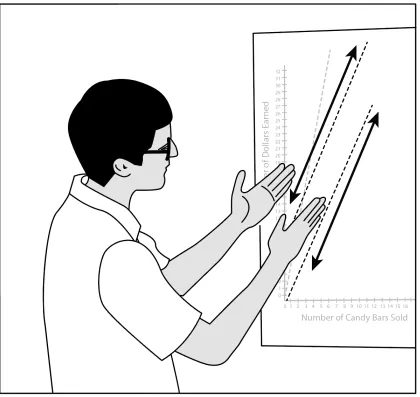
gestures that involve holding up and manipulating objects) are functionally similar to representational gestures because they depict meaning through action. To illustrate, one of the teachers in their sample was giving a lesson about calculating the area of a triangle; as part of this lesson, the teacher held up two identical paper triangles and moved them together to illustrate that two triangles form a rectangle (see Figure 6).
Practical actions produced during thinking have gesture-like properties when the hand interacts with objects for reasoning and thinking, as well as for communication. Consider an example from the study, described above, in which children were asked to describe the task objects used in Piagetian conservation tasks (Alibali et al., 2000). In one task, children were shown two identical balls of playdough, and then the experimenter flattened one ball into a disk. In describing the task objects, one child said, “One’s round,” while rolling the unchanged ball around on the table. In this example, the child’s rolling action expressed a physical property of the ball—its spherical shape—by actually manipulating the ball. Along with this action, the child expressed the spherical shape in speech with the word “round.” The child then continued by saying, “and one’s flat,” and indicated the flattened disk with a flat palm gesture facing down over the disk, in this case, without manipulating the playdough. Thus, in this part of the utterance, the child used a gesture that represented an aspect of the object, but did not manipulate the object. In this example, object manipulation and gesture were used in parallel parts of the same utterance, suggesting that they are similar in a fundamental way.
Some theoretical accounts of co-speech gesture production have proposed that
gestures are generated by the same cognitive processes that also generate practical
actions. According to the Information Packaging Hypothesis, "what underlies a gesture is
an action in virtual [imagined] environment" (Kita, 2000, p. 170). Similarly, the Interface
Hypothesis (Kita, 2014; Kita & Özyürek, 2003) proposes that gestures are generated from
a general-purpose "action generator", which determines the content of both practical
actions and representational actions, i.e., gestures. The Gesture as Simulated Action
framework (Hostetter & Alibali, 2008) holds that the mental representations that underlie
gestures are simulated actions and perceptual states. In addition to these theories about
co-speech gestures, the Action Generation Hypothesis (Chu & Kita, 2015) extends the
embed gesture generation solely within speech production processes (Butterworth & Hadar, 1989; de Ruiter, 2000; McNeill, 1992)
The Gesture-for-Conceptualization Hypothesis builds on the idea that gestures are generated from the same process that generates practical actions(cf. Chu & Kita,
2015; Hostetter & Alibali, 2008; Kita, 2000; Kita & Özyürek, 2003). That is, the information encoded in gestures is generated from the action system.
What is the evidence for this link between practical actions and gestures? There
are three primary lines of evidence. First, people produce more gestures when they think or speak about motoric content than when they think or speak about other content, because thinking and speaking about such content presumably involves simulating actions or movements in space. Indeed, people produce more co-speech gestures when they talk about motor imagery (e.g., explain how to wrap a present) than when they talk about visual imagery (e.g., describe your favorite painting) or about abstract information (e.g., express your view on the use of a single currency in Europe) (Feyereisen & Havard, 1999). Furthermore, in object description tasks, people produce more co-speech gestures when they describe objects that are highly manipulable, such as a stapler, than when they describe objects that people do not typically manipulate with their hands, such as a fence (Hostetter, 2014; Masson-Carro et al., 2015; Pine, Gurney & Fletcher, 2010). This pattern holds, even when controlling for the objects’ spatiality, concreteness, and ability for self-produced movement (Hostetter, 2014). Moreover, when people describe manipulable objects, they tend to produce gestures that depict the physical actions involved in using or handling those objects (Masson-Carro et al., 2015).
mugs as the stimulus objects (Figure 8). Thus, gestures were affected by the affordances of the stimulus objects in the same way that practical actions would be affected.
Third, experience with physically manipulating objects influences speakers’ gestures. Hostetter and Alibali (2010) examined the gestures people produced when they described information (the dot and line patterns in Figure 2c) that they had acquired either visually or through physical action. Participants who constructed the patterns manually (using wooden disks)—who would therefore be expected to simulate action more strongly—produced more co-speech gestures than participants who simply viewed the patterns.
Gestures about actions reflect features of the action that the speaker has performed. Cook and Tanenhaus (2009) asked participants to solve Tower of Hanoi problems (Newell & Simon, 1972), which involve lifting disks off pegs and moving them to other pegs. Participants in a physical action group solved the problems with real objects, actually lifting and moving disks. Participants in a computer action group solved the same problems on a computer screen, dragging disks with the mouse from one peg to another. When participants verbally reported how they had solved the problems, those in the physical action group produced more co-speech gestures with grasping hand shapes. In addition, the motion trajectories of their gestures were more curved than those of speakers in the computer action group. Thus, gesture reflected features of the actions that participants had actually performed.
If gestures are generated from the same system that generates practical action, how can we account for the fact that the contents of speech and gesture are highly coordinated (McNeill, 1992)? We argue that this occurs because the action generation system and the speech production system are highly interactive. As proposed by Kita and Özyürek (2003), the two systems can exchange information and align their contents. Thus, the contents of concurrent gesture and speech tend to converge.
5 indicated the taller glass in gesture (Panel a), and also depicted the height of the shorter dish in gesture (Panel b), but he never expressed these pieces of information in his spoken explanation. When it is advantageous for gesture to explore information possibly relevant to the task at hand (Kita, 2000), the pressure to semantically align speech and gesture may be relaxed, and speakers may produce gestures that are not redundant with speech. Thus, our framework, in which speech and gesture are generated interactively in separate processes, is compatible with both semantic integration of speech and gesture (e.g., Kita & Özyürek, 2003; McNeill, 1992), and systematic weakening of this integration (e.g., Church & Goldin-Meadow, 1986).
Gesture Goes Beyond Practical Action by Schematizing Information Although gestures are closely linked to actions, there is a critical difference between gesture and action: namely, gestures are representational. Gestures represent the world; in most cases, they do not influence, alter, or directly affect the physical world (Novack & Goldin-Meadow, 2016). Thus, gestures are somewhat “removed” from action—they schematize actions, rather than represent actions veridically (see Annett, 1990).
Because gestures are representational, one might expect that gestures would have less influence on thought than actions. However, evidence to date points in the opposite direction: gestures have a more powerful influence on thought than actions do.
We argue that gesture’s powerful influence on thought is a consequence of its ability to schematize. This schematization is a form of abstraction—that is, it strips away some elements, while maintaining others. In this section, we first present evidence that gestures affect thought more strongly than actions do. We then make the case that these effects are due to gesture’s ability to schematize information. We then discuss how gestural schematization shapes the four functions of gesture.
Gestures Affect Thought More Strongly than Actions Do
Four lines of evidence converge on the conclusion that gesture can affect thinking more strongly than actions. First, gesture has a stronger influence on solvers’
solutions. During the explanation phase, participants either verbally explained their solutions with gestures (the gesture group) or physically moved the disks to illustrate their solutions (the action group). All participants later solved Tower of Hanoi problems with real objects again, with half of the participants in each group using the original set of disks (the no-switch condition) and the other half using disks whose weights had been switched so that the smallest disk was heaviest and the largest disk was lightest (the switch condition). The weight change affected how people’s hands were involved in the solution: the heaviest disk had to be moved using two hands, whereas the lightest could be moved using one hand. Participants in the action group were not affected by the weight switch; their solution times were similar in the two conditions. In contrast,
participants in the gesture group took longer to solve the problem in the switch condition than in the no-switch condition. This finding suggests that gesturing about actions exerted a stronger influence on how action-relevant information was mentally represented than did actually performing the actions. Put another way, weight information was
incorporated into the schematized spatio-motor representations (one-handed vs. two-handed movement) that participants constructed in the gesture condition, so the shift in weight was more problematic for them.
Second, gesture facilitates encoding of spatial information more so than practical actions do. So, Ching, Lim, Cheng, and Ip (2014) familiarized participants with a
diagram showing a spatial route. They then removed the diagram and asked participants either to rehearse the route with hand gestures in the air (the gesture group), to draw the route on a piece of paper (the action group), to mentally visualize the route without moving their hands (the mental-simulation group), or to read aloud some random letters (the no-rehearse group). All participants were then asked to recall the route verbally. Participants in the gesture group recalled more steps correctly than did participants in the action group (and those in the gesture and action groups did better than those in the other two groups). These results suggest that producing gestures was beneficial for
Third, gestures have been found to facilitate generalization of mathematical strategies more than actions do. Novack and colleagues (2014) presented children with mathematical equations (e.g., 2 + 9 + 4 = __ + 4) on a white board, with the numbers covered by matching number magnets. All of the children were then asked to repeat the explanation, provided by the experimenter, that both sides of the equation needed to be equal. Along with this speech, children were asked to produce actions or gestures. In the action condition, children were asked to pick up the magnetized numbers 2 and 9 from the left side and move them into the blank on the right side. In two gesture conditions, children were asked either to mimic the actions described in the action group but without physically moving the numbers (termed a “concrete gesture”), or to point with the fingers of one hand to the two digits on the left side and then point to the answer blank (termed an “abstract gesture”). In a subsequent test phase, children in both gesture conditions performed better than those in the action condition in solving equations with a different structure (i.e., with the blank in a different position). Further, children in the abstract-gesture condition performed better than those in the other conditions in solving equations without a repeated addend (e.g., 2 + 5 + 3 = __ + 6). Thus, children who produced
gestures were more successful than children who performed actions in generalizing the knowledge they gained in the training phase to solve structurally different problems, and the benefits were greatest for those children whose gestures were more schematic. Novack and colleagues concluded that gestures promoted a deeper understanding of mathematical equivalence by focusing attention on relevant aspects of the equations and abstracting away from irrelevant aspects.
Fourth, abacus experts can calculate faster without an abacus than with a physical abacus, and their calculation is less accurate if they are prohibited from gesturing when they calculate without an abacus (Hatano et al., 1977). Thus, gestures allow abacus experts to use schematized spatio-motoric information for efficient and accurate calculation. Calculation is slower with a physical abacus because the physical objects impose constraints that are not relevant to computation (e.g., beads need to move a particular distance).
manipulated objects (Beilock & Goldin-Meadow, 2010) and for visually presented routes (So et al., 2014). Furthermore, gesture promotes learning of problem-solving strategies that are generalizable to new situations, more so than practical actions (Novack et al., 2014). In some cases, gesture also manipulates spatial representations (e.g., for abacus calculation) more efficiently than practical actions (Hatano et al., 1997).
Key Differences between Action and Gesture
There are several key differences between practical action and gesture. First, gesture is always representational (it stands for something else) (Novack & Goldin-Meadow, 2016), but action is not always so. On this basis, gesture may influence other representations, such as verbal thought, spatial memory and problem-solving strategies, more strongly than action (see, e.g., Novack, et al., 2014; So et al., 2014). Second, gesture is usually free from the physical constraints that practical actions are subject to. This makes gesture more flexible than action in what it represents and how it represents than action. Third, gesture usually does not leave a physical trace, but practical action often does. Physical traces may help reduce working memory load, but they may also constrain how malleable the representation is. Finally, and most crucially, gesture schematizes information. We argue that schematization affects mental representations in specific ways that shape the four functions, and we discuss this issue in the following section.
Why Do Gestures Affect Thought More than Actions?
relevant to the task, more strongly than producing the actions does (Beilock & Goldin-Meadow, 2010; see also So et al., 2014 for a similar view). However, it is difficult for this account to explain gesture's advantage in generalizing strategies (Novack et al., 2014).
To explain gesture's advantage over practical action, we argue that gestures enrich thinking via a process of schematization. Schematization involves deleting or stripping away some elements of a representation, and maintaining others. Gesture schematizes actions and perceptual states, and this schematization facilitates cognitive processing in three main ways.
First, as Goldin-Meadow (2015) has argued, schematization facilitates generalizing knowledge to new contexts. This occurs because schematic gestural
representations omit concrete details of actions and action-related features of objects. In this way, schematization helps people focus attention on essential elements, and neglect irrelevant details that are tied to specific actions or objects (Novack & Goldin-Meadow, 2016). This schematization makes it easier to transfer the represented information to new contexts (Novack et al., 2014).
Second, schematization makes processing of task-relevant information more efficient. Schematized information is “light-weight” and free from physical constraints. This makes it more efficient to use the representations, as indicated by studies of route memory (So et al., 2014) and mental abacus (Hatano et al., 1977).
speaker’s gestural representation of the cartoon scene evolved from one that contained too much information for felicitous verbalization, to one with an appropriate amount of information for verbalization.
Schematized gestural representations can also be elaborated, as needed for the task at hand. For example, when solving gear movement prediction problems, people often have difficulty understanding that a gear system with an odd number of gears arranged in a circle will not move, because the gears will “jam” (Spencer, 2003). When people fail on problems with configurations that jam, they sometimes enrich their gestural representations of the problems, adding more details about the gears’ movements, in order to reason through how the gears will move. Because gestural representations are flexible and modifiable, they can be adapted to be richer or leaner, depending on the solver’s needs at that moment in time.
When considering the consequences of schematization, it is important to consider what information gesture sheds and what information it retains. There is no evidence, to date, that gesture “intelligently” selects information useful for the task goal (unless participants are asked to imitate a gesture that is designed to do so, as in Novack et al., 2014, and Goldin-Meadow et al., 2009). Indeed, gesture sometimes retains information that is not useful for the task goal. For example, when telling a story based on an
Gestures schematize information in specific ways; thus, the extent to which gestural schematization is useful for a given task depends on the match between the nature of that schematization and task goals. For example, gestures may schematize the movement of an object in three ways: (1) tracing the trajectory with a point, (2) by moving the hand along the trajectory with a handshape that represents some aspects of the object or the surface (which supports the object), (3) the hand depicting grasping of the object (Chu & Kita, 2008; Sekine, Wood & Kita, under review). Gestures may schematize an object also in three ways: (1) tracing its outline, (2) moving the hands as if to touch (sculpt) the object surfaces, (3) using handshape to represent the shape (e.g., a flat hand to represent a flat object) (Masson-Carro et al., 2015; Müller, 1998). Focusing only on the trajectory of object movement and abstracting away the object shape may be useful when describing rotation of the object, as in Figure 3. However, if the task depends crucially on the details of the shape of a moving object (e.g., in the game, Tetris), such schematization may not be helpful. In fact, it is not easy for a gesture to represent both movement and shape of an object in detail at the same time. Thus, the benefits of gesture may be limited for tasks that require both details of movement and details of shape. More generally, the benefits of gesture may be especially large when the way gestures schematize information happens to be useful for the task at hand.
How Schematization Shapes the Four Functions of Gestures
The schematic nature of gestural representation shapes the four basic functions of gesture in particular ways. In all cases, information reduction plays a key role.
First, let us consider the role of schematization in the activation of spatio-motoric representations. When thinking about a stimulus or an event, there are often many
on the number of gears in the array (a non spatio-motoric aspect of the stimulus, Alibali, Spencer et al., 2011). We argue that the action of producing gesture may lend additional activation to spatio-motoric aspects of a representation of a stimulus or event, or it may actually create new spatio-motoric representations, de novo. This puts a focus on spatio-motoric aspects of situations, stripping away other aspects.
Next, let us consider manipulating spatio-motoric representations. Manipulating images or ideas (for example, rotating, altering, inverting, or taking a different
perspective) requires one to zero in on and analyze the spatio-motoric information that is relevant to that transformation, and schematization via gesture enables this focus and analysis. In addition, manipulating information places a heavy load on working memory, especially if one must keep track of every detail. If an image or idea is schematized into a more “light-weight”, less complex, more stripped-down representation, it will require less working memory to manipulate (see Koedinger, Alibali, & Nathan, 2008, for discussion of this issue). Thus, gesture facilitates the manipulation of ideas because schematization via gesture reduces the amount of information to be processed.
For the same reason, schematization is also relevant to packaging spatio-motoric representation into units for speaking. Not all of the elements of complex visuo-spatial events, scenes, or objects can be simultaneously captured in a single utterance or in a single step in a reasoning process; instead, one must focus on an appropriate, relevant subset of elements at a time—specifically, a subset that is suitable for speaking or thinking. Thus, in the same way that a schematized representation is more suitable for mental manipulation than a richly detailed representation, a schematized representation is more suitable for packaging into units or chunks for speaking or thinking.
Finally, schematization is also involved in exploring the space of possibilities for speaking or thinking. People use gesture to explore different ways of conceptualizing a situation. Because gesture schematizes information, this search is efficient and effective. That is, schematization via gesture reduces the amount of information being considered at any given moment. This "distilled" information can be more easily focused on and
the widths of the containers, the pouring of the liquid, or any of a number of other features. Each of these features may be relevant for making a judgment and providing an explanation. Producing gestures can help to convert this rich array of information into a unique landscape of possible schematizations; exploring these schematized possibilities is efficient and may readily lead to novel ideas and solutions. For example, the child in Figure 5 seems to have generated the notion of area in gesture, and he eventually focused on this schematization of the task object in his verbal explanation.
Discussion
Summary of the Claims
We have considered how co-speech and co-thought representational gestures influence gesturers’ mental representations and processes in speaking and thinking. We proposed the Gesture-for-Conceptualization Hypothesis. First, representational gesture— including both co-speech and co-thought gesture— shapes the ways we conceptualize information through four basic functions: gesture activates, manipulates, packages and explores spatio-motoric representations for the purposes of speaking and thinking. Second, the schematic nature of gestural representation shapes these four functions. By schematizing spatio-motoric representations for these four functions, gesture facilitates cognitive processing and generates novel ideas, strategies and solutions that are easy to process, adaptable and generalizable.



![CADRE COMMUNAUTAIRE D'APPUI 1989 1993 pour le développement des zones rurales [objectif n° 5 b)] DANEMARK 6 juin 1990 = Community Support Framework for development of rural zones [objective no 5 b] Denmark](data:image/gif;base64,R0lGODlhAQABAIAAAP///wAAACH5BAEAAAAALAAAAAABAAEAAAICRAEAOw==)