© 2019, IRJET | Impact Factor value: 7.211 | ISO 9001:2008 Certified Journal
| Page 7843
Performance of Multi-story RCC structure with Floating Column
Akshay Gujar
1, H.S. Jadhav
21
M. Tech. student, Dept. of Civil-structural Engineering, RIT, Maharashtra, India
2
Professor, Dept. of Civil-structural Engineering, RIT, Maharashtra, India
---***---Abstract - Now a days, building structure with floatingcolumn is a challenging requirement for designers in the multistoried construction. In present condition, building structures are analyzed in single step by using linear static analysis with assumption that the structures are having total load once the whole structure constructed completely. But in actual condition construction of building is completed story by story. Therefore that effect due to sequential loading is different than actual analysis. Objectives of this study is evaluate effect of vertical irregularity such as floating column in the buildings. In this paper effect of construction sequence analysis and regular analysis are compared. For analysis the G+10 story building is considered for zone IV. The results such as displacement story shear, story drift are obtained using ETAB software.
Key Words: floating column, transfer beam, sequential analysis, conventional analysis, deformation, ETAB.
1. INTRODUCTION
India is a developing country, where urbanization is at the faster rate in the country including adopting the methods and type of constructing buildings which is under vast development in the past few decades. As a part of urbanization multi-story buildings with architectural requirements are constructed. These requirements are nothing but soft story, floating column, heavy load, the reduction in stiffness, etc. Now a day’s most of the urban multi-story buildings have open first story as an unavoidable feature. For a hotel or commercial building, where the lower floors contain halls, conference rooms, lobbies, show rooms or parking areas, large interrupted space is required for the movement of people or vehicles. Accommodation of parking or reception lobbies is the primary use of these open first story in the multi-story buildings constructed. But Conventional Civil Engineering structures are designed on the basis of strength and stiffness criteria. Usually the ground story is kept free without any constructions, except the columns which transfer the building weight to the ground.
1.1 Floating Column (FC)
“A column is supposed to be a vertical member starting from foundation level and transferring the load to the ground, and the term “Floating Column” is also a vertical element which at its lower level rests on a beam which is a horizontal member”.
Multi-story buildings constructed for the purpose of residential, commercial, industrial etc., with an open ground story is becoming a common feature. For the purpose of parking, usually the ground story is kept free without any constructions, except the columns which transfer the building weight to the ground. Closely spaced columns based on the layout of upper floors are not desirable in the lower floors of such buildings. For these critical conditions floating column concept has come into existence.
1.2 Transfer Beam (TB)
Portal frames are the structures which has beams and columns that are connected by rigid joint. Floating column rest on beams these are known as transfer girder, which are different from regular structural beam. Depth of transfer beam varies from 0.6m to 1m. The transfer girder have to be designed and detailed properly, especially in earthquake zones. The column is a concentrated load on the beam which supports it and transfer to the other columns below it. For the software analysis the column is assumed to be pinned at the base and taken as a point load on the transfer beam. Floating columns are competent enough to gravity loading but transfer girder must be of adequate dimension with minimum deflection.
2. CONSTRUCTION SEQUENCE ANALYSIS:
© 2019, IRJET | Impact Factor value: 7.211 | ISO 9001:2008 Certified Journal
| Page 7844
analysis assumes that the entire loads are carried by theentire structure. All loads are applied simultaneously is not valid in real construction because a building is constructed floor by floor and dead load acts sequentially.
In construction sequence analysis loading is considered sequentially at each story being constructed where in linear static analysis, loading is considered when whole structure is completed.
2.1
Modelling and Analysis
To study the sequential analysis of structure, G+10 multi-storied building is considered. The modelling and analysis of work is done by using ETABS software.
The basic material properties used are as follows: • Modulus of Elasticity of steel, Es = 20,0000 MPa • Modulus of Elasticity of concrete, Ec = 27386.12 MPa • Grade of concrete = M20
Details of models:
[image:2.595.319.552.91.158.2]The various parameters considered for analysis of building which is modelled in ETABS. Seismic parameters are taken from IS 1893 (Part 1) 2016. Parameters considered are as per tabulation.
Table -1: Parameters considered for modelling
Type of Building RCC No. of story G+10 Plan area 14mx14m Height of building 33 Height of floor 3m
Type of building Residential Seismic zone 4
Importance factor 1 Response reduction factor 5
Type of soil Medium soil Grade of steel Fe415
Column 350x450
Beam 300x350mm and
350x650mm
Slab thickness 120mm Live load 2kN/m2
Dead load (F. F.) 1kN/m2
2.2 Loads Considered in the Analysis
The following loads were considered for the analysis of various buildings:
a. Gravity Loads –
The intensity of dead load and live load at various floor levels considered in the study are listed below.
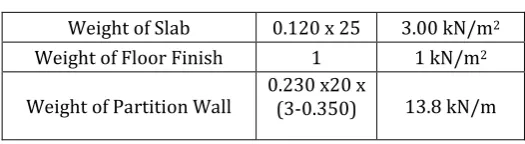
[image:2.595.302.565.300.372.2]i. Dead Load –Dead load is indicated in Table-2. Table -2: Dead Load
Weight of Slab 0.120 x 25 3.00 kN/m2
Weight of Floor Finish 1 1 kN/m2
Weight of Partition Wall 0.230 x20 x (3-0.350) 13.8 kN/m
ii. Live Load –Live Load at all floor levels has been taken as 2.0 kN/m2, this live load is reduced to 25% for calculating the
seismic weight of the structure as per provisions of IS 1893. b. Seismic Load -
IS 1893(part I) is used for seismic load calculations. The mass of the building is supposed to be lumped at the floor levels. The weight of columns, beams and walls have been equally distributed to the floors above and below. For the purpose of analysis the following seismic factors were considered.
i. Response spectrum factor:-The response reduction factor (R) for the buildings in this study is taken as 5 i.e. special RC moment resisting frame (SMRF) has been considered as these are the basic common structural element being used in earthquake resistant structure.
ii. Zone Factor:-The seismic zone factor (Z) for the selected buildings is taken as 0.24 as the structures are supposed to be in the seismic zone IV.
iii. Damping Ratio:-The critical damping for problem structures is assumed to be 5% as specified for concrete by IS1893 (Part I).
© 2019, IRJET | Impact Factor value: 7.211 | ISO 9001:2008 Certified Journal
| Page 7845
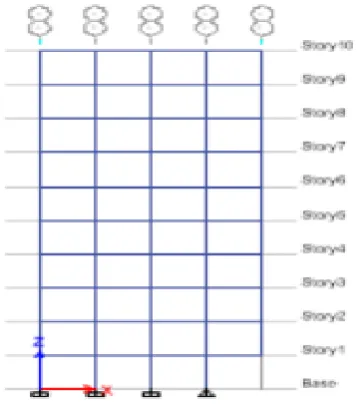
Case 1) Floating column at mid first floor:-Fig -1: Plan of building with FC
Fig -2: Elevation of building with FC
Figure shows that the plan and elevation of building which is considered for sequential analysis. Building consist of G+10 stories with 4 bays x4 bays of 3.5m are considered. It also consist of one floating column and transfer beam.
2.3 Analysis of transfer beam at first floor:
Transfer beam gives more result for construction sequence analysis. The parameters like deformation, bending moment, and shear force are considered to compare conventional analysis and construction sequence analysis.
2.4 Building with floating column resting on RCC
transfer beam
A) Deformation
Table -3: Deformation of R.C.C. transfer beam
Analysis
Type Conventional Analysis (mm) Construction sequence analysis (mm)
% increase of deformation
TB1 12.157 22.488 45.94
TB2 12.356 22.865 45.96
Table 3 gives percentage increase in deformation of transfer beam due to construction sequence analysis. Deformation of transfer beam due to construction sequence analysis is 43.73% greater than deformation due to conventional analysis.
B) Bending moment and Shear force
Table -4:Bending moment by conventional and const. sequence analysis
Analysis Type Conventional analysis
Const. sequence
analysis
% Increase
TB1 252.70 422.18 40.14
TB2 257.98 429.33 39.91
Table -5:Shear force by conventional and const. sequence analysis
Analysis Type Conventional analysis
Const. sequence
analysis
% Increase
TB1 181.01 225.19 19.61
TB2 183.56 227.42 19.28
© 2019, IRJET | Impact Factor value: 7.211 | ISO 9001:2008 Certified Journal
| Page 7846
by conventional analysis is 181.01Kn and by constructionsequence analysis is 225.19 kN. Case 2) Floating column at corner:-
Fig -3: Plan of building with FC at corner
Fig -4: Elevation of building with FC at corner
Figure shows that the plan and elevation of building which is considered for sequential analysis. Building consist of G+10 stories with 4 bays x4 bays of 3.5m are considered. It also consist of one floating column and transfer beam at corner.
2.5 Analysis of transfer beam at first floor:
Transfer beam gives more result for construction sequence analysis. The parameters like deformation, bending moment, and shear force are considered to compare conventional analysis and construction sequence analysis.
2.6 Building with floating column resting on RCC
transfer beam
[image:4.595.48.270.151.341.2]A) Deformation
Table -6: Deformation of R.C.C. transfer beam
Analysis
Type Conventional Analysis (mm) Construction sequence analysis (mm)
% increase of deformation
TB1 14.371 34.818 58.73
TB2 15.020 37.196 59.62
Table-6 gives percentage increase in deformation of transfer beam due to construction sequence analysis. Deformation of transfer beam due to construction sequence analysis is 58.73% greater than deformation due to conventional analysis.
[image:4.595.73.252.378.582.2]B) Bending moment and Shear force
Table -7:Bending moment by conventional and const. sequence analysis
Analysis Type Conventional analysis
Const. sequence
analysis
% Increase
TB1 128.47 265.65 51.64
TB2 127.12 228.69 44.41
Table -8:Shear force by conventional and const. sequence analysis
Analysis Type Conventional analysis
Const. sequence
analysis
% Increase
TB1 98.78 172.07 42.59
TB2 97.75 133.43 26.74
© 2019, IRJET | Impact Factor value: 7.211 | ISO 9001:2008 Certified Journal
| Page 7847
by conventional analysis is 98.78kN and by constructionsequence analysis is 172.07kN.
Chart-1
: Maximum deformation of transfer beamFrom chart-1 it is observed that the maximum deflection values obtained for FC located at corner are more than the FC located at mid of the building.
3. CONCLUSION
From the interpretation of results it is observed that there is considerable variations in deformations and design forces between sequential analysis and conventional analysis. The deformation in corner floating columns is more in construction sequence analysis compare to linear static analysis. There is 10-13% increase in the deformation of floating column located at corner than the column located at mid. The special structures with floating column requires construction sequence analysis. Also location of vertical irregularity such as floating column affects more in case of sequential analysis.
ACKNOWLEDGEMENT
I extend my sincerest gratitude to my parents, my Guides, head of program, head of dept., and my well-wishers who helped me in all situations whenever needed during this project completion.
REFERENCES
[1] Dubey N., Sonparote R.S. & Kumar R. (2015), “Effect of Construction Sequence Analysis on Seismic Performance of Tall Buildings”, Journal of Civil Engineering and Environmental Technology, Volume 2.
[2] Kumar R., et al. (2016), Effect of Staged Construction Analysis on Seismic Design and Performance of RC Buildings, Visvesvaraya National Institute of Technology.
[3] Badgire U.S., Shaikh A.N., Maske R.G.(2015), “Analysis Of Multistorey Building With Floating Column”, International Journal Of Engineering Research, Volume 4.
[4]Rao J.V., et al. (2016), “Study And Comparison of Construction Sequence Analysis with Regular Analysis by Using E-TABS”, Civil Engineering International Journal, Volume 2.
[5]Agarwal P., Shrikhande M., Earthquake resistant design of structures, Eastern Economy Edition, 2006
[6]Kara N., Celep Z., "Nonlinear seismic response of structural systems having vertical irregularities due to discontinuities in columns", 15 WCEE, 2012.
[7]Gowda Keerthi (2014).“Seismic analysis of multi-storey building with floating column” Proc.,first annual conference on innovations and developments in civil engineering, ACIDC,NITK, Surathkal, India 528-535.
[8]Maitra Kishalay , N. H. M. Kamrujjaman Serker (2018). “Evaluation of Seismic Performance of Floating Column Building” American Journal of Civil Engineering. Vol. 6, No. 2, pp. 5559
[9] Das G.G. & Praseeda K.I. (2016), “Comparison of Conventional and Construction Stage Analysis of a RCC Building”, IJSTE - International Journal of Science Technology & Engineering, Volume 3.
BIOGRAPHIES
Mr. Akshay A. Gujar, PG Student, M.Tech, Structural Engineering, at Rajarambapu Institute of Technology, Rajaramnagar. Graduated from Shivaji University, Kolhapur.
Dr. H.S. Jadhav is presently working as Dean, Diploma, RIT and also worked as Head, Department of Civil Engineering. He is chairman MSBTE external Academic monitoring committee and Exam lapses committee at Shivaji University, Kolhapur.