
© 2019, IRJET | Impact Factor value: 7.211 | ISO 9001:2008 Certified Journal
| Page 3815
EBR and GM Methods for External Flexural Strengthening of RC Beams
Anju Antony
1, Reshmi P.R
2, Preetha Prabhakaran
31
PG Student, Computer Aided Structural Engineering, Sree Narayana Gurukulam College of Engineering,
Kadayirippu P.O, Kolenchery, Kerala, India
2
Assistant Professor, Dept. of Civil Engineering, Sree Narayana Gurukulam College of Engineering,
Kadayirippu P.O, Kolenchery, Kerala, India
3
Associate Professor, Dept. of Civil Engineering, Sree Narayana Gurukulam College of Engineering,
Kadayirippu P.O, Kolenchery, Kerala, India
---***---Abstract -
In recent years, using FRP sheets forstrengthening and rehabilitation of reinforced concrete (RC) beams has been considered as an effective, convenient and practical method. Externally Bonded Reinforcement (EBR) is a common method for mounting the sheet that uses conventional surface preparation. Premature debonding is one of the issue facing the use of FRP sheets as external flexural and shear reinforcement of concrete beams. It is caused by the lack of appropriate bonding between concrete surface and composite sheet. Grooving method (GM) is a special form of Externally Bonded Reinforcement on Grooves which is proposed as an alternative to conventional method of surface preparation. In this experimental investigation, reinforced concrete beams with dimension of 120x140x1000 mm were strengthened with CFRP sheets by EBR and GM methods. Specimens with different groove pattern, bond length and FRP plies were designed in a way under which the efficiency of GM method was evaluated. This study focused on load carrying capacity and deflection of strengthened RC beams.
Key Words: FRP, Strengthening, EBR, Debonding, GM.
1. INTRODUCTION
Demolishing and rebuilding new structures is often not economically cost effective, therefore finding an appropriate solution for repairing and strengthening the existing structures has a great importance. Rehabilitation and strengthening of structures provides upgrading of its resistance to withstand underestimated loads, increase in the load carrying capacity for higher permit loads, eliminating premature failure due to inadequate detailing, restoration of lost load carrying capacity due to corrosion or other types of degradation caused by aging, etc.An array of methods are available for this purpose, the selection of which depends on a great number of variables. The improper choice of an inappropriate repair or strengthening method can even worsen structure’s function.
One of the most common technique for the external flexural strengthening of RC beams with FRP composite is the Externally Bonded Reinforcement (EBR), where the FRP composites are adhesively bonded to the tension face of the structure.Although EBR technique has been widely utilized in strengthening projects all around the world due to certain
benefits such as simple and rapid installation.But the major difficulty with RC beam strengthened with EBR method is their premature failure which is due to the sudden de-bonding of the FRP sheet before its ultimate capacity can be exploited. Debonding of FRP sheet is mainly due to the development of high interfacial shear stresses at plate or FRP sheet ends while loading. Many studies have been conducted to find solutions to this premature debonding and to reduce the interfacial stresses between the RC substrate and the FRP sheet.
Davood Mostofinejad introduced an effective alternative method for EBR to postpone debonding of FRP laminates in concrete beam [1, 3, 4]. In this method, grooves on the concrete surface of the elements were cut and filled with suitable epoxy, and FRP sheets were installed on the concrete surface.This method is called Externally Bonded Reinforcement on Grooves (EBROG) or Grooving Method (GM).
This
method has shown great promises in dealing with debonding problems. Previous investigations have revealed that in this technique, debonding is postponed and in some cases is completely eliminated.The present study illustrates an experimental investigation on the external flexural strengthening of RC beam specimens with Carbon Fiber Reinforced Polymer (CFRP) composite by EBR and GM methods. A number of RC beam specimens were strengthened using CFRP woven fabric sheets, which are then subjected to static loading. The efficiency of grooving method is evaluated by studying the parameters like CFRP layer, grooving pattern and bond length.
2. EXPERIMENTAL PROGRAMME
2.1 Characteristics of Concrete Specimens
© 2019, IRJET | Impact Factor value: 7.211 | ISO 9001:2008 Certified Journal
| Page 3816
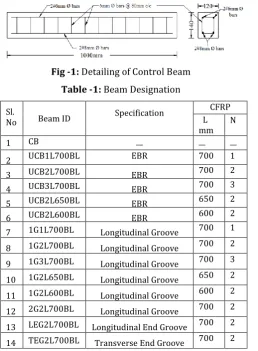
of the beam as compression reinforcement. For the shear strengthening of beam, 6mm diameter bars were provided as stirrups at 80 mm center to center distance. Concrete cover of 25 mm was used. Fig-1 shows the detailing of RC control specimen.
Out of the fourteen RC beams, five beams were strengthened in flexure with EBR method, eight beams were strengthened in flexure with GM method and the remaining one is considered as control beam. Table-1 shows the details of specimens.The designation CB stands for control beam. UCB stands for EBR strengthened beams. L stands for number of CFRP sheet layers (1L, 2L, 3L), BL stands for bond length of CFRP sheet (700BL, 650BL, 600BL). And beam strengthened by Grooving Method was designated with the type of groove as initial component, where G stands for the number of groove (1G, 2G). LEG stands for the longitudinal end grooves and TEG stands for the transverse end grooves. CFRP width for all strengthened specimens were kept constant as 100 mm.
All beams were tested under three-point bending test. The tests were conducted with Universal Testing Machine (UTM). The midspan deflection of the beam was taken using dial gauge. Fig-2 shows the test setup. Clear distance between the two supports is 750mm.
[image:2.595.320.556.57.188.2]
Fig -1: Detailing of Control Beam
Table -1: Beam Designation Sl.
No Beam ID Specification
CFRP L mm N
1 CB __ __ __
2 UCB1L700BL EBR 700 1
3 UCB2L700BL EBR 700 2
4 UCB3L700BL EBR 700 3
5 UCB2L650BL EBR 650 2
6 UCB2L600BL EBR 600 2
7 1G1L700BL Longitudinal Groove 700 1 8 1G2L700BL Longitudinal Groove 700 2 9 1G3L700BL Longitudinal Groove 700 3 10 1G2L650BL Longitudinal Groove 650 2 11 1G2L600BL Longitudinal Groove 600 2 12 2G2L700BL Longitudinal Groove 700 2 13 LEG2L700BL Longitudinal End Groove 700 2 14 TEG2L700BL Transverse End Groove 700 2
L- Length of CFRP sheet, N- Number of layers of CFRP sheet
Fig -2: Three-Point Loading Set-up
2.2 Material Characteristics
Inorder to achieve a 28th day compressive strength of
25MPa, IS 10262:2009 and IS 456:2000 were employed for the mix design.The mix proportion selected is 1:1.690:2.852 with w/c 0.4 and super plasticizer of 0.2% of cement content. To obtain the compressive strength, 418.96 kg/m3 of
ordinary Portland cement, 708.39 kg/m3 of fine aggregate
and 1194.75 kg/m3 of coarse aggregate were used.
[image:2.595.306.566.379.466.2]The FRP composite used were fabricated via wet layup process and were made up of woven carbon fibers. Mechanical properties of carbon fiber and epoxy utilized in this study are provided in Table-2 according to the manufacturer’s catalog.
Table -2: Material Properties
Item Thickness (mm) Tensile Strength (MPa)
Elastic Modulus (GPa)
Density
(g/cc) Elongation
CFRP 0.75 4000 230 1.8 1.7%
Araldite
(Epoxy) ___ 4800 ___ 1.17 9%
2.3 Strengthening Procedures
All beams except control beams were strengthened using EBR and GM methods. Carbon Fiber Reinforced Polymer (CFRP) sheets were used to strengthen the RC beam specimens.The basic procedures carried out in strengthening the RC beam specimens are described below.
EBR Method
Externally Bonded Reinforcement (EBR) technique is the most common method to strengthen reinforced concrete structures. In this method, after surface preparation, CFRP sheets were adhesively bonded to the tension face of the concrete member using Araldite (Epoxy). The purpose of surface preparation is to remove contamination and polish the concrete surface to promote its adherence capacity. RC beams strengthened by EBR method is considered as the strengthened control beams. Parameters like number of layers and bond length of CFRP sheet were varied.
GM Method
[image:2.595.40.299.401.753.2]© 2019, IRJET | Impact Factor value: 7.211 | ISO 9001:2008 Certified Journal
| Page 3817
depth for all beams were kept constant as 10 mm. Volume of grooves in each beam is also kept as constant as 210000mm2,
[image:3.595.314.562.111.357.2] [image:3.595.37.286.199.293.2]but with varying pattern such as; single longitudinal groove, double longitudinal groove, longitudinal end groove and transverse grooves. Dimensions of grooves are shown in the Fig- 3. Different stages of strengthening of RC beams by GM method is shown in Fig -4.
Fig -3: Groove Patterns
(a) (b)
Fig -4: (a) Groove Cutting (b) Filling Grooves with Epoxy and Fixing CFRP Sheets
3. RESULTS AND DISCUSSIONS
3.1 Load Carrying Capacity
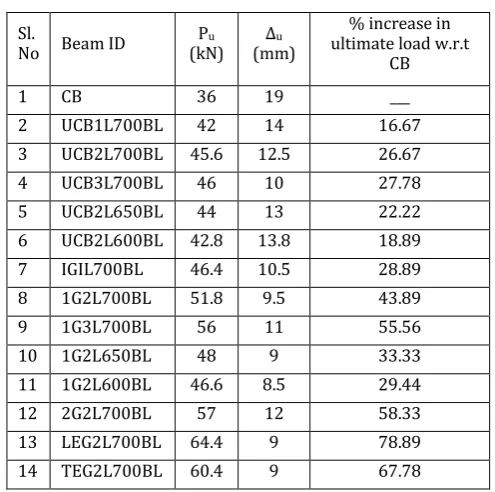
Table-3 provides the results obtained from the experimental tests carried out on control beam and beams strengthened by both EBR and Grooving Method. The strengthening methods to the RC beams with CFRP sheet caused superior load-carrying capacity and reduced ultimate deflection.
Both EBR and Grooving Method increases the performance of RC beam specimens in terms of load carrying capacity. However, RC beams strengthened by Grooving Method achieved much higher load resistance compared to EBR specimens. Test results shows that grooving method increases the load carrying capacity up to 79% more than the ordinary beam, whereas EBR method increases load capacity up to 28%. Compared to the grooving patterns, beam with longitudinal end groove shows the maximum load carrying capacity.
Table-3: Summary of Test Results Sl.
No Beam ID (kN) Pu (mm) ∆u
% increase in ultimate load w.r.t
CB
1 CB 36 19 ___
2 UCB1L700BL 42 14 16.67 3 UCB2L700BL 45.6 12.5 26.67 4 UCB3L700BL 46 10 27.78 5 UCB2L650BL 44 13 22.22 6 UCB2L600BL 42.8 13.8 18.89 7 IGIL700BL 46.4 10.5 28.89 8 1G2L700BL 51.8 9.5 43.89 9 1G3L700BL 56 11 55.56 10 1G2L650BL 48 9 33.33 11 1G2L600BL 46.6 8.5 29.44 12 2G2L700BL 57 12 58.33 13 LEG2L700BL 64.4 9 78.89 14 TEG2L700BL 60.4 9 67.78
Pu- Ultimate load, ∆u- Midspan deflection corresponding to failure load
3.2 Failure Modes
[image:3.595.37.286.266.476.2]The failure modes of all beams are shown in Fig -5 to 18. The control beam was failed due to concrete crushing after steel yield mechanism. All beams strengthened by EBR method were found to be failed by debonding of CFRP sheet from concrete substrate before utilizing its maximum capacity. All beams strengthened by Grooving Method (except 1G3L700BL) were found to be failed by FRP rupture. Debonding of CFRP sheet in 1G3L700BL is due its excess thickness; hence it is experimentally proved that two layers of CFRP sheet improved the performance of RC beam without debonding.
Fig -5: CB
Fig -6: UCB1L700BL
[image:3.595.308.557.528.775.2]© 2019, IRJET | Impact Factor value: 7.211 | ISO 9001:2008 Certified Journal
| Page 3818
Fig -8: UCB3L700BLFig -9: UCB2L650BL
Fig -10: UCB2L600BL
Fig -11: 1G1L700BL
Fig -12: 1G2L700BL
Fig -13: 1G3L700BL
Fig -14: 1G2L650BL
Fig -15: 1G2L600BL
Fig -16: 2G2L700BL
Fig -17: LEG2L700BL
Fig -18: TEG2L700BL
3.3 Parametric Study
Effect of Strengthening Method
In table- 3, the ultimate loads of the strengthened beams have been compared with the control beam specimen. It can be observed that maximum load carrying capacity of UCB1L700BL has increased 16.67% compared to CB. This increase is 28.89% for 1G1L700BL specimen. That means 10.48% increment has been occurred for 1G1L700BL compared to UCB1L700BL specimen. When two layers of FRP is used, 13.6% increment in ultimate load has been occurred for the beam strengthened with Grooving Method compared (1G2L700BL) to the EBR strengthened (UCB2L700BL) specimen; whereas 19.15% increment has been occurred when three layers of FRP is used. In chart-1, a comparison has been made for ultimate loads of specimens, showing the significant influence of strengthening techniques on the ultimate load carrying capacity of the beams. From the figure it is clear that three layers of CFRP sheets for GM method gives maximum strength. But due to the debonding problem with three layers of CFRP sheet, two layers are considered as effective.
© 2019, IRJET | Impact Factor value: 7.211 | ISO 9001:2008 Certified Journal
| Page 3819
In fact, due to the better performance of Grooving Method in transferring the stresses between CFRP materials and concrete substrate, beams strengthened with GM method could experience much higher loads than the beams strengthened with EBR method.
Effect of Number of CFRP Layers
Number of CFRP layers has an important role in the strengthening of RC beams. Debonding phenomena is directly depends upon the number of FRP layers used. Chart-2 shows the effect of number of CFRP layers on the load carrying capacity of RC beams strengthened by both EBR method and Grooving Method. The data collected from beams UCB1L700BL, UCB2L700BL, UCB3L700BL, 1G1L700BL, 1G2L700BL and 1G3L700BL were used to analyse this influence.
(a)
(b)
Chart-2:Effect of Number of CFRP Layers strengthened by (a) EBR Method (b) Grooving Method
Load carrying capacity of specimens strengthened by Grooving Method is increased by 28.89%, 43.89% and 55.56% for 1G1L700BL, 1G2L700BL and 1G3L700BL respectively when compared to the control beam; whereas this increment for UCB1L700BL, UCB2L700BL and UCB3L700BL is 16.67%, 26.67% and 30.56% respectively. Maximum load carrying capacity was achieved when three layers of FRP sheets were used. But the specimen 1G3L700BL was failed by the debonding of CFRP sheet from the concrete surface. In EBR method of strengthening, all beams were found to be failed by debonding of CFRP sheet from concrete substrate before utilizing its maximum capacity. But the
failure method in Grooving Method is much more improved because of more contact between the CFRP and concrete surface.
Effect of Bond Length
For all strengthening methods, bond length has a great influence on the flexural performance. As the bond length increases the load carrying capacity increases. The specimens UCB2L700BL, UCB2L650BL, UCB2L600BL, 1G2L700BL, IG2L650BL and IG2L600BL were used to analyse the effect of bond length on the load carrying capacity of strengthened RC beam specimens. From Chart-3 it is clear that as the bond length increases, load carrying capacity of the strengthened beams increases considerably; 700 mm bond length gives the maximum result. In EBR method, load carrying capacity increases as 18.89%, 22.22% and 26.67%, for 600 mm, 650 mm and 700 mm bond lengths respectively, when compared to the control beam. In GM method this increment is 29.44%, 33.33% and 43.89%.
Chart-3:Effect of Bond Length Effect of Groove Patterns
Four different groove patterns were considered for this study, such as; beams with single longitudinal groove, double longitudinal groove, longitudinal end grooves and transverse end grooves. Chart-4 shows the effects of groove patterns. Load carrying capacity varies with varying groove patterns. Specimen with longitudinal end grooves has the maximum load carrying capacity of 64.4 kN; which is 78.89% higher than the load carrying capacity of control specimen. Specimen with single longitudinal groove pattern has an increment of 43.89% in ultimate load with respect to the control beam specimen. This increment is 55.56% and 67.78% for 2G2L700BL and TEG2L700BL respectively. From the result it is proved that the longitudinal end groove pattern is the best choice to improve the load carrying capacity of RC beam specimens.
© 2019, IRJET | Impact Factor value: 7.211 | ISO 9001:2008 Certified Journal
| Page 3820
Chart -4: Effects of Groove Patterns4. CONCLUSIONS
In present study, efficiency of grooving method was investigated through experimental studies. Three point bending tests were conducted on RC beam specimens strengthened via EBR and Grooving methods. Based on the results, the following conclusions can be drawn:
CFRP fabric properly bonded to the tension face of RC beams can enhance the flexural strength substantially. The EBR specimens exhibit an increase in flexural strength of 16.67% for single layer 26.67% for two layers and 27.78% for three layers of CFRP sheet. But premature debonding was the main problem observed for all specimens strengthened by EBR method.
GM specimens with single longitudinal groove pattern can exhibit an increase in flexural strength of 28.89% for single layer 43.89% for two layer and 55.56% for three layers when compared to the specimen without any surface preparations. Grooving method performs much more effective when two layers of CFRP sheets were used, which can completely eliminate premature debonding. GM method can utilize higher tensile strength of CFRP sheets and tends to achieve FRP rupture before debonding.
Load carrying capacity is also affected by the bond length of CFRP sheet. Bond length of CFRP was varied as 700 mm, 650 mm and 600. It was observed that decrease in bond length decreases the load carrying capacity of specimens strengthened by both EBR and GM method. Bond length of 700 mm gives the better result among all strengthened beams.
Grooving method is a very efficient technique for beams strengthened with multilayers of CFRP sheets and as it was shown, beams strengthened with this method increased ultimate failure load by 28 to 79% as compared to specimen without surface preparations.
Using GM in different patterns increased the ultimate load carrying capacity compared to the specimens
strengthened by EBR method. Maximum enhancement greatly occurred in longitudinal end grooving.
REFERENCES
[1] Davood Mostofinejad and Ehsan Mahmoudabadi (2010),
“Grooving as alternative method of surface preparation to postpone debonding of FRP laminates in concrete beams”, Journal of Composites for Construction, ASCE, Vol.14, Pp.804-811.
[2] Kamyar Khozaei and Davood Mostofinejad (2015),
“Effects of GM patterns on ductility and debonding control of FRP sheets in RC strengthened beams”, Construction and Building Materials, ELSEVIER, Vol.93, Pp.110-120.
[3] Ardalan Hosseini, Davood Mostofinejad and Seyed
Masoud Shameli (2012), “Experimental investigation on the effectiveness of EBROG method for flexural strengthening of RC beams”, RESEARCH GATE.
[4] Davood Mostofinejad and Masound Shameli (2011),
“Performance of EBROG method under multilayer FRP sheets for flexural strengthening of concrete beams”, The Twelfth East Asia Pacific Conference on Structural Engineering and Construction, ELSEVIER, Vol.14, Pp.3174-3182.
[5] Amirhomayoon Tabatabaei Kashani, Davood
Mostofinejad and Seyed Amirali Mostafavizadeh (2012), “Grooving method to postpone debonding of FRP sheets used for shear strengthening”, International Journal of Civil and Environmental Engineering, Vol.6, Pp.1092-1096.
[6] R. Balamuralikrishnan and C. Antony Jayasehar (2009),
“Flexural behaviour of RC beams strengthened with carbon fiber reinforced polymer fabrics”, The Open Civil Engineering Journal, Vol.3, Pp.102-109.
[7] Ardalan Hosseini and Davood Mostofinejad (2013),
“Experimental investigation into bond behaviour of CFRP sheets attached to concrete using EBR and EBROG techniques”, Composites, ELSEVIER, Vol.51, Pp.130-139.
[8] Amirreza Moghaddas and Davood Mostofinejad (2014),
“Bond efficiency of EBR and EBROG methods in different flexural failure mechanisms of FRP strengthened RC beams”, Construction and Building Materials, ELSEVIER, Vol.54, Pp.605-614.
[9] Mahdie Mohammadi, Davood Mostofinejad and Majid
© 2019, IRJET | Impact Factor value: 7.211 | ISO 9001:2008 Certified Journal
| Page 3821
on FRP-Concrete bond strength under alkaline condition”, Composites and Construction, ASCE.
[10] Bamshad Sadjadi Manizani, Shahriar Tavousi Tafreshi
and Abbas Akbarpour (2016), “Effects of using multilayers of high resistance AFRP on loading capacity of reinforced concrete beams in comparison with low resistance AFRP considering EBROG method”, Journal of Structural Engineering and Geotechnics, Vol.6, Pp.26-29.
[11] Davood Mostofinejad and Seyed Masoud Shameli
(2013), “Externally bonded reinforcement in grooves (EBRIG) technique to postpone debonding of FRP sheets in strengthened concrete beams”, Construction and Building Materials, ELSEVIER, Vol.38, Pp.751-758.
[12] Davood Mostofinejad, Seyed Masoud Sahameli and
Ardalan Hosseini (2014), “EBROG and EBRIG methods for strengthening of RC beams by FRP sheets”, European Journal of Environmental and Civil Engineering, Vol.18, Pp.652-668.
[13] Ardalan Hosseini and Davood Mostofinejad (2013),
“Effect of groove characteristics on FRP-to-concrete behaviour of EBROG joints: Experimental study using particle image velocity (PIV)”, Construction and Building Materials, ELSEVIER, Vol.49, Pp.364-373.
[14] Davood Mostofinejad, Seyed Arman Hosseini and Seyed
Behzad Razavi (2016), “Influence of different bonding and wrapping techniques on performance of beams strengthened in shear using CFRP reinforcement”, Construction and Building Materials, ELSEVIER, Vol.116, Pp.310-320.
[15] Javad Sabzi and M. Reza Esfahani (2018), “Effect of
tensile steel bars arrangement on concrete cover separation of RC beams strengthened by CFRP sheets”, Construction and Building Materials, ELSEVIER, Vo.162, Pp.470-479.
BIOGRAPHIES
Anju Antony: Master’s student in SNGCE, Kerala.
Reshmi P.R: Assistant Professor in civil department, SNGCE, Kerala.
![N (2 Hydroxyethyl) 2 [2 (hydroxyimino)propanamido]ethanaminium 2 (hydroxyimino)propanoate](data:image/gif;base64,R0lGODlhAQABAIAAAP///wAAACH5BAEAAAAALAAAAAABAAEAAAICRAEAOw==)