High's Dairy u!
to keep their
11·
Maybe you never thought you'd
ager of a retail dairy store invo
communications.
But it's happening right now at
1stores operated by High's Dairy
Pn
Washington, D,C. metropolitan are
This system for ordering dairy
~pies standard Touch-Tone® phone s
store and the computer center at
Instead of writing out all the items h
manager calls the computer
center-regular telephone network-and tr
COHPll TeHS
AI-H>'
;,i\UTOHATICtJ
• .,. "11
"InOfl
It; n ' t f>-" ..
.
;.," ~" \oove.
s. At the
cen-ate in
Data-five
transla-;hes.
lalf with this
to a djust his
's a sudden
demand.
: is the man
th
communi-)s.
-size.
r.51 Touch-Tone Ll.!LJ phone service
e'!:'
Data·PhoneIiiIiI
data set~ Computer
C
Center~
Card PunchThe NCR Century Series
of computers.
When you learn how advanced they are,
you'll know why others are old-fashioned.
It's going to change all your old ideas about computer costs and capabilities.
The Century Series offers a price/performance ratio un~ equalled in the industry.
It's the first truly compatible family of computers that incorpo-rates the most modern technolog.:. ical developments. It's perfect for all levels of users. For both busi-ness and scientific applic.ations.
The Century Series wi II meet your requ irements today and to-morrow. You can expand capacity and power as your needs change. Just plug in a more powerful pro-cessor. Same peripherals. And no re-programming. True upward compatibility.
Internal memories range from 16,384 to 524,288 bytes. Future Century computers will offer memories with up to one million bytes. On-I i ne process i ng and three-way simultaneity offered in the lowest cost member. It rents for less than $2000 a month with
an extended contract. You can move up to multi-programming and nine-way simUltaneity. Even-tually to multi-processing and 17-way simultaneity.
You get the benefit of great technological developments. Mon-olithic integrated circuitry is used throughout. With the power of con-ventional or hybrid circuits but at a fraction of the size. Thin film, short rod memories. With speed in the 800 nanosecond range, yet lower cost than core memories be-cause of automated manufacturing techniques. (Only $375 for an ad-ditional 16,000 bytes of memory.)
A dual spindle disc unit that sets a new standard in the indus-try. With 45 ms average access time, it's the fastest removable disc unit in the industry. Each re-cording surface with 12 floating read/write heads.
Card Random Access Memory (CRAM) units each with on-line storage capacities over 125 mil-lion bytes. Magnetic tape drives
Designate No. 12 on Reader Service Card
with transfer rates up to 240 kc. Line printers with speeds up to 3000 LPM. A wide range of periph-eral devices: punched card and tape input/output units, MICR sorter/ readers, OCR scanners and remote on-line devices.
Sophisticated software! No other computer in the same price range as the Century computer can offer as much. Compilers, op-erating systems, applied programs and utility routines. All written, tested and ready-to-go. Program-ming languages: COBOL, FOR-TRAN and NCR's own NEAT /3.
There's much more to tell. Call your NCR representative today for the story of the Century. Or write to The National Cash Register Company, Dayton, Ohio 45409.
ELEI
...
.. IJIJ
FOR PEOPLE WHO THOUGHT THEY COULDN'T AFFORD A DIGITAL COMPUTER
A
$
4900
DIGITAL
COMPUTER
2 MICROSECOND CORE STORE.
400 NANOSECOND READ ONLY STORE.
6 j.1 SEC FULL WORD ADD TIME.
MICROPROGRAM MABLE. UP TO 256 I/O. DEVICES.
ALL DTL INTEGRATED CIRCUIT CONSTRUCTION. (Booth 1012 - 5JCC)
~ELBIT
COMPUTERS LTD.
88, HAG I B 0 RIM S T R E E T e P.O.B. 5390 e HAIFA eISRAEL. . Designate No. 21 on Reader Service Card
Vol. 17, No. 4 - April, 1968
Editor Edmund C. Berkeley L1.ssociate Editor Sharry Langdale Assistant Editors Moses M. Berlin Linda Ladd Lovett Neil D. MacDonald Contributing Editors John Bennett Andrew D. Booth Dick H. Brandon John W. Carr III
Ned Chapin Alston S. Householder Peter Kugel Leslie Mezei Rod E. Packer Ted Schoeters Advisory Committee T. E. Cheatham, Jr.
Art Directors
Fulfillment Manager
James J. Cryan Richard W. Hamming Alston S. Householder Victor Paschkis Ray W. Hass Daniel T. Langdale William J. McMillan
Why companies
standardize on
WANG
electronic
calculators
VERSATILITY
Just one basic calculator design, the WANG 300 Series, can solve the needs of many company operations. On compact keyboard displays, all basic arithmetic functions (+, -, X, -;-) can be performed instantly, silently, accu-rately by simply touching a key. Op-.... ____ . ________ tional keys produce x2,vx,
Logex, eX. 80Advertising Representatives
NEW YORK 10018, Bernard Lane 37 West 39 St., 212·279·7281 CHICAGO 60611, Cole, Mason, and Deming 737 N. Michigan Ave., 312·787·6558 PASADENA, CALIF. 91105, Douglas C. Lance 562 Bellefontaine St., 213·682·1464 SAN FRANCISCO 94123, Richard C. Alcorn 2152 Union St., 415·922·3006 ELSEWHERE, The Publisher Berkeley Enterprises, Inc. 815 Washington St., 617·332·5453 Newtonville, Mass. 02160
Step tab cards and plug-in card readers can make any model fully program-mable.
EXPANDABILITY
As needs increase, add-on compatibility makes it possible to expand into a powerful computing system that will branch, loop, do sub-routines, make decisions and manipu-late arrays.CONVENIENCE
Wang calculators are as simple to learn and operate as a ten-key adding machine but infinitely faster and more powerful.ECONOMY
Wang multiple keyboard systems cost far less per station than any comparable electronic calculators. In use, they can eliminate 67 to 93 per - - - c e n t of calculation time. (One leadingEDITORIAL OFFICES 815 Washington Street Newtonville, Mass. 02160
::@'~
Circulation audited by ',.,." Audit Bureau of CirculationsCOMPUTERS AND AUTOMATION IS PUBLISHED MONTHLY AT 815 WASHINGTON ST .• NEWTONVillE, MASS. 02160, BY BERKELEY ENTER-PRISES, INC. PRINTED IN U.S.A. SUBSCRIPTION RATES: UNITED STATES, $15.00 FOR 1 YEAR, $29.00 FOR 2 YEARS, INCLUDING THE JUNE DIRECTORY ISSUE; CANADA, ADD 50¢ A YEAR FOR POSTAGE; FOREIGN, ADD $3.50 A YEAR FOR POSTAGE. ADDRESS All EDITORIAL AND SUBSCRIPTION MAil TO BERKELEY ENTERPRISES, INC., 815 WASHINGTON ST .• NEWTONVillE, MASS., 02160. SECOND CLASS POSTAGE PAID AT BOSTON, MASS.
POSTMASTER: PLEASE SEND All FORMS 3579 TO BERKELEY ENTER-PRISES, INC., 815 WASHINGTON ST .• NEWTONVillE, MASS. 02160. ® COPYRIGHT, 1968, BY BERKelEY ENTERPRISES, INC. CHANGE OF ADDRESS: IF YOUR ADDRESS CHANGES, PLEASE SEND US BOTH YOUR NEW ADDRESS AND YOUR OlD ADDRESS (AS IT APPEARS ON THE MAGAZINE ADDRESS IMPRINT), AND AllOW THREE WEEKS FOR THE CHANGE TO BE MADE.
company reports a saving of $73,000 four months after installing Wang Elec-tronic Calculators.)
Why not investigate? Write or call:
Dept. 4·0,836 North St., Tewksbury, Mass. 01876 Tel.: (617) 851·7311
In Major Cities, Tel.: (514) 482.0737 (201) 241·0250 (313) 278·4744 (518) 463·8877 (203) 666·9433 (314) 727·0256 (601) 234·7631 (205) 245·6057 (317) 631·0909 (612) 881·5324 (206) 622·2466 (319) 365·2966 (614) 488·9753 (212) 682·5921 (402) 341·6463 (617) 851·7311 (213) 278·3232 (404) 457·6441 (702) 322·4692 (214) 361·4351 (405) 842·7882 (702) 735·5802 (215) 642·4321 (412) 366·1906 (713) 668·0275 (216) 333·6611 (415) 454·4140 (714) 234·5651 (301) 588·3711 (416) 364·0327 (716) 381·5440 (301) 821·8212 (504) 729·6858 (717) 397·3212 (303) 364·7361 (505) 255·9042 (816) 421·0890 (305) 841·3691 (512) 454·4324 (817) 834·1433 (312) 456·1542 (513) 531·2729 (919) 288·1695
J
~
!
APRIL, 1968, Vol ... 17, No.4
SPecial Feature.'
Electronic Data Processing and Management
16
THE FULL CONTROL OF OPERATIONS IN DATA PROCESSING
by Russell W. FenskeA suggested system for effective control of computer operations - a reasonable combi-nation of a manual system and a completely computer-operated system.
24
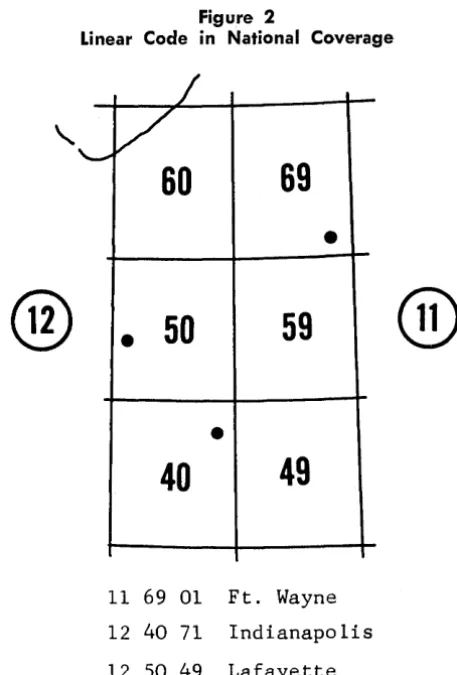
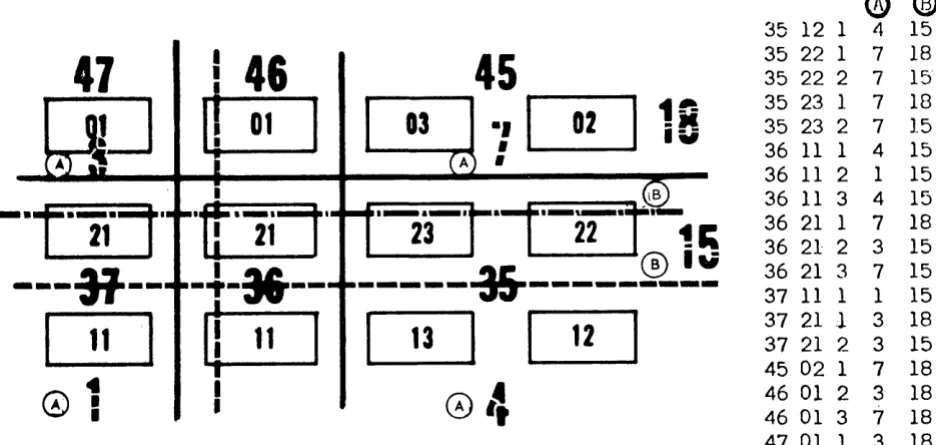
A LINEAR GEOGRAPHICAL CODE FOR MANAGEMENT INFORMATION
SYS-TEMS
by Jiri Kallab
A geographical code which matches physical location in the real world: how it works, and how it neatly solves many management problems.
32
HOW TO LIVE WITH A UNION -
PEACEFULLY AND PROFITABLY
by A. A. Imberman
How management can help reduce industrial unrest and inefficiency.
40
THE CONCEPT OF THE "DATA ANALYSIS AND CONTROL CATALOG" FOR
MANAGEMENT INFORMATION SYSTEMS
by William B. Stevens
A technique for developing a well-defined data base for management information sys-tems.
43
THE IMPACT OF DATA PROCESSING TECHNOLOGY ON THE LEGAL
PRO-FESSION
by Vaughn C. Ball
Why lawyers should examine computers - to protect clients' rights, perform their professional duties, and come closer to the goals of justice.
Regular Features
Editorial
7 Access to Information and a Mailing List of All Computer People - II, by Edmund C. Berkeley
C&
A Worldwide
36 Report from Great Britain, by Ted Schoeters
Computer Market Report
48 The Future of Computer Communications - and the Small Peripheral Equipment Manufacturers, by Ted Schoeters
Fifteen Years Ago in rrComputers and Automation"
54 Mechanical Translation, by Andrew O. Booth
Ideas: Spotlight
53 The Value of Swift Knowing of New Knowledge, by Frank J. Moran
Jobs and Careers in Data Processing
52 The Ten-Mile Gap - Part 2: Solutions, by Stephen F. Keating
Multi-Access Forum
10 10 11
In Favor of Merging Two Societies That Supplement Each Other, by C. M. Rollins Integrated Civil Engineering System (ICES) for Programming - Non-Proprietary All Bank Export Credits Should be Exempted from Present Ceilings, by Richard Bliss
12 Refund of Overpayment of Social Security Tax by Multiple Employers - II, by Robert M. Ball, 13
13 14 14
5S
and Mrs. Helen Solem
The Human Computer, Mr. William Klein IFIP Congress 1968 Program
Hands On Contact with a Computer for Young People - Announcement Preview of "Who's Who in the Computer Field," Fifth Edition
Anti-Complicity Movement Organized
COMPUTERS and AUTOMATION for April, 1968
The front cover shows sixth grader Joanne Chomich trying her hand at running the ancient
Meso-I potamian city-state
0/
Lagash -with the aid0/
a computer. Pro-jected on the wall is an artist's con-ception0/
what Lagash looked like I in its heyday, about 3500 B.C. Forthe story, see page 60.
~NOTICEK
*D ON YOUR ADDRESS IMPRINT MEANS THAT YOUR SUBSCRIPTION INCLUDES THE COMPUTER DIREC-TORY. *N MEANS THAT YOUR PRES-ENT SUBSCRIPTION DOES NOT IN-CLUDE THE COMPUTER DIRECTORY. SEE PAGE S1.
I
! I
,I
Departments
S7 Across the Editor's Desk -
Com-I
puting and Data Processing Newsletter
:1
(For detailed contents,
I page 56)
74 Advertising Index
: I 73 Books and Other Publications
:1
Ii
50 Calendar of Coming EventsI 70 Monthly Computer Census
68 New Contracts 69 New Installations 74 New Patents
by Raymond R. Skolnick
Ii
47 Problem Cornerb~ Walter Penney, COP
I
.J
see
•
It won't cost you anything to find out.
We know your type.
If you're presently making copies
from line printer output, it's no
pleas-ure to read. Or to handle.
If
you're using traditional
type-setting methods there's room for error.
If
you'd like to iron out the bugs
in multi-copy printing of computer
gen-erated data, our type is your type.
Who are we? Alphanumeric.
And what we have to offer is the
most advanced technique of electronic
photocompo~ition.
A service that can
add a new dimension of graphic arts
quality to the printed pieces you prepare
from computer generated data. A
choice of type styles and sizes. Bold
type. Light type. Italics. Plus the savings
that can be made in bulk. Time. And
printing costs. The risk of error in
type-setting is virtually eliminated because
data is converted directly to type within
the computer.
To find out if we're really your
type, though, send us your name and
ad-dress. In return we'll send you the facts.
You'll learn how your output tapes can
be used to generate graphic arts quality
type.
If you have any doubts about
whether we're all we say we are: we set
the type you're reading now. In less than
one second.
Alp1!~l!\Y!leric
C-
a
EDITORIAL
Access to Information and a Mailing List of
All Computer People - II
In our January editorial, we discussed the continuing prob-lem of access to information for everybody in the computer field, and reported some history; then we said:
We think the time has come to go back to the simple concept of a mailing list for all computer people. Computers and Automation has decided to start a
mail-ing list of all people interested in the field of computers and data processing.
C&A invites everybody who is interested in the field to send us their name and address for inclusion in this list, Computers and Automation's Universal Mailing List, CA UML.
We said that the rules covering the universal mailing list would be about as follows: that anybody who wishes to mail information that bears some reasonable relation to the inter-ests of people in the computer field would automatically have permission to mail to this list, at a ,mailing list rental fee of $20 per thousand pieces addressed; and that the net income from the list would be contributed to worthy causes for improving education in the computer field.
We discussed the advantages of "junk mail" in the com-puter field; described the crazy quilt pattern of magazines, associations, and mailing lists to disseminate information in the field of computers and data processing; and concluded that it was silly to try to cover the computer field of over 200,000 persons with the existing pattern of dissemination - and that a universal mailing list was really needed.
To our astonishment,· over 1100 persons have so far sent us their names and addresses for inclusion in CAUML. This is the result of jus"t one mention in the January editorial.
We have begun putting these names and addresses not on metal plates, but on magnetic tape, under a system which will enable us to record additional information about these persons as it becomes available. An example might be a code for "Please do not send me information about . . . for I am not interested". We also plan to include in CAUML names .and addresses that are in the public domain (such as an officer
~ of a computer association, or the author of a computer maga-zine article).
Also we have made a decision not to record in CAUML any information which might be derog-atory (such as security or credit information), and thus infringe on the privacy of an individual.
Several letters have come in with interesting comments. In particular, Michael F. Weisbard, Senior Programmer and Systems Analyst in a large bank computer installation in Chicap;o, has written us a5 follows:
I have recently re-read your
.T
anuary Editorial, and think it is a most useful idea. Several technical points, however, might be reexamined for possible improvement.(1) May I argue for a computer-based system of keep-ing and convertkeep-ing the lists? Several possible ad-vantages appear:
COMPUTERS and AUTOMATION for April, 1968
/
(2)
(a)
(b)
(c)
(d)
You could carry more information' about ,each name, such as what computers he (or. she) has worked on, what languages, what committees and groups affiliated with, etc.
You could form sublists, for better file organiza-tions and accessing.
A computer-based system would allow you to make each search-request more effective be-cause you can program to count-classify-qualify each name and to show the relationship of the names extracted from the total population rep-resented.
Speed and cost could probably be shown to be better for the life of the system, than for the metal plates. This is particularly true in a file where attributes to basic information (such as a person's address) change often.
May I suggest investigation of several supporting ideas?
(a) Organization of the file:
(b)
ZIP-code order is desirable because that is what mailers and the post office seem to require. The advantage of zip codes is lost if the post offi~e
(or bulk mailer) must physically sort each item. Zip coding is also useful for geographic selec-tion and for relating to census/economic data. Alphabetical within a zip code might be de-sirable.
File system: Several short items in your maga-zine have annou.nced the availability of file sys-tems for storing-extracting-summarizing data. Several that come to mind are: QUICK QWERY from Consolidated Analysis Centers Inc. (CACI), Los Angeles, Cal.; MARK IV from Informatics, Inc.; Sherman Oaks, Cal.; PDQ Information Retrieval System from Ap-plied Data Research, Inc., Princeton, N.].; and G RS (General Retrieval System) from Infor-mation Science Inc., New City, N.Y. Alterna-tively I should think that the basic file mainte-nanc; system shouldn't be too complex in COBOL, and could be readily done by a local service organization. The benefit of QUIC:rz OWER Y and the others is that they are avall-.ilile and probably well-tested, as well as being versatile.
I am enclosing pertinent information about myself on a separate sheet, for inclusion in the CAUML mailing-list file. I hope these suggestions and ideas are of some use and benefit to you.
\Ve promptly telephoned Mr. Weisbard, and asked him please to become a member of an Advisory Committee on
(Please turn
topage 55 )
Weather has no respect for national boundaries. Perhaps that's why
international cooperation in forecasting has for a long time been a constant in an area fraught with inconsistency.
Cooperation is important, but it's not the only answer to more accurate and longer range forecasting. Computer technology is a key factor.
This is fortunate for the United States, because no other nation is further advanced in this area.
And no other nation's weather research establishment has two UNIVAC@ 1108 Systems at its disposal.
Scientists at the Environmental Science Services Administration's
Geophysical Fluid Dynamics Laboratory use them to simulate the earth's
atmosphere by means of theoretical models. Their goal is to develop a satisfactory model comprised of elements which closely approximate those of the real atmosphere. By changing just one variable in this mathematical model-sea surface
temperature, snow cover, atmospheric pollutants, for instance - scientists can in effect experiment with the atmosphere and determine how that one alteration
influences the entire model.
These simulations are so complex, the elements so numerous that a 24-hour forecast for the northern hemisphere can take 10 hours of computing.
Despite this scientists are optimistic. In fact, current results indicate that reliable 14-day forecasts are a distinct future possibility. Also, the observational network must be expanded to the whole of the earth.
It will take some time, therefore, before two week forecasts become standard. Scientists estimate five to ten years.
But if it weren't for computers, it might take forever.
UNIVAC
Univac is saving a lot of people a lot of time. ...JL
-''Sr-'C~Y
RAf\D
Designate No. 15 on Reader Service CardThe Ultimate Weapon in the Wet War.
No one can stop the rain, but we can help you be ready for
it.
I
Letters
To
The Editor
Computer Graphics
I am the engineer at the graphics con-sole used as the cover for you'r February, 1968 issue, and would like five copies of your magazine for my personal distri-bution.
For your own interest, I represent Body Engineering Applications and have devised a method of analyzing and de-signing mechanical linkages, e.g. con-vertible top mechanisms, hood hinge mechanisms, from suspensions, etc.
I am glad to see the interest that your publication has shown in the field of computer graphics, especially the Ford Computer Graphic's Project ("The Ford Computer Graphics Project", Computers and Automation, November, 1967, page 35) .
LAWRENCE E. ANTINONE Dearborn, Mich.
(Ed. Note - Copies sent.)
IIEmbezzling Primerll
The "Worth Reading" section of the February Systems & Procedures Journal refers me to your article, "Embezzling Primer" (Computers and Automation, November, 1967, page 41). I am inter-· ested in reading this article and in hav-ing a look at your publication. Will you please forward me a copy of the No-vember, 1967 issue? I will be happy to accept billing.
J.
C. STEPHENSON, JR. Systems ManagerNewport News, Va. 23607
(Ed. Note - Copy sent.)
Computer Art Exhibition
An article in your issue of August 1966 in which there is a discussion with photographs concerned with your annual Computer Art Contest has been brought to my attention.
I suspect that other galleries and mu-seums have displayed an interest in these works for exhibition purposes; so per-haps you have already given the matter some thought. .
I would be intensely interested in hav-ing one of your annual Computer Art Contests for e:l,{hibition at our gallery some time du~ing the school year of 1968-69, and would like to enquire about availability.
ALVIN BALKIND, Curator
Univ. of British Columbia Vancouver 8, Canada
(Ed. Note - A copy of our August
1967 art contest issue is being sent to you. We do not have originals of the computer art to loan, but I would sug-gest that you blow up photographically the art shown in our contest issue and use it for exhibition, with appropriate credit to Computers and Automation.)
Keeping Up With Reading
Regarding "The Problem of Keeping Up With One's Reading" (editorial in Computers and Automation, January, 1968), we suggest an additional scheme: SCHEME 6: Subscribe to Data Process-ing Digest, as many of our subscribers have for the past 14 years.
MARGARET MILLIGAN, Publisher
Data Processing Digest, Inc. Los Angeles, Calif. 90035
(Ed. Note - Thank you for your «Scheme 6"j but it seems to me to be included in Scheme 31)
Correction
Please allow me to call your attention to a slight mistake in the address of the Information Processing Association of Israel (IPA) which appears on page 132 of the June, 1967 issue of Computers and Automation.
The correct address is: IPA, c/o Dr. D. Chevion, Director, Office Mechaniza-tion Centre, Hakirya-Romena, P.O. Box 30 16, Jerusalem, Israel.
DA. SALOMON M. DORF RUDICH Havana, Cuba
COMPUTERS and AUTOMATION for April, 1968
GET A
NEW LEASE
ON YOUR
COMPUTER'S
LIFE
IT'S WORTH IT!
Let Management Data Corporation show you this unique leasing program.
• Save 10 to 30% of your present rentals for data processing equip-ment
• C·ontinue with direct manufac-turer's service
• Maintain full flexibility on equip-ment additions and replaceequip-ments • No loss of manufacturer's
soft-ware support
For full details, prices and free brochure write or phone collect.
~
MANAGEMENT
~
DATA CORPORATION
1424 Walnut Street
Philadelphia, Pa. 19102 (215) KI 6-6600
Designate No. 39 on Reader Service Card
Library Selection Guide
The following annotation for your magazine will be included in a list I am preparing for use as a magazine se-lection guide by libraries:
"This is a good choice for a general periodical on computers, data processors, automation. Lead articles, reflecting state-of-the-art in a multitude of areas (design, programming, applications, edu-cation, even art by computers), although ostensibly written on an intermediate level, are still intelligible to the layman. Market reports, newsletters, monthly
compute~ census, new patents, announce-ments of government contracts, also make this a necessity for any special li-brary serving computer clientele. The June issue alone, consisting of a roster of organizations, products, services, glos-sary, etc., justifies a subscription."
W. A. KATZ, Professor
School of Library Science State University of New York Albany, N.Y. 12203 .
(Ed. Note -- Thank you.)
MULTI-ACCESS FORUM
IN FAVOR OF MERGING TWO SOCIETIES THAT SUPPLEMENT EACH OTHER
C. M. Rollins
Director, Information Systems
Applied Technology (Div. of Itek Corp.) 3410 Hillview Ave.
Palo Alto, Calif. 94304
I was fortunate to attend the Data Processing Management Association (DPMA) Conference in Boston in June, 1967. At this convention there was considerable representation (sev-eral thousanq delegates) from various companies that utilize electronic computers for Business Data Processing. I also at-tended the Systems and Procedures Association (SPA) Con-ference conducted in Detroit, Michigan in October 1967. The SPA seminar was primarily conducted for systems people representing various companies, and over 2,000 delegates attended. In reviewing the sessions at the DPMA Conference and the SPA Conference I drew some conclusions.
The DPMA Convention in Boston was not very well or-ganized, and it was confusing for delegates to find and attend the proper sessions. However, the DPMA Convention had considerable computer equipment and peripheral equipment on exhibit which was very interesting and informative. On the other hand, the SPA conference in Detroit was very well organized; the delegates seemed pleased with the physical layout, the easy system for room identification, and the rela-tive ease in finding and attending the right sessions. However, at the SPA seminar in Detroit, there were no computers or related peripheral equipment exhibited. The exhibits con-sisted primarily of Reproduction Equipment.
I would like to recommend that the Data Processing Man-agement Association be merged with the Systems and
Pro-cedures Association. There is little justification for having these two groups separate, since Systems and Data Processing are intricately woven together. I think a new combined or-ganization should be created. Consolidation of the two groups would produce a much more effective, more powerful group and could do a considerably better job of explaining and selling the uses of systems and data processing in indus-try, business, and government. It seems to me than an ecumenical movement should be started on the merging of these two groups.
The combined organization would pool objectives, purpose, resources, facilities; the members would strengthen their over-all position and prestige in the business world. Some of the results or objectives from such an integrated organization could be: professional status; standard requirements for com-puters for business systems; standardization in systems and in data processing; greater power and influence in systems and in the data processing profession; commingling of assets, talents, objectives, and facilities; and elimination of redun-dance and ,duplication of effort.
I am directing similar letters to the President of the DPMA, the Editor of Data Processing Magazine and the Editor of the Systems and Procedures Journal. I hope that a movement can be started for the merging of these two groups.
INTEGRATED CIVIL ENGINEERING SYSTEM (ICES) FOR
PROGRAMMING-NON-PROPRIETARY
Civil Engineering Systems Laboratory, Room 1·163 Department of Civil Engineering
Mass. Inst. of Technology Cambridge, Mass. 02139
The .Department of Civil Engineering at Massachusetts Institute of Technology has recently developed and released a large-scale, non-proprietary computer system called the Integrated Civil Engineering System (ICES). The system was developed over the past three years as a cooperative venture between government, industry, foundations, and universities concerned with the use of information systems in civil engineering. The cost of the development exceeds
$3 million.
10
ICES is built upon past work of the Department of Civil Engineering at MIT, including COGO, STRESS and DTM.
ICES contains a series of subsystems corresponding to vari-ous engineering disciplines. Subsystems presently exist for geometric problem solving, project scheduling, structural analysis and design, soil mechanics, transportation planning, and highway engineering. An engineer can use one or more of these subsystems in the solution of a single problem. Each-subsystem has associated with it a problem-oriented language to enable an engineer to easily communicate his problem solving requests to the computer.
All of the ICES subsystems utilize a general set of ICES system programs which provide advanced computer capabili-ties in secondary storage management, dynamic allocation of primary memory, and dynamic program structure. The ICES subsystem programs are written using ICETRAN (ICES
FORTRAN), an extension of FORTRAN incorporating such
ALL BANK EXPORT CREDITS SHOULD BE
Richard Bliss, Sr. Vice Pres. International Banking Department Bankers Trust Co.
P.O. Box 318
New York, N.Y. 10015
Amid all the discussions over encouraging greater U.S. exports, one key point seems to be overlooked. This country has an extremely efficient and imaginative international bank-ing system, which is currently prevented from makbank-ing its full contribution to export financing. Already handicapped under the so-called voluntary restraint programs, lending ceilings have been further reduced, and the banks are barred from further significant increases in direct export financing. Major banks have gone on record recommending that all bank export credits be exempted from present ceilings. This position has been advocated continuously since 1965, when "voluntary" restraints on their overseas financing were in-troduced. Unfortunately, three full years later, with steadily increasing balance of payments problems, no bank export credit exemption has yet been approved.
The Export Import Bank
As a result, a situation has developed where substantial export increases above current levels must now be financed through the Export Import Bank of Washington, the only U.S. lending institution not subject to balance of payments restrictions. In answer to continual requests for more liberal
(I treatment for bank export financing, the authorities seem to have confused the issue by emphasizing that they know of no export sales lost for lack of financing which can be attributed to balance of payments restrictions. In a literal sense this may be true, but their comments not only ignore the clearcut shift from the private sector to the public, but also pay insufficient attention to the impact of severe new restrictions on possible nationwide export financing efforts that might otherwise be developed by the commercial bank-ing system.
In calling for the exemption of their export credits, com-mercial banks are not expressing reservations about the long-time effective' role of the Export Import Bank in the ex-port financing field. It has done well, and merits the
In-crease in its lending authority which it currently seeks. Its basic role, however, has been, and should continue to be, to add to, and not replace, the export financing operations of the American commercial banking system. The Export
COMPUTERS and AUTOMATION for April, 1968
features as dynamic and relational data structures, data management, dynamic program structures, and a push-down program stack. In addition, a command definition language (CDL) is provided to enable programmers to define" the problem-oriented user languages associated with each sub-system.
The initial version of ICES is implemented for the IBM System/360, and operates as a normal job under control of OS/360. The system is designed in a modular flexible man-ners so that each organization can choose which su'bsystems
it wishes to use, modify other subsystems and add new sub-systems. Although ICES was initially developed for Civil Engineerin'g applications, new subsystems are currently being developed for other areas of engineering and for management.
Vve shall be glad to provide further information.
EXEMPTED FROM PRESENT CEILINGS
Import Bank has continually demonstrated an awareness of this basic function, with the need for separate private export activity, as well as for joint public-private export efforts.
But, while commercial bank export financing is being curtailed, . the Export Import Bank has re'cently asked for a 50 percent increase in its total financing authority, from a current $9 billion to $13.5 billion. Obviously, if this is justified, commercial banks should likewise be authorized to increase their export credits, and thus help meet export financing requirements. The system is there. It should be used.
The paradox of the present restrictions is further evidenced by the fact that the Export Import Bank, and other Wash-ington agencies, make constant requests for commercial bank participations in their loans. The added export financing efforts of commercial banks are therefore evidently required, but are sought only after much of the new export financing has been pushed through Washington, a sort of refinancing in reverse.
The "Cash Substitution" Theory
In defense of present limitations, there has been advanced one of the most untenable and frustrating ideas to come out of Washington in recent years. This goes by name of the "cash substitution" theory. It maintains that if current bank restrictions were remov~d, the banks CQuld and would provide export financing to overseqS buyers who would otherwise pay cash. Th,~.t cash might then be used for other purposes, including gold purchases from the dwindling U.S. reserve.
Practical banking and business experience shows that this reasoning is wholly unfounded. A hard pressed buyer may be forced to pay cash once, but he is certainly going to seek other suppliers the second time around. Under present highly competitive world market conditions, cash is generally not used, nor is it available, except for down payments. Since credit is available from various competing industrial coun-tries, American insistence on full cash payments would therefore simply encourage buyers to shift pmchases to other countries. Moreover, any actual credit substitution for cash
payments would create only a temporary advantage for off-shore buyers, since much of the U.S. bank export financing is arranged on a relatively short 6-month or, at most, 12-month basis.
Nobody has disputed the present competitive danger. From 1958 through 1966, we have lost ground to Western Europe and Japan. Unfortunately, we do not appear to have reached the obvious conclusion that the risk of further damaging competition must be decreased by a new and more flexible approach, including the exemption of all U.S. commercial bank export credits from present restraints.
The Balance of Payments Problem
Our balance of payments problem is highly complicated, and I certainly do not suggest that increased ability of the banks to finance exports is a panacea. As has been pointed out by many others, a liberal dose of fiscal responsibility must be the starting point. However, any measures that can help to encourage exports should be wel.comed.
Most current emphasis has been on the useful increase in aggregate U.S. exports from $25.3 billion in 1964 to $29.2 billion in 1966 and an estimated $31 billion in 1967. Less attention has been focllsed on the far ,more significant decrease in the U.S. trade surplus from $6.7 billion in 1964 to $3.7 billion in 1966 and to below $3 billion estimated for 1967. Still less note has been given to the disastrous decline in our commercial trade surplus (after deducting Government financed exports), which has plummeted from $3.9 billion in 1964 to a minuscule $600 million in 1966, with no significant improvement evident.
Certainly we all agree that the balance of payments prob-lem is severe and warrants drastic measures. However, in this atmosphere of crisis, let us not base policies on unproven arguments such as the "cash substitution" theory, nor on the presumption that the public sector has more ability to sf'lect and finance "proper" exports than the private sector. Such theories can do a great deal of harm.
.The commercial banks have a vital role in export financing. We should not diminish it.
REFUND OF OVERPAYMENT OF SOCIAL SECURITY TAX BY
MULTIPLE EMPLOYERS -
II
I.
From a letter written to Mrs. Helen Solem by Robert M. Ball, Commissioner of Social Security, Dept. of Health, Education, and Welfare, Baltimore, Md. 21235.The law does not permit employers to consider for social security tax purposes wages paid by other employers during the year. The employer's contribution is an excise tax which the employer pays because he has persons in his employ; it is levied on the covered wages he pays to all his workers. The employer contribution is not set aside for the benefit of any particular employee. It is used to help finance social security benefits for all beneficiaries. The employer has an obligation to contribute toward the social insurance protection of his employees on the basis of wages paid up to the maximum for each employee. He is not relieved of this obligation be-cause the employee may have worked elsewhere during the year.
There are a number of considerations against providing for a refund to employers in cases where an employee is paid a total of more than $6,600 ($7,800 beginning in 1968) by
II. From Mrs. Helen S'olem, Accountant, to the Editor 666 E. Main
- Hillsboro, Ore. 97123
I do not believe that it would be difficult to equitably administer a refund of overpayment of Social Security tax paid by employers. (See "Refund of Overpayment of Social Security Tax by Multiple Employers", Computers and Automation, March, 1968, page 16.) It would, how-ever, require a change in the law.
The computers the Internal Revenue Service now uses could quite easily select the overpayment by individual tax credit application, and the refund could automatically be given to the employer to whom it is due. An example is for the following individual who changed jobs during the year:
two or more employers. It would be difficult to set up an equitable basis 01) 'which to make a refund. Where the individ-ual changes employers during the year, the question would arise as to the extent to which each employer should bear the responsibility for the payment of contributions. If it were decided that all employers should share in a refund of earn-ings above that amount, fairly complex rules would have to be established to determine the proportionate liability for each employer. A similar situation could apply if the indi-vidual worked simultaneously for two or more employers,
with the added consideration that the employee might not want either employer to know what the other is paying or even that he has other employment. Any provision for re-funding the employer's share of contributions would make it essential that employers have this information.
S.S. No.
Refund Due Employer No. S.S. Tax Earnings
%
Employer:)41-34-4467 93 6002236W' $147.66 $3,993 36% 64%
$53 95 93 W002231 290.40 6,750
Since the Social Security tax is increasing, it will be more important than ever for employers to reduce their payroll costs as best they can. Without computers, refunding this overpayment would of course be a complex problem.
The battle to bring about a change is far from over. The next step is to bring the matter to the attention of Represen-tative Wilbur Mills, Chairman of the House Ways and Means Committee. I urge you and all your readers to help to see that the benefit of refunding overpayments of Social Security taxes to employees is also extended to employers.
THE HUMAN COMPUTER, MR. WILLIAM KLEIN
(Based on an interview with William Klein
by
David Ehrlich as reported in the January 26, 1968 edition ofMedical News, published in London, England.)
With all the complicated computers at the European Cen-tre for Nuclear Research, located on the borders of France and Switzerland, the Theory Division of that centre also employs the services of a "human computer", Mr. William Klein.
For many years, Mr. Klein has entertained audiences with exhibitions of lightning speed in manipulating numbers. Mul-tiplication of any five-figure numbers takes a few seconds. Even 1388978361 x 5645418496 = 7841364129733165056 is all done in his head in 64 seconds. This involves 25 multi-plications of two-digit numbers, and additions-over 50 opera tions in all.
Division, addition, subtraction, powers, roots, logarithms and factors come with equal facility. Behind Mr. Klein's unique ability lie a phenomenal memory for numbers and sheer intellectual virtuosity.
Mr. Klein rarely follows a standard sequence of calculation that a computer would follow. His basic material, acquired by long effort, includes knowing by heart the multiplication tables up to 100 x 100, all squares up to 1000 x 1000,
loga-rithms of all numbers less than 150 (to five decimal places), and all prime numbers less than 1O,000-plus an enormous number of odd facts and principles, some his own, some adopted from the great theoreticians of history.
An occurrence at a British Business Exhibition a few years ago illustrates how all this helps. Mr. Klein was visiting the Friden Company booth at the Exhibition, and asked for a demonstration of their new "root" machine.
"All right, sir, let's try all the fives," offered a smug. sales-man, feeding 555555555555 into the machine. Before he could press the button for the result, Mr. Klein said quietly, "745356 should be about right." The operator nearly col-lapsed when 745355.9924 appeared.
Mr. Klein had obviously not gone through the laborious
proces~ of conventional square rooting. He had remembered that 0.5555 . . . is the decimal fraction for 5/9, whose
IFIP CONGRESS 1968 PROGRAM
International Federation for Information Processing 23 Dorset Square
fI London,
N.W.l,
EnglandAt the IFIp Congress 68, which will be held in Edinburgh, . Scotland, August 5-10, 1968, some 250 papers will be de-livered to the 4000 delegates from 40 countries who are ex-pected to attend.
The committee responsible for organizing the program Ihas two a~ms: (1) to present an authoritative and
compre-hensive review of the current state of the data processing art, and (2) to disseminate information on the most important developments and significant advances that have occurred throughout the world since the previous IFIP Congress held in New York in 1965.
To achieve the first objective, a number of international experts in particular aspects of computer technology have been invited to speak on computer development and usage. Nine of the 35 invited papers will last for one hour, and will review progress made in major areas of the information
COMPUTERS and AUTOMATION for April, 1968
square root is 1/3 root 5. Knowing root 5 and dividing by 3 gives the answer easily.
Describing his life, Mr. Klein told how he had studied medicine, but never higher mathematics. He was born in Amsterdam on December 4, 1912. His first interests in mental arithmetic were factors and prime numbers. In his spare time he worked up to almost 20,000, distinguishing the indivisible prime numbers from those that were products of two or more other' numbers.!
He became more and more enthusiastic as memorizing be-came easier with all his basic baterial. Teachers never en-couraged him nor recognized that he could help other pupils. Indeed, they usually asked, "How did you get the solution so quickly?" And when he told them, they would say, "But this is not the way I taught you to do it - and expect you to do it."
What does he think of the New Math and children's edu-cation? He declines to comment, but says, "Fortunately there are not yet computers in grammar schools."
"Basically there are two ways of doing multiplication, one bad, used by almost everybody, and the other excellent, but used by very few." (This is the one-line answer, the rest of the operations carried mentally.)
"Mental arithmetic would be very good for general memory training. The next generation would work so much faster, too .... Society is the poorer for rejecting mental arithmetic." Mr. Klein admits that computers can do more and more. When he first joined the Centre for Nuclear Research in 1951 as theoretician supreme for numbers and problem-solving, the scientists relied heavily on him for programming. "Now everyone wants to do his own programming. I don't trust 'the machine," he comments. "Of course it turns out great . quantities of results, five or six thousand. I can't bother
to check them all, but I do fifteen or so."
To keep mental arithmetic alive, Mr. Klein gives 37 lectures in schools for 3 weeks each year, in French, German, and Italian.
sciences. The remammg 26 invited papers will be of hal£-hour duration, and will deal with subjects of particular im-portance, or subjects where very rapid developments are taking place.
The program timetable has been arranged so that it will be possible for a delegate to attend all the invited lectures, and in this way obtain a comprehensive view of progress in the information sciences.
The second objective is to be achieved by selecting 200 papers, from the many hundreds submitted, that cover the complete range of information processing activities. Papers will be chosen essentially on quality, but also to maintain a fair balance between the major areas of interest.
To complement this extensive series of lectures, four dis-cussion panel sessions are also being organized.
HANDS ON CONTACT WITH A
COMPUTER FOR YOUNG
PEOPLE-ANNOUNCEMENT
ComjJUters and Automation has decjded to acquire a PDP-9 Computer made by Digital Equipment Corporation, in order to carry out a number of obj ectives:
- perform some of our record keeping and calculations; - investigate some of the properties of computer
pro-grams first hand;
- develop to a bettcr extent: the programming language LISP; computer-assisted instruction; computer-assisted explanation;
and to :
- invite all young people: who have not passed their 16th birthday, who can read easily, who can pass a simple math test, and who are children of our sub-scribers, to come and use our computer and work with it and play with it, at suitable times and under suitable rules.
We think we can make a contribution in this way to the encouragement of young people to become excited about computers and their powers.
We expect that this computer will either be installed in an office right next door to our office, or else at a more generally accessible location in Cambridge, Mass.
PREVIEW OF "WHO'S WHO IN THE
COMPUTER FIELD", FIFTH EDITION
Special Abbreviations b: born
ed: education
ent: entered computer field m-i: main interests
t: title org: organization
pb-h: publications, honors, memberships and other distinctions
h: home address
Abbreviations for Main Interests A Applications
B Business C Construction
o
Design L Logic Mg Management Ma MathematicsP Programming Sa Sales Sy Systems
KAERCHER, Jacque E. / programmer / b: 1927 / ed: Robert Morris Jr. College, Akron Univ., BSIE man-agement, Geneva College / ent: 1957 / m-i: ABMgPS / t: data processing programming supervisor / org: Uabcock
&
Wilcox Co., Tubular Products Div., p. O. Uox 401, Beaver Falls, Pa. 15010 / pb-h: director of education Beaver Valley Chapter NAA, 1965 DPMA COP / h: 109 Oakville Rd., Beaver Falls, Pa. 1501014
KAHL, Alfred L., Jr. / professor / b: 1932 / ed: BA Univ. of Md., MBA Univ. of Pittsburgh / ent: 1958 / m-i: ABMgS / t: assistant professor / org: University of Georgia, Athens, Ga. / pb-h: 2 pub-lications and several papers; member ACM, TIMS, AE~
AFA; associate editor Management Science / h: 220 Stoneland Drive, Athens, Ga. 30601
KAHLER, Milford S. / general manager / b: 1932 / ed: AA, business / ent: 1958 / m-i: BMgS / t: general manager / org: Computers & Systems, 30 S. Laura St., Jacksonville, Fla. / pb-h: member DPMA / h: 9241 Altamont Ave., Jacksonville, Fla. 32208
KIVIAT, Philip J. / logistics specialist / b: 1937 / ed: BME & MIE, Cornell Univ. / ent: 1959 / m-i: APS / t: logistics specialist / org: The Rand Corp., 1700 Main St., Santa Monica, Calif. 90406 / pb-h: several publications, TIMS, ORSA, ACM, SCI, AAAS, associate editor Simulation / h: 2654 Rosco-mare Rd., Los Angeles, Calif. 90049
KORN, Karl E. / engineer / b: 1921 / ed: BME, PE / ent: 1957 / m-i: ASy, theory
&
concepts of lang-uages including Engl. and artif. intelligence / t: senior research engineer / org: Western Electric Engineering Research Ctr., P. O. Box 900, Princeton, N.J. / pb-h: several publications on production&
inventory control, ACM, Professional Engr., N.Y. & N.J. / h: 433 Latona Ave., Trenton, N.J.KORNBLUH, Marvin / educator
&
consultant / b: 1927 / ed: BA&
MS, psychology / ent: 1955 / m-i:. MgSy, consulting&
systems education / t: president /org: Kornbluh-Barnett Associates, Inc., 7942 Wis-consin Ave., Bethesda, Md. 20014 / pb-h: book "Ef-fective Systems Development", ORSA, American Psych-ological Assoc., Institute of Mgt. Sciences, Soci-ety for Advancement of Mgt., Washington Operations Research Council / h: 6421 Holins Drive, Bethesda, . Md. 20034KRANZLEY, Arthur S. / consultant / b: 1927 / ed: BS, commerce; MBA, Drexel Inst. of Tech. / ent: 1950 / m-i: Mg / t: managing director / org: Ar-thur S. Kranzley
&
Co., Inc., 1110 Wynwood Ave., Cherry Hill, N.J. 08034 / pb-h: author of several articles and papers, member of ACM, IEEE, TIMS, AMA, / h: 1137 Winding Drive, Cherry Hill, N.J.KRAVET, Morton / principal systems analyst / b: 1934 / ed: BA / ent: 1961 / m-i: LMgSy / t: deputy director, div. of data processing / org: Food
&
Drug Administration, 200 CSt., SW, Washington, D. C. / pb-h: Guide, H.E.W. ADP Career Board / h: B512, 1400 S. Joyce St., Arlington, Va.KUCH, T. D. C. / manager, computer operations / b: 1937 / ed: BA, Philosophy; PhD, Computer Science / ent: 1960 / m-i: MgP operations / t: manager, computer operations / org: Applied Data Research, Inc., 2425 Wilson Blvd., Arlington, Va. 22201 / pb-h: Datamation, Computing Reviews, etc., ACM, Mensa / h: 1910 13th St. N., Apt. 204, Arlington, Va. 22201
Above are some capsule biographies which we shall publish in the 1968-69 edition of Who's Who in the Computer Field.
SEND US YOUR ENTRY TODAY!
Use the entry form on page 55 in this issue (or send us your information on any piece of paper).
Introducing
the
Varian Data 520/i
New - dual environment computer
for systems applications
The Varian Data 520/i is our newest systems-oriented computer with some remarkably
useful innovations. We've designed the Varian Data 520/i to handle independent, dual
tasks quickly and efficiently, and that's why we've called the 520/i a dual-environment
computer. To do the job we've equipped the 520/i with two complete sets of hardware
registers, including index registers.
These independent registers allow the 520/i to run parallel programs, each program using
its own set of registers. And a single 1.5 microsecond instruction is all it takes to
transfer control between parallel programs or between processing and I/O programs.
For easy adaptability to the user's data needs, we've designed the Varian Data 520/i to
manipulate data in multiple 8-bit bytes. This multi-precision capability allows the 520/i to
perform arithmetic in 8, 16, 24 or 32 bit lengths, within the same program! And-each
program can change its own precision at any time.
Our new Varian Data 520/i, with a 4K memory, sells for less than $10,000. If you'd like to
know more about it, write for a Varian Data 520/i brochure.
@
varian
data machines
a varian subsidiary
Formerly Decision Control, Inc. Designate No. 11 on Reader Service Card 1590 Monrovia Ave., Newport Beach, Calif .
.!
(714) 646-9371 TWX (910) 596-1358THE FULL CONTROL OF OPERATIONS
IN DATA PROCESSING
16
On Line Inputs
On Line Outputs
\
,[I
L
I'
'\V
Russell W. Fenske
School of Business Administration
University of Wisconsin
Milwaukee Wisc. 53201
Figure 1.
TYPICAL OPERATIONS REQUIRING CONTROL
Periodic Volume Work
J,
~
J
Manual
"
Operations
,
J"
,
,
Periodic Small Batch Jobs
"
"
if., ,II'If
Conversion to Machine Readable Documents
"
L~ I '
,~
,
If 'If
Computer
J,
Direct Output
'"
,.
"
~
Special Jobs and Reports
1
...
:1,
Tab Equipment
J,
, \ '
Mailing and Other Output Activities
J,
[image:16.613.106.472.402.729.2]"There are some characteristics which typify a data processing
opera-tion which is out of control: peak loads require more and more overtime
of personnel; other departments increase their complaints about late
deliveries of important information and reports; the work stations and
machine areas become clogged with backlogs of jobs; (crises' occur
closer and closer together; and the effects of infrequent equipment
breakdowns cause traumatic reactions in the whole organization."
It has become quite popular lately for authors to write "scenarios" of possible or typical world situations. Herman Kahn, the most prolific practitioner of this technique, de-scribes scenarios as " ... hypothetical sequences of events con-structed for the purpose of focusing attention on causal pro-cesses and decision-points."l A brief scenario of a typical data processing installation will illustrate some of the problems to which this article is addressed.
Scenario of a Data Processing Installation
The XYZ Company originally performed all of its data processing functions on a manual basis with clerical labor desk calculators, adding machines, and typewriters. In
th~
1950's due to the ~xpansion of the business the firm installed punched card equipment (key punches, sorters, accounting machines, etc.) and retrained most of the clerical help to operate this equipment. Several new supervisory positions had to be established, but the supervisors were still selected pri-marily on the basis of seniority, assuming that the individual could handle the position reasonably well.Each supervisor handled adequately the flow of work within his or her department, but delays in transferring jobs between departments or giving insufficient priority to "rush jobs" often occurred. The supervisors kept cryptic notes and schedules on their desks, but these were usually unintelligible to anyone else and were often not kept up-to-date because of crises that were habitually occurring. Most of the necessary information on previous operation times, schedules, and expected work loads was based on experience and was "in the heads" of the supervisors.
In the early 1960's, the increasing expansion of the business caused the management to lease a second-generation electronic computer with both card and tape capabilities. Some of the punched card equipment was sold. Continued expansion in the mid-60's required the purchase of a second computer. The former supervisor of the punched card operations is now in
lKahn, H. and Wiener A., The Year 2000, MacMillan and Co., New York,
1967, p 6.
COMPUTERS and AUTOMATION for April, 1968
charge of the computer room but he has hired several profes-sional programmers and a systems analyst. Two machine op-erators are on duty on the first shift along with the other data processing personnel. Second and third shifts are each manned by one machine operator and an assistant.
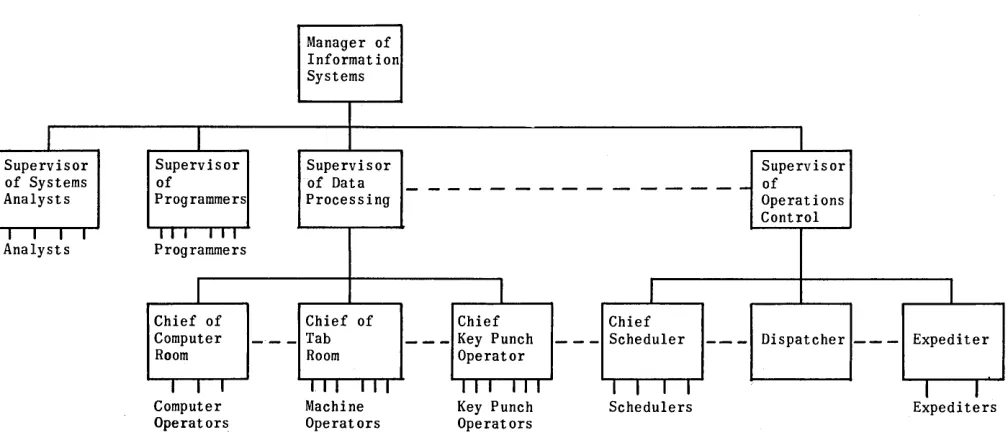
The computer room supervisor schedules the computer, based on his experience, but his supervision leaves much to be desired. The Key Punch, Manual Operations, and Tab Room Supervisors each have continued to do their own informal scheduling as described earlier. The top executives are ex-tremely concerned about the catastrophe that might result if one of these supervisors left or were otherwise lost. No single individual actively directs and controls the flow of work through these departments, although all the supervisors report to the Manager of Data Processing. (See Figure 1.)
Lately the effectiveness of the system has been decreasing rapidly. Peak loads are requiring more and more overtime of persoimel; other departments are increasing their complaints about late deliveries of important information and reports; the work stations and machine areas are becoming clogged with backlogs of jobs; "crises" are occurring closer and closer to-gether; and the effects of infrequent equipment breakdowns cause ~raumatic reactions in the whole organization.
Russell W. Fenske is the Assistant Dean of Graduate Programs and an Associate Professor of Quantitative Analysis in the School of Business Administration at the Univ. of Wise. He earned his B.S. in Mechanical Engi-neering at the Univ. of Wise., his MBA in Finance at Northwestern Univ., and his Ph.D. in Business Statistics at Northwestern Univ. He is a member of the Institute of Management Sciences, The American. Statistical As-sociation, and the American Production and Inventory Control Society.
Generality of This Scenario
This scenario, as many readers of this article will attest, is neither unusual nor extreme in its portrayal of conditions.. The system of controlling data processing operations at many rap-idly growing companies has developed as the needs arose dur-ing a period when the volume and complexity of business was much less than at the present time. These systems develop growing pains as activities, policies, and procedures are stretched beyond their effective capacities. At some point basic changes are required to allow for further growth, much as a point is reached when the cuffs on a teenager's trousers can no longer be lengthened, and a new pair of trousers with more growth potential must be purchased.
Objectives of a Data Processing Control System
The design of a new, or at least improved, control system usually will have short, intermediate, and long term objectives as listed below in a sequence reverse to that usually expressed by harried executives seeking help.
A. Long Term Object~ves
1. To insure the highest rate of utilization of the exist-ing data processexist-ing resources.
2. To produce information of the desired accuracy at the highest speeds, with maximum reliability as close to the desired times as possible consistent with mini-mum cost.
B. Intermediate Goal
To improve the scheduling of operations, in order to eliminate or at least minimize both employee over-time and failing to meet deadlines.
C. Short Term Goal
To improve the "effective capacity" of the existing equipment because of some impending crisis (such as a new load or scheduled release or sale of equipment) .
When a call for help is made under the type of conditions described in the scenario, the intermediate goal is usually emphasized most heavily. This is reflected in the fact that tht typical.request made to a consultant is to develop a highly sophisticated automatic computer scheduling procedure that will solw all the computer room problems. However there are two fallacies with this type of reasoning.
First, examination of only computer operations will not ful-fill the long term objectives desired. This is true of any op-erations 'where attention is focused only on one or a few pieces of high-capacity expensive equipment' (be it manufac-turing machinery, construction equipment, or computers). It is particularly true of operations such as data processing, where document preparation, key punching, tab operations, etc., are intimately related and where schedules and estimates do not always delineate computer and non-computer opera-tions. For these reasons "operatlons control," hereafter, is meant to includ<? control of all operations from the time the basic job or data is received from the originating department or source, until it is delivered to the terminating department or destination.
Second, any scheduling system is only one of many factors that affects data processing performance. All of the other characteristics and activities of the operations control system affect (with varying degrees of significance) the performance of the computer room specifically and the company's data processing in general.
In fact, it is generally true that improvements of a much simpler and more basic nature are required before the sophis-ticated scheduling step should be taken. Furthermore, these
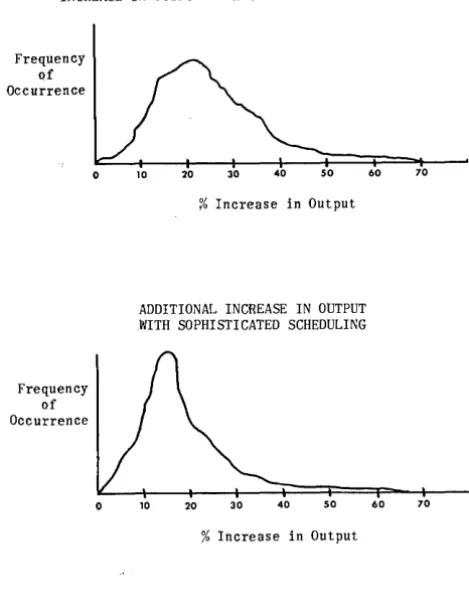
fundamental steps will probably improve operations as much if not more than high-powered scheduling techniques (See Figure 2.) The goal, then, is to improve the system so as to increase its effectiveness as an end in itself and also as a means to incorporating an automatic scheduling system.
Figure 2
INCREASE IN OUTPUT WITH SIMPLE OPERATIONS CONTROL
Frequency
of
Occurrence
Frequency
of
Occurrence
10 20 30 40 so
%
Increase in OutputADDITIONAL INCREASE IN OUTPUT WITH SOPHISTICATED SCHEDULING
10 20 30 40 so
%
Increase in Output60 70
60 70
Utilization of Production Control Technology
Data processing operations typically have grown until they are of the magnitude and complexity of many other produc-tion operaproduc-tions which contribute a good or a service. The characteristics of data processing which indicate this similarity are listed below:
1. A combination of mass production and job shop data processing.
a. Quasi-mass-production of operations such as cus-tomer billing, payroll, demand deposit accounting, inventory control, etc.
b. Quasi-mass-production periodic reporting (usually accounting related).
c. Job shop requests from other departments. 2. A mixture of manual, man-machine, and
automatic-machine processing.
3. Existence of limited-capacity bottleneck equipment (such as computers).
4. Fixed schedules of payroll, billing, etc., with sharp deadlines.
5. Seasonal capacity fluctuations due to calendar and seasonal business variations.
6. Rigid requirements for precedence and sequence of operations.
7. Time limitations on availability of raw data.
[image:18.617.302.537.157.464.2]