©AMPEX CORP. 1963
What new high speed tape transport means less down time?
AMPEX TM-5
Here's how it's done. The highly stable, solid
state servo requires less adjustment. Capstan
rollers are quickly changed. Settings are quickly
made. The head assembly is isolated. (This
makes the tape path highly stable. In fact,
dy-namic skew at start time is less than dydy-namic
skew continuous.) And precision practices
re-duce static skew. There's no tape flap; an erase
head isn't needed. Positive safety interlocks
eliminate tape damage. Instantaneous speed
CIRCLE 1 ON READER CARD
variation has been reduced. Plus:. up to 150 ips
tape speeds; 2 ms maximum start time; 1.5 ms
maximum stop time; 800 bpi capability with or
without clock track; available as a complete
tape memory system with transfer rates up to
240 kc. And above all, there's Ampex reliability
0
and ruggedness throughout. The TM-5 is made
by the Ampex Computer Products Co., Culver
City, Calif. For information write Ampex Corp.,
Redwood City, Calif. Worldwide s'ales, service.
u
o
A SIGNIFICANT
aDvance In
ranDom
access
DATA PROCE$SING
July 1963
Burroughs introduces a new type of random access magnetic disk file which-with its data communications and inquiry devices-makes practical real time applications possible.
In addition, it allows significant advances in memory capacity, reliability and economy.
The new file eliminates hydraulic or mechanical read/write head positioners and gives each track of information an electronic head of its own. This head-per-track principle allows a':1 average access speed of 20 milliseconds-five times faster than the best of its type now available.
Instant availability of data eliminates the need for artificial file organization techniques-and the programing and use problems which they impose.
Read/write head assemblies self-adjust to maintain a uniform, precision-controlled air gap between head and disk. Retraction is automatic as disks decelerate. Result: a completely reliable system. A totally new disk-plating technique allows high packing density. Per-module capacity is 9.6 million alphanumeric characters. Thus data storage can be "built up" in small economical increments to a maximum of nearly one billion characters. Modules can be added to your system as needed.
The new disk file greatly extends the application range of our B 5000 and B 200 series, while giving both systems additional im-munity to obsolescence. For additional details, write us at Detroit 32, Michigan. Remember: our business is computation for all busi-nesses of all sizes, everywhere.
Burroughs Corporation
U
l1
D
U
11UD
Ul1
"09
DDD
"usBDuDBODB!eOOBoDa6
,~'} ~
") ')
8<$ ' ) 0 -; If
09'119',oDBOiO aa00011801
t 3_
'~~n~"""unUnnnn~Bnnn~n
1
11 '11'"",,,,,,,,,,,,,,,,
II",
D
1 1 1 r 1 1 'I 1 r I 1 1
IlJ
1 1 J 1"
~
$~,.)
'2 2 2 2 2 2 11 , , ., ., n ..'"111 't 'I> "J "II '} "'l_
~, .. "''J "»_ "" ..
lJJJIH13333333J::., . ,'"l "" l. ~ ')
') . . ." • . . H II II
lJ
4a
Ifl
II II 4 II lIIl4 II 4 4D
n
4 II 14 '''' , 55 5 55 5 5 55 5 5 5U
5 5D
5 5 5a
5 5 5 5 l51J 5 5 5 5 5 5f1
a
5 5 5 5 5 5 5 5U
5~'"
.)~
., Q3 lJ3333l13J{J
I I I I I I I I I I
D
I I IIJ I I I I I Ifli
I I I I I II I I I I I I I I I I I I0
I I ID
I I Ih,~
1~') Q444444
'*,
-;1'*~44. ' ')
1 111
0
1 11 1 111 111 1 1 1 1 111 111 11
n
111 1 1 111 1 1 1 1 1 1 1 1 1 1 1 1 1 1 1 1 1 1I)"
'~ )
I "
I " " " I81 "
I " I " B Ba a
III
I I B I I " I " IS I JB I B I 8 B I I B B BIB I I I B "i.e,;: .'n ') , '" - b )
,
~
"5 5
! ! lJ! ! , f),
11
! ! , ! , I ! I I I I !III
I I I I I I I ,III
I I I I I I I I I I Ifli
I I Ia
I I I I 1 I I IU
IIi',,,",
". o····."hn"~,,
an ""'" n •• ""." "0 ..o.~
••••• """",, •• ,," '''''' •• an •••• """"".,".rii16888
--~nii;;;.t:;:::9'11,11"IO
.
4888888808q~~~~~UU9990999
""'-- $4 5$
~
$1 Sf :, EO 61 •• 9!J 9 9 9!,
n A _..
---"<
IJ If n __'F._
il
1~
o
18116000
'Is If n " lJ"
111111
~
9
©
~
9
~
~
t!fl
IJ El IJ~
fi)
9
t:::::lll~
~
fl9
9
~
r.:=::::Jtff)
C IJ tl~
@
~
@
9
~
c:::::.:JM
r:=::=::I@
C)
~9
c:::J c(f?)
""::!tin
~
®
c:s
~ ~~
~
t::::l 1:1 .::=::::]~
©
r::=:i)~
©
~
cg
~
F>
@)
9
~
r=::::::::J@
~W)
~
©
g;
Ii
,~I .~
"""~;;;;;:~
~
~&!i$~
· increase your computing power without changing ...
or people
You can move up from a mInImum cost
system to bigger, faster systems by simply
changing the central processor. The
pro-grams are the same- bu t they run faster.
The peripheral equipment is the
same-only you can apply it more efficiently. The
people are the same ones you trained in the
first place.
So, before you buy or replace your
sys-tem, investigate The Compatibles. Write
General Electric Computer Department,
Section
J
-7, Phoenix, Arizona.
GE-215 GE-225 GE-235
Tops in its Medium-sized, Most powerful in price range: versatile system: the family to date: 36 microsecond 18 microsecond 6 microsecond
word time word time word time
\
Progress Is Our Most ImporllJnf Pror/u(;f
GENERAL" ELECTRIC
4
POTTERMT-120:
It doesn't require lengthy trial to determine if MT-120 is compatible with your computer system. It is. This highly advanced digital mag-netic tape transport features exceptional performance in a COM-PLETELY STANDARD, LOW COST PACKAGE. For example, a patented tape handling system* eliminates program restrictions - permits Start/Stop, Reverse/Stop or Forward/Reverse operation at up to 200 commands per second and at tape speeds to 120 ips.
To learn more about the MT-120 and its unprecedented I-year war-ranty of reliability, write to our Director of Marketing. We'll send you full specifications, then you can judge for yourself.
THE MT-120 FEATURES:
PUSH SUTTON TAPE LOA . tiates automatic electrical retrac·
tion of loop control. and low-tape, sensing arms ... '
<,' "-~ .
.. . Special i'nterlocking- devices prevent inadvertent arm retraction when reel drive motors are energized.
Potter • 'Quick-lock" NARTS reel hubs and IBM reel hubs are avail-· able as standard accessories.
IBM and split-post type EOT and BOT sensing amplifiers are avail-able for positive tape control.
·Potter Patent No. 3,016.207
POTTER INSTRUMENT COMPANY, INC.
MARKETING DIVISION. 151
Sunnyside Boulevard, Plainview, New York'
T.M.
CIRCLE 6 ON READER CARD'
DATAMATION
o
- --_._--.-_ ... ---~.--... . .
-o
o
'volume
9,
numberStaff
President FRANK D. THOMPSON
Publisher
GARDNER F. LANDON
Vice President & Publication Manager
RICHARD W. NIELSON
Editor ROBERT B. FOREST
Managing Editor & Art Director
CLEVE MARIE BOUTELL
Assistant Editor EDWARD YASAKI
News Editor VALERIE ROCKMAEL
Editorial Advisers
DANIEL D. McCRACKEN ROBERT L. PATRICK
Contributing Editor
H. R. J. GROSCH
Technical Consultant DON B. PRELL
Production Manager
MARILEE PITMAN
Circulation Mgr.- ALGENE TRAINA
Eastern District Manager
JAY S. MARTIN
141 E. 44th St., New York 17, N.Y. MUrray Hili 7·5180
New England District Manager
WARREN A. TIBBEnS
112 West Haven Rd., Manchester, N.H., NAtional 5-9498
Midwest District Manager
JOHN BRENNAN
201 N. Wells St., Chicago 6, III. Financial 6-1026
J11 estern District Manager & V ice President
HAMILTON S. STYRON
1 (J30 W. Olympic Blvd., Los Angeles 6, Cal. 385-0474
EDITORIAL OFFICES
1830 WEST OLYMPIC BLVD. LOS ANGELES 6, CALIF.
Microfilm copies of DATAMATION may be ob-tained from University Microfilms, Inc_, 313 No. First St., Ann Arbor, Mich.
July 1963
the automatic handling
0/
in/ormationFeature Articles
24 28
31
34 36 45 46 47Communications Switching and Buffering Networks, by John D. Beierle
Compiling in English, by Jerry Schwalb
A Modern-Day Medicine Show, by Robert L. Albrecht
Building Internal Accounting Controls, by S. M. Salvino
ACM Meets in Denver The '63 Spring Joint Wescon '63: A Preview
COBOL and Compatibility, by Robert M. Gordon
50 Electronic Retina Character -Reader
51
69 73Departments
6 LO 17 23 55 58 63 67 71 74The Datanet-30 and 600 Libraries and Automation
The IBM 7094 II
Important Dates in Datamation Letters to the Editor
Datamation in Business and Science The Editor's Readout
News Briefs in Datamation People in Datamation New Products in Datamation Component Products in Datamation New Literature in Datamation Advertisers' Index
THIS ISSUE - 45,423 COPIES
(over
Graphically illustrated on the cover is the mad scramble of messages, incoming and out-going, reduced to relative placidity in switch-ing and bufferswitch-ing networks, this month's feature article_ Art Director Cleve Boutell creates -design from this seeming array of confusion:
Circulation audited by Business Publications Audit
Member, National Business Publications
':JVA'
DATAMATION is published monthly on or about the tenth day of every month by F. D. Thompson Publications, Inc., Frank D. Thompson, president. Executive, Circulation and Advertising offices, 141 East 44th St., New York 17, N.Y. (MUrray Hill 7-5180). Editorial offices, 1830 W Olympic Blvd., Los Angeles, 6. Published at Chicago, III. Con-trolled Circulation paid at Columbus, O. Form 3579 to be sent to F. D. Thompson Publications, Inc., 201 N. Wells St., Chicago 6, III. Copyright 1963, F. D. Thompson Publications, Inc. Printed by Beslow Associates, Inc.
• The sixth annual Summer Confer-ence, sponsored by the Northwest Computing Assoc., will be held August 8-9 at the Pacific Science Center, Seattle, Wash.
• The Western Electronics Show and Conference· (WESCON) will be held August 20-23 at the Cow Palace, San Francisco, Calif. Sponsors are Region 6, WEMA, and all PGs.
• The first annual meeting of the Assn. for Machine Translation and Computa-tional Linguistics will be held August 25, 26 at the Hilton hotel, Denver, Colo., immediately preceding the ACM conference.
• The 1963 ACM National Confer-ence will be held Aug. 27th through 30th in Denver, Colorado.
• The second Institute on Electronio Information Display Systems will be held September 16-20 at The Ameri-can Univ., Washington, D.C.
• The 12th annual Industrial Elec-tronics Symposium will be held Sep-tember 18-19 at Michigan State Univ.,
E. Lansing, Mich. Sponsors are PGIE, AlEE, and ISA.
• The fourth annual Symposium on Switching Circuit Theory and Logical Design will be held Oct. 7-11 in Chi-cago, Ill. Sponsor is .the AlEE sub-committee on Logic and Switching Circuit Theory.
~ The BEMA (Business Equipment Manufacturers Assn.) Exposition/Con-ference will be held Oct. 28 to Nov. 1 at the Coliseum, New York, N.Y.
• The 1963 Fall Joint Computer Con-ference will be held in the Las Vegas, Nev., Convention Center, Nov. 12-14.
• The annual meeting of the Ameri-can Mathematical Society will be held January 20-24, 1964, in Miami, Fla.
• The 1964 Spring Joint Computer Conference will be held at the Shera-ton Park Hotel, WashingShera-ton, D.C.,
April '21-23.
6
Take
me
to
your
reader
An invasion from Mars? . . . No, an innovation from Dura. This tape belongs in the Reader of Dura's remarkable MACH 10* DIGITAL COORDINATOR*. It's the automatic typewriter that gives you" systems control" over your business data.
To set up a DC* "instant" office system you simply put all of yoUr pertinent data on the MACH 10 master tape or edge-punched cards. You then punch out a control tape with specific program instructions on it and place it in the DC unit. By taking instructions from this control tape, the MACH 10 picks out and automatically types at 175 words a minute only that information needed for a particular function.
With the MACH 10 DC you can still use your <.>ld forms. There is no costly electronic changeover to go through. If you change forms, just _ change the DC tape. What's more, the MACH 10 DC automatically controls the position of typing, reading, and punching a by-product tape for further data processing. Its versatility is amazing.
Write: Dura Business Machines, Inc., Dept. P, 32200 Stephenson Highway, Madison Heights, Michigan.
BUSINESS MACHINES, INC.
*
subsidiary dura corporation
-Trademark Dura Business Machines, Inc.
CIRCLE 7 ON READER CARD
DATAMATION
._---_ .. _ .. _ - - _ . _ _ ._ .. _ .. _-- - - - ---~ ... - - - - -.. _ .. _ •.•..
__
.. _._-_. ---.----.•. -.... -- .-o
Here, at Lockheed Missiles & Space Company's Space Communications Lab-oratory, scientists are re-investigating the possi~ility of using the moon to facilitate earth communications. Possibilities for the use of the moon as a relay station for earth-to-earth communications have been largely neglected because the moon's shape and rugged surface greatly dis-torted a return signal. But Lockheed research into the extension of communi-cations on difficult communication channels, using techniques applicable to dispersive time variant channels, is mak-ing significant inroads into this problem.
Another area receiving intense study at Lockheed is satellite tracking of deep space probes. Since tracking accuracy
depends greatly on stations being as far from each other as possible, while retain-ing line-of-sight communications, Lock-heed is studying the use of two earth-orbiting satellite tracking stations, 8000 miles apart. Not only would great accuracy be gained by the separation, but itwould be further enhanced by the positioning of the stations above the earth's atmosphere, thus eliminating atmospheric distortion. Exam pies of other research projects being pursued by Lockheed in the com-munications area include: Random mul-tiplexing, satellite readout techniques, scatter communications, radar mapping, submarine tracking, modulation of optical energy, communications over multipath channels, and learning systems.
LOOK AT LOCKHEED
LOOK AT LOCKHEED . .. AS A CAREER
Consider Lockheed's leadership in space technology. Evaluate its accomplishments -such as the Polaris missile and the Agena vehicle's superb record of space missions. Examine its outstanding advan-tages-location, advancement policies, creative climate, opportunity for individual recognition.
Then write for a brochure. that gives you a more complete Look at Lockheed. Address: Research & Development Staff, Dept. M-43C, P.O. Box 504, Sunnyvale, California. Lockheed is an equal oppor-tunityemployer.
SCIENTISTS & ENGINEERS: In addition to positions in the research and develop-ment of communications and optics, other important openings include: Inertial guidance. Orbit thermodynamics. Electromagnetics • Mission & trajectory analysis. Gas dynamics • Chemical and nuclear propulsion. Systems engineering
LOCKHEED
MISSILES & SPACE COMPANY
A GROUP DIVISION Or LOCKHEED AIRCRAFT CORPORATION
Sunnyvale, Palo Alto, Van Nuys, Santa Cruz, Santa Maria, California • Cape Canaveral, Florida • Huntsville, Alabama • Hawaii
---Gentlemen:
Please enter our order for _ _ _ s,et(s) of AUERBACH/BNA Standard EDP REPORT? Each five-volume set covers 44 major computer systems. The price per set is $900.
Name _ _ _ _ _ _ _ _ _ _ _ _ _ --'-_ _ _ _ _ _ _ _ Title _ _ _ _ _ _ _ _ _ _ _ _
Company _ _ _ _ _ _ _ _ _ _ _ _ _ _ _ _ _ _ _ _ _ _ _ _ _ _ _ _ _ _ _ _ ___
Address_--_ _ _ _ _ _ _ _ _ _ _ _ _ _ _ _ _ _ _ _ _ _ _ _ _ _ _ _ _ _ _
City _ _ _ _ _ _ _ _ _ _ _ _ _ _ _ _ _ _ _ Zone _ _ _ _ _ State _ _ _ _ _ _ _ _
---
!For detailed information write:
AUERBACH!
£
1231 24th Street, N.W., Washington 7, D.C,Mechanical simplicity ... which yields a degree of reliability unattainable by any other paper tape reader! Simplicity made possible through the utilization of the revolutionary PMI printed motor direct drive servo. Movement of the tape through the read head is achieved by merely start-ing and stoppstart-ing a printed motor. The brakes, clutches and pinch rollers that cause big trouble and down time in conventional tape transports are completely eliminated.
Line by line cycle: movement of tape (A) over read head (B) is controlled by drive capstan (C)-attached directly to shaft of PMI printcll motor* (D); spring-loaded rollers (E) hold tape gently against capstan, keeping tape movement in exact accorcl 'with capstan rotation; advance command pulse accelerates motor, capstan, ancl tape; as read head cletects next sprocket hole, a reverse pulse to motor halts capstan and tape with next character perfectly aligned in read head. *U.S. Patcnts of Printcd J.1iotors) Inc. Pending.
PHONE) WIRE OR WRITE FOR CO~IPLETE INFOR~IATION
CIRCLE 9 ON READER CARD
C O R P O R A T I O N
U
L~ ~IE
[N [2F..dD
l2[R
[J)n
'U'
n
s n
((j) [;\j
NEW
OUTPUT
from
Prentice-Hall
• Programming the IBM 1401:
A Self-Instructional Programmed Manual
Learn to program more quickly, with greater . ease, and more thoroughly-aided by extensive, crystal-clear expla-nations and examples. Avoid costly er-rors and gain quick insight into tech-niques and shortcuts usually discovered only after long experience. Get imme-diate feed-back of correct answers to all problems. By James A. Saxon & Wil-liam S. Piette, United Research Serv-ices, Inc. 208 pp., illus., $9.
• Programming the IBM 7090:
A Self-Instructional Programmed Manual
Obtain all the essentials for actually programming the IBM 7090 (also appli-cable to the IBM 709/7094 computers, and to some degree to the IBM 704). Master these vital specifics: the func-tions of the Data Channel; the charac-teristics of card and tape devices; the three phases of computer processing (input, computation, and output); and the four steps of planning, all designed for ease of programming. By James A. Saxon, Saxon Research Corp. 210 pp., illus., $9.
• Programming the IBM 1620 You'll be able to write, assemble and run SPS programs on the 1620 by the time you are one-third of the way through this new book. Gives you all the major 1620 programming methods plus the Symbolic Programming System (SPS), FORTRAN, GOTRAN, and the Iriterpretative Programming System (IPS). By Clarence B. Germain, Coll. of St .Thomas. 186 pp., illus.
(paper-bound), $6. .
• Logic of Computer Arithmetic A complete coverage of high-speed par-allel binary computer arithmetic. Deals exclusively with logic, not circuitry. In-cludes complete dissection of floating point arithmetic, thorough treatment of special purpose arithmetic units, and the first presentation of its kind of residue arithmetic and its applications. Also covers binary number representations; basic high-speed adders; short-cut mul-tiply and divide algorithms; and square root and polynomial logic. By Ivan Flores, Private Consultant. 493 pp., il-Ius., $15.
• COBOL:
A Self-Instructional Programmed Manual
Pub. June, 1963-Enables you to write programs for a variety of computers. With small modifications, a COBOL program is equally applicable to IBM, Burroughs, Remington Rand, Honey-well, and other computers. Self-con-tained, complete course of some 200 problems, specially prepared for self-education. By James A. Saxon, Saxon Research Corp. 200 pp., illus., $6.
. - - - 10-DAYS' FREE TRIAL
USE----PRENTICE-HALL, INC. Englewood Cliffs, N. J.
Send me book (8) checked below for
10-days' examination on approval. In 10 days I will remit for book (s) I keep plus a few cents for postage and insurance, and re-turn unwanted book (s). NOTE-We pay
p~stage . and insurance costs if you remit wIth thIS coupon-same return privilege. D Saxon & Plette-Prog. the IBM 1401, $9.
D Saxon-Prog. the IBM 7090, $9.
D Germain-Prog. the IBM 1620, $6.
D Flores-Logic of Computer Arithmetic, $15.
D Saxon-COBOL, $6.
Name __________________________ _
Addres,,-s ______________________ _
City ___________ --'-'Zone_State _ _ _
D-OOOO-Jm
.---~
CIRCLE 10 ON READER CARD
10
0 0 0 0 0 0
0 0 0 0
0 0 0
00
unclear comparison Sir:
I find it difficult to understand the com-parison in "The 301 and 1401 - A User's Critique" (April, p. 33). While Mr. Kurzenknabe acknowledges a speci-fications edge for the IBM 7330 tape drive, he claims a 30 per cent superior performance for the RCA 381. On what does he base this - the color of the tape drive? It seems to me that four 7330's would be able to replace the six (or more) 381's, and result in less user time on the system.
Another comment that appears to be above me concerns the "modular ex-pansibility" of the 301. The 1401 main-frame holds 4K storage. To go' to 16K
requi~es another unit, but it appears that the 1401, together with auxiliary storage, could fit within the 301 main-frame - and leave space for a 7330. Nearly any manufacturer could use a packaging, method which would provide space for system modification. But I was of the impression that the trend was toward taking as little floor space as the system required.
W. V. SEBESTA
Johnson City, N. Y.
(Editor's note: Comparing tape drives, Kurzenknabe pointed out design fea-tures which favor the 381, saying: "So
there are other advantages, aside from net performance characteristics; it's also how much labor time is involved in set-up, handling, and attrition of reruns." On the point of the commodious accom-modations within the 301 mainfraine, of greater significance is the resultant ac-cessibility for servicing and the ease of system expansion.)
translation to MAD Sir:
'Regarding "Automatic Program Transla-tion" by Ascher Opler (May, p. 45), the Univ. of Michigan executive system has a FORTRAN-to-MAD translator, MAD-TRAN, which has been available through SHARE for almost two years. The translator, itself written in MAD, very likely inspired the SIFT translator effort.
MADTRAN is used by. MIT as a substitute for FORTRAN in its time-sharing system, in which MADTRAN output is immediately processed by MAD. The entire translation time is less than that for FORTRAN alone, al-though the resulting program ~uffers
from the usual, slight MAD loss in ob-ject program efficiency.
I might add that this work was itself
infl~enced by a FORTRANSIT-to-GAT (both on the 650) translator written in GAT and first used in 1959.
Although I don't share this view, it should be pointed out that some people call this class of programs, "translitera-tors." It seems likely, however, that there exists a spectrum of programs of this type, ranging from the relatively trivial to the ultra-complex.
ROBERT ROSIN
Cooley Electronics Laboratory' University of Michigan Ann Arbor, Michigan
on-line comments Sir:'
I have ~ead with great interest tpe article, "Programming On-Line Sys-tems," by Frank, Gardner and Stock (May, p. 29). It is· regrettable that such a thoroughgoing and lucid presentation should be marred by a few apparent misunderstandings about certain facets of commercial real-time systems.
In referring to an airline reservation system's inability to achieve a partic-cular response time, the authors note that "the delay in the response is not catastrophic since no data is lost and the additional time does not significantly affect system performance." Actually, a delay in response in such a system may well be catastrophic if it is chronic . . .
Airline reservation systems must be de-signed to avoid delays.
Concern is expressed about simul-taneity of file references in multi-ter-minal· systems, such as developed for savings banks: "Thus, two essentially simultaneous transactions executed by independent functions upon the same record may invalidate both transac-tions . . .:' As a practical matter, this does not turn out to be a significant problem in many real-time systems. The basic record has the characteristic of be-ing called in from the system files only at the customer's request. And since the customer cannot normally appear at two counter positions at the same time, there is built-in protection from simul-taneous references to the same record. Other sources of demand for these records can be classified as internally originated by the system, and subject to control by the system designer to eliminate competition for records.
ROBERT V. HEAD
IBM Systems Research Institute New York, N.Y.
(Editor's Note: The authors reply, "Mr. Head's first comment is justified from the point of view of the system de-signer whose responsibility is to specify bounds on response time (deterministic or statistical) , select equipment, and manage the programming implementa-tion. The intent of the example was to illustrate the programming difference between input rates that are controllable and those, such as continuous radar data, where there is no control. Relaxa-tion of the response time in the reserva-tion system does not lead to lost data
DATAMATIDN
o
/
o
)
0
while, of course, it could lead to lost sales.
"The concern expressed regarding simultaneity of file reference is intended to be just that: a concern-to indicate to the programmer that he must guard against such a circumstance. As indicated by Mr. Head the problem is usually met in the system design.")
of girls & foreign computers Sir:
Datamation shares with Playboy the
dis-tinction of being read ahead of turn as I attack my ever growing backlog of unread magazines. But time remains to correct and supplt~ment specs in your list of foreign computers by Adams Associates (May, p. 41). Information on the Stantec Zebra and many others could have been cribbed from Bulletin 13 of the Provisional International Com-putation Centre, April 1961. Or "Ask the Man Who Owns One."
On the Zebra, I submit: Add time: 312 usec
Storage Cycle: 10 msec (random access) Instr. Addresses: 1 drum
+
1 fast Paper Tape In: 100 cps (not 200) Paper Tape Out: 50 cps (not 10) Software: interpretive "Simple Code" forscientific computing
Not Supplied: Mag Tape, Buffering, Random Access File, Cards, Printer, Program Interrupt.
W. L. CLINK
Department of National Defence Defence Research Board
Suffield Experimental Station Ralston, Alberta, Canada
Sir:
I was surprised to find omitted from your list of foreign computers the Italian Elea 6001 and Elea 9003, manufactured by Olivetti. Technical specifications are as follows: .
Elea9003 Elea 6001
First delivery 1960 1960
Storage 20-160K core 10-100K core 360K drum
Word length la la
Add time 200 usee 364 usee
Cycle time 10 usee 6 usee
Mag tape 45 KC 22.5 KC
Printer 600 Ipm 600 Ipm
Card reader 500 cpm 150 cpm
Card punch 50 cpm 50 epm
Index registers 40 16
Gianfranco Biraghi
Schede Perforate e Calcolo Elettronico Via Manara, II
Milano, Italy
July
1963
This is the
only
computer you. need·.
to figure your savings
on exports via
BOAC Air Cargo
Exporting adding machines, typewriters, computers; cash registers or data processing sys-tems to Britain? Direct BOAC flights to London, Manchester/Liverpool and Glasgow put your shipments next door to any business or industrial center in Britain.
Jot down the new BOAC Specific Cargo Rates for office machines - for example, you can ship typewriters, adding and duplicating machines from New York to London, Manchester / Liverpool or Glasgow for as little as 22¢ per lb.; office machines and electronic computers, 36¢ per lb.
Subtract what you'll save with lighter packaging, lower insurance rates, faster inven-tory turnover, minimal warehousing expense, more efficient use of working capital, and no costly refurbishing of mishandled goods.
Then add the advantages of speedy delivery, conscientious handling, and the fastest air cargo clearance and transfer in Europe through BOAC's new cargo facilities at London Airport. You'll find that BOAC's combined fleet of Rolls-Royce 707 jets and DC-7F wide-door freighters provide the most frequent and comprehensive service from the U.S.A. to Britain. Ask for your free copy of our new Air Cargo Digest. It pinpoints the rates for world trade via BOAC Air Cargo.
-~
ALL OVER
THE WORLD
B·O·A·C
TAKES GOOD CARE OF YOUR CARGO
BRITISH OVERSEAS AIRWAYS CORPORATION
530 Fifth Ave., N. Y. 36 • MU 7-8900
Air Cargo Offices in all principal cities
On-line Air Cargo service from New York, Boston, Philadelphia,
Washington, Chicago, Detroit, Los Angeles, San Francisco, Honolulu, Toronto, Montreal.
CIRCLE 11 ON READER CARD
what on earth
does a systems man do here?
Under our collective roofs in Paramus, New Jersey, International Electric Corporation houses one of the largest aggregations of systems specialists in the nation ... and probably the largest group of programming and software experts. Here is a partial breakdown of their activities that relate to space as well as earthbound systems situations:
Command & Control Technology
Parametric System Analysis Airborne, Terrestrial Data
Processing & Displays Survivable Communications
Di stri b uted / Ce ntr~ lized
Data Bases Weapons Systems C&C
Advanced Development Projects
Advanced Display & Control Systems Advanced Information Storage,
Retrieval & Distribution Recon. Mapping & Data Recording Data Acquisition Sensing &
Detection Systems
Simulation & Training Complexes
Advanced Systems Projects
Space Range Systems Surveillance Systems Space Command & Control Space & Ground Military
Information Handling Systems
Management Information Systems
Control Systems Communications Data Processing Systems
Human Factors Sciences
Man-Machine Integration Personnel Subsystem Analysis Command Staff/System Exercising
& Evaluation Human Engineering
Systems Sciences
Optimization Techniques in System Design & Control Real Time Management &'Control System Simulation & Scheduling Control & Staffing of Human &
Human Linked Subsystems Gaming Technology
Space Science
Life Sciences - Bioastronautics, Psychoastronautics
Manned Space Subsystem Integration Analysis
Psychophysiological Support Reqmts. Bio-Medical Data Subsystem Reqmts.
Whether your own background is largely theoretical, or design ... systems hardware, or software oriented ... if you'd like to join us in these efforts, we invite your early inquiry. Write fully in strict confi-dence to Mr. E. A. Smith, Manager of Employment, Division 3S-MK, 'International Electric Corp., Route 17 & Garden State Parkway, Paramus, New Jersey. (An Equal Opportunity Employer)
ITT
INTERNATIONAL ELECTRIC CORPORATIONCIRCLE 92 ON READER CARD
12 ;
••• and what, in space?
DATAMATION
o
o
NEW RCA ADVANCES IN FERRITE TECHNOLOGY
EXTEND MEMORY STACK CAPABILITIES
RCA offers Wide-Temperature-Range Stacks ... Microferrite Stacks ... Temperature Controlled Stacks
... Conventional Memory Stacks ... in virtually any configuration to meet today's computer demands
RCA WIDE·TEMPERATURE·RANGE
STACKS COVER 80°C SPAN
New RCA wide-temperature-range ferrite cores permit the construction of planes and.stacks that operate over any 80°C range within the limits of -60°C to +125°C without peripheral temperature-control equipment. In those applications where small size, minimum weight and reduced periph-eral equipment are required, these de-vices can help you achieve vital space and cost savings.
RCA CONTROLS STACK TEMPERATURE
TO WITHIN +2°C OVER A 120°C RANGE
RCA Memory Stacks, temperature-controlled within ±2°C are designed to meet MIL Specifications. Available in conventional or high density pack-ages, these stacks can be utilized where specifications call for conventional core operation over extreme temperature ranges (up to a 120°C span).
July 1963
RCA's versatile line of memory stacks now in-cludes sizes from 256 words by 8 bits' to 16,304 words by 32 bits, with ferrite cores from .030" to .080" O.D. for system speeds as fast as 375 nsec. RCA stacks can be supplied in a wide range of configurations and operating characteristics to meet your design needs, including types de-signed to meet stringent environmental specifi-cations for shock and vibration. In addition, you can select from a broad range of plane construc-tions-new molded epoxy, phenolic, and printed-circuit types, or· aluminum types designed to meet MIL specifications. All RCA stacks are 100 percent dynamically tested to assure dependa-bility under actual operating conditions.
RCA CONVENTIONAL MEMORY STACKS
MEET LOW-COST REQUIREMENTS
RCA conventional memory stacks may be used where temperature extremes are not a critical problem, but where RCA's high quality and reliability are required at lowest possible cost. Hun-dreds of these stacks are now in use with an outstanding record of relia-bility.
RCA's EXCLUSIVE MICRO FERRITE
STACK ACHIEVES 65 nsec. SWITCHING
New RCA microferrite memory stacks complete a full read/write cycle in 300 nano seconds with less than 350 ma driving current and bitoutputsof50mv. These revolutionary word-address systems, using proved ferrite cores, achieve packing densities to 2,000 bits per cubic inch. Available in multiples of 32 words by 32 bits.
Service:
Your local RCA Semiconductor and Materials Division Field Representative is prepared to provide a completely coordinated application service, covering ferrite cores and memory systems, and semiconductor devices. Call him today. For further technical information, write RCA Semiconductor and Materials Division, Memory Products Department, Section FD6, 64 "A" Street, Needham, Mass.G
THE MOST TRUSTED NAME IN
E~ECTRONICS
CIRCLE 13 ON READER CARD
636
the computer that experience built
These few facts tell the reliability story for Daystrom's new 636 General Purpose Digital Computer:
• The 636 is the product of more than a quarter century of experience by Daystrom computers in actual on-line operation.
• During this accumulated span of almost 26 years, Daystrom computers have set an average availability record of better than 99.5 per cent Each of the computers listed must operate 24 hours a day, 7 days a week.
In addition to providing the assurance fostered by this proven record of reliability, the Daystrom 636 gives you the problem-solving speed you require for today's complex com-puting applications.
1958 1959
JUNE
..
Louisiana Power & Light Company Gulf States Utilities Company Carolina Power & Light Company Louisiana Power & Light Company Duquesne Light Company Kansas. Gas and Electric Company Uilion Carbide Chemicals Company Clark Oil & Refining Corporation Public Service Electric and Gas Company Carolina Power & Light Company Continental Oil Company
Here is the full-size computer that can handle complex real-time data acquisition and control problems requiring pro-grammed core-drum memory in capacities up to 294,912 words ... that has excess speed capacity for simultaneous on-line and off-on-line use' ... that provides true direct memory access for input-output with no computation slow~down.
The 636 merits your attention for on-line monitoring and control ... off-line conversion ... engineering and scientific problem-solving ... tc1cmetering ,', . any
ap-plications requiring a full-size computer. Getting the facts is as easy as circling the reader, service number for this booklet, or calling your local Daystrbm office.
BASIC 636: $95,000.
1960 1961 1962 1963 YEARS ON-LINE
4.90 3.25 3.25· 2.60 2.25 2.25 2.00 1.80 1.33 1.33 1.00 25.96
Average availability: 99.5 per cent.
14
I··· -
_
,
D,
•
AVSTROM,
r
CONTROL SYSTEMS DIVISION INCORPORATEDMiramar Road, La Jolla, California • Telephone: 454-0421
CIRCLE 14 ON READER CARD
Area Code 714
DATAMATION
--- ----.---.----~ ~
o
o
July 1963 CIRCLE 15 ON READER CARD
.The SDS
9300 is faster than the 7090.
It costs $215,000.
Kiss the computer speed/cost barrier goodby!
The SDS 9300 adds in 1.75 microseconds and multiplies in 7 microseconds, including indexing. With optional hardware, it executes 4S-bit floating point multiply in 14 microseconds. Compared to a 7090, that's over 100% faster at less than 25% the cost. And there's more to the 9300's speed than arithmetic: Input/output rates exceed 2-million characters per second simultaneous with com-putation (you can operate eight high-speed tape units, all running at 96Kc, concurrent with arithmetic execu-tion) . The price of the basic 9300 is $215,000. With
over-lapping SK ~emory, floating point hardware and a mag-tape unit, it costs $330,000. First delivery: December.
If you'd like more information on the computer that represents an order of magnitude increase in answers per dollar for a wide range of scientific and systems applica-tions, request a copy of our 9300 Computer brochure.
8 1 1 - 1 8 9 3 0 0
SCIENTIFIC DATA SYSTEMS 1649 Seventeenth St., Santa Monica, Calif.
CIRCLE 16 ON READER CARD
16· DATAMATICN
o
-v.
80 86 92
98 303 307
Programmers
GROW
with the
Programming
Systems Division
of
Honeywell EDP
The Programming Systems Divi-sion of Honeywell EDP is one of the first software-based divi-sions in the computer industry. With their own specially con-structed facility in suburban Boston, Honeywell programmers engage in assignments involving the design and development of COBOL, FACT and ALGOL type Compilers, Executive Routines, Scientific Libraries, and other advanced software packages. Backed by the Honeywell Cor-poration's 76 years of technical management experience, we've created and produced a growing line of business and scientific digital computer systems that include the H800, H400 and H 1800. Earlier this year our powerful new computer system, the H1400 was announced. Com-patible with our other systems, it has broadened and deepened the software production require-ments of our Programming staff and has helped create many new additional career opportuni-ties for Honeywell Programmers. Opportunity to join our staff ex-ists in the following departments:
Scientific Programming
Automatic Programming
Previous experience is
neces-sary in the programming of
scientific and engineering
problems.
Address your resume to:
Mr •. Edmund Murray
Employment Supervisor
Programming Systems Division 60 Walnut Street, Dept. 786 Wellesley Hills 81, Massachusetts
Honeyvvell
ELECTRONIC DATA PROCESSING
Opportunities also exist in other Honeywell divisions. Send resume to H. E. Eckstrom, Honeywell, Minneapolis 8, Minnesota. An equal opportunity employer.
CIRCLE 79 ON READER CARD
BUSINESS
&
SCIENCE
PHILCO REORGANIZES,
NARROWS MARKETING SIGHTS
Amidst rumors and remlnlscences of last year's Bendix
"consolidation," Philco last May announced that it was
pulling its Computer Division into the Communications
&
Electronics Division. Dropping the six-month-old
4000 from the line, Philco will now concentrate on the
large-scale systems market, emphasizing military and
scientific, areas of greatest success to date. The
1000 will be sold only as a satellite for 2000-series,
which now represent, according to Philco, roughly 10%
(23 systems) of those installed costing $40K/month or
more. Personnel cutbacks involve only 4000
special-ists, with no reduction in 2000 sales or support
activities, according to newly named computer
market-ing manager Bill Doherty.
Philco sights are set squarely on the command and
control market, centering mainly on 7090-94 FORTRAN
and COBOL users, says Doherty.
Current re-structuring of 2000 prices, says the
balding, beaming Philco executive, "will make us
com-petitive."
A~dhe points to "a quite encouraging" 212
backlog as added reason for healthy optimism. Also
coming up: "significant" hardware and software
an-nouncements.
FORTRAN IV:
~
BRIEF PROGRESS REPORT
The current wait and see upgrading mode has not
af-fected software, where the spotlight is on the FORTRAN
IV race. Here's a quick run-down on present progress
among some pf the big boys:
Burroughs; qll of its scientific language eggs in
the ALGOL ,basket, has made no decision on a IV
com-piler yet.
.
CDC says 'i ts 1604 version of "FORTRAN '63" was in
field test in mid-June, with the 3600 model ready
soon. The 1604 version hangs up on some statements but
will eventually accept and compile all but IV data
statements. Compiling speeds are about the same as
earlier version; object codes are "near maximum
effi-ciency."
GE, according to one source, will announce in August
a
compil~rcombining "II language with IV
capabili-ties," part of a monitor system, with quoted 80% '
O
efficiency.
Honeywell's Automath 1800, already announced,
con-tains the IBM
~Vlanguage as a subset, requires 15K
memory. Features include an alternate form of the data
~
~
<)~
L
~
'z-O·
~
ANELEX HIGH SPEED
PRI NTER SYSTEMS
When you look inside Anelex Printer Systems, you can't see the things that really make them great . . . the plant, the tools and most of all the people. The fact is it takes a lot of plant . . . more than 21/2 acres of machine tools, instruments and special equipment ... and a lot of people ... over 900 of us . . . to build the variety and numbers of standard and special purpose printer systems which bear the Anelex symbol of quality. For your next system, be sure of the finest printer; write Anelex for further information.
( /
,--,'AN E
LE~"
~"
155 CAUSEWAY ST., BOSTON 14, MASSACHUSETTS
SYMBOL O~ QUALITY
CIRCLE 17 ON READER CARD
18 DATAMATIDN
r-I
;';:';:".~~'~~""'~"':~'i'
TH~!.!~ERw(i{iK
BOUtE ...
i(
with
a dsd
1260
PRINTER
Document rate adds up to
dol-lars. In most applications you
can almost DOUBLE THE
OUT-PUT of your data processing
system with this completely new
high-speed line printer
fea-turing superior print quality on
all types of single and
multi-part forms.
PARTIAL SPECIFICATIONS
Printing Speed 1200 lines/min.
Skip Rate . . . 60" /sec.
Form Width . . 3" minimum
22" maximum,
132 columns
Presently being demonstrated at
DATA
SYSTEMS
DEVICES
OF BOSTON, INC. 342 Western Ave., Boston 35, Massachusetts
Area Code 617 AL 4·0440
CIRCLE 36 ON READER CARD
-
N)!TIT
eo
At
ell
--
PRe1
10 : 19 :
28 :
37 : 46 '
55 !
64 ( 73 ;
-
NA TITeo
AD
ell
--
PRO1
10 1 19 2
28 2
37 3 46 4
55 5
o
o
nUSINESS &. SCIENCE [ : 1
======::::=========================================-::.::l'
TWO COMPUTER BILLS UP;
WASHINGTON THUMBS DOWN?
WASHINGTON AGAIN
THE FLEET'S IN
July 1963
statement, variable sized arrays, octal constants. A
Honeywell SIFT for the 800 is due September
1.
FORTRAN father IBM, reportedly having trouble with
its 90 IV compiler -- said to be running slower than
the not-notoriously swift II -- says the IV will be
part of a comprehensive 90-series IBJOB system; this
makes
dire~tcomparisons difficult. One independent
source says the
IV
is slower only on shorter programs.
Trouble or not, the company has hired consultant CUC
to review its 90/94 programming support program and
evaluate competitive software.
'
,
Philco says work on'its IV compiler is winding up;
it will be
a~ailabl~to the field "later this year."
RCA is "well down the road"
~nan enhanced II,
scheduled for field test on the 354 (scientific 301)
around the first of July,.
'
,
Univac says its IV for' the 1107 is in opera'tion,
has been accepted by a major gov't agency. Said to be
"two to 10 times as fast as the IV on the 94," the
compiler is
rat~dby one independent consultant as the
tightest, most efficient he's yet seen. AIV compiler
for the Univac III will be ready this fall.
All that publicity about computers was bound to
back-fire. Now Washington is trying to do something about
their proper procurement and use. Hearings have been
conducted lately on two bills, one sponsored by Texas
Representative Jack Brooks, the other by veteran Senate
wat6hdog Paul Douglas.
'
.
The Brooks, bill, HR 5171, wants to charge the GSA
with the responsibility for all EDP purchase/lease
decisions, the evaluation of their effective use, and
estab~ish
a revolving fund for purchase of computers,
whiCh would be rented to agencies. The Douglas bill,
S-816, would establish P/L review authority in the
Ex-ecutive office of the President.
.
,Both bills reflect the growing push for more
govern-ment purchasing of computers.
Anunspoken industry
fear: purchase will strengthen the healthy IBM grip on
the government market, make it harder to justify the
, switch to other machines. Strong oPPosition is also
raised by department heads who consider such
legisla-tiona usurpation of cabinet secretaries' authority.
insiders feel that neither bill is likely to pass this
session.
Another hot government trend--fleet purchases of
computers, with the Air Force playing the lead role.
Following up the AFLC order for 30 301's (May
Datama-tion) , the Air Force has announced plans to install
between 160 and 174 NCR 390's for payroll processing
at some 105 US and
250vers~asbases. The two orders
sandwiched a dinky order for 19 CDC 160A's for an AF
Satellite Control Facility tracking network.
But the fun is only beginning. The USAF Electronic
BUSINESS & SCIENCECI
===============:::;::=====================::=::J
20
CLIPPINGER'S REPLACEMENT
IN X3.4 CHAIR IS NAMED
THE
~5000:
HARDWARE IN.
SOFTWARE FIRMING UP
Syst~ms
Division has asked 24 manufacturers to submit
proposals "for the installation of an
e~psystem
~tsome
~52Air Force bases throughout the world." The
applic~tion: ba~e-Ievelinventory control. Proposals
were due July 20, and a coded 'benchmark program is to
be turned in by high noon, August 15. Proposals will
be evaluated by the ESD's Data Processing Equipment
office, and the contract awarded by
GSA~And DOD,
~videntlygetting ready to make use of
beaucoup computers, has purchased rights to reproduce
and distribute Auerbach
C~rporation'sprogammed course
in
COBOL~distributed by Basic Systems, Iric., NYC.
Dr. Franz Alt, of the Bureau of Standards, has been
named chairman of ASA
X3.4-~CommonProgramming
Lan-guages--succeeding Dick Clippinger. Dr. Ait has had
no previous association with ASA, but has achieved
sufficient prominence to merit'mention in "American
Men of Science
~ IIA mite tardy getting off the ground, the B 5000 was
flying high last month with eight installations,
thre~within Burroughs. Two more systems are scheduled for
delivery this month. Number one was delivered March 31
to United
Tech~Center, Division of United Aircraft in
Sunnyvale. Initial hardware tests used a prototype
Master dontrol Program and extended ALGOL 'aO 5000
compiler. USing a FORTRAN translator, the B 5000
handled a rocket
engin~ analysi~ problem~ transl~tedit
into ALGOL,
co~piledarid ran approximaiely
~.5times
as long as the" originai 90 'program without
muitipro-cessing on a machine
a~outone-third the cost:of' a90.
The second 5000 at NASA Huntsville inclu4es one
processor, four consoles (three slightly remote),
fou~I/O
ch~nnels,four memory modules (with four more on
order), a 700 lpm pririter and 12 tapes,plus some
special telemetry coupling'gear which acts as four
pseudo-tapes. Both systems were in acceptance test in
mid-June. 'Other 5000's shipped since include Northern
Natural Gas, Dow'Chemical, and L.'A. Board of
Education.
On the software front, Burroughs says its extended
'60 ALGOL compiler was completed with the
additio~of
I/O in early June. Goodies added to '60 ALGOL include
stream
proc~dur~s'for handling
ch~racteroriented
logic, Bbil1ty to handle partial word fields and
sym-bolic monitor 'and dump debugging aids. COBOL, minus
the'SORTconstruction, is now being used to debug'
customer programs, ,and was supposed to be ready this
month. A final-format MCP was installed in June,
although more work will be done on'it, says Burroughs.
The fORTRAN translator is reportedly running well at
both UTC and NASA •.
DATAMATION y ' . , ,
)
)
•
•
•
• •
••
•
o
0 • 0• • 0 • • 0
. e..
. . .
.
o • . , 0 .•.•. '. .' CD
• • • • • • .Hle2e2e4-1 05031Q.(.1e4 • • • -t • • • • • • • • } .. - • - - ~1 e202e4 ... 1-S.31()8(., 84 • • • oltl . . . l ~Ee4 .... ., G6.sti()e("
04-• • • CD • CD • • • • • •
•• • 0
• • • • •
0.. ••
•
••••
• • •
••••
• • •
••••
•
•
•
•
•
•
•
•
•
•
•
•
•
•
•
••
. .
•
•
••
./.
•
• • •
. ...•• • • ... ., ~.2 ~ .... jj 0311 tI.. ~ fit • • • 4 . . . _ .+.1e2e2e4 .... 105.3CO.( .1.4 • • • • t . . . _ • • _ . . . . '-
a. a. ....
10 5altGt ~ t_ . . . ...• • ••
• • ••
•
•
••
••
• • •
• • • • •
••
••
•
• • • • • •
•
• • • • • •
•
••••
•
•
•
• • •
• • •
•
0 . . .
. "•...
,;:.
..
. . . .
. .
.
cO.ol(tI/~ . . . ) . . . '.2.2.40 .... 1.50300.<.1.4 • • •
_t.Ae+o'" ...
1.2 ~ "'_.1• • • •
• • ••
•
o
Model 430 Printing Perforator
Where your perforated tape preparation problems con-cern numerical control, computer programming, in-ventory recording, accounting, or data recording, you should see how the new Tally Printing Perforator can work for you.
Here is a versatile, modestly priced approach to all kinds of source data recording. Technically, this new unit is an 8 channel, fixed code, printing perforator which will operate at 8 characters per second with entry provided by a 20 character keyboard consisting of a standard 10 character adding machine keyboard plus 10 additional characters. At the time of punching, the entry is printed directly to the left of the sprocket hole and· in line with the coded character. The tape can be automatically positioned for visual verification. You can select any.alpha-numeric-symbolic code com-bination desired at the time of order. A full 1000 foot tape supply is standard. Price is a low $1,395 and quantity discounts apply.
For a demonstration, call your Tally sales represent-ative. For more information, please write Tally Cor-poration, 1310 Mercer Street, Seattle 9, Washington.
TALLY®
22
Give your computers a 3000-mile reach
Put DATA-PHONE service to' work for your company and your business machines can reach anywhere there are regular telephone lines.
Send any kind of data that can be put on punched cards or tape-any time of the day or night at regular telephone rates.
Think how DATA-PHONE service can save you time and money in shipping vital word and figure data to and from all your business locations. See one of our Com-munications Consultants about it. Just call your Bell Telephone Business Office and ask for him.
Bell Telephone System
CIRCLE 19 ON READER CARD
DATAMATION
o
c
o
)
o
---DATAMATION
D · · ·
O~
EDITOR'S READOUT
July 1963
ON SCIENCE AND SOCIETY: A DEVOUT WISH FOR AFIPS
. At its most recent meeting at the Detroit SJCC, the AFIPS Board of Governors decided to establish a central office in New York City, manned by an executive secretary yet to be chosen. Also still missing: a well defined public information program for AFIPS. This is understandable. Only two years old, AFIPS is still feeling its way toward a satisfactory understanding of its relationship to its member societies and to the world at large.
But it is devoutly to be wished that AFIPS does not underestimate the importance of public information - the responsibility of any scientific or technical community to inform society of its work. More important, it is the responsibility to help evaluate - and prepare for - the impact of that work upon society.
This responsibility is especially critical in a democratic society, where the general public, through elected representatives, plays so large a role in determining technical expenditures and progress. And information processing is undoubtedly affecting our society more directly, broadly and dramatically than any other single technology, even in its infancy.
-Already in its short history, AFIPS has built the foundations of a sound public information program. -The machinery for presenting talks on information processing to lay groups has been established; press seminars have been conducted at several conferences and relationships established with the press; the framework for a speakers' and information bureau has been set up; an eight-page pamphlet introducing information -processing has been prepared. The prognosis for AFIPS public information is healthy: new chairman Don Madden is an enlightened and articulate advocate of a sound, aggressive and progressive public information program.
We hope that the AFIPS executive committee shares and supports his public information policies; and we hope that they will help him select an executive secretary capable of putting them into effect. But this isn't really enough. Members of -AFIPS societies at every level must realize, too, thei~ public in-formation responsibilities. '
This can mean writing a letter to an editor of a local paper ... or partioipat-ing in local, state or federal government citizens' committee work involvpartioipat-ing information processing. It should mean, certainly, a more direct and active partiCipation in AFIPS and its member societies. They are what you make them. And what you make them may determine how well our -free society makes use of computers and information processing.
COMMUNICATIONS
SWITCHING AND
BUFFERING
NETWORKS
principles and
requirements
by JOHN D. BEIERLE, Automatic Electric Laboratories, Inc.,
Northlake, Illinois
. '
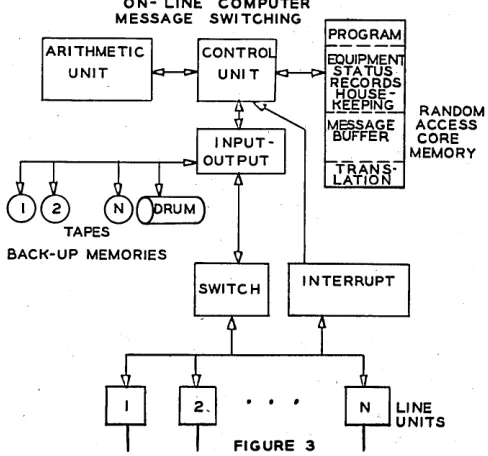
Structurally, a communications switch-ing network is a highly parallel com-puter consisting of a grid of independ-ent, interconnected, spatially separated, functionally similar switching and com-puting modules, each with its own logic, memory and input-output hard-ware.I See figure 1. A switching and
computing module communicates with another module by building a path to it: ~ A path may be direct or . may include intermediate modules. Path building instructions are generated at the originating module by a subscriber and transmitted along the path as it grows. Highly parallel computers are called Holland machines in the literature.2
In voice/data call switching networks, all path building is completed prior to channel utilization, which is then bidirectional. In unidirectional store and forward message switching networks, path building and channel utilization alternate until a message reaches its destination or desti-nations. Message switching modules include buffer storage to hold delayed messages during path building. Message switching networks may also include specialized buffer modules to handle code, signalling, and timing conversions.
message switching and computing modules
The functional organization of a store and forward message switching module is depicted in figure 2. The principal functions of the module are:
24
(a) Monitor lines for incoming messages either from subscribers or other modules.
PARALLEL GRID or SWITCHING MODULES
LOGIC
I
I
MEMORyl-M (J:, J)
C:=:l
CJ CJ CJ C1,,.... -L-O-G-I
c---'I
IMEMORY
I
M(I+ I,J)
FIGURE
LOGIC
I
MEMORYI
M(r,Jt I)
o
T
(b) Switch incoming messages into high speed buffer storage.
(c) Analyze path building instructions received with messages to determine message destination,' route and priority level in accordance with' message format specifications. Provide optimum routing of messages where possible.
(d) Find idle outgoing lines, make them. busy, and transmit messages over them from high speed buffer memory.
(e) Perform message format, code and speed conver-sion, where necessary.
(f) Maintain a log of messages, including time re-ceived and time transmitted. Administer assign-ment of message identificat~on numbers.
(g) Transmit messages to multiple destinations as directed by path building instructions. Buffer. messages until all replicas have been transmitted.
TO MESSAGE SWITCHING
M(l-I)J) MODULE Mll:.J)
I
LOCALI
SUBS
~~
I
TO
HIGH SPEED M(l
BUFFER MEMORY
• J+I)
o M(I.J-I) --;::!::
I
I
SWITCH
[TRANSLATION
BACK UP
MEMORY
I
LOGICI
TO I
M (1+ I,J) FIGURE 2
(h) Transmit messages in proper order of priority, and administer queue discipline in buffer memory for messages waiting behind busy outgoing lines. (i) Monitor buffer memory for overflow, and divert messages in excess of high speed buffer capacity to medium speed, large scale back up memory.
(j) Monitor lines for transmission errors. Provide error detection and correCtion.
(k) Monitor lines and internal subsystems for errors and faults, and generate maintenance messages when faults are detected.
(l) Perform message accounting; assemble informa-tion for customer billing.
DATAMATION