warwick.ac.uk/lib-publications
Manuscript version: Author’s Accepted Manuscript
The version presented in WRAP is the author’s accepted manuscript and may differ from the published version or Version of Record.
Persistent WRAP URL:
http://wrap.warwick.ac.uk/109987
How to cite:
Please refer to published version for the most recent bibliographic citation information. If a published version is known of, the repository item page linked to above, will contain details on accessing it.
Copyright and reuse:
The Warwick Research Archive Portal (WRAP) makes this work by researchers of the University of Warwick available open access under the following conditions.
Copyright © and all moral rights to the version of the paper presented here belong to the individual author(s) and/or other copyright owners. To the extent reasonable and
practicable the material made available in WRAP has been checked for eligibility before being made available.
Copies of full items can be used for personal research or study, educational, or not-for-profit purposes without prior permission or charge. Provided that the authors, title and full
bibliographic details are credited, a hyperlink and/or URL is given for the original metadata page and the content is not changed in any way.
Publisher’s statement:
Please refer to the repository item page, publisher’s statement section, for further information.
C:\Users\lyslbp\AppData\Local\Microsoft\Windows\Temporary Internet Files\Content.Outlook\OANR45ZE\ces-221018-wrap--wrapthe_purpose_in_life_scale_catholic_priests_italy_final.docx 23/10/2018
The Purpose-in-Life Scale (PILS): Internal consistency reliability, concurrent validity and
construct validity among Catholic priests in Italy
Leslie J Francis*
University of Warwick, Coventry, UK
Giuseppe Crea
Salesian Pontifical University, Rome, Italy
Ursula McKenna
University of Warwick, Coventry, UK
Author note:
*Corresponding author: Leslie J Francis
Warwick Religions & Education Research Unit Centre for Education Studies
The University of Warwick
Coventry CV4 7AL United Kingdom Tel: +44 (0)24 7652 2539
Fax: +44 (0)24 7657 2638
Abstract
The Purpose in Life Scale was designed to provide a 12-item unidimensional measure of
purpose in life employing a five-point Likert rating for each item. The present study supports
the psychometric properties of the Italian translation of this instrument among 155 Catholic
priests (mean age = 46 years, SD = 12.16). Internal consistency reliability generated an alpha
coefficient of .90. The first factor generated by principal component analysis accounted for
49.5% of variance. Concurrent validity against the Purpose in Life Test was supported by a
correlation of .63. Construct validity was supported by a correlation of .54 with the
Satisfaction in Ministry Scale and by a correlation of -.51 with the Scale of Emotional
Exhaustion in Ministry. These properties commend the scale for future use among Catholic
priests.
Keywords: Purpose in Life Scale, factor structure, reliability, construct validity, concurrent
Introduction Purpose in life and Logotherapy
Interest in conceptualising and measuring the construct ‘Purpose in Life’ has been
largely rooted in the field of Logotherapy, as stimulated by the pioneering work of Victor
Frankl (1955, 1958, 1959, 1966, 1967, 1969, 1978, 1992, 2010) and as subsequently
developed by others (see Guttmann, 1996; Lukas, 2000; Lukas & Hirsch, 2002). Logotherapy
focuses on the meaning of human existence as well as on man's search for such a meaning.
According to Frankl:
Man’s search for meaning is the primary motivation in his life and not a ‘secondary
rationalization’ of instinctual drives. This meaning is unique and specific in that it
must and can be fulfilled by him alone; only then does it achieve a significance which
will satisfy his own will to meaning. (Frankl, 1992, p. 105)
Logotherapy is an explicit philosophy of life. More specifically, it is based on three
fundamental assumptions which form a chain of interconnected links described and defined
by Frankl as: Freedom of Will, Will to Meaning, and Meaning to Life (Frankl, 1978, pp.
13-14). In contrast, failing to find meaning in life and the experience of a total lack, or loss, of an
ultimate meaning to one’s existence that would make life worthwhile has been termed by
Frankl (2010, p. 49) ‘the existential vacuum’.
The Purpose in Life Test
Working within the theoretical framework proposed by logotherapy, the Purpose in
Life Test was proposed and developed by Crumbaugh and Maholick (1964, 1969). This
instrument comprises three parts: Part A is composed of 20 items, each of which is rooted
within a 7-point semantic space; Part B is composed of 13 incomplete sentences; and Part C
requests the respondent to compose a paragraph. Within quantitatively-framed studies, Part A
Chinese (Shek, 1988), Italian (Brunelli, Bianchi, Murru, Monformoso, Bosisio, Gangeri,
Miccinesi, Scrignaro, Ripamonti, & Borreani, 2012), Japanese (Ishida & Okada, 2006),
Polish (Wnuk, Marcinkowski, & Fobair, 2012), Slovak and Hungarian (Halama, Martos, &
Adamovová, 2010), Spanish (Gallego-Perez, Garcia-Alandete, & Perez-Delgado, 2007;
Garcia-Alandete, Martínez & Nohales, 2013a, 2013b), and Swedish (Jonsén, Fagerström,
Lundman, Nygren, Vähäkangas, & Strandberg, 2010). The Purpose in Life Test has been
developed in short form by Schulenberg, Schnetzer, and Buchanan (2011) and this has been
translated into Chinese by Wang, Koenig, Ma, and Al Shohaib (2016). A revised version has
been developed by Harlow, Newcomb, and Bentler (1987) and this has been translated into
Persian by Aghababaei, Sohrabi, Eskandari, Borjali, Farrokhi, and Chen (2016).
The Purpose in Life Test continues to be widely used. The PILT has been used among
a range of different populations including school and college students (Wang, Koenig, Ma, &
Al Shohaib, 2016; Halama, Martos, & Adamovová, 2010; DeWitz, Woolsey, & Walsh,
2009); adults within the general population (Crea, 2016; Jonsén, Fagerström, Lundman,
Nygren, Vähäkangas, & Strandberg, 2010); and the elderly (Gerwood, LeBlanc, & Piazza,
1998). The PILT has been used frequently within medical and health care contexts, including,
for example, persons with AIDS (Lewis, Erlen, Dabbs, Breneman, & Cook, 2006; Litwinczuk
& Groh, 2007); cancer patients (Wnuk, Marcinkowski, & Fobair, 2012); mental health
(Dezutter, Soenens, & Hutsebaut, 2006); general anxiety (Ishida & Okada, 2006); death
anxiety (Aghababaei, Sohrabi, Eskandari, Borjali, Farrokhi, & Chen, 2016); eating disorder
(García-Alandete, Ros, Salvador, & Rodríguez, 2018); suicidal ideation (Marco, Cañabate,
Pérez, & Llorca, 2017); substance abuse (Wnuk, 2015); and patients with amyotrophic lateral
sclerosis (Garcia, Morey, Kasarskis, & Segerstrom, 2017).
A number of studies and reviews provide general support for the reliability and
with measures of wellbeing and distress and good internal consistency reliability (Crumbaugh
& Maholick, 1964; Reker & Cousins, 1979; Shek, 1988; Hutzell, 1988; Zika & Camberlain,
1992; Reker, 2000; Litwinczuk & Groh, 2007; Jonsén, Fagerström, Lundman, Nygren,
Vähäkangas & Strandberg, 2010; Schulenberg & Melton, 2010). Nonetheless, there remain
significant problems with the measure, both conceptual and empirical.
The main conceptual problem with the Purpose in Life Test concerns the broad nature
of the construct as operationalised. At face value the 20 items combine some that are very
directly concerned with purpose (e.g. My personal existence is: utterly meaningless without
purpose…very purposeful and meaningful) alongside others that embrace the far-reaching
implications of Frankl’s theory, including the need for excitement (Life to me seems:
completely routine…always exciting), continuing change (Every day is: exactly the
same…constantly new and different), and freedom (concerning man’s freedom to make his
own choices, I believe man is: completely bound by limitations of heredity and
environment…absolutely free to make all life choices). Conceptually such a broad construct
may be more effectively accessed by a series of measures concentrating on the component
parts (see for example, Dyck, 1987).
The main conceptual problem is reflected in the main empirical problem that concerns
the factor structure of the Purpose in Life Test. A range of studies has demonstrated an
inconsistent factor structure, with no agreement on how many factors should be extracted (see
Schulenberg & Melton, 2010, p. 97). Various factor solutions have been proposed, ranging
from two factors (Morgan & Farsides, 2009) to as many as six factors (Reker & Cousins,
1979). Undertaking factor analysis of a Chinese translation of the Purpose in Life Test Shek
(1988) found support for both a five-factor solution and a two-factor solution. Some studies
have drawn attention to and interrogated the individual items that confuse the factor structure.
Two of these items were, ‘I am a: very irresponsible person – very responsible person’ and
‘With regard to suicide, I have: thought of it seriously as a way out – never given it a second
thought’. Jonsén et al (2010) argue these questions are hard to answer either because the
respondent feels compelled to produce a socially desirable response or because the topic is
sensitive. Other recent commentators have taken a more positive view of the factor structure
of the Purpose in Life Test. For example, Schulenberg and Melton (2010) used confirmatory
factor analysis to compare ten published factor-analytic models of the 20-item Purpose in
Life Test to identify the one that provided the best fit to the data. This study found support for
the two-factor model reported by Morgan and Farsides (2007), distinguishing between the
‘exciting life’ subscale and the ‘purposeful life’ subscale.
A further problem has been raised in connection with the typographic design of the
Purpose in Life Test. For example, Harlow, Newcomb, and Bentler (1987) argue that the
format of the purpose in life test is somewhat awkward and bulky especially when a large
number of tests are administered. Each of the 20 items has its own separate response scale
with different labels for the endpoints. This may be confusing to the test-taker and may make
it difficult to display the test compactly.
Over a number of years the Purpose in Life Test has played an important role within
the empirical psychology of religion with a number of studies exploring the connection
between different aspects of religion and purpose in life, including work reported by Crandall
and Rasmussen (1975), Pearson and Sheffield (1975), Bolt (1975), Paloutzian, Jackson, and
Crandall (1978), Gladdings, Lewis, and Adkins (1981), Paloutzian and Ellison (1982),
Chamberlain and Zika (1988), Jackson and Coursey (1988), Richards (1991), Carroll (1993),
Weinstein and Cleanthous (1996), Gerwood, LeBlanc, and Piazza (1998), French and
Stephen (1999), Janssen, Bänziger, Dezutter, and Hutsebaut (2005), Dezutter, Soenens, and
Pérez-Delgado (2007), Piedmont, Ciarrocchi, Dy-Liacco, and Williams (2009), Dy-Liacco,
Piedmont, Murray-Swank, Rodgerson, and Sherman (2009), Halama, Martos, and
Adamovová (2010), Williams, Francis, and Robbins (2011), Blazek and Besta (2012),
García-Alandete, Martínez, and Nohales (2013a), Wnuk (2015), Aghababaei, Sohrabi,
Eskandari, Borjali, Farrokhi, and Chen (2016), Francis and Crea (2016), Wang, Koenig, Ma,
and Al Shohaib (2016), and Turton, Nauta, Wesselmann, McIntyre, & Graziano (2018).
The Purpose in Life Scale
Robbins and Francis (2000) introduced the Purpose in Life Scale as an alternative
measure of purpose in life. This instrument differs from the Purpose in Life Test in two
important ways. First, the new instrument was designed to assess a much more tightly
focused notion of purpose in life. Second, the new instrument comprised 12 Likert-type items
rated on the conventional five-point scale, ranging from agree strongly, through not certain,
to disagree strongly. In the foundation study, conducted among 517 first-year undergraduate
students, Robbins and Francis (2000) reported an alpha coefficient (Cronbach, 1951) of .90
with the correlations between each item and the sum of the other items varying between .41
and .76, demonstrating good internal consistency reliability.
In this foundation paper construct validity was explored by locating purpose in life
scores within the three dimensional psychological space proposed by the Revised Eysenck
Personality Questionnaire (Eysenck, Eysenck, & Barrett, 1985). The Eysenckian dimensional
model of personality proposes three orthogonal factors characterised by the high scoring
poles of extraversion, neuroticism and psychoticism. Within this dimensional model of
personality, neurotic and psychotic disorders are conceptualised as continuous with
individual differences in normal personality. Thus the neuroticism scale is understood to
progress from emotional stability through emotional lability to neurotic disorder, and the
toughmindedness to psychotic disorder. On this account, if purpose in life is conceptualised
as indicative of normal healthy human functioning, the construct would be hypothesised as
negatively associated with both psychoticism scores and neuroticism scores. Additionally, the
third dimension of the Eysenckian model is understood to progress from introversion through
ambiversion to extraversion. The distinctive Eysenckian conceptualisation of extraversion is
associated with healthy social functioning. On this account, if purpose in life is
conceptualised as indicative of healthy social functioning, the construct would be
hypothesised as positively associated with extraversion scores. Robbins and Francis’ (2000)
data supported all three hypotheses: purpose in life was positively correlated with
extraversion (r = .23, p < .001), negatively correlated with neuroticism (r = -.35, p < .001),
and negatively correlated with psychoticism (r = -.12, p < .01).
Robbins and Francis’ (2000) study was based on 517 first-year undergraduate
students, of whom 70% were under the age of 20, 12% were aged 20 or 21, and 18% were
aged 22 or over. In a complementary study, Francis, Jewell, and Robbins (2010) conducted a
study among 407 older Methodists, among whom 36% were in their sixties, 44% were in
their seventies, and 20% were aged eighty or over. In this study internal consistency
reliability for the Purpose in Life Scale was supported by an alpha coefficient of .92;
construct validity was supported by a positive correlation with extraversion (r = .23, p <
.001), and a negative correlation with neuroticism (r = -.26, p < .001), although the
correlation with psychoticism was not significant (r = .04, ns).
Further evidence for the reliability and validity of the Purpose in Life Scale is
provided by the following five studies. In a study conducted among 342 psychology students
(mean age = 21.3 years, SD = 5.7), Sillick and Cathcart (2014) reported good internal
consistency reliability with an alpha coefficient of .91, and good construct validity in terms of
Questionnaire (Hills & Argyle, 2002). In a study conducted among 146 high school students
(mean age = 16.0 years, SD = 1.3), Poteat et al (2015) reported an alpha coefficient of .92
and a good construct validity in terms of a positive correlation with self-esteem (r = .72, p <
.001) and a negative correlation with victimisation (r = -.18, p < .05). In a study employing
the Italian translation of the Purpose in Life Scale among 934 participants (mean age = 30
years, SD = 15.9), Crea (2016) reported good internal consistency reliability with an alpha
coefficient of .90, and convergent reliability in terms of a correlation of .67 between scores
recorded on the Purpose in Life Scale and on the Purpose in Life Test (Crumbaugh &
Maholick, 1969). In a study employing a modified version of the Purpose in Life Scale (using
10 items) among 501 university students in Canada (mean age = 21.4 years, SD = 4.9), Chow
(2017) reported an alpha coefficient of .92 and construct validity in terms of lower levels of
death anxiety ( β = -.17, p < .001). In a study employing the Purpose in Life Scale among 150
students aged between 16 and 18 years Francis, Village, and Parker (2017) reported an alpha
coefficient of .92.
Research question
Against this background the aim of the present study is to explore the psychometric
properties of the Italian translation of the Purpose in Life Scale among Catholic priests in
Italy. Specifically four research questions are addressed concerning: the internal consistency
reliability as assessed by the alpha coefficients (Cronbach, 1951), and the correlations
between the individual items and the sum of the remaining items; the proportion of variance
accounted for by the first factor proposed by principal component analysis, and the loadings
of the individual items on that factor; the concurrent validity as assessed by the Purpose in
Life Test (Crombaugh & Maholick, 1969); and the construct validity as assessed against the
measures of positive affect and negative affect proposed by the Francis Burnout Inventory
Method Procedure
In the context of programmes operated in Rome for Catholic priests on the topic of
personality and spirituality, participants were invited to complete a questionnaire covering
issues relevant to the programme. Participation in the programme was voluntary and
responses to the questionnaire were confidential and anonymous. Full data were provided by
155 priests.
Participants
Three fifths of the participants were Italians (63%) and the remaining 37% were from
a number of other countries; 56% were diocesan priests, and 44% were religious priests.
Participants’ age ranged from 24 to 76 years with an average age of 46 years (SD = 12.16);
8% of the participants were in their twenties, 29% in their thirties, 30% in their forties, 21%
in their fifties, 6% in their sixties, and 7% in their seventies.
Measures
The Purpose in Life Scale (PILS), developed by Robbins and Francis (2000), is a
12-item instrument. Each 12-item is rated on a five-point Likert scale: agree strongly, agree, not
certain, disagree, disagree strongly. The foundation paper reported an alpha coefficient of .90.
The Purpose in Life Test (PILT), developed by Crumbaugh and Maholick (1969), is a
20-item instrument. Each item is rated on a seven-point semantic differential grid. The
foundation paper reported split-half reliability coefficients ranging from .81 to .90.
The Francis Burnout Inventory (FBI), developed by Francis, Kaldor, Robbins, and
Castle (2005), proposes two 11-item measures: Satisfaction in Ministry Scale (SIMS,
concerned with positive affect) and Scale of Emotional Exhaustion in Ministry (SEEM,
strongly, agree, not certain, disagree, disagree strongly. The foundation paper reported alpha
coefficients of .84 for SIMS and .84 for SEEM.
Data analysis
The data were analysed by the SPSS statistical package using the frequency,
reliability, factor and correlation routines.
Results
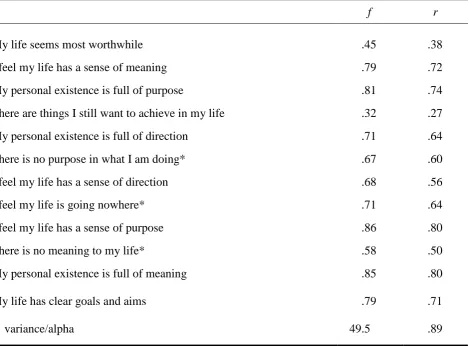
-insert table 1 about here-
The first step assessing the psychometric properties of the Purpose in Life Scale
involved exploring the factor structure, testing the internal consistency reliability of the
measure and reporting the item endorsement. These data are presented in Table 1. The
loadings on the first unrotated factor extracted by principal components analysis confirm that
this 12-item instrument generates a strong single factor scale. The first principal component
accounts for 49.5% of the variance, and all items load at least .3 on the first factor. The alpha
coefficient (Cronbach, 1951) of .89 confirms the homogeneity and internal consistency
reliability of the scale, and the correlations between each individual item and the sum of the
other items demonstrate that one item (There are things that I still want to achieve in life)
functions less strongly than the others.
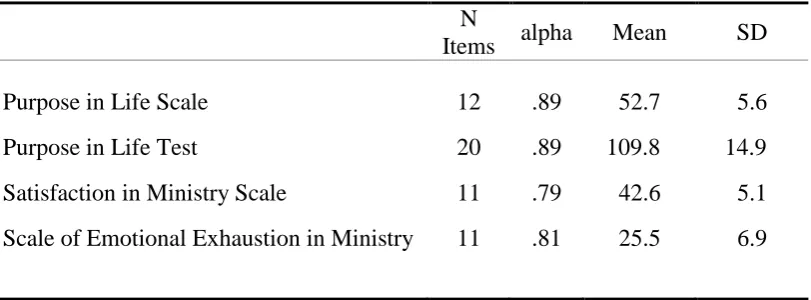
- insert table 2 about here -
The second step involved examining the psychometric properties of the three
instruments against which concurrent validity and construct validity may be assessed. The
data presented in Table 2 demonstrate that all three measures (the Purpose in Life Test, the
Scale of Emotional Exhaustion in Ministry, and the Satisfaction in Ministry Scale) all record
alpha coefficients well above the threshold of acceptability proposed by DeVellis (2003).
- insert table 3 about here -
Life Scale and the other three measures. The data presented in Table 3 demonstrate good
concurrent validity between the Purpose in Life Scale and the well-established Purpose in
Life Test (r = .63, p < .001), and good construct validity between the Purpose in Life Scale
and the two measures proposed by the Francis Burnout Inventory: a strong positive
correlation with the Satisfaction in Ministry Scale (r = .54, p < .001) and a strong negative
correlation with the Scale of Emotional Exhaustion in Ministry (r = -.51, p < .001).
Conclusion
The Purpose in Life Scale (Robbins & Francis, 2000) was designed as a research
instrument appropriate for assessing individual differences in purpose in life, with particular
relevance within the broad field of the empirical psychology of religion, in a way that
avoided the conceptual and empirical problems associated with the longer-established
Purpose in Life Test proposed by Crumbaugh and Maholick (1969). The present paper set out
to explore four aspects of the psychometric properties of this Italian translation of the 12-item
Purpose in Life Scale.
The first aspect concerned the internal consistency reliability. Both the alpha
coefficient of .90 and the high correlation between the individual items and the sum of the
remaining 11 items confirmed good properties of internal consistency reliability.
The second aspect concerned the factor structure as uncovered by unrotated principal
component analysis. A strong first factor that accounted for 49.5% of the variance and the
high loadings of all 12 items on this principal factor confirmed the single factor interpretation
of these items.
The third aspect concerned the concurrent validity of the scale against the Purpose in
Life Test developed by Crumbaugh and Maholick (1969). The correlation of .63 is strong
enough to demonstrate that the two measures share considerable variance in common but that
Purpose in Life Test may be assessing a broader and less focused construct than that assessed
by the Purpose in Life Scale, an observation confirmed by an examination of the scale items.
The fourth aspect concerned the construct validity of the scale against measures of
positive affect and negative affect. Theory suggests that a sense of purpose in life enhances
positive affect and depresses negative affect, as conceived within the field of logotherapy (see
Frankl, 1955, 1958, 1959, 1967, 1969, 1978, 1992, 2000). In the present study among priests,
negative affect was operationalised as emotional exhaustion in ministry and positive affect
was operationalised as satisfaction in ministry (Francis, Kaldor, Robbins, & Castle, 2005).
The correlations of .54 with positive affect and of -.51 with negative affect locate the
construct assessed by the Purpose in Life Scale within the domain hypothesised by
logotherapy.
Taken together these four findings support the psychometric properties of the Italian
translation of the Purpose in Life Scale and commend this instrument for use in further
studies and among Italian speakers, particularly among Catholic priests, and for further
studies concerned with empirical testing of the hypotheses proposed by logotherapy and by
References
Aghababaei, N., Sohrabi, F., Eskandari, H., Borjali, A., Farrokhi, N., & Chen, Z. (2016).
Predicting subjective well-being by religious and scientific attitudes with hope,
purpose in life, and death anxiety as mediators. Personality and Individual
Differences, 90, 93-98. doi.org/10.1016/j.paid.2015.10.046
Blazek, M., & Besta, T. (2012). Self-concept clarity and religious orientations: Prediction of
purpose in life and self-esteem. Journal of Religion and Health, 51, 947-960.
doi.org/10.1007/s10943-010-9407-y
Bolt, M. (1975). Purpose in life and religious orientation. Journal of Psychology and
Theology, 3, 116-118.
Brunelli, C., Bianchi, E., Murru, L., Monformoso, P., Bosisio, M., Gangeri, L., Miccinesi, G.,
Scrignaro, M., Ripamonti, C., & Borreani, C. (2012). Italian validation of the Purpose
In Life (PIL) test and the Seeking Of Noetic Goals (SONG) test in a population of
cancer patients. Support Cancer Care, 20, 2775-2783.
doi.org/10.1007/s00520-012-1399-6
Byrd, K., Hagemann, A., & Isle, D.B. (2007). Intrinsic motivation and subjective well-being: The unique contribution of intrinsic religious motivation. International Journal for
the Psychology of Religion, 17, 141-156. doi.org/10.1080/10508610701244155
Carroll, S. (1993). Spirituality and purpose in life in alcoholism recovery. Journal of Studies
on Alcohol, 54, 297-301. doi.org/10.15288/jsa.1993.54.297
Chamberlain, K., & Zika, S. (1988). Religiosity, life meaning and wellbeing: Some
relationships in a sample of women. Journal for the Scientific Study of Religion, 27,
411-420. doi.org/10.2307/1387379
death anxiety among university students in a western Canadian city. Death Studies,
41, 345-352. doi.org/10.1080/07481187.2017.1279240
Crandall, J. E., & Rasmussen, R. D. (1975). Purpose in life as related to specific values.
Journal of Clinical Psychology, 31, 483-485.
doi.org/10.1002/1097-4679(197507)31:3<483::AID-JCLP2270310326>3.0.CO;2-C
Crea, G. (2016). The psychometric properties of the Italian translation of the Purpose in Life
Scale (PILS) in Italy among a sample of Italian adults. Mental Health Religion and
Culture, 19, 858-896. doi.org/10.1080/13674676.2016.1277988
Cronbach, L. J. (1951). Coefficient alpha and the internal structure of tests. Psychometrika,
16, 297-334. doi.org/10.1007/BF02310555
Crumbaugh, J. C., & Maholick, L. T. (1964). An experimental study in existentialism: The
psychometric approach to Frankl’s concept of noogenic neurosis. Journal of Clinical
Psychology, 20, 200-207.
doi.org/10.1002/1097-4679(196404)20:2<200::AID-JCLP2270200203>3.0.CO;2-U
Crumbaugh, J. C., & Maholick, L. T. (1969). Manual of instructions for the Purpose in Life
Test (PIL). Munster, IN: Psychometric Affiliates.
DeVellis, R. F. (2003). Scale development: Theory and applications. London: Sage.
DeWitz, S. J., Woolsey, M. L., & Walsh, W. B. (2009). College student retention: An
exploration of the relationship between self-efficacy beliefs and purpose in life among
college students. Journal of College Student Development, 50, 19-34.
doi.org/10.1353/csd.0.0049
Dezutter, J., Soenens, B., & Hutsebaut, D. (2006). Religiosity and mental health: A further
exploration of the relative importance of religious behaviours versus religious
attitudes. Personality and Individual Differences, 40, 807-818.
Dyck, M. J. (1987). Assessing logotherapeutic constructs: Conceptual and psychometric
status of the purpose in life and seeking of noetic goals tests. Clinical Psychology
Review, 7, 439-447. doi.org/10.1016/0272-7358(87)90021-3
Dy-Liacco, G. S., Piedmont, R. L., Murray-Swank, N. A., Rodgerson, T. E., Sherman, M. F.
(2009). Spirituality and religiosity as cross-cultural aspects of human experience.
Psychology of Religion and Spirituality, 1, 35-52. doi.org/10.1037/a0014937
Eysenck, S. B. G., Eysenck, H. J., & Barrett, P. (1985). A revised version of the psychoticism
scale. Personality and Individual Differences, 6, 21-29.
doi.org/10.1016/0191-8869(85)90026-1
Francis, L. J., & Crea, G. (2016). The relationship between priestly motivational styles and
personal wellbeing in ministry: Exploring the connection between religious
orientation and purpose in life among Catholic priests serving in Italy. Review of
Religious Research, 58, 219-228. doi.org/10.1007/s13644-015-0242-1
Francis, L. J., Jewell, A., & Robbins, M. (2010). The relationship between religious
orientation personality and purpose in life among an older Methodist sample. Mental
Health, Religion and Culture, 13, 777-791. doi.org/10.1080/13674670802360907
Francis, L. J., Kaldor, P., Robbins, M., & Castle, K., (2005). Happy but exhausted? Assessing
two dimensions of work-related psychological health among clergy in Australia,
England and New Zealand. Pastoral Sciences, 24, 101-120.
Francis, L. J., Village, A., & Parker, S. G. (2017). Exploring the trajectory of personal, moral
and spiritual values of 16-to 18-year-old students taking religious studies at A level in
the UK. Journal of Beliefs and Values, 38, 18-31.
doi.org/10.1080/13617672.2016.1232567
Frankl, V. E. (1955). The doctor of the soul: An introduction to logotherapy. New York:
Frankl, V. E. (1958). The will to meaning. Journal of Pastoral Care, 12, 82-88.
Frankl, V. E. (1959). From death-camps to existentialism. Boston, MA: Beacon Press.
Frankl, V. E. (1966). Logotherapy and existential analysis: A review. American Journal of
Psychotherapy, 20, 252-260. doi.org/10.1176/appi.psychotherapy.1966.20.2.252
Frankl, V. E. (1967). Psychotherapy and existentialism. New York: Washington Square
Press.
Frankl, V. E. (1969). The will to meaning: Foundations and applications of logotherapy.
New York: The World Publishing Co.
Frankl, V. E. (1978). The unheard cry for meaning: Psychotherapy and humanism. New
York: Simon and Schuster.
Frankl, V. E. (1992). Man’s search for meaning: An introduction to logotherapy (Fourth
edition). Boston, MA: Beacon Press.
Frankl, V. E. (2010). The feeling of meaninglessness: A challenge to psychotherapy and
philosophy.Milwaukee, WI: Marquette University Press.
French, S., & Stephen, J. (1999). Religiosity and its association with happiness, purpose in
life, and self-actualisation. Mental Health, Religion and Culture, 2, 117-120.
doi.org/10.1080/13674679908406340
Gallego-Pérez, J. F., García-Alandete, J., & Pérez-Delgado, E. (2007). Purpose in life test
factors and religiosity.Universitas Psychologica, 6, 213-229.
Garcia, N. E., Morey, J. N., Kasarskis, E. J., & Segerstrom, S. C. (2017). Purpose in life in
ALS patient-caregiver dyads: A multilevel longitudinal analysis. Health Psychology,
36, 1092-1104. doi.org/10.1037/hea0000507
García-Alandete, J., Martínez, E. R., & Nohales, P. S. (2013a). Religious orientation and
meaning in life. Universitas Psychologica, 12, 363-374.
internal consistency of a Spanish version of the Purpose in Life. Universitas
Psychologica, 12, 517-530. doi.org/10.11144/Javeriana.UPSY12-2.efci
García-Alandete, J., Ros, M. C., Salvador, J. H. M., & Rodríguez, S. P. (2018). Psychometric
properties of the Purpose-in-Life Test and age-related differences among women
diagnosed with eating disorders. Psychiatry Research, 261, 161-167.
doi.org/10.1016/j.psychres.2017.12.052
Gerwood, J. B., LeBlanc, M., & Piazza, N. (1998). The Purpose in Life Test and religious
denomination: Protestant and Catholic scores in an elderly population. Journal of
Clinical Psychology, 54, 49-53.
doi.org/10.1002/(SICI)1097-4679(199801)54:1<49::AID-JCLP5>3.0.CO;2-P
Gladding, S. T., Lewis, E. L., & Adkins, L. (1981). Religious beliefs and positive mental
health: The G.L.A scale and counselling. Counselling and Values, 25, 206-215.
doi.org/10.1002/j.2161-007X.1981.tb00896.x
Guttmann, D. (1996). Logotherapy for helping professionals: Meaningful social work. New
York: Springer.
Halama, P., Martos, T., & Adamovová, L. (2010). Religiosity and well-being in Slovak and
Hungarian student samples: The role of personality traits. Studia Psychologica, 52,
101-115.
Harlow, L., Newcomb, M., & Bentler, P. (1987). Purpose in Life Test assessment using latent
variable methods. British Journal of Clinical Psychology, 26, 235-236.
doi.org/10.1111/j.2044-8260.1987.tb01355.x
Hills, P., & Argyle, M. (2002). The Oxford Happiness Questionnaire: A compact scale for the
measurement of psychological well-being. Personality and Individual Differences, 33,
1073-1082. doi.org/10.1016/S0191-8869(01)00213-6
Logotherapy, 11, 89-101.
Ishida, R., & Okada, M. (2006). Effects of a firm purpose in life on anxiety and sympathetic
nervous activity caused by emotional stress: Assessment by psycho-physiological
method. Stress and Health, 22, 275-281. doi.org/10.1002/smi.1095
Jackson, L. E., & Coursey, R. D. (1988). The relationship of God control and internal locus
of control to intrinsic religious motivation, coping and purpose in life. Journal for the
Scientific Study of Religion, 27, 399-410. doi.org/10.2307/1387378
Janssen, F., Bänziger, S., Dezutter, J., & Hutsebaut, D. (2005). Religion and mental health:
Aspects of the relation between religious measures and positive and negative mental
health. Archive for the Psychology of Religion, 27, 19-44.
doi.org/10.1163/008467206774355402
Jonsén, E., Fagerström, L., Lundman, B., Nygren, B., Vähäkangas, M., & Strandberg, G.
(2010). Psychometric properties of the Swedish version of the Purpose in Life scale.
Scandinavian Journal of Caring Sciences, 24, 41-48.
doi.org/10.1111/j.1471-6712.2008.00682.x
Lewis, M. P., Erlen, J. A., Dabbs, A. D., Breneman, K., & Cook, C. (2006). The utility of the
Purpose-in-Life Test in persons with AIDS. Journal of the Association of Nurses in
AIDS Care, 17, 51-59. doi.org/10.1016/j.jana.2005.11.005
Litwinczuk, K. M., & Groh, C. J. (2007). The relationship between spirituality, purpose in
life, and well-being in HIV-positive persons. Journal of the Association of Nurses in
AIDS Care, 18, 13-22. doi.org/10.1016/j.jana.2007.03.004
Lukas, E. (2000). Logotherapy textbook: Meaning centred therapy. Toronto: Liberty Press.
Lukas, E., & Hirsch, B. Z. (2002). Logotherapy. In R. F. Massey & S. D. Massey (Eds.),
Comprehensive handbook of psychotherapy (Volume 3, pp. 333-356). New York:
Marco, J. H., Cañabate, M., Pérez, S., & Llorca G. (2017). Associations among meaning in
life, body image, psychopathology, and suicide ideation in Spanish participants with
eating disorders. Journal of Clinical Psychology, 73, 1768-1781.
doi.org/10.1002/jclp.22481
Morgan, J., & Farsides, T. (2009). Measuring meaning in life. Journal of Happiness Studies,
10, 197-214. doi.org/10.1007/s10902-007-9075-0
Paloutzian, R. F., & Ellison, C. W. (1982). Loneliness, spiritual well-being, and the quality of
life. In L. A. Peplau & D. Perlman (Eds.), Loneliness: A sourcebook of current theory,
research and therapy (pp. 224-237). New York: Wiley-Interscience.
doi.org/10.1177/009164717800600403
Paloutzian, R. F., Jackson, S. L., & Crandall, J. E. (1978). Conversion experience, belief
systems and personal ethical attitudes. Journal of Psychology and Theology, 6,
266-275.
Pearson, P. R., & Sheffield, B. (1975). Purpose in life and social attitudes in psychiatric
patients. Journal of Clinical Psychology, 31, 330-332.
doi.org/10.1002/1097-4679(197504)31:2<330::AID-JCLP2270310237>3.0.CO;2-Y
Piedmont, R. L., Ciarrocchi, J. W., Dy-Liacco, G. S., & Williams, E. G. (2009). The
empirical and conceptual value of the Spiritual Transcendence and Religious
Involvment Scales for personality research. Psychology of Religion and Spirituality,
3, 162-179. doi.org/10.1037/a0015883
Poteat, V. P., Yoshikawa, H., Calzo, J. P., Gray, M. L., DiGiovanni, C. D., Lipkin, A.,
Mundy-Shephard, A., Perrotti, J., Scheer, J. R., & Shaw, M. P. (2015).
Contextualizing gay-straight alliances: Student, advisor, and structural factors related
to positive youth development among members. Child Development,86, 176-193.
Reker, G. T. (2000). Theoretical perspective, dimensions, and measurement of existential
meaning. In G. T. Reker & K. Chamberlain (Eds.), Exploring existential meaning:
Optimizing human development across the life span (pp. 39-55). Thousand Oaks, CA:
Sage. doi.org/10.4135/9781452233703.n4
Reker, G. T., & Cousins, J. B. (1979). Factor structure, construct validity and reliability of the
seeking of noetic goals (SONG) and purpose in life (PIL) tests. Journal of Clinical
Psychology, 35, 85-91.
doi.org/10.1002/1097-4679(197901)35:1<85::AID-JCLP2270350110>3.0.CO;2-R
Richards, D. G. (1991). The phenomenology and psychological correlates of verbal prayer.
Journal of Psychology and Theology, 19, 354-363.
doi.org/10.1177/009164719101900404
Robbins, M., & Francis, L. J. (2000). Religion, personality and wellbeing: The relationship
between church attendance and purpose in life among undergraduates attending an
Anglican College in Wales. Journal of Research in Christian Education, 9, 223-238.
doi.org/10.1080/10656210009484908
Schulenberg, S., & Melton, A. (2010). A confirmatory factor-analytic evaluation of the
purpose in life test: Preliminary psychometric support for a replicable two-factor
model. Journal of Happiness Studies, 11, 95-111.
doi.org/10.1007/s10902-008-9124-3
Schulenberg, S., Schnetzer, L., & Buchanan, E. (2011). The Purpose in Life Test (short
form): Development and psychometric support. Journal of Happiness Studies, 12,
861-876. doi.org/10.1007/s10902-010-9231-9
Shek, D. (1988). Reliability and factorial structure of the Chinese version of the purpose in
life questionnaire. Journal of Clinical Psychology, 44, 384-392.
Sillick, W. J., & Cathcart, S. (2014). The relationship between religious orientation and
happiness: The mediating role of purpose in life. Mental Health, Religion and
Culture, 17, 494-507. doi.org/10.1080/13674676.2013.852165
Turton, G. M., Nauta, M. M., Wesslemann, E. D., McIntyre, M. M., & Graziano, W. G.
(2018). The associations of Greek and religious organisation participation with
college students’ social wellbeing and purpose. The Journal of Psychology, 152,
179-198. doi.org/10.1080/00223980.2018.1431601
Wang, Z., Koenig, H., Ma, H., & Al Shohaib, S. (2016). Religion, purpose in life, social
support, and psychological distress in Chinese university students. Journal of Religion
and Health, 55,1055-1064. doi.org/10.1007/s10943-016-0184-0
Weinstein, L., & Cleanthous, C. C. (1996). A comparison of Protestant ministers and
parishioners on expressed purpose in life and intrinsic religious motivation.
Psychology: A journal of human behaviour, 33, 26-29.
Williams, E., Francis, L. J., & Robbins, M. (2011). Implicit religion and the quest for
meaning: Purpose in life and transcendental beliefs. Implicit Religion, 14, 45-65.
Wnuk, M. (2015). Religious-spiritual sources of hope and the meaning of life in alcohol co-
dependent subjects receiving support in self-help groups. Journal of Substance Use,
20, 194-199. doi.org/10.3109/14659891.2014.896954
Wnuk, M., Marcinkowski, J. T., & Fobair, P. (2012). The relationship of purpose in life and
hope in shaping happiness among patients with cancer in Poland. Journal of
Psychosocial Oncology, 30, 461-483. doi.org/10.1080/07347332.2012.684988
Zika, S., & Chamberlain, K. (1992). On the relation between meaning in life and
psychological well-being. British Journal of Psychology, 83, 133-145.
Table 1
Purpose in Life Scale
f r
My life seems most worthwhile .45 .38
I feel my life has a sense of meaning .79 .72
My personal existence is full of purpose .81 .74
There are things I still want to achieve in my life .32 .27
My personal existence is full of direction .71 .64
There is no purpose in what I am doing* .67 .60
I feel my life has a sense of direction .68 .56
I feel my life is going nowhere* .71 .64
I feel my life has a sense of purpose .86 .80
There is no meaning to my life* .58 .50
My personal existence is full of meaning .85 .80
My life has clear goals and aims .79 .71
% variance/alpha 49.5 .89
Note: r = item correlation with sum of the other items
* These items were reverse coded
Table 2
Scale Properties
N
Items alpha Mean SD
Purpose in Life Scale 12 .89 52.7 5.6
Purpose in Life Test 20 .89 109.8 14.9
Satisfaction in Ministry Scale 11 .79 42.6 5.1
Table 3
Correlation matrix
PILS SIMS SEEM
Purpose in Life Test .63*** .54*** -.51***
Scale of Emotional Exhaustion in Ministry -.44*** -.51***
Satisfaction in Ministry Scale .58**