High energy cosmic ray interactions and UHECR composition problem
Sergey Ostapchenko1,2,⋆
1Frankfurt Institute for Advanced Studies (FIAS), 60438 Frankfurt am Main, Germany
2D.V. Skobeltsyn Institute of Nuclear Physics, Moscow State University, 119992 Moscow, Russia
Abstract.The differences between contemporary Monte Carlo generators of high energy hadronic interactions are discussed and their impact on the interpretation of experimental data on ultra-high energy cosmic rays (UHECRs) is studied. Key directions for further model improvements are outlined. The prospect for a coherent interpretation of the data in terms of the UHECR composition is investigated.
1 Introduction
Among the most challenging problems of the high energy cosmic ray research is the enigma of ultra-high energy cos-mic rays (UHECRs). Despite a long history of UHECR studies, one is still quite far from understanding their po-tential sources and acceleration mechanisms. On the ex-perimental side, because of the very low UHECR flux, one has to rely on indirect detection techniques: measuring the properties of nuclear-electromagnetic cascades, so-called extensive air showers (EAS), initiated by interactions of the primary cosmic ray (CR) particles in the upper atmo-sphere [1]. In turn, a correct interpretation of the respec-tive data requires a good quantitarespec-tive understanding of the EAS development.
A substantial progress in the latter direction has been achieved with the development of contemporary Monte Carlo (MC) tools for air shower simulations, like the COR-SIKA [2], AIRES [3], SENECA [4], and CONEX [5] programs. One of the key ingredients of those numer-ical codes are MC models of high energy collisions of hadrons and nuclei, which describe interactions of both primary CRs and of the produced secondary hadrons with nuclei of the air. However, since such collisions gener-ally involve nonperturbative physics, no first principle de-scription can be employed for them and the correspond-ing models are largely phenomenological ones. There-fore, further progress in the understanding of ultra-high energy cosmic rays is closely linked to accelerator studies of high energy collisions of hadrons and nuclei, which are required both for calibrating parameters of such hadronic interaction models and, more importantly, for discriminat-ing between the respective theoretical approaches.
2 Impact of LHC data and further progress
Valuable information on the properties of high energy proton-proton, proton-nucleus, and nucleus-nucleus
inter-⋆e-mail: [email protected]
actions has been provided by experimental studies at the Large Hadron Collider (LHC). In particular, of the high-est importance for the high energy cosmic ray field proved to be measurements of the total and elastic ppcross sec-tions by the TOTEM [6–10] and ATLAS experiments [11, 12]. First of all, the corresponding results allow one to constrain seriously model predictions for proton-air and nucleus-air inelastic cross sections and thereby, for the mean free path (m.f.p.) of primary CR particles in the at-mosphere. This is related, in turn, to the position of the starting point for air shower development and, thus, im-pacts all EAS observables, most notably, the shower max-imum depth Xmax. Secondly, experimental results on the energy-dependence ofσtotppconstrain the underlying theo-retical approaches of hadronic interaction models and al-low one to fix important model parameters.
Among the most commonly used MC generators of high energy cosmic ray interactions are EPOS [13, 14], QGSJET-II [15–18], and SIBYLL [19–22]. All those models are inspired by the qualitative picture of quantum chromodynamics (QCD): hadron-proton, hadron-nucleus, and nucleus-nucleus collisions are mediated by cascades of partons [(anti-)quarks and gluons]. Since such cas-cades generally involve partons of small virtuality, one deals with nonperturbative phenomenological approaches. Nevertheless, the respective models have a considerable predictive power; using a particular approach, the energy dependence of the basic interaction properties, such as to-tal and inelastic cross sections, multiplicity of secondary particles, etc., is a mere consequence of the increase of the phase space available for such cascades to develop. Moreover, moving from proton-proton to pion-proton in-teractions or to proton-nucleus and nucleus-nucleus col-lisions, one keeps the same interaction mechanism; the only thing which changes are the initial conditions for those parton cascades, i.e. the structure of the so-called constituent parton Fock states representing the interacting particles. Thus, fixing basic parameters of a particular ap-proach, based on the measured proton-proton cross
tions, substantially constrains many other model predic-tions.
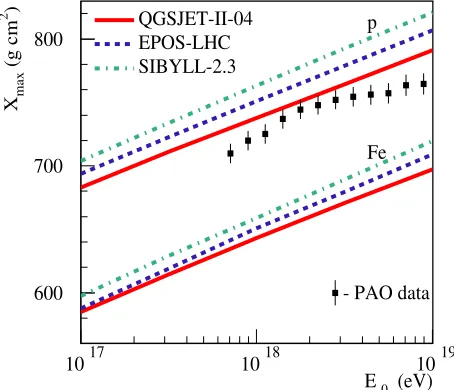
Nevertheless, despite the fact that all the above-mentioned models have been updated with the data of Run I of LHC, their predictions for various characteristics of extensive air showers differ considerably. If we compare, for example, the energy-dependence of the average shower maximum depth, calculated using the newest model ver-sions, the differences between the predictedXmax values reach 40 g/cm2at the highest energies, as one can see in Fig. 1, which is a factor of two larger than the respective
600 700 800
1017 1018 1019
E 0 (eV)
X
max
(g/cm
2 ) QGSJET-II-04
EPOS-LHC SIBYLL-2.3
p
Fe
- PAO data
Figure 1. Primary energy dependence of the average shower maximum depth for proton- and iron-initiated vertical EAS, as calculated using the QGSJET-II-04 [17, 18], EPOS-LHC [14], and SIBYLL-2.3 [21] models (solid, dashed, and dashed-dotted lines respectively), compared to the data of the Pierre Auger Ob-servatory (PAO) [23] (squares).
experimental accuracy. It is thus highly desirable to reveal the reasons for those differences and to find ways to further constrain model predictions.
Starting first with the differences between the SIBYLL-2.3 results and the ones of the other two mod-els, those appeared to be related to the very basic model assumptions concerning the structure of constituent par-ton Fock states in hadrons, i.e. to the above-mentioned ini-tial conditions for parton cascades, as discussed in more detail in Ref. [24]. Like most of the hadronic event gener-ators used in the collider field, the SIBYLL model is based on the “minijet” approach [25–27] which corresponds im-plicitly to the picture shown schematically on the left-hand side of Fig. 2. There, one starts from the same universal parton Fock state of the proton. Additional partons (sea quarks or gluons) giving rise to new branches of the parton cascade, which take part in multiple scattering processes, result from the evolution of the parton density correspond-ing to this initial state and their momentum fractionsxare distributed as∝ 1/xin the very high energy limit. Such a picture reflects itself in the hadron production pattern predicted by the model: multiple scattering affects mostly central particle production, while having a weak influence
Figure 2. Schematic view of the initial part of the parton cas-cade in the proton. Left: the cascas-cade starts from the same uni-versal parton Fock state; new partons participating in multiple scattering processes emerge from the cascade development, be-ing characterized by∝1/xdistributions for the momentum frac-tion. Right: the proton is represented by a superposition of Fock states consisting of different numbers of largexconstituent par-tons; the more abundant multiple scattering the larger Fock states involved in the process.
of forward hadron spectra. Indeed, the latter are formed by the hadronization of partons emerging from the initial part of the parton cascade, which starts from the same ini-tial conditions and covers a short rapidity interval, being thus weakly dependent on the further development of the cascade.
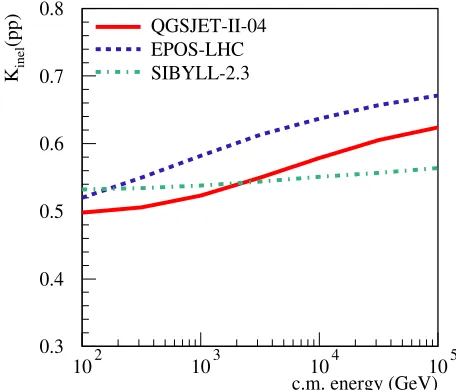
A direct consequence of the above-discussed approach is a weak energy-dependence of the inelasticity Kinel, i.e. the relative energy loss of leading (most energetic) hadrons produced. With increasing energy, one obtains a signifi-cant enhancement of secondary particle production in the central rapidity region only, which has a weak impact on the energy loss of leading nucleons in proton-proton and proton-nucleus collisions. As one can see in Fig. 3, the en-ergy dependence ofKinel
pp is indeed almost flat for SIBYLL-2.3. In turn, a slower energy-rise of the inelasticity implies a larger EAS elongation rate, hence, a largerXmaxat suffi -ciently high energies (see, e.g. Ref. [28]), as we observed indeed in Fig. 1.
In the alternative approach, implemented in the EPOS and QGSJET-II models, any hadron is represented by an infinite sequence of Fock states containing different num-bers of largexconstituent partons, as shown schematically on the right-hand side of Fig. 2. Further cascading of those partons “dresses” them with low xparton clouds. As the overall multiplicity of (anti-)quarks and gluons in the cen-tral rapidity region is roughly proportional to the number of initial constituent partons, stronger multiple scattering is typically associated with larger Fock states. Thus, there is a strong long-range correlation between central and for-ward particle production; higher multiplicity in the central region reflects stronger multiple scattering. In turn, this implies that larger ensembles of constituent partons are in-volved in the process, which has a strong impact on for-ward hadron spectra.
This naturally leads to a substantial energy-rise of the inelasticity, which is clearly seen in Fig. 3 for EPOS-LHC
and QGSJET-II-04. The reason for this rise is twofold. First, for any given Fock state, increasing multiple scat-tering implies that more and more constituent partons take part in the interaction, thus leaving smaller fractions of the initial proton momentum for spectator partons which fi-nally form the leading nucleons. Additiofi-nally, Fock states containing bigger numbers of largexconstituent partons come into play. Momentum sharing between these par-tons results in a smaller fraction of the initial proton mo-mentum, possessed by each parton, which thus enhances the energy loss of the leading nucleons.
A crucial discrimination between the two approaches may be provided by measuring correlations between the signal strengths in central and forward-looking detectors at the LHC. For the particular case of the CMS and TOTEM experiments, this is illustrated in Fig. 4, where we plot for √s = 8 TeV the pseudorapidity density of produced charged hadronsdnch
pp/d|η| at|η| = 6 (averaged over the interval 5.5 < |η| < 6.5) as a function of the centralη -density (|η|<1) of charged hadrons. Both EPOS-LHC and QGSJET-II-04 predict a strong correlation of the signal strengths in CMS and TOTEM. The respective results of the two models practically coincide with each other, apart from the tails of the multiplicity distributions. In contrast, for SIBYLL 2.3 such a correlation is twice weaker, being thus a “smoking gun” signature for the desirable discrimi-nation.
In turn, the difference between the EPOS-LHC and QGSJET-II-04 predictions forXmaxis related to the treat-ment of forward hadron production in pion-air collisions, the main effect coming from a copious production of baryon-antibaryon pairs and from a higher rate of the in-elastic diffraction in EPOS-LHC [29, 30]. As discussed in detail in Ref. [29], this can be discriminated based on PAO measurements of the maximal muon production depth [31].
0.3 0.4 0.5 0.6 0.7 0.8
102 103 104 105
c.m. energy (GeV)
K
inel
(pp) QGSJET-II-04 EPOS-LHC
SIBYLL-2.3
Figure 3. Energy dependence of the inelasticity of leading nucleons in ppcollisions, as calculated using the QGSJET-II-04, EPOS-LHC, and SIBYLL-2.3 models (solid, dashed, and dashed-dotted lines respectively).
0 5 10 15 20 25
0 10 20 30 40 50
dn/d|η| (|η|=0)
dn/d|
η
| (|
η
|=6) p+p → C (8 TeV c.m.)
QGSJET-II-04 EPOS-LHC SIBYLL-2.3
Figure 4. Pseudorapidity density of produced charged hadrons dnch
pp/d|η|at|η|=6 (pt>0) as a function ofdnchpp/d|η|at|η|=0 (pt >0.1 GeV) in ppcollisions at
√
s = 8 TeV, as calculated using the QGSJET-II-04, EPOS-LHC, and SIBYLL-2.3 models (solid, dashed, and dashed-dotted lines respectively).
Generally, further progress concerning the reliability of model predictions for various properties of extensive air showers will come both from improving the calibration of model parameters (so-called model tuning), based on the presently available and forthcoming accelerator data, and from further development of the underlying theoreti-cal approaches, aiming at a better self-consistency of the models. For cosmic ray applications, especially important is the treatment of forward hadron production in proton-air and pion-proton-air collisions. In this respect, one can benefit from recent results of the NA61 [32] and LHCf [33–38] experiments. In Ref. [18], the dominance of the pion ex-change mechanism has been postulated for forward meson production in nondiffractive pion-proton and pion-nucleus collisions, in order to reach an agreement with measured spectra of π0 and ρ0 mesons. While this conjecture has been further confirmed by the NA61 results onρ0 produc-tion in pion-carbon interacproduc-tions [32], which are consistent with previous measurements forπ+p collisions [39], the signatures of the very same mechanism are now clearly seen in the neutron spectra for ppcollisions at LHC en-ergies: at large Feynmanx, LHCf observed a pronounced “bump” in the forward neutron spectra, corresponding to the pion exchange mechanism [37, 38]. Thus, a consis-tent model implementation of the mechanism is an urgent task. While the basic contribution to the process comes from the so-called Reggeon-Reggeon-Pomeron (RRP)
di-agram, the treatment of the respective absorptive correc-tions, which describe the suppression of this contribution with increasing energy [40–42], is a nontrivial problem in a Monte Carlo framework.
3 Composition of UHECRs: coherent
interpretation of experimental data?
At present, we have a very puzzling situation with the studies of the composition of ultra-high energy cosmic rays. On the one side, there exists a wealth of experimen-tal results of high statistical significance, concerning mea-surements of various properties of UHECR-initiated EAS, which are sensitive to the primary composition. The list is quite extensive and includes, in particular, the primary energy dependence of the average shower maximum posi-tionXmaxand its fluctuations RMS(Xmax), of the maximal muon production depthXµmax, and of the muon density at groundρµ. On the other hand, a coherent interpretation of
all those data sets, in terms of a unique UHECR composi-tion, proves to be a very difficult challenge. This is related, in particular, to the fact that UHECR composition studies necessarily involve models of high energy hadronic inter-actions and that the relevant predictions of those models are yet rather different from each other. Moreover, none of the presently available models appeared to be able to pro-vide an overall self-consistent interpretation of the avail-able experimental results on UHECRs. Most gravely, they can not even describe specific data sets, like ρµ for the
highest energy events [43], for any reasonable assumptions concerning the primary composition.
One possible explanation of the above-mentioned problems is that the present models of high energy inter-actions do not provide an adequate enough description of the corresponding physics. In the following, we are go-ing to test this assumption by checkgo-ing whether a coherent interpretation of the various experimental results can be achieved applying some physically meaningful changes of the relevant model predictions. We shall concentrate on the data of the Pierre Auger Observatory, which have high statistics of UHECR events and contain measurements of the different EAS observables of interest.
3.1 “Marrying”XmaxandX
µ
maxin terms of UHECR
composition
Among the most composition-sensitive EAS observables is the average shower maximum depth Xmax. It is also a good anchor point for our analysis since the respec-tive measurements of the Pierre Auger Observatory and the Telescope Array experiment are consistent with each other [44, 45]. However, comparing the PAO data with model predictions forXmaxin Fig. 1, it is quite evident that the inferred UHECR composition will be highly model-dependent. To discriminate between the different models, we can use another EAS observable measured by PAO – the maximal muon production depthXµmax. The respective data clearly disfavor EPOS-LHC and SIBYLL-2.3 as the results of the two models require the primary cosmic rays to be much heavier than iron nuclei1 [30, 31].
Neverthe-1A dedicated study performed in Ref. [29] showed that the deepXµ
max of EPOS-LHC is caused by a too abundant (anti-)baryon production in pion-air interactions at high energies, predicted by that model [46]. In
ad-dition, the model is characterized by a rather high rate of inelastic diff
rac-tion for pion-air collisions, which also contributes to the elongarac-tion of the profile for muon production [30].
less, even using QGSJET-II-04, a consistent interpretation of the PAO data onXmaxandXmaxµ is not possible: while a comparison with the measured shower maximum position indicates a rather light primary composition, an agreement of the model prediction for Xmaxµ with the measurements can only be reached if UHECRs are iron nuclei [31].
Let us now try to “marry” the PAO data onXmaxand Xmaxµ composition-wise by changing the model predictions for high energy proton-air and pion-air collisions. It is not obvious a priori if this is possible since any modification of the model treatment, which affectsXmax, will also impact Xmaxµ predictions, and vice versa, and both quantities will change in the same direction.
Let us first try to increase the predicted Xmax, in or-der to change the interpretation of the respective PAO data towards a heavier cosmic ray composition. It is worth re-minding that the shower maximum position is most sen-sitive to the properties of the primary particle interaction in air, notably, to the respective inelastic cross section, to the rate of the inelastic diffraction, and to the inelasticity of the collisions [28]. It is important to stress, however, that potential changes of these characteristics of the first interaction will only impact the initial stage of EAS devel-opment, hence, give rise to an approximately parallel shift of the electromagnetic and hadronic longitudinal shower profiles, without any serious modification of the profile shapes. As a result, one will obtain a similar effect on XmaxandXmax:µ ∆Xmax≃∆Xµmax.
As discussed in Section 2, the inelastic proton-air cross sectionσinel
p−airis seriously constrained by measurements of the total and elastic proton-proton cross sections at LHC. In turn, changing the treatment of the inelastic diffraction, within present uncertainties on the diffractiveppcross sec-tion, allows one to changeXmaxby less than 10 g/cm2[47]. Thus, the only significant freedom left is related to the energy-dependence ofKinelp−air.
In order to check the impact of a slower energy-rise of Kinel
p−air on model predictions for Xmax and X
µ
max, we shall use the “cocktail” method [29]: treat the primary parti-cle interaction with the air, using the SIBYLL-2.3 model, but keep QGSJET-II-04 for the description of interactions of all secondary hadrons in the cascade. The so-obtained energy-dependences of Xmax and Xµmax are compared in Fig. 5 with the respective results of QGSJET-II-04 and with the PAO data.2 As one can see in the left panel of Fig. 5, a slower energy-rise of Kinel
p−air allows one to shift the position of the shower maximum somewhat deeper in the atmosphere and, thus, to change the interpretation of the PAO data onXmax towards a slightly heavier UHECR
2While the PAO results forX
max have been corrected for the
de-tector acceptance and the experimental reconstruction effects [23], this
is not the case forXmaxµ . Therefore, the QGSJET-II-04 predictions for
Xµmax(solid lines in the right panel of Fig. 5) are taken from the original
PAO publication [31], while the respective results of the above-described “cocktail” model (dashed lines in the right panel of Fig. 5) are obtained
assuming that relative differences betweenXµmaxresults of any two
mod-els remain unaffected by the acceptance and reconstruction effects. Such
a conjecture is supported by the fact that relative differences between
Xµmax values of EPOS-LHC and QGSJET-II-04 forp- and Fe-induced
EAS in Ref. [31], the experimental acceptance and reconstruction effects
included, coincide, within few g/cm2, with the ones obtained from pure
CONEX simulations.
600 650 700 750 800
1017 1018 1019
E0 (eV)
X
max
(g/cm
2 )
p
Fe
- PAO data QGSJET-II-04
SIBYLL for p-air (QGSJET-II - rest)
450 500 550 600 650
1020
E 0 (eV)
X
µ
max
(g/cm
2 )
QGSJET-II-04
SIBYLL for p-air, QGSJET-II - rest
p
Fe
Figure 5.Primary energy dependence ofXmax(left) andXmaxµ (right) for proton- and iron-induced vertical EAS, as calculated using the QGSJET-II-04 model (solid lines) or applying SIBYLL-2.3 for the treatment of proton-air collisions and QGSJET-II-04 for the rest of the hadron cascade (dashed lines). PAO data [23, 31] are shown by squares.
composition. But at the same time, the obtained maximal muon production depth, plotted by the dashed lines in the right panel of Fig. 5, also moves deeper and the respective interpretation requires primaries heavier than iron. There-fore, proceeding this way, we can not reach the desirable consistency between the two sets of experimental data.
Let us now try to shift the predicted Xmaxµ higher in the atmosphere and thus change the interpretation of the PAO data on the maximal muon production depth towards a lighter UHECR composition. As discussed in Ref. [29], the most efficient way to do so is to change the treatment of pion-air and kaon-air interactions, e.g., by increasing the respective inelastic cross sections, by decreasing the rate of the inelastic diffraction, or by increasing the in-elasticityKinel
π−airand the multiplicity of secondary hadrons produced. Very importantly, whatever option we choose, it will impact every step in the hadronic cascade develop-ment, hence, its effect onXµmaxwill be cumulative over all those steps. For example, higherσinel
π−airandσ inel
K−airwould shorten the mean free path of every pion and kaon in the cascade, thus considerably speeding up the cascade devel-opment and giving rise to a significant shrinkage of the longitudinal hadron and muon production profiles, hence, to sizable upward shifts of the maxima of those profiles. A similar effect can be obtained by using a smaller diff rac-tive cross section for pion-air collisions. Indeed, since in diffractive interactions the incident hadron typically looses a small portion of its energy, those may be regarded, in the first approximation, as quasielastic processes. Therefore, using a smallerσdiffr
π−airis essentially equivalent to having a shorter pion m.f.p. Finally, an increase of the inelasticity and multiplicity of pion-air collisions would speed up the decrease of the average pion energy in the cascade, hence, most of the pions will reach the pion critical energy, for which the probabilities of pion interaction and decay be-come equal, at a smaller depth.
Very remarkably, the above-discussed changes of the treatment of pion-air collisions would have a much weaker impact on the average shower maximum depth sinceXmax is only sensitive to pion-air and kaon-air interactions in the beginning of the hadron cascade, before most of the energy of the primary particle is channelled into secondary electromagnetic cascades [29].
Let us now check these conjections by applying again the “cocktail” method: keeping QGSJET-II-04 for the de-scription of (anti-)nucleon interactions but treating pion-air and kaon-pion-air collisions by means of the old QGSJET model [48–50]. Asσinel
π−air,K inel
π−air, and, especially, the mul-tiplicity of pion-air interactions have a steeper energy-rise in QGSJET, compared to QGSJET-II-04, we obtain indeed a much smallerXmax, as one can see in Fig. 6 (right). Atµ the same time, the shower maximum position goes just slightly higher in the atmosphere, as shown in Fig. 6 (left), such that the two PAO measurements can be consistently interpreted in terms of a light UHECR composition.
Thus, in this subsection we obtained two important re-sults. First, changing the treatment of high energy pion-air collisions, one is able to reach a consistent interpretation of the PAO data on the average shower maximum depth and the maximal muon production depth. Secondly, pro-ceeding in such a way, we inevitably arrive to a very light, predominantly proton-dominated, UHECR composition.
3.2 What about the small RMS(Xmax)?
Let us now check if small Xmaxfluctuations observed by PAO for highest energy UHECRs [23] can be made com-patible with a light primary composition. Obviously this is not the case for the present high energy interaction models, see Fig. 7. Thus, we have to address the question whether there exists a physically sensible way to substantially re-duce the predicted RMS(Xmax).
600 650 700 750 800
1017 1018 1019
E0 (eV)
X
max
(g/cm
2 )
p
Fe
- PAO data QGSJET-II-04
QGSJET for π-air
450 500 550 600 650
1020
E 0 (eV)
X
µ
max
(g/cm
2 )
QGSJET-II-04
QGSJET for π-air
p
Fe p
Fe
Figure 6. Primary energy dependence ofXmax(left) andXµmax(right) for proton- and iron-induced vertical EAS, as calculated using the QGSJET-II-04 model (solid lines) or applying QGSJET-II-04 for the treatment of (anti-)nucleon-air collisions and QGSJET for the description of pion-air and kaon-air interactions (dashed lines). PAO data [23, 31] are shown by squares.
0 20 40 60 80 100
1017 1018 1019
E 0 (eV)
RMS(X
max
) (g/cm
2 ) QGSJET-II-04
EPOS-LHC SIBYLL-2.3
p
Fe
- PAO data
Figure 7.Primary energy dependence of RMS(Xmax) for proton-and iron-initiated vertical EAS, as calculated using the QGSJET-II-04, EPOS-LHC, and SIBYLL-2.3 models (solid, dashed, and dashed-dotted lines respectively), compared to PAO data [23] (squares).
In case of proton-induced EAS, the largest contribu-tion to RMS(Xmax) comes from fluctuacontribu-tions of the free path of the primary proton [51], which is related to the inelastic proton-air cross section. As already discussed above, there is very little freedom for changing the pre-dictedσinel
p−air since it is strongly constrained by measure-ments of the total and elastic pp cross sections. Ad-ditionally, RMS(Xmax) depends somewhat on the rate of the inelastic diffraction in proton-air collisions. However, modifying the diffraction treatment within present uncer-tainties on σdiffr
pp , one obtains only few g/cm2 effect for RMS(Xmax) [47]. Finally, the quantity depends on the
Glauber(-Gribov) geometry for nondiffractive proton-air collisions [52, 53], mainly, on fluctuations of the impact parameter and the related variations of the number of tar-get nucleons taking part in the interaction. Here, one also has little freedom, given the known nuclear transverse pro-files and the effective “size” of the proton, constrained by measurements of the differential elastic ppcross sec-tion at LHC. The overall uncertainty for calculasec-tions of RMS(Xmax) for p-induced EAS is well represented by the differences between the current model predictions, which are quite small, as one can see in Fig. 7.
Coming now to the case of primary nuclei, fluctuations of the free path of primary particles are of secondary im-portance, since the corresponding m.f.p. is short due to the large nucleus-air cross sections, especially, for relatively heavy nuclei. The same is true for the inelastic diff rac-tion since the diffraction rate in nucleus-nucleus interac-tions is much smaller than in the pA case [48]. Thus, the dominant contribution to RMS(Xmax) comes here from the Glauber(-Gribov) geometry of nucleus-nucleus colli-sions, notably, from fluctuations of the impact parameter and, correspondingly, of the number of projectile nucle-ons taking part in the interaction [48, 54]. While this is well-constrained, given the known nuclear profiles, a po-tential source of uncertainty forXmaxfluctuations is related to the fragmentation of the “spectator part” of the incident nucleus, i.e. to the treatment of the projectile nucleons not taking part in the inelastic interaction. For the two extreme cases, when the whole spectator part is kept as a single sec-ondary nucleus or when it is broken into separate nucleons, the respective RMS(Xmax) differs by a factor of two [48].
Since experimental data on the production of nuclear fragments are available at fixed target energies only, this may pose a problem for predicting nuclear fragmentation at very high energies. Fortunately, relative fragment yields scale above few GeV per nucleon (see, e.g., Ref. [55] for a review), which allows one to calibrate fragmentation
cedures with low energy data and then to extrapolate them reliably to ultra-high energies. Thus, also in the case of nu-clear primaries, there is very little freedom to change the model predictions for RMS(Xmax). This is well illustrated by the excellent agreement between the respective results of QGSJET-II-04 and SIBYLL-2.3 for different primary nuclei, see Fig. 8.
0 20 40
1017 1018 1019
E 0 (eV)
RMS(X
max
) (g/cm
2 )
QGSJET-II-04 EPOS-LHC SIBYLL-2.3
He
C
Fe
Figure 8. Primary energy dependence of RMS(Xmax) for (from top to bottom) He-, C-, and Fe-induced vertical EAS, as cal-culated using the QGSJET-II-04, EPOS-LHC, and SIBYLL-2.3 models (solid, dashed, and dashed-dotted lines respectively).
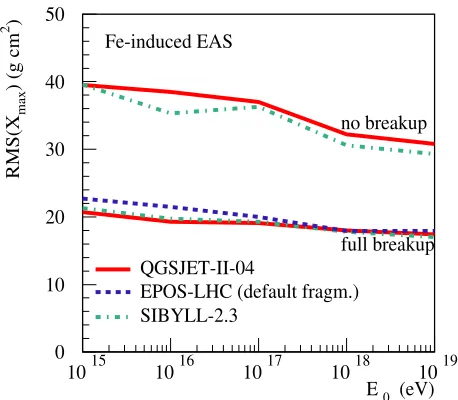
In view of the discussion above, it is quite sur-prising that the EPOS-LHC model predicts substantially smaller RMS(Xmax) for nuclei-initiated EAS, compared to QGSJET-II-04 and SIBYLL-2.3, especially, for interme-diate mass nuclei. To clarify this problem, let us compare in Fig. 9 the default EPOS-LHC results for Fe-induced EAS to calculations of QGSJET-II-04 and SIBYLL-2.3 for the two above-mentioned extreme cases: when the nu-clear spectator part is kept as a single nucleus or when it is broken into separate nucleons. It is easy to see that the EPOS-LHC predictions are very close to the full break-up option, irrespective the primary energy, which clearly in-dicates that the small RMS(Xmax) predicted by that model originates from an underestimation of the production of relatively heavy nuclear fragments.3
The main conclusion of this subsection is that the ac-tual uncertainties for calculations of RMS(Xmax) are very small, as, in fact, has been stated earlier in Ref. [57]. Thus, “marrying” experimental data on Xmax fluctuations with the ones on the average shower maximum depth and the maximal muon production depth is a purely experimental challenge.
3.3 “Muon excess” problem
The most outstanding problem with the interpretation of UHECR data is a significant excess of the EAS muon
3A likely origin of the problem is an incorrect matching between the
interaction and nuclear fragmentation procedures in EPOS-LHC [56].
0 10 20 30 40 50
1015 1016 1017 1018 1019
E 0 (eV)
RMS(X
max
) (g/cm
2 )
Fe-induced EAS
QGSJET-II-04
EPOS-LHC (default fragm.) SIBYLL-2.3
no breakup
full breakup
Figure 9. Primary energy dependence of RMS(Xmax) for Fe-induced vertical EAS, calculated with QGSJET-II-04 and SIBYLL-2.3 (solid and dashed-dotted lines respectively) for two nuclear breakup options, as discussed in the text, compared to the default EPOS-LHC results (dashed line).
content for very high energy primaries, compared to cur-rent EAS simulation results: the observed muon density at ground level is substantially higher than model predictions for iron-induced air showers [43, 58, 59]. Let us first ad-dress the question if this contradiction can be eliminated by a change of the treatment of the primary particle inter-action. To obtain a substantial enhancement of the muon numberNµ, one has to consider a very radical change of
the interaction mechanism, producing an order of magni-tude increase of the number of secondary hadrons [28, 60]. Such a change necessarily involves physics beyond the Standard Model. However, to have a significant impact on theaverageEAS muon content, such new physics should impact the bulk of UHECR-induced air showers, hence, to emerge with barn-level cross sections [61]. It is note-worthy that such a speculative scenario would give rise to a substantial increase of fluctuations of muon density at ground [61], which can be easily discriminated by current UHECR experiments.
Without invoking an exotic scenario, to obtain a sub-stantial muon excess at very high energies, one has to mod-ify the treatment of pion-air collisions over a wide energy range [60]. In such a case, the final effect onNµis a
cu-mulative one over many generations of hadrons in the at-mospheric nuclear cascade. Thus, the process is described qualitatively by the Geitler’s picture [62, 63] and we have the usual power-like energy-dependence ofNµ:
Nµ(E0)=Nµ(Eref) (E0/Eref)αµ,
with Eref being some reference energy. The desirable
modification amounts to an increase of the correspond-ing effective exponent: αµ → α˜µ. Since no muon excess
has been observed at energies around the knee of the CR spectrum [64], we can safely set Eref = 1 PeV. Now, if
at 10 EeV one has an excessR(10 EeV)µ =10000α˜µ−αµ, there
should be
q
R(10 EeV)µ excess at 1017 eV, which is at
vari-ance with the data of the KASCADE-Grande [65] and Ice-Top [66, 67] experiments.
While we thus see no sensible way to explain the ob-served muon excess by changing the treatment of high en-ergy hadronic interactions, one may investigate other pos-sibilities. In particular, since most of the relevant muon density measurements have been performed at large dis-tances from the shower core, a somewhat flatter shape of the muon lateral distribution function (LDF) could im-prove the agreement with the data. It is worth reminding that the muon LDF shape depends mostly on muon mul-tiple scattering in the atmosphere and on the transverse momentum pt spectra of pions produced in pion-air col-lisions at relatively low energies (E . 100 GeV) [68]. In particular, at large core distances (Rcore > 1 km), one is quite sensitive to the tails of the above-mentioned pt-distributions, which gives rise to a substantial dependence of predicted muon LDF on low energy hadronic interac-tion models [69]. Apart from that, one may think about improving the treatment of the Landau (large angle) muon scattering in current EAS simulation programs, since this mechanism may also influence significantly the shape of muon LDF at large distances.
4 Outlook
We discussed here the state of the art concerning the de-scription of cosmic ray interactions at very high ener-gies. The main conclusion may be formulated as follows: while we need hadronic interaction models for interpret-ing UHECR data, those models will remain phenomeno-logical ones and, thus, improvements of the model treat-ment will always be an issue. The present Monte Carlo generators of high energy hadronic interactions consider-ably benefited from experimental studies of proton-proton, proton-nucleus, and nucleus-nucleus interactions at the Large Hadron Collider, especially, from LHC data on the total and elastic proton-proton cross sections. Neverthe-less, there remain substantial differences between model predictions for various EAS characteristics. While some of those differences can be explained by evident draw-backs of certain models, additional dedicated accelerator studies are needed to discriminate between alternative the-oretical approaches and thereby reduce other sources of uncertainty.
We also investigated the possibility to obtain a consis-tent interpretation of the data on various air shower prop-erties, in terms of the UHECR composition, by consid-ering some plausible changes of the predictions of high energy hadronic interaction models. Changing the treat-ment of pion-air collisions, one is able indeed to “marry” the PAO data on the average shower maximum depth and the maximal muon production depth, which leads one to a very light, predominantly proton-dominated, cosmic ray composition at very high energies. However, no sensible changes of the models of high energy hadronic interactions would allow one to bring the PAO data on fluctuations of the shower maximum depth and on the EAS muon density
in agreement with the ones onXmaxandXµmax. Thus, reach-ing an overall self-consistent composition interpretation of the UHECR data requires to address systematic issues in the current experimental measurements and, possibly, to improve other parts of air shower simulation procedures, e.g., concerning the treatment of hadronic interactions at relatively low energies.
The author acknowledges the support by Deutsche Forschungs-gemeinschaft (project OS 481/2-1).
References
[1] M. Nagano and A. A. Watson,Observations and im-plications of the ultrahigh-energy cosmic rays, Rev. Mod. Phys.72, 689 (2000).
[2] D. Heck, J. Knapp, J. N. Capdevielle, G. Schatz and T. Thouw,CORSIKA: A Monte Carlo code to simu-late extensive air showers, Tech. Rep. FZKA-6019, Forschungszentrum Karlsruhe, 1998.
[3] S. J. Sciutto,AIRES: A System for air shower simu-lations. User’s guide and reference manual. Version 2.2.0, astro-ph/9911331.
[4] H.-J. Drescher and G. R. Farrar,Air shower simula-tions in a hybrid approach using cascade equasimula-tions, Phys. Rev. D67, 116001 (2003).
[5] T. Bergmann, R. Engel, D. Heck, N. N. Kalmykov, S. Ostapchenko, T. Pierog, T. Thouw and K. Werner, One-dimensional Hybrid Approach to Extensive Air Shower Simulation, Astropart. Phys.26, 420 (2007). [6] G. Antchev et al. (TOTEM Collaboration), First measurement of the total proton-proton cross section at the LHC energy of√s=7 TeV, Europhys. Lett.96, 21002 (2011).
[7] G. Antchevet al.(TOTEM Collaboration), Measure-ment of proton-proton elastic scattering and total cross-section at √s =7 TeV, Europhys. Lett. 101, 21002 (2013).
[8] G. Antchev et al. (TOTEM Collaboration), Luminosity-independent measurements of total, elastic and inelastic cross-sections at √s = 7TeV, Europhys. Lett.101, 21004 (2013).
[9] G. Antchev et al. (TOTEM Collaboration), Luminosity-Independent Measurement of the Proton-Proton Total Cross Section at √s = 8TeV, Phys. Rev. Lett.111, 012001 (2013).
[10] G. Antchev et al. (TOTEM Collaboration), First measurement of elastic, inelastic and total
cross-section at √s = 13 TeV by TOTEM and
overview of cross-section data at LHC energies, arXiv:1712.06153 [hep-ex].
[11] G. Aadet al.(ATLAS Collaboration),Measurement of the total cross section from elastic scattering in pp collisions at √s =7 TeV with the ATLAS detector, Nucl. Phys. B889, 486 (2014).
[12] M. Aaboudet al.(ATLAS Collaboration), Measure-ment of the total cross section from elastic scattering in pp collisions at √s =8TeV with the ATLAS de-tector, Phys. Lett. B761, 158 (2016).
[13] K. Werner, F.-M. Liu and T. Pierog, Parton lad-der splitting and the rapidity dependence of trans-verse momentum spectra in deuteron-gold collisions at RHIC, Phys. Rev. C74, 044902 (2006).
[14] T. Pierog, Iu. Karpenko, J. M. Katzy, E. Yatsenko and K. Werner,EPOS LHC: Test of collective hadroniza-tion with data measured at the CERN Large Hadron Collider, Phys. Rev. C92, 034906 (2015).
[15] S. Ostapchenko, QGSJET-II: Towards reliable de-scription of very high energy hadronic interactions, Nucl. Phys. Proc. Suppl.151, 143 (2006).
[16] S. Ostapchenko,Nonlinear screening effects in high energy hadronic interactions, Phys. Rev. D 74, 014026 (2006).
[17] S. Ostapchenko,Monte Carlo treatment of hadronic interactions in enhanced Pomeron scheme: QGSJET-II model, Phys. Rev. D 83, 014018 (2011).
[18] S. Ostapchenko, QGSJET-II: physics, recent im-provements, and results for air showers, EPJ Web Conf.52, 02001 (2013).
[19] R. S. Fletcher, T. K. Gaisser, P. Lipari and T. Stanev, SIBYLL: An Event generator for simulation of high-energy cosmic ray cascades, Phys. Rev. D50, 5710 (1994).
[20] E.-J. Ahn, R. Engel, T. K. Gaisser, P. Lipari and T. Stanev, Cosmic ray interaction event generator SIBYLL 2.1, Phys. Rev. D80, 094003 (2009). [21] F. Riehn, R. Engel, A. Fedynitch, T. K. Gaisser
and T. Stanev, A new version of the event gen-erator Sibyll, Proc. Sci., ICRC2015 (2016), 558; arXiv:1510.00568 [hep-ph].
[22] F. Riehn, H. P. Dembinski, R. Engel, A. Fedynitch, T. K. Gaisser and T. Stanev,The hadronic interaction model SIBYLL 2.3c and Feynman scaling, Proc. Sci., ICRC2017 (2018), 301; arXiv:1709.07227 [hep-ph]. [23] A. Aabet al.(Pierre Auger Collaboration),Depth of maximum of air-shower profiles at the Pierre Auger Observatory. I. Measurements at energies above 1017.8eV, Phys. Rev. D90, 122005 (2014).
[24] S. Ostapchenko, M. Bleicher, T. Pierog and K. Werner, Constraining high energy interaction mechanisms by studying forward hadron production at the LHC, Phys. Rev. D94, 114026 (2016). [25] T. K. Gaisser and F. Halzen,Soft Hard Scattering in
the TeV Range, Phys. Rev. Lett.54, 1754 (1985). [26] L. Durand and H. Pi, Semihard QCD and
High-energy pp andpp Scattering, Phys. Rev. D¯ 40, 1436 (1989).
[27] X.-N. Wang,pQCD based approach to parton pro-duction and equilibration in high-energy nuclear collisions, Phys. Rept.280, 287 (1997).
[28] R. Ulrich, R. Engel and M. Unger, Hadronic Mul-tiparticle Production at Ultra-High Energies and Extensive Air Showers, Phys. Rev. D 83, 054026 (2011).
[29] S. Ostapchenko and M. Bleicher,Constraining pion interactions at very high energies by cosmic ray data,
Phys. Rev. D93, 051501 (2016).
[30] T. Pierog, Open issues in hadronic interactions for air showers, EPJ Web Conf.145, 18002 (2017). [31] A. Aabet al.(Pierre Auger Collaboration),Muons in
air showers at the Pierre Auger Observatory: Mea-surement of atmospheric production depth, Phys. Rev. D90, 012012 (2014); ibid.,90, 039904 (2014); ibid.,92, 019903 (2015).
[32] A. Aduszkiewicz et al. (NA61/SHINE Collabora-tion),Measurement of meson resonance production inπ−+C interactions at SPS energies, Eur. Phys. J. C77, 626 (2017).
[33] O. Adriani et al. (LHCf Collaboration), Measure-ment of zero degree single photon energy spectra for √
s =7 TeV proton-proton collisions at LHC, Phys. Lett. B703, 128 (2011).
[34] O. Adriani et al. (LHCf Collaboration), Measure-ment of forward neutral pion transverse moMeasure-mentum spectra for √s=7 TeV proton-proton collisions at LHC, Phys. Rev. D86, 092001 (2012).
[35] O. Adrianiet al.(LHCf Collaboration), Transverse-momentum distribution and nuclear modification factor for neutral pions in the forward-rapidity re-gion in proton-lead collisions at √sNN = 5.02TeV, Phys. Rev. C89, 065209 (2014).
[36] O. Adriani et al. (LHCf Collaboration), Measure-ment of very forward neutron energy spectra for 7 TeV proton-proton collisions at the Large Hadron Collider, Phys. Lett. B750, 360 (2015).
[37] O. Adriani et al. (LHCf Collaboration), Measure-ments of longitudinal and transverse momentum dis-tributions for neutral pions in the forward-rapidity region with the LHCf detector, Phys. Rev. D 94, 032007 (2016).
[38] O. Adriani et al. (LHCf Collaboration), Measure-ment of inclusive forward neutron production cross section in proton-proton collisions at √s = 13 TeV with the LHCf Arm2 detector, JHEP1811, 073 (2018).
[39] N. M. Agababyanet al.(EHS-NA22 Collaboration), Inclusive production of vector mesons inπ+p inter-actions at 250 GeV/c, Z. Phys.C46, 387 (1990). [40] A. B. Kaidalov, V. A. Khoze, A. D. Martin and M. G.
Ryskin,Leading neutron spectra, Eur. Phys. J. C47, 385 (2006).
[41] B. Z. Kopeliovich, I. K. Potashnikova, B. Povh and I. Schmidt,Pion structure function at small x from DIS data, Phys. Rev. D85, 114025 (2012).
[42] V. A. Khoze, A. D. Martin and M. G. Ryskin,Total π+p cross section extracted from the leading neutron spectra at the LHC, Phys. Rev. D96, 034018 (2017). [43] A. Aab et al.(Pierre Auger Collaboration), Testing Hadronic Interactions at Ultrahigh Energies with Air Showers Measured by the Pierre Auger Observatory, Phys. Rev. Lett.117, 192001 (2016).
[44] W. Hanlon et al. for the Pierre Auger Collabora-tion and the Telescope Array CollaboraCollabora-tion,Report of the Working Group on the Mass Composition of
Ultrahigh Energy Cosmic Rays, JPS Conf. Proc.19, 011013 (2018).
[45] A. Yushkov et al. for the Pierre Auger Collabora-tion and the Telescope Array CollaboraCollabora-tion, Depth of maximum of air shower profiles: testing the com-patibility of measurements, these proceedings. [46] T. Pierog and K. Werner, Muon Production in
Ex-tended Air Shower Simulations, Phys. Rev. Lett.101, 171101 (2008).
[47] S. Ostapchenko, LHC data on inelastic diffraction and uncertainties in the predictions for longitudinal extensive air shower development, Phys. Rev. D89, 074009 (2014).
[48] N. N. Kalmykov and S. S. Ostapchenko, The nucleus-nucleus interaction, nuclear fragmentation, and fluctuations of extensive air showers, Phys. Atom. Nucl.56, 346 (1993).
[49] N. N. Kalmykov, S. S. Ostapchenko and A. I. Pavlov, EAS and a quark - gluon string model with jets, Bull. Russ. Acad. Sci. Phys.58, 1966 (1994).
[50] N. N. Kalmykov, S. S. Ostapchenko and A. I. Pavlov, Quark-Gluon String Model and EAS Simulation Problems at Ultra-High Energies, Nucl. Phys. Proc. Suppl.52B, 17 (1997).
[51] K.-H. Kampert and M. Unger,Measurements of the Cosmic Ray Composition with Air Shower Experi-ments, Astropart. Phys.35, 660 (2012).
[52] R. J. Glauber,High-energy collision theory, in: Lec-tures in theoretical physics, Ed. by W. E. Brittin and L. G. Dunham, Interscience Publishers, New York, 1959, vol. 1, p. 315.
[53] V. N. Gribov, Glauber corrections and the inter-action between high-energy hadrons and nuclei, Sov. Phys. JETP29, 483 (1969).
[54] J. Engel, T. K. Gaisser, T. Stanev and P. Lipari, Nucleus-nucleus collisions and interpretation of cos-mic ray cascades, Phys. Rev. D46, 5013 (1992). [55] S. Fredriksson, G. Eilam, G. Berlad and
L. Bergström, High-energy Collisions With Atomic Nuclei. Part 1, Phys. Rept.144, 187 (1987).
[56] T. Pierog, private communications.
[57] R. Aloisio, V. Berezinsky, P. Blasi and S. Ostapchenko, Signatures of the transition from Galactic to extragalactic cosmic rays, Phys. Rev. D 77, 025007 (2008).
[58] A. Aabet al.(Pierre Auger Collaboration),Muons in air showers at the Pierre Auger Observatory: Mean number in highly inclined events, Phys. Rev. D91, 032003 (2015); ibid.,91, 059901 (2015).
[59] R. U. Abbasiet al.(Telescope Array Collaboration), Study of muons from ultrahigh energy cosmic ray air showers measured with the Telescope Array experi-ment, Phys. Rev. D98, 022002 (2018).
[60] S. Ostapchenko,Models for cosmic ray interactions, Czech. J. Phys.56, A149 (2006).
[61] S. Ostapchenko,LHC results and hadronic interac-tion models, eConf C16-09-04.3; arXiv:1612.09461 [astro-ph.HE].
[62] W. Heitler,The Quantum Theory of Radiation, third ed., Oxford University Press, London, 1954, p. 386. [63] J. Matthews,A Heitler model of extensive air
show-ers, Astropart. Phys.22, 387 (2005).
[64] W. D. Apelet al.(KASCADE Collaboration), Com-parison of measured and simulated lateral distribu-tions for electrons and muons with KASCADE, As-tropart. Phys.24, 467 (2006).
[65] W. D. Apel et al. (KASCADE-Grande Collabora-tion),Lateral distributions of EAS muons ( Eµ>800
MeV) measured with the KASCADE-Grande Muon Tracking Detector in the primary energy range 1016 - 1017eV, Astropart. Phys.65, 55 (2015).
[66] J. G. Gonzalez for the ICECUBE Collaboration, Measurement of the Muon Content of Air Showers with IceTop, J. Phys. Conf. Ser.718, 052017 (2016). [67] K. Andeen for the IceCube Collaboration, Latest Cosmic Ray Results from IceTop and IceCube, these proceedings.
[68] L. Cazon, R. Conceiç˝ao, M. Pimenta and E. Santos, A model for the transport of muons in extensive air showers, Astropart. Phys.36, 211 (2012).
[69] H.-J. Drescher, M. Bleicher, S. Soffand H. Stoecker, Model dependence of lateral distribution functions of high energy cosmic ray air showers, Astropart. Phys. 21, 87 (2004).

.](https://thumb-us.123doks.com/thumbv2/123dok_us/8122691.1353378/6.595.56.537.78.281/primary-dependence-initiated-vertical-calculated-anddashed-respectively-compared.webp)