warwick.ac.uk/lib-publications
Manuscript version: Author’s Accepted Manuscript
The version presented in WRAP is the author’s accepted manuscript and may differ from the
published version or Version of Record.
Persistent WRAP URL:
http://wrap.warwick.ac.uk/113745
How to cite:
Please refer to published version for the most recent bibliographic citation information.
If a published version is known of, the repository item page linked to above, will contain
details on accessing it.
Copyright and reuse:
The Warwick Research Archive Portal (WRAP) makes this work by researchers of the
University of Warwick available open access under the following conditions.
Copyright © and all moral rights to the version of the paper presented here belong to the
individual author(s) and/or other copyright owners. To the extent reasonable and
practicable the material made available in WRAP has been checked for eligibility before
being made available.
Copies of full items can be used for personal research or study, educational, or not-for-profit
purposes without prior permission or charge. Provided that the authors, title and full
bibliographic details are credited, a hyperlink and/or URL is given for the original metadata
page and the content is not changed in any way.
Publisher’s statement:
Please refer to the repository item page, publisher’s statement section, for further
information.
UAV Relaying Assisted Secure Transmission With Caching
Fen Cheng, Guan Gui,
Senior Member, IEEE,
Nan Zhao,
Senior Member, IEEE,
Yunfei Chen,
Senior
Member, IEEE,
Jie Tang,
Senior Member, IEEE,
and Hikmet Sari,
Fellow, IEEE
Abstract—Unmanned aerial vehicle (UAV) can be utilized as a relay to connect nodes with long distance, which can achieve significant throughput gain owing to its mobility and line-of-sight (LoS) channel with ground nodes. However, such LoS channels make UAV transmission easy to eavesdrop. In this paper, we propose a novel scheme to guarantee the security of UAV-relayed wireless networks with caching via jointly optimizing the UAV trajectory and time scheduling. For every two users that have cached the required file for the other, the UAV broadcasts the files together to these two users and the eavesdropping can be disrupt-ed. For the users without caching, we maximize their minimum average secrecy rate by jointly optimizing the trajectory and scheduling, with the secrecy rate of the caching users satisfied. The corresponding optimization problem is difficult to solve due to its non-convexity, and we propose an iterative algorithm via successive convex optimization to solve it approximatively. Furthermore, we also consider a benchmark scheme in which we maximize the minimum average secrecy rate among all users by jointly optimizing the UAV trajectory and time scheduling when no user has the caching ability. Simulation results are provided to show the effectiveness and efficiency of our proposed scheme.
Index Terms—Caching, physical layer security, time schedul-ing, trajectory optimization, UAV relaying.
I. INTRODUCTION
Unmanned aerial vehicles (UAVs) have been widely utilized in wireless networks to improve the system performance recently [1], which have many advantages. First, UAVs often provide line-of-sight (LoS) channel links with ground users, which can enhance the transmission performance significantly [2]. Then, UAVs can be deployed quickly and flexibly for on-demand wireless systems due to their high mobility and agility. In addition, UAVs are less expensive than traditional communication infrastructures such as ground base stations
Manuscript received July 19, 2018; revised October 26, 2018 and December 20, 2018; accepted January 19, 2019. The work was supported by the National Natural Science Foundation of China (NSFC) under Grant 61871065, the open research fund of State Key Laboratory of Integrated Services Networks under Grant ISN19-02, the Fundamental Research Funds for the Central Universities under DUT17JC43, and the Xinghai Scholars Program. Part of this work has been published in preliminary form in the Proceedings of IEEE ICC 2019. The associate editor coordinating the review of this paper and approving it for publication was R. Zhang.(Corresponding author: Nan Zhao.)
F. Cheng and N. Zhao are with the School of Information and Com-munication Engineering, Dalian University of Technology, Dalian, Liaon-ing, P. R. China, and also with the State Key Laboratory of Integrated Services Networks, Xidian University, Xi’an, 710071, P. R. China (email: [email protected], [email protected]).
G. Gui is with Nanjing University of Posts and Telecommunications, Nanjing, Jiangsu, China (e-mail: [email protected])
Y. Chen is with the School of Engineering, University of Warwick, Coventry CV4 7AL, U.K. (e-mail: [email protected]).
J. Tang is with the School of Electronic and Information Engineering, South China University of Technology, Guangzhou, Guangdong, P. R. China (Email: [email protected]).
H. Sari is with Nanjing University of Posts and Telecommunications, Nanjing, Jiangsu, China (e-mail: [email protected]), and he is also the Chief Scientist of Sequans Communications, 92700 Colombes, France.
(BSs). Due to its promising performance, UAV assisted com-munication has attracted great interest from both industry and academia.
First, UAVs can be employed as aerial BSs to improve the capacity and coverage of traditional wireless networks [3]–[6]. For example, UAVs can be used to establish connections with users in some areas without infrastructures or achieve rapid service recovery after ground infrastructures being damaged in natural disasters. In [4], some fundamental work has been conducted to maximize the minimum throughput in multi-UAV networks via jointly optimizing the trajectory, power and scheduling. UAVs can also help ground BSs offload data traffic in crowded areas or improve the performance of cell-edge users [7]–[10]. Then, UAVs can be adopted as relays to help transmit information from source nodes to long-distance des-tination nodes [11]–[14]. Compared with ground static relays, UAV relay can achieve significant throughput gain because of its mobility and LoS channel. In [11], the throughput for UAV relaying system was maximized by designing UAV’s trajectory and optimizing the source/relay transmit power. The outage probability of the UAV relaying network was significantly minimized by optimizing the UAV trajectory and power allocation in [12] and [13]. When there exist multi-layer UAV relays in the cellular network, mean packet transmission delay was minimized by optimizing resource allocation in [14]. In addition, UAVs should often connect to the core networks via limited wireless backhaul, which will degrade the user experience at peak-traffic hours. To overcome this problem, caching can be exploited for UAVs transmission to avoid network congestion [7], [15], [16]. In [15], the UAVs in a cloud radio access network were proposed to cache appropriate content during off-peak time via predicting users’ behavior. An effective algorithm based on liquid state machine learning was proposed to predict the content request distribution of the users in LTE-U UAV networks [16]. In [7], the UAVs stored the enhancement layer segments of videos in advance, and then, they can fly close to the users who required the videos to provide transmission. Proactive caching can be also utilized to overcome the endurance issue for UAV communications, and some excellent work has been done in [17].
reliably transmitted without eavesdropping [20]. There have been plenty of works on physical layer security to disrupt the eavesdropping. The information beamforming and jamming beamforming were jointly optimized in [21] to guarantee the transmit and receive security for a full duplex BS. In [22], an overview of research on enhancing wireless transmission secrecy via cooperation was presented. The secure multiple amplify-and-forward relaying was studied in [23] over cor-related fading channels. In [24], interference alignment was exploited to guarantee the secure transmission in wireless multi-user networks, and the methods of interference align-ment and transceiver optimization for physical layer security were compared in [25]. In [26], artificial noise was gener-ated and leveraged to improve the security of the cognitive non-orthogonal multiple access networks with simultaneous wireless information and power transfer. Two secure schemes of secure precoding were proposed for directional modulation systems via artificial noise in [27]. In [28], some fundamental research has been done to introduce artificial neural network to guarantee the security of cellular-connected UAVs. In [29], the joint trajectory design and user scheduling were applied in a novel dual-UAV-enabled wireless network to guarantee the secure transmission. Caching can be leveraged to improve the security of wireless networks, and in [30], the pre-cached file was transmitted along with the target file to cache-enabled user, which would disturb eavesdropping effectively.
Due to the LoS channel of UAV, the adversarial eavesdrop-ping is a key threat for the UAV transmission, and some initial works have been focused on this aspect [31], [32]. In [31], the secrecy rate of UAV relaying systems was maximized by optimizing the transmit power of the source node and the UAV relay. In [32], the UAV trajectory was optimized to guarantee the secrecy rate from the UAV to the ground destination. Different from these works, in this paper, the secrecy rate of the UAV-relayed multi-user wireless network is guaranteed when there exists an eavesdropper, via using local caching and jointly optimizing the UAV trajectory and time scheduling.
The main motivations and contributions of this paper are summarized as follows.
• In this paper, the UAV trajectory and time scheduling are jointly optimized to guarantee the secure transmission in UAV-relaying systems with local caching. For every two users who have cached the file that is not required by themselves but required by the other, the UAV can broadcast the files cooperatively to them and disrupt the eavesdropping. For the users without caching, their secrecy rate should be improved through the trajectory optimization of UAV.
• In the optimization problem, the minimum secrecy rate of the uncached users is maximized through jointly maximizing the trajectory and time scheduling, with the secrecy rate requirement of caching users satisfied. The problem is a mixed-integer non-convex problem. We divide it into two subproblems, and propose an iterative algorithm to solve them alternately. The convergence of the algorithm is proved.
• We also consider the scenario in which no user is equipped with cache as a benchmark, and the
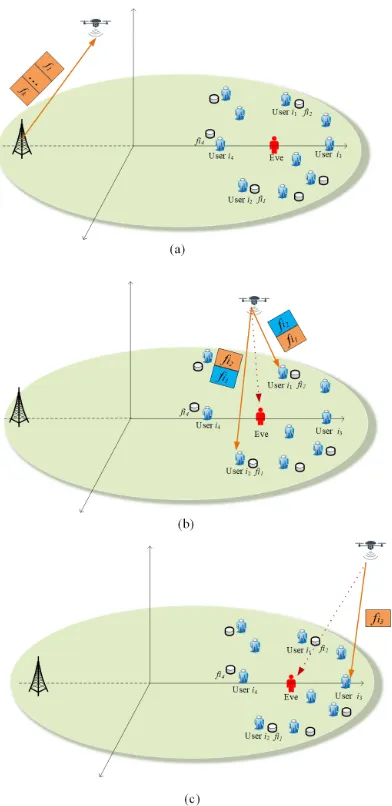
mini-Fig. 1. UAV relaying assisted secure transmission with caching: (a) UAV obtains files from the BS; (b) UAV broadcasts files to Useri1(i1∈ I1) and Useri2(i2∈ I2); (c) UAV transmits file to Useri3(i3∈ I3).
mum secrecy rate among all users is maximized through jointly optimizing UAV trajectory and time scheduling. The corresponding problem is also non-convex, which can be solved similarly as that with caching. Through comparison, we can conclude that local caching can help the UAV relaying assisted networks improve the security significantly.
The rest of the paper is organized as follows. We describe the system model and formulate the optimization problem in Section II. In Section III, an iterative algorithm is proposed to solve it through two subproblems alternately. In Section IV, the problem and its corresponding algorithm for the scenario without caching are presented. Simulation results are shown in Section V, followed by conclusions in Section VI.
II. SYSTEMMODEL
A. System Model
[image:3.612.341.537.49.452.2]ground. The eavesdropper is close to the users. There are no direct links from the BS to the users and the eavesdropper due to long distance or blockages between them. The UAV is exploited as a mobile relay to ferry the information from the BS to the users owing to its mobility, as shown in Fig. 1(a). Assume that the users all require a specific file from a library denoted by F, and the size of each file in the library is limited and proper due to the limited caching capacity of each user. In addition, assume that the UAV is equipped with a large-size cache, and the users have limited caching capacity. The users with caching capability can pre-cache some popular files during off-peak time. During the peak-traffic time, we assume that there are four different categories of users. Define
Il as the set of the users in the lth category, l = 1,2,3,4. Assume that User irequires file iwith data sizeWi. The 1st category of users and the 2nd category of users have cached the files that are required by the users in the other category. For example, User i1in the 1st category (i1∈ I1) has cached the filefi2 required by Useri2in the 2nd category (i2∈ I2), and
User i2 in the 2nd category has cached the file fi1 required
by User i1 in the 1st category. The UAV can broadcast fi1
andfi2 to them as shown in Fig. 1(b), which will disrupt the
eavesdropping towards User i1 or User i2 via caching. The 3rd category of users have no caching abilities. When they obtain their required files from the UAV at different slots, they are much easier to be eavesdropped, as shown in Fig. 1(c). The users in the 4th category have cached their required files. Thus, they can obtain the required files directly from their local caches without eavesdropping. Meanwhile, it can help reduce the peak traffic and alleviate the backhaul load, which can avoid the network congestion. Thus, the secrecy rate of the users in the 3rd category should be guaranteed by optimizing the trajectory and time scheduling of UAV.
Without loss of generality, Cartesian coordinate is adopted to describe the proposed model. We assume that the horizontal locations of the BS, the eavesdropper and the ith user are denoted as wb = (xb, yb), we = (xe, ye) and wi = (xi, yi), respectively,i∈ I1∪ I2∪ I3∪ I4. The location of the ground eavesdropper can be detected and tracked by the UAV through the equipped optical camera or synthetic aperture radar [33], and thus the eavesdropping channel state information (CSI) can be obtained due to the LoS channel from UAV to the eavesdropper, which is a common assumption in the existing literature of UAV [31], [32]. The flight altitude and period of the UAV are assumed to be H and T, respectively. We can observe that a larger flight period T will achieve higher throughput since more time can be provided for the UAV to fly closer to each ground user to make better wireless chan-nel. Nevertheless, larger T will also result in higher energy consumption and larger access delay since each user need to wait for longer time to communicate with the UAV in the next cycle. Therefore, we need to choose the period T properly to keep balance between the throughput, the access delay as well as the energy consumption. In addition, our proposed scheme can also be utilized in delay-tolerant applications and can exploit energy harvesting techniques such as solar energy to provide sufficient energy supply. The periodT is divided into N equal time slots, i.e.,T =N ς, whereς is small enough to
guarantee that the UAV’s location is approximately unchanged within each slot. The horizontal position of the UAV at thenth time slot is denoted as q[n] = (x[n], y[n]), n= 1,2, . . . , N. The UAV’s maximum speed is assumed to beVmax. Besides, we assume that the UAV’s initial location is fixed, which is denoted as q0 = (x0, y0). Thus, we have the trajectory constraints as
x[1] =x[N] =x0, y[1] =y[N] =y0,
(1)
(x[n+ 1]−x[n])2+ (y[n+ 1]−y[n])2≤d2ς, n= 1,2, . . . , N−1, (2)
wheredς =VmaxT /N.
The UAV obtains the required files of the users from the BS first, and then transmits them to the users. Thus, the total N time slots are divided into two parts. Assume that the 1st slot to the N1th slot are allocated to the UAV for obtaining the files required for the users from the BS1, while the remaining
slots are allocated to the UAV for transmitting the files to the users. The UAV cannot broadcast the files to cache-enabled users i1 (i1 ∈ I1) and i2 (i2 ∈ I2) and transmit file to user i3 (i3 ∈ I3) simultaneously due to interference. Instead, it serves the users without caching or cache-enabled user pairs via the time division multiple access (TDMA) protocol. For convenience, some binary variables, i.e.,αb[n]andαi[n],i∈
I1∪ I2∪ I3∪ I4, are defined, which reflect the UAV time scheduling. The UAV obtains the files from the BS at thenth time slot if αb[n] = 1, otherwise,αb[n] = 0. Thus, we know that αb[n] = 1, n = 1, ..., N1 and αb[n] = 0, n = N1 + 1, ..., N. In addition, since User i4 in the 4th category can obtain the desired file from its local cache, we haveαi4[n] = 0
over all slots. Furthermore, the UAV broadcastsfi1 andfi2 to
Useri1and Useri2at thenth time slot ifαi1[n] =αi2[n] = 1,
otherwise, αi1[n] = αi2[n] = 0,i1 ∈ I1,i2 ∈ I2. Similarly,
if αi3[n] = 1, the UAV transmits fi3 to User i3 at the nth
time slot, i3 ∈ I3. Then, the following conditions should be satisfied as
αi1[n] =αi2[n]∈ {0,1}, αi3[n]∈ {0,1}, ∀n, (3)
αb[n]+αi1[n]+αi3[n]≤1, ∀n, i1∈ I1, i2∈ I2, i3∈ I3.(4)
For simplicity, the wireless links from the BS to the UAV and from the UAV to the ground users and eavesdropper are assumed to be dominated by LoS. The Doppler effect due to the UAV mobility is assumed to be perfectly compensated at the receivers. Thus, the free-space path-loss model can be adopted, which is a common assumption in [4], [11], [31], [32]. Thus, when αb[n] = 1, the instantaneous rate in bit/second/Hz (bit/s/Hz) of the UAV at the nth time slot can be expressed as
ru,b[n] = log2
(
1+ P1ρ0
σ2(H2+(x[n]−x
b)2+(y[n]−yb)2)
)
,(5)
where P1 is the transmit power of the BS, σ2 is the noise
power, andρ0is the reference channel power for the distance d0= 1 m.
Let zi1 andzi2 denote the signals of fi1 andfi2 with unit
power, respectively. When αi1[n] = αi2[n] = 1, the UAV
broadcasts the signal √θi1P2zi1+
√
θi2P2zi2 to Useri1and
Useri2[30].θil(l= 1,2) is the portion of the UAV’s transmit
power P2 allocated to the file fil, where0 < θil <1, θi1+
θi2 = 1. Since User il knows the pre-cached fij perfectly,
j, l= 1,2,j̸=l, it can eliminate the interferencefij using the
similar method of successive interference cancellation (SIC) in non-orthogonal multiple access (NOMA) [34]. Therefore, the instantaneous rate of Useril(l= 1,2) at thenth time slot can be expressed as
ru,il[n] = log2
(
1 + θijP2ρ0 σ2(H2+(x[n]−x
il)
2+(y[n]−y il)
2)
)
,
∀l= 1,2, il∈ Il. (6)
When αi3[n] = 1, the instantaneous rate of User i3 at the
nth time slot can be expressed as
ru,i3[n] = log2
(
1+ P2ρ0
σ2(H2+(x[n]−x i3)
2+(y[n]−y i3)
2)
)
,
i3∈ I3. (7)
In addition, when the eavesdropper wants to eavesdrop User il, l = 1,2, the instantaneous eavesdropping rate at the nth time slot can be expressed as
ru,eil[n] = log2
1 +
θilP2ρ0
H2+(x[n]−x
e)2+(y[n]−ye)2
θijP2ρ0
(H2+(x[n]−x
e)2+(y[n]−ye)2)+σ
2
,
∀il∈ Il, l, j = 1,2, j̸=l, (8)
where (H2+(x[n]−θijxP2ρ0
e)2+(y[n]−ye)2) is the interference from the
file fij. Sincefij is unknown by the eavesdropper, it will be
viewed as interference to disrupt the eavesdropping when the eavesdropper aims to eavesdrop User il,l= 1,2,j̸=l.
When the eavesdropper wants to intercept the information for User i3, the instantaneous eavesdropping rate at the nth time slot can be presented as
ru,ei3[n] = log2
(
1+ P2ρ0
σ2(H2+(x[n]−xe)2+(y[n]−ye)2)
)
,
∀i3∈ I3. (9)
Thus, the achievable average transmission rate for the UAV to obtain the files from the BS can be expressed as
Ru= 1 N
∑N
n=1αb[n]ru,b[n]. (10) The average transmission rate from the UAV to the ith user can be presented as
R[i]= 1 N
∑N
n=1αi[n]ru,i[n], i∈ I1∪ I2∪ I3. (11) The average secrecy rate from the UAV to theith user can be denoted as
R[i]s=1 N
N
∑
n=1
[αi[n] (ru,i[n]−ru,ei[n])] +
, i∈ I1∪I2∪I3,(12)
where[x]+,max(x,0).
B. Problem Formulation
In this paper, we mainly aim at maximizing the mini-mum secrecy rate of the users without caching by jointly optimizing the UAV trajectory and time scheduling, with the secrecy rate of other caching users guaranteed. Define A =
{αk[n],∀n,∀k = b, i1, ..., i4,∀il ∈ Il}, x = {x[n],∀n}, and
y={y[n],∀n}. The optimization problem can be formulated as
(P1) max
A,x,y ϕ3 (13a)
s.t. R[i3]
s ≥ϕ3,∀i3∈ I3 (13b) R[il]
s ≥η, ∀il∈ Il, l= 1,2, (13c) R[il]≥β[il],∀i
l∈ Il, l= 1,2,3, (13d)
Ru≥γ, (13e)
αb[m] = 1, ∀m= 1,2, ..., N1, (13f) αb[n] = 0, ∀n=N1+ 1, ..., N, (13g) αi1[n] =αi2[n] ={0,1}, αi3[n] ={0,1},∀n, (13h)
αb[n] +αi1[n] +αi3[n]≤1, ∀n, (13i)
x[1] =x[N] =x0, y[1] =y[N] =y0, (13j) (x[n+ 1]−x[n])2+ (y[n+ 1]−y[n])2≤d2ς, n= 1,2, . . . , N−1. (13k)
Although the eavesdropping towards User i1 and User i2 can be effectively disrupted via local caching, to maximize the minimum secrecy rate of User i3, more resource will be allocated to it, which will lead to a severe decline in the transmission rate of User i1 and Useri2. Thus, to guarantee their performance, we add the secrecy rate constraints for these cached users as (13c), whereηmeans the threshold of average secrecy rate for them. In addition,β[il]is the average
transmis-sion rate threshold of Useril, which should satisfyβ[il]≥ Wil BT. B is the channel bandwidth in Hertz. The constraint of the average transmission rate for the UAV to obtain the files from the BS is also added in (13e), where γ is its corresponding
threshold satisfyingγ≥
∑
il∈Il
Wil+ ∑
i2∈I2
Wi2+ ∑ i3∈I3
Wi3
BT .
It is important to notice that (P1) is non-convex due to the non-concave objective function and non-convex constrains. In addition, R[il]
s in (P1) is non-smooth at zero due to [·]+ in (12). Furthermore, (13f) to (13h) are integer constraints since the time scheduling variables are binary. Therefore, the optimization problem (P1) is quite difficult to solve directly, which will be further discussed in Section III.
III. ITERATIVEALGORITHM FORPROBLEM(P1)
In this section, we will propose an effective algorithm to solve the problem (P1) approximately. First, according to the following proposition, the objective function of (P1) can be changed to be smooth.
Proposition 1: The optimization problem (P1) can be
solutions.
(P1′) max
A,x,y ϕ3 (14a)
s.t. 1 N
N
∑
n=1
αi3[n] (ru,i3[n]−ru,ei3[n])≥ϕ3,∀i3∈I3, (14b)
1 N
N
∑
n=1
αil[n] (ru,il[n]−ru,eil[n])≥η,∀il∈Il, l=1,2,(14c)
1 N
∑N
n=1αil[n]ru,il[n]≥β [il],∀i
l∈Il, l=1,2,3, (14d)
(13e)−(13k). (14e)
Proof:It’s obvious to find that the optimized secrecy rate of Useri3at each time slot must be higher than or equal to 0, due to the fact that if the secrecy rate of Useri3is less than 0 at thenth time slot,αi3[n]will be equal to 0 for maximizing the
minimum average secrecy rate of the users without caching. In addition, the value of ru,eil[n] is always lower than or equal
to that ofru,il[n]due to the interference from pre-cached file,
l= 1,2. Thus, the optimization problems(P1)and(P1′)have same solutions.
According to Proposition 1, the problem (P1′) has same solutions as those of (P1). Then, the integer constraints in (13h) are relaxed into continuous ones, and the optimization problem(P1′)can be reformulated as
(P1′′) max
A,x,y ϕ3 (15a)
s.t. 1 N
N
∑
n=1
αi3[n] (ru,i3[n]−ru,ei3[n])≥ϕ3,∀i3∈I3,(15b)
0≤αi1[n] =αi2[n]≤1,0≤αi3[n]≤1,∀n (15c)
(14c),(14d),(13e),(13f), (15d) (13g),(13i),(13j),(13k). (15e)
Although the above transformations have been performed, the optimization problem (P1′′)is still difficult to solve due to its non-convexity. Thus, (P1′′) is divided into two sub-problems, which can be solved alternately through an iterative algorithm in next subsections.
A. Subproblem 1: Time Scheduling Optimization With Fixed Trajectory
The time scheduling optimization of(P1′′)can be expressed as the following subproblem with given trajectory.
(SP11) max
A ϕ3 (16a)
s.t. 1 N
∑N
n=1αi3[n] (ru,i3[n]−ru,ei3[n])≥ϕ3, (16b) 1
N N
∑
n=1
αil[n] (ru,il[n]−ru,eil[n])≥η, l= 1,2, (16c)
1 N
∑N
n=1αil[n]ru,il[n]≥β
[il], l= 1,2,3, (16d)
1 N
∑N
n=1αb[n]ru,b[n]≥γ, (16e) αb[m] = 1, ∀m= 1,2, ..., N1, (16f) αb[n] = 0, ∀n=N1+ 1, ..., N, (16g) αb[n] +αi1[n] +αi3[n]≤1, ∀n, (16h)
0≤αi1[n] =αi2[n]≤1,0≤αi3[n]≤1,∀n. (16i)
It can be observed that (SP11) is a standard linear pro-gramming. Thus, we can solve it through using standard optimization tools such as CVX.
B. Subproblem 2: Trajectory Optimization With Fixed Time Scheduling
For any given time scheduling, the UAV trajectory optimiza-tion problem of(P1′′)can be expressed as
(SP12) max
x,y ϕ3 (17a)
s.t. 1 N
N
∑
n=1
αi3[n] (ru,i3[n]−ru,ei3[n])≥ϕ3 (17b)
1 N
N
∑
n=1
αil[n] (ru,il[n]−ru,eil[n])≥η, l= 1,2, (17c)
1 N
N
∑
n=1
αil[n]ru,il[n]≥β
[ij], l= 1,2,3, (17d)
1 N
N
∑
n=1
αb[n]ru,b[n]≥γ, (17e)
x[1] =x[N] =x0, y[1] =y[N] =y0, (17f) (x[n+ 1]−x[n])2+ (y[n+ 1]−y[n])2≤d2ς, n= 1,2, . . . , N−1. (17g)
The problem (SP12) is difficult to solve due to the fact that the constraints in (17b), (17c), (17d) and (17e) are non-convex with respect to x andy. Thus, we transform (SP12) into a convex problem approximatively by utilizing successive convex optimization. Before the transformation, we introduce Lemma 1 as follows.
Lemma 1:Define a bivariate function as
f(¯x,y¯) = log2
(
1 + D
L+ ¯x+ ¯y
)
, (18)
following inequality for any givenx¯0 andy¯0.
log2
(
1 + D
L+ ¯x+ ¯y
)
≥log2
(
1 + D
L+ ¯x0+ ¯y0
)
+ −Dlog2e
(L+D+ ¯x0+ ¯y0)(L+ ¯x0+ ¯y0)
((¯x−x¯0)+(¯y−y¯0)). (19)
Proof:The Hessian matrix of the functionf(¯x,y¯)can be expressed as
∇2f(¯x,y¯) =
[ C C C C ] , (20) where
C= (2L+ 2¯x+ 2¯y+D)Dlog2e
((L+ ¯x+ ¯y+D)(L+ ¯x+ ¯y))2 >0. (21) It can be concluded that the Hessian matrix is positive semidef-inite when x¯ ≥ 0, andy¯ ≥ 0. Thus, the function is convex with respect to x¯ andy. Then, according to the fact that the¯ value of the convex function is larger than or equal to that of its first-order Taylor expansion at any point [35], we obtain the inequation (19).
ru,k[n],∀k = b, i1, i2, i3,∀il ∈ Il, in (17b), (17c), (17d), and (17e) is neither convex or concave with respect to x[n] andy[n]. When we let
¯
xk[n] = (x[n]−xk)2, (22)
¯
yk[n] = (y[n]−yk)2, (23)
ru,k[n] is in the form of log2
(
1 + Dk
L+¯xk[n]+¯yk[n]
)
, where
Db = P1ρ0
σ2 , Dil =
θilP2ρ0
σ2 , l = 1,2, Di3 =
P2ρ0 σ2 and L=H2.
Then, according to Lemma 1, we can obtain
ru,k[n]≥Ark[n] ((¯xk[n]−x¯rk[n]) + (¯yk[n]−y¯ r
k[n])) +B r k[n] =Ark[n]
(
(x[n]−xk)2−x¯rk[n]+(y[n]−yk)2−y¯rk[n]
)
+Bkr[n]
,rˇu,k[n], k=b, i1, i2, i3,∀il∈ Il,∀n, (24)
where Ar
k[n], Bkr[n], x¯rk[n] and y¯kr[n] are the constants ex-pressed as
Ark[n] =
−Dk
(L+Dk+ ¯xrk[n]+ ¯yrk[n])(L+ ¯xrk[n]+ ¯yrk[n]) ln 2 <0,(25)
Bkr[n] = log2
(
1 + Dk
L+ ¯xr k[n] + ¯y
r k[n]
)
, (26)
¯
xrk[n] = (xr[n]−xk)2, (27)
¯
yrk[n] = (yr[n]−yk)2, (28)
where xr = {xr[n],∀n} and yr = {yr[n],∀n} describe the UAV flying trajectory in the rth iteration. It is observed that ˇ
ru,k[n]is concave with respect tox[n]andy[n]since the value of Ar
k[n]is less than 0. Then, for the secrecy rate of Useri3, we have
R[i3]
s ≥ 1 N
∑N
n=1ai3[n] (ˇru,i3[n]−ru,ei3[n]),∀i3∈ I3. (29) In order to further transform the optimization problem into a
convex one, the constraint in (17b) needs to be convex with respect tox[n]andy[n]. Sinceˇru,i3[n]is concave with respect
to x[n] and y[n], we can transform ru,ei3[n] into a convex
function to make the constraint in (17b) convex as follows. We introduce slack variables as
S={Sxe[n]|Sxe[n] = (x[n]−xe)2,
Sye[n]|Sye[n] = (y[n]−ye)2,∀n}. (30)
Then, ru,ei3[n]expressed as (10) can be rewritten as
ru,ei3[n] = log2
(
1 + P2ρ0
σ2(H2+Sxe[n] +Sye[n]
)
= log2
(
1+ Di3
σ2(L+S
xe[n]+Sye[n]
)
,rˆu,e[n]. (31)
According to Lemma 1, rˆu,e[n] is convex with respect to Sxe[n] andSye[n], which also makesru,ei3[n] convex. Thus,
the constraint in (17b) can be approximatively transformed into convex.
On the other hand, the constraint (17c) can be approximately expressed as
1 N
∑N
n=1αil[n] (ˇru,il[n]−ru,eil[n])≥η, l= 1,2. (32) Similarly, since rˇu,il[n] (l = 1,2) is concave, we can
trans-form ru,eil[n] into a convex function to make the constraint
(32) convex,l = 1,2. For convenience,ru,eil[n] (l= 1,2) in
(9) can be simplified as
ru,eil[n]= log2
(
1 + P2ρ0
σ2(H2+ (x[n]−x
e)2+ (y[n]−ye)2)
)
−log2
(
1 + θijP2ρ0
σ2(H2+ (x[n]−xe)2+ (y[n]−ye)2)
)
= ˆru,e[n]−log2
(
1 + θijP2ρ0
σ2(H2+ ¯xe[n] + ¯ye[n])
)
,
∀il∈ Il,∀l, j= 1,2, j̸=l, (33)
where
¯
xe[n] = (x[n]−xe)2, (34)
¯
ye[n] = (y[n]−ye)2. (35)
Then, according to Lemma 1, we have
log2
(
1 + θijP2ρ0
σ2(H2+ ¯xe[n] + ¯ye[n])
)
≥Eirj[n] ((¯xe[n]−x¯
r
e[n]) + (¯ye[n]−y¯ r
e[n])) +F r ij[n]
=Eirj[n]
(
(x[n]−xe)2−x¯re[n]+(y[n]−ye) 2−
¯ yer[n]
)
+Firj[n] ,rˇeil[n], ∀il∈ Il,∀l, j= 1,2, j̸=l, (36)
where Er ij[n], F
r ij[n], x¯
r
e[n] and y¯re[n] are the constants ex-pressed as
Eirj[n]= −Dij
(L+Dij+ ¯x
r
e[n]+ ¯yer[n])(L+ ¯xre[n]+ ¯yer[n]) ln2
<0,(37)
Fir
j[n] = log2
(
1 + Dij
L+ ¯xr
e[n] + ¯yre[n]
)
, (38)
¯
¯
yer[n] = (yr[n]−ye)2. (40)
Thus, ru,eil[n] in constraint (32) satisfies the following
inequation.
ru,eil[n]≤rˆu,e[n]−rˇeil[n], ∀il∈ Il,∀l= 1,2. (41)
Since Er
ij[n] < 0, rˇeil[n] is concave with respect to x[n]
andy[n]. In addition,rˆu,e[n]is convex with respect toSxe[n] andSye[n]. Therefore, the constraint (32) can be transformed into convex as
1 N
∑N
n=1αil[n] (ˇru,il[n]−rˆu,e[n]+ ˇreil[n])≥η, l= 1,2.(42) Then, the optimization problem (SP12) can be rewritten as
max
x,y,S ϕ3 (43a)
s.t. 1 N
∑N
n=1αi3[n]
(
ˇ
ru,i3[n]−log2
(
1+ P2ρ0
σ2(H2+S
xe[n]+Sye[n]
))
≥ϕ3 (43b)
1 N
N
∑
n=1
αil[n](ˇru,il[n]−ˆru,e[n]+ ˇreil[n])≥η, l= 1,2,(43c)
1 N
N
∑
n=1
αil[n]ˇru,il[n]≥β
[ij], l= 1,2,3, (43d)
1 N
N
∑
n=1
αb[n]ˇru,b[n]≥γ, (43e)
Sxe[n]≤(x[n]−xe)2,∀n, (43f) Sye[n]≤(y[n]−ye)2,∀n, (43g)
(13j),(13k). (43h)
It can be concluded that in (43f) and (43g), all constraints can be satisfied with equality to obtain the optimal solution, due to the fact that we can always increaseSxe[n]andSye[n] to enhance the objective value. However, the constraints in (43f) and (43g) are not convex with respect tox[n]andy[n]. Thus, Lemma 2 is introduced to make the constraints in (43f) and (43g) convex.
Lemma 2: Define a quadratic function as
h(x) = (x−a)2, (44)
where a is a constant. For any given xr, it satisfies the following inequality as
(x−a)2≥2(xr−a)(x−xr) + (xr−a)2. (45)
Proof: It is obvious that the quadratic function is convex with respect tox. Recall that the value of the convex function is larger than or equal to that of its first-order Taylor expansion at any point, we can obtain (45).
Thus, according to Lemma 2, with given xr[n] and yr[n], we have
(x[n]−xe)2≥2(xr[n]−xe)(x[n]−xr[n])+(xr[n]−xe)2, (46)
(y[n]−ye)2≥2(yr[n]−ye)(y[n]−yr[n])+(yr[n]−ye)2. (47)
Finally, according to the above transformations, the origi-nal optimization subproblem (SP12) can be approximatively
transformed into a convex optimization problem as shown in Proposition 2.
Proposition 2: The optimization subproblem (SP12) can
be expressed as (48) approximatively, which is convex and its optimal objective value is a lower bound of that of subproblem (SP12) in (17).
max
x,y,S ϕ3 (48a)
s.t. 1 N
N
∑
n=1
αi3[n] (ˇru,i3[n]−rˆu,e[n])≥ϕ3,∀i3∈ I3, (48b)
1 N
N
∑
n=1
αil[n] (ˇru,il[n]−rˆu,e[n]+ ˇreil[n])≥η, l= 1,2,(48c)
1 N
N
∑
n=1
αil[n]ˇru,il[n]≥β
[ij], l= 1,2,3, (48d)
1 N
N
∑
n=1
αb[n]ˇru,b[n]≥γ, (48e)
x[1] =x[N] =x0, y[1] =y[N] =y0, (48f) (x[n+ 1]−x[n])2+ (y[n+ 1]−y[n])2≤d2ς,
n= 1,2, . . . , N −1, (48g) Sxe[n]≤(xr[n]−xe)2+2(xr[n]−xe)(x[n]−xr[n]),∀n,(48h) Sye[n]≤(yr[n]−ye)2+2(yr[n]−ye)(y[n]−yr[n]),∀n.(48i)
Proof:Since ˇru,k[n]is concave with respect tox[n]and y[n],k=b, i1, i2, i3, the constraints in (48c), (48d) and (48e) are convex. The constraint in is convex because rˇu,i3[n] is
concave and rˆu,e[n] is convex. In addition, according to the inequalities (46) and (47), the constraints of slack variables can be transformed into linear constrains as (48h) and (48i). Thus, the optimization subproblem (48) is convex. On the other hand, we can conclude that any feasible solution of the subproblem (48) can also make the subproblem (SP12) feasible, but the reverse is not always true. Thus, the optimal objective value of the subproblem (48) is less than or equal to that of the subproblem(SP12), which is a suboptimal solution.
Therefore, according to all the above transformations, the optimization problem (48) can be solved efficiently by using standard convex optimization tools such as CVX, since it has been changed into convex.
C. Iterative Algorithm
Algorithm 1 Iterative algorithm for (P1)
1: Initializexr andyr. Set r= 0.
2: repeat
3: Solve the subproblem (SP11) under given xr and yr, and update the solution asAr+1.
4: Solve the subproblem (48) under given Ar+1, and update the solution asxr+1 andyr+1.
5: Updater=r+ 1.
6: until The fractional increase of the objective value is
below a predefined thresholdϵ >0.
Since Algorithm 1 only needs to solve a standard linear programming of (16) and a convex optimization problem of (48) in each iteration, it can be solved with polynomial complexity in the worst case [35]. In addition, the convergence of Algorithm 1 is proved in Proposition 3.
Proposition 3: Algorithm 1 can be guaranteed to converge
at the suboptimal solutions for the original problem (P1′′).
Proof: Define
Rs3(A,x,y) = min
(
1 N
N
∑
n=1
αi3[n] (ru,i3[n]−ru,ei3[n])
)
,
∀i3∈ I3,(49)
ˇ
Rs3(A,x,y) = min
(
1 N
N
∑
n=1
αi3[n] (ˇru,i3[n]−rˆu,e[n])
)
,
∀i3∈ I3. (50)
Firstly, in the(r+1)th iteration, because the optimal solution
Ar+1can be obtained by solving the subproblem(SP11)under givenxr andyr, we have
Rs3(Ar,xr,yr)≤Rs3(Ar+1,xr,yr). (51)
Second, according to the fact that the value of the function is equal to that of it’s first-order Taylor expansion at the given local points, we have
Rs3(Ar+1,xr,yr) = ˇRs3(Ar+1,xr,yr). (52)
Then, since the optimal solution xr+1 andyr+1 are obtained by solving the subproblem (43) under givenAr+1, we have
ˇ
Rs3(Ar+1,xr,yr)≤Rˇs3(Ar+1,xr+1,yr+1). (53)
Finally, because the optimal objective value of subproblem (48) is the lower bound of that of the subproblem(SP12), we have
ˇ
Rs3(Ar+1,xr+1,yr+1)≤Rs3(Ar+1,xr+1,yr+1). (54)
Thus, based on (51)-(54), we can obtain
Rs3(Ar,xr,yr)≤Rs3(Ar+1,xr+1,yr+1). (55)
From (55), we can know that the optimal objective value of problem(P1′′)is non-decreasing and finite over iterations. As a result, the proposed algorithm is guaranteed to converge at the suboptimal solutions for the original problem (P1′′)[11], [36], [37].
According to the results of Algorithm 1, αil[n], l= 1,2,3,
should be changed back into binary. If the optimized values of αil[n]can converge to binary, this relaxation does not have any
influence on the optimization. Otherwise, we can reconstruct αil[n] by further dividing each time slot into τ ≥ 1
sub-slots according to [4]. Then, the number of sub-sub-slots assigned to User il in the nth time slot can be denoted as Nil[n] =
τ αil[n]. It is obvious that asτ increases,Nil[n]will approach
an integer.
IV. SECURITYOPTIMIZATIONWITHOUTCACHING
In the previous sections, we improve the network security by optimizing UAV trajectory and time scheduling with caching. In this section, we consider another scenario where no user is equipped with cache. At this point, any user is easy to be eavesdropped. To guarantee the secure transmission, we maximize the minimum secrecy rate among all users through jointly optimizing UAV trajectory and time scheduling, which can be formulated as
(P2) max
A,x,y ϕ (56a)
s.t.R¯[i]s ≥ϕ, ∀i∈ I1∪ I2∪ I3∪ I4 (56b)
Ru≥γ, (56c)
αb[m] = 1, ∀m= 1,2, ..., N1, (56d) αb[n] = 0, ∀n=N1+ 1, ..., N, (56e) αi[n] ={0,1}, ∀n,∀i, (56f)
αb[n] + 4
∑
i=1
αi[n]≤1, ∀n, (56g)
x[1] =x[N] =x0, y[1] =y[N] =y0, (56h) (x[n+ 1]−x[n])2+ (y[n+ 1]−y[n])2≤d2ς, n= 1,2, . . . , N−1, (56i)
where the constraint (56g) implies that the UAV only commu-nicates with at most one ground node at each time slot. The average secrecy rate of Useriin (56b) can expressed as
¯ R[i]s = 1
N
∑N
n=1[αi[n] (¯ru,i[n]−ru,e3[n])] +
, (57)
where
¯
ru,i[n] = log2
(
1 + P2ρ0
σ2(H2+(x[n]−xi)2+(y[n]−yi)2)
)
.(58)
scheduling as follows.
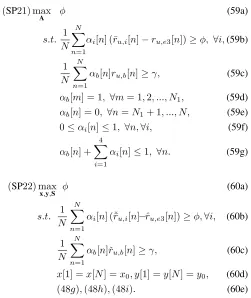
(SP21) max
A ϕ (59a)
s.t. 1 N
N
∑
n=1
αi[n] (¯ru,i[n]−ru,e3[n])≥ϕ, ∀i,(59b)
1 N
N
∑
n=1
αb[n]ru,b[n]≥γ, (59c)
αb[m] = 1, ∀m= 1,2, ..., N1, (59d) αb[n] = 0, ∀n=N1+ 1, ..., N, (59e) 0≤αi[n]≤1, ∀n,∀i, (59f)
αb[n] + 4
∑
i=1
αi[n]≤1, ∀n. (59g)
(SP22) max
x,y,S ϕ (60a)
s.t. 1 N
N
∑
n=1
αi[n] (ˇ¯ru,i[n]−ˆru,e3[n])≥ϕ,∀i, (60b)
1 N
N
∑
n=1
αb[n]ˇru,b[n]≥γ, (60c)
x[1] =x[N] =x0, y[1] =y[N] =y0, (60d) (48g),(48h),(48i). (60e)
Since the subproblems (SP21) and (SP22) above are both convex, they can be solved efficiently by using standard convex optimization tools. Then, similar iterative algorithm as Algorithm 1 can solve the subproblems (SP21) and (SP22) alternately until convergence. Therefore, we can obtain the optimal solutions of the problem (P2) accordingly.
V. SIMULATIONRESULTS ANDDISCUSSION
In this section, we provide numerical simulation results to demonstrate the performance of our proposed UAV re-laying network for secure transmission. We first take four typical users, i.e., I1 = {1}, I2 = {2}, I3 = {3}, and
I4 = {4}. Set the horizontal locations of the BS and the users are wb = (−1000m,0m), w1 = (500m,500m),w2= (500m,−500m), w3 = (1000m,0m), and w4 = (0m,0m) respectively. For simplicity, we assume that all the files have the same size equal to 150 Mbits, i.e.,Wi= 150Mbits,∀i. We also set γ= 3bit/s/Hz,β = 1bit/s/Hz and η = 0.75bit/s/Hz. In addition, we assume that the time allocated for the UAV obtaining files from the BS is half of the total period, i.e. N1ς = 0.5N ς. Unless stated, other parameters in the simula-tions are given in Table I.
In Fig. 2, we show the UAV trajectory for different schemes with we = (500m,0m). We adopt the elliptical trajectory (Scheme 1) and the linear trajectory (Scheme 2) as bench-marks, while our proposed scheme is named as Scheme 3. In Scheme 1 and Scheme 2, the time scheduling is optimized with given trajectory,T is set to be 200 s, andN= 200. In Scheme 3, we set T > V2L
max = 80s to guarantee the convergence of
UAV trajectory. From the results, we can see that the UAV can fly closer to each user to obtain better performance in our
TABLE I
PARAMETERS FOR THESIMULATIONS
UAV flight altitude H= 100m [4], [11]
UAV maximum speed Vmax= 50m/s [4], [11]
BS transmit power P1= 0.1W
UAV transmit power P2= 0.1W [4]
Noise power σ2=−110dBm [4]
Reference channel power ford0= 1m ρ0=−60dB [4] Power allocation coefficients θ1=θ2= 0.5
−1000 −800 −600 −400 −200 0 200 400 600 800 1000 −600
−400 −200 0 200 400 600
m
m
Scheme 3, T=200s
Scheme 3, T=140s
[image:10.612.52.303.70.368.2]Scheme 2 Scheme 1
Fig. 2. Comparison of UAV trajectory for different schemes and different
T, whenwe= (500m,0m).
proposed scheme, and the performance can be still improved with larger T.
According to the optimized scheduling and trajectory in Fig. 2, we compare the secrecy rate (SR) of the 2nd user and the 3rd user for different periodT and different schemes in Fig. 3 and Fig. 4, when the horizontal location of the eavesdropper is set towe= (500m,0m)andwe= (700m,0m), respectively. ς=2 s. From the results in Fig. 3, we can see that the secrecy rate of the 3rd user in our proposed scheme can be improved effectively with largerT, due to the optimization of trajectory and scheduling. For the 3rd user in Scheme 1 and Scheme 2, its secrecy rate is much lower than that in our proposed scheme. We can also see that the secrecy rate of the 2rd user is almost the same in these three schemes, and will be nearly unchanged with T. This is because the secrecy rate of the 1st and 2rd user can be mainly guaranteed via caching as we analyzed. In Fig. 4, the eavesdropper is set towe= (700m,0m), which is farther away from the 1st user and the 2nd user and closer from the 3 user. From the results, we can see that the secrecy rate of the 3rd user in our proposed scheme can be still improved by optimizing the trajectory and scheduling. However, the secrecy rate of the 3rd user in Scheme 1 and Scheme 2 cannot be guaranteed, which is even much lower than the 2rd user.
[image:10.612.315.558.73.363.2]150 200 250 300 350 400 450 500 0.5
0.6 0.7 0.8 0.9 1 1.1 1.2 1.3 1.4 1.5
T (s)
Secrecy Rate (bit/s/Hz)
SR of user 3,Scheme 3 SR of user 2,Scheme 3 SR of user 3,Scheme 2 SR of user 2,Scheme 2 SR of user 3,Scheme 1 SR of user 2,Scheme 1
Fig. 3. Secrecy rate comparison of the 2nd user and the 3rd user for different schemes and differentT, when the horizontal location of the eavesdropper is we= (500m,0m).
150 200 250 300 350 400 450 500
0.4 0.5 0.6 0.7 0.8 0.9 1 1.1
T (s)
Secrecy Rate (bit/s/Hz)
SR of user 3,Scheme 3 SR of user 2,Scheme 3 SR of user 3,Scheme 2 SR of user 2,Scheme 2 SR of user 3,Scheme 1 SR of user 2,Scheme 1
Fig. 4. Secrecy rate comparison of the 2nd user and the 3rd user for different schemes and differentT, when the horizontal location of the eavesdropper is we= (700m,0m).
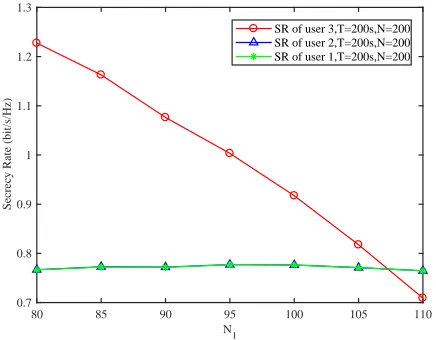
80 85 90 95 100 105 110
N
1
0.7 0.8 0.9 1 1.1 1.2 1.3
Secrecy Rate (bit/s/Hz)
[image:11.612.326.544.58.230.2]SR of user 3,T=200s,N=200 SR of user 2,T=200s,N=200 SR of user 1,T=200s,N=200
Fig. 5. Secrecy rate comparison of our proposed scheme with different number of time slotsN1 allocated for the UAV to obtain files from the BS, whenwe= (500m,0m).
0 5 10 15 20 25 30 35 40 45 50
Iteration Number 0.4
0.5 0.6 0.7 0.8 0.9 1 1.1 1.2 1.3
Secrecy Rate (bit/s/Hz)
[image:11.612.65.285.60.235.2]SR of user 3,T=200s,N=200,we=(700,0) SR of user 3,T=200s,N=200,we=(500,0)
Fig. 6. Secrecy rate convergence of the 3rd user in Algorithm 1, when
T = 200s andN= 200.
time slots will be allocated to the 3rd user to guarantee its security. For the 1st and 2nd users, the secrecy rate remains almost unchanged with differentN1, due to the fact that their security is mainly guaranteed via caching. On the other hand, we cannot set N1 too small, otherwise, the constraint (13d) cannot be satisfied. Thus, we can conclude thatN1 should be set as small as possible to achieve better performance, on the condition that the optimization problem can be solved.
The convergence of Algorithm 1 for our proposed scheme is shown in Fig. 6, when T = 200 s and N = 200. From the results, we can see that the proposed Algorithm 1 can be guaranteed to converge for bothwe= (700m,0m)andwe= (500m,0m)within about 5 iterations, which is consistent with the analysis in Proposition 1. In addition, recall that we only need to solve two convex problems in each iteration, and the computational complexity of Algorithm 1 is appropriate for practical applications.
[image:11.612.64.283.297.471.2] [image:11.612.64.282.535.705.2]−1000 −500 0 500 1000 −500
0 500
m
m
−1000 −500 0 500 1000 −500
0 500
m
m
−1000 −500 0 500 1000 −500
0 500
m
m
−1000 −500 0 500 1000 −500
0 500
m
m
−1000 0 1000 −500
0 500
m
m
−1000 −500 0 500 1000 −500
0 500
m
m
Case 1 Case 2
Case 3 Case 4
[image:12.612.51.298.56.252.2]Case 5 Case 6
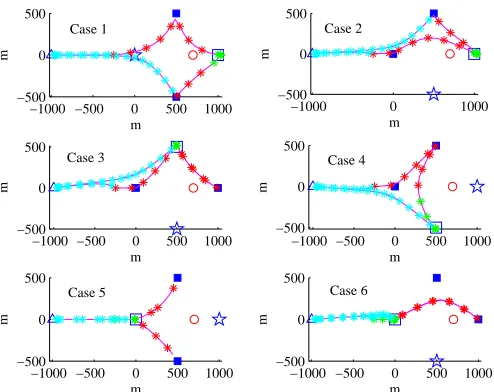
Fig. 7. Optimized trajectories for different cases. The BS is marked by blue ‘△’ and the eavesdropper is marked by red ‘⃝’. The user whose required file already exists in its local cache is marked by blue ’I’, the two cooperative caching users are marked by blue , and the user without cached file is marked by blue ‘’. The trajectory is sampled every 4 s and marked with ‘∗’. The sampled points marked by cyan ‘∗’ show that the UAV obtains files from the BS. The sampled points marked by red ‘∗’ indicate that the UAV broadcasts files to two cooperative caching users. The sampled points marked by green ‘∗’ mean that the UAV transmits file to the user without caching.
TABLE II
SECRECYRATE FOR THEUSERS INDIFFERENTCASES
SR (bit/s/Hz) User 1 User 2 User 3 User 4
Case 1 0.7765 0.7764 0.9078 ⋆
Case 2 0.8000 ⋆ 0.9994 0.8000
Case 3 1.3691 ⋆ 0.7962 0.7962
Case 4 0.8251 1.4556 ⋆ 0.8251
Case 5 0.8256 0.8256 ⋆ 1.4597
Case 6 0.7956 ⋆ 0.7956 1.5938
6 is farther away from the eavesdropper than the user in Case 1 and Case 2.
Furthermore, we consider a more general case with six users, which are randomly distributed. In the simulation, User 1 and User 2 have cached the files that are required for each other, User 3, User 4 and User 5 have no caching capability, and User 6 has already cached its required file, i.e., I1 = {1}, I2 = {2}, I3 = {3,4,5} and I4 = {6}. We aim to maximize the minimum secrecy rate of all the uncached users by jointly optimizing the UAV trajectory and time scheduling, with the secrecy rate of other caching users guaranteed. We set T = 200 s,N = 100,N1 = 40,γ = 3.5 bit/s/Hz,β = 0.7bit/s/Hz andη= 0.6bit/s/Hz. The optimized UAV trajectory is shown in in Fig. 8, and the secrecy rate of the users are presented in Table III. From the results, we can conclude that our proposed scheme can also be utilized in the general case of more users with reliable performance. Specifically, the minimum secrecy rate of all the uncached users can be optimized to be 0.607 bit/s/Hz, with the secrecy rate of cached users higher than η= 0.6 bit/s/Hz.
Finally, we consider the scenario in which no user has caching ability, and we maximize the minimum secrecy rate
−1000 −800 −600 −400 −200 0 200 400 600 800 −600
−400 −200 0 200 400 600
m
m
5
6
2
4 3 1
[image:12.612.329.549.375.401.2]
Fig. 8. Optimized UAV trajectory for the case of 6 users. The BS is marked by blue ‘△’ and the eavesdropper is marked by red ‘⃝’. The user with its required file cached is marked by blue ‘I’, the cooperated caching users are marked by blue ‘’, and the users without caching are marked by blue ‘’. Each trajectory is sampled each 2 s and marked with ‘∗’. The sampled points marked by cyan ‘∗’ show that the UAV obtains files from the BS. The points marked by red ‘∗’ indicate that the UAV broadcasts files to the cached users. The points marked by blue, mauve and green ‘∗’ show that the UAV transmits files to the uncached users 3, 4, and 5, respectively.
TABLE III
SECRECYRATE OF THECASE WITH6 USERS
SR (bit/s/Hz) User 1 User 2 User 3 User 4 User5
0.635 0.635 0.607 0.607 0.607
−1000 −800 −600 −400 −200 0 200 400 600 800 1000 −800
−600 −400 −200 0 200 400 600 800
m
m
t=134s t=164s
t=158s
[image:13.612.62.287.65.239.2]t=138s
Fig. 9. Optimized trajectory for maximizing the minimum secrecy rate over all users without caching. The BS is marked by blue ‘△’, the users are marked by blue ‘’ and the eavesdropper is marked by mauve ‘⃝’ when we = (500m,0m) or blue ‘⃝’ when we = (700m,0m). The mauve
curve is optimal UAV trajectory when we = (500m,0m), while the blue
curve is optimal UAV trajectory whenwe= (700m,0m). Each trajectory is
sampled every 2 s and marked with ‘∗’ or ’’. The sampled points marked by cyan ‘∗’ show that the UAV obtains files from the BS. The sampled points marked by red ‘∗’, mauve‘∗’, green ‘∗’ and yellow ‘∗’ indicate that the UAV transmits file to the 1st user, the 2nd user, the 3rd user and the 4th user when we = (500m,0m), respectively. Whenwe = (700m,0m), the marks ‘∗’
are replaced by ’’.
−1000 −800 −600 −400 −200 0 200 400 600 800 1000 −800
−600 −400 −200 0 200 400 600 800
m
m
t=118s t=170s
t=168s
t=116s
Fig. 10. Optimized trajectory for maximizing the minimum secrecy rate over all users with caching. The markers are similar to those in Fig. 9.
VI. CONCLUSIONS
In this paper, the security of UAV-relayed wireless networks with caching has been studied. In our proposed scheme, the UAV first obtains the files from the BS and then transmits them to the users. The users with caching capability can pre-cache some files during off-peak time. When two users have cached the file required by the other, the UAV can broadcast the files to them and disrupt the eavesdropping. For the users without caching, their security can be guaranteed by optimizing the UAV trajectory. Thus, we propose to maximize the minimum
TABLE IV
SECRECYRATE OF THEPROPOSED ANDBENCHMARKSCHEMES
SR (bit/s/Hz) User 1 User 2 User 3 User 4
Proposed Scheme 0.7765 0.7764 0.9078 ⋆
Benchmark Scheme 0.3908 0.3908 0.3908 0.3908
secrecy rate of the uncached users via jointly optimizing the UAV trajectory and time scheduling, with the performance requirement of caching users satisfied. The problem is non-convex, which is divided into two subproblems, and an it-erative algorithm is proposed to solve them alternately. In addition, we also consider the scenario in which no user is equipped with cache as a benchmark. Simulation results are finally presented to show the effectiveness and efficiency of the secure transmission in proposed UAV relaying systems with local caching.
REFERENCES
[1] Y. Zeng, R. Zhang, and T. J. Lim, “Wireless communications with unmanned aerial vehicles: opportunities and challenges,”IEEE Commun. Mag., vol. 54, no. 5, pp. 36–42, May 2016.
[2] A. A. Khuwaja, Y. Chen, N. Zhao, M.-S. Alouini, and P. Dobbins, “A survey of channel modeling for UAV communications,”IEEE Commun. Surv. Tuts., vol. 20, no. 4, pp. 2804–2821, 4th Quart. 2018.
[3] J. Lyu, Y. Zeng, R. Zhang, and T. J. Lim, “Placement optimization of UAV-mounted mobile base stations,”IEEE Commun.Lett., vol. 21, no. 3, pp. 604–607, Mar. 2017.
[4] Q. Wu, Y. Zeng, and R. Zhang, “Joint trajectory and communication design for multi-UAV enabled wireless networks,”IEEE Trans. Wireless Commun., vol. 17, no. 3, pp. 2109–2121, Mar. 2018.
[5] X. Liu, Z. Li, N. Zhao, W. Meng, G. Gui, Y. Chen, and F. Adachi, “Transceiver design and multi-hop D2D for UAV IoT coverage in disasters,” IEEE Internet Things J., Online, DOI: 10.1109/JIOT.2018.2877504.
[6] Y. Zeng, X. Xu, and R. Zhang, “Trajectory design for completion time minimization in UAV-enabled multicasting,”IEEE Trans. Wireless Commun., vol. 17, no. 4, pp. 2233–2246, Apr. 2018.
[7] N. Zhao, F. Cheng, F. R. Yu, J. Tang, Y. Chen, G. Gui, and H. Sari, “Caching UAV assisted secure transmission in hyper-dense networks based on interference alignment,”IEEE Trans. Commun., vol. 66, no. 5, pp. 2281–2294, May 2018.
[8] J. Lyu, Y. Zeng, and R. Zhang, “UAV-aided offloading for cellular hotspot,”IEEE Trans. Wireless Commun., vol. 17, no. 6, pp. 3988–4001, Jun. 2018.
[9] F. Cheng, S. Zhang, Z. Li, Y. Chen, N. Zhao, F. R. Yu, and V. C. M. Leung, “UAV trajectory optimization for data offloading at the edge of multiple cells,”IEEE Trans. Veh. Technol., vol. 67, no. 7, pp. 6732–6736, Jul. 2018.
[10] D. Yang, Q. Wu, Y. Zeng, and R. Zhang, “Energy tradeoff in ground-to-UAV communication via trajectory design,”IEEE Trans. Veh. Technol., vol. 67, no. 7, pp. 6721–6726, Jul. 2018.
[11] Y. Zeng, R. Zhang, and T. J. Lim, “Throughput maximization for UAV-enabled mobile relaying systems,”IEEE Trans.Commun., vol. 64, no. 12, pp. 4983–4996, Dec. 2016.
[12] S. Zeng, K. H. Zhang, and L. Song, “Uav relaying: Power allocation and trajectory optimization using decode-and-forward protocol,,” in Proc. IEEE ICC’18, pp. 1–6, Kansas City, MO, USA, May. 2018.
[13] S. Zhang, H. Zhang, Q. He, K. Bian, and L. Song, “Joint trajectory and power optimization for UAV relay networks,”IEEE Commun. Lett., vol. 22, no. 1, pp. 161–164, Jan. 2018.
[14] J. Li and Y. Han, “Optimal resource allocation for packet delay min-imization in multi-layer UAV networks,”IEEE Commun.Lett., vol. 21, no. 3, pp. 580–583, Mar. 2017.
[image:13.612.330.546.81.116.2]