ICROKIT
Theone
microcomputer
that tackles
every job
product development
data processing
dedicated control
MICROKIT Universal Systems are available for the most popular micro-processors-8080, 6800 and Z-80. All of these systems are designed specifically to handle a wide variety of applications and are being used as powerful microcomputer develop-ment systems, general purpose data processing systems and dedicated controllers.
MICROKIT MICROCOMPUTER
S'r'STEMS
~lICROKIT
INC.
1
1205S. La CieneGa Blvd.
Los RnGelesl CR 90045
TABLE OF CONTENTS
1.0 MICROKIT-S/:16 --- Univer'sal frticrocomPlJter Development. 5'y·stems for the S8S8 and the 6S08 . . . . . . . . :1 .:1
I
n-CirclJi tM
I
CROEMULRTOR5 . . . . . 1.2 Tape and Disk 5'y·st.ems . . . . :1.3 Tape OperatinG 5,··st.em 50rt.(~al"e . :1.4 QUICKRUN Memory Resident SYstem:1.5 fotICROKI T Disk Oper·at.inG 5'(st.em Sort.(~are . :1. 6 MICROKIT-S/16 5t.andard Feat.ur·es . . . :1.7 MICROKIT Handles Many Rpplications . .
2.8 MICROKIT Tape OperatinG 5ystem
2.:1 fr1T05 DebuG Ger ... ·'Moni t.or' 2.2 MT05 Editor
2. 3 frlTOS Assembler . . . . 2.4 MTOS Utility . . . .
3.8 t,:;/UICKRUN fotemor'y· Resident. Operat.inG 5,··st.em
1-1 1-1 1-1 1-1 1-2 1-2 1-2 1-3 2-1 2-1 2-3 2-5 2-6 3-1
3.:1 Instantaneous P""'OGram Development . . . . 3-1 3.2 fotemorv is l.Jr·i t·e Prot.ect.ed . . . • . 3-1 3.3 QUICKRUN l1emory ReQuirements . . . . 3-2
3.4 QUICKRUN frlonitor .. Editor .. and Rssembler. 3-2 3.5 ProGram Development. UsinG t'JUICKRUN. . 3-2
4.8 frlICROKIT Disk Oper·at.inG S'y'stem .
4.1 Diskette Format. . . . . 4.2 P,....·oGram Development. UsinG 11005 4.3 HODS Files • . . . .
4.4 Transfer'rinG between 5vst·em Functions 4,5 HODS Honi t.or . • •
4.6 HODS Editor
4.7 11005 Rssembler . • 4.8 HODS DebUGGer 4.9 11005 Ut.ilit.y
5.8 t1ICROEt1ULRTOR In-Circui
t.
EfiJulator . . . . • . 5-1 5.1 Basic Operat.ion of t.he t1ICROEt1ULRTOR. • . . . 5-25.2
t1ICROEt1ULRTOR DebuG Commands . • • .5-3
6.8 System Speci ficat.ions . . . . . 6-1
6.:1 Standard MICROKIT S",'st.em ConfiGuration 6-1
6.2 f>lICRODISK Floppy Disk Unit.s . . 6.3 MICROPRINT Line Print·er . . . . 6.4 Tabtllar S""'stem Specificat.ions .
7. 0 I>1odlile Speci ficat.ions 7.:1. 8888 CPU . . • . .
7. 2 8K RRM Memory . . . . . 7.3 CRT-Ke'..-board Interface 7.4 Tape-EIR Interface
8. tl f>1 I CROK IT l.Jord Pr'ocessor' . . .
6-2 6-2 6-4 7-1
-'.
<
MICROKIT UNIVERSRL DEVELOPMENT SYSTEM
:1..0 NICROKIT-S/:1.6 --- UNIVERSRL MICROCOMPUTER DE\"ELOPMENT 5'r'STEN FOR BOTH THE 8080 RND THE 6880
Tile MICROKIT-S/:1.6 is a complet.e st.and-alone development. syst.em for·
,,'r i tinG.. debuGGinG.. and execut.inG prOGj""ams on t.he 8080 or t.he 6800 micropr"ocessors. The syst.em can be order'ed as an 8t.180 based
system or a 6800 based s)'st.em. C'::rnve,... .. sion packaGes consistinG of
a plUG-in processor module and sot"t.(,Iar'e ar'e available so t.hat. ei t.her system can be swi t.ched t.o handle t.he ot.he, ... pi'"'·ocessor·.
:1..:1. IN-CIRCUIT f"ICROEMULRTOR5
Rny microcomput.er system used for product development must. have an in-circuit. emulator. The MICROKIT MICROEMULRTOR p, ... ovides for·
in-circui t emulation and EPROl'l prOG' ... ammimi all in one lo(.,1-cost. packaGe. The MICROEMULRTOR also provides a nwnbe, ... of addit.ional debUGGinG aids includinG sinGle-st.ep execut.ion.. t.,. .... ace e:":ecl~t.ion .. Ilar'd",'are breakpoint.s ... and soft,,'are br·eakpoints.
:1..2 TRPE RND DISK S'r'STEI'1S CO",E COl'1PLETE NITH CRT DISPLRy'
The standard I'1ICROKIT S)··st.em comes complet.e (,Ii Ut an SK memo," .. y.· an alphanume, ... ic CRT display .. an RSCI I ke',.-boar·d.. t.(,IO casset.t.e t.ape units .. and software.
Tile I'1ICROKIT CRT display ",'Ilich comes st.andard (,Iit.h eve, ... ,.. syst.em holds 960 character's t"ormat t.ed as 24 lines of 40 charact.ers. Since t.he display is refreshed directl)' from the microcomput.e, ... memot""r'.' t.he full 968 cl1aract.er screen can be (,Iri t.ten at 28 .. 088 cps.
The casset.te t.ape unit.s are st·andard 10I.\I-cost. audio l ... ecorde, ... s.
Because of' I'1ICROKIT.I's proprietarY recor"dinG t.eci'lniQue .. dat.a is t.ransferred t.o the alldio casset. t.e uni t.s at. t.he rat.e of 2880 bps with data reliability eQuivalent. t.o diGital casset.t.e units.
Two t.),pes of' floppy disk unit.s ar'e available as opt.ional
peripherals. The I'1ICRODISK/2 is a standard dual drive floppy disk lmi t . This lmi t pr'ovides 588K byt.es of hiGh-speed data on-line.
The MICRODISK/21'1 incorporates t.""O minifloppy drives and provides :1.6BK byt.es ot" data.
:1..3 TRPE OPERRTING SYSTEM SOFTNRRE
The MICROKIT Tape OperatinG Syst.em software includes a
/'1ICROKIT UNIVERSRL DEVELOPMENT SYSTEM
hiGh-speed CRT display and the tape I/O.
UsinG the fast CRT t.he int.eract.ive debuGGinG prOGram Gene, .... ates full screen hexadecimal memor)"' dump displays inst.ant.aneousl y. This kind
of
Quick system response speeds the debUGGinG t.ask.The MICROKIT Editor also makes use or the rast. CRT display. The screen based edi tor is Quickl y lear'ned and easy'
to
llse.- because chanGes are displayed inst.ant.l y and in full cont.ext. on the CRT.:1.4 QUICKRUN "'EMOR~' RESIDENT OPERRTING S~'STEM
The QUICKRUN system is an exclusive MICROKIT sort.("are system that provides the debl/GGer.- edit.or and assembler all co-r·esident. in memory at. once. Since t.he operatinG sYst.emsortware .. tJ1e source
Pf"OGr'am.- and t.he obJect. code at"e all in memorv I t.he llser is able
to instantaneouslv switch from editinG
to
assemblinGto
debUGGinG. Virtuall vall I/O is eliminat.ed durinG t.he development. processes exceptfor
initial loadinG and final dumpinGof
data t.o tape.Because evervt.hinG is in memorY', QUICKRUN is e'-..Ien fast.er than disk ror prOGrams or UP to :1088 statement.s t.hat fi
t.
int.o t.he memory work area.:1.5 MICROKIT DISK OPERRTING SYSTEM SOFTURRE
The MICROKIT Disk Operat.inG 5yst·em adds t.he speed and ver·sat.ilit..,' or the MICRODISK/2 and MICRODISK/2M rloPPY disk st.oraGe units t.o t.he MICROKIT-S/:16 sy·st.em. The Disk OperatinG 5..,'st.em is a
sophisticated piece or sort.ware t.hat. provides tull disk data manaGement. facilities.
:1..6 MICROKIT-S/:1.6 STRNDRRD FERTURES
The MICROKIT-S/:16 incorporates a nwnbef" ot standard feat.ures.- some ot which are lmiQue amonG microcomput.er s'y·st.ems:
*
8K byt.es or RRM memor..,' -- expandable t.o 4SK b .. ,.-t.es.*
Memory ,,'ri t.e prot.ect. ("here each :1.K paGe or memory can be write p, .... ot.ect.ed llnder sort.waf"e cont.rol.*
968 character CRT displav refreshed from syst.em memor)··.*
53 kev RSCI I keY'board with 2-ke'( roll ovet".*
Two audio cassette t.ape units .. full..,' suPPorted b)' the soft.ware.MICROKIT UNIJ,.'ERSRL DEVELOPMENT S~'STEM
*
R crystal controlled proGrammable real-t.ime clock t...1i t.h 32 microsecond resoll/t.ion.*
8-level vect.ored int.errupt..*
Boot.st.rap loade,..· in PROM.*
Two EIR RS-232C sei''''ial interfaces - one for modem .. one for t.eleprinter.*
1 meGabyt.e/second DMR capabili t.~..
*
Six ext.,...·a card slot.sfor cl/st.om
int.erf aces.1.7 THE MICROKIT SYSTEM IS UELL SUITED FOR MRNY RPPLICRTIONS
Uit.h all
of
t.he st.andard feat.w"es .. as t...lell as t.he lonG list.of
optional enhanceMent'SI t.he I1ICROKIT s~'stem is an excellent. choice as
a
microcoMPuter development. syst.em.However I t.his is not it.s onl)' application.
It.
is ideal for man')" dat.a processinG applications especiall')"' t.hose t,Ihich can make effective USEt of t.he 10t...I-cost. tape media or t.he mini f 10PP)" media.In a
barebones for .. ltb the MICROI::.'IT syst.em is also perfect. for matn'micro-control applicat.ions. Rn)'
of
t.he low-cost. peripherals can be selectedfot..
addi tiont.o
the barebones systemt.o
make a",.Ie,·"y
MICROKIT TRPE OPERRTING SYSTEM (MTOS)
2.0 MICROKIT TRPE OPERRTING SYSTEM
The MICROKIT Tape Opel"atinG SYstem (MTOS'> comes wi tI, rour sortware support proGrams:
a
DebuGGer/Moni tor.. an Edi tor., an Rssembler Jand
a
Utilit
Y prOGram. The prOGrams all run directl,·· on theMICROKIT-S/16.. are supplied on cassette tapes.. and load in 38
to
58 seconds.
2.1 TRPE OPERRTING SYSTEM DEBUGGER/MONITOR
*
Loads and dumps prOGrams on cassette tape.*
DebuGGinG commands display and store memory.. set and clear breakpoints., display and set contents or ,..'eGisters.*
Executes prOGrams in memory.*
Handles breakpoint interrupt.s so prOGrams can be interr'upted and restarted.*
Sets and resets memory protect boundaries.*
Tape .. EIR" CRT and Ke,~board I/O drivers.The MICROKIT Monitor is loaded rrom tape int.o bytes or memory by the PROM bootstrap loader. wri te protect.ed so that the Irfoni tor cannot be clobbered by
a
user prOGram.the hiGh or-del" 5K The memor \" is t.hen accidentally
When t.he Monitor is in cantral, a displa," is Generated on the CRT which shows the contents or memor'l" in he.~·adecimal ror·m. Each display shows :1..68 b'y·t.es or memor,··. When prOGram execution is interrupted by
a
st.ored breakpoint inst.ructionor by
the BRERK keY"t.he
Monitor stol"es and displaysthe
CPU status (reGist.e,"'s and rlaG bits). Stat.us can be reloaded., and execution can becontinued rrom t.he point or inter'ruption. Listed belo(\l is a summary or Irfonitor commands:
o
t1 D +mo
-m
D
*
CTRL R REPT
CTRL B REPT
En
Displa," memol"'y' around locat.ion "n".
Rdvance the display by
"m"
bytes.Back-up the displa'l by "m" bytes.
Display indirect ..
Scroll ahead t.hrouGh memory.
Scroll back thrOUGh memory.
Store data byt.es lid" (entered in hexadecimal.> startinG
at the
current display locat.ion.M I CROK IT
ASSEMBLER
DISPLAY
2-2
MICROKIT
EDITOR
DISPLAY
MICROKIT TAPE OPERATING S'r'STEf'1 (MTOS)
L W
n .• m
Z , ... =d
x
F d .. d} . ..
8 Sn
8 Dn
B R
8 C
Load a p,''''OGu''''am f, .... om t.ape into memory.
W, .... i t.e a p, .... OGram st.art.inG at. location "n" and endinG
at
"m" onto cassette tape.Set. reGiste,.... ",..." t.o ... altJe "d". ReGist.e, .... s are loaded prior
to
beGinninG execut.ion by the "E"command.
S""i tch "", .... i t.e pr·otect. st.at.us of t.he displ.an·ed memo,''''Y paGe.
Find data in memory.
Set. b, .... eakpoint.. Fou,'" aj-"'e available .. specified by
"n".
Display breakpoint "n".
Reset breakpoint.
Clear all breakpoint.s.
A breakpoint can be set in a prOGram by st.orinG a he:x:adecimal byte
"FF"} 0;-'" b..,·· usinG t.he "8" command {"hich saves the dat.a ,''''eplaced by
the "FF". Uhen execut.ed} the stored "FF" instruction , .... et.urns
to
t.he Moni t.or'
f·o,....
debtJGGinG and saves all t.he CPU r·eGist.e, ... sfo, ....
displa'l.The Monitor also p,''''ovides seve,''''al tJseful I/O se, .... vice sub,"'otJtines. These include dril,..'ers for cassette taF'e 1 .... ·0 .. EIA I/O .. and
CRT-keyboard I/O.
2.2 TAPE OPERATING SYSTEM EDITOR
*
Allot"s tJser t.o edit SH,)bolic data ent.ered from ke..,.·board or casset.t.e tape.*
CRT based.. line o, .... ient.ed edi t.or.*
St.r inG searchinG command.*
Cha, ... act.er· and line insert ... ···,' ... eplace/delete commands.*
Set.table tab stops.The MICROKIT Edito,'''' provides. a means fo,'''' c,''''eat.inG and updatinG source data stored on casset. t.e tapes. Un de,'''' cont.rol of the MICROKIT user} dat.a
to
be edit·ed is ,''''ead f'rom t.ape0,· ...
keyboard int.o a work area in t.he mic, .... ocomPtJt.er memory. Data in this {,Iork area is displa""'ed Otl the CRT, and can be modified by int.eractiveMICROKIT TRPE OPERRTING SYSTEM (MTOS)
memory onto
a
second tape. The work area holds about 288 linesat
a time in the basic 8K system. LarGer prOGrams are edited by repeat.inG the above process., workinG on one seGment at a time.
There is no inherent limit
to
prOGram size.The Edi t·or will automaticall )"' confiGure the work area fo,.... syst.ems wi th memories larGer that. SK. Each addi tional 8K available
provides space (or an additional 558 lines
of
data.The CRT display shows
21
data lines. The line in the centerof
the screen separated by horizont.al bars is t.he line
to
be edi t.ed. Ten lines before and ten lines aft.er are displayed for context.. R summar)"'of
the Line Edi tor commands are as (ollo(o.Is:R n
CTRL R REPT
B n
CTRL B REPT
DEL n
x
I
F "'strinG'"
L
U N E REU CLRT
n .. n., ...
DurinG line edit:
SP (space)
TRB
Rdvance the display "n" lines.
Scroll ahead.
Back' UP the display "n" lines. Scroll back.
Delete "n" lines.
Edi
t
t.he cent.er line.BeGin insertinG lines.
Search (or "st.rinG If.
Load memory (olork area from t.ape.
Uri te memor'l' wo,... .. k area
to
tape.Urit.e t.hen load.
Rel.\lind input.
Clear work area.
Set. tab st.ops.
Move cursor riGht.
Move cursor t.o next. t.ab.
MICROKIT TAPE OPERRTING S~'STEM (MTOS)
Back-space Move cursor back.
CTRL X Clear line for' ",·e-ent.r·Y.
1
Insert. char .. act.ei"s.D Delet.e charact.ers.
R
RETURN
Replace characters.
Exi t. fr'om edi t.inG .
2.3 TRPE OPERATING S~'STEM ASSEI'1BLER
*
St.andard s",..mbolic assembler"s l../sinG 1 nt.el 8888 mnemonics or'Mot.orola 6888 mnemonics.
*
Inputfrom
casset.t.e t.ape.*
ListinG to CRT.. or' pr·int.e,.. ....*
Ob ... iect to tape or' dir·ect.l y t.o memo, ... ,...*
Assembler can Gene",-·at.e list.inG t.o CRT., list.inG to print.er .. obJect t.o t.ape., and ob .. ..iect. t.o memo, ... ..,·· sinwl t.aneol../sl..,·· dur'inG pass 2.The f1ICROI\'I T Assemble,.. ... Generat.es ob . ..iect. prOGrams (i. e .. , binary data which is loadable and execl.Jt.able b..,- t.he microcomput.er'> ', ... om a sow"'ce p,.."'OGram (\'ri t. t.en in ~n'mbolic assembl..,·· lanGI.JaGe. This
prOGram is prepa, ... ed b..,·· t.he I'1ICROKIT Edit.or. The As:sembler
processes t.he t.he sow"ce prOG/ ... am in t.(\IO passes. Dur'inG the , i, .... st
pass the Rssembler reads t.he source t.ape and Generates a symbol
t.able (\Ihich is kept. in memory. Dlu"'inG pass 2.. t.he Rssembler uses t.he symbol table and converts the symbolic instructions into
bina, ... ..,.· data.
DurinG pass 2 a number of Rssembler options ar'e available as
follo(,Is:
L
T
P
Bn
E
o
Generate
a
list.inG on the CRT display.Gene,.. ... at.e a list.inG on t.he CRT displa..,·· t.runcat.ed t.o 48 charact.ers.
Print a list.inG on Ule MICROKIT line pr·int.er.
Select. Baud rate and output. list.inG
t.o
a p,.. ... intinGt.erminal connect.ed via EIR port 1.
MICROI<:IT TRPE OPERRTING SYSTEM (,.,TOS.>
Th~ ass~mbl 'Y' lanGtujG~ its~lf includ~s a compl~t~ s~t.
of
f'eat.Uf"~s.Const.ants ma)~ b~ s'Y·mbolic .. hexad~cimal .• d~cimal .•
or
RSCII J and~xpr~ssiot1s arE> allowE>d usinG plus and mintls. Tile RssE>mbler
allo("s free
fornlat
st.at.E>ments .. i. E>. fieldsof
t,h~ stat.ement.s ma)" be sE>parat.E>d b'y' oneor
more blanks.In addi t.ion
to
allof
t.he st.andard micr·ocomputer inst.ruct.ions.. t.he RssemblE>r provides t.hE> follo(,IinG tlsE>ful pseudo inst.,.. .. t/ct.ions:ORG RE>oriGin t.he locat.ion count.er.
EQU EQuat.E> a s)"mbol t.o t.lle value
of
an expression.DC Define const.ant.s - one b',.-t.e.. t.(,IO byt.e .• hiGh byt.e .. or 10(,/
b)~t.e .
DS Reserve st.oraGe space.
END End
of
input ..SPC Blank line in list.inG.
EJE SIc.:ip t.o t.op
of
next. paGe in list.inG.2.4 M[CROKIT TRPE OPERRTING SYSTEM UTILITY
The Ut.ilit.)~ prOG,.. .. am Pt'ovides and eas)" (,Ja)" t.o cOP't~ t.apes Generat.ed by t.he Edi t.or.. and ob .. iect. t.apes Generat.ed b),' t.he Rssenlbler and Moni t.or .
The Ut.ili
t. ).,
prOGram i tsel f is available in sotlrce form. Since t.he Ut.ilit. ).,
prOGram is desiGned in a modlllar..for·ft)
it. is possibleto
add drivers
fo, ....
1/0to
devices ot.her t.han t.ape. This allo("s t.ranst"'ers bet.("een casset.t.E> t.ape and ot.her devices such as print.ers .. paper-t.ape readers .. paper t.ape ptmches .. etc.MICROKIT TRPE OPERRTING S'r'STEM (MTOS)
SRMPLE RSSEMBL'r' LISTING GENERR TED
B'r'M
I CROK
ITRSSEf'1BLER:
MICROKIT RSSEf"BLER -- VER
2.0
****************************************
:It ".
*
BUBBLE SORT
*
".
*
****************************************
... 100t1
ORG g'·:108'·
ORIGIN RT :100
B1B0
31t100:1
ENTR'r' LXI SP .. X"'100·' SET STRCK PTR
0103 0EFF
MVI
C ..
2SS
INIT LOOP CTR
0105 2100l:t2
LXI H .. .'x:'·200··· RRER TO BE SORTED
8108 71
ILOOP MOV
M~C0189 23
INX H
t1eR
00
OCR
C
0108 Cl8BS1
JNZ
ILOOP
8:1.0£ 2688
MVI
H .. g"'288'"
8110 0EFF
MVl
C .. 2SS
8:1.12 7E
SORT
MOV R .. M
OUTER LOOP
0113 £5
PUSH H
SRVE RDOR
0114
41MOV B .. C
INIT INNER LOOP
0115 BE
SORTL
CMP M
COMPRRE
0116 DR1C01
JC
SORT1
8119 56
MOV D .. M
XCHG DRTR WITH HEM
811R 77
MOV M
.. R
811B 7R
Mall RID
011C 23
SORT1
INX H
INCR RDDRESS
B11D 05
DCR B
DECR LOOP CTR
8:1.:1.E C2:1.581
JNZ SORTL
0121 E1
POP H
END
OF INNER LOOP
8122 77
MOV MIR
STORE DRTR
B123 23
INX H
INCR RDDRESS
8124 0D
DCR
C
DEeR LOOP CTR
0125 C212l11
JNZ SORT
0128 76
HLT
DONE
QUICKRUN MEMORY RESIDENT OPERRTING S'r'STEM
3.
a
QUICKRUN --- MEI'tOR'r' RESIDENT OPERRTING S'r'STEf'tQUICKRUN is a complet.e "in memor'Y" oper·at.inG syst.em fo,...· developinG S0S0 or 6880 microcofilPut.e,·" pr'OGrams usinG t.he M I CROK IT -S/16.
QUICKRUN provides a prOGram develoPfilent. t.ool unmat.ched by any
other soft(\Iat'e de I, ... e 1 oPtllen t. s)~st.em. It. consist·s of a
fIloni t.o;-"/deblJGGe;-"., edi t.o,'" and assefllble,'" all co-resident in fIlefllor-"Y alonG (\Ii t.l1
a
14K b~··te SOlw'ce code (,.Io/"kspace and 4K byte ob . ..iect. code work space. This is sufficient. t.o st.o,. .... e a 100tl line sour'ce PI""'OG;-"am.3.:1. INSTANTANEOUS PRO GAM DE\lELOPf'1ENT
Since t.he s'y'stem soft.(\Ia;-"e., the sour'ce PI"OGr'am and the ob ... iect. code are sifllul taneousl y in memory ~ t.he user is able t.o inst.ant.aneolJsl y sl.!.Ii tch f'rom edi tinG t.o assemblinG to debuGGinG. This f acili t.ates rapid proG,'-'amminG development because chanGes al"e made direct.l )., in
t.he sow"ce p,'''OGram. Then t.he prOGram is r'e-assembled .and is i""ead~" for test.inG in
a
mat. t.e,.-' of seconds.Once t.he t=1UICKRUN softt..lare is loaded} and once t.he sow"ce p,'··OGt'am is loaded at the beGinninG of a de".'elopment. session., no fur't.he,'" I/O is ,..'el~uir'ed. Fo,'" the usual application (\Ihere t.he SOl-wce
prOGrafil will fi t int.o t.he :1.088 stat.ement fIlemory (\Ior·k a,''''ea.' pr'OGram de ... eloPfilent. is even fast.er t.han disk based syst.ems.
3.2 MEMOR'r' IS URI TE PROTECTED
QUICKRUN makes lIse of the f'1ICROKIT s~··st.em"'s unir..~ue 8K ~:Af't memo,· ... '·· boa,'-'ds (IIi t.h (\Iri te pi""'ot.ect.ion r·eGist.er·s. This allo(\Is eack 1K paGe
of memo,"y t.o be individlJall 'y' protect.ed and w-,p,''''ot.ect.ed under
prOGram control. loJi thout this feat.ure., t.he user' could
inadver'tent.l )., "clobber-"" his sow"ce p,"'OGr·am dur'inG e.x:ecut.ion and destroY hours of IAlo, .... k.
Non-volat.ile storaGe of debl/GGed prOGrams
<'
SO'-J, .... ce and ob . ..iect.,) is p;-"ovided by the f'tICROKIT-S/:1.6 syst.em casset.te tape '-mits. LoadinG and dWIlPinG t.o casset.t.e tape takes less t.han 3 mim./t.es and isusuall)' done onl ~., once per' session. Thus aUICKRUN provides t.he
mic,"'ocotnPl./ter p,· .. OG,· ... ammer I.I.Ii t.h t.ools t.hat (\Ier'e previol./sl )., available onl Y on t.he larGest of compute,'" sYstems., and m.akes the
QUICKRUN MEMOR'r' RESIDENT OPERRTING S'r'5TEM
3.3 QUICKRUN MEMOR'r' REQUIREMENTS
The QUICKRUN Operat.inG System re6wir'es 32K of microcomput.er memorv. User prOG1"amS can occupy t.he first. 4K of memorv.' from 8888 to I3FFF, The syst.em soft,(,'are.. edi t.or (,Ior·k area.. and
assembler symbol table OCCt/PY t.he reGion f'rom 100f:.l to 7FFF.
3.4 QUICKRUN DEBUGGER/MONITOR .. EDITOR .. RND RSSE,.1BLER
The QUICKRUN Memor'r' Resident Oper'at.inG 5yst.em uses t.he st.andard f1ICROKIT edit.or .. asselubler and debt.tGGer· ... monit.or p,""OGrams wit.h
a
series of enhancff'ment.s.
Th,""eff' s\~st.em commands ha ... e beff'n added t.o all p,... .. OGrams. These allo(,1 t.he user t.o s(o.li t.ch bff't.wff'en t.he t.hrff'e s)··st.em p,""OGrams: Edi t.or.. Rssff'mblff',"" and Moni t.or. Tf1e'r' arff':
JR - Jt/mp t.o t.he Rssembler
Jf1 - Jump t.o the Moni t.or/Dff'buGGer JE - Jump to Editor
The Rssemblff'r prOG,,"am di ffers from t.he st.andard tape assembler in t.hat i t ordinaril)" t.akes its input. from the editor (!lork area .. and places t.he ob .. ..iect dat.a direct.l'l·· in memor)~. Ho(,Iff'ver .. it. can
assff'mble from tapff' as ("ff'll.. and it. can Gener·at.e ob .. ,iect. tapff'S t.oo.
The DebuGGe, .... prOGram has one siGnificant. enhancement over the standard DebuGGer.· ... ,.1oni t.or. Values of' s)"mbols in t.he assembler s)~mbol t.able can bff' refff', .... enced b'r' t.heir s)"mbolic name. For example .. if'
a
prOGram . .Just. assemblff'd hasa
symbol "LOOP" in it. .. t.he dff'buGGe,'" command liD #LOOP" (,till move t.he display t.o t.hff' memory locat.ion assiGned t.o t.hff' symbol by t.hff' assff'mbler. Each t.ime t.he prOG ... am is rff'assembled.. t.he s",..mbol table value (,Iill beatJt.omaticall y t./pdat.ed t.o t·he net,' symbolic values.
:3.5 PROGRR,.1 DEVELOPfo1ENT USING QUICKRUN
The prOGr'am del,lff'lopment. process t./sinG QUICKRUN beGins by loadinG the aUICKRUN S)··st.ff'm t .. rom t.ape. Cont,,,"ol is t.ransf'ff'I .. , .... ed to t.he Edi t.or· usinG the "J E" command. I f' the prOGr-3m t.o be t.ff'st.ed is al. .... ead..,·· on tape.. t.he source t.apff' is loaded b),' t.he Edi t.OI"'.
Ot.her(,tisff' t.he prOGram is ent.ered from t.he ke",.-board.
Once i.he prOGram is in t.he Edit.or (,I01"k area and has beff't1 modified .. it. is read)' for assembl )., and f.est.inG. The Rssembler is invoked b"" t.he "J A" command. J·Jhile matn' assembl'r' paramet.ers cu"e available ..
if no paramete ... s are specified for the assembly .. t.he QUICKRUN
assembler' (,Iill ,"'ead t.l1ff' Pl"OGram in t.he Edito,'" (!lork area .. and place
QUICKRUN MEMOR',' RESIDENT OPERRTING S'r'STEM
the obJect code directl y in memory. Rn assembl \"' t...ill t.ake from 1
to
15 seconds dependinG upon t.he lenGth of' the source pr'OGram. RprOGram of' abol/t. 1888 statements will take about 15 seconds t.o
assemble.
I f' an\"' S\"ntax er,"'ors are detect.edJ a messaGe (,till indicat.e t.his
at
the end of the assembl \~ . When e, ... rors are e:)!,·pect.ed i t is a Good
idea t.o reQuest. the etY'or onl \., displa)" on t.he CRT by the "E"
opt.ion. Then error lines will appea;~ and can be cOi .... ,"·ect.ed in the Edi tor b\"' doinG
a
"J £".Once the p,"'OGram is assembled, t.estinG can beGin. The DebUGGer is
called usinG t.he "J M" command. The l/ser p,''''OGram can then be execut.ed usinG t.he "E" command. The full ranGe of debUGGinG commands a, .... e available
t.o
t.rack do(,1f') any bl/GS.When chanGes are
to
be made, it. is easiest.to
j''''et.urnt.o
the Editorrat.her· than patchinG in hexadecimal. l.Jhen chanGes are made
direct.l)~ in t.he source prOGr'am.' i t can be reassembled and read),' for t.est.inG in a mat. tel' ot'" seconds.
Onl"{ act.ual usaGe of t.he MICROKIT QUICKRUN syst.em I.o.lill communicate the real speed and po(,ler of t.his lmi ... ':?ue prOGram development.
MICRO/( lTD I S/( OPERRT I NG S'r'STEM (MDOS)
4. 8 ,..,1 CROK ITO 15K OPERRT 1 NG S~'STE/l1 (' MOOS .>
The 111CROKI T Disk Operat.inG S)"stem (' MOOS'> adds t.he speed and versat.ilit.)·· of t.he NICROOISK/Z or t.he MICR001SK/Zf" flopp)·· disk
storaGe uni ts and
a
sophist.icated disk operatinG system t.o theMICROKIT-S/16 f'1icr·ocomPl/t.er .. Del,lelopment. S)··st.em.
Uith I1DOS the I1ICROk'IT l/ser is able t.o edi
t.
and assemble la,... .. Ge p,.-·OGrams 16 t.imes fast.er t.hat. (\Iit.h t.he t.ape based s)··stem .. and 168 times fast.er than TT'r' based syst.ems. The flopp ... disk mediacombined wi t.1l t.he unil.~ue scr'een based edi t.o,... int.e, ... act.ive
debuGGe,... .... hiGh-speed assembler .. and opt.ional in-circlli t. emulat.or makes t.he /If ICROKI T -8.····16 t.he most po(,lerfl.11 microcomPl/t.er
development. system available.
MDOS has a number' of siGnificant. desiGn feat.ures (\Ihicl-, make it. one
of t.he most flexible and po(,lerful disk opei"'at.inG systems available on any microcomPl-lt.e,... s'Y·st.em. These feat.ures a~"'e:
*
Variable size files.*
Rllocat.ion b),' t., ... acks.*
Files can be (o,/i"'i te prot.ected.*
Files can be pe, ... manent. so U-,e'{ can ...t.
be accident.all y delet.ed.*
Files can expand even aft.er· fillinG ini t.ial a110cat.ion.*
Unused space can be released from files.*
Loade,... .. in EPROn allo(o,ls I, ... irt.uall y all of memory to be loaded from disket.t.e.*
Disk 1/0 can be overlapped (,Ii t.h processo~'" execution.*
Ent.ire disket.t.e can be copied in :3 minut.es.*
Dat.a can be loaded int.o memo,... ... at. the rat.e of 3848 b)··tes per· second.*
32K b)··tes of memor)" can be loaded in less than 18 seconds.*
R 2888 line p, ... OGram can be j""'ead by t.he Edi t.o,... in less t.han itt seconds.*
R 2888 line prOGt"'am can be assembled in less than 45 seconds.*
Diskette files can be copiedt.o
and from casset.t.e t.ape.*
Easy t.ransfet'" from one S)··st.em funct.ion t.o anot.ller·.*
Rl1 dat.a manaGement. fllnct.ions ar·e callable from lIserprOGrams.
*
User can easil y add new fl-lnct.ions to t.he syst.em.*
Disket.t.es are formatted so t.hat. 5 sect·oj""'s can be read pe, ... revoilition .. or .38 sect.ors pe~'" second.*
Rutomat.ic CRC test and e, .. ...,...·or , ... ecove, ... )··.*
1BI1 coft)pat.ible media.4.1 DISKETTE FORI'1RT
Each disket.t.e has 77 t.racks .. t.he first. of (,Ihich is , ... eserved by
I1ICROKIT DISK OPERRTING S'r'STEM Ow/DOS)
maximum of 76 tracks is available for user files.
Each tr'ack has a capacit.., .. of 26 sectors" which are 128 b..,··tes in
lenGth. This makes the capacib·· of a t.rack 3328 byt.es .. and the capaci t . ..,.. of the disket te 252 .• 928 b '..-tes . Since none of this space is reQuired for system data .. i t is all available fo, ... user data. Space for files lltlder the MOOS s","st.en) is reser'ved in mult.iples of
tracks. That is.. the smallest amount of disk space t.hat. can be allocat.ed
t.o a
file is onet.rack. ConseGwentl..,.· there can bea
maximum of 76 riles per diskette. In the other' ext.,..-eme .• tile
maximum amount of space that. can be allocated t.o a sinGle file is the full 76 tracks of available space.
4. 2
USING THE MDOS S'r'STEM FOR PROGRRf" OEVELOPMENTThe t1ICROKIT Disk OperatinG System provides all or the sortt..,are tools necessary for tile ,..'apid development of larGe microcomput.#r prOGrams. The MOOS syst.em is composed of four- IIlaJor- functions: Edi tor JRssembl f!'r ..f)f!'buGGe~'" " and Moni tor.
The sofwa, ... e development process t ypicall y procef!'ds in tI,e
follott}inG Inanner. Fi,· ... st t.he EDITOR is used
t.o
entera
prOG,..'am in sYfnbolic assembl..," lanGuaGti. The prOGran) ist.
",'ped int.o the Edi to,'" f.\Ihich stores t.he data in files on t.he diskcatt.e mf!'dia. The Edi tor is also used in lat.er revision of t.he prOGram t.o re.~d i t from diskette.. revise it.. and I.tH"'i t.f!' i t out. aGain.Once
a
prOGram has been st.ored on disket.t.f!' in symbolic assembl Y lanGuaGe form .• the RS5EHBLER is usedt.o
t.ranslat.e it. into binar..," or machine lanGuaGe form. The Rssembler reads the file Generat.ed by the Editor .• refer'red t.o as a "source" file .. convert.s t.hesymbolic prOGram into t·he binary execut.able eGwivalent ... and (t}rites t.he exec('/t.able form int.o anot.her file called an "ob • .iect." file. The Rssembler is capable of detect.inG a number of simple s)"J·.,t.a.'>\· errors.. and flaGS lines (,Ii til e, ... rors in them ("hen t./.,e',.. are fOlmd.
The p,.."DGram can be test.ed (\,hen it. is loaded int.o memDry b),' t.he DEBUGGER. The Rssembler on1..,·· provides for the t.r-anslatio,.., of the prOGram frolt} symbolic assembl'),' lanGuaGe form int.o execut.ablf!'
machine lanGuaGe form .. but. does not. allot,' for prOGr'am t.est.inG. The DebUGGer prDvidf!'s fDr t.he t.estinG and lIdebl/GGinG" of t.he prOGram. The prDGram is IDaded frDm t.he ob . ..iect. filepr'odl/ced b..,··
the Rssembler int.o t.he microcomPt.tt.er memory. The memo, ... )" t.hen cont.ains t.he machine readable and execl/t.able form of t.he s)"mbolic prOGram first Genel"'at.ed in t·1le Editor'. The DebUGGer has a command which beGins execut.ionof t.he prDGt"'am. The prOGram can make lise
of the I1ICROKIT CRT displa"", for out.put .. and t.he ke)"boar'd for inPl/t.. I f t.he prOGram does not. execllt.e properl ).... as is lJsllall'y'
MICRO/(IT DI5/( OPERRTING S'r'STE,.., (1'1005'>
the case ini tiall "r.... a ("hole ,..-anGe of facili t.ies are provided by
t.he DebuGGer' t.o diaGnose t.he pr·oblem.
Execut.ion of t.he prOGram can be interrupted by br'eakpoint.s set b..,·· the DebuGGer'. R bt'eakpoint. is
a
place in t.he pr'OGt'·am (,Iher-econt.rol will be returned t.o t.he DebuGGer- so t.hat. the cont.ent.s of
t.he CPU r'eGist.er's and memo,' ... ..,·· can be examined. J>1emor)" dat.a can be chanGed b..,·· the DebUGGer.. and t.he prOGram t.est.ed .aGain. Thr'ouGh memot'.,.. displa""'sl t'eGist.e,'''' dumps .. and b,''''eakpoint.s t.he pr'OG,''''am er'rors a~ ... e soon found.
Then t.he pi' ... OGram ~ ... e" ... ision process beGins aGain by ent.e,''''inG t.he chanGes int.o t.he s'{mbolic prOGram t.hrolJGh the Edi t.or- . The
Assembler is aGain used t.o t.ranslat.e t.he SOlu"ce P,'''OGu'''am t.o ob...iect. .. and t.he DebUGGer is used t.o load and t.est. t.he p,'''OGr-am. Th,... .. olJGh """epeti t.ion of t.his cycle.. t.he prOG,'''am is l.'1lJickl..,·· F·e,'''fect.ed.
The MOOS syst.em facili t.at.es t.lh? de .... 'elopment. cycle by considerabl y
reducinG t.he amOlU'lt. of t.ime t.o car·ry OI..Jt. the edi t.inG.. assemblinG .. loadinG.. and t.estinG cycle. For' la,''''Ge prOGr .. ·ams.. t.he NDllS syst.em Quickl )., ret.lIr-ns the ini t.ial invest.ment. b),' savinG siGnificant.
amount.s of expensive Pt'OGr-am development. t.ime.
4.3 MOOS FILES
The NICRO/(I T Disk Operat.inG 5)··st.em is act.uall·)" ·a collect.ion of
files ("hich cont.ain t.he e:x:ecut.able modules of t.he s)··st.em:
MONITOR (File name: J>10N,; 5ize: 2 t., ... acks.>
Provides disk dat.a manaGft)ent. funct.ions such as cr-eat.e files .. delet.e (' scrat.ch.> files .. rename files .. displa'r' file names.· chanGe file at.t.r·ibut.es.. and copy files.
EDITOR (File name: EDIL 5ize: 2 t.racks)
Allo",s for c,'''eat.inG and updat.inG sow"ce
<'
t.e.>.-t.'> files st.ored on disket. t.e .A55EMBLER
<'
File name: A5M,; Size: 3 t.~"'acks'>Convert.s. source files creat.ed by t.he edi t.o;· ... int.o ob,.iect. files which are loadable and execut.able.
DEBUGGER (File name: DEBUG; 5ize:
2
t.racks.>IH CROK lTD 15K OPERRT I NG S'r'STE'" (MDOS'>
breakpoint. is encount.er·ed durinG execution .. the debUGGer' Gene,"'at.es a f'lJll reGist.el" and f'laG displa'(.
The DebUGGer provides f'or ob ... iect. f'iles t.o be loaded into memor)" f'or execution or' dumped f'f"'om memo,..'..," af't.e/" beinG modi fied b..,·· t.he debuGGer.
UTILIT'r' (File name: UTIL; Size: 3 t,,,,,·acks.>
The lJtili
t..,.·
prOGram pr'ovides the capabilit. ).,
of' cOP)"inG data bet(o)een the var'ious peripheral devices (e. G. t.apes~ disk..paper tape~ et.c . .> al.lailable for t.he MICROKIT-8/1..6. OBJECT FILES (File name: TRPE-IO~ Size: 1 t.r·ack.>
Cont.ains t.he t.ape~ EIA .. CRT and k:e""'boar'd ;-"oI..Jt.ines available in t.he Tape Operat.inG S)··st.efl) ,.toni t.or. This is an ob .. ..iect. f'ile which means t.hat. it. contains t.he rOlJt.ines in e::{ecut.able form.
SOURCE FILES (File names: IO-SUBR and UTIL-SRC'>
The first. file cont.ains sow"ce code for' t.he EIA .. CRL and Ke)'board rout.ines I and t.f1e second file contains sour'ce for' t.he Ut.ili t.)- prOGram. The I/O subroutinesa,'''e p, .... ovided for
incll/sion (,Ii t.1l lJSer Generat.ed pr·OGrams. The Utili t . ..,., prOGr'am SOlJ, .... ce code is provided so t.hat. addi t.ional customized
f'unctions can be easil )., added.
4.4 TRANSFERING BETWEEN SYSTEM FUNCTIONS
All f'lmct.ions of ,.1005 r'ecoGnize t.he .... iump "J" command t.o pass cont.rol
to
anot.her s)··st.em flmct.ion. The f'ormof
U.,e "J" command is t.he c/')a,'''act.t?r "J" follo(,It?d b),' t.j,e first. let. t.t?r of t.he s",··st.t?m filt? namt? cont.aininG t.he dt?si,'''ed funct.ion.Command
J,.,
JE JA JD JU JI JWMonit.or· Edit.or Rssemblt?r Dt?buGGer' Ut.ili
t. ).,
Emlllat.o,.... DebUGGer (opt.ional'> l.Joi'''d Pr'ocesso,'"
<'
opt.ional .>NICROKIT DISK OPERATING S'r'STEN (MDOS'>
4.5 MDOS MONITOR
When the /llICROKI T disk operat.inG S)··st.em is ini t.iall )., loaded~ t.he "10ni t.or prOGr·am receives cont.r·ol. The Moni t.or p,. .... ovides all t.he necessary disk dat.a manaGement. funct.ions incllJdinG creat.e.. delet.e <sc,... .. atch.> .. ","ename .. free space.' e:>(chanGe names .. chanGe at.U"'ibut.es .. displa-r' file names.. COP)" file.. and cop'y' all files.
The moni t.or commands ar·e as follo(\Is:
COMMAND
C filename
C filename~init~ext.
S filename
R filename,at.tribut.es
D
D unit
I
J funct.ion
FUNCTION
Creat.es
a
file (\Ii t.h t.he name "filename" .. havinG an init.ial sizeof
"init."~ and an ext.ension sizeof
"ext.". Bot.h" ini t." and"ext." ar"e speci fied as decimal number's bet.~leen 1 and 76.
Delet.e (" Scrat.ch.> "filename".
ChanGes t.he at.t.ributes
of
"filename". The list.of
at.t.r'iblJt.es follo(\Is as aseQuence
of t.he
let.t.ers 0,5,
W,p,
orZ.
At. t.r·ibut.es are:S sow .... ce file
o
ob .. ..iect. fileW
writ.e prot.ect. fileP permanent file
Z syst.em file
Displa)" unit. 3. list.
of
t.racks.information abOlJt t.he files on AlonG ~lit.h each file name .. is a t.he attr·ibutes and t.he size in
Display t.he files on "unit" .. (\Ihich may be
"3" or "1".
Initialize t.he diskette in lWtit i. All
files a,... .. e delet.ed and an empt)~ director)' is format. t.ed.
M 1 CROK 1 T D 15K OPERRT 1 NG 5'r'5TE~t (11£>05)
M from-name .. t.o-name
R old-name .. ne(,,-name
E filename1.- filename2
F filename
X from-uni t .. t.o-uni
t.
X fr'om-uni t .. - t.o-uni t'l 5
X from-uni t'l t.o-uni t .. - R
4.6 ND05 EDITOR
Copies (Hoves.> t.he content.s of
"from-name" to t.he file speci f ied by
"to-name" .
Renames "old-na/ue"
t.o
"ne~-name". EXc/lanGeS the names of t.het.("O
files"filename1" and "filename2". This can be used t.o e:x:chanGe "old" and "ne«\'" Editor source files.
Frees an)' unused tracks in "filename" and returns them
t.o
t.he free t.r'aek list.Copies (Xfrs) all non-sYst.em files (i. e. without. "Z" att.ribut.e) from "from-unit." (0 or 1) to "to-unit" (8 or 1).
Copies onl )., s)'st·em files. This allo(\Is a convenient. ~.Iay of cOP)"inG ~tDOS t.o a nef....1 disket. t.e .
Copies all files.- s)"stem and non-sYstem. This allo(\Is a convenient. (\Iay of makinG a backl.Jp COP)" of a disket. t.e.
The /l1ICROKIT disk oper·at.inG syst.em edit.or is ent.ered fr·om an)' of
t.he S)··st.em funct.ions usinG t.he "JE" command. The edit.or provides t.he capabili t. y fo,"" cr'eat,inG and updat.inG source (t.e:x:t. ) files on disk:et.t.e.
The commands of t.he DOS edi t.or' are fo,'''' t.he most. part. identical t.o
t.hose of t.he Tape Opei· .... at.inG S)"stem Edi t.o" ....
The commands "L" (Load) .. "REl.J" (Re(,tind) ..
"u"
(l.Jrit.e) .. "N" (Next) .. and "E" (End-file.> are eit.her not needed .. or' haCle been modified topr'ovide for' the specification of input. and out·PI.Jt. files necessar)··
for t.he operat·ion of t.he disk S)··st.em.
4.7 NDOS RSSENBLER
The NICROKIT Disk Oper'atinl], S)··st.em Rssembler is capable of readinG
assembl )., lanGl/aGe sow"'ce files and performinG t.he t.ranslat.ion int.o machine e:x,:ecl./t.able ob . ..iect. files.
!HeROKIT DI5K OPERRTING S \-'5 TE/,,1 (/,,1D05.>
The assemble,'~ fut1ct.ions are ident.ic.::d t.o t.hose of t.he Tape Operat.inG Syst.em.
4 . .g !·WOS DEBUGGER and /"lICROE/"1ULATOR DEBUGGER
The Dis#-:: Oper"at.inG 5yst.em Debu'::'Gel~ pr'ol,iides t.he same basic
debt./GGinG feat.w"es as t.he Tape Opel~at.inG S)'·st.em /,,10ni t.o,"'. The commands P,'~ol, ... ided b),' t.he debI..JGGe,'~ are "D" (DisplaY'> .. "5" (5tol~e'>~
"E" (E.>;·ecut.e) .. "gil (ChanGe p,~ot.ect.ion'> .. "F" (Find) .. "B"
(Br·eakpoint. set-,"'·eset.) .. "L" (Load.> .. "1.J" (l.Jr·it.e)~ "Z" (ChanGe
r·eGist.er· ".fa 1 lies J .. and "J" (E::<i t..>. The b,.~eakpoint. flmct.ion of the BRK ke)" and t.he breakpoint. inst.,'~lJct.ion RST 7 (X~'FF"',> ar'e also implement.ed b'i" t.he dis#-:: syst.em debuGGer.
The Nic,.~oenwlator· Debl./I.'ElGe,'~ is made available (,Ihen t.he opt.ional MICROEf'1ULATOR in-cir'cui
t.
eml..llat.OI~ .and EPRO/"1 prOG,'~ammer is o,'~dered. I t1 .addi t.iotl t.o t.he commands provided b),' t.he standard debl./GGel".. the Nicr·oeml..llat.oi''' Debtu5Ge,"" has t.he commands for cont.rollinG emulat.ion ..sinGle-st.ep execut.ion~ t.race execut.ionl hardware breakpoint.~ and
EPRON Pj·"clI,'Elr·amminG. The addi t.ional commands pi'''ol.,lided b'l" t.he
Nicroeflwlat.o,'~ DebuGGe,'" are "N" (E.'x:ectlt.e (,Ii t.h int.e," .. /'''tIPt.s disabled J ..
"T" (T"'-'ace exect./t.ior,) .. "N" (Set emulat.ion mode) ..
"c"
(Verif)" EPRO/"1 empt. )., J.. "P" (ProGram EPRO!O.. "V" n"eri f\·· EPRO/"O.. and 1/ I" (Input. dat.a fr·om EPRON,).The p"'-'imar'Y di fference bet.(oIeet1 Ole ND05 debuGGers and t.he Tape OF·er·at.itiG S)··st.em DebuGGer's is t.he memory loadinG and dt./mpinG commands. The "L"
<'
Lo.ad'> and "1"/" (' 1·lri t.e.> commands ha".'e been ext.ended t.o allo(.,1 for loadinG meflKW)" from and dllmpinG memor ... t.odisk files.
4.9 NDOS UTILIT'r'
The Oisk S)··st.em Utilih·· funct.ion prol,lides t.he capabilit.,( of
t.r·ansfer"rinG dat.a bet.(,leen t.he l.,I.ariot/s media suPPort.ed by the NICROKIT system.
MICROEMULATOR IN-CIRCUIT EMULATOR
5.0 I'lICRDEI1ULATOR IN-CIRCUIT EMULRTOR
The I1ICROKIT MICROEMULATOR provides the desiGn enGineer and prOGrammer (oJi th a valuable tool that ext.ends all of t.he MICROKIT-8,"'16'"s powerf'ul editinGI assemblinG and debUGGinG
f acili t.ies dir'ect.l ~~ int.o a hardwat'e s"Y·st.em t.hat is beinG
developed. The desiGner/proGrammer· is able t.o exercise all of the user s',..st.em I/O dec..'ices .. memot"YI inter·rupt st.t .. ucture and direct memoi'''.,- access f'acilit.ies t.hrouGh t.he MICROEMULATOR plUG. With the MI CROEMUL A TOR .. the MICROKIT-8/:L6 (,till respond to user s~"stem
int.errupt.sl ready linel reset. line .. hold line and clocks.
It
will Generat.e addr·esses .. stat.us siGnals and strobes and it. fA,ill send toand receive dat.a ft'om t.he user syst.em.
When the MICROEf'WLRTOR plUG is installed in i.he CPU socket. of t.he
user system .. t.he MICROKIT s'l'·st.em can access t.he memory and I/O devices of' t.he user s',-st.em. ProGrams residinG in the MICROKIT RRM
memor~~ can execut.e and access memory of' t.he user system as i f the"Y' we,'"'e runninG in t.he user s~··stem. Thus t.he MICROKIT RRM can be used as PROM or RRM simulator in place of memory in the user
syst.em. Of' course since the f'lICROKIT syst.em can access me/nory in t.he user S)"s
t.
em .' it. can directl y execut.e prOGrams residinG in t.hePROf'1 0,...· RRM memory of the user syst.em.
The MICROENULRTOR consists of' f'our modules:
1. The MICROEI'1ULATOR lOGic boat"d .. ,-"hich plUGS into the MICROKIT S)"stem card caGe.. and controls the connection between the mic,'''oprocessor ("ithi" the MICROKIT and the user system.
2. The MICROEMULATOR plUG assembl)··.. fA,hich provides t.he processor siGnals at. t.he end of a remote cable tf1at can be plUGGed
directl"y· into the system microprocessor socket..
3. The hardfA'a,'"'e b,'''eakpoint.. sinGle-step.. and EPROM prOGrammer int.erface modtde .. ,-"hich also plUGS into the NICROKIT card caGe.
4. The EPROM proGramminG assembly wit.h a zero-insert.ion f'orce socket ... ,-,'hich is connected via 26 pin flat cable to the EPROM prOGrammer int.erface module.
The NICROEMULATOR packaGe pt"ovides three separat.e f'unctions. These are:
1. The ext.ension of the MICRDKIT-8/:L6"s microprocessor int.o the user system.
2 . The anal ysis f'eat.to/res of' hardwar·e b,.-·eakpoint and sinGle step. 3. The abili t)·· to prOGram t.he 2708 (1824 x 8) and the 2784 (512
fHCROEJlTULATOR IN-CIRCUIT Ef1ULRTOR
This combinat.ion of tools is especiall)' useful in the t.ask of
combined hard(t/are and soft(,lare development.
It
shollld be particularly valuable durinG product development .. hardwar'esoft.ware int.eGrat.ion .. pr'oduction t.esL and depot. maintenance of
microP;'"'ocessor systems.
S.i
BRSIC OPERRTION OF THE f1ICROEf1ULRTORThe f'IICRtJEf1ULATtJR uses t.he same mic,... ... oprocessor for both the host funct.ions of prOGram development... and the user functions of
emulatinG the micr'oprocessor in t.he syst.em lmder t.est.. Commands ar'e included in the f1 I CROEf1ULATOR ~loni t.o,... t.hat. allow t.he desiGner
to s(.)i t.ch o (le,"" va, ... ious of the microprocesso~"" funct.ions int.o the lJSer s)··stem. Thus 1 there is separat.e soft(.)are contr'ol of i ) t.he sou,' .... ce of clocks.; 2) t.he source and response t.o interrupt.s 1 reset.
line and ",,"ead)" line; 3) ,''''esponse t.o w~er Df1A I' .... el:~uest.si and 4.>
memor'Y mappinG funct.ions.
The NICROENULATtJR soft.wa,""e packaGe is ext.r·emel '\". simple to use and eas)' to learn. In addit.ion t.o t.he basic f1ICROKIT I"onit.or
commands 1 the f1ICROENULATOR f10ni tor pf .... ovides for enablinG
emldat.ion mode .. sinGle-st.ep execution.. t.race execut.ion .. hardware b,...·eakpoint.s, and EPROf't prOGr·amminG.
DurinG t.he ini tial phases of a desiGn prOGram, before an)' prot.ot. \"F'e hard(,Jare is availablel t.he I'lICROKI T is used in its normal mode t.o def".'elDP software. GradlJall y, as U-,e hardware
s)··st.em is b,... .. oUGht UP, variol.4s funct.ions can be sttli t.ched into
the
user s)'stem for t.est.inG.
Fir'st. t./1e clocks are switched over to see i f t.he clock
circui ts, sync., et.c., are (.)orkinG pi""oper 1)' . f1emory of the user syst.em can be displayed b'\"' t/1e f1 ICROEf1ULRTOR f10ni tor.
Second, test. prOGrams are execlJted so that. response to
int.err·upt.s, ~""eset and I"" ea d'\"' line can be test.ed. User Df1R
mode is connected and enabled ;,is reQuired.
Third 1 diaGt1ost.ic pt"'OGr"ams are developed and run usinG t.he f1ICROEf1ULATOR t.o t.est. the operat.ion of 1/1.1 devices and verify
the hard(,lare desiGn.
F ol/rth, t.he user S)··st.em is exercised ,.)i th all prOGram and data memory in the f1ICROKIT InemOr)", thereby simulatinG PROf1 and RRf1 in t.he user syst.i?m.
Fift.h .• the memor)" functions ar'e s(,litched over to the user' syst.em ttli th user RRf1 and user PROf1 t.akinG the place of
MICROEMULRTOR IN-CIRCUIT EMULRTOR
MICROKIT PROM and RRM simulator memory.
Finally~ sixth~
the HICROKIT is completelY disconnected and
the user microprocessor is installed in the system.
This stepwise approach to debuGGinG hardware and software is
extremely effective since each step is a relatively small
extension of the precedinG step.
5.2 MICROEMULRTOR DEBUG COMMRNOS
Only
afew commands have been added to the standard
Monitor/DebuGGer but provide access to all the power of the
MICROEMULRTOR.
Because the MICROEMULRTOR has the efrect of makinG
all of the user system memory appear to be within the MICROKIT
system~
the user PROM and RRH memory can be displayed exactlY like
HICROKIT system memory.
In ractJ when the HICROEHULRTOR is pluGed
into the user
system~all or the
no,~malDebuGGer/Honit.or commands
runction .ror the user system exactlY the same way that they do ror
the I1ICROKIT system i t.self.
The -D" display command is used to
display 168 bytes at a timeJ and the fISH store command is used to
make chanGes in the memory data.
Rlsol the HE" execute command is
used to beGin execution or prOGrams in the user system memory.
The commands provided to handle the
speci~lfeatures or the
HICROEHULRTOR are as
1'0110(,)5:T
T
addr
T#
CTRL E
CTRL E REPT
B 58
Set operatinG mode.
Four parameters can be
speciried.
C
switch to user clocks.
U
enable t.o user control lines.
D
enable user DMR reQuest.
E
does all or above.
BeGin trace execution at present display location.
BeGin trace execution at hexadecimal address
"addr" .
Recall last trace display.
SinGle-step t.he prOGram.
Slow-step the prOGram at about 18 instructions per
second.
MICROEMULRTOR IN-CIRCUIT EMULRTOR
B DB
NN addr
c
I addr
P addr
P addr .. len
Vaddr
Display location
Of
hardware breakpoint reGister.BeGin execution at. the Ct/rrent display location
with
interrupts disabled.BeGin execution
at
locat.ion "addr" wi th interrupts disabled.Check that EPROM is completelY erased.
Input. data rrom EPROM into memory start.inG
at
location "addr.
ProGram EPROM rrom mt?mory startinG
at
location "addr" .When lenGth is, specified .• this provides
for
proGramminG smaller
2784
EPROMs.Verif"" that the EPROM data matcl'les memory data.
When sinGle-step execution is used.. the MICROEMULRTOR Monitor updat.es t.he memor .. " dump displa't· and the reGister display arter execution of' each inst.ruction. This lets t.he prOGrammer watch the execution or
a
pr'OGram in int.ilnate detail.The trace execut.ion mode stores the instruction executed and the rull reGister contents arter the execution
Of
each instruction. The trace execution save area hold data for the last 28inst.f"l/ct.ions. When a prOGram is inte"'''lIPted by a hardware
breakpoint. .. sortware breakpoint ... or manual bf"eakpoint (BRK key) .. t.he f1ICROEMULRTOR Monitor Genel"ates
a
complete t.race display.This display has one line
for
each instruct.ion in t.he trace table. The address .. t.he instruct.ion code .. t.he t"'eGistet"'s .• and t.he st.ack pointer are all saved and displa)"ed.MICROKIT SYSTEM SPECIFICRTIONS
6.1 STRNDRRD MICROKIT-S/16 HRRDURRE CONFIGURRTION
The MICROKIT-S/16 system consists of t.he rollo(IIinG elements: mainrrame .. keyboard .. CRT displa.,·· .. and two cassett.e t.ape unit.s.
The mainframe is packaGed in a COMPact desk-top enclosur·e and contains power' supplies..
a
card caGe.. and the fow'"' system modt-iles: CPU .. RRM .. CRT-Keyboard 1/0 .. Tape-ErR 1/0.The MICROKIT system is built. at"'ound
a
unil"..Ier·sal system bussthrouGh ""hich all t.he system modules communicat.e. The CPU module interfaces to this buss and controls t.he opet"'at.ion of the system. The 8888 and 6888 are only the first of a seri~s of p,""ocessors to
be suPPorted b.,·, the MICROKIT-8/16 s'Y·st.em. The modulat"' nat.w"'e of
the system makes i t adaptable t.o ot.her popular 8 and 1..6 bi
t.
pr"ocessors.
The 8K byt.e memor'Y' of the standard s)~stem is contained
on
ont? memOt"''Y' module. The s'y'stem memor-"'y is easil 'y' expanded b.,·, plUGGinG in additional SK modules. Each 1K paGe I,f memory is sepa,"'atel y wr i te Pf"'otectable tinder soft",'at"'e cont/"'ol.Input/outPut from t.he MICROKIT-S/:1.6 is provided by t.he tlo./O 1","0 modules. The CRT-Ke'y'board I/O module cont.ains the interrace lOGic for the keyboard and t.he CRT display. The ke"lboard interface
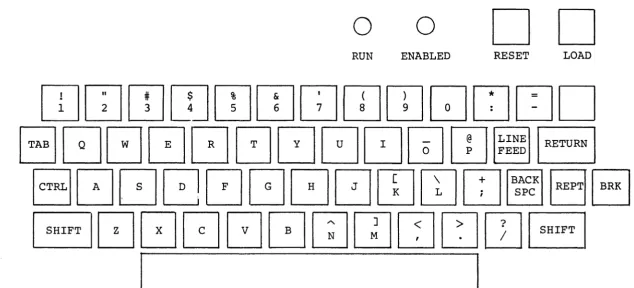
suPPorts the mini-operat.oi'"' console located on the ke,,··board. The console flmctions include tlo.IO s""i t.ches: "system reset." and
"initial prOGram load" (from casset·t.e t.ape'>., and t(,IO stat.lJS
displays: "run"., and "interrupt. enabled". Rll other front. panel functions and debUGGinG aids ar"e provided by an inter'active
debUGGer t.hrouGh the CRT display.
The second I/O module .. ",'hich is t.he Tape-EIR module .. contains a number of int.erf aces as follows:
Tape Interrace - The tape int.er'race connects the microcomputer t.o the two audio cassette tape units.
Dual R5-232C Interrace - This allo(IIs bit se," .. ial communicat.ion (,lith both
a
t.erminal anda
modem. Speeds UP t.o 1283 Baud are possible .. under' prOGr'am control.Cr.,~stal Controlled Real Time Clock - The real t.ime clock is used by the RS-232C int.erfaces foi'"' accurat.e bit t.iminG'. The clock is also availab.le for