1 How do plants sense their nitrogen status?
Lucas Gent and Brian G. Forde*
Lancaster Environment Centre, Lancaster University, Lancaster, LA1 4YQ, UK
*Corresponding author: [email protected]
Running title: N status sensing
Word count: 5031
Figures: 1 (colour)
2 Abstract
1
The primary processes that contribute to the efficient capture of soil nitrate are the development of a 2
root system that effectively explores the soil and the expression of high-affinity nitrate uptake systems 3
in those roots. Both these processes are highly regulated to take into account the availability and 4
distribution of external nitrate pools and the endogenous N status of the plant. Whilst significant 5
progress has been made in elucidating the early steps in sensing and responding to external nitrate, 6
there is much less clarity about how the plant monitors its N status. This review specifically addresses 7
the questions of what N compounds are sensed and in which part of the plant, as well as the identity of 8
the signalling pathways responsible for their detection. Candidates that are considered for the role of N 9
sensory systems include the Target of Rapamycin (TOR) signalling pathway, the General Control Non-10
derepressible 2 (GCN2) pathway, the plastidic PII-dependent pathway and the family of Glutamate-Like 11
Receptors (GLRs). However, despite significant recent progress in elucidating the function and mode 12
of action of these signalling systems, there is still much uncertainty about the extent to which they 13
contribute to the process by which plants monitor their N status. The possibility is discussed that the 14
large GLR family of Ca2+ channels, which are gated by a wide range of different amino acids and 15
expressed throughout the plant, could act as amino acid sensors upstream of a Ca2+-regulated 16
signalling pathway such as the TOR pathway to regulate the plant’s response to changes in N status. 17
Key words: amino acids; GCN2; glutamate receptors; nitrate uptake; PII; root development; signal 18
transduction; target of rifampicin. 19
Abbreviations: 2-OG, 2-oxoglutarate; AspRS, aspartyl-tRNA synthetase; BABA, β-aminobutyric acid; 20
eIF2α eukaryotic translation initiation factor alpha; GCN2, general amino acid control non-derepressible 21
2; GLR, glutamate-like receptor; GS, glutamine synthetase; hVps34, human vacuolar protein sorting 22
34; iGluR, ionotropic glutamate receptor; NAGK, N-acetyl-L-glutamate kinase; NR, nitrate reductase; 23
PP2A, protein phosphatase 2A; TAP46, 2A phosphatase-associated protein of 46 kDa; TORC, target 24
of rapamycin complex. 25
26
27
3 Introduction
29
It has long been appreciated that plants are able to regulate their nutrient uptake to match their demand 30
for those nutrients. As far back as 1906, J. F. Breazeale demonstrated that wheat plants that were 31
nitrogen starved for the first 15 d after germination subsequently showed much higher capacities for 32
absorbing nitrate than plants that had received sufficient N (Breazeale, 1906). Developmental 33
processes in both roots and shoots are also known to be modified by signals related to the N status of 34
the plant (Forde and Lorenzo, 2001). As there is no evidence that plants have evolved separate N 35
sensing mechanisms for controlling N uptake and plant development, this review will consider the most 36
recent evidence relating to the control of both physiological and developmental processes, focusing 37
specifically on how plants sense their internal N status. To learn more about the downstream 38
components of N signalling pathways in plants the reader is referred to a number of excellent reviews 39
that have taken a broader view of the topic (Krapp, 2015; Li et al., 2014; Liu et al., 2015; Medici and 40
Krouk, 2014; O'Brien et al., 2016; Ruffel et al., 2014; Sirohi et al., 2016; Vidal et al., 2015). 41
What is sensed and where is it sensed? 42
An ability to respond to changes in the internal N status implies the existence of mechanisms that can 43
monitor the abundance of one or more key effector molecules that provide reliable information on the 44
availability of N in specific plant tissues. In molecular terms we would expect to find molecules (usually 45
proteins), that act as sensors by binding to specific N-containing compounds and transmitting that 46
information to downstream components of a signal transduction pathway. We will begin by considering 47
what the key effector molecules might be and in which parts of the plant their abundance is likely to be 48
monitored. 49
Glutamine, as the product of the first step in the pathway of N assimilation in bacteria and fungi 50
as well as in plants (Lea et al., 1990), is the organic form of N that has been most commonly considered 51
to be a candidate for the key effector in the sensing of the intracellular N status in many organisms. In 52
Aspergillus nidulans and other filamentous fungi, when glutamine levels are high, pathways responsible 53
for assimilating energetically unfavourable N sources (like nitrate) are down-regulated through a 54
process called nitrogen metabolite repression (Crawford and Arst, 1993). However, although much is 55
known about the complex genetic control of nitrogen metabolite repression, the precise mechanism by 56
which glutamine is sensed has not been determined (Tudzynski, 2014), which leaves open the 57
4
Saccharomyces cerevisiae, the evolutionarily conserved Target Of Rapamycin Complexes (TORCs) 59
are involved in sensing amino acid-derived signals to stimulate a variety of metabolic processes. 60
However, glutamine sensing appears to be only part of the story (Fumarola et al., 2005; Nakajo et al., 61
2005), with other amino acids such as leucine and arginine also being implicated in some of the multiple 62
pathways of TORC activation (Kingsbury et al., 2015; Shimobayashi and Hall, 2016). For example, 63
SLC38A9, a solute carrier family protein with a proposed role in transporting glutamine and arginine 64
into the mammalian lysosome, has recently been identified as an arginine sensor upstream of 65
mammalian TORC1 (mTORC1) (Shimobayashi and Hall, 2016) and two distinct leucine sensors 66
operating in this pathway leucyl-tRNA synthetase (Han et al., 2012) and Sestrin2 (Wolfson et al., 2016) 67
have also been uncovered. Another important mechanism for monitoring the internal N status in yeast 68
and mammals is the General amino acid Control Non-derepressible 2 (GCN2) pathway, which does not 69
sense amino acids per se but rather the uncharged tRNAs that accumulate during amino acid 70
deprivation (Chantranupong et al., 2015). 71
In bacteria, it is the glutamine:2-oxoglutarate (2-OG) ratio that is the key indicator of N status, 72
regulating as it does glutamine synthetase activity through a PII-mediated mechanism (discussed 73
below). In E coli, the PII proteins are encoded by the related GlnB and GlnK genes and their main 74
function is to regulate glutamine synthetase (GS) activity (Arcondeguy et al., 2001). The PII-modifying 75
enzyme GlnD, which uridylylates and deuridylylates PII proteins, is inhibited by binding to glutamine 76
and has the role of glutamine sensor, while GlnB itself binds to 2-OG and acts as a 2-OG sensor. 77
In plants, the question of the signalling role of glutamine in feedback regulation of nitrate uptake 78
has often been asked, but without producing a definitive answer. It has long been thought likely that 79
phloem-mediated shoot-to-root signalling is responsible for regulating NO3- uptake activity to match the 80
plant’s demand for N (Forde and Clarkson, 1999; Imsande and Touraine, 1994). Amino acids, as 81
significant components of phloem sap, have generally been considered strong candidates for the 82
relevant phloem transmissible compounds (Cooper and Clarkson, 1989). However, attempts to identify 83
glutamine or other individual amino acids as key effectors in this pathway have proved inconclusive. 84
For example, when individual amino acids were indirectly loaded into the phloem through the cut surface 85
of soybean cotyledons, 8 of the 14 amino acids tested were effective in down-regulating nitrate uptake 86
in the roots, but glutamine was significantly less potent than arginine or alanine (Muller and Touraine, 87
1992). Despite these and other reports indicating a negative correlation between the amino acid content 88
5
systems that feedback regulation of nitrate uptake can occur independently of any change in the amino 90
acid content of the phloem (Tillard et al., 1998). Furthermore, it has been found that the local amino 91
acid content of the root itself is not correlated with nitrate uptake rates (Lainé et al., 1995) and that 92
feedback regulation of the expression of the NRT2.1 nitrate transporter in roots is dependent on the 93
global N status of the plant and not the local supply of N to the root (Gansel et al., 2001). These pieces 94
of evidence support the idea of long distance shoot-to-root signals that communicate the plant’s N status 95
to the root nitrate uptake system and but argue against those signals being amino acids. A detailed 96
discussion of the identity of alternative long-distance signals is beyond the scope this review, but 97
includes a variety of phloem-mobile molecules that have been implicated in N signalling, including auxin 98
(Forde, 2002), microRNAs (Zeng et al., 2014) and small peptides (Araya et al., 2014). Very relevantly 99
in this context, a recent report identified Arabidopsis ELONGATED HYPOCOTYL5 (HY5), a bZIP 100
transcription factor, as a shoot-to-root phloem-mobile signal that stimulates both root growth and nitrate 101
uptake in response to illumination of the shoot (Chen et al., 2016). This is particularly significant for the 102
integration of N and C metabolism because, as well as acting as a hub for multiple hormonal and abiotic 103
signalling networks, HY5 is also known to regulate C fixation in the shoot (Lau and Deng, 2010). 104
In terms of the identity of the key metabolite(s) directly relevant to N sensing, candidates other 105
than glutamine have been identified. A detailed transcriptomics and metabolomics analysis in 106
Arabidopsis found evidence that leucine abundance was strongly correlated to the expression of a set 107
of several hundred genes (Hannah et al., 2010), leading to the suggestion that in plants, as in yeast 108
and mammals, leucine could be a key regulator of gene expression. There is also evidence that tissue 109
nitrate concentrations can also contribute to the plant’s perception of its N status. Using tobacco lines 110
with varying levels of nitrate reductase (NR) activity it was found that accumulation of high 111
concentrations of nitrate in the shoot led to stimulation of organic acid metabolism, repression of starch 112
synthesis and inhibition of root growth (Scheible et al., 1997a; Scheible et al., 1997b; Stitt and Feil, 113
1999). These are responses associated with high N status, yet were seen even though the NR-defective 114
plants were severely deficient in organic N. Similarly, early lateral root development in an NR-deficient 115
mutant was found to be more sensitive than the wild-type to the inhibitory effects of high nitrate 116
concentrations (Zhang et al., 1999), rather than less sensitive as would have been expected if 117
assimilation of nitrate into organic forms of N was required for feedback repression. Thus we must 118
consider the possibility that nitrate sensors present in the shoot have an important role to play in global 119
6
It is of course over-simplistic to consider N status sensing in isolation since the plant must 121
integrate signals from a wide range of other metabolites, most notably those related to carbon 122
metabolism (Nunes-Nesi et al., 2010; Zheng, 2009). The PII regulatory pathway in bacteria, which 123
senses the glutamine:2-oxoglutarate ratio (Arcondeguy et al., 2001), is a good example of how sensing 124
of the C/N balance can be achieved. However, the mechanisms by which nitrogen and carbon signalling 125
are integrated in plants are poorly understood and likely to be much more complex than in bacteria, so 126
will not be dealt with in detail here. We have already noted above the important identification of HY5 as 127
a novel regulatory molecule that has the ability to integrate C and N metabolism both within and between 128
distant plant organs (Chen et al., 2016). In the following sections, we review the most recent advances 129
in our understanding of the multiple mechanisms by which N-containing compounds are sensed in 130
plants, as candidates for the role of sensing global N status. 131
132
Glutamine sensing in plastids by PII proteins 133
PII proteins belong to one of the most evolutionarily conserved families of signalling proteins, being 134
widely distributed in bacteria and plants as well as in many species of the archaeal kingdom 135
(Forchhammer and Luddecke, 2016). However, despite their conservation at the amino acid sequence 136
level, the signalling roles of PII proteins are diverse. In plants, the plastid-localized PII protein (encoded 137
by the nuclear-localized GlnB gene) has been shown to interact with N-acetyl-L-glutamate kinase 138
(NAGK) (Burillo et al., 2004; Sugiyama et al., 2004), which catalyses an important rate-limiting step in 139
arginine biosynthesis, and with acetyl-CoA carboxylase (Bourrellier et al., 2010), a key enzyme in fatty 140
acid biosynthesis. More recently it has been discovered that glutamine binds to a plant-specific C-141
terminal extension of the PII protein and it is only after binding that the PII protein is able to form a 142
complex with and activate NAGK (Chellamuthu et al., 2014). By this means plants have evolved a 143
simplified glutamine-sensing mechanism for the PII regulatory pathway, circumventing the need for 144
covalent modification of PII by a glutamine-sensitive uridyl transferase as occurs in E. coli. It has been 145
proposed that the low-affinity binding site for glutamine on PII allows for activation of NAGK only at high 146
plastidic glutamine concentrations, enabling increased biosynthesis of arginine (which can be used for 147
N storage) under conditions of N over-supply (Chellamuthu et al., 2014). Although the glutamine-binding 148
motif in PII is highly conserved in plants, it is surprisingly missing in Arabidopsis and other members of 149
the Brassicaceae family (Chellamuthu et al., 2014), yet two PII knock-out mutants of Arabidopsis 150
7
(Chellamuthu et al., 2014; Ferrario-Mery et al., 2006). Therefore, it appears that Arabidopsis must use 152
an alternative mechanism for PII-dependent regulation of arginine metabolism. 153
Despite the significance of PII signalling in plastids, and evidence that over-expressing PII in a 154
leguminous plant leads to a decline in rates of N-fixation in nodules (D'Apuzzo et al., 2015), its primary 155
function would appear to be limited to the regulation of the arginine biosynthesis and fatty acid 156
metabolism and therefore a more global role in sensing the shoot’s N status does not currently appear 157
likely. 158
159
TOR Signalling 160
Arabidopsis has a single TOR kinase gene (AtTOR) (Menand et al., 2002) and also carries homologues 161
of many, but not all, of the genes encoding components of the TORC1 complex in mammals (Xiong and 162
Sheen, 2014). TOR kinase is known to have diverse roles in regulating plant growth and development 163
and to act as an integrator of multiple signalling networks to coordinate growth and developmental 164
transitions (Dobrenel et al., 2016; Xiong and Sheen, 2014). The TOR complex is therefore ideally placed 165
to play a key role in N status sensing in plants, as it does in yeast and mammals (discussed above). 166
There are several lines of evidence indicating that the TOR complex in Arabidopsis is involved in 167
regulating N metabolism as well as in coordinating N and C metabolism. A number of studies that have 168
investigated the metabolic effects of down-regulating TOR itself, or of down-regulating genes encoding 169
TOR-associated proteins, have observed major shifts in metabolism that include an accumulation of 170
amino acids and additional effects on the abundance of starch and sugars (Caldana et al., 2013; 171
Deprost et al., 2007; Moreau et al., 2012). Because TOR is a positive regulator of protein synthesis and 172
a negative regulator of protein turnover, this accumulation of amino acids in TOR-deficient plants could 173
be accounted for by a combination of a decline in the rate of protein synthesis and an up-regulation of 174
the rate of protein degradation (Caldana et al., 2013). However, other factors may additionally be at 175
play because, in Arabidopsis lines that are defective in expression of either the TOR or TAP46 (2A 176
PHOSPHATASE ASSOCIATED PROTEIN OF 46 kDa) genes, effects are seen at the mRNA level that 177
could contribute to the changes in N metabolism, namely down-regulation of nitrate assimilatory genes 178
and an induction of genes involved in amino acid recycling (Ahn et al., 2011). TAP46 is a protein 179
8
been identified as a downstream effector of the TOR complex (Ahn et al., 2011). This implies that TOR, 181
acting at the transcriptional level through TAP46 and PP2A, may be important for regulating the balance 182
between primary N assimilation and N recycling to accommodate changes in the plant’s N status. 183
However, while there is evidence that TOR activity in plants is regulated by intracellular sugar availability 184
(Dobrenel et al., 2016), there is currently no corresponding information in plants on the mechanism of 185
N sensing upstream of TOR, or on which N metabolites are sensed. 186
187
The GCN2 protein kinase 188
The GCN2 protein kinase is a key component of the general amino acid control mechanism in yeast, 189
which is responsible for suppressing global protein synthesis under conditions of N deficiency to help 190
maintain amino acid homeostasis (Schneper et al., 2004). During N starvation, the hyperaccumulation 191
of uncharged tRNAs directly stimulates the kinase activity of GCN2 which then phosphorylates its target, 192
the eukaryotic translation initiation factor eIF2α. Phosphorylation of eIF2α stimulates the translation of 193
a specific set of mRNAs (e.g. the mRNA for the GCN4 transcription factor in yeast) whilst reducing the 194
efficiency of translation initiation for most mRNAs, leading to a general decline in protein synthesis. 195
Plants possess genes for GCN2 and two types of eIF2α kinases, although no plant GCN4 homologue 196
has been identified. In yeast, activation of the kinase activity of GCN2 involves binding of the uncharged 197
tRNAs to a histidyl-tRNA synthetase-related domain located at its C-terminus. Despite the plant 198
homologue of GCN2 having a truncated version of the C-terminal domain, it has recently been 199
demonstrated using in vitro assays that it too is activated by binding to uncharged tRNAs and is then 200
able to phosphorylate both of the eIF2α homologues present in Arabidopsis (Li et al., 2013b). 201
A recent insight into the role and mechanism of amino acid sensing in plant defence has come 202
from studies into the mechanism of β-aminobutyric acid (BABA)-induced priming of the plant immune 203
response. A screen for Arabidopsis mutants defective in BABA-induced priming revealed that plant 204
perception of BABA is mediated by an aspartyl-tRNA synthetase (AspRS) encoded by the Impaired in 205
BABA-induced Immunity 1 (IBI1) gene (Luna et al., 2014). As well as priming the defence response in 206
leaves, BABA also inhibits plant growth and the same study found evidence that this response to BABA 207
(but not the priming response) operates through a GCN2-dependent pathway. This has led to a model 208
9
levels, reducing the canonical AspRS activity of IBI1 and thereby activating a secondary IBI1 activity to 210
prime the defence response. In this model, R-BABA (the active enantiomer of BABA, which has 211
stereochemical similarity to L-Asp) acts by blocking the binding of L-Asp to IBI1 and thereby ‘tricks’ the 212
protein into sensing low L-Asp levels. Thus, it appears that an enzyme whose primary function is in 213
protein synthesis (AspRS) has been co-opted to serve a role in assisting the plant to mobilise its 214
defences to pathogen attack. It has been proposed that activation of GCN2 by BABA arises from its 215
inhibition of AspRS activity, leading to accumulation of the uncharged tRNAs (Luna et al., 2014). 216
Subsequent GCN2-catalysed phosphorylation of eIF2α would then trigger downstream responses such 217
as inhibition of plant growth and presumably other eIF2α-regulated responses to amino acid deficiency. 218
219
GSI-like genes 220
In addition to the well-studied cytoplasmic and plastidic glutamine synthetases (GSs) that are so 221
important for N metabolism, plants also carry another form of GS that is more closely related to 222
prokaryotic GS (GSI-type) than to these eukaryotic forms (GSII-type). Most plant GSI-type genes 223
encode a protein with an N-terminal aminohydrolase domain related to the nodulin 6 protein 224
(Doskocilova et al., 2011) and hence are referred to as NodGS. The first fusion protein of this form to 225
be identified was the fungal FluG protein, and in Aspergillus sp. FluG has a regulatory role as a 226
morphogenetic factor that stimulates asexual sporulation under conditions of N starvation (but not C 227
starvation), a role that was shown to reside in the GSI-like domain of the protein (D'Souza et al., 2001). 228
In Arabidopsis, downregulation of NodGS by RNAi led to multiple developmental effects, including a 229
shortened primary root and disruption of the root cap, suggesting a possible regulatory role in root 230
morphogenesis (Doskocilova et al., 2011). The model legume Medicago truncatula has two NodGS 231
genes, MtGSIa and MtGSIb, which are preferentially expressed in roots and root nodules and whose 232
expression is down-regulated by externally applied amino acids (Silva et al., 2015). Neither FluG nor 233
the plant NodGSs so far analysed possess significant GS enzymatic activity (D'Souza et al., 2001; 234
Doskocilova et al., 2011; Silva et al., 2015), leading to speculation that their GSI-like domains might 235
perform a different function, perhaps in the production of some form of signalling molecule. The lack of 236
GS activity in FluG/NodGS is associated with the lack of conservation of two key amino acid residues 237
in the active site (Doskocilova et al., 2011), but the overall sequence conservation of the protein 238
10
potentially perform a role as some form of N sensor. The general idea of a sensory role for a GS enzyme 240
is supported by a study in the rice fungal pathogen Fusarium fujikuroi (Wagner et al., 2013), which found 241
evidence that the GSII-type enzyme in that species has a regulatory function involving NH4+ sensing 242
that could be separated from its catalytic activity by site-directed amino acid substitutions. 243
244
The GLR family of glutamate receptor-like proteins 245
Plants possess a large family of membrane proteins with homology to the ionotropic glutamate receptor 246
(iGluR) family that was first identified and characterised in mammals (Price et al., 2012). Mammalian 247
iGluRs are primarily known for their role as fast excitatory neurotransmitters in the central nervous 248
system where they act as glutamate-gated cation channels, selective for Na+, K+ and Ca2+ ions. In 249
Arabidopsis there are 20 GLR (Glutamate-Like Receptor) genes encoding proteins with the same 250
modular structure as their mammalian homologues: an N-terminal domain, a ligand-binding domain, a 251
transmembrane domain that includes a pore region, and a C-terminal domain (Davenport, 2002). Since 252
their discovery in 1998 (Lam et al., 1998) there has been considerable interest in what role the GLR 253
proteins might play in plants, where a nervous system is obviously lacking. At the molecular level the 254
accumulated evidence indicates that GLRs act as amino acid-gated Ca2+ channels and that members 255
of the family are located in different cell membranes, including the plasma membrane, the inner and 256
outer chloroplast membranes and the mitochondrion (reviewed by Weiland et al. 2016). However, while 257
the iGluRs are largely glutamate-specific (with only aspartate acting as an alternative, weak agonist 258
(Flores-Soto et al., 2012), plant GLRs appear to be gated by a broad range of different amino acids. 259
Evidence for this has come from studies using both GLR knockout mutants (Michard et al., 2011; Qi et 260
al., 2006; Stephens et al., 2008; Tapken et al., 2013) and heterologous expression (Tapken et al., 2013; 261
Vincill et al., 2012). For example, when expressed in Xenopus oocytes the Arabidopsis AtGLR1.4 262
protein was found to be gated to varying degrees by methionine, tryptophan, phenylalanine, leucine, 263
tyrosine, asparagine and threonine, but not by L-glutamate or other proteinogenic amino acids (Tapken 264
et al., 2013), while the AtGLR3.4 protein expressed in Human Embryonic Kidney 293 cells was sensitive 265
to asparagine, L-serine and glycine, but not to L-glutamate, alanine, cysteine or phenylalanine (Vincill 266
et al., 2012). These findings are consistent with the evidence from various Arabidopsis knock-out 267
mutants (Michard et al., 2011; Qi et al., 2006; Stephens et al., 2008; Tapken et al., 2013) that, in contrast 268
to their mammalian homologues, the plant GLRs are relatively promiscuous in their ligand specificity. 269
11
that all members of the AtGLR family could potentially bind amino acids but also that the sequence 271
diversity that exists in their ligand-binding domains would be consistent with them being gated by a 272
diverse set of agonists (Tapken et al., 2013). In addition, there is the possibility that amino acids or 273
other metabolites could allosterically regulate the plant GLRs by binding to sequences in their extended 274
N-terminal domains (Weiland et al., 2016). Some mammalian iGluRs have a similarly long N-terminal 275
domain that allows both positive and negative allosteric regulation of the receptor by a variety of small 276
molecules and ions (Kumar and Mayer, 2013). Should the N-terminal domain in plant GLRs serve a 277
similar function it would greatly amplify the potential of this family of receptors to integrate a multitude 278
of metabolic signals. 279
Of the candidates for a role in sensing N status the GLRs are amongst the most compelling. As 280
a family they are ubiquitously expressed throughout the plant, their products are located on both the 281
plasma membrane and organellar membranes, collectively their activity is gated by a diverse set of 282
amino acids, and their ability to control the movement of Ca2+ ions across these membranespotentially 283
provides a direct link to multiple Ca2+ signalling pathways (Dodd et al., 2010). Experimental evidence 284
for their physiological role comes primarily from two early papers that described the pleiotropic effects 285
of disrupting the expression of the AtGLR1.1 gene on aspects of carbon, nitrogen and hormone 286
metabolism (Kang et al., 2004; Kang and Turano, 2003). It was reported that germination of AtGLR1.1 287
antisense lines on N-free full-strength Murashige and Skoog medium was inhibited by the presence of 288
3% sucrose (but not by other C sources) and that the inhibitory effect of sucrose could be overcome by 289
the inclusion of 5 mM NO3- (but not 5 mM NH4+) (Kang and Turano, 2003). Other aspects of the 290
pleiotropic phenotype of the antiAtGLR1.1 line included effects on the expression of some enzymes of 291
C and N metabolism (Kang and Turano, 2003) and an increased sensitivity of germination and root 292
growth to external abscisic acid (ABA) treatment (Kang et al., 2004). Taken together with additional 293
effects on the expression of some genes related to ABA signalling and biosynthesis (Kang et al., 2004) 294
these observations were interpreted as indicating a role for AtGLR1.1 in linking changes in C/N status 295
to ABA signalling and other metabolic and developmental responses. 296
There are three clades of GLR genes in plants and most studies into the physiological role of 297
plant GLRs have focussed on members of clade 3 (principally AtGLR3.3, AtGLR3.4 and AtGLR3.5) 298
(Weiland et al., 2016). Diverse functions that have been assigned to these GLRs on the basis of the 299
phenotype of knock-out mutants or over-expressing lines have so far included roles in stomatal closure, 300
12
defence response (reviewed Weiland et al. 2016). However, there is surprisingly little experimental 302
evidence directly linking any of these phenotypes to activation of a GLR by its known agonist(s). One 303
notable exception is a study of the role of the AtGLR3.3 gene in the immune response (Li et al., 2013a), 304
where it was found that cysteine and the tripeptide glutathione (both of which were identified as 305
AtGLR3.3 agonists) were each able to suppress growth of the bacterial pathogen Pseudomonas 306
syringae pv tomato DC3000 in Arabidopsis leaves and that this response was defective in an atglr3.3 307
knock-out mutant. A more recent paper reported that L-glutamate was able to trigger stomatal closure 308
in Arabidopsis leaves and that this was dependent on a functional AtGLR3.5 gene (Yoshida et al., 309
2016). The difficulty in achieving this degree of definition in our understanding of the physiological role 310
of most of the GLRs is likely to be due to a combination of genetic redundancy in the large gene family 311
and the multiplicity of agonists that can activate them. Nevertheless, based on what we know so far, it 312
seems plausible that many or all the diverse and pleiotropic phenotypes caused by disruption or 313
overexpression of members of the GLR family are due, directly or indirectly, to perturbations in amino 314
acid (or small peptide) sensing. If this is the case then it points to the GLR family having important roles 315
throughout the plant in monitoring changes in amino acid distribution (between different cellular and 316
extracellular compartments), amino acid composition and overall amino acid abundance. It remains to 317
be established how important the Ca2+ signals generated as a result of this GLR activity are in initiating 318
the effects on gene expression and root development that are symptomatic of changes in the plant’s N 319
status. 320
321
Conclusions 322
In this review, we have attempted to assess the most recent advances in our understanding of how 323
plants monitor their N status. The main candidates for this N sensing role belong to signalling pathways 324
that have mostly been chosen for investigation on the basis of their homology to nutrient sensing 325
systems previously identified in other organisms (bacteria, yeast or mammals). The exception to this 326
rule is the GLR family of glutamate receptor-like proteins, whose homologues in mammals are primarily 327
(but not exclusively) associated with the nervous system and the process of neurotransmission. Despite 328
the progress that has been made in recent years, particularly in elucidating the TOR-, PII- and GCN2-329
mediated pathways in higher plants, there is still little clarity about which N-compounds are being 330
13
compounds. In the absence of hard evidence, some speculation may be permissible. Is it possible that 332
members of the GLR family, whose credentials for the role of ubiquitous amino acid sensors have been 333
outlined above, are the upstream components required by a TOR-mediated amino acid signalling 334
pathway? Although yeast has no GLR/iGluR homologues, there is a precedent for this in mammals 335
where there is evidence that iGluRs belonging to the NMDA group are able to regulate mTOR signalling 336
activity in neurons (Burket et al., 2015; Gong et al., 2006; Huang et al., 2007). Some experimental 337
support for this hypothesis exists in the form of the phenotype of the AtGLR1.1 antisense line described 338
above, involving changes in the expression of enzymes involved in C and N metabolism and ABA 339
signalling (Kang et al., 2004; Kang and Turano, 2003), which is not dissimilar to phenotypes described 340
for lines defective in components of the TOR signalling pathway (Dobrenel et al., 2016). 341
It is also worth noting that there are examples in both mammals and yeast of interactions 342
between Ca2+ signalling and TOR signalling (Deutsch et al., 2014; Mulet et al., 2006) and a study using 343
human cell lines found evidence that amino acids activate the mTOR complex via a pathway involving 344
Ca2+-dependent activation of the human vacuolar protein sorting 34 (hVps34), a type III 345
phosphatidylinositol 3-kinase (Gulati et al., 2008). To date there are no reports of a role for Ca2+ 346
signalling in the activation of the TOR complex in plants, however Arabidopsis does have a homologue 347
of hVp34 (AtVPS34) in which the Ca2+-dependent lipid-binding domain is conserved between plants 348
and humans (Welters et al., 1994). Thus we consider that the possibility of a link between Ca2+ influx 349
through amino acid-gated members of the GLR family and an AtVPS34-dependent TOR signalling 350
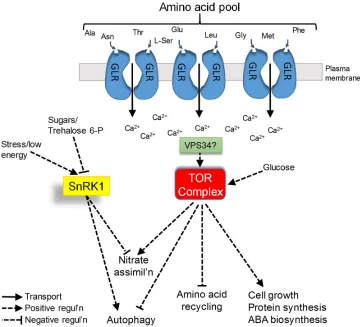
pathway in plants is one that is worthy of investigation. 351
Fig. 1 illustrates how amino acid signalling through a panel of GLR complexes with multiple and 352
differing ligand specificities could, via a Ca2+-dependent signalling pathway, provide a mechanism for 353
regulating the TOR complex in response to changes in the overall amino acid pool. The multiplicity of 354
the amino acids that are able to act as ligands for plant GLRs could help to explain why, as discussed 355
above, previous research has failed to pinpoint any particular amino acid(s) for the role of effector in N 356
status sensing. Overcoming genetic redundancy amongst GLR family members to test the postulated 357
link between GLRs and TOR in amino acid signalling will be a challenge, but as previously discussed 358
in more detail (Forde, 2014), opportunities may arise through the application of chemical genetic 359
approaches if small molecule agonists or antagonists can be identified that target specific clades or 360
14
how they regulate the processes of N acquisition, N metabolism and N storage that a better 362
understanding of these is expected to be important for future efforts to improve the efficiency with which 363
crop plants capture and utilize soil nitrate. 364
365
Acknowledgements 366
LG is supported by a Doctoral Training Partnership (DTP) grant from the UK Biotechnology and 367
15 References
Ahn CS, Han JA, Lee HS, Lee S, Pai HS. 2011. The PP2A regulatory subunit Tap46, a component of the TOR signaling pathway, modulates growth and metabolism in plants. Plant Cell 23, 185-209. Araya T, Miyamoto M, Wibowo J, Suzuki A, Kojima S, Tsuchiya YN, Sawa S, Fukuda H, von Wirén N, Takahashi H. 2014. CLE-CLAVATA1 peptide-receptor signaling module regulates the expansion of plant root systems in a nitrogen-dependent manner. Proceedings of the National Academy of Sciences USA 111, 2029-2034.
Arcondeguy T, Jack R, Merrick M. 2001. P-II signal transduction proteins, pivotal players in microbial nitrogen control. Microbiology and Molecular Biology Reviews 65, 80-105.
Bourrellier ABF, Valot B, Guillot A, Ambard-Bretteville F, Vidal J, Hodges M. 2010. Chloroplast acetyl-CoA carboxylase activity is 2-oxoglutarate-regulated by interaction of PII with the biotin carboxyl carrier subunit. Proceedings of the National Academy of Sciences USA 107, 502-507.
Breazeale JF. 1906. The relation of sodium to potassium in soil and solution cultures. Journal of the American Chemical Society 28, 1013-1025.
Burillo S, Luque I, Fuentes I, Contreras A. 2004. Interactions between the nitrogen signal transduction protein PII and N-acetyl glutamate kinase in organisms that perform oxygenic photosynthesis. Journal of Bacteriology 186, 3346-3354.
Burket JA, Benson AD, Tang AH, Deutsch SI. 2015. NMDA receptor activation regulates sociability by its effect on mTOR signaling activity. Progress in Neuro-Psychopharmacology & Biological Psychiatry 60, 60-65.
Caldana C, Li Y, Leisse A, Zhang Y, Bartholomaeus L, Fernie AR, Willmitzer L, Giavalisco P. 2013. Systemic analysis of inducible target of rapamycin mutants reveal a general metabolic switch controlling growth in Arabidopsis thaliana. Plant Journal 73, 897-909.
Chantranupong L, Wolfson RL, Sabatini DM. 2015. Nutrient-sensing mechanisms across evolution. Cell 161, 67-83.
Chellamuthu VR, Ermilova E, Lapina T, Luddecke J, Minaeva E, Herrmann C, Hartmann MD, Forchhammer K. 2014. A widespread glutamine-sensing mechanism in the plant kingdom. Cell 159, 1188-1199.
Chen XB, Yao QF, Gao XH, Jiang CF, Harberd NP, Fu XD. 2016. Shoot-to-root mobile transcription factor HY5 coordinates plant carbon and nitrogen acquisition. Current Biology 26, 640-646.
Cooper HD, Clarkson DT. 1989. Cycling of amino nitrogen and other nutrients between shoots and roots in cereals: a possible mechanism integrating shoot and root in the regulation of nutrient uptake. Journal of Experimental Botany 40, 753-762.
Crawford NM, Arst HN. 1993. The molecular genetics of nitrate assimilation in fungi and plants. Annual Review of Genetics 27, 115-146.
16
D'Souza CA, Lee BN, Adams TH. 2001. Characterization of the role of the FluG protein in asexual development of Aspergillus nidulans. Genetics 158, 1027-1036.
Davenport R. 2002. Glutamate receptors in plants. Annals of Botany 90, 549-557.
Deprost D, Yao L, Sormani R, Moreau M, Leterreux G, Nicolai M, Bedu M, Robaglia C, Meyer C. 2007. The Arabidopsis TOR kinase links plant growth, yield, stress resistance and mRNA translation. Embo Reports 8, 864-870.
Deutsch SI, Tang AH, Burket JA, Benson AD. 2014. NMDA receptors on the surface of cancer cells: Target for chemotherapy? Biomedicine & Pharmacotherapy 68, 493-496.
Dietrich P, Anschutz U, Kugler A, Becker D. 2010. Physiology and biophysics of plant ligand-gated ion channels. Plant Biology 12, 80-93.
Dobrenel T, Caldana C, Hanson J, Robaglia C, Vincentz M, Veit B, Meyer C. 2016. TOR signaling and nutrient sensing. Annual Review of Plant Biology 67, 261-285.
Dodd AN, Kudla J, Sanders D. 2010. The language of calcium signaling. Annual Review of Plant Biology 61, 593-620.
Doskocilova A, Plihal O, Volc J, Chumova J, Kourova H, Halada P, Petrovska B, Binarova P. 2011. A nodulin/glutamine synthetase-like fusion protein is implicated in the regulation of root morphogenesis and in signalling triggered by flagellin. Planta 234, 459-476.
Ferrario-Mery S, Besin E, Pichon O, Meyer C, Hodges M. 2006. The regulatory PII protein controls arginine biosynthesis in Arabidopsis. FEBS Letters 580, 2015-2020.
Flores-Soto ME, Chaparro-Huerta V, Escoto-Delgadillo M, Vazquez-Valls E, Gonzalez-Castaneda RE, Beas-Zarate C. 2012. Structure and function of NMDA-type glutamate receptor subunits. Neurologia 27, 301-310.
Forchhammer K, Luddecke J. 2016. Sensory properties of the P-II signalling protein family. Febs Journal 283, 425-437.
Forde BG. 2002. Local and long-range signaling pathways regulating plant responses to nitrate. Annual Review of Plant Biology 53, 203-224.
Forde BG. 2014. Glutamate signalling in roots. Journal of Experimental Botany 65, 779-787.
Forde BG, Clarkson DT. 1999. Nitrate and ammonium nutrition of plants: physiological and molecular perspectives. Advances in Botanical Research 30, 1-90.
Forde BG, Lorenzo H. 2001. The nutritional control of root development. Plant and Soil 232, 51-68. Fumarola C, La Monica S, Guidotti GG. 2005. Amino acid signaling through the mammalian target of rapamycin (mTOR) pathway: Role of glutamine and of cell shrinkage. Journal of Cellular Physiology 204, 155-165.
Gansel X, Munos S, Tillard P, Gojon A. 2001. Differential regulation of the NO3- and NH4+ transporter genes AtNRT2.1 and AtAMT1.1 in Arabidopsis: relation with long-distance and local controls by N status of the plant. Plant Journal 26, 143-155.
17
Gulati P, Gaspers LD, Dann SG, Joaquin M, Nobukuni T, Natt F, Kozma SC, Thomas AP, Thomas G. 2008. Amino acids activate mTOR Complex 1 via Ca2+/CaM signaling to hVps34. Cell Metabolism 7, 456-465.
Han JM, Jeong SJ, Park MC, Kim G, Kwon NH, Kim HK, Ha SH, Ryu SH, Kim S. 2012. Leucyl-tRNA synthetase is an intracellular leucine sensor for the mTORC1-signaling pathway. Cell 149, 410-424. Hannah MA, Caldana C, Steinhauser D, Balbo I, Fernie AR, Willmitzer L. 2010. Combined transcript and metabolite profiling of arabidopsis grown under widely variant growth conditions facilitates the identification of novel metabolite-mediated regulation of gene expression. . Plant Physiology 152, 2120-2129.
Huang YF, Kang BN, Tian J, Liu Y, Luo HR, Hester L, Snyder SH. 2007. The cationic amino acid transporters CAT1 and CAT3 mediate NMDA receptor activation-dependent changes in elaboration of neuronal processes via the mammalian target of rapamycin mTOR pathway. Journal of Neuroscience 27, 449-458.
Imsande J, Touraine B. 1994. N demand and the regulation of nitrate uptake. Plant Physiology 105, 3-7.
Kang JM, Mehta S, Turano FJ. 2004. The putative glutamate receptor 1.1 (AtGLR1.1) in Arabidopsis thaliana regulates abscisic acid biosynthesis and signaling to control development and water loss. Plant and Cell Physiology 45, 1380-1389.
Kang JM, Turano FJ. 2003. The putative glutamate receptor 1.1 (AtGLR1.1) functions as a regulator of carbon and nitrogen metabolism in Arabidopsis thaliana. Proceedings of the National Academy of Sciences USA 100, 6872-6877.
Kingsbury JM, Sen ND, Cardenas ME. 2015.) Branched-chain aminotransferases control TORC1 signaling in Saccharomyces cerevisiae. Plos Genetics 10.1371/journal.pgen.1005714.
Krapp A. 2015. Plant nitrogen assimilation and its regulation: a complex puzzle with missing pieces. Current Opinion in Plant Biology 25, 115-122.
Kumar J, Mayer ML. 2013. Functional insights from glutamate receptor ion channel structures. Annual Review of Physiology 75, 313-337.
Lainé P, Ourry A, Boucaud J. 1995. Shoot control of nitrate uptake rates by roots of Brassica napus L . Effects of localized nitrate supply. Planta 196, 77-83.
Lam H-M, Chiu J, Hsieh M-H, Meisel L, Oliveira IC, Shin M, Coruzzi G. 1998. Glutamate receptor genes in plants. Nature 396, 125-126.
Lau OS, Deng XW. 2010. Plant hormone signaling lightens up: integrators of light and hormones. Current Opinion in Plant Biology 13, 571-577.
Lea PJ, Robinson SA, Stewart GA. 1990. The enzymology and metabolism of glutamine, glutamate and asparagine. In: Miflin BJ, Lea PJ, eds. The Biochemistry of Plants Vol 16: Intermediary Metabolism. San Diego: Academic Press, 121-157.
18
Li MW, AuYeung WK, Lam HM. 2013b. The GCN2 homologue in Arabidopsis thaliana interacts with uncharged tRNA and uses Arabidopsis eIF2 alpha molecules as direct substrates. Plant Biology 15, 13-18.
Li Y, Krouk G, Coruzzi GM, Ruffel S. 2014. Finding a nitrogen niche: a systems integration of local and systemic nitrogen signalling in plants. Journal of Experimental Botany 65, 5601-5610.
Liu Q, Chen XB, Wu K, Fu XD. 2015. Nitrogen signaling and use efficiency in plants: what's new? Current Opinion in Plant Biology 27, 192-198.
Luna E, van Hulten M, Zhang YH, Berkowitz O, Lopez A, Petriacq P, Sellwood MA, Chen BN, Burrell M, van de Meene A, Pieterse CMJ, Flors V, Ton J. 2014. Plant perception of beta-aminobutyric acid is mediated by an aspartyl-tRNA synthetase. Nature Chemical Biology 10, 450-456. Medici A, Krouk G. 2014. The Primary Nitrate Response: a multifaceted signalling pathway. Journal of Experimental Botany 65, 5567-5576.
Menand B, Desnos T, Nussaume L, Berger F, Bouchez D, Meyer C, Robaglia C. 2002. Expression and disruption of the Arabidopsis TOR (target of rapamycin) gene. Proceedings of the National Academy of Sciences USA 99, 6422-6427.
Michard E, Lima PT, Borges F, Silva AC, Portes MT, Carvalho JE, Gilliham M, Liu LH, Obermeyer G, Feijo JA. 2011. Glutamate receptor-like genes form Ca2+ channels in pollen tubes and are regulated by pistil D-serine. Science 332, 434-437.
Moreau M, Azzopardi M, Clement G, Dobrenel T, Marchive C, Renne C, Martin-Magniette ML, Taconnat L, Renou JP, Robaglia C, Meyer C. 2012. Mutations in the Arabidopsis Homolog of LST8/G beta L, a partner of the Target of Rapamycin kinase, impair plant growth, flowering, and metabolic adaptation to long days. Plant Cell 24, 463-481.
Mulet JM, Martin DE, Loewith R, Hall MN. 2006. Mutual antagonism of target of rapamycin and calcineurin signaling. Journal of Biological Chemistry 281, 33000-33007.
Muller B, Touraine B. 1992. Inhibition of NO3- uptake by various phloem translocated amino acids in soybean seedlings. Journal of Experimental Botany 43, 617-623.
Nakajo T, Yamatsuji T, Ban H, Shigemitsu K, Haisa M, Motoki T, Noma K, Nobuhisa T, Matsuoka J, Gunduz M, Yonezawa K, Tanaka N, Naomoto Y. 2005. Glutamine is a key regulator for amino acid-controlled cell growth through the mTOR signaling pathway in rat intestinal epithelial cells. Biochemical and Biophysical Research Communications 326, 174-180.
Nunes-Nesi A, Fernie AR, Stitt M. 2010. Metabolic and signaling aspects underpinning the regulation of plant carbon nitrogen interactions. Molecular Plant 3, 973-996.
O'Brien JA, Vega A, Bouguyon E, Krouk G, Gojon A, Coruzzi G, Gutierrez RA. 2016. Nitrate transport, sensing, and responses in plants. Molecular Plant 9, 837-856.
Price MB, Jelesko J, Okumoto S. 2012.) Glutamate receptor homologs in plants: functions and evolutionary origins. Frontiers in Plant Science 10.3389/fpls.2012.00235.
Qi Z, Stephens NR, Spalding EP. 2006. Calcium entry mediated by GLR3.3, an Arabidopsis glutamate receptor with a broad agonist profile. Plant Physiology 142, 963-971.
19
Ruffel S, Gojon A, Lejay L. 2014. Signal interactions in the regulation of root nitrate uptake. Journal of Experimental Botany 65, 5509-5517.
Scheible WR, Gonzalez-Fontes A, Lauerer M, Muller-Rober B, Caboche M, Stitt M. 1997a. Nitrate acts as a signal to induce organic acid metabolism and repress starch metabolism in tobacco. Plant Cell 9, 783-798.
Scheible WR, Gonzalez-Fontes A, Morcuende R, Lauerer M, Geiger M, Glaab J, Gojon A, Schulze ED, Stitt M. 1997b. Tobacco mutants with a decreased number of functional nia genes compensate by modifying the diurnal regulation of transcription, post-translational modification and turnover of nitrate reductase. Planta 203, 304-319.
Schneper L, Duvel K, Broach JR. 2004. Sense and sensibility: nutritional response and signal integration in yeast. Current Opinion in Microbiology 7, 624-630.
Shimobayashi M, Hall MN. 2016. Multiple amino acid sensing inputs to mTORC1. Cell Research 26, 7-20.
Silva LS, Seabra AR, Leitao JN, Carvalho HG. 2015. Possible role of glutamine synthetase of the prokaryotic type (GSI-like) in nitrogen signaling in Medicago truncatula. Plant Science 240, 98-108. Sirohi G, Pandey BK, Deveshwar P, Giri J. 2016. Emerging trends in epigenetic regulation of nutrient deficiency response in plants. Molecular Biotechnology 58, 159-171.
Stephens NR, Qi Z, Spalding EP. 2008. Glutamate receptor subtypes evidenced by differences in desensitization and dependence on the GLR3.3 and GLR3.4 genes. Plant Physiology 146, 529-538. Stitt M, Feil R. 1999. Lateral root frequency decreases when nitrate accumulates in tobacco transformants with low nitrate reductase activity: consequences for the regulation of biomass partitioning between shoots and root. Plant and Soil 215, 143-153.
Sugiyama K, Hayakawa T, Kudo T, Ito T, Yamaya T. 2004. Interaction of N-Acetylglutamate kinase with a PII-Like protein in rice. Plant and Cell Physiology 45, 1768-1778.
Tapken D, Anschutz U, Liu LH, Huelsken T, Seebohm G, Becker D, Hollmann M. 2013.) A plant homolog of animal glutamate receptors is an ion channel gated by multiple hydrophobic amino acids. Science Signaling 10.1126/scisignal.2003762.
Teardo E, Formentin E, Segalla A, Giacometti GM, Marin O, Zanetti M, Lo Schiavo F, Zoratti M, Szabo I. 2011. Dual localization of plant glutamate receptor AtGLR3.4 to plastids and plasmamembrane. Biochimica et Biophysica Acta: Bioenergetics 1807, 359-367.
Tillard P, Passama L, Gojon A. 1998. Are phloem amino acids involved in the shoot to root control of NO3- uptake in Ricinus communis plants? Journal of Experimental Botany 49, 1371-1379.
Tudzynski B. 2014. Nitrogen regulation of fungal secondary metabolism in fungi. Frontiers in Microbiology 5.
Vidal E, Álvarez J, Moyano T, Gutiérrez R. 2015. Transcriptional networks in the nitrate response of Arabidopsis thaliana. Current Opinion in Plant Biology 27, 125-132.
Vincill ED, Bieck AM, Spalding EP. 2012. Ca2+ conduction by an amino acid-gated ion channel related to glutamate receptors. Plant Physiology 159, 40-46.
20
Weiland M, Mancuso S, Baluska F. 2016. Signalling via glutamate and GLRs in Arabidopsis thaliana. Functional Plant Biology 43, 1-25.
Welters P, Takegawa K, Emr SD, Chrispeels MJ. 1994. AtVPS34, a phosphatidylinositol 3-kinase of Arabidopsis thaliana, is an essential protein with homology to a calcium-dependent lipid-binding domain. Proceedings of the National Academy of Sciences USA 91, 11398-11402.
Wolfson RL, Chantranupong L, Saxton RA, Shen K, Scaria SM, Cantor JR, Sabatini DM. 2016. Sestrin2 is a leucine sensor for the mTORC1 pathway. Science 351, 43-48.
Xiong Y, Sheen J. 2014. The role of target of rapamycin signaling networks in plant growth and metabolism. Plant Physiology 164, 499-512.
Yoshida R, Mori IC, Kamizono N, Shichiri Y, Shimatani T, Miyata F, Honda K, Iwai S. 2016. Glutamate functions in stomatal closure in Arabidopsis and fava bean. Journal of Plant Research 129, 39-49.
Zeng HQ, Wang GP, Hu XY, Wang HZ, Du LQ, Zhu YY. 2014. Role of microRNAs in plant responses to nutrient stress. Plant and Soil 374, 1005-1021.
Zhang HM, Jennings A, Barlow PW, Forde BG. 1999. Dual pathways for regulation of root branching by nitrate. Proceedings of the National Academy of Sciences USA 96, 6529-6534.
21 Legends
Fig. 1. Hypothetical model for activation of the TOR complex by amino acid sensing through the family of GLR glutamate receptor-like Ca2+ channels present in plants. The TOR complex plays a
central role in regulating plant growth and metabolism in response to changes in nutrient availability,
working in conjunction with the Snf1-related kinase (SnRK1) which largely acts antagonistically to TOR
(Dobrenel et al., 2016; Robaglia et al., 2012). The diagram depicts a cell in which a diverse set of GLRs
are expressed, each activated by a variety of different amino acid ligands (only a proportion of which
are indicated). Collectively this panel of amino acid sensors would be able to respond to changes in the
overall amino acid pool, therefore potentially providing an accurate reflection of the N status of the
tissue. Although the GLRs are shown as located in the plasma membrane, there is evidence that they
are also to be found on internal (plastidic) membranes (Teardo et al., 2011), so that their sensory role
would not be restricted to amino acids in the apoplast. Ligand binding by plant GLRs is known to trigger
Ca2+ influx (Dietrich et al., 2010) and it is proposed that this could be linked to activation of the TOR
complex, perhaps through a pathway involving the Ca2+-dependent regulation of VPS34 and the
downstream production of phosphatidic acid which is an activator of TOR in animals (Gulati et al., 2008).
22