Web Based Manipuri Corpus for Multiword NER and
Reduplicated MWEs Identification using SVM
Thoudam Doren Singh
Department of Computer Science and
Engineering
Jadavpur University
[email protected]
Sivaji Bandyopadhyay
Department of Computer Science and
Engineering
Jadavpur University
[email protected]
Abstract
A web based Manipuri corpus is devel-oped for identification of reduplicated multiword expression (MWE) and mul-tiword named entity recognition (NER). Manipuri is one of the rarely investi-gated language and its resources for natural language processing are not available in the required measure. The web content of Manipuri is also very poor. News corpus from a popular Ma-nipuri news website is collected. Ap-proximately four and a half million Ma-nipuri wordforms have been collected from the web. The mode of corpus col-lection and the identification of redupli-cated MWEs and multiword NE based on support vector machine (SVM) learning technique are reported. The SVM based reduplicated MWE system is evaluated with recall, precision and F-Score values of 94.62%, 93.53% and 94.07% respectively outperforming the rule based approach. The recall, preci-sion and F-Score for multiword NE are evaluated as 94.82%, 93.12% and 93.96% respectively.
1
Introduction
The NER and MWE identification are important tasks for natural language applications that in-clude machine translation and information re-trieval. The present work reports the NER and reduplicated MWE identification of Manipuri on web based news corpus. The use of web as a corpus for teaching and research on languages
has been proposed several times (Rundell, 2000; Fletcher, 2001; Robb, 2003; Fletcher 2004). A special issue of the Computational Linguistics journal on web as corpus (Kilgarriff and Gre-fenstette, 2003) was published. Several studies have used different methods to mine web data. The web walked into the ACL meetings starting in 1999. The special interest group of ACL on web as corpus is promoting interest in the use of the web as a source of linguistic data, and as an object of study in its own right. India is a multi-lingual country with a lot of cultural diversity. Bharati et al. (2001) reports an effort to create lexical resources such as transfer lexicon and grammar from English to several Indian lan-guages and dependency Treebank of annotated corpora for several Indian languages. In Indian context, a web based Bengali corpus develop-ment work from web is reported in Ekbal and Bandyopadhyay (2008) and Manipuri-English semi automatic parallel corpora extraction by Singh et. al., (2010). Newspaper is a huge source of readily available documents. In the present work, the Manipuri monolingual corpus has been developed from web for NLP and re-lated tasks.
language are bound and the affixes are the de-termining factor of the class of the words in the language. Annotated corpus, bilingual dictiona-ries, name dictionadictiona-ries, WordNet, morphologi-cal analyzers etc. are not yet available in Mani-puri in the required measure.
In the present work, the tasks of identifica-tion of Manipuri multiword named entity (MNE) and reduplicated multiword expression (RMWE) identification using support vector machine (SVM) learning technique on the corpus col-lected from web is reported.
Works on multiword expressions (MWEs) have started with a momentum in different lan-guages. In the Indian context, some of the works can be seen in (Dandapat et. al., 2006; Kunchukuttan and Damani, 2008; Kishorjit et. al., 2010). The identification of MWEs in sev-eral languages concentrate on compound nouns, noun-verb combination, some on idioms and phrases and so on but not much on RMWEs. The reason may be that the reduplicated words are either rare or easy to identify for these lan-guages since only complete duplication and some amount of partial reduplication may be present in these languages. On the other hand, reduplicated MWEs are quite large in number in Manipuri and there are wide varieties of redup-licated MWEs in Manipuri.
2
Manipuri News Corpus and Sta
tis-tics
The content of Manipuri language on the web is very poor. One of the sources is the daily news publications. Again, there is no repository. Thus, the possibility of deploying web crawler and mining the web corpus is not possible. The Ma-nipuri news corpus is collected from http://www.thesangaiexpress.com/ covering the period from May 2008 to May 2010 on daily basis. The Manipuri news is available in PDF format. A tool has been developed to convert contents from PDF documents to Unicode for-mat. There are 15-20 articles in each day. Con-sidering the Manipuri corpus covering the pe-riod from May 2008 to May 2010, there are 4649016 wordforms collected1.
1
There are no publications on some occasions.
2.1 Conversion from PDF to UTF-8
The general Manipuri news collected is in PDF format. A tool has been developed to convert Manipuri news PDF articles to Bengali Unicode. The Bengali Unicode characters are used to represent Manipuri as well. The conversion of PDF format into Unicode involves the conver-sion to ASCII and then into Unicode using mapping tables between the ASCII characters and corresponding Bengali Unicode. The map-ping tables have been prepared at different le-vels with separate tables for single characters and conjuncts with two or more than two cha-racters. The single character mapping table con-tains 72 entries and the conjunct characters mapping table consists of 738 entries. There are conjuncts of 2, 3 and 4 characters. Sub-tables for each of the conjuncts are prepared. English words are present on the Manipuri side of the news and they are filtered to avoid unknown character features.
2.2 Use of language resources
The Manipuri web corpus collected from the web is cleaned by removing the unknown cha-racters. After the cleaning process, the running texts are picked up followed by spelling correc-tion. The web based news corpus is POS tagged using the 26 tagset2 defined for the Indian lan-guages based on the work of (Singh et. al., 2008). The Manipuri news corpus developed in this work has been used to identify MNE and RMWEs identification.
3
Support Vector Machine
The SVM (Vapnik, 1995) is based on discr minative approach and makes use of both pos i-tive and negai-tive examples to learn the distinc-tion between the two classes. The SVMs are known to robustly handle large feature sets and to develop models that maximize their generali-zability. Suppose we have a set of training data
for a two-class problem:
{( , ),...(
x y
1 1x y
N,
N)}
, where xi RD is a feature vector of the ith sam-ple in the training data and yi {+1, -1} is the
class to which xi belongs. The goal is to find a
decision function that accurately predicts class y
2h
for an input vector x. A non-linear SVM clas-sifier gives a decision function f (x)= sign (g (x))
for an input vector where,
1
( ) i ( , )
m
i i
g x w K x z b
Here, f(x)=+1 means x is a member of a certain class and f(x)=-1 means x is not a member. The support vector is represented by zi and stands for the training
ex-amples; m is the number of support vectors Therefore, the computational complexity of g(x) is proportional to m. Support vectors and other constants are determined by solving a certain
quadratic programming problem. K x z( , )i is a
kernel that implicitly maps vectors into a higher dimensional space. Typical kernels use dot
products:
K x z
( , )
i
k x z
( . )
.A polynomialker-nel of degree d is given by
K x z
( , )
i = (1+x)d. We can use various kernels, and the design of an appropriate kernel for a particular application is an important research issue.The MNE/RMWE tagging system includes two main phases: training and classification. The training process has been carried out by YamCha3 toolkit, an SVM based tool for detect-ing classes in documents and formulatdetect-ing the MNE/RMWE tagging task as a sequence labe-ling problem. Here, both one vs rest and pair-wise multi-class decision methods have been used. Different experiments with the various degrees of the polynomial kernel function have been carried out. In one vs rest strategy, K bi-nary SVM classifiers may be created where each classifier is trained to distinguish one class from the remaining K-1 classes. In pairwise classification, we constructed K (K-1)/2 clas-sifiers considering all pairs of classes, and the final decision is given by their weighted voting. For classification, the TinySVM-0.074 classifier has been used that seems to be the best opti-mized among publicly available SVM toolkits.
4
Multiword Named Entity
Recogni-tion
Named Entity Recognition for Manipuri is re-ported in (Singh et. al., 2009). The present work focuses and reports on the recognition of mul-tiword NEs. In order to identify the MNEs,
3http://chasen-org/~taku/software/yamcha/ 4
http://cl.aist-nara.ac.jp/~taku-ku/software/TinySVM
28,629 wordforms from Manipuri news corpus has been manually annotated and used as train-ing data with the major named entity (NE) tags, namely person name, location name, organiza-tion name and miscellaneous name to apply Support Vector Machine (SVM) based machine learning technique. Miscellaneous name in-cludes the festival name, name of objects, name of building, date, time, measurement expression and percentage expression etc. The SVM based system makes use of the different contextual information of the words along with the variety of word-level orthographic features that are helpful in predicting the MNE classes.
MNE identification in Indian languages as well as in Manipuri is difficult and challenging as:
Unlike English and most of the European lan-guages, Manipuri lacks capitalization infor-mation, which plays a very important role in identifying MNEs.
A lot of MNEs in Manipuri can appear in the dictionary with some other specific meanings.
Manipuri is a highly inflectional language providing one of the richest and most chal-lenging sets of linguistic and statistical fea-tures resulting in long and complex wor d-forms.
Manipuri is a relatively free word order lan-guage. Thus MNEs can appear in subject and object positions making the NER task more difficult compared to others.
Manipuri is a resource-constrained language. Annotated corpus, name dictionaries, sophis-ticated morphological analyzers, POS taggers etc. are not yet available.
MNE Tag
Meaning MNE
Exam-ples
B-LOC Beginning, Internal or the End of a multiword location name
থাঙ্গা (Thanga)
I-LOC মমাইরাংথথম
(Moi-rangthem)
E-LOC লৈকায় (Leikai)
B-PER Beginning, Internal or the End of a mul-tiword person name
ওইনাম (Oinam)
I-PER ইথিাবি (Ibobi)
E-PER মীতৈ (Meetei)
In the present work, the NE tagset used have been further subdivided into the detailed categories in order to denote the boundaries of MNEs properly. Table 1 shows examples.
5
Reduplicated MWEs Identification
Manipuri is very rich in RMWEs like other Ti-beto-Burman languages. The work of (Singh, 2000) describes the linguistic rules for identif y-ing reduplicated words. A rule based Manipuri RMWE identification is reported in (Kishorjit and Bandyopadhyay, 2010). The process of re-duplication (Singh, 2000) is defined as: ‘redup-lication is that repetition, the result of which constitutes a unit word’. These single unit words are the MWEs. The RMWEs in Manipuri are classified as: 1) Complete RMWEs, 2) Par-tial RMWEs, 3) Echo RMWEs and 4) Mimic RMWEs. Apart from these four types of RMWEs, there are also cases of a) Double RMWEs and b) Semantic RMWEs.
Complete RMWEs: In the complete RMWEs the single word or clause is repeated once forming a single unit regardless of phono-logical or morphophono-logical variations.
মরিক
মরিক
(‘
marik marik
’) which means
‘drop by drop’.
অটেক
অটেকপা
(‘
atek atek-pa
’ ) which
means ‘fresh’
করি
করি
(‘
kari kari
’) means ‘what/which’.
Partial RMWEs: In case of partial reduplication the second word carries some part of the first word as an affix to the second word, either as a suffix or a prefix.
For example,
চটথাক চরসিন
(‘thok chat-sin’) means ‘to go to and fro’;শামী
লানমী
(‘saa-mi laan-mi’) means ‘army’.Mimic RMWEs: In the mimic
reduplication the words are complete reduplication but the morphemes are onomatopoetic, usually emotional or natural sounds. For example,
কিক
কিক
(‘krak krak’ ) means ‘cracking sound of earth in drought’.Echo RMWEs: The second word does not have a dictionary meaning and is basically an echo word of the first word. For example,
থকরি
খারি
(‘thak-si kha-si‘) means ‘good manner’.Double RMWEs: Such type of reduplica-tion generally consists of three words where the prefix or suffix of the first two words is
redupli-cated but in the third word the prefix or suffix is absent. An example of double prefix reduplica-tion is
ইমুন
ইমুন
মুনবা
(‘i-mun i-mun mun-ba’) which means, ‘completely ripe’.Semantic RMWEs:Both the reduplication words have the same meaning and so also is the MWE. Such types of MWEs are very special to the Manipuri language. For example,
পামবা
কক
(‘paamba kei’) means ‘tiger’ and each of the component words means ‘tiger’.
5.1 Role of suffix and prefix
Apart from the above cases meaningful prefixes or suffixes are used with RMWEs otherwise they are ungrammatical.
Suffixes/ wh- duplicating words
Part of Speech
দা
(–da),রগ
(–gi) andরক
(–ki)Beginning, Internal or the End of
a multiword location name
Noun
বা
(–ba) andপা
(–pa) Adjectiveনা
(–na) Adverbকরি
করি
(‘kari kari’),কনা
কনা
(‘kanaa kanaa’),
কদায়
কদায়
(‘kadaay kadaay’) and
কিম
কিম
(‘karam karam’)Wh- ques-tion type
Table 2. Suffixes/wh- duplicating words list used in Complete Reduplication and POS tagging
Prefix: With such prefixes the semantic shapes are different and sometimes even the same prefix carries a different meaning. By these prefixation, the root is reduplicated as given below:
{[
ই
(i)-/পঙ
(pang)-/খঙ
(khang)-/ৈ
(ta)-/পুম
(pum)-/শুক
(suk )] + Root }
{[
ই
(i)-/পঙ
(pang)-/খঙ
(khang)-/ৈ
(ta)-/পুম
(pum)-/শুক
(suk )] + Root + Root}মহাক্না
ইৱাঙ
ৱাঙই
mahaak-na i-waang waang-ngi he/she-nom –tall tall-asp He/She is the tallest
[image:4.595.307.518.271.430.2](-dreng),
থ্রাক
(-sroke) etc. Generally these suffix-es indicate a superlative degree or emphatic meaning.Some examples are as follows,
মুনরিক
মুনবা
mun-trik mun-ba
ripe ripe
‘very ripe’
Role of affix in Partial Reduplication:
Character-wise comparisons are done with not less than two characters either from front or rear for both the words since the second word is not a complete repetition.Also the last few characters of the first word and the same number of first characters of the second word are compared to check the par-tial reduplication. The prefixes or suffixes are verified with a list of accepted suffixes and pre-fixes (see table 2) to validated the reduplication.
Role of affix in Echo Reduplication:
Identification of echo reduplication is done by comparing the equality of suffixes of consecu-tive two words w1 and w2.6
Best Feature Selection for SVM
The use of prefix/suffix information works well for the highly inflected languages like the In-dian languages. Different combinations from the following set for identifying the best feature set for MNE/RMWE are experimented: F={wim, ..,wi1,w wi, i1, ....,win, |prefix|<=n,
|suffix|<=n, MNE/RMWE tag(s) of previous word(s), POS tag(s) of the current and/or the surrounding word(s), First word, Length of the word, Digit information, Infrequent word}, where
w
i is the current word;w
im is the previous mth word andw
in is the next nth word. Following are the details of the features:1 Context word feature: Preceding and fol-lowing words of a particular word since the surrounding words carry effective in-formation for the identification of MNE/RMWEs.
2 Word suffix: Word suffix information is helpful to identify MNE/RMWEs. This is based on the observation that the MNE/RMWEs share some common
fixes. The fixed length (say, n) word suf-fix of the current and/or the surrounding word(s) can be treated as the feature. If the length of the corresponding word is less than or equal to n − 1 then the feature values are not defined and are denoted by ‘ND’. The feature value is also not de-fined (ND) if the token itself is a punctua-tion symbol or contains any special sym-bol or digit. Word suffixes are the effec-tive features and work well for the highly inflective Indian languages like Manipuri. 3 Word prefix: Word prefixes are also
help-ful to identify MNE/RMWEs. It is based on the observation that MNE/RMWEs share some common prefix strings. This feature has been defined in a similar way as that of the fixed length suffixes. 4 MNE and RMWE Information: The
MNE/RMWE tag(s) of the previous word(s) have been used as the only dy-namic feature in the experiment. The out-put tag of the previous word is very in-formative in deciding the MNE/RMWE tag of the current word.
5 Digit features: Several binary valued digit features have been defined depending upon the
(i). Presence and/or the exact number of digits in a token.
(a). CntDgtCma: Token consists of digits and comma
(b). CntDgtPrd: Token consists of digits and periods
(ii). Combination of digits and sym-bols. For example,
(a). CntDgtSlsh: Token consists of digit and slash
(b). CntDgtHph: Token consists of digits and hyphen
(c). CntDgtPrctg: Token consists of digits and percentages
(iii). Combination of digit and special symbols. For example,
These binary valued digit features are
helpful in recognizing miscellaneous
NEs such as measurement expression
and percentage expression.
6 Infrequent word: The frequencies of the words in the training corpus have been calculated. A cut off frequency has been chosen in order to consider the words that occur with less than the cut off frequency in the training corpus. A binary valued feature ‘Infrequent’ is defined to check whether the current word appears in this infrequent word list or not. This is based on the observation that the infrequent words are most probably MNE/RMWEs. 7 Length of a word: This binary valued
fea-ture is used to check whether the length of the current word is less than three or not. We have observed that very short words are most probably not the MNE/RMWEs.
8
Part of Speech (POS) information:
We have used an SVM-based POS
tagger (Singh et. al., 2008) that was
originally developed with 26 POS
tags, defined for the Indian languages.
The POS information of the current
and/or the surrounding words can be
effective for MNE/RMWE
identifica-tion.
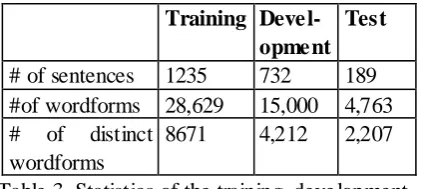
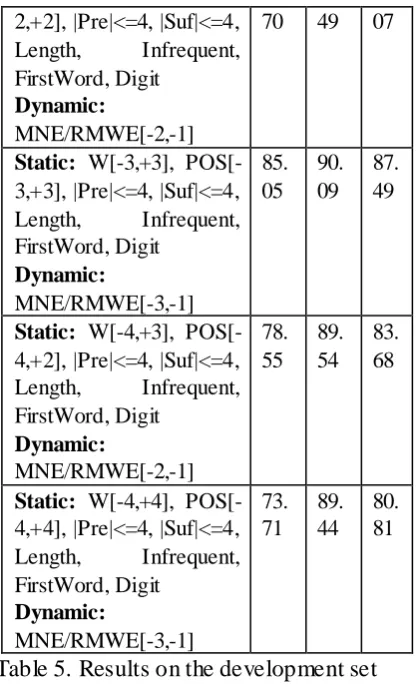
[image:6.595.306.523.69.229.2]The Table 3 gives the statistics of training, development and test sets. The various nota-tions used in the experiments are presented in Table 4. The Table 5 shows the recall (R), pre-cision (P) and F-Score (FS) in percentage in the development set.
Table 3. Statistics of the training, development and test sets
Notation Meaning
W[-i,+j] Words spanning from the ith left position to the jth right position POS[-i, +j] POS tags of the words spanning
from the ith left to the jth right positions
Pre Prefix of the word Suf Suffix of the word
[image:6.595.307.516.255.727.2]NE [-i, -j] NE tags of the words spanning from the ith left to the jth left positions
Table 4. Meaning of the notations
Feature R
% P %
FS % Static: W[-2,+2],
POS[-2,+2], |Pre|<=3, |Suf|<=3, Length, Infrequent, FirstWord, Digit
Dynamic:
MNE/RMWE[-2,-1]
94. 26
96. 72
95. 47
Static: W[-3,+3], POS[-3,+3], |Pre|<=3, |Suf|<=3, Length, Infrequent, FirstWord, Digit
Dynamic:
MNE/RMWE[-3,-1]
88. 23
94. 82
91. 40
Static: W[-3,+2], POS[-3,+2], |Pre|<=3, |Suf|<=3, Length, Infrequent, FirstWord, Digit
Dynamic:
MNE/RMWE[-3,-1]
90. 32
93. 18
91. 72
Static: W[-4,+3], POS[-4,+3], |Pre|<=3, |Suf|<=3, Length, Infrequent, FirstWord, Digit
Dynamic:
MNE/RMWE[-2,-1]
88. 15
92. 62
90. 32
Static: W[-4,+3], POS[-4,+3], |Pre|<=3, |Suf|<=3, Length, Infrequent, FirstWord, Digit
Dynamic:
MNE/RMWE[-3,-1]
86. 24
92. 31
89. 17
Static: W[-2,+2], POS[- 88. 91. 90.
Training Deve l-opment
Test
# of sentences 1235 732 189 #of wordforms 28,629 15,000 4,763 # of distinct
wordforms
[image:6.595.78.289.598.692.2]2,+2], |Pre|<=4, |Suf|<=4, Length, Infrequent, FirstWord, Digit
Dynamic:
MNE/RMWE[-2,-1]
70 49 07
Static: W[-3,+3], POS[-3,+3], |Pre|<=4, |Suf|<=4, Length, Infrequent, FirstWord, Digit
Dynamic:
MNE/RMWE[-3,-1]
85. 05
90. 09
87. 49
Static: W[-4,+3], POS[-4,+2], |Pre|<=4, |Suf|<=4, Length, Infrequent, FirstWord, Digit
Dynamic:
MNE/RMWE[-2,-1]
78. 55
89. 54
83. 68
Static: W[-4,+4], POS[-4,+4], |Pre|<=4, |Suf|<=4, Length, Infrequent, FirstWord, Digit
Dynamic:
MNE/RMWE[-3,-1]
73. 71
89. 44
80. 81
Table 5. Results on the development set
7
Results on the Test Set
The best feature set (F) of Manipuri MNER and RMWE is identified as F=[prefixes and suffixes of length upto three characters of the current word, dynamic NE tags of the previous two words, POS tags of the previous two and next two words, digit information, length of the word]. After the selection of the best feature set, the SVM based system for MNE and RMWEs is tested on the test set of 4,763 wordforms.
Reduplicated MWE type
Recall %
Precision %
F-Score %
Complete and mimic
96.21 95.12 95.66
Partial 88.32 85.03 86.64
Echo 97.76 96.45 97.10
Double 93.23 94.23 93.72
Semantic 74.45 81.56 77.84
Table 6. Result on RMWE test set
In this work, SVM that parses from left to right is considered. The break-up of the RMWEs and the scores are given in Table 6. The handling of semantic RMWEs requires fur-ther investigation to improve the performance. The rule based RMWE identification (Kishorjit and Bandyopadhyay, 2010) shows a recall, pre-cision and F-Score of 94.24%, 82.27% and 87.68% respectively.
Multiword NE
Recall %
Precision %
F-Score %
Person 94.21 95.12 94.66
Location 94.32 95.03 94.67 Organization 95.76 93.45 94.59 Miscellaneous 92.23 91.23 91.72 Table 7. Result on MNE test set
It is observed that the SVM based system outperforms the rule based system. Table 7 shows the break-up scores of different types of MNEs and Table 8 shows the overall scores of MNE and RMWE.
Recall %
Precision %
F-Score %
MNE 94.82 93.12 93.96
RMWE 94.62 93.53 94.07
Table 8. Overall recall, precision and F-Scores on test set
8
Conclusion
identification shows a recall, precision and F-Score of 94.24%, 82.27% and 87.68% respec-tively. The overall performance of the system shows reasonable output for both MNE and RMWE.
References
Bharati, A., Sharma, D. M., Chaitanya, V., Ku lka rni, A. P., & Sangal, R., 2001. LERIL: Collaborative effort fo r creating le xica l resources. In Proceed-ings of the 6th NLP Pacific Rim Symposium
Post-Conference Work shop, Japan.
Dandapat, S., M itra, P., and Sarkar, S., 2006. Statistical investigation of Bengali noun-verb (N-V) collocations as multi-word-e xprmulti-word-essions, In Proceedings of Modeling and
Shallow Parsing of Indian Languages (MSPIL),
Mumbai, pp 230-233
Ekbal, A., and Bandyopadhyay, S., 2008. A web based Bengali news corpus for Named Entity Recognition, Lang Resources & Evaluation
(2008) 42:173–182, Springer
Fletcher, W. H., 2001. Concordancing the web with KWiCFinder. In Proceedings of the Third North American Symposium on Corpus Linguistics and
Language Teaching, Boston, MA, 23–25 March
2001.
Fletcher, W. H., 2004. Making the web more use-ful as source for linguists corpora. In U. Conor & T. A. Upton (Eds.), Applied corpus linguists: A
mul-tidimensional perspective (pp. 191–205). A
mster-dam: Rodopi.
Kilgarriff, A., and Grefenstette, G., 2003. Introduc-tion to the special issue on the web as corpus.
Computational Linguistics, 29(3), 333– 347.
Kishorjit, N., and Bandyopadhyay, S., 2010. Ident i-fication of Reduplicated MWEs in Manipuri: A Rule Based Approch, In proceedings of 23rd International Conference on the Computer Processing of Oriental Languages (ICCPOL 2010) - New Generation in Asian Information
Processing , Red mond City, CA
Kunchukuttan, A., and Damani, O. P., 2008. A Sys-tem for Co mpound Nouns Multiword Expression Extraction for Hindi, In Proceedings of 6th Inter-national conference on Natural Language
Processing (ICON 2008), Pune, India
Robb, T., 2003. Google as a corpus tool? ETJ
Journal, 4(1), Sp ring.
Rundell, M., 2000. The biggest corpus of all. Hu ma -nising Language Teaching, 2(3)
Singh. Chungkha m Y., 2000. Manipuri Gra mmar,
Rajesh Publications, Delhi, pp 190-204
Singh, Thoudam D., Ekba l, A., Bandyopadhyay, S. 2008. Manipuri POS tagging using CRF and SVM : A language independent approach, In
pro-ceeding of 6th International conference on Natural
Language Processing (ICON -2008), Pune, India,
pp 240-245
Singh, Thoudam D., Kishorjit, N., Ekbal, A., Ban-dyopadhyay, S., 2009. Na med Entity Recognition for Manipuri using Support Vector Machine, In
proceedings of 23rd Pacific Asia Conference on
Language, Information and Computation (
PAC-LIC 23), Hong Kong, pp 811-818
Singh, Thoudam D., Singh, Yengkho m R. and Ban-dyopadhyay, S., 2010. Manipuri-English Se mi Automatic Pa ralle l Co rpora Ext raction fro m Web,
In proceedings of 23rd International Conference on the Computer Processing of Oriental La n-guages (ICCPOL 2010) - New Generation in
Asian Information Processing , Redmond City,
CA