Automated Evaluation of Scientific Writing:
AESW Shared Task Proposal
Vidas Daudaraviˇcius VTeX
Mokslininku st. 2a Vilnius, Lithuania
Abstract
The goal of the Automated Evaluation of Sci-entific Writing (AESW) Shared Task is to an-alyze the linguistic characteristics of scientific writing to promote the development of auto-mated writing evaluation tools that can assist authors in writing scientific papers. The pro-posed task is to predict whether a given sen-tence requires editing to ensure its “fit” with the scientific writing genre. We describe the proposed task, training, development, and test data sets, and evaluation metrics.
Quality means doing it right when no one is looking.
– Henry Ford 1 Introduction
De facto, English is the main language for writ-ing and publishwrit-ing scientific papers. In reality, the mother-tongue of many scientists is not English. Writing a scientific paper is likely to require more effort for researchers who are nonnative English speakers compared to native speakers. The lack of authoring support tools available to nonnative speakers for writing scientific papers in English is a formidable barrier nonnative English-speaking au-thors who are trying to publish, and this is becoming visible in academic community. Many papers, af-ter acceptance to journals, require improvement in overall writing quality which may be addressed by publishers. However, this is not the case with most conference proceedings.
The vast number of scientific papers being au-thored by nonnative English speakers creates a large demand for effective computer-based writing tools
to help writers compose scientific articles. Several shared tasks have been organized (Dale and Kil-garriff, 2011; Dale et al., 2012; Ng et al., 2013; Ng et al., 2014) which constituted a major step toward evaluating the feasibility of building novel grammar error correction technologies. English lan-guage learner (ELL) corpora were made available for research purposes (Dahlmeier et al., 2013; Yan-nakoudakis et al., 2011). An extensive overview of the feasibility of automated grammatical error de-tection for language learners was conducted by Lea-cock et al. (2010). While these achievements are critical for language learners, we also need to de-velop tools that support genre-specific writing fea-tures. The shared task proposed here focuses on the genre of scientific writing.
Above and beyond correct use of English conven-tions, the genre of scientific writing is characterized by features, including, but not limited to declara-tive voice, and appropriate academic and discipline-specific terminology. There are many issues for writers that are not necessarily related to grammar issues such as, vocabulary usage, and correct word and phrase order among other issues. In addition, many ELL writers have a different way of thinking and reasoning in their native language which may be reflected in their writing. For instance, it is likely that ELLs and native English (EN) writers would write the same text in different ways:
1. ELL ”Completely different role of elastic inter-action occurs due to local variations in the strain field...”
EN ”Elastic interaction takes on a completely
different role with local variations in the strain field...”
2. ELL ”The method is straightforward and concise, and its applications is promising.”
EN ”The method is straightforward and concise, and it holds promise for many applications.”
The difference in the readability and the fluency of texts due to grammatical errors is apparent.
The task of automated writing evaluation applied to scientific writing is critical, but it is not well stud-ied because no data for research have been avail-able until recently when the dataset of language ed-its of scientific texts was published (Daudaravicius, 2014).
On the other hand, some scientists propose to use Scientific Globish versus scientific English (Ty-chinin and Kamnev, 2013). The term ‘Globish’ de-notes the international auxiliary language proposed by Jean-Paul Nerri`ere, which relies on a vocabulary of 1500 English words and a subset of standard En-glish grammar1. The proposed adoption of ‘ scien-tific Globish’ as a simplified language standard may appeal to authors who have difficulty with English proficiency. However,Globishmight lead to further deterioration of the quality of English-language sci-entific writing, and, in general, it cannot be a reason-able direction. Therefore, we propose theautomated evaluation of scientific writingshared task.
2 Language Quality in Scientific Discourse In this section, we define the concept of language qualityand provide examples of previous work that has evaluated scientific writing.
2.1 Definition
While writers may have proficiency in English, they may still struggle to be effective writers in the genre of scientific writing. The concept of ‘quality’ in scientific discourse is ill-defined. For instance, a student in a seventh-grade science classroom asked a question ‘Maestro, what is quality?’ during an experiment engaging students to address two ques-tions: “What is the quality of air in my community?” and “What is the quality of water in our river?”
1See: http://en.wikipedia.org/wiki/Globish (Nerriere)
(Moje et al., 2001). The student was asking, “What do you mean when you talk about quality?” As a result of this question, Maestro Tomas spent a class period working on what it meant to refer to quality, especially in science, and how scientists determined
quality. In the most explicit discussion, Maestro Tomas told the students thatqualitydiffers depend-ing on one’s purpose, one’s background, and one’s position (e.g., as a scientist, an activist, an industri-alist, a community member).
We find that the concept of academic language
and the concept ofthe language of academic writ-ingare different at a conceptual level. Krashen and Brown (2007) discuss the concept of academic guage proficiency. They argue that academic lan-guage proficiency consists of the knowledge of aca-demic language and specialized subject matter. The
academic language concept can be described as a proper use of discipline-specific and academic vo-cabulary to express topic and discourse structure.
2.2 Previous work: Scientific Writing Evaluation
The boundary problem forV(t, x)is of the form
(∂t+L−r)V(t, x) = 0, x > h, t < T; (1)
V(t, x) = 0, x≤h, t≤T; (2) V(T, x) = G(x), x > h. (3)
Boyarchenko and Levendorskiˇi (BLbook; BLAAP02) derived the generalization of the Black– Scholes equation 1 under a weak regularity condition: the process (t, Xt) in 2D satisfies the (ACP) condition (for the definition, see e.g. (Sa)). Note that the (ACP) condition is satisfied if the processX has a transition density. Equation 1 is understood in the sense of the theory of generalized functions: for any infinitely smooth functionuwith compact support
suppu⊂(−∞, T)×(h,+∞),
(V,(−∂t+ ˜L−r)u)L2= 0, (4)
whereL˜is the infinitesimal generator of the dual process.
Figure 1: A short example of common academic text writing (from (Kudryavtsev and Levendorskiˇı, 2009)).
The boundary problem for MATH is of the form MATHDISP . Boyarchenko and Levendorskii CITE derived the C
generalization of the Black–Scholes equation ( REF ) under a weak regularity condition: the process MATH in 2D C
satisfies the (ACP) condition (for the definition, see e.g. CITE ). Note that the (ACP) condition is satisfied if the C
process MATH has a transition density. Equation ( REF ) is understood in the sense of the theory of generalized C
functions: for any infinitely smooth function MATH with compact support MATH , MATHDISP , where C
MATH is the infinitesimal generator of the dual process.
Figure 2: The transformation of the text in Fig 1 using named entities.
insights about translation issues/errors on different levels of granularity up to the word or phrase level as input for systematic approaches to overcome trans-lation quality barriers. MQM framework does not provide a translation quality metric, but rather pro-vides a framework for defining task-specific transla-tion metrics. MQM describes three typical layers of annotation in MT development:
– the phenomenological level (target errors/is-sues);
– the linguistic level (source or target POS, phrases, etc.);
– the explanatory level (source/system-related causes for certain errors).
A wide range of translation quality evaluation as-pects show that the field is growing, and more efforts needed to solve many issues of translation quality evaluation.
3 The Language of Scientific Texts
Some elements of scientific writing that are distinct from other genres of writing, include, but are not limited to the following:
– Formal notations, e.g.f(x) = cos(x).
– Extensive mathematical expressions which can be independent sentences or a continuation of a preceding sentence, see example in Fig 1.
– Discipline-specific terminology. – Citations.
– Section headers.
– References to other elements of a paper, which are of logical relation only. The scientific writ-ing is highly multidimensional compared to lin-ear daily language.
– Lists and enumerations.
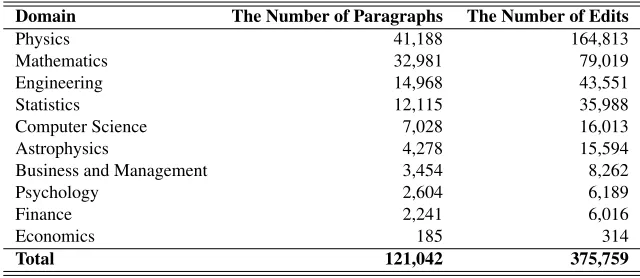
Domain The Number of Paragraphs The Number of Edits
Physics 41,188 164,813
Mathematics 32,981 79,019
Engineering 14,968 43,551
Statistics 12,115 35,988
Computer Science 7,028 16,013
Astrophysics 4,278 15,594
Business and Management 3,454 8,262
Psychology 2,604 6,189
Finance 2,241 6,016
Economics 185 314
[image:4.612.145.465.57.196.2]Total 121,042 375,759
Table 1: Main characteristics of the training dataset.
– Figures are also used as the continuation of sen-tences, though not so frequently.
– Hypertext references.
4 The Task Objectives and Definition The objectives of the AESW Shared Task are to pro-mote the use of NLP tools to help ELL writers the quality of their scientific writing.
In the scope of the task, the main goals are:
– to identify sentence-level features that are unique to scientific writing;
– to provide a common ground for development and comparison of sentence-level automated writing evaluation systems for scientific writ-ing;
– to establish the state-of-the-art performance in the field.
Some interesting uses of sentence-level quality eval-uations are the following:
– automated writing evaluation of submitted sci-entific articles;
– authoring tools in writing English scientific texts;
– filtering out sentences that need quality im-provement.
The task will examine automated evaluation of scientific writing at the sentence-level by using the output of the professionally edited scientific texts,
which are text extracts before and after editing (by native English speakers).
The goal of the task is to predictwhether a given sentence needs for any kind of editing to improve it. The task is a binary classification task. Two cases of decisions are examined: binary decision (False or True) and probabilistic estimation (between 0 and 1).
5 Data
5.1 The Editing Process
This section describes the role of the professional language editors who completed the data editing de-scribed in Section 5.3.Language editorsare defined as individuals who performproofreading(see Smith (2003)). There are no standards that define language quality. The language editors use best practices, for instance (see Society for Editors and Proofreaders (2015)).
Language editors edited selected papers as part of publishing service. Each edited paper has two ver-sions: textbeforeandafter editing. Language edi-tors do their best to improve writing quality within the limited time span. In this data set, however, there was no double-annotation for quality control. We es-timate that approximately 20% of the data may still contain errors, and also that there may be errors in the editors edits.
5.2 Tex2TXT
We use the open-source tooltex2txt2for the
con-version from LATEX to text, which was developed
<par pid=”9” domain=”Physics”> <edits>
<edit originalParOffset=”7” editedParOffset=”7” type=”replaced”> <original>ultimately</original>
<edited>finally</edited> </edit>
</edits>
<sentence type=”original” sid=”9.0”>Let us ultimately insist on the fact that the expression in the right hand side MATH is a function of MATH due to the action of the shift and is therefore a different function than MATH .</sentence>
<sentence type=”edited” sid=”9.1”>Let us finally insist on the fact that the expression in the right hand side MATH is a function of MATH due to the action of the shift and is therefore a different function than MATH .</sentence>
<sentence type=”nonedited” sid=”9.2”>Only the expectations of both expressions of Eq. ( REF ) are equal.</sentence> </par>
Figure 3: Training data example of the paragraph annotation with data before language editing, after language editing, and the difference.
<par pid=”9” domain=”Physics”>
<sentence sid=”9.0”>Let us ultimately insist on the fact that the expression in the right hand side MATH is a func-tion of MATH due to the acfunc-tion of the shift and is therefore a different funcfunc-tion than MATH . </sentence>
<sentence sid=”9.1”>Only the expectations of both expressions of Eq. ( REF ) are equal.</sentence> </par>
Figure 4: A sample from the test data.
specifically for this task. The tool is stand-alone and does not require any other LATEX processing tools or
packages. The primary goal was to extract the cor-rect textual information.
5.3 The Data Set
The data set is the collection of text extracts from more than 4,000 published journal articles (mainly from physics and mathematics)beforeandafter lan-guage editing. The data were edited by profes-sional editors (per above) who were native English speakers3. Editing includes grammar error
correc-tions, text cleaning, rephrasing, spelling correction, stylistics, and sentence structure corrections. Each extract is a paragraph which contains at least one
3VTeX provides LATEX-based publishing solutions and data
services to the scientific community and science publishers. Publishers often request language editing services for papers ac-cepted for publication. The data of our proposed shared task are based on selected papers published in 2006–2009 by Springer publishing company and edited at VTeX by professional lan-guage editors.
edit done by language editor. All paragraphs in the dataset were randomly ordered for the source text anonymization purpose. The distribution of para-graphs and edits are presented in Table 1.
Sentences were tokenized automatically, and then both versions – textsbeforeandafterediting – auto-matically aligned with a modifieddiffalgorithm. Each sentence is annotated as either ‘original’, or ‘edited’, or ‘nonedited’. Non-editedsentences con-tained no errors. Theoriginal text– the text before language editing – can be restored simply by delet-ing sentences that are annotated as ‘edited’. Also, the edited text can be restored simply by deleting sentences that are annotated as ‘original’.
Figure 3 for an example of annotated training data.
The training data will include annotations to show differences between the ‘original’ and ‘edited’ texts. The ‘edits’ data are used for a quick reference to what the changes are.
The development data: An additional 5,000 paragraphs similar to test data will be provided. The development data set will be comprised of a set of articles that are independent from articles used for compiling the training and test sets. The development data will be distributionally similar to training data and test data with regard to edited and non-edited sentences, and domain.
The test data: An additional 5,000 paragraphs will be provided for testing the registered sys-tems of the AESW Shared Task. The test data set will be comprised of a set of articles that are independent from articles used for compil-ing the traincompil-ing and development sets. Test para-graphs will retain ‘original’ and ‘nonedited’ ver-sions only. The ‘edited’ sentence version will be removed. The test data anotation will be similar to training and development data. However, no data about edits and sentence class will be pro-vided until submission of system results. See an example in Figure 4.
Shared Task participating teams will be allowed to use external data that are publicly available. Teams will not be able to use proprietary data. Use of ex-ternal data should be specified in the final system report.
6 The Task and Evaluation
The task is to predict the class of a test sentence: ‘original’ or ‘edited’. In Section 2, we saw that both Boolean and probabilistic prediction are used for various tasks. Therefore, there will be two tracks of the task:
Boolean Decision: The prediction of whether a test sentence is edited (TRUE), or before editing and corrections are needed (FALSE).
Probabilistic Estimation: The probability esti-mation of whether a test sentence is edited (P =
0), or before editing and corrections are needed (P = 1).
Participating teams will be allowed to submit up to two system results for each track. In total, a max-imum of four system results will be accepted. All participating teams are encouraged to participate in both tracks.
The primary goal of the task is to predict ‘origi-nal’ sentences with poor writing quality. Each reg-istered system will be evaluated with a Detection score, which is described below.
6.1 Detection score
The score will be an F-score of ‘original’ class pre-diction. The score will be computed for both tracks individually. For the Boolean decision track, a gold standard sentenceGi is considered detected if there
is an alignment in the set that containsGi. We
calcu-latePrecision(P) as the proportion of the sentences that were ‘original’ in the gold standard:
Pbool = #Sentence#Sentencedetected
spurious+ #Sentencedetected.
Similarly,Recall(R) will be calculated as:
Rbool = ##SentenceSentencedetected gold .
Thedetection scoreis the harmonic mean (F-score):
DetectionScorebool = 2·PPbool ·Rbool bool +Rbool.
For the probabilistic estimation track, the Mean squared error (MSE) will be used. A gold standard sentenceGiis assigned to 1 if it is ‘original’, and to
0 if it is ’nonedited’. A gold standard sentenceGiis
considered detected if there is correlation in the set that containsGi. We calculatePrecisionas the MSE
of the sentencesEithat were estimated as ‘original’,
i.e., their estimated probability is above 0.5:
Pprob = 1−n1
n
X
i=1
(Ei, >0.5 −Gi)2.
The higher thePprobthe better the system is.
Sim-ilarly, we calculateRecall as the MSE of the sen-tencesGithat were ‘original’ in the gold standard:
Rprob = 1−n1
n
X
i=1
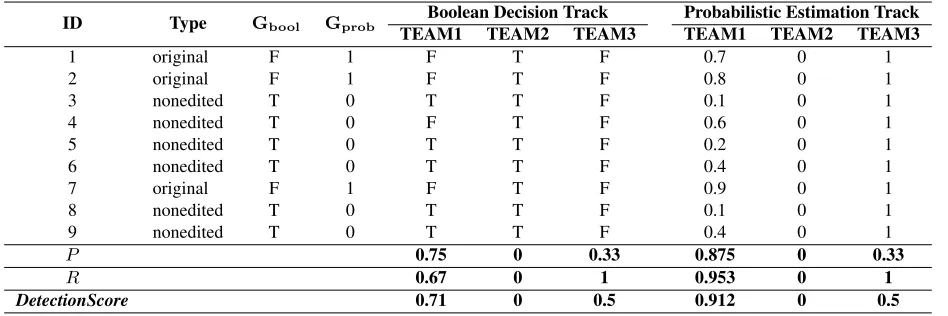
ID Type Gbool Gprob TEAM1Boolean Decision TrackTEAM2 TEAM3 Probabilistic Estimation TrackTEAM1 TEAM2 TEAM3
1 original F 1 F T F 0.7 0 1
2 original F 1 F T F 0.8 0 1
3 nonedited T 0 T T F 0.1 0 1
4 nonedited T 0 F T F 0.6 0 1
5 nonedited T 0 T T F 0.2 0 1
6 nonedited T 0 T T F 0.4 0 1
7 original F 1 F T F 0.9 0 1
8 nonedited T 0 T T F 0.1 0 1
9 nonedited T 0 T T F 0.4 0 1
P 0.75 0 0.33 0.875 0 0.33
R 0.67 0 1 0.953 0 1
[image:7.612.72.546.59.217.2]DetectionScore 0.71 0 0.5 0.912 0 0.5
Table 2:DetectionScorecalculation example.
The harmonic mean DetectionScoreprob is
calcu-lated similarly as DetectionScorebool. The higher
theDetectionScoreprobthe better the system is. An
example of score calculation is shown in Table 2. 7 Report submission
The authors of participant systems are expected to submit a shared task paper describing their system. The task papers should be 4-8 pages long and con-tain a detailed description of the system and any fur-ther insights.
Acknowledgments
We would like to thank the Springer publishing com-pany for permission to publish a large number of text extracts from published scientific papers. We appre-ciate the support and help in improving writing qual-ity and organization of this paper from Building Ed-ucational Applications (BEA) workshop organisers. And special thanks to Joel Tetreault for the discus-sions and valuable suggestions. This work has been partially supported by EU Structural Funds admin-istrated by the Lithuanian Business Support Agency (Project No. VP2-1.3-UM-02-K-04-019).
References
Allan Berrocal Rojas and Gabriela Barrantes Sliesarieva. 2010. Automated detection of language issues af-fecting accuracy, ambiguity and verifiability in soft-ware requirements written in natural language. In Pro-ceedings of the NAACL HLT 2010 Young Investiga-tors Workshop on Computational Approaches to
Lan-guages of the Americas, pages 100–108, Los Angeles, CA.
Aljoscha Burchardt, Kim Harris, Alan K. Melby, and Hans Uszkoreit, 2015. Multidimensional Quality Met-rics (MQM) Definition. Version 0.3.0 (2015-01-20), http://www.qt21.eu/mqm-definition/definition-2015-01-20.html.
Daniel Dahlmeier, Hwee Tou Ng, and Siew Mei Wu. 2013. Building a large annotated corpus of learner English: The NUS Corpus of Learner English. In Pro-ceedings of the Eighth Workshop on Innovative Use of NLP for Building Educational Applications, pages 22– 31, Atlanta, GA, June.
Robert Dale and Adam Kilgarriff. 2011. Helping Our Own: The HOO 2011 Pilot Shared Task. In Pro-ceedings of the Generation Challenges Session at the 13th European Workshop on Natural Language Gen-eration, pages 242–249, Nancy, France.
Robert Dale, Ilya Anisimoff, and George Narroway. 2012. HOO 2012: A report on the Preposition and Determiner Error Correction Shared Task. In
Proceedings of the Seventh Workshop on Building Educational Applications Using NLP, pages 54–62, Montr´eal, Canada.
Vidas Daudaravicius. 2014. Language editing dataset of academic texts. InProceedings of the Ninth Interna-tional Conference on Language Resources and Evalu-ation (LREC’14), Reykjavik, Iceland. European Lan-guage Resources Association (ELRA).
F. Fabbrini, M. Fusani, S. Gnesi, and G. Lami. 2001. An automatic quality evaluation for natural language requirements. In Proceedings of the Seventh Inter-national Workshop on RE: Foundation for Software Quality (REFSQ2001), pages 4–5.
Oleg Kudryavtsev and Sergei Levendorskiˇı. 2009. Fast and accurate pricing of barrier options under L´evy pro-cesses. Finance and Stochastics, 13(4):531–562. Claudia Leacock, Martin Chodorow, Michael Gamon,
and Joel Tetreault. 2010. Automated Grammatical Error Detection for Language Learners. Morgan and Claypool.
G. Miller, R. Beckwith, C. Fellbaum, D. Gross, and K. Miller. 1993. Introduction to WordNet: An online lexical database. Technical report.
Elizabeth B. Moje, Tehani Collazo, Rosario Carrillo, and Ronald W. Marx. 2001. “Maestro, what is ‘qual-ity’?”: Language, literacy, and discourse in project-based science. Journal of Research in Science Teach-ing, 38(4):469–498.
Hwee Tou Ng, Siew Mei Wu, Yuanbin Wu, Chris-tian Hadiwinoto, and Joel Tetreault. 2013. The CoNLL-2013 Shared Task on Grammatical Error Cor-rection. In Proceedings of the Seventeenth Confer-ence on Computational Natural Language Learning: Shared Task, pages 1–12, Sofia, Bulgaria.
Hwee Tou Ng, Siew Mei Wu, Ted Briscoe, Christian Hadiwinoto, Raymond Hendy Susanto, and Christo-pher Bryant. 2014. The CoNLL-2014 Shared Task on Grammatical Error Correction. In Proceedings of the Eighteenth Conference on Computational Natural Language Learning: Shared Task, pages 1–14, Balti-more, MD, USA.
Olga Ormandjieva, Ishrar Hussain, and Leila Kosseim. 2007. Toward a text classification system for the qual-ity assessment of software requirements written in nat-ural language. In Fourth International Workshop on Software Quality Assurance: In Conjunction with the 6th ESEC/FSE Joint Meeting, SOQUA ’07, pages 39– 45, New York, NY, USA. ACM.
Karin Kipper Schuler. 2005. Verbnet: A Broad-coverage, Comprehensive Verb Lexicon. Ph.D. thesis, Philadelphia, PA, USA.
B. Smith. 2003.Proofreading, Revising & Editing Skills Success in 20 Minutes a Day. Learning Express Li-brary. Learning Express.
Society for Editors and Proofreaders, 2015. Ensur-ing editorial excellence: The SfEP code of practice. http://www.sfep.org.uk/pub/bestprac/cop5.asp. Dmitry N. Tychinin and Alexander A. Kamnev. 2013.
Scientific Globish versus scientific English. Trends in Microbiology, 21(10):504–505.