Learning Distributed Representations for Multilingual Text Sequences
Hieu Pham Minh-Thang Luong Christopher D. Manning Computer Science Department Stanford University, Stanford, CA, 94305
{hyhieu,lmthang,manning}@stanford.edu
Abstract
We propose a novel approach to learning dis-tributed representations of variable-length text sequences in multiple languages simultane-ously. Unlike previous work which often de-rive representations of multi-word sequences as weighted sums of individual word vec-tors, our model learns distributed representa-tions for phrases and sentences as a whole. Our work is similar in spirit to the recent paragraph vector approach but extends to the bilingual context so as to efficiently encode meaning-equivalent text sequences of multi-ple languages in the same semantic space. Our learned embeddings achieve state-of-the-art performance in the often used crosslingual document classification task (CLDC) with an accuracy of92.7 for English to German and
91.5 for German to English. By learning text sequence representations as a whole, our model performs equally well in both classifi-cation directions in the CLDC task in which past work did not achieve.
1 Introduction
Distributed representations of words, also known as word embeddings, are critical components of many neural network based NLP systems. Such represen-tations overcome the sparsity of natural languages by representing words with high-dimensional vec-tors in a continuous space. These vecvec-tors encode semantic information of words, leading to success in a wide range of tasks, such as sequence tag-ging, sentiment analysis, and parsing (Collobert et al., 2011; Maas et al., 2011; Socher et al., 2013a;
Chen and Manning, 2014). As a natural extension, being able to learn representations for larger lan-guage structures such as phrases or sentences, has also been of interest to the community lately, for in-stance (Socher et al., 2013b; Le and Mikolov, 2014). In the multilingual context, most of the recent work in bilingual representation learning such as (Klementiev et al., 2012; Mikolov et al., 2013b; Zou et al., 2013; Hermann and Blunsom, 2014; Koˇcisk´y et al., 2014; Gouws et al., 2014) only focus on learn-ing embeddlearn-ings for words and use simple functions, e.g., idf-weighted sum, to synthesize representations for larger text sequences from their word members. In contrast, our work aims to learn representations for phrases and sentences as a whole so as to repre-sent non-compositional meanings.
In essence, we extend the paragraph vector ap-proach proposed by Le and Mikolov (2014) to the bilingual context to efficiently encode meaning-equivalent multi-word sequences in the same seman-tic space. Our method only utilizes parallel data and eschews the use of word alignments. When tested on the often used crosslingual document classification (CLDC) tasks, our learned embeddings yield state-of-the-art performance with an accuracy of92.7for English to German and91.5for German to English. One notable feature of our model is that it performs equally well in both classification directions in the CLDC task in which past work did not achieve as we detail later in the experiment section.
2 Related work
Word representations – Work in learning dis-tributed representations for words can largely be
grouped into two categories: (a) pseudo-supervised methods which make use of properties in the unan-notated training data as supervised signals and (b) task-specific approaches that utilizes annotated data to learn a prediction task. For the former, word embeddings are often part of neural language mod-els that learn to predict next words given contexts by either minimizing the cross-entropy (Bengio et al., 2003; Morin, 2005; Mnih and Hinton, 2009; Mikolov et al., 2010; Mikolov et al., 2011) or max-imizing the ranking margins (Collobert and Weston, 2008; Huang et al., 2012; Luong et al., 2013). Rep-resentatives for the latter include (Collobert and We-ston, 2008; Maas et al., 2011; Socher et al., 2013a) which finetune embeddings for various tasks such as sequence labelling, sentiment analysis, and con-stituent parsing.
Larger structure representations– Learning dis-tributed representation for phrases and sentences is harder because one needs to learn both the com-positional and non-comcom-positional meanings beyond words. A method that learns distributed represen-tations of sentences, which is closely related to our approach, is the paragraph vector by Le and Mikolov (2014). The method attempts to predict words in
N-grams of a sentence, given the same shared sen-tence vector. Errors are backpropagated to train not only the word vectors but also the sentence vector. This method has an advantage that it only requires training data to be sequences of words unlike other work that require annotated data such as parse trees (Socher et al., 2013b; Socher et al., 2013a).
Multilingual embedding– Previous work to learn-ing multillearn-ingual distributed representations, often optimize for a joint objective consisting of several monolingual components, such as neural language models, and a bilingual component to tie representa-tions across languages together. The bilingual objec-tive varies through different approaches and can be formulated as either a multi-task learning objective (Klementiev et al., 2012), a translation probability (Koˇcisk´y et al., 2014), or anL2 distance of various forms between corresponding words (Mikolov et al., 2013b; Zou et al., 2013; Gouws et al., 2014).
The work of Hermann and Blunsom (2014) and Chandar A P et al. (2014) are similar to our work in eliminating the monolingual components and just training a model with bilingual objective to pull
distributed representations of parallel sentences to-gether. These approaches, however, only use sim-ple bag-of-word models to compute sentence repre-sentations and has a potential disadvantage that it is hard to capture the non-compositional meanings of sentences. Instead, we learn representations for text sequences as a whole, similar to Le and Mikolov (2014), but in the bilingual context.
3 Joint-space bilingual embedding
In this section, we describe our method to learn the distributed representations of sentences from two languages given a parallel corpus. Our learned representations have the property that sequences of words with equivalent meanings across different lan-guages will have their representations clustered to-gether in the shared semantic space. We call this property the clustering constraint.
Our method is based on the following assump-tions observed by (Le and Mikolov, 2014): the dis-tributed representation vector of a sequence of words can contribute its knowledge to predict theN-grams in the sequence, and conversely, if a vector can con-tribute well to the task, then one can think of it as the representation of the sequence. Since the assump-tion is not made specific to any language, we gener-alize it to learn the distributed representation of word sequences in multiple languages. However, instead of duplicating the representations to have one vector per sentence per language, we simply force parallel sentences in the languages of consideration to share only one vector. This allows us to avoid a bilingual term in our learning objective function to cluster the corresponding vectors together.
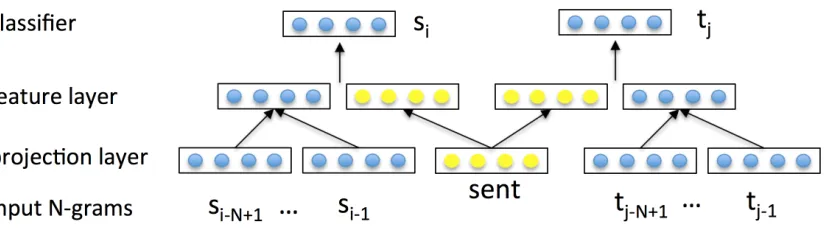
Figure 1 illustrates the architecture of our model. Each word in each language is associated with a
D-dimensional vector, whereas each parallel sen-tence is tied to the same sensen-tence vector of di-mension P. These word and sentence vectors are used to predict N-grams in both of the sen-tences. More precisely, suppose that s1, s2, ..., sS andt1, t2, ..., tT are our two parallel sentences that share the same sentence representationv. For every
N-gram[wi−N+1, wi−N+2, ..., wi], wherewcan be eithersort, our model computes theN-gram prob-ability as follows
Figure 1: Our architecture to learn bilingual distributed representations of sentences. sent is the shared context that contributes to predictingN-grams in both sentences.
wheref is a feature vector computed based on the
N-gram and the shared sentence vectorv.
There are several ways to compute f. As pro-posed in (Le and Mikolov, 2014), one can either take the average of v and the word embeddings of
wi−N+1, wi−N+2, ..., wi−1 or concatenate them to formf. In the former “average” approach, one al-ways needsD=P, which implies that the contribu-tion ofvis less impactful as it needs to compete with the other(N −1)word representations in the aver-age term. In the latter “concatenate” approach, the dimension off isP+ (N−1)×D, which suggests that the model cannot afford to have large word em-bedding size or longerN-grams. To overcome both problems, we propose to concatenatevwith the sum of the word vectors in each of theN-grams. More precisely
f =
v; Xi−1
j=i−N+1
wj
(2)
This hybrid approach allows us the freedom to tune
DandP for our purpose.
There are also numerous approaches for the clas-sifier that predicts the next word. However, to op-timize for efficiency, we narrow our choices to the factorized multiclass classifier, also known as the hi-erarchical softmax (Morin, 2005). The words in the vocabulary of each language are represented as leaf-nodes of a binary tree. Each nodenof the tree has a vectorvp whose dimension is equal to that of the feature vectorf. These vectors encode the model’s belief whether a f belongs to the left or the right child ofn
p(go left|noden, f) =σ fT ·vn (3)
whereσ(·)is the logistic sigmoid function andvnis a vector associated to the noden. The probability of seeing a word is then factored into the product of probabilities of the node along the path from the tree’s root to the node corresponding to it.
At training time, pairs of parallel sentences are shown to the model for several epochs. The model maintains the shared sentence vectors and updates them, along with the word vectors and hierarchical softmax parameters of both languages, to minimize the cross-entropy prediction error
J =−X (s,t)
logp(s, t), (4)
where the probability of the pair of sentences(s, t)is computed simply based on the Markov assumption
p(s, t) =YS
i=1
p(si|si−N+1, ..., si−1)
×YT j=1
p(tj|tj−N+1, ..., tj−1) (5)
might potentially be a cause of nondeterminism if other models attempt to learn or classify based on these sentence vectors. However, our training objec-tive for eachN-gram has the form
JN-gram=−
X
n
log σ fT ·vn, (6)
Since σ(·) is log-concave, our training objective is convex. This guarantees a global minimum sen-tence embedding vector to which our sensen-tence vec-tors would converge. Moreover, at train time, the model has been trained to minimize the prediction errors of pairs of sentences that share the same sen-tence vector, its parameters have adapted to this manner. Hence, at test time, although two sentence vectors are learned independently, one can expect that they converge to close points in the shared se-mantic space.
4 Experiments
4.1 Training data and procedures
We attempt to learn the distributed representation for arbitrary sequences of words in English and Ger-man. We train our model using the Europarl v7multilingual corpora (Koehn, 2005), in particu-lar the English-German corpus. The corpus consists of multilingual parliament documents automatically aligned into1.8Mequivalent pairs of sentences. We preprocess the corpus by filtering out the tokens that appear less than5times and desegment the German compound words. This leads to the final set of43K
English words and95KGerman words.
Parameters of our model are updated using a gradient-based method. While for each pair of sen-tences, the prediction and N-grams and parameter updates are performed in sequence, our training im-plementation uses the multithreading approach to train through pairs of sentences in our training cor-pus in parallel and updates parameters with asyn-chronous gradient descent. Since our model predicts
N-gram probabilities, we tune our hyperparame-ters, includingP,Dand the learning rate, based on the model’s perplexity on the newstests devel-opment data provided by the Workshop in Machine Translation1.
1http://www.statmt.org/wmt15/
At the beginning of our training procedure, we use word2vec (Mikolov et al., 2013a) to guide our hierarchical softmax trees. In particular, first we precompute the distributed representations for all the tokens in all the languages and run the K-Means algorithm to classify our word vectors into
Cclasses based onL2 distance. Then, we sort each language’s vocabulary into contiguous strides of the same class. Finally, we construct our hierarchical softmax tree as the weight-balanced binary tree on each of the sorted vocab. The resulted hierarchi-cal softmax trees thus have the semantic informa-tion about the cluster of words held by each of its nodes, similar to the WordNet taxanomy tree (Fell-baum, 1998).
We performed experiments with different settings for the model’s architecture, such as the dimension
P of sentence vectors, Dof word vectors, and N -gram lengthN, and the learning rate. Our finding is thatP ≈5Dgenerally gives the best performance. Also we used the start learning rate of0.0001which decreases as the model is trained for more epochs. We trained all models for50 epochs. In Section 5, we will discuss the effect of the parametersP and
D. Following, we report our best experiment results, withP = 500,D= 100,N = 7andC= 500.
4.2 Document classification on RCV1/RCV2
We test the learned bilingual distributed representa-tions on the English-German Cross-Lingual Docu-ment Classification (CLDC, henceforth), proposed by (Klementiev et al., 2012). The corpus con-sists of documents from Reuter, written in English and German, annotated into 4 categories: Corpo-rate/Industrial, Economics, Government/Social, and Markets. The documents are separated into 1K
satisfy the clustering constraint mentioned in Sec-tion 3.
As in (Klementiev et al., 2012), the CLDC dataset was proposed to evaluate embeddings of words only, so we follow the author in using the document positional model where the document vector is com-puted by taking the sum of all embeddings of the words that appear in the document, weighted by their inverse document frequencies (idf). We refer to this method aspara sum. It demonstrates that the English and German word embeddings learned by our model indeed satisfy the clustering constraint. Our model achieves competitive classification result withpara sum.
However, our model has not only the word embeddings but also the capability of computing the distributed representation of arbitrary word se-quences, so we propose computing the document vectors in this manner. We call this method
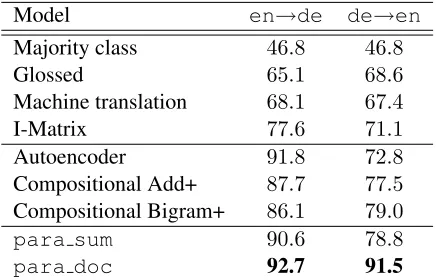
para doc. We find thatpara doc gives signif-icantly better results thanpara sum, especially on the de→endirection. In Table 1, we present our classification results on the CLDC task and compare them against strong baselines. Specifically, we first show the results of the original baselines in (Kle-mentiev et al., 2012), then we show the stronger baselines (Chandar A P et al., 2014; Hermann and Blunsom, 2014), which perform considerably bet-ter but the gains are uneven between en→de and
de→en. Finally, we show that our method works better than all these baselines. While para sum
outperforms the all the baselines but still with a significantly worse result in de→en, para doc
achieves better results and at once, avoids the asym-metry of all the other approaches.
5 Discussion
5.1 Symmetry of multilingual model
The key to succeed on the CLDC task is that equiv-alent documents in English and German should be mapped into similar points in the joint semantic space. This goal, however, is hard to achieve by us-ing the idf weighted sum of word vectors in docu-ments as proposed by (Klementiev et al., 2012). The major reason for this is perhaps due to the linguis-tic asymmetry between English and German. For example, verbs in German have more conjugations
Model en→de de→en
Majority class 46.8 46.8
Glossed 65.1 68.6
Machine translation 68.1 67.4
I-Matrix 77.6 71.1
Autoencoder 91.8 72.8
Compositional Add+ 87.7 77.5
[image:5.612.318.536.54.194.2]Compositional Bigram+ 86.1 79.0 para sum 90.6 78.8 para doc 92.7 91.5
Table 1: Performances on CLDC English-German. Each model is trained on one language and tested on the other one. The numbers reported are the per-centage of correctly predicted test documents. The first four baselines (Klementiev et al., 2012) are less sensitive to languages, so we do not observe large difference between the tasksen→deandde→en. Other methods that involve weighted sum of word vectors by (Chandar A P et al., 2014) and (Hermann and Blunsom, 2014) perform better onen→dethan on de→en. Our work bridges the gap and simul-taneously achieves state-of-the-art performance on both tasks.
than their English counterparts and there is gener-ally a large number of compound words in German. These phenomena are evidenced by the fact that the German vocab size is about twice of that of English (95K versus 43K) according to our training data. As a result, many German words appear less often, giving the model less opportunity to optimize for their representations. All these observations explain that it is inferior to simply represent documents as as weighted sum of the embeddings of their words. As highlighted in Table 1, methods that adopt the weighted average approach all suffer from the dis-crepancy betweenen→deandde→enCLDC re-sults. Note that such asymmetry also holds for our learned word vectors when we simply sum them up (thepara sumrow).
time, the same clustering constraint leads the doc-ument vectors computed by our model to be more symmetric than the weighted sum of word vectors. This symmetrization explains why our classification results on en→de andde→en using para doc
are about equally strong, and both are better than those ofpara sum.
5.2 Effects of embedding dimensions
10 15 20 25 30
0 20 40 60 80 100
epoch
de2en classification accuracy
[image:6.612.75.283.195.359.2]P=128 P=256 P=512 P=1024
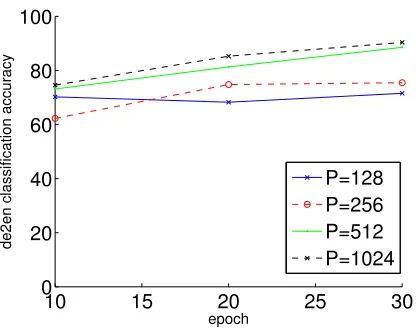
Figure 2: Test results for the de→en CLDC task across training epochs. LargerP gives better result while converging slower at test time.
We train four models on English-German data with withD= 128andP ∈ {128,256,512,1024} and compare their test performances as training pro-gresses. As demonstrated in Figure 2, models with larger P give better classification results (though they require more test iterations to converge to good sentence embeddings).
6 Conclusion
In summary, we have presented our novel approach to computing distributed representations of arbitrary word sequences in different languages from unan-notated parallel data. Our method achieves state-of-the-art performance on a bilingual benchmark be-tween English and German. We also gave our intu-itions to explain why the model works even though it is nondeterministic while computing sentence vec-tors at test time. Further intuitions also suggest that it is possible to incorporate new languages into the model without hurting the previously known one. In
the future, we plan to investigate the model’s capac-ity to learn embeddings in other languages, such as French.
Acknowledgment
We gratefully acknowledge support from a gift from Bloomberg L.P. and from the Defense Advanced Research Projects Agency (DARPA) Broad Oper-ational Language Translation (BOLT) program un-der contract HR0011-12-C-0015 through IBM. Any opinions, findings, and conclusions or recommen-dations expressed in this material are those of the author(s) and do not necessarily reflect the view of DARPA, or the US government. We also thank members of the Stanford NLP Group as well as the annonymous reviewers for their valuable comments and feedbacks.
References
Yoshua Bengio, Rejean Ducharme, Pascal Vincent, and Christian Jauvin. 2003. A neural probabilistic lan-guage model.JMLR, 3:1137–1155.
Sarath Chandar A P, Stanislas Lauly, Hugo Larochelle, Mitesh Khapra, Balaraman Ravindran, Vikas C Raykar, and Amrita Saha. 2014. An autoencoder ap-proach to learning bilingual word representations. In NIPS.
Danqi Chen and Christopher D Manning. 2014. A fast and accurate dependency parser using neural net-works. InEMNLP.
Ronan Collobert and Jason Weston. 2008. A unified ar-chitecture for natural language processing: deep neural networks with multitask learning. InICML.
Ronan Collobert, Jason Weston, Leon Bottou, Michael Karlen, Koray Kavukcuoglu, and Pavel Kuksa. 2011. Natural language processing (almost) from scratch. JMLR, 12:2493–2537.
Christiane Fellbaum. 1998. WordNet: An Electronic Lexical Database. Bradford Books.
Stephan Gouws, Yoshua Bengio, and Greg Corrado. 2014. Bilbowa: Fast bilingual distributed representa-tions without word alignments. InNIPS Deep Learn-ing Workshop.
Karl Moritz Hermann and Phil Blunsom. 2014. Multilin-gual Models for Compositional Distributional Seman-tics. InACL.
Alexandre Klementiev, Ivan Titov, and Binod Bhattarai. 2012. Inducing crosslingual distributed representa-tions of words. InCOLING.
Philipp Koehn. 2005. Europarl: A Parallel Corpus for Statistical Machine Translation. InMT Summit. Tom´aˇs Koˇcisk´y, Karl Moritz Hermann, and Phil
Blun-som. 2014. Learning Bilingual Word Representations by Marginalizing Alignments. InACL.
Quoc Le and Tomas Mikolov. 2014. Distributed repre-sentations of sentences and documents. InICML. Minh-Thang Luong, Richard Socher, and Christopher D.
Manning. 2013. Better word representations with re-cursive neural networks for morphology. InCoNLL. Andrew L. Maas, Raymond E. Daly, Peter T. Pham,
Dan Huang, Andrew Y. Ng, and Christopher Potts. 2011. Learning word vectors for sentiment analysis. InNAACL-HLT.
Tomas Mikolov, Martin Karafi´at, Lukas Burget, Jan Cer-nock´y, and Sanjeev Khudanpur. 2010. Recurrent neu-ral network based language model. InInterspeech. Tomas Mikolov, Stefan Kombrink, Lukas Burget, Jan
Cernock´y, and Sanjeev Khudanpur. 2011. Exten-sions of recurrent neural network language model. In ICASSP.
Tomas Mikolov, Kai Chen, Greg Corrado, and Jeffrey Dean. 2013a. Efficient estimation of word representa-tions in vector space. InICLR.
Tomas Mikolov, Quoc V. Le, and Ilya Sutskever. 2013b. Exploiting similarities among languages for machine translation. CoRR, abs/1309.4168.
Andriy Mnih and Geoffrey Hinton. 2009. A scalable hierarchical distributed language model. InNIPS. Frederic Morin. 2005. Hierarchical probabilistic neural
network language model. InAISTATS.
Richard Socher, John Bauer, Christopher D. Manning, and Andrew Y. Ng. 2013a. Parsing With Composi-tional Vector Grammars. InACL.
Richard Socher, Alex Perelygin, Jean Wu, Jason Chuang, Christopher D. Manning, Andrew Y. Ng, and Christo-pher Potts. 2013b. Recursive deep models for se-mantic compositionality over a sentiment treebank. In EMNLP.