Encoding a syntactic dictionary into a super granular unification
grammar
Sylvain Kahane
MoDyCo, CNRS/Universit´e Paris Ouest [email protected]
Franc¸ois Lareau OLST, Universit´e de Montr´eal [email protected]
Abstract
We show how to turn a large-scale syntactic dictionary into a dependency-based unification mar where each piece of lexical information calls a separate rule, yielding a super granular gram-mar. Subcategorization, raising and control verbs, auxiliaries and copula, passivization, and tough-movement are discussed. We focus on the semantics-syntax interface and offer a new perspective on syntactic structure.
1 Introduction
The encoding of large-scale syntactic dictionaries into formal grammars has been achieved many times since the 1990s. This paper presents the encoding of a large-scale syntactic dictionary in a dependency grammar (DG) characterized by extreme granularity. The first main contribution of this paper lies in the fact that each specification in the dictionary calls a separate rule. All rules are expressed in the same basic unification-based formalism in the form of elementary structures `a laTree Adjoining Grammar (TAG). The second contribution is that our syntactic dependency structure is richer than the usual representations in most DGs. It appears as a directed acyclic graph (DAG) from the point of view of the semantics-syntax interface, but as a proper tree for the syntax-text interface.
The formal framework in question, Polarized Unification Grammar (PUG), has been presented in var-ious papers (Kahane, 2006; Kahane and Lareau, 2005; Lareau, 2008; Kahane, 2013), but the description of the lexicon in PUG has never been formally discussed. To see whether PUG could handle a wide range of lexico-syntactic phenomena, we built a formal lexicon-grammar interface on top ofLexique des
formes fl´echies du franc¸ais(Lefff), a large-scale syntactic dictionary of French (Sagot, 2010). For the
sake of clarity, we translated the entries discussed here into English and adapted some notations (without modifying the dictionary’s architecture).
Unlike other unification-based grammars (Shieber, 1986; Francez and Wintner, 2011), PUG makes lin-guistic structure more apparent: we do not combine abstract feature structures, but geometrical structures such as graphs and trees. We have only one abstract mechanism, polarization, to control the combination of rules, so we do not needad hocfeatures to do that. All the features in our structures correspond to lexical information that could not be suppressed in any framework. Thus, model artifacts are minimal.
Elementary PUG structures can combine to obtain less granular descriptions equivalent to TAG ele-mentary trees. But unlike TAG, PUG uses the same mechanism for the combination of eleele-mentary pieces of information than for whole lexical units. In other words, it expresses both TAG’s grammar and meta-grammar (Candito, 1996; de La Clergerie, 2010) in the same formalism, which allows us to consider at the same time very fine-grained rules and rules with a larger span (routines, for instance).
In this paper, we focus on the semantics-syntax interface, including the mismatches between these two levels of representation, i.e., what generative grammar models in terms of movement. In our dependency-based approach, it is not words or constituents that are moved around, but rather the dependencies them-selves, i.e., the relations between words (or constituents).
This work is licenced under a Creative Commons Attribution 4.0 International License. License details: http://creativecommons.org/licenses/by/4.0/
2 Lexical description
Lefff’s entries are divided into six fields, as illustrated below:
WANT; V; ‘want’; ⟨1=subj:N|ProNom, 2=obj:N|ProAcc, 3=comp:to-Vinf⟩; CtrlObjComp:to-Vinf; passive.
This entry contains the following information: 1. the lemma,WANT;
2. the part of speech V;1 3. the meaning, ‘want’;2
4. the subcategorization frame, giving for each semantic argument its syntactic realization; e.g., the third argument (3) realizes as an infinitive verb (Vinf) being a complement (comp) marked byTO; 5. control and raising features: CtrlObjComp:to-Vinf indicates that the object ofWANTis controlled
by (the “subject” of) thecomp:toinfinitive verb;
6. redistributions, such as passive voice for verbs or tough-movement for adjectives. We slightly enriched the Lefff in three ways:
• We introduced an explicit numbering of semantic actants, useful for an interface with semantic description. It corresponds to the order in which actants are listed in the subcategorization frame. • We slightly modified some entries for a better account of the distinction between control and raising,
as well as tough-movement.
• We added entries for some lexical units that have a grammatical use, such as auxiliaries, that we encoded in Lefff’s format.
3 Model architecture
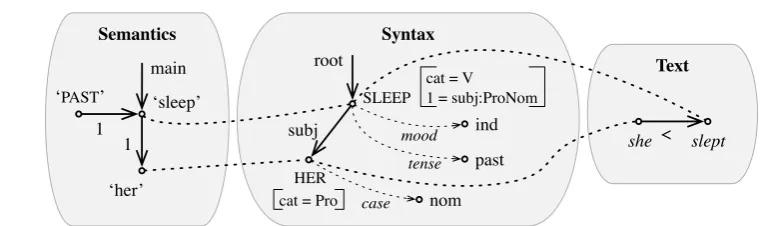
Our approach is based on Meaning-Text Theory (MTT), which views a linguistic model as a device that associates meanings to texts (Mel’ˇcuk, 2016). Meanings are represented as graphs of predicate-argument relations between semantemes (i.e., signifieds of linguistic signs). We do not consider the phonological module here, so our texts are just strings of wordforms. Between meaning and form, we consider an intermediate level of representation, a syntactic dependency graph. Fig. 1 illustrates the full representation of sentence (1).
(1) She slept.
Semantics Syntax
‘PAST’ 1
‘sleep’
1 main
‘her’
subj root
HER cat = Pro
SLEEP cat = V 1 = subj:ProNom
mood ind
tense past
case nom
Text
[image:2.595.96.478.494.607.2]slept she <
Figure 1: The three linguistic representations of (1)
The semantic representation contains two main kinds of objects: semantic nodes, labeled by seman-temes (e.g., the lexical semanteme ‘sleep’ or the grammatical semanteme ‘PAST’) and semantic
depen-dencies, labeled by a numberr linking a predicate to itsr-th argument. In addition to semantemes and predicate-argument relations, there is one pointer labeled “main” that flags one semanteme as the most salient; it corresponds roughly to the rheme’s dominant node (Mel’ˇcuk, 2001).
A syntactic representation comprises three kinds of objects: lexical nodes, labeled by lexical units (e.g.,SLEEP), grammatical nodes, labeled with grammemes and linked to lexical units (e.g., “past” which
1Morphosyntactic subclasses, such as the conjugation group for verbs, are not considered here.
2Lefff’s entries do not contain this information; by default, we just recopy the lemma. We add it manually for grammatical
is atense), and syntactic dependencies, labeled with syntactic functions (e.g.,subj). All objects can bear
features, such as “[cat=V]” onSLEEP.
A text representation contains two kinds of objects: nodes labeled by wordforms (e.g., slept), and linear precedence relations labeled “<”.
Fig. 1 also shows another kind of object, correspondence links, represented by undirected dashed lines between nodes corresponding to the same linguistic sign across levels.3 In the following sections, we will focus on the semantics-syntax interface.
4 The formal grammar
PUG generates a set of finite structures by combining elementary structures. A structure is a set of objects that are linked to three kinds of elements: 1) other objects (e.g., a dependency is linked to its source and target nodes), 2) atomic values (labels or feature values), or 3) polarities. All objects of elementary structures are polarized; this simple mechanism ensures that all necessary rules have been triggered without imposing any order on the combination of the rules (Kahane, 2006). The same rules are used for both analysis and synthesis, and the model allows incremental application strategies.
Polarities differ from atomic values in the way they combine. When two (elementary) structures combine, at least one object of a structure must be unified with an object of the other structure (as with TAG substitution, whereby the root of one tree is unified with a leaf of the other tree). When two objects are unified, all the elements linked to them must also be combined: objects and values are unified while polarities combine by a special operation called the product. We consider two polarity values in this paper: ◽(white, unsaturated, or active), and◾ (black, saturated, or inactive). Only◽can combine with other polarity values, and it is the identity element of the product: ◽ × ◽ = ◽; ◽ × ◾ = ◾; ◾ × ◾ = . Polarities should be interpreted as follows: white objects are unsaturated (they absolutely must combine with a non-white object and a final structure derived by the grammar must not contain any white object), while black objects are the elements of the structure constructed by the grammar. Objects are polarized by associating them to one of these two values via a function.
The grammar is modular: each module has its own polarizing function and also uses the polarities of adjacent modules to trigger their application (Kahane and Lareau, 2005). We consider here three levels (semantics, syntax and text) and two interfaces (semantics-syntax and syntax-text), giving us five modules. Instead of explicitly plotting the polarizing functions in our figures, we use five different geometric shapes, each associated with one module, as sketched in Fig. 2.
Semantics ⇔ Syntax ⇔ Text
★
▲ ∎ ∎Figure 2: Modules of the grammar
We refer to modules by their proper polarizing function. For instance, G★is the semantic module, which builds semantic graphs, while G is the semantics-syntax interface, which links semantic and syntactic objects. Each module is interfaced with its two adjacent modules (or only one for the modules at the ends of the pipeline). In consequence, a rule of a given module handles three polarities: the main polarity (the one proper to its module) and two articulation polarities (the ones of the adjacent modules). Generally, when an object’s main polarity is saturated, its articulation polarities are white; they are used to trigger rules from adjacent modules, which are the only rules that saturate these polarities. We use black articulation polarities only when there are mismatches between two levels (e.g., with raising, when a semantic dependency does not correspond to a syntactic dependency linking the same lexical units). Indeed, an object with a black articulation polarity, being already saturated, does not trigger rules from the adjacent module. A rule always contains at least one object with a black main polarity. Objects with a white main polarity are used to specify the context and are not articulated.
interface polarity, or ∎. To make our figures more legible, we only show the black polarities. But keep in mind that, for instance, a syntactic object drawn with only▲in a rule actually also bears and ◻, since a syntactic object has always these (and only these) three polarities.
5 Encoding the lexicon
5.1 Lexicalization and government patterns
Let us start with the basic sentence (1) to show how modules are articulated. This first fragment of the grammar contains about twenty rules, which seems a lot for such a simple sentence. But most of these rules constitute the heart of the grammar and would be re-used for almost any sentence. The rules relating to specific lexical units’ idiosyncrasies are directly derived from our lexical resource by instantiating a few very generic patterns. As we will show in the following sections, we do not need lots of additional rules to handle much more complex phenomena. For now, let us look at the following two lexical entries:
SLEEP; V; ‘sleep’; ⟨1=subj:N|ProNom⟩; Ø; Ø.
HER; Pro; ‘her’; ⟨Ø⟩; Ø; Ø.
Our first module, G★(Fig. 3), builds the semantic graph and calls G . All objects constructed by these rules bear
★
, while context objects bearI(not shown). Remember that each★
object is interfaced with G by bearing as an articulation polarity (not plotted here). The rule R★mainis the initial rule, marking one of the semantic nodes as the most communicatively salient meaning (which is normally realized as the syntactic root). R★sleep indicates that ‘sleep’ is a unary predicate; this is trivially derived from the subcategorization frame ofSLEEP, which states that this lexeme has only one argument.R
★ main main
R
★ PAST ‘PAST’
1
R
★ sleep ‘sleep’
1
R
[image:4.595.181.415.356.421.2]★ her ‘her’
Figure 3: A fragment of G★
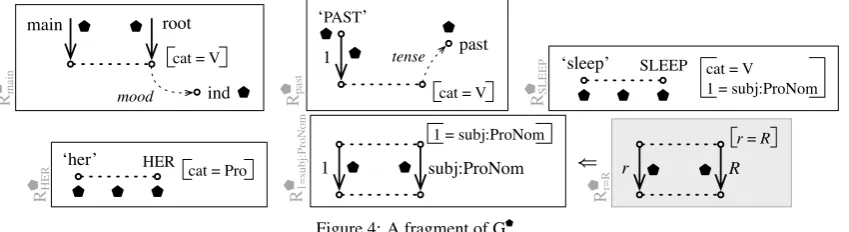
The next module, G (Fig. 4), ensures the lexicalization and arborization of the semantic representa-tion.4 The left part of the rule contains semantic objects (bearing I, not plotted here), while the right part contains syntactic objects (bearing△, also hidden). Semantic and syntactic objects that correspond to each other are linked by a correspondence link object. The objects constructed by a rule bear , while the others bear (implicit). The two correspondence links of R1=subj:ProNom (represented by dashed lines) ensure that the governors and dependents of the semantic and syntactic dependencies will be put in correspondence by a lexicalization rule that saturates them. Rmainindicates that the main verb can have the indicative mood (there could be competing rules to allow different roots). Rpast indicates that ‘PAST’ is realized by a grammeme. The dotted link labeledtenseis a function linking the grammatical object to the lexical node and is not an object itself (and therefore is not polarized).
Rmain
cat = V
main root
ind
mood Rpast
‘PAST’
cat = V
1 tense past
RSLEEP
‘sleep’ SLEEP cat = V 1 = subj:ProNom
RHER
‘her’ HER
cat = Pro R1=subj:ProNom
1 = subj:ProNom
1 subj:ProNom ⇐
Rr=R
r = R
r R
Figure 4: A fragment of G
The lexical rules RSLEEP and RHER are directly induced by the dictionary: the meaning and lemma fields provide the labels for the semantic and syntactic nodes, the part of speech field provides the value for the “cat” attribute, and the subcategorization frame provides a list of features that are recopied as is 4We chose to present the grammar in the perspective of synthesis, from meaning to text, but this model is completely
[image:4.595.91.516.569.685.2]on the syntactic node. If present, control and redistribution features are also attached to the syntactic node and used as explained in §5.2. The actancial rule R1=subj:ProNom instantiates the generic pattern Rr=R(grayed out). The syntactic dependencysubj:ProNomis a “temporary” object and R1=subj:ProNomonly makes sense when combined with R▲subj:ProNom, presented below.
The module G▲(Fig. 5) verifies the well-formedness of syntactic structures. The lexical rules of G▲ have been reduced to the minimum here, just to verify the general constraints related to parts of speech.5 Grammatical rules verify that the grammemesind,past, andnomappear in the right context. R▲subj:ProNom expresses the fact thatsubj:ProNom is indeed a subject dependency (subj), the dependent of which is a pronoun (Pro) with the nominative case (Nom). This is realized by “replacing” subj:ProNomwith subj.
In fact, there is no replacement, as both dependencies actually remain in the syntactic structure (both are syntactic objects), but onlysubj:ProNomis active for G (it bears ), while subjis active for G∎ (it
bears ◻). This amounts to considering deep and surface functions (Fillmore, 1968; Blake, 2002). A dependency labeled by a surface function is validated by a rule such as R▲subj, which sends it to G∎ just by leaving the articulation polarity ◻white. Consequently, the syntactic dependencies built by G▲form a DAG, from which only a subtree receives ◻and thus is visible to G∎and interfaced with the text.6
R
▲ root root
R
▲ subj:ProNom
r
cat = Pro
case nom
r:ProNom
R
▲ V
cat = V
mood ▲ RPro
cat = Pro
case ▲ Rsubj
cat = V mood ind subj
R
▲ ind
cat = V
mood ind
tense ▲ Rpast
cat = V
mood ind
tense past ▲ Rnom
[image:5.595.85.515.281.400.2]cat = Pro case nom
Figure 5: A fragment of G▲
The module G∎(Fig. 6) ensures the linearization of the syntactic tree. R∎
subjindicates that the subject can precede its governor without constraints. Rslept∎ indicates that the indicative past form ofSLEEPis
sleptand Rshe∎ indicates that the nominative form ofHERisshe. See (Kahane and Lareau, 2016) for a
more detailed description of G∎, including rules for non-projective cases.
The module G∎, which verifies that the output of G∎is a string, is trivial and not discussed here.
R
∎ slept
cat = V SLEEP tense past
slept
ind mood ∎ Rshe cat = Pro
HER
case nom
she
R
∎ subj <
subj
Figure 6: A fragment of G∎
5.2 Modification
Adjectives have at least one actant, which receives thesubjfonction. However, it can never be realized as a subject on the adjective because asubjdependency can only be validated by G▲, which requires it to be
headed by a verb (see R▲subj, Fig. 5). In other words, thesubj relation on the adjective must be “moved”. Two solutions are possible: 1) the adjective is attributive and becomes a dependent of its first semantic actant (R▲mod), or 2) the adjective is predicative and becomes the dependent of the copula (R▲BEcopula), its subject becoming the subject of the copula (R▲RaisSubjAux). The copula has no semantic contribution. Its lexical entry says that it has an adjective (Adj) or a past participle (Ved) as a dependent with theaux
relation and thatBEhas the same semantic correspondent as its dependent. The rule R▲RaisSubjAuxsaturates asubjdependency (thus making it inert for G∎) and “replaces” it by a newsubjrelation (which receives
because it must not be interfaced with the semantic level). The triggering of R▲RaisSubjAuxis only possible
5More specific constraints can be verified, such as the fact that a syntactic actant is obligatory, by introducing the
corre-sponding syntactic dependency with△.
6It is very easy to write a PUG grammar to check that a structure is a proper tree (Kahane, 2006). We do not present this
[image:5.595.89.508.486.530.2]if the verb has the feature “[RaisSubjAux]”, which comes from the dictionary and is just recopied on the node. Its value is a boolean; by convention, its presence means it is “True”, while its absence means “False”. The same goes for the control and raising features in §5.3.
RED; Adj; ‘red’; ⟨1=subj:N|ProNom⟩; Ø; Ø.
BEcopula; V; Ø; ⟨0=aux:Adj|Ved⟩; RaisSubjAux; Ø.
R
▲ mod
subj cat = Adj
mod
RBE
copula
BEcopula
[image:6.595.90.486.135.217.2] [image:6.595.162.432.285.335.2] [image:6.595.78.475.499.646.2]aux:Adj | Ved 0 = aux:Adj|Ved RaisSubjAux
R
▲ RaisSubjAux
aux
RaisSubjAux
subj
subj
Figure 7: Adjectival modifiers
The rule RBEcopula, as shown above, is in fact the combination of two simpler rules: a lexicalization rule that says BEcopulahas no specific semantic contribution, and a rule that activates the “0=aux:Adj∣Ved” in-struction by mapping a single semanteme to a configuration of lexemes that jointly express that meaning (i.e., one is semantically empty):
RBE
copula
(le
x)
BEcopula 0 = aux:Adj|Ved RaisSubjAux R0=R
R 0 = R
Figure 8: Decomposition of RBEcopula
5.3 Control and raising
All verbs have asubjdependency, even infinitives and participles, but for these thesubjdependency will not be active for G∎. This is achieved by rules of control and raising, which say that thesubjdependency
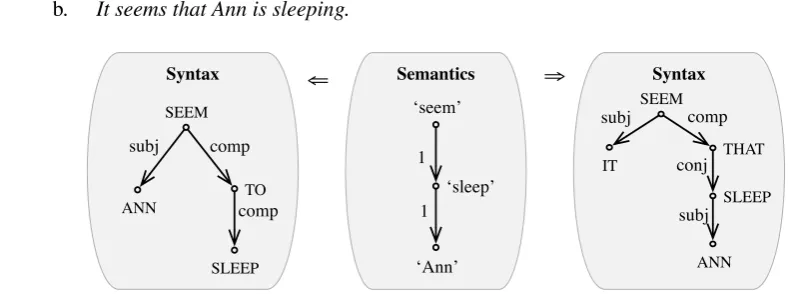
of the infinitive is realized on another verb.SEEMis a classical example of a raising verb; it has only one actant, which is realized as its complement (Fig. 9). Its subject can be an expletive ((2-b), RITexpletive) or the subject of its verbal dependent ((2-a), R▲RaisSubjComp:to-Vinf).
SEEM; V; ‘seem’; ⟨1=comp:to-Vinf|that-Vind⟩; RaisSubjComp:to-Vinf; Ø.
(2) a. Ann seems to sleep.
b. It seems that Ann is sleeping.
Syntax
IT
comp
SLEEP SEEM
subj
THAT conj
ANN subj Semantics
‘seem’
1
‘sleep’ 1
‘Ann’ Syntax
ANN
comp
SLEEP SEEM
subj
TO comp
⇒ ⇒
Figure 9: The simplified semantic and syntactic representations of (2).
A specification such as “[2=comp:to-Vinf]” will be expressed in three steps: a G rule associates the semantic2dependency to a syntacticcomp:to-Vinf dependency (Rr=R), which is first “replaced” by a
comp:todependency with a dependent that is a verb (V) with an infinitive mood (inf) (R▲comp:to-Vinf), and
then the comp:to dependency is “replaced” by a configuration with TO (R▲comp:to). Even if as a result, comp:tois not active anymore for any of the interface modules G and G∎, it is still part of the syntactic
R ▲ CtrlSubjComp:to-V
inf
comp:to CtrlSubjComp:to subj
subj inf
mood
R
▲ RaisSubjComp:to-V
inf
comp:to
RaisSubjComp:to
subj
subj inf
mood
R
▲ comp:to-V
inf comp:to
cat = V comp:to-Vinf
inf mood
R
▲ comp:to
comp comp:to
TO prep
R
▲ comp:that
comp comp:that
THAT conj
RIT
expleti
ve
subj
[image:7.595.96.498.61.193.2]IT cat = Pro
Figure 10: Rules for control and raising
to R▲RaisSubjComp:to-Vinf, R▲CtrlSubjComp:to-Vinfdoes not block the semantic correspondence of thesubj(cf. onsubjin R▲RaisSubjComp:to-Vinf). Such rules are in fact G▲rules validating the infinitive grammeme.
Tense-aspect-mood auxiliaries can also be described as raising verbs, such as the English progressive, which is a unary predicate expressed by the auxiliary BEimposing the gerundive form (Ving) on its unique actant and raising its subject:
BEprogressive; V; ‘PROGRESSIVE’; ⟨1=aux:Ving⟩; RaisSubjAux:Ving; Ø.
5.4 Redistributions
In PUG, redistributions are dependency rewriting rules. For instance, the passive voice promotes the object to the subject position (R▲passiveObj). The marker of this redistribution is the past participle, so such a rule can also be interpreted as a rule realizing this mood grammeme. As can be seen in Fig. 11, the
objdependency becomes inactive for G∎ and is replaced by asubjdependency inactive for G but still
active for G▲. The R▲passiveObjcan be combined with another rule, R▲passiveSubj, which demotes the subject to an agent complement (comp:by). Theobjwith a separate dependent ensures that thesubjto be demoted is not an object that had been promoted by another rule.
R
▲ passi
veObj subj:ProNom | N
[image:7.595.109.479.417.480.2]passive
obj:ProAcc | N
ed mood
R
▲ passi
veSubj comp:by-ProAcc | N passive
subj:ProNom | N
ed mood
obj
Figure 11: Passive
5.5 Tough-movement
Tough-movement is an interesting case of redistribution.
(3) a. The book is easy to read.
b. a book easy to read
We consider that in the expressions in (3) the initial subject ofEASYhas been demoted as a complement and that the object of its verbal dependent has been promoted in thesubjposition ofEASY(Fig. 12). This is done by the rule R▲tough-mvt, which combines a demotion rule and a raising rule (where anobjand not asubjis raised). The infinitive is not validated by R▲tough-mvt, but by R▲inf-*ONE, which suppresses thesubj
dependency but allows it to correspond to a general meaning ‘one’, as inOne reads the book.
R ▲ tough-mvt
comp:to tough-mvt
subj
obj
inf mood
subj
R
▲ inf-*ONE cat=V
subj
*ONE
inf mood
⇒
‘easy’
1 main
‘one’
subj root
BOOK
READ
mood inf ‘read’
‘book’ 2 1
EASY
*ONE
subj obj
subj
comp:to
[image:8.595.74.520.68.176.2]tough-mvt
Figure 12: Tough-movement 6 Conclusion
The implementation of a dictionary as a formal grammar has been achieved in many frameworks (TAG, Lexical Functional Grammar (LFG), Head-driven Phrase Structure Grammar (HPSG), etc.). The dictio-nary we consider here has been used by TAG and LFG parsers for French (Boullier and Sagot, 2005; de La Clergerie, 2010). Implementing this dictionary in a new formal grammar is not challenging in itself. What should be interesting in our work is the fact that our grammar is very granular and each piece of information from the dictionary yields a separate rule. Moreover, the rules coming from the dictionary and the rules associated with grammatical items are quite similar in essence. It results from it that there is no real frontier between lexicon and grammar: what we obtain is a list of correspondence rules in the spirit of theconstructiconof CxG (Goldberg, 1995; Fillmore et al., 2012), i.e., a dictionary describing both lexical units and more abstract constructions, such as dependencies, control and redis-tribution patterns, etc. That is, we have a grammar that describes linguistic signs, regardless of their lexical or grammatical nature. The cost of this granularity is that it is harder to implement, since PUGs must consider more possible object unifications than simple unification grammars. We are working on heuristics that will speed up unification in an implementation that is underway.
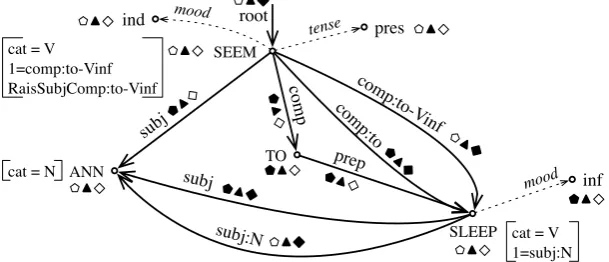
Another important point is that our grammar allows to understand some divergences in the literature concerning the nature of the syntactic structure. If we consider that the syntactic structure is the one containing all the objects with▲, then our structure is richer than that of most frameworks; it contains various substructures considered by other formal grammars,`a la(Hudson, 2007) (Fig. 13).
ANN
com p
SLEEP SEEM
subj
TO prep
root
subj
com p:
to com
p:to-V inf
cat = N cat = V 1=comp:to-Vinf RaisSubjComp:to-Vinf
cat = V 1=subj:N
mood inf ind mood tense pres
subj:N
Figure 13: The whole syntactic structure of (2-a) produced by G▲
• The substructure that is interfaced with the text by G∎ (objects that bear ◻) is a surface syntactic
tree, as considered by many dependency grammars. This structure contains both lexical nodes and grammatical nodes and has exactly one node per “syntaxeme” (lexeme or grammeme). Such a structure is more or less equivalent to a surface constituency tree in X-bar tradition, containing both lexical and functional projections.
[image:8.595.144.449.483.614.2]• The whole structure can be compared to a phrase structure with movements (Graf, 2012; Stabler, 1997). A word can have several governors corresponding to several steps in the construction of the structure (cf. raising rules, for instance), which means that the same word occupies several positions alternatively. It is also comparable to the dependency structures considered by Word Grammar (WG) (Hudson, 2007) or Functional Generative Description (FGD) (Sgall et al., 1986). Note that in PUG, “movements” do not duplicate the nodes in a structure. The number of nodes we consider never exceeds the number of syntaxemes. What we multiply are the dependencies between nodes, each encoding a syntactic combination of two items, which would be encoded in phrase structure trees by a new binary branching (Kahane and Mazziotta, 2015). In other words, we can involve a lexeme in various combinations without having to duplicate it, thus avoiding coindexation and movement.
References
Blake, B. (2002). Relational grammar. Routledge.
Boullier, P. and Sagot, B. (2005). Efficient and robust lfg parsing: Sxlfg. InProceedings of the Ninth International
Workshop on Parsing Technology, pages 1–10. Association for Computational Linguistics.
Candito, M.-H. (1996). A principle-based hierarchical representation of ltags. InProceedings of the 16th
confer-ence on Computational linguistics-Volume 1, pages 194–199. Association for Computational Linguistics.
de La Clergerie, E. V. (2010). Building factorized tags with meta-grammars. InThe 10th International Conference
on Tree Adjoining Grammars and Related Formalisms-TAG+ 10, pages 111–118.
Fillmore, C. J. (1968). The case for case. In Bach, E. and Harms, R. T., editors,Universals in Linguistic Theory,
pages 1–88. Holt, Rinehart, and Winston.
Fillmore, C. J., Lee-Goldman, R., and Rhodes, R. (2012). The framenet constructicon. In Boas, H. C. and Sag,
I. A., editors,Sign-based construction grammar, pages 309–372. CSLI Publications, Stanford.
Francez, N. and Wintner, S. (2011).Unification grammars. Cambridge University Press, Cambridge.
Goldberg, A. E. (1995). Constructions: A construction grammar approach to argument structure. University of
Chicago Press.
Graf, T. (2012). Movement-generalized minimalist grammars. In B´echet, D. and Dikovsky, A. J., editors,LACL
2012, volume 7351 ofLecture Notes in Computer Science, pages 58–73.
Hudson, R. (2007).Language networks: the new Word Grammar. Oxford University Press.
Kahane, S. (2006). Polarized Unification Grammars. InProceedings of Coling-ACL 2006, Sydney.
Kahane, S. (2013). Predicative adjunction in a modular dependency grammar. InProceedings of the Second
Inter-national Conference on Dependency Linguistics (DepLing 2013), pages 137–146, Prague. Charles University, Matfyzpress.
Kahane, S. and Lareau, F. (2005). Meaning-Text Unification Grammar: modularity and polarization. In
Proceed-ings of MTT 2005, pages 163–173, Moscow.
Kahane, S. and Lareau, F. (2016). Word ordering as a graph rewriting process. In Foret, A., Morrill, G., Muskens,
R., Osswald, R., and Pogodalla, S., editors, Formal Grammar: 20th and 21st International Conferences, FG
2015, Barcelona, Spain, August 2015, Revised Selected Papers. FG 2016, Bozen, Italy, August 2016,
Proceed-ings, pages 216–239. Springer, Berlin/Heidelberg.
Kahane, S. and Mazziotta, N. (2015). Syntactic polygraphs. a formalism extending both constituency and
depen-dency. InProceedings of the 14th Meeting on the Mathematics of Language (MoL), Chicago, USA. Association
for Computational Linguistics.
Lareau, F. (2008). Vers une grammaire d’unification Sens-Texte du franc¸ais: le temps verbal dans l’interface
s´emantique-syntaxe. Ph.d. thesis, Universit´e de Montr´eal / Universit´e de Paris 7.
Mel’ˇcuk, I. A. (2001). Communicative organization in natural language: the semantic-communicative structure
Mel’ˇcuk, I. A. (2012). Semantics: From Meaning to Text, volume 1 ofStudies in Language Companion Series. John Benjamins, Amsterdam/Philadelphia.
Mel’ˇcuk, I. A. (2016). Language: From Meaning to Text. Ars Rossica, Moscow/Boston.
Sagot, B. (2010). The lefff, a freely available and large-coverage morphological and syntactic lexicon for french. In7th international conference on Language Resources and Evaluation (LREC 2010).
Sgall, P., Hajiˇcov´a, E., Panevov´a, J., and Mey, J. L. (1986). The meaning of the sentence in its semantic and
pragmatic aspects. D. Reidel/Kluwer Academic, Dordrecht/Boston Hingham.
Shieber, S. M. (1986). An Introduction to Unification-Based Approaches to Grammar. CSLI Publications,
Stan-ford, CA.
Stabler, E. (1997). Derivational minimalism. InInternational Conference on Logical Aspects of Computational