High Selectivity in the Oxidation of Mandelic Acid Derivatives and in
O-Methylation of Protocatechualdehyde: New Processes for Synthesis of
Vanillin,
iso-Vanillin, and Heliotropin
Hans-Rene´ Bjørsvik,*,†Lucia Liguori,‡and Francesco Minisci*,‡
Department of Chemistry, UniVersity of Bergen, Alle´gaten 41, N-5007 Bergen, Norway, and Dipartimento di Chimica del Politecnico di Milano,Via Mancinelli 7, I-20131 Milano, Italy
Abstract:
New synthetic procedures for vanillin, iso-vanillin, heliotropin, and protocatechualdehyde starting from catechol are described. The utilisation of statistical experimental design and multivari-ate modelling and the mechanistic interpretation of the acid and base catalysis in the condensation of catechol derivatives with glyoxylic acid and in the regiocontrolled methylation of protocatechualdehyde and of the Cu(II) salt catalysis in the oxidative decarboxylation of mandelic acid derivatives have allowed the development of new highly selective processes.
Introduction
Vanillin (3-methoxy-4-hydroxy benzaldehyde) 1, ethyl-vanillin (3-ethoxy-4-hydroxy benzaldehyde) 2, iso-ethyl-vanillin (3-hydroxy-4-methoxy benzaldehyde) 3, and heliotropin (benzo[1,3]dioxol-5-carbaldehyde) 4, are important products of fine chemical industry. Vanillin 1 is used as intermediate in pharmaceuticals, and it is one of the most important flavouring agents in confectionery, beverage, food, and in perfumery. iso-Vanillin 3 is an important building block used in the synthesis of the PDE4 inhibitors,1,2Ariflo (SB207499),2
targeted for treatment of bronchial asthma, and (R)-Rolip-ram1,3 that is approved as an antidepressant. Since the
olfactory profile of iso-vanillin 3 varies with the temperature, it is also suitable as a perfumery active ingredient for the cosmetic and perfumery industry.
Heliotropin (or piperonal) 4 is also used in perfumery, cherry and vanilla flavors, and as an intermediate for fine chemicals. Vanillin is available from two commercial processes: from catechol 5 (Scheme 1) and by catalytic oxidation of lignosulfonate.4Ethyl-vanillin 2 is produced by
a process similar to that of Scheme 1.
Two substantial processes (Scheme 2) have been reported for the synthesis of iso-vanillin 3: regiocontrolled demeth-ylation by sulphuric5or Lewis acids6of veratraldehyde
(3,4-dimethoxy benzaldehyde) 6, obtained by methylation of
vanillin 1. The selectivity of this dealkylation was improved7
starting from 3-alkoxy-4-hydroxy benzaldehyde, in which the alkoxy group is different from the methoxy and can undergo a faster hydrolysis; the only starting material commercially available on large scale for this purpose is ethylvanillin 2. Thus, the overall process involves five steps starting from catechol 5: (i) monomethylation or ethylation of catechol 5, giving guaiachol 7 and guethol 8, respectively; (ii) reaction of guaiachol 7 or guethol 8 with glyoxylic acid 9; (iii) catalytic oxidation of the mandelic acid derivatives, 10 or 11; (iv) methylation of vanillin 1 or ethylvanillin 2; * Authors to whom correspondence should be addressed. E-mail:
[email protected] and [email protected].
†University of Bergen. ‡Politecnico di Milano.
(1) DalPiaz, V.; Giovannoni, M. P.; Castellana, C.; Palacios, J. M.; Beleta, J.; Domenech, T.; Segarra, V. J. Med. Chem. 1997, 40, 1417.
(2) Torphy, T. J.; Barnette, M. S.; Underwood, D. C.; Griswold, D. E.; Christensen, S. B.; Murdoch, R. D.; Nieman, R. B.; Compton, C. H. Pulm.
Pharmacol. Ther. 1999, 12, 131.
(3) Braun, M.; Opdenbusch, K.; Unger, C. Synlett 1995, 1174. (4) Bjørsvik, H.-R.; Minisci, F. Org. Process Res. DeV. 1999, 3, 330.
(5) Brossi, A.; Gurien, H.; Rachlin, A. I.; Teitel, S. J. Org. Chem. 1967, 32, 1269.
(6) Prager, R. H.; Tan, Y. T. Tetrahedron Lett. 1967, 3661. (7) Maliverney, C. (Rhone-Polenc Chimie). EP 0 709 361 A1, 1996. Scheme 1
Scheme 2 Organic Process Research & Development 2000, 4, 534−543
(v) regiocontrolled dealkylation of compound 6 or 12. The complete process is shown by Schemes 1 and 2. Another method reported8for synthesis of iso-vanillin 3 involves the
mono O-methylation of protocatechualdehyde 13 by using sodiumhydride and methyliodide in dimethyl sulfoxide, but is too expensive from industrial point of view. The synthesis of heliotropin 4 involves the chromic oxidation of piperonyl alcohol, the condensation of 4-bromo benzo[1,3]dioxole9by
N-methylformanilide and ozonolysis,10 or chromic(VI)salt
oxidation of iso-safrole. We have designed a new strategy for the synthesis of vanillin 1, iso-vanillin 3, and heliotropin 4 from catechol-based general Scheme 3.
We succeeded in the development of an efficient synthesis of protocatechualdehyde 13 and the selective mono O-methylation by dimethylsulphate to vanillin 1 or iso-vanillin 3, depending on the reaction conditions. However, attempts to obtain heliotropin 4 from protocatechualdehyde 13 ac-cording to the route c of Scheme 3 gave only moderate results, and we realized that the best way to heliotropin 4 from catechol was to reverse the oxidation and methylation steps according to Scheme 4.
In any case all of the syntheses in Schemes 3 and 4 involve only three steps, starting from catechol.
Methods and Results
Synthesis of Protocatechualdehyde 13. The synthesis of 3,4-dihydroxymandelic acid 14 from catechol 5 and glyoxylic acid 9 (Scheme 3) was previously11reported, but
our attempts to reproduce the reported procedure led to poor yields (<20%). The synthesis is based on the reaction of catechol with glyoxylic acid in aqueous basic medium (NaOH) and in the presence of Al2O3; it is substantially
similar to the industrial procedure for the synthesis of vanillin (Scheme 1). We have performed a development of this reaction by using statistical experimental design12 and
multivariate modelling,13 since, as mentioned above, the
availability of protocatechualdehyde 13 is a restricting factor for the success of our new process. An assessment of the existing synthetic procedure gave that the following variables could be considered in an optimisation study: the amount of catechol (f1), the volume of water (f2), the reaction time
(f3), the amount of glyoxylic acid (x1), the amount of
aluminium oxide (x2), the reaction temperature (x3), and the
amount of NaOH (x4). Initially, the variables indicated as
x1-x4 were selected as independent variables for the
experimental design, whereas the other variables, f1-f3were
selected at convenient fixed levels. A full factorial design at two levels with two “center” experiments (24+2
f18 run) was set up. Some introductory experiments were performed to obtain a preliminary overview of the experimental variables’ effects on the response parameters: the amount of recovered catechol (r [mmol]), the amount of 3,4-dihydroxy mandelic acid (o [mmol]), the selectivity percent to 3,4-dihydroxy mandelic acid (s [%]), and finally the yield percent of 3,4-dihydroxy mandelic acid calculated from catechol (y [%]). These introductory experiments showed that the isolated product was found to be much more impure when an excess of NaOH was used in the reaction mixture (implies that both catechol and glyoxylic acid appear as Na salts) compared to the experiments performed under less basic conditions. Thus, only the variables x1-x3were explored in
a full factorial design (23 +1
f 9 experiments), and the variable “amount of sodium hydroxide” (x4) turned out to
be the fourth variable used at a fixed experimental level (x4 ff4). The statistical experimental design with the variables
x1-x3with their adjacent measured and calculated responses η ) [r, o, s, y] are given in Table 1. The response s, [%]-selectivity, and the variables x1-x3with their interactions (8) Kessar, S.; Gupta, Y. P.; Mohammad, T.; Goyal, M.; Sawal, K. K. J. Chem.
Soc., Chem. Commun. 1983, 7, 400.
(9) Holum, J. R. J. Org. Chem. 1961, 26, 4815. (10) Feugeas C. Bull. Soc. Chim. 1964, 1892.
(11) Umemura, S.; Takamitsu, N.; Enomiya, T.; Shirashi, H.; Nakamura, T. (Ube Industries Ltd.). German Patent DE 28 04 063 B2, 1980.
(12) Box, G. E. P.; Hunter, W. G.; Hunter, J. S. Statistics for Experimenters, An
Introduction to Design, Data Analysis, and Model Building; Wiley: New
York, 1978.
(13) Martens, H.; Næs, T. MultiVariate Calibration; Wiley: Chichester, 1989.
Scheme 3 Scheme 4
were multivariate-correlated using the multiple linear regres-sion (MLR)14method to obtain a regression model as given
in eq 1
with R2of 0.968. Even though cumulative normal probability
plot (CND-plot)15is a rough method for assessment of model
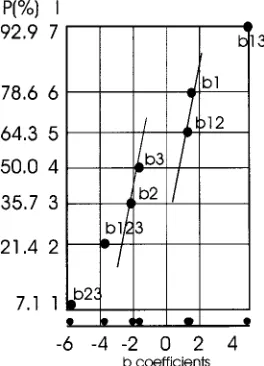
parameters, it is a suitable method for assessment of such a simple model as eq 1. The CND plot given in Figure 1 shows that the β13,β23, and possibly β123also are the significant parameters of this model and gives information about the
main direction of the experimental domain. Due to an aberrant response in Table 1, the inlying values of the CND plot are fitted by two straight lines in parallel, and not by only one straight line. See Box et al.15
The obtained model s ) f (x1, x2, x3) eq 1 holds out
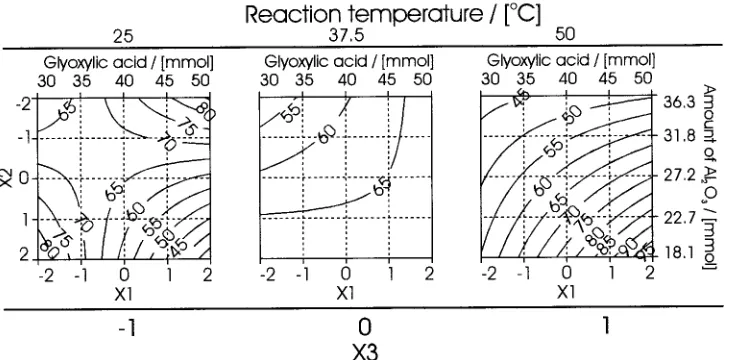
[image:3.612.108.240.41.224.2]expectations of high selectivity for the reaction 5+9f14 when one simultaneously (i) increases the quantity of glyoxylic acid 9 to slightly more than 1 equiv of catechol 5, (ii) adjusts the quantity fraction catechol:aluminiumoxide within the range 2.17-2.28, and (iii) adjusts the temperature to be within the range 50-60 °C. Even though the model shows that it may be beneficial with a low quantity of aluminium oxide, experiments have shown that without aluminium oxide present, the reaction did not proceed at all. Increased quantity of glyoxylic acid implies double alkylation on the aromatic ring, with a consequence of a lower selectivity and higher cost of the process. The model eq 1 is graphically represented as a response surface projection in Figure 2, from which the conditions for an optimising experiment were predicted. The model predicted a selectivity of 100% for 3,4-dihydroxymandelic acid 14; the selectivity of the optimised experiment was 90.5% with a conversion of 78.4%. The unconverted catechol 5 was easily recovered and recycled by extraction under suitable acidity; the aqueous phase containing the mandelic acid derivative 14, was directly utilised for the oxidative decarboxylation to obtain protocatechualdehyde 13.
Preliminary attempts of oxidation by oxygen and Cu(II) catalysis, which is effective for vanillin (Scheme 1) and heliotropin 4 (Scheme 4), led to poor yields of protocate-chualdehyde 13 due to the formation of a large amount of a by-product, which from NMR analysis appears to arise from oxidative dimerisation of protocatechualdehyde 13 to give 17 (Scheme 5).
We have therefore developed a different procedure involving a two-liquid system (water:ethyl acetate) and the use of a 3-fold excess of CuCl2 and HCl under nitrogen.
The large excess of the copper salt is used to ensure a complete conversion of the mandelic acid derivative 14. Under these conditions the oxidation take place with high yields (>95%); the organic phase, containg 13, is separated, and CuCl2is regenerated in the aqueous phase by bubbling
air and recycled so that the overall process is catalytic in CuCl2and the actual oxidant is air.
Selective O-Methylation of Protocatechualdehyde 13. The O-methylation of protocatechualdehyde 13 by dimeth-ylsulphate in basic medium can lead to three different products: vanillin 1, veratraldehyde 6, and iso-vanillin 3 (Scheme 6).
(14) Montgomery, D. C.; Peck, E. A. Introduction to Linear Regression Analysis; Wiley: New York, 1982; Draper, N. A.; Smith, H. Applied Regression
Analysis, 2nd ed.; Wiley: New York, 1981.
(15) Daniel, C. Technometrics 1959, 1, 311. Box, G. E. P.; Draper, N. R.
Empirical Model-Building and Response Surfaces; Wiley: New York, 1987;
pp 128-134.
Figure 1. CND plot of the model for 3,4-dihydroxy mandelic acid.
Table 1.Experimental conditions with corresponding measured and calculated responses for the screening and introductory optimization study of the reaction 5+9f14
(3,4-dihydroxy mandelic acid)
experimental variablesa responsesb
no. x1 x2 x3 r o s y
1 -1 -1 -1 10.34 24.78 70.66 54.57
2 +1 -1 -1 11.00 18.53 53.81 40.81
3 -1 +1 -1 15.08 20.67 68.15 45.52
4 +1 +1 -1 9.22 25.75 71.15 56.71
5 -1 -1 +1 12.80 20.11 61.67 44.29
6 +1 -1 +1 10.04 27.99 79.13 61.64
7 -1 +1 +1 12.15 16.88 50.75 37.17
8 +1 +1 +1 6.87 22.57 58.56 49.70
9 0 0 0 12.09 19.76 59.30 43.51
aIn each of the experiments: 45.41 mmol of catechol, 80.37 mmol of NaOH,
55 mL of water, and a reaction time of 24h was used. The other experimental variables were varied: x1: amount of glyoxylic acid /[mmol] [34.96, 45.41],
x2: amount of aluminiumoxide /[mmol] [22.70, 31.79], x3: reaction temperature
/[°C] [25, 50].br)mmol recovered catechol, o)mmol of 3,4-dihydroxy mandelic acid, s)percent selectivity to 3,4-dihydroxy mandelic acid, and y) yield percent of 3,4-dihydroxy mandelic acid calculated from catechol.
s)63.68+1.428×x1-2.082×x2-1.708×x3+
1.275×x1×x2+4.890×x1×x3
-5.790×x2×x3-3.688×x1×x2×x3 (1)
Scheme 5
[image:3.612.323.539.42.141.2]Clearly the formation of veratraldehyde 6 is related to the conversions; with an excess of dimethylsulphate and NaOH and complete conversion veratraldehyde 6 is the only reaction product. Thus partial conversions are necessary in order to obtain vanillin 1 and iso-vanillin 3. On the basis of the differences in the pKa values of protocatechualdehyde 13 (pKa(3-OH)≈11.6, and pKa(4-OH)≈7.5) we tried to develop
direct O-methylation procedures to iso-vanillin 3 or vanillin 1. We carried out some O-methylation preliminary experi-ments on protocatechualdehyde 13, that showed that the product distribution, the quantity of vanillin 1, iso-vanillin 3, and veratraldehyde 6 varied, depending on several of the experimental variables; the addition time of reagents (x1),
the reaction time (x2), the amount of NaOH added during
the reaction (x3), the start amount of NaOH (x4), the reaction
temperature (x5), the amount of dimethyl sulphate (x6), the
volume of methylene chloride (which revealed better than ethyl acetate) (x7), and the volume of water (x8). To study
these variables’ influence on the selectivity and the yield, a fractional factorial design of the type 28-4, including two
experiments in the centre of the experimental domain was used. The experimental levels and design with adjacent measured responses from the experimental runs are reported in Table 2.
The estimated models [y1)f(x1-x8) and y3)h(x1-x8)]
which relate the observed responses (y1)mol % yield of
vanillin 1 and y3) mol % yield of iso-vanillin 3) to the
experimental variables are two linear models to which cross-product terms have been added. However, due to the resolution (resolution)IV) of the experimental design that has been used, all of cross-terms in the two models have a certain confounding pattern with the other cross-terms. The regression coefficients were estimated by application of the partial least-squares regression (PLSR)13method, and their
[image:4.612.126.491.45.225.2]significances were determined by using CND plots and Figure 2. Contour projections of the response surface where the response is the selectivity to 3,4-dihydroxymandelic acid 12.
Scheme 6 Table 2.Experimental design with adjacent measured
responses, the quantities of vanillin 1, veratraldehyde,
iso-vanillin 3, and protocatechualdehyde
experimental variablesa responsesb
no. x1 x2 x3 x4 x5 x6 x7 x8 y1 y2 y3 y4 1 -1 -1 -1 -1 -1 -1 -1 -1 6.46 2.09 19.06 63.73 2 +1 -1 -1 -1 +1 -1 +1 +1 6.15 1.60 31.23 59.75 3 -1 +1 -1 -1 +1 +1 -1 +1 1.49 0.94 34.43 34.88 4 +1 +1 -1 -1 -1 +1 +1 -1 3.02 0.63 14.35 77.23 5 -1 -1 +1 -1 +1 +1 +1 -1 6.86 5.92 21.57 56.70 6 +1 -1 +1 -1 -1 +1 -1 +1 4.70 4.70 13.85 42.35 7 -1 +1 +1 -1 -1 -1 +1 +1 4.01 2.76 11.93 74.67 8 +1 +1 +1 -1 +1 -1 -1 -1 6.74 8.38 26.74 49.95 9 -1 -1 -1 +1 -1 +1 +1 +1 4.28 2.09 14.52 68.61 10 +1 -1 -1 +1 +1 +1 -1 -1 6.85 4.07 38.01 40.81 11 -1 +1 -1 +1 +1 -1 +1 -1 6.35 3.48 32.13 51.39 12 +1 +1 -1 +1 -1 -1 -1 +1 5.58 3.25 26.47 63.89 13 -1 -1 +1 +1 +1 -1 -1 +1 8.10 10.01 23.42 51.31 14 +1 -1 +1 +1 -1 -1 +1 -1 2.12 2.71 10.80 65.34 15 -1 +1 +1 +1 -1 +1 -1 -1 7.95 10.01 19.06 56.57 16 +1 +1 +1 +1 +1 +1 +1 +1 8.32 10.37 25.84 47.04 17 0 0 0 0 0 0 0 0 5.92 4.31 29.78 46.88 18 0 0 0 0 0 0 0 0 6.20 4.78 27.88 52.16
aGenerators for the experimental design: x
5)x1x2x3; x6)x2x3x4; x7)
x1x3x4; x8)x1x2x4. The present experimental design makes it possible to estimate
the effects of the single variables and the values for the following confounded two-factor interactions: β12+β35+β48+β67,β13+β25+β47+β68,β23+ β15+β46+β78,β14+β28+β37+β56,β24+β18+β36+β57,β34+β17+β26 +β58,β16+β27+β38+β45. Experimental variables [-1,+1] /unit x1: addition
time [45, 75]/min., x2: reaction time [45, 75]/min., x3: amount of NaOH added
during the reaction [0.70, 0.85]/g, x4: start amount of NaOH [0.18, 0.23]/g, x5:
reaction temperature [35, 55]/°C, x6: amount of dimethyl sulphate [2.3, 2.7]/g,
x7: volum of methylene chloride [14, 20]/mL, x8: volum of water [14, 20]/mL.
bConfounding patterns for the present design are: y
1: yield mol % of vanillin
1, y2: yield mol % veratraldehyde 6, y3: yield mol % of iso-vanillin 3, y4
unconverted mol % protocathecuic aldehyde 13.
[image:4.612.62.290.249.423.2]statistical analysis.14The final model- and statistical
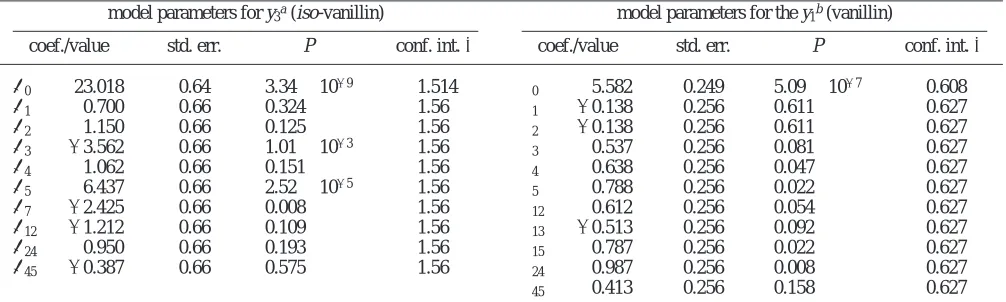
param-eters are given in Table 3.
Model for iso-Vanillin 3. The experimental variables, x1, x2, x3, x4, x5, and x7 were the variables that were
determined to have influence on the formation of iso-vanillin 3. Three two-factor interaction terms were also determined to have influence in the model; x1x2, x2x4, and x4x5. The final
multivariate predictive model for iso-vanillin 3 is shown in eq 2, numerical values are given in Table 3. The statistical products, (root mean squares-error of prediction) RMSEP )2.64, R2)0.956, and Q2)0.734 indicate a quite good
explanatory power of the model. The model eq 2 was estimated using the PLS method.13
The model in eq 2 was used to produce the response surface given in Figure 3. By using such a response surface, a selectivity of 94.6% was obtained for the para O-methylation of 3,4-dihydroxybenzaldehyde. The conversion is kept low (42.5%) to limit formation of veratraldehyde 2.
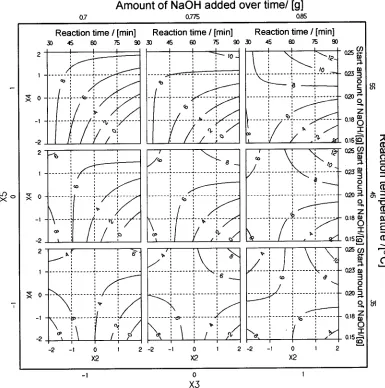
Model for Vanillin 1. The experimental variables x1, x2,
x3, x4, and x5were found to have significant influence in the
model. In this model some more two-factor interactions were determined to have influence; x1x2, x1x3, x1x5, x2x4, and x4x5.
The final multivariate predictive model for vanillin 1 is shown in Equation 3. Also for this model, the statistical products, RMSEP ) 1.025, R2 ) 0.905, and Q2 )0.523
indicate a fairly good explanatory power of the model. The estimation of the model eq 3 was also here carried out using the PLS method.13
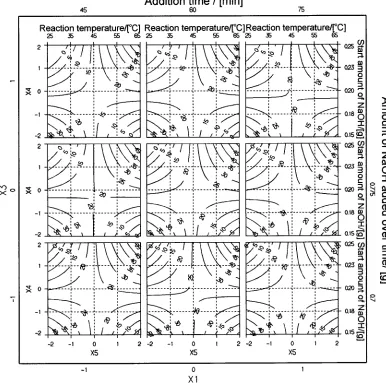
As for iso-vanillin, the derived model for vanillin in eq 3 was used to produce a response surface as given in Figure 4. By using such a response surface, a selectivity of 86.8%
of vanillin with 44.6% conversion of protocatechualdehyde 13 was obtained.
For both of the two procedures, for vanillin 1 and for iso-vanillin 3, the reaction was carried out in a two-phase system (water:ethyl acetate), and the unreacted protocate-chualdehyde 13 is easily recovered and recycled by taking advantage of the higher acidity of protocatechualdehyde 13 compared to that of vanillin 1 and iso-vanillin 3.
Synthesis of Heliotropin 4. (A) The reaction of proto-catechualdehyde 13 with CH2Cl2 to obtain heliotropin 4,
Scheme 7 was known.16-18 On the basis of the reported16
synthetic procedure an experimental study concerning the ring-closure step using statistical experimental design12with
subsequently multivariate modelling13was performed.
From this study we have derived a mathematical model, which describes the yield of heliotropin 4 under the influence of the experimental variables: the amount of NaOH, reaction temperature, reaction time, and amount of phase-transfer catalyst (tert-Bu4N+Br-). Optimised experiments based on
this model have led to selectivity in the range 61-64%, which are not sufficient for an industrial development. On the other hand attempts to reproduce the results reported in the literature16gave much lower yields (<20%).
(B) The process according to Scheme 4 appeared more convenient for the synthesis of heliotropin 4. In this case the basic medium is not suitable for the condensation of glyoxylic acid with benzo[1,3]dioxol 15, as in the reaction with catechol for obtaining protocatechualdehyde 13 (Scheme 3). We have developed an acid catalysis, which has allowed
(16) Kirby, J. A. (Eli Lilly & Co.). U.S. Patent 4,082,774, 1978. (17) Maggioni, P. (Brichima SpA). U.S. Patent 4,183,861, 1980.
[image:5.612.56.559.52.203.2](18) Gensler W. J.; Samour, C. M. J. Org. Chem. 1953, 18, 13; Tampta, M.; Aoyopi, Y. Chem. Pharm. Bull. 1968, 16, 523; Bonthrone W.; Cornorth, J. W. J. Chem. Soc. (C) 1969, 1202.
Table 3.Estimated model parameter values for eq 2 and eq 3
model parameters for y3a(iso-vanillin) model parameters for the y1b(vanillin)
coef./value std. err. P conf. int.( coef./value std. err. P conf. int.(
R0 23.018 0.64 3.34×10⁻⁹ 1.514 β
0 5.582 0.249 5.09×10⁻⁷ 0.608
R1 0.700 0.66 0.324 1.56 β1 -0.138 0.256 0.611 0.627
R2 1.150 0.66 0.125 1.56 β2 -0.138 0.256 0.611 0.627
R3 -3.562 0.66 1.01×10⁻³ 1.56 β
3 0.537 0.256 0.081 0.627
R4 1.062 0.66 0.151 1.56 β4 0.638 0.256 0.047 0.627
R5 6.437 0.66 2.52×10⁻⁵ 1.56 β
5 0.788 0.256 0.022 0.627
R7 -2.425 0.66 0.008 1.56 β12 0.612 0.256 0.054 0.627
R12 -1.212 0.66 0.109 1.56 β13 -0.513 0.256 0.092 0.627
R24 0.950 0.66 0.193 1.56 β15 0.787 0.256 0.022 0.627
R45 -0.387 0.66 0.575 1.56 β24 0.987 0.256 0.008 0.627
β45 0.413 0.256 0.158 0.627
aStatistical products for the model y
3describing the formation of iso-vanillin (PLS components)4, N)17, confidence level)95%) R2)0.956, Q2)0.734, RMSEP)2.64.bStatistical products for the model y
1describing the formation of vanillin (PLS components)4, N)17, Confidence level)95%): R2)0.905,
Q2)0.523, RMSEP)1.0247.
y3) R0+ R1x1+ R2x2+ R3x3+ R4x4+ R5x5+ R7x7+ R
12x1x2+ R24x2x4+ R45x4x5 (2)
y1)β0+β1x1+β2x2+β3x3+β4x4+β5x5+β12x1x2+
β13x1x3+β15x1x5+β24x2x4+β45x4x5 (3)
Scheme 7
the synthesis of 3,4-dioxymethylene mandelic acid in high yields (in the range 86-90%). The oxidative decarboxylation was carried out in a two-phase system (water:toluene) by oxygen and CuCl2 catalysis with quantitative yield of
heliotropin 4. The oxidative decarboxylation was carried out also with high yields by Na2S2O8and catalysis by Ag(I) salt.
Discussion
The good yields and the simple and convenient procedure for the synthesis of protocatechualdehyde 13 by statistical experimental design and multivariate modelling for the synthesis of 3,4-dihydroxy mandelic acid 14 and the devel-opment of a highly selective catalytic process for its oxidation suggested that protocatechualdehyde 13 could be an interest-ing intermediate for the synthesis of vanillin 1, iso-vanillin 3, and heliotropin 4. A critical point for the oxidation of 3,4-dihydroxy mandelic acid 14 was the presence of oxygen, which leads to large amounts of the by-product 17, Scheme 5. We explain this behaviour by the mechanism of the Scheme 8.
The hydrogen abstraction by the peroxyl radical B is faster for the hydroxyl group in position 3, which is less acidic (pKa(3-OH) ≈ 11.6) than the hydroxyl group in position 4
(pKa(4-OH) ≈7.5) because of the influence of the carbonyl
group in the para position. To overcome this inconvenience we have developed an oxidation process in two steps and a two-phase system (water:ethyl acetate). The first step was carried out under nitrogen atmosphere by an excess of CuCl2
and HCl so that route b of Scheme 8 was avoided and only route a took place. The oxidation occurs in the aqueous phase, and the organic solvent continuously extracts the formed aldehyde; the aqueous phase is separated, and CuCl is oxidised by bubbling air and recycled. In this way the process is always catalytic in CuCl2, and the selectivity is
very high (>95%) with complete conversion.
[image:6.612.111.497.48.431.2]For the synthesis of vanillin 1 and iso-vanillin 3 from protocatechualdehyde 13 the critical point was the regio-controlled O-methylation. We have taken advantage of the different acidity of the two hydroxyl groups, as mentioned before. In the presence of an excess of NaOH both the hydroxyl groups are salified, but the phenoxide ion in position 3 is more nucleophilic, and it is preferentially attacked by dimethylsulphate leading to vanillin 1, due to the conjugation of the phenoxide ion in position 4 with the carbonyl group (Scheme 9).
Figure 3. Contour projections of the response surface where the response is the selectivity to iso-vanillin 3.
For the same reason when we use one mole or less of NaOH per mole of protocatechualdehyde 13, the hydroxy-lgroup in position 4 is more acidic, is preferentially salified, and is attacked by dimethylsulphate leading to iso-vanillin 3 (Scheme 10).
In both cases partial conversion (40-50%) is necessary to avoid dimethylation leading to veratraldehyde 6, but the separation and the recycle of unreacted protocatechualdehyde 13 is quite simple and inexpensive; protocatechualdehyde 13 remains in the water phase while the reaction products (1, 3, 6) are soluble in dichloromethane. The starting aldehyde 13 can then be recovered by acidifying the water phase and extracting with ethyl acetate. The recovered substrate 13 is practically pure enough to be reused, but an eventually further purification can be performed by using the different acidity of the compounds. Attempts to utilise Scheme 3 for the synthesis of heliotropin 4 led to 64% maximum selectivity, probably because of the instability of protocatechualdehyde 13 under basic experimental condi-tions. Thus, Scheme 4 appeared to be more convenient in this case. Contrary to the behaviour of guaiachol 7 (Scheme 1) or catechol 5 (Scheme 3), the condensation of benzo[1,3]-dioxole 15 with glyoxylic acid 9 cannot be catalysed by a
basic mechanism; we have further developed catalysis by sulphuric acid which leads under high selectivity to the mandelic acid derivative 16 (Scheme 11).
The basic catalysis on the contrary involves the nucleo-philic addition of phenoxide ion to the carbonyl group (Scheme 12).
The oxidative decarboxylation of the mandelic acid derivative 16 to heliotropin 4 can be carried out in high yield with catalytic amount of Cu(II) salt in the presence of oxygen because the absence of hydroxyl groups prevents the oxida-tive dimerisation of heliotropin 4 by a process similar to that described in Scheme 8. The oxidative decarboxylation was carried out also by Ag(I)-catalysed Na2S2O8oxidation. The
mechanism is shown in Scheme 13.
Conclusions
[image:7.612.111.496.44.432.2]A new strategy of industrial interest for the synthesis of protocatechualdehyde 13, vanillin 1, iso-vanillin 3, and heliotropin 4 was designed and optimised. The condensation of catechol or benzo[1,3]dioxole with glyoxylic acid, the oxidative decarboxylation of the mandelic acid derivatives, and the regiocontrolled O-methylation of protocatechualde-hyde 13 were the key points in all of these syntheses and Figure 4. Contour projections of the response surface where the response is the selectivity to vanillin 1.
they were developed by a combination of statistical experi-mental design, multivariate modelling, and reaction mech-anisms. A flexible procedure that allows to perform the O-methylation of the hydroxy groups either in position 3 or 4 of protocatechualdehyde 13 to obtain respectively vanillin 1 and iso-vanillin 3 was developed; it was based on the different acidity of the two hydroxyl groups. For the synthesis of heliotropin 4 it appeared more convenient to start from benzo[1,3]dioxole 15 than from protocatechualdehyde 13.
Experimental Section
General Methods. Mass spectra were performed on a GLC-MS Finnigan TSQ 70 instrument, using a Varian 3700 gas chromatograph equipped with SBP-1 fused silica column (L 30 m×0.2 mm i.d., 0.2µm film thickness) and He as carrier gas.
GLC analyses were performed on a capillary gas chro-matograph equipped with SBP-5 fused silica column (L 25 m×0.25 mm i.d., 1µm film thickness) at a hydrogen flow rate of 8 cm3 min-1, PTV injector, and flame ionisation
detector.
HPLC analyses were performed on a HPLC instrument equipped with a RP-18 (5µm packing material, L 250 mm, 4 mm i.d.) and UV detector (λ )281 nm).
1H NMR spectra were recorded on a NMR spectrometer
operating at 400 MHz. Chemical shifts are referenced to internal TMS.
Starting materials and reagents were purchased com-mercially and used without further purification. All of the
Scheme 8 Scheme 9
Scheme 10
Scheme 11
reaction products were known and were analysed by GC and GC-MS and by comparison with authentic samples.
3,4-Dihydroxy Mandelic Acid 1 (Optimised Proce-dure). Catechol (5.00 g, 45.41 mmol) was dissolved in aqueous NaOH (3.21 g, 80.3 mmol in 55.0 mL of water) followed by addition of Al2O3(2.04 g, 20 mmol). After 5
min glyoxylic acid (7.10 g of 50% aqueous solution, 48.0 mmol) was added to the reaction mixture, and the mixture was heated at 60°C for 24 h under vigorous stirring. The reaction mixture was then allowed to precipitate for 10 min. and filtered to remove Al2O3. The obtained filter cake was
washed with 1 M NaOH (20 mL). The basic washing water was combined with the water solution, and this was acidified to pH 3-4 with 6.0 mL of 37% HCl and extracted with ethyl acetate to recover the unreacted catechol (1.2 g). The aqueous solution was further acidified to pH 1 by 2 mL of concen-trated HCl and extracted with ethyl acetate to isolate the mandelic acid derivative (5.1 g, 28.08 mmol). Conversion 77.5%, selectivity 90.5%.
Protocatechualdehyde 13. 3,4-Dihydroxy mandelic acid (2 g, 10.86 mmol) was dissolved in 140 mL of ethyl acetate, and 11.11 g of CuCl2‚2H2O was dissolved in 30 mL of water.
The two-phase system was vigorously stirred and heated at 60°C for 5 h under nitrogen atmosphere. The organic phase was separated, and the solvent was removed. The HPLC
analysis revealed a complete conversion of the mandelic acid derivative and the yield of protocatechualdehyde of 96%. The copper salt aqueous solution/suspension was recycled by oxidising Cu(I) to Cu(II) by air after the removal of the organic phase; the results were substantially unchanged.
Vanillin 1. Protocatechualdehyde 13 ( 7.2 mmol) and NaOH (18 mmol) were dissolved in 25 mL of water; 20 mL of CH2Cl2was added, and 5 mmol dimethyl sulphate was
added dropwise under vigorous stirring during 1 h at a temperature of 55-60°C. The reaction was run for a further 4 h at the same temperature. The two phases were separated, and the water phase was further extracted with 2×25 mL of CH2Cl2. The organic layers were combined and dried with
sodium sulphate, and the solvent was removed under vacuum to give the desired product. The aqueous phase was acidified by 35% HCl to pH 1-2 and extracted by ethyl acetate (2× 50 mL) to recover the unreacted protocatechualdehyde 13. HPLC analyses revealed a recovery of 55.4% of unreacted protocatechualehyde 13 (conversion 44.6%) with a selectivity of 77.5% of vanillin, 8% of iso-vanillin, and 3.4% of veratraldehyde.
iso-Vanillin 3. (A) Protocatechualdehyde 13 (7.2 mmol) and NaOH (2.1 mmol) were mixed in 3.5 mL of water and 3.3 mL of CH2Cl2; 6 mmol of dimethyl sulphate and 3.7
mmol of NaOH in 1.5 mL of water were simultaneously added dropwise with stirring over a period of 45 min. After the complete addition of the reagents, the reaction mixture was stirred for a further 50 min at a temperature of 55-60 °C. The reaction mixture was allowed to cool to room temperature, the two phases were separated, and the water phase was further extracted with 2×25 mL of CH2Cl2. The
organic layers were combined and dried with sodium sulphate, and the solvent was removed under vacuum to give the desired product. The aqueous phase was acidified by 35% HCl to pH 1-2 and extracted by ethyl acetate (2×50 mL) to recover the unreacted protocatechualdehyde 13. HPLC analyses revealed a conversion of 18.3% with a selectivity of 93.5% of iso-vanillin, 5.8% of vanillin, and 0.5% of veratraldehyde.
(B) The reaction was carried out as in (A) at 55°C by using 21.7 mmol of protocatechualdehyde and 4.5 mmol of NaOH and by simultaneously adding dropwise 21.4 mmol of dimethyl sulphate and 17.5 mmol of NaOH. The conver-sion was 70.8%, and the selectivity 93.2% in iso-vanillin, 4.0% of vanillin, and 2.8% of veratraldehyde.
3,4-Dioxymethylene Mandelic Acid 16. Benzo[1,3]-dioxole 15 (8.20 mmol) was added dropwise over a period of 30 min to a mixture of 8.41 mmol of glyoxylic acid, 14.59 mmol of sulphuric acid, and 11.34 mmol of water at 0-5 °C. The reaction was run for 20 h at 0°C and then diluted with 20 mL of water. The 3,4-dioxymethylene mandelic acid precipitated and was then filtered off. HPLC analysis revealed a yield of 86% with selectivity>95%.
Heliotropin 4. (A) 3,4-Dioxymethylene mandelic acid (5 mmol), Na2S2O8(6 mmol), and AgNO3(0.05 mmol) in 30
mL of water and 30 mL of CH2Cl2were refluxed for 5 h.
The CH2Cl2phase was removed and analysed by HPLC; a
yield of 96% of heliotropin was obtained. Scheme 12
Scheme 13
(B) 3,4-Dioxymethylene mandelic acid (5 mmol), CuCl2
(0.5 mmol), and 4.05 g of 37% HCl in 30 mL of water and 30 mL of toluene was heated at 80°C and bubbling O2for
22 h. The organic phase was separated and analysed by HPLC; a yield of 98% of heliotropin was obtained. The aqueous solution is ready to be used for further oxidation. (C) Protocatechualdehyde (13.1 g, 0.1 mol), NaOH (12 g), and tetrabutylammonium bromide (3.2 g) in 100 mL of water and 100 mL of CH2Cl2were heated for 4 h at 80°C
in an autoclave. The aqueous phase was then separated and analysed by HPLC. The aqueous solution was acidified and
extracted by ethyl acetate to recover the unreacted proto-catechualdehyde. The conversion was 58.6% and selectivity in heliotropin 64%.
Acknowledgment
Borregaard Synthesis (Norway) is gratefully acknowl-edged for financial support to this project.
Received for review May 15, 2000.
OP0000529