A Performance Study of Cube Pruning for Large-Scale Hierarchical
Machine Translation
Matthias Huck1 and David Vilar2 and Markus Freitag1 and Hermann Ney1
1Human Language Technology and Pattern 2 DFKI GmbH Recognition Group, RWTH Aachen University Alt-Moabit 91c
D-52056 Aachen, Germany D-10559 Berlin, Germany
<surname>@cs.rwth-aachen.de [email protected]
Abstract
In this paper, we empirically investigate the impact of critical configuration parameters in the popular cube pruning algorithm for decod-ing in hierarchical statistical machine transla-tion. Specifically, we study how the choice of the k-best generation size affects trans-lation quality and resource requirements in hierarchical search. We furthermore exam-ine the influence of two different granular-ities of hypothesis recombination. Our ex-periments are conducted on the large-scale Chinese→English and Arabic→English NIST translation tasks. Besides standard hierarchi-cal grammars, we also explore search with re-stricted recursion depth of hierarchical rules based on shallow-1 grammars.
1 Introduction
Cube pruning (Chiang, 2007) is a widely used search strategy in state-of-the-art hierarchical de-coders. Some alternatives and extensions to the classical algorithm as proposed by David Chiang have been presented in the literature since, e.g. cube growing (Huang and Chiang, 2007), lattice-based hierarchical translation (Iglesias et al., 2009b; de Gispert et al., 2010), and source cardinality syn-chronous cube pruning (Vilar and Ney, 2012). Stan-dard cube pruning remains the commonly adopted decoding procedure in hierarchical machine transla-tion research at the moment, though. The algorithm has meanwhile been implemented in many publicly available toolkits, as for example in Moses (Koehn et al., 2007; Hoang et al., 2009), Joshua (Li et
al., 2009a), Jane (Vilar et al., 2010), cdec (Dyer et al., 2010), Kriya (Sankaran et al., 2012), and Niu-Trans (Xiao et al., 2012). While the plain hierar-chical approach to machine translation (MT) is only formally syntax-based, cube pruning can also be uti-lized for decoding with syntactically or semantically enhanced models, for instance those by Venugopal et al. (2009), Shen et al. (2010), Xie et al. (2011), Almaghout et al. (2012), Li et al. (2012), Williams and Koehn (2012), or Baker et al. (2010).
Here, we look into the following key aspects of hi-erarchical phrase-based translation with cube prun-ing:
• Deep vs. shallow grammar.
• k-best generation size.
• Hypothesis recombination scheme.
We conduct a comparative study of all combinations of these three factors in hierarchical decoding and present detailed experimental analyses with respect to translation quality and search efficiency. We fo-cus on two tasks which are of particular interest to the research community: the Chinese→English and Arabic→English NIST OpenMT translation tasks.
The paper is structured as follows: We briefly out-line some important related work in the following section. We subsequently give a summary of the grammars used in hierarchical phrase-based trans-lation, including a presentation of the difference be-tween a deep and a shallow-1 grammar (Section 3). Essential aspects of hierarchical search with the cube pruning algorithm are explained in Section 4. We show how thek-best generation size is defined (we apply the limit without counting recombined
candidates), and we present the two different hy-pothesis recombination schemes (recombination T
and recombination LM). Our empirical investiga-tions and findings constitute the major part of this work: In Section 5, we first accurately describe our setup, then conduct a number of comparative exper-iments with varied parameters on the two translation tasks, and finally analyze and discuss the results. We conclude the paper in Section 6.
2 Related Work
Hierarchical phrase-based translation (HPBT) was first proposed by Chiang (2005). Chiang also in-troduced the cube pruning algorithm for hierarchical search (Chiang, 2007). It is basically an adaptation of one of the k-best parsing algorithms by Huang and Chiang (2005). Good descriptions of the cube pruning implementation in the Joshua decoder have been provided by Li and Khudanpur (2008) and Li et al. (2009b). Xu and Koehn (2012) implemented hierarchical search with the cube growing algorithm in Moses and compared its performance to Moses’ cube pruning implementation. Heafield et al. re-cently developed techniques to speed up hierarchical search by means of an improved language model in-tegration (Heafield et al., 2011; Heafield et al., 2012; Heafield et al., 2013).
3 Probabilistic SCFGs for HPBT
In hierarchical phrase-based translation, a proba-bilistic synchronous context-free grammar (SCFG) is induced from a bilingual text. In addition to con-tinuous lexical phrases, hierarchical phrases with usually up to two gaps are extracted from the word-aligned parallel training data.
Deep grammar. The non-terminal set of a stan-dard hierarchical grammar comprises two symbols which are shared by source and target: the initial symbolS and one generic non-terminal symbolX. Extracted rules of a standard hierarchical grammar are of the form X → hα, β,∼i where hα, βi is a bilingual phrase pair that may containX, i.e. α ∈
({X} ∪VF)+ and β ∈ ({X} ∪VE)+, where VF andVE are the source and target vocabulary, respec-tively. The ∼ relation denotes a one-to-one corre-spondence between the non-terminals inαand inβ. A non-lexicalized initial rule and a special glue rule
complete the grammar. We denote standard hierar-chical grammars asdeepgrammars here.
Shallow-1 grammar. Iglesias et al. (2009a) pro-pose a limitation of the recursion depth for hierar-chical rules with shallow grammars. In ashallow-1
grammar, the generic non-terminal X of the stan-dard hierarchical approach is replaced by two dis-tinct non-terminals XH andXP. By changing the left-hand sides of the rules, lexical phrases are al-lowed to be derived from XP only, hierarchical phrases fromXH only. On all right-hand sides of hierarchical rules, theX is replaced byXP. Gaps within hierarchical phrases can thus be filled with continuous lexical phrases only, not with hierarchi-cal phrases. The initial and glue rules are adjusted accordingly.
4 Hierarchical Search with Cube Pruning
Hierarchical search is typically carried out with a parsing-based procedure. The parsing algorithm is extended to handle translation candidates and to in-corporate language model scores via cube pruning.
The cube pruning algorithm. Cube pruning op-erates on a hypergraph which represents the whole parsing space. This hypergraph is built employ-ing a customized version of the CYK+ parsing
al-gorithm (Chappelier and Rajman, 1998). Given the hypergraph, cube pruning expands at most k
derivations at each hypernode.1 The pseudocode of the k-best generation step of the cube pruning algorithm is shown in Figure 1. This function is called in bottom-up topological order for all hy-pernodes. A heap of active derivationsA is main-tained. Ainitially contains the first-best derivations for each incoming hyperedge (line 1). Active deriva-tions are processed in a loop (line 3) until a limitk
is reached or A is empty. If a candidate deriva-tion d is recombinable, the RECOMBINE auxiliary function recombines it and returnstrue; otherwise (for non-recombinable candidates) RECOMBINE re-turnsfalse. Non-recombinable candidates are ap-pended to the list D ofk-best derivations (line 6). This list will be sorted before the function terminates
1
(line 8). The PUSHSUCCauxiliary function (line 7) updatesAwith the next best derivations followingd
along the hyperedge. PUSHSUCC determines the cube order by processing adjacent derivations in a specific sequence (of predecessor hypernodes along the hyperedge and phrase translation options).2
k-best generation size. Candidate derivations are generated by cube pruning best-first along the in-coming hyperedges. A problem results from the guage model integration, though: As soon as lan-guage model context is considered, monotonicity properties of the derivation cost can no longer be guaranteed. Thus, even for single-best translation,
k-best derivations are collected to a buffer in a beam search manner and finally sorted according to their cost. The k-best generation size is consequently a crucial parameter to the cube pruning algorithm.
Hypothesis recombination. Partial hypotheses with states that are indistinguishable from each other are recombined during search. We define two no-tions of when to consider two derivano-tions as indis-tinguishable, and thus when to recombine them:
Recombination T. The T recombination scheme recombines derivations that produce identical translations.
Recombination LM. The LM recombination scheme recombines derivations with identical language model context.
Recombination is conducted within the loop of the k-best generation step of cube pruning. Re-combined derivations do not increment the gener-ation count; the k-best generation limit is thus ef-fectively applied after recombination.3 In general, more phrase translation candidates per hypernode are being considered (and need to be rated with the language model) in therecombination LM scheme compared to therecombination Tscheme. The more partial hypotheses can be recombined, the more it-erations of the inner code block of the k-best gen-eration loop are possible. The same internalk-best
2
See Vilar (2011) for the pseudocode of the PUSHSUCC function and other details which are omitted here.
3Whether recombined derivations contribute to the
genera-tion count or not is a configuragenera-tion decision (or implementa-tion decision). Please note that some publicly available toolkits count recombined derivations by default.
Input: a hypernode and the sizekof thek-best list
Output:D, a list with thek-best derivations
1 letA←heap({(e,1|e|)|e∈incoming edges)}) 2 letD←[ ]
3 while|A|>0 ∧ |D|< kdo 4 d←pop(A)
5 if notRECOMBINE(D, d)then 6 D←D++[d]
7 PUSHSUCC(d, A)
8 sortD
Figure 1:k-best generation with the cube pruning al-gorithm.
generation size results in a larger search space for re-combination LM. We will examine how the overall number of loop iterations relates to thek-best gener-ation limit. By measuring the number of derivgener-ations as well as the number of recombination operations on our test sets, we will be able to give an insight into how large the fraction of recombinable candi-dates is for different configurations.
5 Experiments
We conduct experiments which evaluate perfor-mance in terms of both translation quality and computational efficiency, i.e. translation speed and memory consumption, for combinations of deep or shallow-1 grammars with the two hypothesis recombination schemes and an exhaustive range of k-best generation size settings. Empirical re-sults are presented on the Chinese→English and Arabic→English 2008 NIST tasks (NIST, 2008).
5.1 Experimental Setup
We work with parallel training corpora of 3.0 M Chinese–English sentence pairs (77.5 M Chinese / 81.0 M English running words after preprocessing) and 2.5 M Arabic–English sentence pairs (54.3 M Arabic / 55.3 M English running words after prepro-cessing), respectively. Word alignments are created by aligning the data in both directions with GIZA++
Table 1: Data statistics for the test sets. Numbers have been replaced by a special category symbol.
Chinese MT08 Arabic MT08
Sentences 1 357 1 360
Running words 34 463 45 095
Vocabulary 6 209 9 387
The decoder loads only the best translation options per distinct source side with respect to the weighted phrase-level model scores (100 for Chinese, 50 for Arabic). The language models are 4-grams with modified Kneser-Ney smoothing (Kneser and Ney, 1995; Chen and Goodman, 1998) which have been trained with the SRILM toolkit (Stolcke, 2002).
During decoding, a maximum length constraint of ten is applied to all non-terminals except the ini-tial symbol S. Model weights are optimized with MERT (Och, 2003) on 100-best lists. The op-timized weights are obtained (separately for deep and for shallow-1 grammars) with a k-best gen-eration size of 1 000 for Chinese→English and of 500 for Arabic→English and kept for all setups. We employ MT06 as development sets. Trans-lation quality is measured in truecase with BLEU (Papineni et al., 2002) on the MT08 test sets. Data statistics for the preprocessed source sides of both the Chinese→English MT08 test set and the Arabic→English MT08 test set are given in Table 1. Our translation experiments are conducted with the open source translation toolkit Jane (Vilar et al., 2010; Vilar et al., 2012). The core imple-mentation of the toolkit is written in C++. We compiled with GCC version 4.4.3 using its -O2
optimization flag. We employ the SRILM li-braries to perform language model scoring in the decoder. In binarized version, the language mod-els have a size of 3.6G (Chinese→English) and 6.2G (Arabic→English). Language models and phrase ta-bles have been copied to the local hard disks of the machines. In all experiments, the language model is completely loaded beforehand. Loading time of the language model and any other initialization steps are not included in the measured translation time. Phrase tables are in the Jane toolkit’s binarized for-mat. The decoder initializes the prefix tree struc-ture, required nodes get loaded from secondary stor-age into main memory on demand, and the loaded content is being cleared each time a new input
sen-tence is to be parsed. There is nearly no overhead due to unused data in main memory. We do not rely on memory mapping. Memory statistics are with respect to virtual memory. The hardware was equipped with RAM well beyond the requirements of the tasks, and sufficient memory has been re-served for the processes.
5.2 Experimental Results
Figures 2 and 3 depict how the Chinese→English and Arabic→English setups behave in terms of translation quality. The k-best generation size in cube pruning is varied between 10 and 10 000. The four graphs in each plot illustrate the results with combinations of deep grammar and recombi-nation scheme T, deep grammar and recombirecombi-nation scheme LM, shallow grammar and recombination scheme T, as well as shallow grammar and recom-bination scheme LM. Figures 4 and 5 show the cor-responding translation speed in words per second for these settings. The maximum memory requirements in gigabytes are given in Figures 6 and 7. In order to visualize the trade-offs between translation qual-ity and resource consumption somewhat better, we plotted translation quality against time requirements in Figures 8 and 9 and translation quality against memory requirements in Figures 10 and 11. Transla-tion quality and model score (averaged over all sen-tences; higher is better) are nicely correlated for all configurations, as can be concluded from Figures 12 through 15.
5.3 Discussion
Chinese→English. For Chinese→English trans-lation, the system with deep grammar performs gen-erally a bit better with respect to quality than the shallow one, which accords with the findings of other groups (de Gispert et al., 2010; Sankaran et al., 2012). The LM recombination scheme yields slightly better quality than the T scheme, and with the shallow-1 grammar it outperforms the T scheme at any given fixed amount of time or memory allo-cation (Figures 8 and 10).
23 23.5 24 24.5 25 25.5
10 100 1000 10000
BLEU [%]
k-best generation size NIST Chinese-to-English (MT08)
deep, recombination T deep, recombination LM shallow-1, recombination T shallow-1, recombination LM
Figure 2: Chinese→English translation quality (truecase).
42.5 43 43.5 44 44.5 45
10 100 1000 10000
BLEU [%]
k-best generation size NIST Arabic-to-English (MT08)
deep, recombination T deep, recombination LM shallow-1, recombination T shallow-1, recombination LM
Figure 3: Arabic→English translation quality (truecase).
0 1 2 3 4 5 6 7 8 9
10 100 1000 10000
words per second
k-best generation size NIST Chinese-to-English (MT08)
[image:5.612.68.546.50.688.2]deep, recombination T deep, recombination LM shallow-1, recombination T shallow-1, recombination LM
Figure 4: Chinese→English translation speed.
0 2 4 6 8 10 12 14 16 18
10 100 1000 10000
words per second
k-best generation size NIST Arabic-to-English (MT08)
deep, recombination T deep, recombination LM shallow-1, recombination T shallow-1, recombination LM
Figure 5: Arabic→English translation speed.
0 8 16 24 32 40
10 100 1000 10000
gigabytes
k-best generation size NIST Chinese-to-English (MT08)
deep, recombination T deep, recombination LM shallow-1, recombination T shallow-1, recombination LM
Figure 6: Chinese→English memory requirements.
0 8 16 24 32 40
10 100 1000 10000
gigabytes
k-best generation size NIST Arabic-to-English (MT08)
deep, recombination T deep, recombination LM shallow-1, recombination T shallow-1, recombination LM
[image:5.612.316.538.487.686.2]23 23.5 24 24.5 25 25.5
0.125 0.25 0.5 1 2 4 8 16 32
BLEU [%]
seconds per word NIST Chinese-to-English (MT08)
[image:6.612.70.536.58.250.2]deep, recombination T deep, recombination LM shallow-1, recombination T shallow-1, recombination LM
Figure 8: Trade-off between translation quality and speed for Chinese→English.
42.5 43 43.5 44 44.5 45
0.125 0.25 0.5 1 2 4 8 16 32
BLEU [%]
seconds per word NIST Arabic-to-English (MT08)
deep, recombination T deep, recombination LM shallow-1, recombination T shallow-1, recombination LM
Figure 9: Trade-off between translation quality and speed for Arabic→English.
23 23.5 24 24.5 25 25.5
8 16 32 64
BLEU [%]
gigabytes
NIST Chinese-to-English (MT08)
[image:6.612.320.536.287.477.2]deep, recombination T deep, recombination LM shallow-1, recombination T shallow-1, recombination LM
Figure 10: Trade-off between translation quality and mem-ory requirements for Chinese→English.
42.5 43 43.5 44 44.5 45
16 32 64 128
BLEU [%]
gigabytes
NIST Arabic-to-English (MT08)
deep, recombination T deep, recombination LM shallow-1, recombination T shallow-1, recombination LM
Figure 11: Trade-off between translation quality and mem-ory requirements for Arabic→English.
shallow-1 grammar at ak-best size between 100 and 1 000 seems to offer a good compromise of quality and efficiency. Deep translation withk= 2 000and the LM recombination scheme promises high qual-ity translation, but note the rapid memory consump-tion increase beyondk= 1 000with the deep gram-mar. Atk ≤1 000, memory consumption is not an issue in both deep and shallow systems, but transla-tion speed starts to drop atk >100already.
Arabic→English. Shallow-1 translation produces competitive quality for Arabic→English translation (de Gispert et al., 2010; Huck et al., 2011). The LM recombination scheme boosts the BLEUscores slightly. The systems with deep grammar are slowed
down strongly with every increase of thek-best size. Their memory consumption likewise inflates early. We actually stopped running experiments with deep grammars for Arabic→English atk= 7 000for the T recombination scheme, and atk= 700for the LM recombination scheme because 124G of memory did not suffice any more for higher k-best sizes. The memory consumption of the shallow systems stays nearly constant across a large range of the surveyed
[image:6.612.73.298.287.476.2]23 23.5 24 24.5 25 25.5
-8.7 -8.65 -8.6 -8.55 -8.5 -8.45 -8.4
BLEU [%]
average model score NIST Chinese-to-English (MT08)
[image:7.612.319.537.58.248.2]deep, recombination T deep, recombination LM
Figure 12: Relation of translation quality and average model score for Chinese→English (deep grammar).
42.5 43 43.5 44 44.5 45
-6.6 -6.5 -6.4 -6.3 -6.2 -6.1
BLEU [%]
average model score NIST Arabic-to-English (MT08)
[image:7.612.72.295.58.248.2]deep, recombination T deep, recombination LM
Figure 13: Relation of translation quality and average model score for Arabic→English (deep grammar).
23 23.5 24 24.5 25 25.5
-9.4 -9.35 -9.3 -9.25 -9.2 -9.15 -9.1
BLEU [%]
average model score NIST Chinese-to-English (MT08)
shallow-1, recombination T shallow-1, recombination LM
Figure 14: Relation of translation quality and average model score for Chinese→English (shallow-1 grammar).
42.5 43 43.5 44 44.5 45
-12.1 -12 -11.9 -11.8 -11.7 -11.6
BLEU [%]
average model score NIST Arabic-to-English (MT08)
shallow-1, recombination T shallow-1, recombination LM
Figure 15: Relation of translation quality and average model score for Arabic→English (shallow-1 grammar).
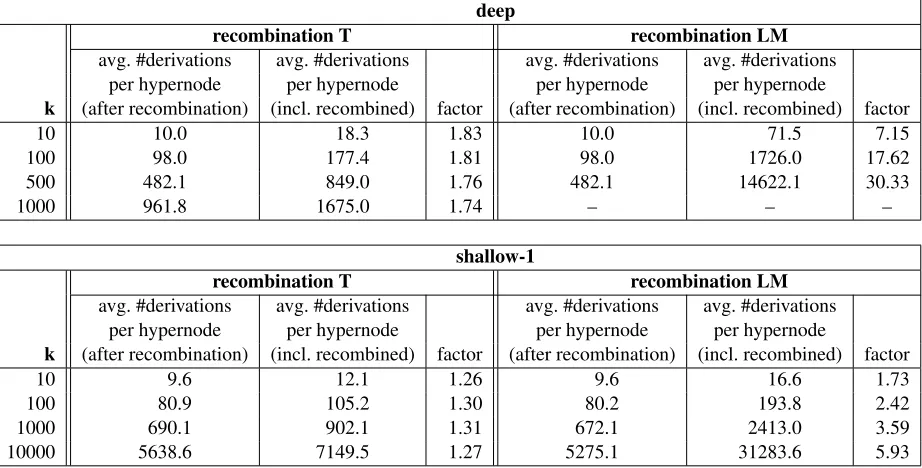
Actual amount of derivations. We measured the amount of hypernodes (Table 2), the amount of actu-ally generated derivations after recombination, and the amount of generated candidate derivations in-cluding recombined ones—or, equivalently, loop it-erations in the algorithm from Figure 1—for se-lected limits k (Tables 3 and 4). The ratio of the average amount of derivations per hypernode after and before recombination remains consistently at low values for all recombination T setups. For the setups with LM recombination scheme, this recom-bination factor rises with larger k, i.e. the fraction of recombinable candidates increases. The increase is remarkably pronounced for Arabic→English with
deep grammar. The steep slope of the recombina-tion factor may be interpreted as an indicator for un-desired overgeneration of the deep grammar on the Arabic→English task.
6 Conclusion
[image:7.612.73.298.289.476.2] [image:7.612.320.536.290.477.2]Table 2: Average amount of hypernodes per sentence and average length of the preprocessed input sentences on the NIST Chinese→English (MT08) and Arabic→English (MT08) tasks.
Chinese→English Arabic→English
deep shallow-1 deep shallow-1
avg. #hypernodes per sentence 480.5 200.7 896.4 308.4
avg. source sentence length 25.4 33.2
Table 3: Detailed statistics about the actual amount of derivations on the NIST Chinese→English task (MT08).
deep
recombination T recombination LM
avg. #derivations avg. #derivations avg. #derivations avg. #derivations per hypernode per hypernode per hypernode per hypernode
k (after recombination) (incl. recombined) factor (after recombination) (incl. recombined) factor
10 10.0 11.7 1.17 10.0 18.2 1.82
100 99.9 120.1 1.20 99.9 275.8 2.76
1000 950.1 1142.3 1.20 950.1 4246.9 4.47
10000 9429.8 11262.8 1.19 9418.1 72008.4 7.65
shallow-1
recombination T recombination LM
avg. #derivations avg. #derivations avg. #derivations avg. #derivations per hypernode per hypernode per hypernode per hypernode
k (after recombination) (incl. recombined) factor (after recombination) (incl. recombined) factor
10 9.7 11.3 1.17 9.6 13.6 1.41
100 90.8 105.2 1.16 90.4 168.6 1.86
1000 707.3 811.3 1.15 697.4 2143.4 3.07
10000 6478.1 7170.4 1.11 6202.8 34165.6 5.51
Table 4: Detailed statistics about the actual amount of derivations on the NIST Arabic→English task (MT08).
deep
recombination T recombination LM
avg. #derivations avg. #derivations avg. #derivations avg. #derivations per hypernode per hypernode per hypernode per hypernode
k (after recombination) (incl. recombined) factor (after recombination) (incl. recombined) factor
10 10.0 18.3 1.83 10.0 71.5 7.15
100 98.0 177.4 1.81 98.0 1726.0 17.62
500 482.1 849.0 1.76 482.1 14622.1 30.33
1000 961.8 1675.0 1.74 – – –
shallow-1
recombination T recombination LM
avg. #derivations avg. #derivations avg. #derivations avg. #derivations per hypernode per hypernode per hypernode per hypernode
k (after recombination) (incl. recombined) factor (after recombination) (incl. recombined) factor
10 9.6 12.1 1.26 9.6 16.6 1.73
100 80.9 105.2 1.30 80.2 193.8 2.42
1000 690.1 902.1 1.31 672.1 2413.0 3.59
[image:8.612.77.538.470.704.2]Acknowledgments
This work was partly achieved as part of the Quaero Programme, funded by OSEO, French State agency for innovation. This material is also partly based upon work supported by the DARPA BOLT project under Contract No. HR0011-12-C-0015. Any opin-ions, findings and conclusions or recommendations expressed in this material are those of the authors and do not necessarily reflect the views of the DARPA. The research leading to these results has received funding from the European Union Sev-enth Framework Programme (FP7/2007-2013) un-der grant agreement no287658.
References
Hala Almaghout, Jie Jiang, and Andy Way. 2012. Ex-tending CCG-based Syntactic Constraints in Hierar-chical Phrase-Based SMT. In Proc. of the Annual Conf. of the European Assoc. for Machine Translation (EAMT), pages 193–200, Trento, Italy, May.
Kathryn Baker, Michael Bloodgood, Chris Callison-Burch, Bonnie Dorr, Nathaniel Filardo, Lori Levin, Scott Miller, and Christine Piatko. 2010. Semantically-Informed Syntactic Machine Transla-tion: A Tree-Grafting Approach. InProc. of the Conf. of the Assoc. for Machine Translation in the Americas (AMTA), Denver, CO, USA, October/November. Jean-C´edric Chappelier and Martin Rajman. 1998. A
Generalized CYK Algorithm for Parsing Stochastic CFG. InProc. of the First Workshop on Tabulation in Parsing and Deduction, pages 133–137, Paris, France, April.
Stanley F. Chen and Joshua Goodman. 1998. An Em-pirical Study of Smoothing Techniques for Language Modeling. Technical Report TR-10-98, Computer Science Group, Harvard University, Cambridge, MA, USA, August.
David Chiang. 2005. A Hierarchical Phrase-Based Model for Statistical Machine Translation. InProc. of the Annual Meeting of the Assoc. for Computational Linguistics (ACL), pages 263–270, Ann Arbor, MI, USA, June.
David Chiang. 2007. Hierarchical Phrase-Based Trans-lation. Computational Linguistics, 33(2):201–228, June.
Adri`a de Gispert, Gonzalo Iglesias, Graeme Blackwood, Eduardo R. Banga, and William Byrne. 2010. Hierar-chical Phrase-Based Translation with Weighted Finite-State Transducers and Shallow-nGrammars. Compu-tational Linguistics, 36(3):505–533.
Chris Dyer, Adam Lopez, Juri Ganitkevitch, Johnathan Weese, Ferhan Ture, Phil Blunsom, Hendra Setiawan, Vladimir Eidelman, and Philip Resnik. 2010. cdec: A Decoder, Alignment, and Learning framework for finite-state and context-free translation models. In
Proc. of the ACL 2010 System Demonstrations, pages 7–12, Uppsala, Sweden, July.
Kenneth Heafield, Hieu Hoang, Philipp Koehn, Tetsuo Kiso, and Marcello Federico. 2011. Left Language Model State for Syntactic Machine Translation. In
Proc. of the Int. Workshop on Spoken Language Trans-lation (IWSLT), pages 183–190, San Francisco, CA, USA, December.
Kenneth Heafield, Philipp Koehn, and Alon Lavie. 2012. Language Model Rest Costs and Space-Efficient Stor-age. In Proc. of the 2012 Joint Conf. on Empir-ical Methods in Natural Language Processing and Computational Natural Language Learning, EMNLP-CoNLL ’12, pages 1169–1178, Jeju Island, Korea, July.
Kenneth Heafield, Philipp Koehn, and Alon Lavie. 2013. Grouping Language Model Boundary Words to Speed K-Best Extraction from Hypergraphs. InProc. of the Human Language Technology Conf. / North American Chapter of the Assoc. for Computational Linguistics (HLT-NAACL), Atlanta, GA, USA, June.
Hieu Hoang, Philipp Koehn, and Adam Lopez. 2009. A Unified Framework for Phrase-Based, Hierarchical, and Syntax-Based Statistical Machine Translation. In
Proc. of the Int. Workshop on Spoken Language Trans-lation (IWSLT), pages 152–159, Tokyo, Japan, Decem-ber.
Liang Huang and David Chiang. 2005. Better k-best Parsing. InProc. of the 9th Int. Workshop on Parsing Technologies, pages 53–64, October.
Liang Huang and David Chiang. 2007. Forest Rescoring: Faster Decoding with Integrated Language Models. In
Proc. of the Annual Meeting of the Assoc. for Com-putational Linguistics (ACL), pages 144–151, Prague, Czech Republic, June.
Matthias Huck, David Vilar, Daniel Stein, and Hermann Ney. 2011. Advancements in Arabic-to-English Hier-archical Machine Translation. In15th Annual Confer-ence of the European Association for Machine Trans-lation, pages 273–280, Leuven, Belgium, May. Gonzalo Iglesias, Adri`a de Gispert, Eduardo R. Banga,
and William Byrne. 2009a. Rule Filtering by Pat-tern for Efficient Hierarchical Translation. InProc. of the 12th Conf. of the Europ. Chapter of the Assoc. for Computational Linguistics (EACL), pages 380–388, Athens, Greece, March.
Trans-ducers. InProc. of the Human Language Technology Conf. / North American Chapter of the Assoc. for Com-putational Linguistics (HLT-NAACL), pages 433–441, Boulder, CO, USA, June.
Reinhard Kneser and Hermann Ney. 1995. Improved Backing-Off for M-gram Language Modeling. In
Proc. of the International Conf. on Acoustics, Speech, and Signal Processing, volume 1, pages 181–184, De-troit, MI, USA, May.
P. Koehn, H. Hoang, A. Birch, C. Callison-Burch, M. Federico, N. Bertoldi, B. Cowan, W. Shen, C. Moran, R. Zens, C. Dyer, O. Bojar, A. Constantin, and E. Herbst. 2007. Moses: Open Source Toolkit for Statistical Machine Translation. InProc. of the Annual Meeting of the Assoc. for Computational Linguistics (ACL), pages 177–180, Prague, Czech Republic, June. Zhifei Li and Sanjeev Khudanpur. 2008. A Scalable Decoder for Parsing-Based Machine Translation with Equivalent Language Model State Maintenance. In
Proceedings of the Second Workshop on Syntax and Structure in Statistical Translation, SSST ’08, pages 10–18, Columbus, OH, USA, June.
Zhifei Li, Chris Callison-Burch, Chris Dyer, Sanjeev Khudanpur, Lane Schwartz, Wren Thornton, Jonathan Weese, and Omar Zaidan. 2009a. Joshua: An Open Source Toolkit for Parsing-Based Machine Transla-tion. InProc. of the Workshop on Statistical Machine Translation (WMT), pages 135–139, Athens, Greece, March.
Zhifei Li, Chris Callison-Burch, Sanjeev Khudanpur, and Wren Thornton. 2009b. Decoding in Joshua: Open Source, Parsing-Based Machine Translation. The Prague Bulletin of Mathematical Linguistics, (91):47– 56, January.
Junhui Li, Zhaopeng Tu, Guodong Zhou, and Josef van Genabith. 2012. Using Syntactic Head Information in Hierarchical Phrase-Based Translation. InProc. of the Workshop on Statistical Machine Translation (WMT), pages 232–242, Montr´eal, Canada, June.
NIST. 2008. Open Machine Translation 2008 Evalua-tion. http://www.itl.nist.gov/iad/mig/
tests/mt/2008/.
Franz Josef Och and Hermann Ney. 2003. A Systematic Comparison of Various Statistical Alignment Models.
Computational Linguistics, 29(1):19–51, March. Franz Josef Och. 2003. Minimum Error Rate Training
for Statistical Machine Translation. InProc. of the An-nual Meeting of the Assoc. for Computational Linguis-tics (ACL), pages 160–167, Sapporo, Japan, July. Kishore Papineni, Salim Roukos, Todd Ward, and
Wei-Jing Zhu. 2002. Bleu: a Method for Automatic Eval-uation of Machine Translation. InProc. of the Annual Meeting of the Assoc. for Computational Linguistics (ACL), pages 311–318, Philadelphia, PA, USA, July.
Baskaran Sankaran, Majid Razmara, and Anoop Sarkar. 2012. Kriya - An end-to-end Hierarchical Phrase-based MT System. The Prague Bulletin of Mathemat-ical Linguistics, (97):83–98, April.
Libin Shen, Jinxi Xu, and Ralph Weischedel. 2010. String-to-Dependency Statistical Machine Translation.
Computational Linguistics, 36(4):649–671, Decem-ber.
Andreas Stolcke. 2002. SRILM – an Extensible Lan-guage Modeling Toolkit. In Proc. of the Int. Conf. on Spoken Language Processing (ICSLP), volume 3, Denver, CO, USA, September.
Ashish Venugopal, Andreas Zollmann, Noah A. Smith, and Stephan Vogel. 2009. Preference Grammars: Softening Syntactic Constraints to Improve Statisti-cal Machine Translation. In Proc. of the Human Language Technology Conf. / North American Chap-ter of the Assoc. for Computational Linguistics (HLT-NAACL), pages 236–244, Boulder, CO, USA, June. David Vilar and Hermann Ney. 2012. Cardinality
pruning and language model heuristics for hierarchi-cal phrase-based translation. Machine Translation, 26(3):217–254, September.
David Vilar, Daniel Stein, Matthias Huck, and Hermann Ney. 2010. Jane: Open Source Hierarchical Transla-tion, Extended with Reordering and Lexicon Models. InProc. of the Workshop on Statistical Machine Trans-lation (WMT), pages 262–270, Uppsala, Sweden, July. David Vilar, Daniel Stein, Matthias Huck, and Hermann Ney. 2012. Jane: an advanced freely available hierar-chical machine translation toolkit. Machine Transla-tion, 26(3):197–216, September.
David Vilar. 2011. Investigations on Hierarchi-cal Phrase-Based Machine Translation. Ph.D. the-sis, RWTH Aachen University, Aachen, Germany, November.
Philip Williams and Philipp Koehn. 2012. GHKM Rule Extraction and Scope-3 Parsing in Moses. In
Proc. of the Workshop on Statistical Machine Transla-tion (WMT), pages 388–394, Montr´eal, Canada, June. Tong Xiao, Jingbo Zhu, Hao Zhang, and Qiang Li. 2012.
NiuTrans: An Open Source Toolkit for Phrase-based and Syntax-based Machine Translation. In Proc. of the ACL 2012 System Demonstrations, pages 19–24, Jeju, Republic of Korea, July.
Jun Xie, Haitao Mi, and Qun Liu. 2011. A Novel Dependency-to-String Model for Statistical Machine Translation. InProc. of the Conf. on Empirical Meth-ods for Natural Language Processing (EMNLP), pages 216–226, Edinburgh, Scotland, UK, July.