ISSN Online: 2167-9541 ISSN Print: 2167-9533
DOI: 10.4236/jfrm.2017.63017 Aug. 11, 2017 231 Journal of Financial Risk Management
Modeling and Quantifying of the Global Wrong
Way Risk
Badreddine Slime
Financial Risk Quant from ENSAE (Ecole Nationale de la Statistique et de l’Administration Economique), Paris, France
Abstract
The counterparty risk issue has become increasingly important in the world of finance. This risk is defined as the loss due to the counterparty default. The
regulator uses the Credit Value Adjustment (CVA) to measure this risk.
However, there is the independency assumption between the default and the exposure behind the CVA computation and it is not verified on the financial market. This paper presents two mathematical models for the assessment and the quantification of the counterparty risk without this assumption. This kind
of risk is known as Wrong Way Risk (WWR). This study focuses on three
ap-proaches: empirical, copula and mixed model. The first one is based on the hazard rate modelling to express the correlation between the probability of default and the exposure. The second one is about calculating the WWR effect using copulas. The last one is a combination of both. There is another
as-sumption that makes easier the CVA computation: The constant of the loss
given default (LGD). As we know this assumption is not verified because the
LGD could be deterministic or stochastic. Otherwise, it could lead to a corre-lation effect between the LGD, the exposure and the default, and we then
ob-tain a Global Wrong Way Risk (GWWR). Indeed, we propose a model
allow-ing the CVA quantification without these assumptions.
Keywords
Counterparty Risk, Credit Value Adjustment, Wrong Way Risk, Copulas
1. Introduction
The credit value adjustment (CVA) computation is based on the independency
assumption between the exposure and the default. However, this assumption is not verified on the market, and we although have correlation between the prob-ability of default (PD) and the exposure at default (EAD). Therefore, we get two How to cite this paper: Slime, B. (2017).
Modeling and Quantifying of the Global Wrong Way Risk. Journal of Financial Risk Management, 6, 231-246.
https://doi.org10.4236/jfrm.2017.63017
Received: June 18, 2017 Accepted: August 8, 2017 Published: August 11, 2017
Copyright © 2017 by author and Scientific Research Publishing Inc. This work is licensed under the Creative Commons Attribution International License (CC BY 4.0).
DOI: 10.4236/jfrm.2017.63017 232 Journal of Financial Risk Management
types of this effect: The Wrong Way Risk (WWR) when the correlation is posi-tive and the Right Way Risk (RWR) when the correlation in this case is negative.
There is another effect appears when the LGD becomes random and also
de-pends on the default. Indeed, this could generate a correlation between the three variables that make the CVA assessment. In this case, we could call this effect as
the Global Wrong Way Risk (GWWR). First, we will focus on the WWR effect
and we make the difference between two kinds:
•The systemic WWR: this kind arises at the moment where the dependency
between the exposure and the default is due to a macroeconomic factor. In this case, this factor increases the EAD and the PD. If we take a put on the CAC40 index with some bank like Société Général (SG) as the issuer, then the CAC40 spot impacts both of the exposure and the counterparty rating. In fact, this index is a systemic factor in the French market and the SG is a part of the CAC40 composition.
•The specific WWR: on the other hand, this kind comes from a specific
fac-tor. For example, we get this effect when we have a put on the stock of the issuer as underlying.
There are several models allowing the CVA computation with the WWR
component. We present some of these approaches:
•The Basel model1 (Basel Committee on Banking Supervision, 2010): this
approach is the most straightforward one to add the correlation effect and it is used by the Basel committee to add the WWR effect in the counterparty credit risk (CCR) charge. It is based on the multiplier coefficient
α
>1, to explain this effect. The exposure at default is given by the formula bellow:EAD= ×
α
EEPEWith EEPE represents the expected effective positive exposure.
We have by default
α
=1.4, whatever, banks could have values above 1.2.Other institutions use values bigger than the default one. The coefficient value is appreciated, on one hand, by the name concentration and that also means the portfolio granularity by counterparties. On the other hand, we have the correla-tion effects between assets of the same counterparty. The Basel II accords do not
give details to manage the WWR. However, Basel III brings more precision to
manage this kind of risk, focusing on three aspects:
Implementation of a detailed process to manage the WWR.
Advising banks to put more provision to cover the counterparty risk.
Explication of the approach to manage transactions containing the specific
WWR.
The implementation of this model remains easy and could be automatically integrated to the existent model, but it has two drawbacks:
It does not give the contribution part of the WWR.
It consumes more capital requirement to cover the counterparty risk, because
1Basel Committee on Banking Supervision (2010), “Basel III: A Global Regulatory Framework for
DOI: 10.4236/jfrm.2017.63017 233 Journal of Financial Risk Management
the standard approach is designed for the worst case.
• The empirical approach: this approach uses the hazard rate according to the
exposure. Indeed, the relation between these two quantities allows getting the diffusion of the PD, and then it could explain the correlation with the expo-sure. The WWR modeling progresses into three steps:
The choice of the function that gives the relation between the hazard rate and
the exposure. The diffusion calculation is performed for each time step:
( )
(
( )
)
h t = p V t
With V
( )
. represents the exposure. Hull and White2 (Hull & White 2012)suggests an exponential function to implement this method.
The PD computation is done using the below formula:
( )
0( )d1 e th s s
PD t = − −∫
The computation of the CVA WWR using the Monte Carlo simulation. This
step is deduced directly from the exposure diffusion.
This approach allows a straight integration within the existent CVA model. In fact, it replaces the computed PDs under the independency assumption with the new one using the dependency between the default and the exposure.
• The copula model: This approach is based on copulas to explain the relation
between the default variable and the exposure. Rosen and Saunders3 (Rosen
& Saunders 2012) use the Vasicek model to make this dependency. They in-troduced the Gaussian copula to compute the expected exposure without the independency assumption. Their model is implemented in three steps:
The default is written as a latent variable and it is divided in two components.
The first part represents the specific risk, and the second part is the systemic risk:
2
1
Y=
ρ
Z+ −ρ
where Z and are two independent random variables and they follow a
Gaussian distribution. The counterparty is deemed in default when Y is lower
than 1
(
)
t
PD
−
Φ . The conditional probability of default regarding to the
system-ic variable is expressed as:
( )
1(
)
2
1
t t
t
PD Z
PD Z ρ
ρ −
Φ −
= Φ
−
With PDt represents the unconditional probability of default.
Future exposures are mapped to a market variable X that also follows a
Gaussian distribution. The relation between this variable and the exposure is:
( )
(
)
1
X = Φ− F V
With F represents the distribution function of exposure and it is uniform. 2J. Hull and A. White (2012), CVA and Wrong Way Risk, Financial Analysis Journal, 68, pp. 58-69. 3D. Rosen, and D. Saunders (2012), CVA Wrong Way Risk, Journal of Risk Management in
DOI: 10.4236/jfrm.2017.63017 234 Journal of Financial Risk Management
This model supposes that the two variables X and Z are linked to a
biva-riate joint distribution. This relation is expressed under a Gaussian copula with the correlation
ρ
between both of variables. Bocker and Brunnbauer4(Bocker & Brunnbauer, 2014) generalized this concept to use others copulas. This approach allows a straight integration within the existent CVA model.
The next section will be devoted to the WWR mathematical modeling using a
mixed model. Indeed, we will use the empirical model to build the diffusion of
PDs, and then we will explain the relation between the default and the exposure under copulas model.
2. Mathematical Modeling of the
WWR
The Credit Value Adjustment (CVA) is defined by the difference between the
portfolio value without the counterparty default and with this component. The
CVA could be written as:
Risk Free
CVA VP= −VP
where Risk Free
VP represents the risk free portfolio value, and VP is the portfo-lio value taking in consideration the counterparty default.
Using this, we find the following formula:
( )
( )
( )
CVA=LGD
τ
×V+τ
×PDτ
With τ is the default time, V+
( )
τ
=max 0,(
V( )
τ
×D( )
τ
)
, D( )
. representsthe discount factor, and LGD defines the Loss Given Default that we deem
constant in this section. We also can write:
(
) ( )
0 d
T
CVA=LGD
∫
EE+ τ=t F twhere EE+
(
τ
= =t)
V+( )
tτ
=t, and F defines the distribution of thede-fault.
First, we begin by modeling the probability of default using the empirical model. For this, we introduce the hazard rate concept that measures the coun-terparty default occurrence. Giving the assumption that the default frequency follows the Poisson density, we get the formula below:
( )
1 exp(
0t( )
d)
PD t = − − h s s
∫
The relation between the h t
( )
, and the exposure is written as:( )
(
,( )
)
h t =p t V t
With p is defined positive since h t
( )
≥ ∀ ≥0, t 0.This function should also verify the following relation under the assumption that the hazard rates curve is flat:
( )
(
)
( )
exp h t t exp s t t
LGD
×
− × = −
DOI: 10.4236/jfrm.2017.63017 235 Journal of Financial Risk Management
With h defines the arithmetic average of simulated values until the date t,
and s t
( )
is the market spread with the maturity of t.We deem the following function of the hazard rate:
( )
, t exp(
( ) ( ) ( )
)
p t V = a t +b t ×V t
where b t
( )
is a function of time and determines the correlation between hand V, and a t
( )
is a function of time.We can find the stochastic derivative equation (SDE) of the hazard rate by ap-plying the Itô’s lemma on the p t V
( )
, t , and we get:( )
2( )
2( )
( )
( )
d 1 d d 2 Q t V V a t h
b t t t b t t W
h t σ σ
∂
= ∂ + × + ×
With d V
( )
d Qt t Wt
V =σ , σV
( )
t defines the volatility of Vt and Q tW repre-
sents the Brownian motion under the risk neutral measure.
We conclude that the hazard rate follows a log-normal distribution with pa-rameters below:
( )
( )
2( )
2( )
2( )
2( )
2( )
0 0
1
d , d
2 V V
t t
h h
a s
t b s s s t b s s s
t
µ = ∂∂ + ×σ σ = ×σ
∫
∫
In our case, we more interest about the distribution of the time integration of
the h. If we take the following approximation
( )
( )
1( )
0 d
t k
i i
h t =
∫
h s s≈∑
=h t ∆tand by using the Fenton-Wilkinson5(Fenton, 1960) approach, this quantity then follows a log-normal distribution with parameters below:
( )
( )
( )
2( )
( )
( )
1 2 2 1
1
2 ln ln , ln 2 ln
2
h t m m h t m m
µ = − σ = −
With,
( )
( )
( )
( )
(
( )
( )
)
2 1 1 2 2 2 1 exp , 2 exp 2 k h i h i i kh i h i
i
t
m h t t
m h t t t
σ µ µ σ = = = = + = = +
∑
∑
It also supposes that h t
( )
i are independent. We get the following result byapplying the Laplace transform approximation:
( )
(
)
( )
( )
( )
2( )
0 0 exp 2 exp 1 ! ! k h k h k k k k t h t h t k k t σ µ ∞ ∞ = = × − + − = − =
∑
∑
If
( )
2
0 2
h
k×
σ
t≈ , then exp
(
−h t( )
)
=exp(
−eµh( )t)
The calibration is made in each time of the Monte Carlo simulation. Indeed,
we minimize the distance between the PD model and the PD market basing on
spreads. So, we need to do this process M times using the discretization form
of the hazard rate:
5Fenton L. (1960) the sum of lognormal probability distribution in scatter transmission system, IEEE
DOI: 10.4236/jfrm.2017.63017 236 Journal of Financial Risk Management
(
)
exp
ij i i ij i ij
h = a +bV +
σ ε
where hij =h t
( )
i and Vij =V t( )
i represent the jth simulation of the exposure and the hazard rate.
The Appropriate parameters are those who minimize the following quantity:
, ,
1 1
1
min exp d exp , 1
i i i
M k
k k
ij a b
j i
s t
h t k N
M LGD
σ = =
×
− − − ≤ ≤
∑
∑
where M is the Monte Carlo number of simulation, N is the number of steps time, sk and represents the spread with maturity tk.
Finally, when the parameters are computed, then the hazard rates are built sequentially at each time step. The next step allows to define the relation be-tween the exposure and the probability of default distribution. Therefore, we use the copulas to get this relation, and we take the following definitions:
• The value of the discount exposure V at time s follows a distribution
( )
(
( )
)
,s
G v = V s ≤v v ∈ with g her density function.
• The default time of the counterparty
τ
>0 is a random variable and wenote his distribution function by F t
( )
=(
τ≤t)
,t>0 and with the densityf .
• The joint distribution of V and τ is defined by:
( )
(
V s ≤v,τ
≤ ≡t)
Js( )
v,t =C Gs(
s( ) ( )
v ,F t)
where Cs indicates the bivariate copula and we suppose Cs is twice
conti-nuously differentiable function. The density function is written as:
( )
2( ) ( )
,[ ]
2, s , , 0,1
s
C x y
c x y x y
x y
∂
= ∈
∂ ∂
The expected positive exposure (EPE) is equal to:
( )
( )
( )
dEE+ s =V+ s τ =s=
∫
−∞+∞ j v s ×v + v With j v t( )
j v t( )
( )
,f t
=
We also have:
( )
, s(
s( ) ( )
,)
s( ) ( )
( )
s(
s( ) ( )
,)
s( )
j v t =c G v F t ×g v ×f t ⇒ j v t =c G v F t ×g v
We then replace the value of the conditional density in the formula to get the following result:
( )
(
( ) ( )
)
( )
( ) ( )
(
)
( )
, d
,
s s s
s s
EE s c G v F s v g v v
c G v F s V s
+∞
+ +
−∞
+
= × ×
= ×
∫
By applying the strong law of large number, we obtain the following approxi-mation of the EPE:
( ) ( )
(
)
( )
(
( )
( )
)
( )
1
1
, ,
M
s s s s j j
j
c G v F s V s c G v F s V s
M
+ +
=
× ≈ ×
∑
DOI: 10.4236/jfrm.2017.63017 237 Journal of Financial Risk Management
estimation of the correlation between the exposure and the probability of default. In fact, it is the requirement parameter to compute c G vs
(
s( )
j ,F s( )
)
. We sug-gest two approaches to do this estimation:• The first one uses the Spearman6(Daniel, 1990) correlation who is defined as:
( )
(
2)
6 1
1
k i
d r t
K K
× = −
× −
∑
where dk=rg PD
( )
−rg V( )
presents the ranks difference between theexpo-sure and the probability of default, and K is the number of observations. We
compute this correlation at each time step and we use the result of the hazard rate
diffusion for this. Finally, we can estimate the correlation by 0
( )
1 N
i i
r r t
N =
=
∑
.• The second one is based on the minimization of the difference between the
simulated survival probabilities at time ti using the hazard rate model and
the copula at each time step:
( ) 1 1
(
( )
( )
)
1
min exp d , , 1
i
M k
ij s s j
r t
j i
h t c G v F s k N
M = =
− − ≤ ≤
∑
∑
We then can estimate the correlation by 0
( )
1 N
i i
r r t
N =
=
∑
.We have now all components to complete the CVA computation with the
WWR effect. It remains to calculate all EE
( )
ti+ and apply the trapezoid
inte-gration method regarding to the PDs to get the value. The implementation of the
mixed model approach will be done on the CAC40 European put option. We
will use the HESTON7(Heston, 1993) model to compute the put price that is based on the stochastic volatility. We then take the following assumptions:
• The Loss Given Default LGD is constant and equal to 60%.
• The discretization of time space is done on 100 steps. • The dividends are equals to 0.
• The credit spread of the counterparty is constant and equal to 0.8%. • The CAC40 put strike value is 4350.
• The Credit Support Annex (CSA) contains a Margin Call with 10 days as
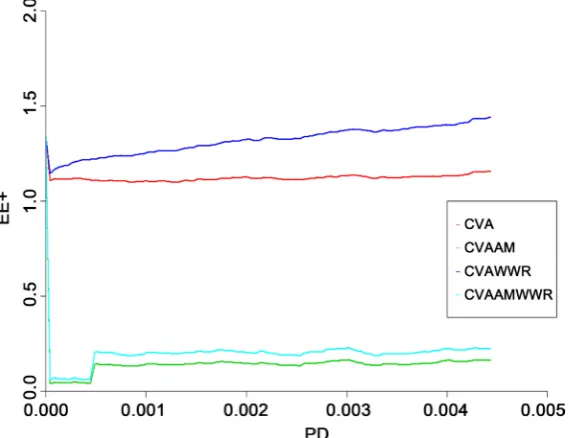
Margin Dates and the calculation will be done with and without collateral. The value of the correlation between exposures and defaults using Spearman is equal to r= −0.101122. The Figure 1 shows the evolution of the EPE re-garding to the PD with and without collateral using the Gaussian copula:
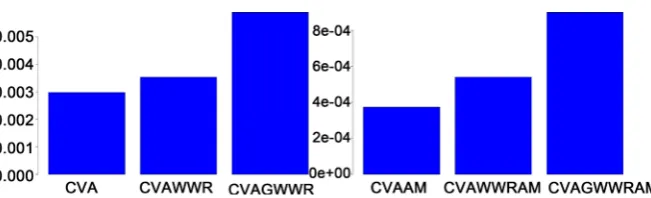
We conclude that the EPE increases with the WWR effect and the CVA will also have the same behavior. The Figure 2 displays this effect:
The WWR increases the CVA quantity with 30%, and that proves its importance
and impact on the counterparty risk measurement. The Table 1 summarizes
these results.
6Daniel, Wayne W. (1990). “Spearman rank correlation coefficient”. Applied Nonparametric
Statis-tics (2nd ed.). Boston: PWS-Kent. pp. 358–365.
7Heston, S.L., (1993), A closed-form solution for options with stochastic volatility with applications
DOI: 10.4236/jfrm.2017.63017 238 Journal of Financial Risk Management
[image:8.595.233.518.72.291.2]Figure 1. Expected positive exposure with and without WWR effect.
Figure 2.CVA and WWR effect with and without collateral.
Table 1. CVA WWR calculation results.
Without Collateral With Collateral
CVA 0.002979613 0.000374312
CVA(WWR) 0.003501835 0.000521428
3. The Global Wrong Way Risk (
GWWR
)
As we saw in the last section, the compute of the CVA supposes that the LGD is constant. Furthermore, this assumption leads to the independency of this varia-ble to the default. Nevertheless, the LGD depends to the default and automati-cally to the exposure, because the WWR proves that there is a dependency be-tween the exposure and the default. We choose the word “Global” because we study the dependency between the three components that allow the calculation
of the CVA. In order to model the Global Wrong Way Risk, we suggest two
ap-proaches:
• The first approach is based on the building of a relation between the LGD
[image:8.595.206.543.321.441.2]DOI: 10.4236/jfrm.2017.63017 239 Journal of Financial Risk Management
the LGD with the exposure through the below function:
( )
( )
V( )
LGD t =L t
With ∀ ∈x R L x,
( )
∈[ ]
0,1 .We then replace in the CVA formula:
( )
( )
( )
( )
( )
( )
( )
GWWR
CVA =LGD t ×V+ t ×PD t =L V t ×V+ t ×PD t
There is two ways to compute this expectation, on one hand; we can make it with empirical approach. We define the relation below:
( )
( )
( )
h t = p V t
With p is defined positive since h t
( )
≥ ∀ ≥0, t 0.We so get the following result:
( )
(
)
( ) ( )
(
( )
)
( )
(
)
( )
(
( )
)
(
(
( )
)
)
0 0 0 0exp d d
exp d d
t s
GWWR
t s
CVA L V s V s h s h u u s
L V s V s p V s p V u u s
+ + = × × × = × × ×
∫
∫
∫
∫
By applying the strong law of large number, we have at each step of time ,1
k
t ≤ ≤k N the approximation of the Global expected positive exposure
(GEPE):
( )
(
( )
)
( )
(
( )
)
(
(
( )
)
)
( )
(
)
( )
(
( )
)
(
(
( )
)
)
0 0 1 exp d 1exp k d
s k
M t
k k k
j
GEE t L s s p s p u u
L t t p t p u u
V V V V
V
M V V V
+ + + = = × × × ≈ × × ×
∫
∑
∫
Using the trapezoid method for calculation the integral, we get:
( )
( ) (
1)
1 1 2 N k k GWWR k k k
GEE t GEE t
CVA t t
+ + − − = + ≈ × −
∑
On the second hand, we can use the copula approach. Given the definitions in the last section, we have:
( )
(
( )
)
( )
( )
( )
dEE+ s L V s V+ s τ s +∞j v s v+ L v v
−∞
= × = =
∫
× × Knowing that, j v t
( )
=c G vs(
s( ) ( )
,F t)
×g vs( )
We get the following result:
( )
(
( ) ( )
)
( )
( )
( ) ( )
(
)
( )
(
( )
)
, d
,
s s s
s s
GEE s c G v F s v L v g v v
c G v F s V s L V s
+∞ + + −∞ + = × × × = × ×
∫
By applying the strong law of large number, we obtain the following approxi-mation of the GEPE:
( ) ( )
(
)
( )
(
( )
)
( )
( )
(
)
( )
(
( )
)
1 , 1 , s s Ms s j j
j
c G v F s s L s
c G v F s s L s
DOI: 10.4236/jfrm.2017.63017 240 Journal of Financial Risk Management
We compute this quantity at each time step, and then we use the trapezoid
method to compute the GWWR CVA.
The implementation of this approach needs to choose the link function be-tween the LGD and the exposure. We then suggest the following function:
( )
(
)
1 e a PD t( )L V t = − ×b − ×
where PD t
( )
= −1 exp(
− 0t p(
V( )
s)
ds)
∫
The calibration of the LGD model could be done by defining the maximum
and the minimum of the LGD. If we note respectively LGDmin and LGDmax
the lower and the upper bound, we thus obtain:
max min min
1 ln
1
1
LGD a
LGD
b LGD
= − −
−
= −
In our case, we take LGDmin=0.6 and LGDmax=0.99. We get the following
values of a=19.81,b=0.4
The Figure 3 displays the evolution of the GEPE regarding to the PD with and without collateral using the Gaussian copula:
We deduce that the GEPE increases with the GWWR effect and the CVA will
also have the same behavior. The GWWR grows the CVA quantity with 100%,
and that proves its importance and impact on the counterparty risk measure-ment. The Table 2 summarizes these results:
The Figure 4 shows this effect:
• The second approach is built around the approximation of the difference
[image:10.595.222.522.423.608.2]between the classical CVA, and the other one without any assumptions using a close formula. We suppose that the default is driven via a systemic factor
Figure 3. Expected positive exposure with and without WWR effect.
Table 2. CVA GWWR calculation results.
Without Collateral With Collateral
CVA 0.002979613 0.000374312
CVA(WWR) 0.003535026 0.000540142
[image:10.595.207.540.659.721.2]DOI: 10.4236/jfrm.2017.63017 241 Journal of Financial Risk Management
Figure 4. CVA and GWWR effect with and without collateral.
X and the default arises at time t when the X reaches some level x:
{
τ= ≡t} {
X=x}
We can write the CVA under to the independency assumption as:
( )
( )
{ }( )
( )
(
(
) (
1)
)
1 I
T
N
k k k k
k
CVA L X LGD V X
LGD t V t F t X F t X
τ
τ
+τ
≤
+
− =
= = × ×
≈
∑
× × −
With
( )
( )
( )
12
k k
k
V t V t
V t
+ +
−
+ = +
We note the Global Wrong Way Risk CVA by GWWR
CVA and we define the
following function:
( )
I(
GWWR I)
,[ ]
0,1D
ε
=CVA + ×ε
CVA −CVA ∀ ∈ε
For
ε
=1, we have CVAGWWR=CVAI+ ×ε
(
CVAGWWR−CVAI)
. We define the following quantities:( )
( )
( )
( )
( )
(
(
) (
1)
)
1
,
k k
N
t t k k k k
k
X X X LGD t V t F t X F t X
µ
µ
µ
+− =
=
∑
= × × −( )
( )
( )
( )
( )
{ 1 }2 2 2
1
,
k k k k
N
t t k k t t
k
X X X LGD t V t τ X
σ
σ
σ
+ −≤ ≤ =
=
∑
= × × Under the assumption of independency of LGD t
( )
k V( )
tk {tk−1τ tk} X +≤ ≤
× × ,
1, ,
k N
∀ = . Using these notations, the Global Wrong Way Adjustment
(GWWA) is defined as:
(
)
(
GWWR)
(
I)
q q q
GWWA CVA =VaR CVA −VaR CVA
For a q∈
[ ]
0,1 .By applying the Taylor expansion on VaRq
(
D( )
ε
)
with second orderac-cording to the
ε
=0 and by replacing theε
=1, we get:(
)
(
( )
)
2(
( )
)
2
1 2
q q q
GWWA CVA VaR
µ
X VaRµ
Xε
ε
∂ ∂
≈ +
∂ ∂
By computing the first and the second derivative terms, we find the following results8(Gourieroux, Laurent, & Scaillet, 2000):
( )
(
)
( ) ( )
( )
0q q
VaR µ X L µ X µ X VaR X
ε
∂
= − = =
∂
8C. Gourieroux, J.P. Laurent, O. Scaillet (2000), Sensitivity analysis of Values at Risk, Journal of
DOI: 10.4236/jfrm.2017.63017 242 Journal of Financial Risk Management
( )
(
)
( )
( ) ( )
( )
( ) 1 2 2 2 1 2 q X q Xx VaR X
x f x
VaR X
f x x x
σ µ µ ε − = ∂ ∂ = − × ′ ∂ ∂
where fX represents the density function of the systemic factor.
We then find the result bellow9(Slime, 2016):
(
)
( )
( )
( )
( )
( )
( )
( )
( ) 1 2 2 1 2 q X q Xx VaR X
f x x
GWWA CVA x x
x f x x
µ σ σ µ µ − = ′ ′′ ′ = − × − + ′ ′
We need to define a model for computing this quantity, and we then chose the
CreditRisk+10(Credit Suisse Financial Products, 1997) model. This model sup-poses that X ~Γ
(
α β,)
whereα β× =1 and we obtain the following relation:( )
1( )
1( )
( )
(
1)
e x , X
X
X
f x
f x x
f x x
α α α α α β α − − ′ − = = − Γ
(
k)
( ) (
k 1)
F t X =x =F t × − + ×w w x
Which w represents the dependence factor between the counterparty and
the systemic factor.
We also need to develop the derivative terms to complete the calculation, so we have:
( )
( )
( )
(
(
) (
)
)
( )
( )
(
( )
( )
)
(
)
1 1 1 kt k k k k
k k k k
x LGD t V t F t X x F t X x
LGD t V t F t F t w w x
µ
+ − + − = × × = − = = × × − × − + × ( )
( )
( )
(
( )
( )
1)
(
)
1
1
N
k k k k
k
x LGD t V t F t F t w w x
µ
+ − = ⇒ =∑
× × − × − + ×and
( )
1( )
( )
(
( )
( )
1)
,( )
0N
k k k k
k
x LGD t V t F t F t w x
µ + µ
−
=
′ =
∑
× × − × ′′ =The CVA assumption is the independency between the LGD, the exposure
and the default, and this allows us to compute the following term:
( )
( )
( )
{ }( )
( )
{ }(
)
(
( )
( )
{ })
1 1 1 2 2 2k k k
k k k k
t k k t t
k k t t k k t t
x LGD t V t x
LGD t V t x LGD t V t x
τ τ τ σ − − − + ≤ ≤ + + ≤ ≤ ≤ ≤ = × × = × × − × ×
( )
( )
{ }(
)
( )
(
)
(
( )
)
(
{ })
1 1 2 2 2 2 k k k kk k t t
k k t t
LGD t V t x
LGD t V t x
τ τ − − + ≤ ≤ + ≤ ≤ × × = × ×
The second assumption of the CreditRisk+ model is that {tk−1≤ ≤τ tk} X follows a Poisson distribution with
(
F t X(
k =x) (
−F tk−1 X =x)
)
as intensity. So, wededuce that:
{ }
(
1)
(
) (
)
(
(
) (
)
)
2 2
1 1
k k k k k k
t−≤ ≤τ t x F t X x F t − X x F t X x F t− X x
= = − = + = − =
9Slime, B. (2016). Credit Name Concentration Risk: Granularity Adjustment Approximation.
Jour-nal of Financial Risk Management, 5, 246-263.
10Credit Suisse Financial Products (1997). Credit Risk+: A Credit Risk Management Framework.
DOI: 10.4236/jfrm.2017.63017 243 Journal of Financial Risk Management
We get the result bellow:
( )
( )
(
( )
)
22
k k k k k
t x Ct t x Dt t x
σ = ×µ + × µ
With
(
( )
( )
)
(
( )
( )
)
( )
( )
2 2
k
k k k k
t
k k
LGD t LGD t V t V t
C
LGD t V t
+ + + + + =
And
( )
( )
( )
( )
( )
( )
( )
( )
2 2 2 2
k
k k k
k t
k k k k
V t LGD t V t
LGD t D
LGD t V t LGD t V t
+ + + + = + +
We conclude that:
( )
(
( )
)
( )
2
1
k k k k
N
t t t t
k
x C D x x
σ
µ
µ
= =
∑
+ × ×( )
(
( )
)
( )
2 1 2k k k k
N
t t t t
k
x C D x x
σ
µ
µ
=
′=
∑
+ × × × ′Subtitling in the GWWA formula, we obtain:
(
)
( )
(
)
( )
( )
( ) 1 2 2 1 1 2 q qx VaR X
GWWA CVA x x
x x
α
α σ σ
µ − = − ′ = − − × + ′
If we note the classical CVA by:
( )
( )
( )
(
( )
( )
1)
1 1
N N
I I
C C k k k k k
k k
CVA CVA t LGD t V+ t F t F t−
= =
=
∑
=∑
× × −Then we have:
( )
IC
x w CVA
µ′ = × and
( ) (
1)
( )
k
I
t x w w x CVA tC k
µ
= − + × ×Finally, we get the following formula:
(
)
( )
( ) (
)
1 1 1 2 k k k N t I Iq I t C k C k
k t
C
D
GWWA CVA C CVA t CVA t
C
CVA = ϑ ϑ
= × × − × × +
×
∑
With
(
)
(
1 1( )
)
, w w VaR q X
q X
w
θ − + × −
=
And
(
( )
)
(
)
1 1 , 1 q q X VaR X α
ϑ α θ
− − = + × −
Under the assumption of
(
( )
( )
)
2( )
21 0 0
I
k k C k
F t −F t− ≈ ⇒CVA t ≈ , we obtain
the simplified formula of GWWA:
(
)
( )
1
2 k
N
S I
q I t C k
k C
GWWA CVA C CVA t
CVA
ϑ =
= ×
×
∑
Furthermore, the Global Wrong Way Risk CVA may be approximate using
the formula bellow in the case of a symmetric distribution:
(
)
, 0.5GWWR I
q
CVA ≈CVA +GWWA CVA q=
For non-symmetric distribution, we have:
(
)
1
0 d
GWWR I
q
CVA ≈CVA +
∫
GWWA CVA qDOI: 10.4236/jfrm.2017.63017 244 Journal of Financial Risk Management
could calibrate the factor α using the Maximum Likelihood Estimation (MLE).
We deem n observation of X =
(
X1,,Xn)
and the likelihood function isdefined by:
(
)
( )
1( )
1 11 1
, e i e in i
n
n n
x x
i i
i i
l x x x
α α
α
α α α
α α
α
α α =
−
− − −
= =
∑
= = × ×
Γ Γ
∏
∏
We then should compute the maximum of the logarithmic function:
(
)
(
( )
(
( )
)
)
(
( )
)
( )
1 1
, ln ln ln ln
n n
i i i
i i
L xα n α α α α x x x
= =
= × × − Γ + × − −
∑
∑
It remains to develop the first and the second derivative. The calculation leads to the following results:
(
)
( )
( )
( )
1(
( )
)
ˆ
, 1
ˆ
0 ln 1 ln
ˆ
n
i i
i
L x
x x
n
α α
α
α α =
′ Γ
∂ = ⇒ + − = × −
∂ Γ
∑
We use the Stirling approximation to resolve this equation:
( )
(
)
( )
( )
(
( )
)
11
1
ˆ
ln ln ln 2π ln 1
2 2
n
i i
i
n
x x
α α α α α
−
=
Γ ≈ − × − − ⇒ = × − −
∑
We compute the estimator, we then get α =ˆ 0.324. This estimator must
ve-rify the second condition, and we obtain by computing the second derivative:
(
)
2
2 2
,
2 ˆ 0
L xα n
α α
∂
= − < ∂
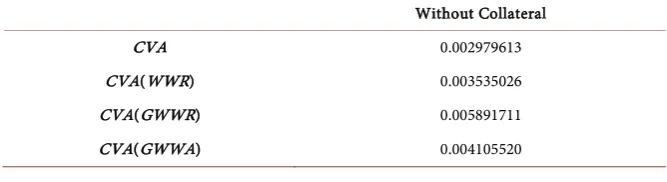
The Figure 5 and the Table 3 summarize the comparison between all
ap-proaches. The approximation of the GWWR using the adjustment has a tow
strong advantage. The first one, it gives us a closed formula to compute the
[image:14.595.258.488.481.594.2]GWWR part. The second one, his implementation is straightforward and it
Figure 5.CVA and GWWA effect without collateral.
Table 3. CVA GWWA calculation results.
Without Collateral
CVA 0.002979613
CVA(WWR) 0.003535026
CVA(GWWR) 0.005891711
[image:14.595.205.539.642.733.2]DOI: 10.4236/jfrm.2017.63017 245 Journal of Financial Risk Management
Figure 6. The evolution of GWWA regarding to the correlation.
could be directly integrated on the existent framework.
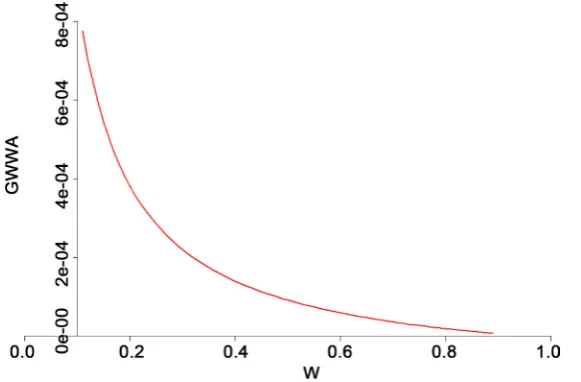
We also conclude in the Figure 6 that the conditional default probability de-creases within w, and the GWWA follows the same effect. This makes sense with the definition of the GWWR. Indeed, the exposure should also decrease regard-ing to the conditional PD, and the GWWA must be reduced.
4. Conclusion
This paper was dedicated to the models allowing, on one hand, the quantifying of the Wrong Way Risk. On the other hand, we also developed two methods to integrate the Loss Given Default correlation effect. First, we began by
introduc-ing the existent approaches that give us the measurement of the WWR effect
when we observe the positive correlation between the exposure and the default. We proposed a new model that combines the empirical and the copulas model.
We made implementation on the European CAC40 put, and we conclude that
the CVA increases potentially with the WWR effect.
Then, we generalized the concept to deem the correlation effects between the three variables. So we added the LGD correlation effect, and we proposed two models in this way. The first one is based on the definition of the function that links the LGD with the default and we also used the copula to compute the con-ditional expectation exposure. The second one defines a close formula to com-pute the difference between the classical CVA and the other one without the in-dependency assumption.
We implemented both of these models on the European CAC40 put, and we
concluded that the GWWR is more important than the WWR in term of the
CVA level. Furthermore, the GWWA allows a direct integration and
computa-tion of the GWWR and we can also apply this model to the WWR. However,
both of models represent some weakness. The first one needs to define and
cali-brate the LGD model, and the integration of the existent model is not
DOI: 10.4236/jfrm.2017.63017 246 Journal of Financial Risk Management
approximation of the GWWR and requests a calibration of the systemic factor. We tried to give a close formula to allow a direct integration on the existent
CVA system, because the implementation arises one of most issues in the bank-ing platform. By the way, we suggest gettbank-ing more researchbank-ing on the approaches that allow a straight integration.
References
Basel Committee on Banking Supervision (2010). Basel III: A Global Regulatory Frame-work for More Resilient Banks and Banking Systems.
http://www.bis.org/publ/bcbs189_dec2010.pdf, December.
Bocker, K., & Brunnbauer, M. (2014). Path Consistent Wrong Way Risk. Risk Magazine, 27, 49-53.
Credit Suisse Financial Products (1997). Credit Risk+: A Credit Risk Management Framework. London: Credit Suisse Financial Products.
Daniel, W. W. (1990). Spearman Rank Correlation Coefficient. Applied Nonparametric Statistics (2nd ed., pp. 358-365). Boston, MA: PWS-Kent.
Fenton, L. (1960). The Sum of Lognormal Probability Distribution in Scatter Transmis-sion System, IEEE Trans. Communication Systems, 8, 56-57.
Gourieroux, C., Laurent, J. P., & Scaillet O. (2000). Sensitivity Analysis of Values at Risk.
Journal of Empirical Finance, 7, 225-245.
Heston, S. L., (1993). A Closed-Form Solution for Options with Stochastic Volatility with Applications to Bond and Currency Options. Review of Financial Studies, 6, 327-343. Hull, J., & White, A. (2012). CVA and Wrong Way Risk. Financial Analysis Journal, 68,
58-69. https://doi.org/10.2469/faj.v68.n5.6
Rosen, D., & Saunders D. (2012). CVA the Wrong Way. Journal of Risk Management in Financial Institutions, 5, 252-272.
Slime, B. (2016). Credit Name Concentration Risk: Granularity Adjustment Approxima-tion. Journal of Financial Risk Management, 5, 246-263.
https://doi.org/10.4236/jfrm.2016.54023
Submit or recommend next manuscript to SCIRP and we will provide best service for you:
Accepting pre-submission inquiries through Email, Facebook, LinkedIn, Twitter, etc. A wide selection of journals (inclusive of 9 subjects, more than 200 journals)
Providing 24-hour high-quality service User-friendly online submission system Fair and swift peer-review system
Efficient typesetting and proofreading procedure
Display of the result of downloads and visits, as well as the number of cited articles Maximum dissemination of your research work