Length-incremental Phrase Training for SMT
Joern Wuebker and Hermann Ney
Human Language Technology and Pattern Recognition Group RWTH Aachen University
Aachen, Germany
{wuebker,ney}@cs.rwth-aachen.de
Abstract
We present an iterative technique to gener-ate phrase tables for SMT, which is based on force-aligning the training data with a modified translation decoder. Differ-ent from previous work, we completely avoid the use of a word alignment or phrase extraction heuristics, moving to-wards a more principled phrase generation and probability estimation. During train-ing, we allow the decoder to generate new phrases on-the-fly and increment the max-imum phrase length in each iteration. Ex-periments are carried out on the IWSLT 2011 Arabic-English task, where we are able to reach moderate improvements on a state-of-the-art baseline with our training method. The resulting phrase table shows only a small overlap with the heuristically extracted one, which demonstrates the re-strictiveness of limiting phrase selection by a word alignment or heuristics. By interpolating the heuristic and the trained phrase table, we can improve over the baseline by 0.5% BLEUand 0.5% TER.
1 Introduction
Most state-of-the-art SMT systems get the statis-tics from which the different component models are estimated via heuristics using a Viterbi word alignment. The word alignment is usually gener-ated with tools like GIZA++(Och and Ney, 2003),
that apply the EM algorithm to estimate the align-ment with the HMM or IBM-4 translation mod-els. This is also the case for the phrases or rules which serve as translation units for the decoder. All phrases that do not violate the word alignment
are extracted and their probabilities are estimated as relative frequencies (Koehn et al., 2003).
A number of different approaches have tried to do away with the heuristics and close this gap be-tween the phrase table generation and translation decoding. However, most of these approaches ei-ther fail to achieve state-of-the-art performance or still make use of the word alignment or the ex-traction heuristics, e.g. as a prior in discriminative training or to initialize a generative or generatively inspired training procedure and are thus biased by their weaknesses. Here, we aim at moving towards the ideal situation, where a unified framework in-duces the phrases based on the same models as in decoding.
We train the phrase table without using a word alignment or the extraction heuristics. Different from previous work, we are able to generate all possible phrase pairs on-the-fly during the train-ing procedure. A further advantage of our pro-posed algorithm is that we use basically the same beam search as in translation. This makes it easy to re-implement by modifying any translation de-coder, and makes sure that training and translation are consistent. In principle, we apply the forced decoding approach described in (Wuebker et al., 2010) with cross-validation to prevent over-fitting, but we initialize the phrase table with IBM-1 lex-ical probabilities (Brown et al., 1993) instead of heuristically extracted relative frequencies. The algorithm is extended with the concept of back-off phrases, so that new phrase pairs can be ated at training time. The size of the newly gener-ated phrases is incremented over the training iter-ations. By introducingfallback decoding runs, we are able to successfully align the complete training data. Local language modelsare used for better phrase pair pre-selection.
The experiments are carried out on the IWSLT 2011 Arabic-English shared task. We are able to show that it is possible and feasible to reach state-of-the-art performance without the need to word-align the bilingual training data. The small over-lap of 18.5% between the trained and the heuristi-cally extracted phrase table demonstrates the limi-tations of previous work, where training is initial-ized by the baseline phrase table or phrase selec-tion is restricted by a word alignment. With a lin-ear interpolation of phrase tables an improvement of 0.5% BLEU and 0.5% TER over the baseline can be achieved. The result in BLEU is statisti-cally significant on the test set with 90% confi-dence. Further, we can confirm the observation of previous work, that phrases with near-zero en-tropies seem to be a disadvantage for translation quality. Although we use a phrase-based decoder here, the principles of our work can be applied to any statistical machine translation paradigm. The software used for our experiments is available un-der a non-commercial open source licence.
The paper is organized as follows. We review related work in Section 2. The decoder and its features are described in Section 3 and we give an overview of the training procedure in Section 4. The complete algorithm is described in Section 5 and experiments are presented in Section 6. We conclude with Section 7.
2 Related Work
Marcu and Wong (2002) present a joint probabil-ity model, which is trained with a hill-climbing technique based on break, merge, swap and move operations. Due to the computational complexity they are only able to consider phrases, which ap-pear at least five times in the data. The model is shown to slightly underperform heuristic extrac-tion in (Koehn et al., 2003). For higher efficiency, it is constrained by a word alignment in (Birch et al., 2006). DeNero et al. (2008) introduce a differ-ent training procedure for this model based on a Gibbs sampler. They make use of the word align-ment for initialization.
A generative phrase model trained with the Expectation-Maximization (EM) algorithm is shown in (DeNero et al., 2006). It also does not reach the same top performance as heuristic ex-traction. The authors identify the hidden segmen-tation variable, which results in over-fitting, as the main problem.
Liang et al. (2006) present a discriminative translation system. One of the proposed strategies for training, which the authors call bold updating, is similar to our training scheme. They use heuris-tically extracted phrase translation probabilities as blanket features in all setups.
Another iteratively-trained phrase model is de-scribed by Moore and Quirk (2007). Their model is segmentation-free and, confirming the findings in (DeNero et al., 2006), can close the gap to phrase tables induced from surface heuristics. It relies on word alignment for phrase selection.
Mylonakis and Sima’an (2008) present a phrase model, whose training procedure uses prior prob-abilities based on Inversion Transduction Gram-mar and smoothing as learning objective to pre-vent over-fitting. They also rely on the word align-ment to select phrase pairs.
Blunsom et al. (2009) perform inference over latent synchronous derivation trees under a non-parametric Bayesian model with a Gibbs sampler. Training is also initialized by extracting rules from a word alignment, but the authors let the sampler diverge from the initial value for 1000 passes over the data, before the samples are used. However, as the model is to weak for actual translation, the usual extraction heuristics are applied on the hier-archical alignments to infer a distribution over rule tables.
Wuebker et al. (2010) use a forced decoding training procedure, which applies a leave-one-out technique to prevent over-fitting. They are able to show improvements over a heuristically extracted phrase table, which is used for initialization of the training.
In (Saers and Wu, 2011), the EM algorithm is applied for principled induction of bilexica based on linear inversion transduction grammar. The model itself underperforms the baseline, but the authors show moderate improvements by combin-ing it with the baseline phrase table, which is sim-ilar to our results.
(Neubig et al., 2011) also propose a probabilis-tic model based on inversion transduction gram-mar, which allows for direct phrase table extrac-tion from unaligned data. They show results simi-lar to the heuristic baseline on several tasks.
se-quence model. For inference, they optimize their parameters towards alignment F-score. The forced derivations are initialized with the standard heuris-tic extraction scheme.
He and Deng (2012) describe a discriminative phrase training procedure, where n-best transla-tions are produced by the decoder on the whole training data. The heuristically extracted relative frequencies serve as a prior, and the probabili-ties are updated with a maximum BLEU criterion based on then-best lists.
3 Translation Model
We use the standard phrase-based translation de-coder from the open source toolkitJane 2 (Wue-bker et al., 2012a) for both the training proce-dure and the translation experiments. It makes use of the usual features: Translation channel mod-els in both directions, lexical smoothing modmod-els in both directions, ann-gram language model (LM), phrase and word penalty and a jump-distance-based distortion model. Formally, the best trans-lationeˆI1ˆas defined by the modelshm(eI1, sK1 , f1J) can be written as (Och and Ney, 2004)
ˆ
eI1ˆ= arg max
I,eI 1
( M X
m=1
λmhm(eI1, sK1 , f1J)
)
, (1)
where f1J = f1. . . fJ is the source sentence,
eI1 = e1. . . eI the target sentence and sK1 = s1. . . sK their phrase segmentation and
align-ment. We define sk := (ik, bk, jk), where ik is
the last position ofkth target phrase, and(bk, jk)
are the start and end positions of the source phrase aligned to the kth target phrase. Different from many standard systems, the lexical smoothing scores are not estimated by extracting counts from a word alignment, but with IBM-1 model scores trained on the bilingual data with GIZA++. They are computed as (Zens, 2008)
hlex(eI1, sK1 , f1J) =
K X
k=1
jk
X
j=bk log
p(fj|e0) +
ik
X
i=ik−1+1
p(fj|ei)
(2) Here, e0 denotes the empty target word. The lexical smoothing model for the inverse direc-tion is computed analogously. The log-linear fea-ture weightsλm are optimized on a development
data set with minimum error rate training (MERT) (Och, 2003). As optimization criterion we use BLEU(Papineni et al., 2001).
4 Training
4.1 Overview
In this work we employ a training procedure in-spired by the Expectation-Maximization (EM) al-gorithm.
The E-step corresponds to force-aligning the training data with a modified translation decoder, which yields a distribution over possible phrasal segmentations and their alignment. Different from original EM, we make use of not only the two translation channel models that are being learned, but the full log-linear combination of models as in translation decoding. Formally, we are searching for the best phrase segmentation and alignment for the given sentence pair, which is defined by
ˆ
sK1ˆ = arg max
K,sK 1
( M X
m=1
λmhm(eI1, sK1 , f1J)
)
(3)
To force-align the training data, the translation decoder is constrained to the given target sentence. The translation candidates applicable for each sen-tence pair are selected through a bilingual phrase matching before the actual search.
In the M-step, we re-estimate the phrase table from the phrase alignments. The translation prob-ability of a phrase pair( ˜f ,˜e)is estimated as
pF A( ˜f|˜e) =
CF A( ˜f ,˜e) X
˜
f0
CF A( ˜f0,e)˜
(4)
whereCF A( ˜f ,˜e)is the count of the phrase pair
( ˜f ,e)˜ in the phrase-aligned training data.
trained log-linear feature weights and the actual probability distribution, without having to resort to an arbitrarily chosen global scaling factor. This corresponds to thecount modelin (Wuebker et al., 2010) and was shown by the authors to perform similar or better than using actual posterior proba-bilities. In our experiments, we set the size of the n-best list ton= 1000.
The first iteration of phrase training is initialized with an empty phrase table. We use the notion of backoff phrases to generate new phrase pairs on-the-fly. To avoid over-fitting, we apply the cross-validation technique presented in (Wuebker et al., 2010) with a batch-size of 2000 sentences. This means that for each batch the phrase and marginal counts from the full phrase table are reduced by the statistics taken from the same batch in the pre-vious iteration. The phrase translation probabili-ties are then estimated from these updated counts. Phrase pairs only appearing in a single batch are assigned a fixed penalty.
4.2 Backoff Phrases
Backoff phrasesare phrase pairs that are generated on-the-fly by the decoder at training time. When aligning a sentence pair, for a given maximum phrase length m, the decoder inserts all combi-nations of sourcems-grams and targetmt-grams
into the translation options, that are present in the sentence pair and with ms, mt ≤ m. Formally,
for the sentence pair (fJ
1, eI1), f1J = f1. . . fJ,
eI1 = e1. . . eI, and maximum lengthm, we
gen-erate all phrase pairs( ˜f ,e)˜ where
∃ms, mt, j, i:
1≤ms, mt≤m∧1≤j≤J−ms+ 1
∧1≤i≤I−mt+ 1
∧f˜=f(j+ms−1)
j ∧e˜=e
(i+mt−1)
i . (5)
These generated phrase pairs are given a fixed penaltypenpper phrase,pensper source word and
pent per target word, which are summed up and
substituted for the two channel models. The lex-ical smoothing scores are computed in the usual way based on an IBM-1 table. Note that this table is not extracted from a word alignment, but con-tains the real probabilities trained with the IBM-1 model by GIZA++.
We use backoff phrases in two different con-texts. In the first mmax = 6 iterations, they are
applied as a means to generate new phrase pairs on the fly. We increase the maximum phrase length min each iteration and always generate all possi-ble backoff phrases before aligning each sentence. Later, when a sufficient number of phrases have been generated in the previous iterations, they are used as a last resort in order to avoid alignment failures.
At the later stage of the length-incremental training, we also make use of a modified version, where we only allow new phrase pairs( ˜f ,e)˜ to be generated, if no translation candidates exist forf˜ after the bilingual phrase matching. However, in this case, backoff phrases are only used if a first decoding run fails and we have to resort tofallback runs, which are described in the next Section.
4.3 Fallback Decoding Runs
To maximize the number of successfully aligned sentences, we allow for fallback decoding runs with slightly altered parameterization, whenever constrained decoding fails. In this work, we only change the parameterization of the backoff phrases. Aftermmax= 6iterations, we no longer
generate any backoff phrases in the first decoding run. If it fails, a second run is performed, where we allow to generate backoff phrases for all source phrases, which have no target candidates after the bilingual phrase matching. Finally, if this one also fails, all possible phrases are generated in the third run. Here, the maximum backoff phrase length is fixed tom= 1. We denote the number of fallback runs withnf b = 2. In our experiments, the two
fallback runs enable us to align every sentence pair of the training data after the sixth iteration.
4.4 Local Language Models
23 24 25 26 27 28
2 3 4 5 6
80 90 100
BLEU[%]
word coverage [%]
Iteration
[image:5.595.309.539.79.359.2]wp=-0.1 wp=-0.3 wp=-0.5 wp=-0.7
Figure 1: BLEU scores and word coverages on dev over the first 6 training iterations with dif-ferent word penalties (wp).
Using the local LM for this means that the pre-selection better suits the current data batch. As a result, the number of phrases remaining after the phrase matching is increased as compared to the same setup without a local language model.
4.5 Parameterization
The training procedure has a number of hyper pa-rameters, most of which do not seem to have a strong impact on the results. This section de-scribes the parameters that have to be chosen care-fully. To successfully align a sentence pair, our decoder is required to fully cover the source sen-tence. However, in order to achieve a good suc-cess rate in terms of number of aligned sentence pairs, we allow for incompletely aligned target sentences. We denote the percentage of success-fully aligned sentence pairs assentence coverage. Note that we count a sentence pair as successfully aligned, even if the target sentence is not fully covered. the word penalty (wp) feature weight λwpneeds to be adjusted carefully. A high value
leads to a high sentence coverage, but many of their target sides may be incompletely aligned. A
24 25 26 27
2 3 4 5 6
0 20 40 60 80 100
BLEU[%]
surplus phrases [%]
Iteration
[image:5.595.80.296.80.357.2]pen0=4 pen0=3 pen0=2 pen0=1 pen0=0.5
Figure 2: BLEUscores and percentage of surplus phrases ondevover the first 6 training iterations with different backoff phrase penaltiespen0.
low word penalty can decrease the sentence cover-age, while aligning larger parts of the target sen-tences. We denote the total percentage of suc-cessfully aligned target words asword coverage. Please note the distincton to the sentence cover-age, which is defined above. Figure 1 shows the word coverages and BLEUscores for training iter-ations 2 through 6 with different word penalties. In the first iteration, the results are identical, as only one-to-one phrases are allowed and the number of aligned target words is therefore predetermined. Forλwp =−0.1, the word coverages are
continu-ously decreasing with each iteration, although not by much. For λwp = −0.3 to λwp = −0.7 the
word coverage slightly increases from iteration 2 to 3 and then decreases again. In terms of BLEU score,λwp=−0.3has a slight advantage over the
other values and we decided to continue using this value in all subsequent experiments.
In-1. Initialize with empty phrase table
2. Set backoff phrase penalties to
pen0= 3 and m= 1
3. Until m=mmax, iterate:
• If iteration > 1: set
m=m+ 1
λs2t=λs2t+δ
λt2s=λt2s+δ
• Force-align training data and re-estimate phrase table
4. Set m= 1 and nf b= 2
5. Iterate:
[image:6.595.307.537.61.239.2]• Force-align training data and re-estimate phrase table
Figure 3: The complete training algorithm.
creasing the penalties means that a larger per-centage of the phrase pairs generated in the pre-vious iterations will be favored over new back-off phrases, which corresponds to a faster learn-ing rate. We denote phrase pairs that are more expensive than their backoff phrase counterparts assurplus phrases. Figure 2 shows the behavior over the training iterations 2 through 6 with differ-ent penaltiespen0 in terms of percentage of sur-plus phrase pairs and BLEU score. Here we set
pens=pent =pen0andpenp = 5pen0. We can see that pen0 = 4 yields less than 0.1% surplus phrases through all iterations, whereaspen0= 0.5 starts off with 98.2% surplus phrases and goes down to 55.9% in iteration 6. In terms of BLEU, a fast learning rate seems to be preferable. The best results are achieved withpen0 = 3, where the rate of surplus phrases starts at 6.8% and decreases to 1.7% until iteration 6. In all subsequent experi-ments, we setpen0 = 3.
5 Length-incremental Training
In this section we describe the complete training algorithm. The first training iteration is initial-ized with an empty phrase table. The phrases used in alignment are backoff phrases, which are gen-erated on-the-fly. The maximum backoff phrase length is set tom= 1. Then the forced alignment is iterated, increasingmby 1 in each iteration, up to a maximum ofmmax= 6.
Aftermmax = 6 iterations, we have created a
sufficient number of phrase pairs and continue it-erating the training procedure with new
parame-Arabic English
train Sentences 305K Running Words 6.5M 6.5M
Vocabulary 104K 74K
dev Sentences 934
Run. Words 19K 20K Vocabulary 4293 3182 OOVs (run. words) 445 182
test Sentences 1664
Run. Words 31K 32K Vocabulary 5415 3650 OOVs (run. words) 658 159
Table 1: Statistics for the IWSLT 2011 Arabic-English data. The out-of-vocabulary words are de-noted as OOVs.
ters. Now, we do not allow usage of any back-off phrases in the first decoding run. If the first run fails, we allow a fallback decoding run, where backoff phrases are generated only for source phrases without translation candidates. If this one also fails, in a final fallback run all possible phrases are generated. Here we allow a maximum backoff phrase length ofm= 1.
The log-linear feature weightsλiused for
train-ing are mostly standard values. Only λwp for
the word penalty is adjusted as described in Sec-tion 4.5, andλs2t,λt2sfor the two phrasal channel
models are incremented with each iteration. We start off withλs2t = λt2s = 0and increment the
weights by δ = 0.02 in each iteration, until the standard value λs2t = λt2s = 0.1 is reached in
iteration 6, after which the values are kept fixed. MERT is not part of the training procedure, but only used afterwards for evaluation. The full algo-rithm is illustrated in Figure 3.
6 Experiments
6.1 Data
We carry out our experiments on the IWSLT 2011 Arabic-English shared task1. It focuses on the translation of TED talks, a collection of lectures on a variety of topics ranging from science to cul-ture. Our bilingual training data is composed of all available in-domain (TED) data and a selection of the out-of-domain MultiUN data provided for the evaluation campaign. The bilingual data selection
[image:6.595.78.274.63.268.2]16 17 18 19 20 21 22 23 24 25 26 27 28
2 4 6 8 10 12 14 16 18 20
BLEU[%]
Iteration
[image:7.595.53.285.58.264.2]Length-incremental Training (dev) Baseline (dev) Length-incremental Training (test) Baseline (test)
Figure 4: BLEUscores ondevandtestover 20 training iterations.
is based on (Axelrod et al., 2011). Data statistics are given in Table 1. The language model is a 4-gram LM trained on all provided in-domain mono-lingual data and a selection based on (Moore and Lewis, 2010) of the out-of-domain corpora. To ac-count for statistical variation, all reported results are average scores over three independent MERT runs.
6.2 Results
To build the baseline phrase table, we perform the standard phrase extraction from a symmetrized word alignment created with the IBM-4 model by GIZA++. The length of the extracted phrases is limited to a maximum of six words. The lexical smoothing scores are computed from IBM-1 prob-abilities. We run MERT on the development set (dev) and evaluate on the test set (test). A sec-ond baseline is the technique described in (Wue-bker et al., 2010), which we denote as leave-one-out. It is initialized with the heuristically extracted table and run for one iteration, which the authors have shown to be sufficient.
Length-incremental training is performed as de-scribed in Section 5. After each iteration, we run MERT ondevusing the resulting phrase table and evaluate. The set of models used here is identical to the baseline.
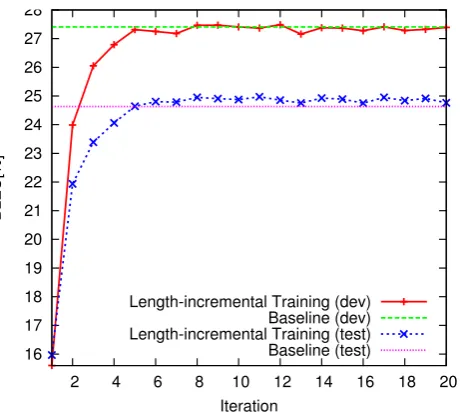
The results in BLEUare plotted in Figure 4. We can see that the performance increases up to it-eration 5, after which only small changes can be observed. The performance on devis similar to
dev test
BLEU TER BLEU TER
[%] [%] [%] [%]
baseline 27.4 54.0 24.6 57.8 leave-one-out 27.3 54.2 24.6 57.7 length-increm. 27.5 53.8 24.9 57.4
lin. interp. 27.9 53.5 25.1† 57.3
Table 2: BLEU and TER scores of the baseline, phrase training with leave-one-out and length-incremental training after 12 iterations, as well as a linear interpolation of the baseline with length-incremental phrase table. Results marked with † are statistically significant with 90% confidence.
the baseline, on test the trained phrase tables are consistently slightly above the baseline. The optimum on dev is reached in iteration 12. Ex-act BLEUand TER(Snover et al., 2006) scores of the optimum on dev and the baseline are given in Table 2. The phrase table trained with leave-one-out (Wuebker et al., 2010) performs simlar to the heuristic baseline. Length-incremental train-ing is slightly superior to the baseline, yieldtrain-ing an improvement of 0.3% BLEU and 0.4% TER on test. Similar to results observed in (DeN-ero et al., 2006) and (Wuebker et al., 2010), a lin-ear interpolation with the baseline containing all phrase pairs from either of the two tables yields a moderate improvement of 0.5% BLEU and 0.5% TER both data sets. The BLEU improvement on test is statistically significant with 90% confi-dence based on bootstrap resampling as described by Koehn (2004).
6.3 Analysis
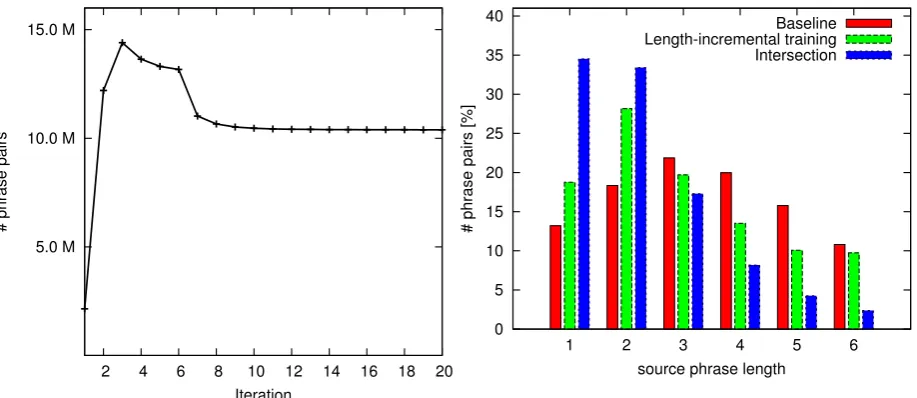
In Figure 5 we plot the number of phrase pairs present in the phrase tables after each iteration. In the first 6 iterations, we keep generating new phrase pairs via backoff phrases. The maximum of 14.4M phrase pairs is reached after three itera-tions. For comparison, the size of the heuristically extracted table is 19M phrase pairs. Afterwards, backoff phrases are only used in fallback decoding runs, which leads to drop in the number of phrase pairs that are being used. It levels out at 10.4M phrases.
[image:7.595.307.525.62.160.2]con-5.0 M 10.0 M 15.0 M
2 4 6 8 10 12 14 16 18 20
# phrase pairs
Iteration
Figure 5: Number of generated phrase pairs over 20 training iterations.
firms observations from previous work. In the trained phrase table, phrases of length one and two make up 47% of all phrases. In the heuristically extracted table it is only 32%. This is even more pronounced in the intersection of the two tables, where 68% of the phrases are of length one and two.
Interestingly, the total overlap between the two phrase tables is rather small. Only about 18.5% of the phrases from the trained table also appear in the heuristically extracted one. This shows that, by generating phrases on-the-fly without restrictions based on a word alignment or a bias from intializa-tion, our training procedure strongly diverges from the baseline phrase table. We conclude that most previous work in this area, which adhered to the above mentioned restrictions, was only able to ex-plore a fraction of the full potential of real phrase training.
Following (DeNero et al., 2006), we compute the entropy of the distributions within the phrase tables to quantify the ’smoothness’ of the distri-bution. For a given source phrasef˜, it is defined as
H( ˜f) =X ˜
e
p(˜e|f˜)log(p(˜e|f˜)). (6)
A flat distribution with a high level of uncer-tainty yields a high entropy, whereas a peaked dis-tribution with little uncertainty produces a low en-tropy. We analyze the phrase tables filtered to-wards the dev andtest sets. The average
0 5 10 15 20 25 30 35 40
1 2 3 4 5 6
# phrase pairs [%]
[image:8.595.57.516.59.258.2]source phrase length Baseline Length-incremental training Intersection
Figure 6: Histogram of the phrase lengths present in the phrase tables.
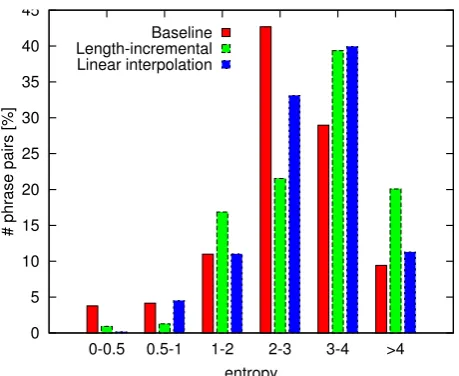
tropy, weighted by frequency, is 3.1 for the ta-ble learned with length-incremental training, com-pared to 2.7 for the heuristically extracted one. However, the interpolated table, which has the best performance, lies in between with an average en-tropy of 2.9. When we consider the histogram of entropies for the phrase tables in Figure 7, we can see that in the baseline phrase table 3.8% of the phrases haven an entropy below 0.5, compared to 0.90% for length-incremental training and 0.16% for the linear interpolation. Therefore, we can confirm the observation in (DeNero et al., 2006), that phrases with a near-zero entropy are undesir-able for decoding. The distribution of the higher entropies, however, does not seem to matter for translation quality. This also gives us a handle for understanding, why phrase table interpolation of-ten improves results: It largely seems to eliminate near-zero entropies from either table.
6.4 Training time
The training was not run under controlled condi-tions, so we can only give a rough estimate of how the training times between the different meth-ods compare. Also, some of the steps were par-allelized while others are not. To account for the computational resources needed, we report the trainig times on a single machine by summing the times for all parallel and sequential processes.
0 5 10 15 20 25 30 35 40 45
0-0.5 0.5-1 1-2 2-3 3-4 >4
# phrase pairs [%]
[image:9.595.51.281.58.246.2]entropy Baseline Length-incremental Linear interpolation
Figure 7: Histogram of entropies present in the phrase tables.
incremental training as well as all iterations after the sixth also took roughly 24 hours. The itera-tions two through six of length-incremental train-ing are considerably more expensive due to the larger size of backoff phrases. Iteration six, with a maximum backoff phrase size of six words on source and target side, was the slowest with around 740 hours.
7 Conclusion
In this work we presented a training procedure for phrase or rule tables in statistical machine trans-lation. It is based on force-aligning the training data with a modified version of the translation de-coder. Different from previous work, we com-pletely avoid the use of a word alignment on the bilingual training corpus. Instead, we initialize the procedure with an empty phrase table and gener-ate all possible phrases on-the-fly through the con-cept ofbackoff phrases. Starting with a maximum phrase length ofm = 1, we incrementmin each iteration, until we reach mmax. Then, we
con-tinue training in a more conventional fashion, al-lowing creation of new phrases only in fallback runs. As additional extensions to previous work we introduce fallback decoding runs for higher coverage of the data and local language models for better pre-selection of phrases. The effects of the most important hyper parameters of our procedure are discussed and we show how they were selected in our setup. The experiments are carried out with a phrase-based decoder on the IWSLT 2011 Arabic-English shared task. The
trained phrase table slightly outperforms our state-of-the-art baseline and a linear interpolation yields an improvement of 0.5% BLEU and 0.5% TER. The BLEU improvement on test is statistically significant with 90% confidence. The small over-lap of 18.5% between the trained and the heuris-tically extracted phrase table shows how initial-ization or restrictions based on word alignments would have biased the training procedure. We also analyzed the distribution of entropies within the phrase tables, confirming the previous observation that fewer near-zero entropy phrases are advanta-geous for decoding. We also showed that, in our setup, near-zero entropies are largely eliminated by phrase table interpolation.
In future work we plan to apply this technique as a more principled way to train a wider range of models similar to (Duan et al., 2012). But even for the phrase models, we have only scratched the surface of its potential. We hope that by finding a meaningful way to set the hyper parameters of our training procedure, better and smaller phrase tables can be created.
Acknowledgments
This work was partially realized as part of the Quaero Programme, funded by OSEO, French State agency for innovation. The material is also partially based upon work supported by the DARPA BOLT project under Contract No. HR0011- 12-C-0015. Any opinions, findings and conclusions or recommendations expressed in this material are those of the authors and do not neces-sarily reflect the views of DARPA.
References
Amittai Axelrod, Xiaodong He, and Jianfeng Gao. 2011. Domain adaptation via pseudo in-domain data selection. InProceedings of the 2011 Conference on Empirical Methods in Natural Language Process-ing, pages 355–362, Edinburgh, Scotland, UK., July. Association for Computational Linguistics.
Alexandra Birch, Chris Callison-Burch, Miles Os-borne, and Philipp Koehn. 2006. Constraining the Phrase-Based, Joint Probability Statistical
Transla-tion Model. InHuman Language Technology Conf.
(HLT-NAACL): Proc. Workshop on Statistical Ma-chine Translation, pages 154–157, New York City, NY, June.
Phil Blunsom, Trevor Cohn, Chris Dyer, and Miles Osborne. 2009. A gibbs sampler for phrasal
the Joint Conference of the 47th Annual Meeting of the ACL and the 4th International Joint Conference on Natural Language Processing of the AFNLP: Volume 2 - Volume 2, ACL ’09, pages 782–790, Stroudsburg, PA, USA. Association for Computa-tional Linguistics.
Peter F. Brown, Stephen A. Della Pietra, Vincent J. Della Pietra, and Robert L. Mercer. 1993. The Mathematics of Statistical Machine Translation:
Pa-rameter Estimation. Computational Linguistics,
19(2):263–311, June.
John DeNero, Dan Gillick, James Zhang, and Dan Klein. 2006. Why Generative Phrase Models
Un-derperform Surface Heuristics. In Proceedings of
the Workshop on Statistical Machine Translation, pages 31–38, New York City, June.
John DeNero, Alexandre Buchard-Cˆot´e, and Dan Klein. 2008. Sampling Alignment Structure under
a Bayesian Translation Model. In Proceedings of
the 2008 Conference on Empirical Methods in Natu-ral Language Processing, pages 314–323, Honolulu, October.
Nan Duan, Mu Li, and Ming Zhou. 2012. Forced derivation tree based model training to statistical
machine translation. In Proceedings of the 2012
Joint Conference on Empirical Methods in ral Language Processing and Computational Natu-ral Language Learning, pages 445–454, Jeju Island, Korea, July. Association for Computational Linguis-tics.
Xiaodong He and Li Deng. 2012. Maximum Expected BLEU Training of Phrase and Lexicon Translation
Models. In Proceedings of the 50th Annual
Meet-ing of the Association for Computational LMeet-inguistics (ACL), pages 292–301, Jeju, Republic of Korea, Jul. P. Koehn, F. J. Och, and D. Marcu. 2003. Statisti-cal Phrase-Based Translation. InProceedings of the 2003 Meeting of the North American chapter of the Association for Computational Linguistics (NAACL-03), pages 127–133, Edmonton, Alberta.
Philipp Koehn. 2004. Statistical Significance Tests for Machine Translation Evaluation. InProc. of the Conf. on Empirical Methods for Natural Language Processing (EMNLP), pages 388–395, Barcelona, Spain, July.
Percy Liang, Alexandre Buchard-Cˆot´e, Dan Klein, and Ben Taskar. 2006. An End-to-End
Discrimina-tive Approach to Machine Translation. In
Proceed-ings of the 21st International Conference on Com-putational Linguistics and the 44th annual meeting of the Association for Computational Linguistics, pages 761–768, Sydney, Australia.
Daniel Marcu and William Wong. 2002. A Phrase-Based, Joint Probability Model for Statistical
Ma-chine Translation. In Proc. of the Conf. on
Em-pirical Methods for Natural Language Processing (EMNLP), pages 133–139, Philadelphia, PA, July.
Robert C. Moore and William Lewis. 2010. Intelligent
selection of language model training data. In
Pro-ceedings of the ACL 2010 Conference Short Papers, pages 220–224, Uppsala, Sweden, July. Association for Computational Linguistics.
Robert C. Moore and Chris Quirk. 2007. An
Iteratively-Trained Segmentation-Free Phrase
Translation Model for Statistical Machine
Transla-tion. In Proceedings of the Second Workshop on
Statistical Machine Translation, pages 112–119, Prague, June.
Markos Mylonakis and Khalil Sima’an. 2008.
Phrase Translation Probabilities with ITG Priors and
Smoothing as Learning Objective. InProceedings
of the 2008 Conference on Empirical Methods in Natural Language Processing, pages 630–639, Hon-olulu, October.
Graham Neubig, Taro Watanabe, Eiichiro Sumita, Shinsuke Mori, and Tatsuya Kawahara. 2011. An unsupervised model for joint phrase alignment and extraction. InProceedings of the 49th Annual Meet-ing of the Association for Computational LMeet-inguis- Linguis-tics: Human Language Technologies - Volume 1, HLT ’11, pages 632–641, Stroudsburg, PA, USA. Association for Computational Linguistics.
Franz Josef Och and Hermann Ney. 2003. A System-atic Comparison of Various Statistical Alignment
Models. Computational Linguistics, 29(1):19–51,
March.
Franz Josef Och and Hermann Ney. 2004. The align-ment template approach to statistical machine
trans-lation. Computational Linguistics, 30(4):417–449,
December.
Franz J. Och. 2003. Minimum Error Rate Training for Statistical Machine Translation. InProc. of the 41th Annual Meeting of the Association for Compu-tational Linguistics (ACL), Sapporo, Japan, July.
Kishore Papineni, Salim Roukos, Todd Ward, and Wei-Jing Zhu. 2001. Bleu: a Method for Automatic Evaluation of Machine Translation. IBM Research Report RC22176 (W0109-022), IBM Research Di-vision, Thomas J. Watson Research Center, P.O. Box 218, Yorktown Heights, NY 10598, September.
Markus Saers and Dekai Wu. 2011. Principled induc-tion of phrasal bilexica. InProceedings of the 15th International Conference of the European Associa-tion for Machine TranslaAssocia-tion, pages 313–320, May.
Joern Wuebker, Arne Mauser, and Hermann Ney.
2010. Training phrase translation models with
leaving-one-out. InProceedings of the 48th Annual
Meeting of the Assoc. for Computational Linguistics, pages 475–484, Uppsala, Sweden, July.
Joern Wuebker, Matthias Huck, Stephan Peitz, Malte Nuhn, Markus Freitag, Jan-Thorsten Peter, Saab Mansour, and Hermann Ney. 2012a. Jane 2: Open source phrase-based and hierarchical statistical
ma-chine translation. In International Conference on
Computational Linguistics, pages 483–491, Mum-bai, India, December.
Joern Wuebker, Mei-Yuh Hwang, and Chris Quirk.
2012b. Leave-One-Out Phrase Model Training
for Large-Scale Deployment. In Proceedings of
the NAACL 2012 Seventh Workshop on Statisti-cal Machine Translation, pages 460–467, Montreal, Canada, June.
Richard Zens. 2008. Phrase-based Statistical Machine