Phrase Training Based Adaptation for Statistical Machine Translation
Saab Mansour and Hermann Ney
Human Language Technology and Pattern Recognition Computer Science Department
RWTH Aachen University, Aachen, Germany
{mansour,ney}@cs.rwth-aachen.de
Abstract
We present a novel approach for translation model (TM) adaptation using phrase train-ing. The proposed adaptation procedure is ini-tialized with a standard general-domain TM, which is then used to perform phrase training on a smaller in-domain set. This way, we bias the probabilities of the general TM towards the in-domain distribution. Experimental re-sults on two different lectures translation tasks show significant improvements of the adapted systems over the general ones. Additionally, we compare our results to mixture modeling, where we report gains when using the sug-gested phrase training adaptation method.
1 Introduction
The task of domain-adaptation attempts to exploit data mainly drawn from one domain (e.g. news, parliamentary discussion) to maximize the perfor-mance on the test domain (e.g. lectures, web fo-rums). In this work, we focus on translation model (TM) adaptation. A prominent approach in recent work is weighting at different levels of granularity. Foster and Kuhn (2007) perform weighting at the corpus level, where different corpora receive differ-ent weights and are then combined using mixture modeling. A finer grained weighting is that of Mat-soukas et al. (2009), who weight each sentence in the bitexts using features of meta-information and opti-mize a mapping from the feature vectors to weights using a translation quality measure.
In this work, we propose to perform TM adapta-tion using phrase training. We start from a general-domain phrase table and adapt the probabilities by
training on an in-domain data. Thus, we achieve direct phrase probabilities adaptation as opposed to weighting. Foster et al. (2010) perform weighting at the phrase level, assigning each phrase pair a weight according to its relevance to the test domain. They compare phrase weighting to a “flat” model, where the weight directly approximates the phrase probability. In their experiments, the weighting method performs better than the flat model, there-fore, they conclude that retaining the original rela-tive frequency probabilities of the TM is important for good performance. The “flat” model of Foster et al. (2010) is similar to our work. We differ in the following points: (i)we use the same procedure to perform the phrase training based adaptation and the search thus avoiding inconsistencies between the two;(ii) we do not directly interpolate the original statistics with the new ones, but use a training pro-cedure to manipulate the original statistics. We per-form experiments on the publicly available IWSLT TED task, on both Arabic-to-English and German-to-English lectures translation tracks. We compare our suggested phrase training adaptation method to a variety of baselines and show its effectiveness. Fi-nally, we experiment with mixture modeling based adaptation. We compare mixture modeling to our adaptation method, and apply our method within a mixture modeling framework.
In Section 2, we present the phrase training method and explain how it is utilized for adaptation. Experimental setup including corpora statistics and the SMT system are described in Section 3. Sec-tion 4 summarizes the phrase training adaptaSec-tion re-sults ending with a comparison to mixture modeling.
2 Phrase Training
The standard phrase extraction procedure in SMT consists of two phases: (i)word-alignment training (e.g., IBM alignment models),(ii) heuristic phrase extraction and relative frequency based phrase trans-lation probability estimation. In this work, we utilize phrase training for the task of adaptation. We use the forced alignment (FA) method (Wuebker et al., 2010) to perform the phrase alignment training and probability estimation. We perform phrase training by running a normal SMT decoder on the training data and constrain the translation to the given target instance. Using n-best possible phrase segmentation for each training instance, the phrase probabilities are re-estimated over the output. Leaving-one-out is used during the forced alignment procedure phase to avoid over-fitting (Wuebker et al., 2010).
In the standard phrase training procedure, we are given a training set y, from which an initial heuristics-based phrase table p0y is generated. FA training is then done over the training setyusing the phrases and probabilities inp0y(possibly updated by the leaving-one-out method). Finally, re-estimation of the phrase probabilities is done over the decoder output, generating the FA phrase tablep1. We
ex-plain next how to utilize FA training for adaptation.
2.1 Adaptation
In this work, we utilize phrase training for the task of adaptation. The main idea is to generate the initial phrase table required for FA using a general-domain training datay0, thus resulting in p0y0, and perform the FA training over yIN, the in-domain training data (instead ofy0 in the standard procedure). This way, we bias the probabilities ofp0y0 towards the in-domain distribution. We denote this new procedure by Y’-FA-IN. This differs from the standard IN-FA-IN by that we have more phrase pairs to use for FA. Thus, we obtain phrase pairs relevant to IN in ad-dition to “general” phrase pairs which were not ex-tracted from IN, perhaps due to faulty word align-ments. The probabilities of the general phrase table will be tailored towards IN. In practice, we usually have in-domain IN and other-domain OD data. We denote by ALL the concatenation of IN and OD. To adapt the ALL phrase table, we perform the FA pro-cedure ALL-FA-IN. We also utilize leaving-one-out
to avoid over-fitting.
Another procedure we experimented with is adapting the OD phrase table using FA over IN, without leaving-one-out. We denote it by OD-FA0 -IN. In this FA scenario, we do not use leaving-one-out as IN is not contained in OD, therefore, over-fitting will not occur. By this procedure, we train phrases from OD that are relevant for both OD and IN, while the probabilities will be tailored to IN. In this case, we do not expect improvements over the IN based phrase table, but, improvements over OD and reduction in the phrase table size.
We compare our suggested FA based adaptation to the standard FA procedure.
3 Experimental Setup
3.1 Training Corpora
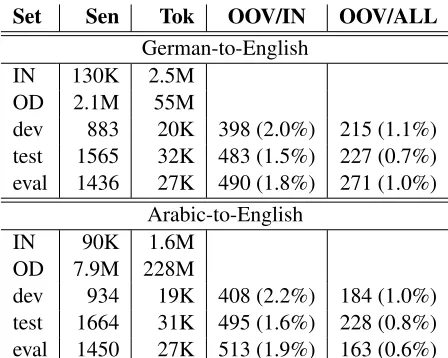
To evaluate the introduced methods experimentally, we use the IWSLT 2011 TED Arabic-to-English and German-to-English translation tasks. The IWSLT 2011 evaluation campaign focuses on the transla-tion of TED talks, a collectransla-tion of lectures on a variety of topics ranging from science to culture. For Arabic-to-English, the bilingual data consists of roughly 100K sentences of in-domain TED talks data and 8M sentences of “other”-domain United Nations (UN) data. For the German-to-English task, the data consists of 130K TED sentences and 2.1M sentences of “other”-domain data assembled from the news-commentary and the europarl corpora. For language model training purposes, we use an addi-tional 1.4 billion words (supplied as part of the cam-paign monolingual training data).
The bilingual training and test data for the Arabic-to-English and German-Arabic-to-English tasks are sum-marized in Table 11. The English data was tok-enized and lowercased while the Arabic data was tokenized and segmented using MADA v3.1 (Roth et al., 2008) with the ATB scheme. The German source is decompounded (Koehn and Knight, 2003) and part-of-speech-based long-range verb reorder-ing rules (Popovi´c and Ney, 2006) are applied.
From Table 1, we note that using the general data considerably reduces the number of
out-of-1
Set Sen Tok OOV/IN OOV/ALL German-to-English
IN 130K 2.5M OD 2.1M 55M
dev 883 20K 398 (2.0%) 215 (1.1%) test 1565 32K 483 (1.5%) 227 (0.7%) eval 1436 27K 490 (1.8%) 271 (1.0%)
Arabic-to-English IN 90K 1.6M
OD 7.9M 228M
[image:3.612.74.298.56.235.2]dev 934 19K 408 (2.2%) 184 (1.0%) test 1664 31K 495 (1.6%) 228 (0.8%) eval 1450 27K 513 (1.9%) 163 (0.6%)
Table 1: IWSLT 2011 TED bilingual corpora statistics: the number of tokens is given for the source side. OOV/X denotes the number of OOV words in relation to corpus X (the percentage is given in parentheses).INis the TED in-domain data,ODdenotes other-domain data,ALL de-notes the concatenation ofINandOD.
vocabulary (OOV) words. This comes with the price of increasing the size of the training data by a factor of more than 20. A simple concatenation of the cor-pora might mask the phrase probabilities obtained from the in-domain corpus, causing a deterioration in performance. One way to avoid this contamina-tion is by filtering the general corpus, but this dis-cards phrase translations completely from the phrase model. A more principled way is by adapting the phrase probabilities of the full system to the domain being tackled. We perform this by phrase training the full phrase table over the in-domain training set.
3.2 Translation System
The baseline system is built using the open-source SMT toolkit Jane 2.0, which provides a state-of-the-art phrase-based SMT system (Wuebker et al., 2012a). In addition to the phrase based decoder, Jane 2.0 implements the forced alignment procedure used in this work for the purpose of adaptation. We use the standard set of models with phrase transla-tion probabilities for source-to-target and target-to-source directions, smoothing with lexical weights, a word and phrase penalty, distance-based reorder-ing and ann-gram target language model. The SMT systems are tuned on thedev(dev2010) development set with minimum error rate training (Och, 2003)
us-ing BLEU(Papineni et al., 2002) accuracy measure as the optimization criterion. We test the perfor-mance of our system on thetest(tst2010) and eval (tst2011) sets using the BLEU and translation edit rate (TER) (Snover et al., 2006) measures. We use TER as an additional measure to verify the consis-tency of our improvements and avoid over-tuning. The Arabic-English results are case sensitive while the German-English results are case insensitive.
4 Results
For TM training, we define three different sets: in-domain (IN) which is the TED corpus, other-in-domain (OD) which consists of the UN corpus for Arabic-English and a concatenation of news-commentary and europarl for German-English, and ALL which consists of the concatenation of IN and OD. We ex-periment with the following extraction methods:
• Heuristics: standard phrase extraction using word-alignment training and heuristic phrase extraction over the word alignment. The ex-traction is performed for the three different training data, IN, OD and ALL.
• FA standard: standard FA phrase training where the same training set is used for initial phrase table generation as well as the FA pro-cedure. We perform the training on the three different training sets and denote the resulting systems by IN-FA, OD-FA and ALL-FA.
• FA adaptation: FA based adaptation phrase training, where the initial table is generated from some general data and the FA training is performed on the IN data to achieve adapta-tion. We perform two experiments, OD-FA0
-IN without leaving-one-out and ALL-FA--IN with leaving-one-out.
Phrase training System Rules dev test eval
method number BLEU TER BLEU TER BLEU TER
Arabic-to-English
Heuristics
IN 1.1M 27.2 54.1 25.3 57.1 24.3 59.9 OD 36.3M 24.7 57.7 21.2 62.6 21.0 64.7 ALL 36.9M 27.1 54.8 24.4 58.6 23.8 61.1
FA standard
IN-FA 1.0M 27.0 54.4 25.0 57.5 23.8 60.3 OD-FA 1.8M 24.5 57.7 21.0 62.4 21.2 64.3 ALL-FA 2.0M 27.2 54.2 24.5 58.1 23.8 60.6
FA adaptation
OD-FA0-IN 0.3M 25.8 55.8 23.6 59.4 22.7 61.7
ALL-FA-IN 0.5M 27.7 53.7 25.3 56.9 24.7 59.3 German-to-English
Heuristics
IN 1.3M 31.0 48.9 29.3 51.0 32.7 46.8 OD 7.3M 29.8 49.2 27.7 51.5 31.8 47.5 ALL 7.8M 31.2 48.3 29.5 50.5 33.6 46.1
FA standard
IN-FA 0.5M 31.6 48.2 29.7 50.5 33.3 46.4 OD-FA 3.0M 29.1 51.0 27.6 53.0 30.7 49.6 ALL-FA 3.2M 31.4 48.3 29.4 50.8 33.6 46.2
FA adaptation
OD-FA0-IN 0.9M 31.2 48.7 29.1 50.9 32.7 46.9
[image:4.612.100.516.57.334.2]ALL-FA-IN 0.9M 31.8 47.4 29.7 49.7 33.6 45.5
Table 2: TED 2011 translation results. BLEU and TER are given in percentages. IN denotes the TED lectures in-domain corpus,ODdenotes the other-domain corpus,ALL is the concatenation ofINand OD.FA0 denotes forced
alignment training without leaving-one-out (otherwise, leaving-one-out is used).
inferior performance of the OD system can be re-lated to noisy data or bigger discrepancy between the OD data domain distribution and the IN distri-bution. TheALLsystem performs according to the usefulness of the OD training set, where for Arabic-to-English we observe deterioration in performance for all test sets and up-to -0.9% BLEU on the test set. On the other hand, for German-to-English, the ALLsystem is improving overIN where the biggest improvement is observed on theevalset with +0.9% BLEUimprovement.
The standard FA procedure achieves mixed re-sults, whereIN-FAdeteriorates the results over the INcounterpart for Arabic-English, while improving for German-English. ALL-FAperforms comparably to theALLsystem on both tasks, while reducing the phrase table size considerably. TheOD-FAsystem deteriorates the results in comparison to theOD sys-tem in most cases, which is expected as training over the OD set fits the phrase model on the OD domain, making it perform worse on IN. (Wuebker et al., 2012b) also report mixed results with FA training.
The FA adaptation results are summarized in the last block of the experiments. TheOD-FA0-IN
im-proves over theOD system, which means that the training procedure was able to modify the OD prob-abilities to perform well on the IN data. On the German-to-English task, the OD-FA0-IN performs
comparably to the IN system, whereas for Arabic-to-EnglishOD-FA0-INwas able to close around half
of the gap between OD and IN.
System dev test BLEU TER BLEU TER
Arabic-to-English
Heuristicsbest 27.2 54.1 25.3 57.1 IN,OD 28.2 53.1 25.5 56.8 IN,OD-FA0-IN 28.4 52.9 25.7 56.5
German-to-English
Heuristicsbest 31.2 48.3 29.5 50.5 IN,OD 31.6 48.2 29.9 50.5 IN,OD-FA0-IN 31.8 47.8 30.0 50.0
Table 3: TED 2011 mixture modeling results. Heuristicsbest is the best heuristics based system,INfor Arabic-English andALL for German-English. X,Y de-notes linear interpolation between X and Y phrase tables.
4.1 Mixture Modeling
In this section, we compare our method to mixture modeling based adaptation, in addition to applying mixture modeling on top of our method. We focus on linear interpolation (Foster and Kuhn, 2007) of the in-domain (IN) and other-domain phrase tables, where we vary the latter between the heuristically extracted phrase table (OD) and the FA adapted one (OD-FA0-IN). The interpolation weight is uniform
for the interpolated phrase tables (0.5). The results of mixture modeling are summarized in Table 3. In this table, we include the best heuristics based tem (Heuristicsbest) from Table 2 as a reference sys-tem. The results on theevalset are omitted as they show similar tendencies to thetestset results.
Linear interpolation ofINandOD(IN,OD) is per-forming well in our experiments, with big improve-ments over thedevset, +1.0% BLEUfor Arabic-to-English and +0.4% BLEU for German-to-English. On thetest set, we observe smaller improvements. Interpolating IN with the phrase training adapted system OD-FA0-IN (IN,OD-FA0-IN) achieves
ad-ditional gains over the IN,OD system, the biggest are observed on TER for German-to-English, with -0.4% and -0.5% improvements on thedev andtest sets correspondingly.
Comparing heuristics based interpolation (IN,OD) to our best phrase training adapted system (ALL-FA-IN) shows mixed results. For Arabic-to-English, the systems are comparable, while for the German-to-Englishtestset, IN,ODis +0.2% BLEU
better and +0.8% TER worse than ALL-FA-IN. We hypothesize that for Arabic-to-English interpolation is important due to the larger size of the OD data, where it could reduce the masking of the IN training data by the much larger OD data. Nevertheless, as mentioned previously, using phrase training adapted phrase table in a mixture setup consistently improves over using heuristically extracted tables.
5 Conclusions
In this work, we propose a phrase training procedure for adaptation. The phrase training is implemented using the FA method. First, we extract a standard phrase table using the whole available training data. Using this table, we initialize the FA procedure and perform training on the in-domain set.
Experiments are done on the Arabic-to-English and German-to-English TED lectures translation tasks. We show that the suggested procedure is im-proving over unadapted baselines. On the Arabic-to-English task, the FA adapted system is +0.9% BLEUbetter than the full unadapted counterpart on
both test sets. Unlike the Arabic-to-English setup, the German-to-English OD data is helpful and pro-duces a strong unadapted baseline in concatenation with IN. In this case, the FA adapted system achieves BLEUimprovements mainly on the development set with +0.6% BLEU, on the test and eval sets, im-provements of -0.8% and -0.6% TER are observed
correspondingly. As a side effect of the FA training process, the size of the adapted phrase table is less than 10% of the size of the full table.
Finally, we experimented with mixture model-ing where improvements are observed over the un-adapted baselines. The results show that using our phrase training adapted OD table yields better per-formance than using the heuristically extracted OD in a mixture framework.
Acknowledgments
References
George Foster and Roland Kuhn. 2007. Mixture-model adaptation for SMT. InProceedings of the Second
Workshop on Statistical Machine Translation, pages
128–135, Prague, Czech Republic, June. Association for Computational Linguistics.
George Foster, Cyril Goutte, and Roland Kuhn. 2010. Discriminative instance weighting for domain adapta-tion in statistical machine translaadapta-tion. InProceedings of the 2010 Conference on Empirical Methods in
Natu-ral Language Processing, pages 451–459, Cambridge,
MA, October. Association for Computational Linguis-tics.
Philipp Koehn and Kevin Knight. 2003. Empirical Meth-ods for Compound Splitting. InProc. 10th Conf. of the Europ. Chapter of the Assoc. for Computational
Lin-guistics (EACL), pages 347–354, Budapest, Hungary,
April.
Spyros Matsoukas, Antti-Veikko I. Rosti, and Bing Zhang. 2009. Discriminative corpus weight estima-tion for machine translaestima-tion. InProceedings of the 2009 Conference on Empirical Methods in Natural
Language Processing, pages 708–717, Singapore,
Au-gust. Association for Computational Linguistics. Franz J. Och. 2003. Minimum Error Rate Training in
Statistical Machine Translation. InProceedings of the 41th Annual Meeting of the Association for
Compu-tational Linguistics, pages 160–167, Sapporo, Japan,
July.
Kishore Papineni, Salim Roukos, Todd Ward, and Wei-Jing Zhu. 2002. Bleu: a Method for Automatic Eval-uation of Machine Translation. InProceedings of the 41st Annual Meeting of the Association for
Computa-tional Linguistics, pages 311–318, Philadelphia,
Penn-sylvania, USA, July.
M. Popovi´c and H. Ney. 2006. POS-based Word Re-orderings for Statistical Machine Translation. In In-ternational Conference on Language Resources and
Evaluation, pages 1278–1283.
Ryan Roth, Owen Rambow, Nizar Habash, Mona Diab, and Cynthia Rudin. 2008. Arabic morphological tag-ging, diacritization, and lemmatization using lexeme models and feature ranking. InProceedings of
ACL-08: HLT, Short Papers, pages 117–120, Columbus,
Ohio, June. Association for Computational Linguis-tics.
Matthew Snover, Bonnie Dorr, Richard Schwartz, Lin-nea Micciulla, and John Makhoul. 2006. A Study of Translation Edit Rate with Targeted Human Anno-tation. InProceedings of the 7th Conference of the
Association for Machine Translation in the Americas,
pages 223–231, Cambridge, Massachusetts, USA, Au-gust.
Joern Wuebker, Arne Mauser, and Hermann Ney. 2010. Training phrase translation models with leaving-one-out. InProceedings of the 48th Annual Meeting of the
Assoc. for Computational Linguistics, pages 475–484,
Uppsala, Sweden, July.
Joern Wuebker, Matthias Huck, Stephan Peitz, Malte Nuhn, Markus Freitag, Jan-Thorsten Peter, Saab Man-sour, and Hermann Ney. 2012a. Jane 2: Open source phrase-based and hierarchical statistical ma-chine translation. In International Conference on
Computational Linguistics, Mumbai, India,
Decem-ber.
Joern Wuebker, Mei-Yuh Hwang, and Chris Quirk. 2012b. Leave-one-out phrase model training for large-scale deployment. In NAACL 2012 Seventh
Work-shop on Statistical Machine Translation, pages 460–