A two-level classifier for discriminating similar languages
Judit ´Acs Budapest University of Technology and Economics
L´aszl´o Grad-Gyenge E¨otv¨os Lor´and University laszlo.grad-gyenge
@creo.hu
Thiago Bruno
Rodrigues de Rezende Oliveira Universidade Federal do
Vale do S˜ao Francisco thiago [email protected]
Abstract
The BRUniBP team’s submission is pre-sented for the Discriminating between Similar Languages Shared Task 2015. Our method is a two phase classifier that uti-lizes both character and word-level fea-tures. The evaluation shows 100% accu-racy on language group identification and 93.66% accuracy on language identifica-tion. The main contribution of the paper is a memory-efficient correlation based fea-ture selection method.
1 Introduction
The discrimination of similar languages (DSL) (Zampieri et al., 2015) can be defined as the sub-task of the language identification (LI) problem. LI is a fundamental task in the area of natural lan-guage processing (NLP). The primary goal of LI is to determine the language of a written text. In practical applications, LI acts as a preprocessor of various NLP techniques as for example machine translation, sentiment analysis or even web search. LI is currently an actively researched topic, DSL is also in the focus of interest (Tiedemann and Ljubeˇsi´c, 2012).
Unlike well-separated languages, multilingual-ism, varieties or dialects of language can seriously degrade the quality of LI. DSL, noisy data, non-well-formatted text, short sentences, mixed lan-guage (i.e. tweets) are other examples of challeng-ing problems in this field. In this paper we focus on the DSL problem on a shared task. Our experi-ment shows that discrimination between Bosnian, Croatian and Serbian and between Argentinian and Peninsular Spanish are the most challenging tasks for our methods.
Most state of the art methods solve the DSL task in two phases. In the first phase the language group is to be identified, in the second phase the
language is to be selected. The first decision of the model is more coarse and high level, the sec-ond labelling is to be more specialized as differ-ent language groups have differdiffer-ent separating fea-tures. Regarding the information representation, most methods work with statistical features of the source text. The statistical features are n-grams at the word and at the character level. The parameter n in the fixed-length character and word n-gram models ranges from1to6.
In our approach a maximum entropy classifier and SVM with different kernels were evaluated. The results show that maximum entropy delivers comparable results to SVM while it is consider-ably faster. To tackle the issue of zero probabil-ities resulting from unseen n-grams, Katz’s back-off smoothing (Katz, 1987) is applied. Training a classifier on a large number of features requires substantial computing resources, which we do not have readily accessible. Features are pruned to less than 10,000 according to their pairwise Pear-son correlation with the labels. The code is avail-able on GitHub.1
Section 2 presents related work. Section 3 de-scribes the dataset the methods are evaluated on. Section 4 provides an overview of the architec-ture of our method and describes the classifica-tion method. Secclassifica-tion 5 gives insight into how the text is preprocessed before calculating the statis-tical features. Section 6 presents the evaluation results. Section 7 concludes the paper.
2 Related work
Most of the DSL methods have a two phase archi-tecture. The first level is to determine the language group, the second level is to discriminate within the language group.
(Porta and Sancho, 2014) utilize maximum en-tropy models for the DSL task. The first classifier
1http://github.com/juditacs/dsl
determines the language group, the second works with empirically selected features that achieved best performance for the specific language group. (Lui et al., 2014) also define a two phase ap-proach involving a POS-tagger. (Goutte et al., 2014) label the language group with a probabilis-tic model based on word co-occurrences in doc-uments. To discriminate at the language group level, SVM based classification is used. (King et al., 2014) compare na¨ıve Bayes, logistic regres-sion and SVM based classifiers. They also prepro-cess the data with manually defined methods as named entity removal and English word removal. (Purver, 2014) introduces a single-level approach, training a linear SVM on word and character n-grams of length 1-3.
3 Dataset
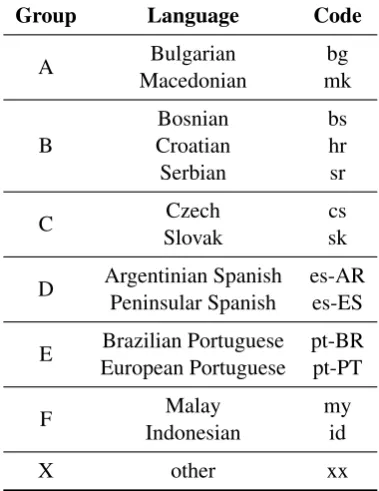
Our method is evaluated on the DSLCC dataset (Tan et al., 2014), which dataset is provided for the shared task. As Tan et al. de-scribe the collection and the preparation of the dataset in detail, we only provide a summary in Table 1. The dataset contains 6 language groups of closely related languages and dialects plus one group called other. The language groups are presented in the first column (Group) of the table. The second column (Language) identifies the language, the third column (code) contains a short identifier for each language.
For each language, the dataset consists of 20 000 sentences. Each list of sentences is divided into two parts as 18 000 sentence training sample and 2 000 sentence development sample.
4 Method
To solve the shared task, we introduce a two-level architecture. On the first level we utilize a clas-sifier to distinguish between the language groups. We refer to this classifier later asinter-group clas-sifier. The inter-group classifier is described in Section 4.1. To conduct a more specialized deci-sion, to distinguish between the languages in a lan-guage group, a second-level classifier is utilized. This classifier is titled the intra-group classifier and is described in Section 4.2
4.1 Inter-group classifier
Although the dataset contains 7 language groups, we trained the classifier on 14 labels according to the languages (instead of groups) and grouped the
Group Language Code
A MacedonianBulgarian mkbg
B CroatianBosnian bshr
Serbian sr
C SlovakCzech skcs
D Argentinian Spanish es-ARPeninsular Spanish es-ES
E European Portuguese pt-PTBrazilian Portuguese pt-BR
F IndonesianMalay myid
[image:2.595.321.511.65.311.2]X other xx
Table 1: Language groups and languages
corresponding labels together according to the lan-guage groups.
From the variety of features tested (see Sec-tion 4.2), tf-idf delivered the best results for the inter-group classification. Although tf-idf is a more common method for information retrieval tasks, it can also be defined for the current task as follows
document set of all sentences in one language,
term one word, see Section 5 for details,
query one test sentence.
The inter-group classifier operates in two steps. In the first step the top 100,000 keywords are ex-tracted for each language. In the second step the weighted sum of keywords is computed for each sentence in each language and the language with the highest score is chosen.
The inter-group classifier provides 100% accu-racy on language group identification. Regarding language labelling, the accuracy of the inter-group classifier is 92.54%.
We used the following tf, idf andqf weight-ings:
tft,d= log(1 +ft,d),
idft= log(1 + Nn t),
whereN is the number of languages andntis the number of languages in which termtappears and
qft=
0.5 + 0.5maxft,q tft,q
×logNn t,
whereqftis the weight of termt,maxtft,qis the highesttf score for termtin any language.
4.2 Intra-group classifier
The language groups are refined by the intra-group classifier further. In the case of groups A, C, D, E and F, there are 2 languages two distinguish be-tween. In the case of group B, there are 3 lan-guages to label. In the case of “group” X there is only 1 language, the intra-group classifier is not used in this case.
Various features are extracted and 6 models are trained for the 6 groups. Character and word n-grams, Katz’s backoff scores, tf-idf scores and stopword n-grams are used as features.
4.2.1 N-grams
Character n-grams proved to be the most promi-nent feature in last year’s DSL task (Zampieri et al., 2014). However, the number of character n-grams grows exponentially with n in theory and subexponentially in practice but it still results in a large number of features. This is the reason why we involved feature selection.
Since PCA and other popular dimension reduc-tion methods are very memory-intensive, Pear-son correlation is involved as a feature selection method. To select the most relevant features, for each feature, the absolute value of the Pearson cor-relation with the labels is calculated and based on this value, the topnfeatures are selected.
4.2.2 Katz’s backoff smoothing
Our baseline system is an implementation of Katz’s backoff smoothing with training option that works well in the general setting.2 It is possible to
train and test with this system up ton= 4grams with reasonable memory consumption. For further memory-saving, see Section 5.
There are several variants of Katz’s backoff smoothing, the one used here discounts the Max-imum Likelihood estimations with a constant
fac-2https://github.com/juditacs/langid
tor and distributes the leftover probability mass ac-cording to lower order n-grams.
Pbo(cn|c1, . . . , cn) =
=
(C(c
1,...,cn)−d
C(c1,...,cn−1), ifC(c1, . . . , cn)>0
αc1,...,cn−1Pbo(cn|c2, . . . , cn−1)otherwise,
where αc1,...,cn−1 is the left-over probability
mass from discounting:
αc1,...,cn−1 = 1−
X
cn:C(c1,...,cn)>0
C(c1, . . . , cn)−d C(c1, . . . , cn−1) .
The probabilities for all the languages are calcu-lated on n-grams of various size,nis ranging from 1 to 4. The language with the highest probability is selected. Both the probabilities and the language are used as features and are passed to the intra-group classifier.
4.2.3 Tf-idf
Similarly to the case of the inter-group classi-fier, tf-idf scores are calculated for each language group. The language group specific tf-idf scores are based on the sentences only in the specific lan-guage group. The tf-idf scores are the used as fea-tures later for the intra-group classification.
4.2.4 Word bigrams
Word bigrams are extracted and after selection are used as features. The selection of word bigrams is similar to the selection of the character n-grams. The absolute value of Pearson correlation of the bigrams with the labels is calculated and then the topnbigrams are selected. In our experimentnis set to 1 000.
4.2.5 Stopwords
Accuracy run1 0.9331428571 run2 0.9366428571 run3 0.9348571429
Table 2: Overall accuracy of our three runs
4.2.6 Classifier
Scikit-learn’s (Pedregosa et al., 2011) maximum entropy and SVM based classifiers are evaluated. In the case of SVM, different kernels are utilized. Due to space limitations and focus we do not pub-lish these evaluation results. As the maximum en-tropy classifier delivers comparable results to the SVM based method, we use the maximum entropy classifier as it is considerably faster.
5 Preprocessing and tokenization
In order to reduce the number of components that do not contribute much to language identification, the corpus is preprocessed before feature extrac-tion. The preprocessing pipeline consists of the following steps
lowercasing Python’s unicode.lower func-tion is used
puncutation filtering standard punctuation (Python’s string.punctuation) and additional quotation symbols are removed
whitespace normalization multiple consecutive whitespaces in the same sentence are re-placed with a single space
digit replacement numbers are replaced with a single 0
All steps are applied before feature extraction except in the case of tf-idf, where lowercasing is not performed.
The preprocessed text is tokenized with NLTK (Bird, 2006). Although the tokenizer is trained on English punctuation corpus, it performs reason-ably well for the current languages.
6 Results
Three runs are submitted. The first two runs are the same except that in the second run we took ad-vantage of the fact that the labels were balanced. The third run only differed in thresholding for
Group Languages Accuracy
A bg,mk 1.0
B bs,hr,sr 0.8417
C cs,sk 1.0
D es-AR,es-ES 0.867
E pt-BR,pt-PT 0.929
F id,my 0.998
other xx 1.0
[image:4.595.332.500.62.202.2]sum 0.9366
Table 3: Detailed results of our best run
group B. The overall accuracy of each run is listed in Table 2 and the detailed results of our best run can be found in Table 3.
To have a deeper insight into the limitations of solving the shared task, a manual evaluation has been performed on the 152 sentences mis-classified Portuguese sentences by our best run by two Brazilian native speakers. The annota-tors have been asked to label each sentence as BR (Brazilian), PT (European Portuguese) or UN (Unknown). UN tag has been introduced to avoid guessing. Their very low agreement on the labels (Cohen’s kappa 0.28) and the fact that only 22 sen-tences have been labeled correctly (according to the gold standard) by both of them suggests that there is very little room for improvement on the shared task.
7 Conclusion
We presented the system description of our DSL2015 task submission which performed an overall accuracy of 93.66%. We ended up the 5th place out of 8 submissions.
We introduced a two-level classifier with a vari-ety of features: character and word n-grams, tf-idf, stopword bigrams and tf-tf-idf, and smoothed language models. The first level solely relies on the output of tf-idf, capable of grouping languages with 100% accuracy. The second level combines all features and uses the maximum entropy classi-fier to classify languages within language groups.
References
Steven Bird. 2006. NLTK: the natural language toolkit. InProceedings of the COLING/ACL on In-teractive presentation sessions, pages 69–72. Asso-ciation for Computational Linguistics.
Cyril Goutte, Serge L´eger, and Marine Carpuat. 2014. The NRC system for discriminating similar lan-guages. In Proceedings of the First Workshop on Applying NLP Tools to Similar Languages, Varieties and Dialects, pages 139–145, Dublin, Ireland, Au-gust. Association for Computational Linguistics.
S. Katz. 1987. Estimation of probabilities from sparse data for the language model component of a speech recognizer. IEEE Transactions on Acoustics, Speech and Signal processing, 35(3):400–401.
Ben King, Dragomir Radev, and Steven Abney. 2014. Experiments in sentence language identification with groups of similar languages. InProceedings of the First Workshop on Applying NLP Tools to Sim-ilar Languages, Varieties and Dialects, pages 146– 154, Dublin, Ireland, August. Association for Com-putational Linguistics.
Marco Lui, Ned Letcher, Oliver Adams, Long Duong, Paul Cook, and Timothy Baldwin. 2014. Explor-ing methods and resources for discriminatExplor-ing simi-lar languages. InProceedings of the First Workshop on Applying NLP Tools to Similar Languages, Vari-eties and Dialects, pages 129–138, Dublin, Ireland, August. Association for Computational Linguistics.
F. Pedregosa, G. Varoquaux, A. Gramfort, V. Michel, B. Thirion, O. Grisel, M. Blondel, P. Pretten-hofer, R. Weiss, V. Dubourg, J. Vanderplas, A. Pas-sos, D. Cournapeau, M. Brucher, M. Perrot, and E. Duchesnay. 2011. Scikit-learn: Machine learn-ing in Python. Journal of Machine Learning Re-search, 12:2825–2830.
Jordi Porta and Jos´e-Luis Sancho. 2014. Using max-imum entropy models to discriminate between sim-ilar languages and varieties. InProceedings of the First Workshop on Applying NLP Tools to Similar Languages, Varieties and Dialects, pages 120–128, Dublin, Ireland, August. Association for Computa-tional Linguistics.
Matthew Purver. 2014. A simple baseline for dis-criminating similar languages. InProceedings of the First Workshop on Applying NLP Tools to Similar Languages, Varieties and Dialects, pages 155–160, Dublin, Ireland, August. Association for Computa-tional Linguistics.
Liling Tan, Marcos Zampieri, Nikola Ljubeˇsic, and J¨org Tiedemann. 2014. Merging comparable data sources for the discrimination of similar languages: The dsl corpus collection. InProceedings of the 7th Workshop on Building and Using Comparable Cor-pora, pages 11–15, Reykjavik, Iceland.
J¨org Tiedemann and Nikola Ljubeˇsi´c. 2012. Efficient discrimination between closely related languages. InProceedings of COLING 2012, pages 2619–2634, Mumbai, India.
Marcos Zampieri, Liling Tan, Nikola Ljubeˇsi´c, and J¨org Tiedemann. 2014. A report on the DSL Shared Task 2014. InProceedings of the First Workshop on Applying NLP Tools to Similar Languages, Varieties and Dialects, pages 58–67, Dublin, Ireland, August. Association for Computational Linguistics.