AllSummarizer system at MultiLing 2015:
Multilingual single and multi-document summarization
Abdelkrime Aries Djamel Eddine Zegour Khaled Walid Hidouci
´Ecole Nationale Sup´erieure d’Informatique (ESI, ex. INI) Oued-Smar, Algiers, Algeria
{ab aries, d zegour, w hidouci}@esi.dz
Abstract
In this paper, we evaluate our automatic text summarization system in multilingual context. We participated in both sin-gle document and multi-document sum-marization tasks of MultiLing 2015 work-shop.
Our method involves clustering the docu-ment sentences into topics using a fuzzy clustering algorithm. Then each sentence is scored according to how well it cov-ers the various topics. This is done us-ing statistical features such as TF, sen-tence length, etc. Finally, the summary is constructed from the highest scoring sen-tences, while avoiding overlap between the summary sentences. This makes it language-independent, but we have to af-ford preprocessed data first (tokenization, stemming, etc.).
1 Introduction
A document summary can be regarded as domain-specific or general-purpose, using the domain-specificity as classification criterion (Hovy and Lin, 1998). We can, also, look at this criterion from language angle: language-specific or language-independent summarization. Language-independent systems can handle more than one language. They can be partially language-independent, which means they use language-related resources, and therefore you can’t add a new language so easily. Inversely, they can be fully language-independent.
Recently, multilingual summarization has re-ceived the attention of the summarization commu-nity, such as Text Analysis Conference (TAC). The TAC 2011 workshop included a task called “Mul-tiLing task”, which aims to evaluate language-independent summarization algorithms on a vari-ety of languages (Giannakopoulos et al., 2011). In
the task’s pilot, there were seven languages cov-ering news texts: Arabic, Czech, English, French, Greek, Hebrew and Hindi, where each system has to participate for at least two languages. MultiLing 2013 workshop is a community-driven initiative for testing and promoting multilingual summariza-tion methods. It aims to evaluate the applicasummariza-tion of (partially or fully) language-independent sum-marization algorithms on a variety of languages. There were three tasks: “Multi-document mul-tilingual summarization”(Giannakopoulos, 2013), “Multilingual single document summarization” (Kubina et al., 2013) and “Multilingual summary evaluation”. The multi-document task uses the 7 past languages along with three new languages: Chinese, Romanian and Spanish. The single doc-ument task introduces 40 languages.
This paper contains a description of our method (Aries et al., 2013) which uses sentences’ clus-tering to define topics, and then trains on these topics to score each sentence. We will explain each task in the system (AllSummarizer), espe-cially the preprocessing task which is language-dependent. Then, we will discuss how we fixed the summarization’s hyper-parameters (threshold and features) for each language. The next section (Section 5) is reserved to discuss the experiments conducted in the MultiLing workshop. Finally, we will conclude by discussing possible improve-ments.
2 Related works
Clustering has been used for summarization in many systems, either using documents as units, sentences or words. The resulted clusters are used to extract the summary. Some systems use just the biggest cluster to score sentences and get the top ones. Others take from each cluster a represen-tative sentence, in order to cover all topics. While there are systems, like ours, which score sentences according to all clusters.
“CIST” (Liu et al., 2011; Li et al., 2013) is a system which uses hierarchical Latent Dirich-let Allocation topic (hLDA) model to cluster sen-tences into sub-topics. A sub-topic containing more sentences is more important and therefore those containing just one or two sentences can be neglected. The sentences are scored using hLDA model combined with some traditional features. The system participated for multi-document sum-marization task, where all documents of the same topic are merged into a big text document.
Likewise, “UoEssex” (El-Haj et al., 2011) uses a clustering method (K-Means) to regroup similar sentences. The biggest cluster is used to extract the summary, while other clusters are ignored. Then, the sentences are scored using their cosine similarities to the cluster’s centroid. The use of the biggest cluster is justified by the assumption that a single cluster will give a coherent summary.
The scoring functions of these two systems are based on statistical features like frequen-cies of words, cosine similarity, etc. In the contrary, systems like those of Conroy et al. (2011) (“CLASSY”), Varma et al. (2011) (“SIEL IIITH”), El-Haj and Rayson (2013), etc. are corpus-based summarizers, which can make it hard to introduce new languages. “CLASSY” uses na¨ıve Bayes to estimate the probability that a term may be included in the summary. The classifier was trained on DUC 2005-2007 data. As for back-grounds of each language, Wikinews are used to compute Dunning G-statistic. “SIEL IIITH” uses a probabilistic Hyperspace Analogue to Language model. Given a word, it estimates the probability of observing another word with it in a window of size K, using a sufficiently large corpus. El-Haj and Rayson (2013) calculate the log-likelihood of each word using a corpus of words frequencies and the multiLing’13 dataset. The score of each sen-tence is the sum of its words’ log-likelihoods.
In our method (Aries et al., 2013), we use a sim-ple fuzzy clustering algorithm. We assume that a sentence can express many topics, and therefore it can belong to many clusters. Also, we believe that a summary must take in consideration other topics than the main one (the biggest cluster). To score sentences, we use a scoring function based on Na¨ıve Bayes classification. It uses the clusters for training rather than a corpus, in order to avoid the problem of language dependency.
3 System overview
One of multilingual summarization’s problem is the lack of resources such as labeled corpus used for learning. Learning algorithms were used either to select the sentences that should be in the sum-mary, or to estimate the features’ weights. Both cases need a training corpus given the language and the domain we want to adapt the rizer to. To design a language-neutral summa-rization system, either we adapt a system for in-put languages (Partly language-neutral), or we de-sign a system that can process any language (Fully language-neutral).
Our sentence extraction method can be applied to any language without any modifications, afford-ing the pre-process step of the input language. To do this, we had to find a new method to train our system other than using a corpus (language and topic dependent). The idea was to find different topics in the input text using similarity between sentences. Then, we train the system using a scor-ing function based on Bayes classification algo-rithm and a set of features to find the probability of a feature given the topic. Finally, we calculate for each sentence a score that reflects how it can represent all the topics.
In our previous work (Aries et al., 2013), our system used only two features which have the same nature (TF: uni-grams and bi-grams). When we add new features, this can affect the final re-sult (summary). Also, our clustering method lies on the clustering threshold which has to be esti-mated somehow. To handle multi-document sum-marization, we just fuse all documents in the same topic and consider them as one document. Figure 1 represents the general architecture of AllSum-marizer1.
3.1 Preprocessing
This is the language-dependent part, which can be found in many information retrieval (IR) works. In our system, we are interested in four pre-processing tasks:
• Normalizer: in this step, we can delete spe-cial characters. For Arabic, we can delete di-acritics (Tashkiil) if we don’t need them in the process (which is our case).
• Segmenter: The segmenter defines two
Input
document(s) Summary
Pre-processing
Normalizer
Segmenter
Stemmer
Stop-word eliminator
List of sentences
List of pre-processed words for each sentence
Processing (our method)
Clustering
Learning
Scoring
List of clusters Summary size
P(f|C)
Extraction
Extraction Sentences'
scores
ReOrdering
List of first higher scored sentences
[image:3.595.72.525.63.290.2]Reordered sentences
Figure 1: General architecture of AllSummarizer.
tions: sentence segmentation and word tok-enization.
• Stemmer: The role of this task is to delete suffixes and prefixes so we can get the stem of a word.
• Stop-Words eliminator: It is used to remove the stop words, which are the words having no signification added to the text.
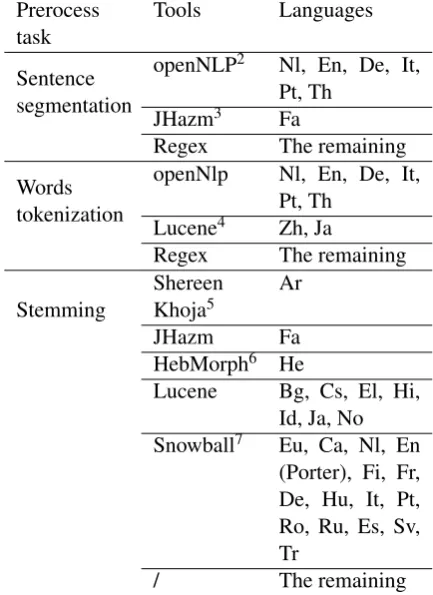
In this work, normalization is used just for Arabic and Persian to delete diacritics (Tashkiil). Concerning stop-word elimination, we use pre-compiled word-lists available on the web. Table 1 shows each language and the tools used in the remaining pre-processing tasks.
3.2 Topics clustering
Each text contains many topics, where a topic is a set of sentences having some sort of relation-ship between each other. In our case, this rela-tionship is the cosine similarity between each two sentences. It means, the sentences that have many terms in common are considered in the same topic. Given two sentencesXandY, the cosine
similar-2https://opennlp.apache.org/
3https://github.com/mojtaba-khallash/JHazm 4https://lucene.apache.org/
5http://zeus.cs.pacificu.edu/shereen/research.htm 6http://code972.com/hebmorph
7http://snowball.tartarus.org/
Table 1: Tools used to pre-process each language Prerocess
task Tools Languages
Sentence segmentation
openNLP2 Nl, En, De, It,
Pt, Th JHazm3 Fa
Regex The remaining Words
tokenization
openNlp Nl, En, De, It, Pt, Th
Lucene4 Zh, Ja
Regex The remaining
Stemming ShereenKhoja5 Ar
JHazm Fa
HebMorph6 He
Lucene Bg, Cs, El, Hi, Id, Ja, No Snowball7 Eu, Ca, Nl, En
(Porter), Fi, Fr, De, Hu, It, Pt, Ro, Ru, Es, Sv, Tr
[image:3.595.307.524.413.711.2]ity between them is expressed by equation 1.
cos(X, Y) =
P
ixi.yi
pP
i(xi)2.pPi(yi)2 (1) Wherexi(yi) denotes frequencies for each term in the sentenceX(Y).
To generate topics, we use a simple algorithm (see algorithm 1) which uses cosine similarity and a clustering thresholdthto clusternsentences.
Algorithm 1:clustering method
Data: Pre-processed sentences
Result: clusters of sentences (C)
foreachsentence Si / i = 1 to ndo
Ci += Si ;
// Ci: ith cluster
foreachsentence Sj / j = i + 1 to ndo
Sim = cosine similarity(Si, Sj) ;
ifsim>ththen
Ci += Sj ;
end end
C += Ci ;
end
foreachcluster Ci / i=n to 1do foreachcluster Cj / j=i-1 to 1do
ifCi is included in Cjthen
C -= Ci ; break ;
end end end
3.3 Scoring function
A summary is a short text that is supposed to repre-sent most information in the source text, and cover most of its topics. Therefore, we assume that a sentencesican be in the summary when it is most probable to represent all topics (clusters)cj ∈ C using a set of features fk ∈ F. We used Na¨ıve Bayes, assuming independence between different classes and different features (a sentence can have multiple classes). So, the score of a sentence si is the product over classes of the product over fea-tures of its score in a specific class and feature (see equation. 2).
Score(si,
\
j
cj, F) =
Y
j
Y
k
Score(si, cj, fk)
(2)
The score of a sentencesi in a specific classcj and featurefkis the sum of probability of the fea-ture’s observations whensi ∈cj(see equation. 3). We add one to the sum, to avoid multiplying by a features’ score of zero.
Score(si, cj, fk) = 1 +
X
φ∈si
P(fk=φ|si ∈cj)
(3) Where φ is an observation of the feature fk in the sentence si. For example, assuming the fea-ture f1 is term frequency, and we have a sen-tence: “I am studying at home.”. The sentence after pre-processing would be:s1={“studi”(stem of “study”), “home”}. So, φ may be “studi” or “home”, or any other term. If we take another fea-turef2which is sentence position, the observation φmay take 1st, 2nd, 3rd, etc. as values.
3.4 Statistical features
We use 5 statistical features to score the sentences: unigram term frequency (TFU), bigram term fre-quency (TFB), sentence position (Pos) and sen-tence length (Rleng, PLeng).
Each feature divides the sentences to several categories. For example, if we have a text writ-ten just with three characters: a, b and c, and the feature is the characters of the text, then we will have three categories. Each category has a proba-bility to occur in a cluster, which is the number of its appearance in this cluster divided by all clus-ter’s terms, as shown in equation 4.
Pf(f =φ|cj) = P |φ∈cj| cl∈C|φ0∈cl|
(4)
Wheref is a given feature. φandφ0 are
observa-tions (categories) of the featuref . Cis the set of clusters.
3.4.1 Unigram term frequency
This feature is used to calculate the sentence per-tinence depending on its terms. Each term is con-sidered as a category.
3.4.2 Bigram term frequency
This feature is similar to unigram term frequency, but instead of one term we use two consecutive terms.
3.4.3 Sentence position
sets: the ones in the 8 first paragraphs, those in last 3 paragraphs and the others in between. Fol-lowing the assumption that the first sentences and last ones are more important than the others.
Three categories of sentence positions seem very small to express the diversity between the clusters. Instead of just three categories, we di-vided the position space into 10 categories. So, if we have 20 sentences, we will have 2 sentences per category.
3.4.4 Sentence length
One other feature applied in our system is the sen-tence length (number of words), which is used originally to penalize the short sentences. Follow-ing a sentence’s length, we can put it in one of three categories: sentences with length less than 6 words, those with length more than 20 words, and those with length in between Osborne (2002).
Like sentence position, three categories is a small number. Therefore, we used each length as a category. Suppose we have 4 sentences which the lengths are: 5, 6, 5 and 7, then we will have 3 categories of lengths: 5, 6 and 7.
In our work, we use two types of sentence length:
• Real length (RLeng): which is the length of the sentence without removing stop-words.
• Pre-processed length (PLeng): which is the length of the sentence after pre-processing.
3.5 Summary extraction
To extract sentences, we reorder them decreas-ingly using their scores. Then we extract the first non similar sentences until we get the wanted size (see algorithm 2).
4 Summarization parameters
In this section, we describe how the summariza-tion parameters have been chosen.
The first parameter is the clustering threshold, which will lead to few huge clusters if it is small, and inversely. The clustering threshold is used with sentences’ similarities to decide if two sen-tences are similar or not. Our idea is to use statis-tic measures over those similarities to estimate the clustering threshold. Eight measures have been used:
• The median
Algorithm 2:extraction method
Data: input text
Result: a summary
add the first sentence to the summary;
foreachsentence in the textdo
calculate cosine similarity between this sentence and the last accepted one;
ifthe simularity is under the threshold
then
add this sentence to the summary;
end
ifthe sum of the summary size and the
current sentence’s is above the maximum
sizethen
delete this sentence from the summary;
end end
• The mean
• The mode which can be divided to two: lower mode and higher mode, since we can have many modes.
• The variance • sDn= P|D|∗|sn|
• Dsn= n∗|PD| |s|
• Ds= P|D| |s|
Where, |s|is the number of different terms in a sentences.|D|is the number of different terms in the documentD. nis the number of sentences in this document.
The second parameter is the features’ set, which is the combination of at least one of the five fea-tures described in section 3.4. We want to know which features are useful and which are not for a given language.
Table 2 represents an example of the 10 lan-guages and their parameters used for both tasks: MSS and MMS. We have to point out that the aver-age is not always the best choice for the individual documents (or topic in multi-document). For ex-ample, in MSS, there is a document which gives a ROUGE-2 score of0.28when we use the param-eters based on average scores. When we use the mean as threshold and just TFB as feature for the same document, we get a ROUGE-2 score of0.31. 5 Experiments
We participated in all workshop’s languages, ei-ther in single document or multi-document tasks. To compare our system to others participated sys-tems, we followed these steps (for every evalua-tion metric):
• For each system, calculate the average scores of all used languages.
• For our system, calculate the average scores of used languages by others. For example, BGU-SCE-M team uses Arabic, English and Hebrew; We calculate the average of scores of these languages for this system and ours. • Then, we calculate the relative improvement
using the averages oursystemothersystem−othersystem.
5.1 Evaluation metrics
In “Single document summarization” task, ROUGE (Recall-Oriented Understudy for Gisting Evaluation) (Lin, 2004) is used to evaluate the participated systems. It allows us to evaluate automatic text summaries against human made abstracts. The principle of this method is to compare N-grams of two summaries based on the number of matches between these two based on the recall measure. Five metrics are used: ROUGE-1, ROUGE-2, ROUGE-3, ROUGE-4 and ROUGE-SU4.
In “Multi-document summarization” task, Three metrics are officially used: AutoSum-mENG, MeMoG (Giannakopoulos and Karkalet-sis, 2011) and NPowER (Giannakopoulos and Karkaletsis, 2013).
5.2 Single document summarization
Besides our system (AllSummarizer), there are two more systems which participated in all 38 lan-guages (EXB and CCS). Table 3 shows the com-parison between our system and the other systems
in single document task, using the relative im-provement.
Looking at these results, our system took the fifth place out of seven participants. It outperforms the Lead baseline. It took the last place out of three participants in all 38 languages.
5.3 Multi-document summarization
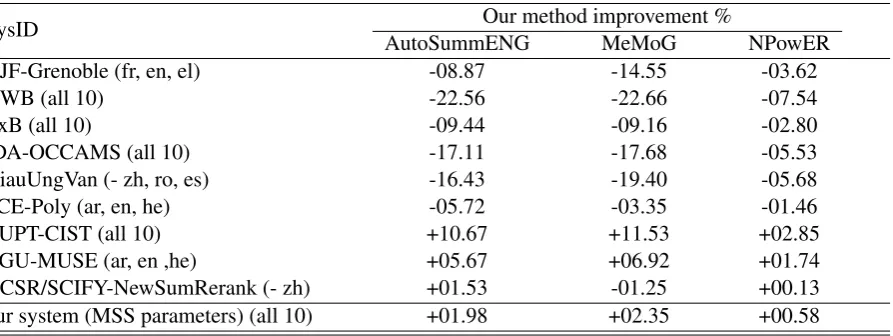
Besides our system (AllSummarizer), there are 4 systems that participated with all the 10 languages. Table 4 shows a comparison between our system and the other systems in multi-document task, us-ing the relative improvement. We used the param-eters fixed for single document summarization to see if the same parameters are applicable for both single and multi-document summarizations.
Looking to the results, our system took the sev-enth place out of ten participants. When we use single document parameters, we can see that it doesn’t outperform the results when using the pa-rameters fixed for multi-document summarization. This shows that we can’t use the same parame-ters for both single and multi-document summa-rization.
6 Conclusion
Our intension is to create a method which is lan-guage and domain independent. So, we consider the input text as a set of topics, where a sentence can belong to many topics. We calculated how much a sentence can represent all the topics. Then, the score is used to reorder the sentences and ex-tract the first non redundant ones.
We tested our system using the average score of all languages, in single and multi-document sum-marization. Compared to other systems, it affords fair results, but more improvements have to be done in the future. We have to point out that our system participated in all languages. Also, it is easy to add new languages when you can afford tokenization and stemming.
Table 2: Example of the parameters used for MSS and MMS. Lang Single document (MSS)Th Features Multidocument (MMS)Th Features
Ar Ds TFB, Pos, PLeng Ds TFB, Pos, RLeng, PLeng
Cs HMode TFU, TFB, Pos, PLeng Ds TFB, Pos, PLeng
El Median TFU, TFB, Pos, RLeng, PLeng LMode TFB, RLeng
En Median TFU, Pos, RLeng, PLeng LMode TFB, Pos, RLeng, PLeng
Es sDn TFB, PLeng Ds TFB, PLeng
Fr Median TFB, Pos, RLeng Mean TFU, TFB, Pos, PLeng
He Ds TFB, PLeng Median TFB, RLeng, PLeng
Hi / / Ds TFB, Pos, RLeng, PLeng
Ro HMode TFB, RLeng, PLeng sDn TFB, Pos, PLeng
[image:7.595.77.526.347.488.2]Zh HMode TFB, RLeng, PLeng sDn TFU, Pos, RLeng, PLeng
Table 3: Relative improvement of our method against other methods on the MultiLing 2015 Single document testing dataset
Methods ROUGE-1 ROUGE-2Our method improvement %ROUGE-3 ROUGE-4 ROUGE-SU4 BGU-SCE-M (ar, en, he) -09.19 -14.02 -19.39 -25.12 -11.07
EXB (all 38) -07.64 -10.55 -09.86 -07.92 -10.63
CCS (all 38) -07.33 -13.24 -10.95 -03.04 -07.40
BGU-SCE-P (ar, en, he) -04.33 -01.63 -02.69 -06.16 -01.89 UA-DLSI (en, de, es) +02.12 +06.25 +13.86 +17.15 +05.62
NTNU (en, zh) +06.44 +07.06 +11.50 +21.81 +05.74
Oracles (all 38) [TopLine] -31.64 -49.00 -63.80 -72.91 -36.77 Lead (all 38) [BaseLine] +02.39 +08.67 +08.20 +04.02 +05.82
Table 4: Relative improvement of our method against other methods on the MultiLing 2015 multi-document testing dataset. The minus sign means that the system participated in all languages except those mentioned.
SysID AutoSummENGOur method improvement %MeMoG NPowER
UJF-Grenoble (fr, en, el) -08.87 -14.55 -03.62
UWB (all 10) -22.56 -22.66 -07.54
ExB (all 10) -09.44 -09.16 -02.80
IDA-OCCAMS (all 10) -17.11 -17.68 -05.53
GiauUngVan (- zh, ro, es) -16.43 -19.40 -05.68
SCE-Poly (ar, en, he) -05.72 -03.35 -01.46
BUPT-CIST (all 10) +10.67 +11.53 +02.85
BGU-MUSE (ar, en ,he) +05.67 +06.92 +01.74
[image:7.595.80.527.577.745.2]References
Abdelkrime Aries, Houda Oufaida, and Omar Nouali. 2013. Using clustering and a modified classification algorithm for automatic text summarization. volume
8658 ofProc. SPIE, pages 865811–865811–9.
John M. Conroy, Judith D. Schlesinger, and Jeff Ku-bina. 2011. Classy 2011 at TAC: Guided and multi-lingual summaries and evaluation metrics. In
Proceedings of the Fourth Text Analysis Conference (TAC 2011)–MultiLing Pilot Track., Gaithersburg, Maryland, USA.
Mahmoud El-Haj and Paul Rayson. 2013. Using a keyness metric for single and multi document
sum-marisation. In Proceedings of the MultiLing 2013
Workshop on Multilingual Multi-document Summa-rization, pages 64–71, Sofia, Bulgaria, August. As-sociation for Computational Linguistics.
Mahmoud El-Haj, Udo Kruschwitz, and Chris Fox. 2011. University of Essex at the TAC 2011
mul-tilingual summarisation pilot. In Proceedings of
the Fourth Text Analysis Conference (TAC 2011)– MultiLing Pilot Track., Gaithersburg, Maryland, USA.
George Giannakopoulos and Vangelis Karkaletsis.
2011. Autosummeng and memog in
evaluat-ing guided summaries. In TAC 2011 Workshop,
Gaithersburg, MD, USA. NIST.
George Giannakopoulos and Vangelis Karkaletsis.
2013. Together we stand npower-ed. In
Proceed-ings of CICLing 2013, Karlovasi, Samos, Greece.
G. Giannakopoulos, M. El-Haj, B. Favre, M. Litvak, J. Steinberger, and V. Varma. 2011. Tac 2011 mul-tiling pilot overview. InProceedings of the Fourth Text Analysis Conference (TAC 2011)–MultiLing Pi-lot Track., Gaithersburg, Maryland, USA.
George Giannakopoulos. 2013. Multi-document mul-tilingual summarization and evaluation tracks in acl
2013 multiling workshop. In Proceedings of the
MultiLing 2013 Workshop on Multilingual Multi-document Summarization, pages 20–28, Sofia, Bul-garia, August. Association for Computational Lin-guistics.
Eduard Hovy and Chin-Yew Lin. 1998. Automated text summarization and the SUMMARIST system. InProceedings of a workshop on held at Baltimore, Maryland: October 13-15, 1998, pages 197–214. Association for Computational Linguistics.
Jeff Kubina, John Conroy, and Judith Schlesinger.
2013. Acl 2013 multiling pilot overview. In
Pro-ceedings of the MultiLing 2013 Workshop on Mul-tilingual Multi-document Summarization, pages 29– 38, Sofia, Bulgaria, August. Association for Compu-tational Linguistics.
Lei Li, Corina Forascu, Mahmoud El-Haj, and George Giannakopoulos. 2013. Multi-document multilin-gual summarization corpus preparation, part 1: Ara-bic, english, greek, chinese, romanian. In Proceed-ings of the MultiLing 2013 Workshop on Multilin-gual Multi-document Summarization, pages 1–12, Sofia, Bulgaria, August. Association for Computa-tional Linguistics.
Chin-Yew Lin. 2004. Rouge: A package for automatic
evaluation of summaries. InProc. ACL workshop on
Text Summarization Branches Out, page 10. Hongyan Liu, Pingan Liu, Wei Heng, and Lei Li. 2011.
The cist summarization system at TAC 2011. In
Proceedings of the Fourth Text Analysis Conference (TAC 2011)–MultiLing Pilot Track., Gaithersburg, Maryland, USA.
Miles Osborne. 2002. Using maximum entropy for
sentence extraction. InProceedings of the ACL-02
Workshop on Automatic Summarization - Volume 4, AS ’02, pages 1–8, Stroudsburg, PA, USA. Associa-tion for ComputaAssocia-tional Linguistics.
Vasudeva Varma, Sudheer Kovelamudi, Jayant Gupta, Nikhil Priyatam, Arpit Sood, Harshit Jain, Aditya Mogadala, and Srikanth Reddy Vaddepally. 2011. IIIT hyderabad in summarization and knowledge
base population at TAC 2011. In Proceedings of