Original citation:
Griffiths, Nathan (2004) Task delegation using experience-based multi-dimensional trust.
University of Warwick. Department of Computer Science. (Department of Computer
Science Research report). CS-RR-410
Permanent WRAP url:
http://wrap.warwick.ac.uk/61325
Copyright and reuse:
The Warwick Research Archive Portal (WRAP) makes this work by researchers of the
University of Warwick available open access under the following conditions. Copyright ©
and all moral rights to the version of the paper presented here belong to the individual
author(s) and/or other copyright owners. To the extent reasonable and practicable the
material made available in WRAP has been checked for eligibility before being made
available.
Copies of full items can be used for personal research or study, educational, or
not-for-profit purposes without prior permission or charge. Provided that the authors, title and
full bibliographic details are credited, a hyperlink and/or URL is given for the original
metadata page and the content is not changed in any way.
A note on versions:
The version presented in WRAP is the published version or, version of record, and may
be cited as it appears here.For more information, please contact the WRAP Team at:
Task Delegation using Experience-Based
Multi-Dimensional Trust
∗
Nathan Griffiths
Department of Computer Science, University of Warwick,
Coventry, CV4 7AL, UK
Abstract
Cooperation among autonomous agents involves an inherent degree of uncer-tainty. Agents determine for themselves when to initiate cooperation or to assist others, when to rescind commitments, and how to conduct cooperative tasks. For example, an agent may delay the execution of a cooperative task, execute it to a reduced quality, or simply fail to complete it. In this paper, we describe how experience-based trust can be used to minimise the risk associated with coopera-tion. In particular we propose a mechanism, called multi-dimensional trust, which allows agents to model the trustworthiness of others according to various crite-ria. This trust information is combined with other factors to enable the selection of cooperative partners. Agents’ preferences are represented by a set of factor weightings, which allow trust information to be tailored to the current cooperative priorities. We also describe the experimental validation of our proposed approach.
1
Introduction
Cooperation and delegation are the defining characteristics of multi-agent systems. It is through cooperation and delegation that the agents in such systems are able to func-tion effectively, since they typically lack the knowledge, capabilities or resources to achieve their objectives alone. To achieve flexibility and robustness in response to en-vironmental change agents are typically given the autonomy to control their individual goals and behaviour. By enabling the individuals within a system to respond appro-priately to change, we allow the system as a whole to exhibit similar flexibility and robustness. By definition, however, giving agents the autonomy to control their own behaviour implies that they control how they cooperate. In particular, agents can de-termine for themselves when to initiate cooperation or assist others, when to rescind cooperative commitments, and how to conduct cooperative tasks. Consequently, where a group of agents cooperate any one of them may change the nature of its cooperation,
∗Research Report CS-RR-410, Department of Computer Science, University of Warwick, December
or even cease to cooperate, at any time. For example, an agent may choose to delay the execution of a task, execute it to a reduced quality, or simply fail to complete it. Such failures in cooperation are costly to the remaining cooperating agents since their goals may not be achieved, or not achieved as effectively (e.g. to a lower quality or after a deadline).
When entering into cooperation an agent is entering into an uncertain interaction in which there is a risk of failure (or reduced performance) due to the decisions and actions of another. To function effectively, agents need some mechanism for managing this risk; the notion of trust can provide this. In this paper we describe an approach, called multi-dimensional trust (MDT), in which agents model the trustworthiness of others along several dimensions. These trust dimensions are combined with other fac-tors when delegating a task, to enable agents to select appropriate cooperative partners based on their current preferences.
Our proposed MDT mechanism is widely applicable, however in this paper we focus upon a particular domain. Specifically, we are a system comprising a set of autonomous self-interested agents, each having certain capabilities that are made avail-able to others for a cost. Agents have a set of goals that are decomposed (through some unspecified planning process) into sequences of tasks. Agents’ individual capabili-ties are such that the execution of these tasks typically requires cooperation with other agents. We use the term delegation to refer to the process of one agent performing a task on behalf of another. In this paper, we are not concerned agent motivations, i.e.
why agents cooperate, rather we simply assume that agents are motivated to perform
tasks on behalf of others in return for imposing a charge. We also assume that auton-omy and self-interest governs agents’ cooperation, in terms of the success, cost, quality, and timeliness of the execution of delegated tasks. Thus, when delegating a task the choice of cooperative partner determines, at least in part, whether the task is successful and its associated cost, quality, and timeliness. We describe how trust dimensions are combined with other factors, such as advertised cost and quality, to enable agents to delegate tasks appropriately.
2
Trust
The notion of trust is well recognised as a means of assessing the risk of cooperating with others [6, 8, 11]. Trust represents an agent’s estimate of how likely another is to fulfil its commitments. When entering into cooperation an agent can use its trust of potential partners to evaluate the risk of failure. There are two main categories of trust:
experience-based and recommendation-based. In the former, agents assess trust based
we are not concerned with agent motivations per se, we do assume that agents are self-interested and so there must be self-self-interested justification for sharing trust information. Without considering motivations in detail, it is difficult to provide this justification, given that sharing positive information about a third party may jeopardise any abil-ity for future cooperation (since others are more likely to delegate tasks to it, thereby reducing its availability). Several researchers are, however, investigating solutions to these problems to enable the use of recommendation-based trust [10, 14, 15, 17]. Our work is orthogonal to this, and we envisage experience-based and recommendation-based trust being combined in the future to provide a single trust mechanism. For the purposes of this paper, however, we are solely concerned with experience-based trust.
2.1
Multi-Dimensional Trust
Castelfranchi and Falcone view trust as encompassing beliefs about competence, dis-position, dependence, and fulfilment [5, 6]. For an agentαto be said to trust anotherβ
with respect to a particular goalg, thenαmust have some specific beliefs, namely that:
• βis useful for the achievinggand is able to provide the expected result (compe-tence belief),
• β is not only capable, but will actually perform the required task (disposition belief),
• the involvement ofβ is essential, or least preferable, for the achievement ofg
(dependence belief), and
• due toβ’s involvementgwill be achieved (fulfilment belief) [6].
We adopt this view of trust, however we take a multi-dimensional approach and decompose trust to represent these beliefs according to the different dimensions of an interaction, such as the quality of a task or the cost imposed for executing it. Coopera-tive interactions are typically more than simple succeed or fail tasks. Agents delegate tasks with an expectation of successful performance to a given quality for some an-ticipated cost. In addition to possible task failure, tasks may succeed but be of lower than expected quality or at a higher than expected cost. Agents can model such charac-teristics as dimensions of trust. Each trust dimension encompasses the corresponding competence, disposition, dependence, and fulfilment beliefs. For example, if an agent is trusted to perform a task to a high quality, then it is believed to be capable of per-forming the task to a high quality (competence), actually doing so (disposition), being the preferred agent to do it (dependence), and being the means for task achievement (fulfilment). These beliefs are potentially (but not necessarily) independent from be-liefs about other trust dimensions. Thus, bebe-liefs about quality, cost, and the likelihood of task success are unrelated, and there is likely to be no correlation between these dimensions of trust. However, if cost is associated with the time to execute a task, then beliefs about cost and timeliness will be related, and there will be a correlation between these dimensions.
based on previous interactions, while situational trust is finer grained and based on interactions in similar situations. In Marsh’s model, when considering cooperation for a particular situation an agent determines a single trust value for another by us-ing a weighted combination of the general trust placed in it, along with the situational trust for similar situations [13]. Our proposed MDT model also gives agents a finer grained model of others, but unlike Marsh’s approach this granularity is according to the dimensions of trust (such as cost and quality), rather than for explicit situations. Maintaining MDT models is relatively simple: on delegating a task an agent has cer-tain expectations according to the dimensions being used, and on receiving results the agent assesses whether its expectations were met. This avoids the main drawback of situational trust, namely, the computational overhead involved in identifying and main-taining trust values for specific similar situations. However, MDT is complementary to situational trust and the two can be combined. For example, an agent might model the situational trustworthiness of others in different dimensions (e.g. to perform to a high quality in particular situations). In the remainder of this paper, however, we do not consider situational trust further.
The trust dimensions of quality and cost discussed above are merely illustrative, and agents can model trust along any number of dimensions according to their preferences and motivations. For the purposes of this paper, however, we model the trust of an agentαalong the following dimensions:
• success (denotedTs
α): the likelihood thatαwill successfully execute the task,
• cost (denotedTc
α): the likelihood that the cost ofαexecuting the task will be no
more than expected,
• timeliness (denotedTt
α): the likelihood thatαwill complete the task no later
than expected, and
• quality (denotedTq
α): the likelihood that the quality of results provided byαwill
meet expectations.
2.2
Representing Trust
We base our representational model of trust on Gambetta’s theoretical work [8], Marsh’s formalism [11], and our previous work [7, 9], and define the trust in an agentα, along a dimensiond, to be a real number in the interval between0and1: Td
α ∈[0,1]. The
Trust initially takes a value according to an agent’s disposition on a continuum from optimistic to pessimistic, and is subsequently updated according to experience. Optimists ascribe high initial trust values (implying low perceived risk), and pessimists ascribe low values. Agents’ dispositions also determine how trust is updated after in-teractions [12]. After interacting, optimists increase their trust more than pessimists for the dimensions in which the interaction met expectations and, conversely, pessimists decrease trust to a greater extent when expectations are not met. An agent’s disposi-tion comprises: the initial trustTinitial ascribed to each trust dimension prior to
inter-acting and functions for updating trust after successful and unsuccessful interactions,
updatesuccess andupdatefail respectively. These functions are simple heuristics that
apply to all trust dimensions, and there is no standard definition for them. Instead, it is the responsibility of the system designer to choose an appropriate heuristic. In this paper we use the following definitions to update the trust in agentαalong dimension
d:
updatesuccess(Tαd) =Tαd+ ((1−Tαd)×(ωs×Tαd))
updatefail(Tαd) =Tαd−((1−Tαd)×(ωf×Tαd))
whereωsandωfare weighting factors defined by the disposition1.
Over time trust values may become inaccurate and outdated if the experiences that gave rise to them are no longer relevant. Resources may change, and a resource that was trustworthy previously may no longer be so. To address this problem, we apply a decay function to converge each trust value toTinitial in the lack of subsequent experience.
Thus, unless reinforced by recent interactions, the positive effect of expectations being met reduces over time, as does the negative effect of failed expectations. The decay function for the trust in agentαalong dimensiondis defined as:
decay(Td
α) =Tαd−((Tαd−Tinitial)/ωd)
where the decay rateωdis defined by the disposition.
3
Stratified Trust for Comparisons
In our approach, trust in each dimension is represented as a numerical value, however some researchers note that the use of such values can introduce ambiguity since the se-mantics are hard to represent [1, 11]. One alternative, is to divide the trust continuum into labelled strata, and use these to represent trust values. Abdul-Rahman and Hailes, for example, take this approach and use four distinct trust strata (“very trustworthy”, “trustworthy”, “untrustworthy”, and “very untrustworthy”) that they argue provide a clear semantics [1]. The problem of defining the meaning of a numerical value, is avoided since “trustworthy” for one agent should correspond to “trustworthy” for an-other. However, these semantics are still subjective, and different agents may ascribe the same experiences to different strata; experiences that rate as highly trustworthy for one may rate as trustworthy for another. Furthermore, representing trust using strata
1It is beyond the scope of this paper to discuss the impact of different dispositions, however our
gives a loss of sensitivity and accuracy, since comparisons become coarse grained with no way to distinguish between agents within a stratum. For this reason Marsh rejects the use of strata in favour of numerical values [11]. Our approach, to avoid loss of sen-sitivity and accuracy, is also to use numerical values to represent trust. Additionally, updating trust values is simple for a numeric representation, whilst stratified approaches often omit details of how agents determine trust strata from experience [1, 2].
The advantage of trust strata is that comparisons when selecting partners are sim-plified. In our approach, suppose that an agent must select between alternative partners with trust values0.5and0.50001for a particular trust dimension. The agent must ei-ther conclude that the numerical difference is insignificant and so the alternatives are equally trusted, or that there is a real difference in trust and the latter is more trustwor-thy. Although such small differences may arise from genuine trust variations, they may also arise from variations in the extent or recency of experience. There is, therefore, a risk of overfitting by drawing conclusions from trust values where differences arise from irrelevant artifacts of the data.
Using strata minimises overfitting, since there are no numerical values for consid-eration. Ideally, a trust model would have the sensitivity and accuracy of a numerical approach, combined with the comparison advantages of a stratified approach. To this end, we use a variable size stratifying of trust at the time of trust comparisons. Trust values are translated into strata immediately before comparison. The number of strata is not fixed, although typically an agent will use the same number of strata for each trust dimension and in each comparison. Fewer strata minimise the risk of overfit-ting but give the least precise comparison, while more strata retain precision, but at an increased risk of overfitting.
4
Delegating by Combining Trust Dimensions
When choosing a cooperative partner, an agent must consider several factors, includ-ing the various dimensions of trust. An agent’s preferences determine the emphasis given to each of these factors. For example, one agent may prefer to minimise the risk of failure and achieve the highest quality, while another may be concerned primarily with minimising cost. Some factors may have associated trust dimensions, such as the expected quality of results, while others may not, such as the available communica-tion bandwidth. Each of these factors, and associated trust values where appropriate, must be combined to determine which potential cooperative partner is the best choice according to the agent’s preferences.
To select between agents we adopt a weighted product model to combining choice factors to obtain a single performance value for each agent [3, 16]. Each factor is raised to the power equivalent to its relative weight according to the selecting agent’s preferences. For each potential partner a performance value is calculated as:
P V(α) =
n Y
i=1
(fαi)
µi
values of the weightingsµidefined by the selecting agent’s preferences must be such that:
n X
i=1
µi= 1
The best alternative is the agentαwhose performance valueP V(α)is greater than that of all other agents. Where several agents have equal performance values, one is selected arbitrarily.
Provided that theµi’s sum to1, individual weightings can take any value in the interval[0 : 1]. Thus agents can select based on a single factor by giving that factor a weighting of1.0. This flexibility is one of the key strengths of the MDT approach, since the trust information maintained by the agent is the same, regardless of its current preferences and factor weightings. An agent’s preferences can be determined by its current goal, without needing additional trust modelling. For example, agents may give more weight to the likelihood of success for crucial goals, while for less important goals (or goals where there is time to re-delegate) the cheapest alternative might be preferred.
Factors such as quality can be used directly in calculating the performance value, provided that they are numerical and the agent wishes to maximise the value. Similarly, factors that should be minimised, such as cost, can be included by using the value
fαc=max(αc. . . ξc) + 1−αc
whereαcrepresents the advertised cost from agentα, andmax(αc. . . ξc)is the max-imum advertised cost of all agents being considered, also denoted asmaxc. (The
ad-dition of1ensures that for a maximal cost alternative, the factor still has a positive value.)
In order to include trust values they must first be stratified, as discussed above2.
Our approach is to divide the trust range intosequal strata such that each is given a value from1tosin order. Trust values are stratified by determining the value of the stratum they occupy. For a trust valuet, its stratum is obtained by using:
stratify(t) =dt×se
For example, using10strata, a trust value of0.35is given a stratum value ofd0.35×
10e= 4.
Recall that in this paper we are considering the trust dimensions of success (Ts α),
cost (Tc
α), timeliness (Tαt), and quality (Tαq), for an agentα. When delegating a task
each of these dimensions should be considered, along with the advertised cost and quality of each alternative agent. Thus, an agent should calculate a performance value for each potential partner as:
P V(α) = (maxc+ 1−αc)µc×αqµq
×stratify(Ts
α)µts×stratify(Tαc)µtc
×stratify(Tt
α)µtt×stratify(Tαq)µtq
2Although trust values could be used directly since they are numerical, the likelihood of overfitting is
whereαcandαqareα’s advertised cost and quality respectively,maxcis the maximum
advertised cost of the agents being considered, µc andµq are the weightings given to advertised cost and quality, andµts,µtc,µtt,µtq are the weightings for the trust dimensions of success, cost, timeliness, and quality respectively.
4.1
Example Performance Values
By way of example, suppose that an agent must choose between two alternatives,α
andβ, such that the factors being considered have the following values.
factor α β
advertised cost (units per second) 8 10 advertised quality (range 1 to 10) 9 8 trust (success dimension) 0.93 0.42 trust (cost dimension) 0.63 0.95 trust (timeliness dimension) 0.81 0.77 trust (quality dimension) 0.42 0.71
Suppose that the selecting agent uses the following factor weightings ( i.e. each is considered equal with the exception of success, which is given a higher weighting).
µc µq µts µtc µtt µtq
0.16 0.16 0.2 0.16 0.16 0.16
The agent should calculate the performance value of each of the alternative part-ners. Thus, applyingP V()to agentαgives:
P V(α) = (10 + 1−8)0.16 ×90.16
×stratify(0.93)0.2 ×stratify(0.63)0.16
×stratify(0.81)0.16 ×stratify(0.42)0.16
= 30.16 ×90.16
×100.2 ×70.16 ×90.16
×50.16
= 6.741
Similarly, for agentβwe getP V(β) = 5.411. Therefore, based on the given weight-ings, agentαis the alternative that best balances the factors considered.
To demonstrate how the factor weightings allow agents to balance their preferences, suppose that the following weights are used emphasising the quality and cost of results (in terms of advertised values and the perceived trustworthiness of potential partners to return those values).
µc µq µts µtc µtt µtq
0.15 0.15 0.05 0.3 0.05 0.3
5
Experimental Scenario
Our proposed MDT model is generally applicable, and can be utilised in a variety of situations. In order to demonstrate its use, however, we use a Grid-based scenario. Grid computing aims to allow heterogeneous computational resources to be shared and utilised globally. These resources and their users can be viewed as autonomous agents, each having individual preferences and objectives. For the purposes of this paper, we consider a multi-agent system in which each agent represents a combined Grid resource and user. Thus, each agent has a set of capabilities that are available to others, and a set of tasks for which it needs to find cooperative partners. Each agent has individual characteristics that determine its success rate and the cost, quality and timeliness with which results are returned. Agents use MDT to determine which of the potential partners to delegate tasks to, according to their preferences. These preferences are defined by the factor weightings, and determine the emphasis given to success, cost, quality etc.
We have investigated this scenario using an extension to the GridSim simulation toolkit [4]. In GridSim, an agent’s capabilities comprise a set of machines that in turn contain a set of processing elements (PEs). Each agent has certain capabilities, defined by its communication bandwidth and the configuration and processor architecture of its PEs. Our extension to GridSim gives agents additional characteristics defining their failure rate, cost and quality variations etc. To test the validity of our proposed MDT approach a series of experiments were performed, using a range of factor weightings in various environmental contexts (in terms of the reliability or otherwise of agents). Several sizes of system were experimented with, however the results presented below are for a system comprising 30 agents, each of which generates 500 random tasks to be completed with varying lengths, PE and bandwidth requirements, and priorities. For each experimental configuration we performed 10 runs, and the results shown below are the average values across those runs.
6
Results and Evaluation
In this section we present results obtained from using MDT for task delegation, fo-cusing upon three main aspects: failure rate, execution cost, and execution quality. We begin by comparing the effectiveness of MDT using various strata sizes, against cost-based, quality-based and random delegation. We also consider a general trust ap-proach, where agents maintain a single trust value representing overall trustworthiness and use a strict numerical comparison [11]. Finally, we consider the impact of the factor weightings in various resource settings.
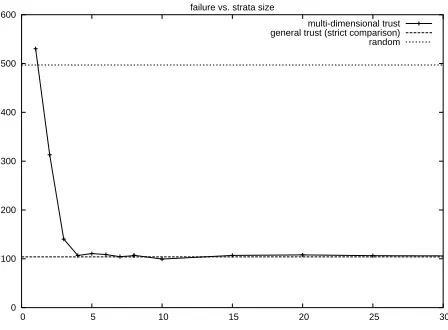
Figure 1 shows the failure rate of delegated tasks for varying strata sizes obtained in a “mixed” environment, i.e. there is a mix of reliable and unreliable agents3. The failure
rates for the general trust and random delegation approaches are also shown, however for clarity the cost and quality delegation methods are omitted from the graph, since
3It should be noted that the effect of the number of strata is broadly the same regardless of the mix of
0 100 200 300 400 500 600
0 5 10 15 20 25 30
failure vs. strata size
[image:11.595.195.419.129.294.2]multi-dimensional trust general trust (strict comparison) random
Figure 1: Failure rate for MDT versus strata.
20000 25000 30000 35000 40000 45000 50000 55000 60000 65000 70000
0 20 40 60 80 100
execution cost vs. strata size
multi-dimensional trust general trust (strict comparison) cost quality random
Figure 2: Execution cost for MDT versus strata.
they give very high failure rates (3902 and 1313 respectively). An equal weighting is given to factor weightings (with a slight emphasis on success), as follows.
µc µq µts µtc µtt µtq
0.16 0.16 0.2 0.16 0.16 0.16
It can be seen that general trust gives the lowest failure rate, followed by MDT provided that at least 2 strata are used, and finally the random delegation method (with cost-based and quality-based being even worse). Increasing the number of strata re-duces the failure rate, and for above around 10 strata, MDT gives the same failure rate as general trust.
[image:11.595.197.419.327.491.2]0 1 2 3 4 5
0 20 40 60 80 100
execution quality vs. strata size
[image:12.595.192.420.128.295.2]multi-dimensional trust general trust (strict comparison) cost quality random
Figure 3: Execution quality for MDT versus strata.
represent the cost only for successfully executed tasks, and so low cost does not neces-sarily correspond to the best approach (due to potentially high failure rates). It can be see that the cost-based approach gives the lowest execution cost, followed by quality-based, random, and general trust respectively. Quality-based is close to cost-based simply because in our environment, low cost tended to correlate with high advertised quality. The execution cost for the MDT approach fluctuates for less than 25 strata, and then stabilises as being the highest cost approach. For less than 25 strata it performs in the region of the general trust and random methods. If execution cost is the sole preference of the selecting agent, then a cost-based approach is best, but as discussed above this results in a very high failure rate (3902 in this example).
One significant disadvantage of using general trust (with strict numerical compar-ison) for task delegation is that a very narrow set of agents is interacted with (due to small numerical differences being treated as significant). In the experiments illustrated in Figures 1 and 2, the general trust approach typically led to a single agent being in-teracted with, according to the task requirements. The MDT approach led to a wider set of agents being delegated to, where reduced strata gave wider sets (a single strata leads to all capable agents being cooperated with equally). For this reason, in addition to the difficulty of tailoring delegation to the agent’s current preferences (e.g. quality, cost or success) we do not consider a general trust approach further.
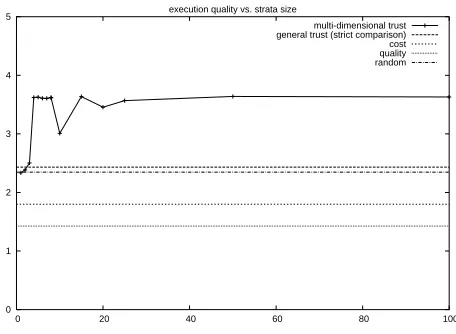
Figure 3 shows the execution quality (again for successfully executed tasks) for the MDT approach, along with alternative approaches for control purposes. Contrary to what might be expected, the quality-based approach actually performs the worst. This is because it is based on advertised quality rather than actual quality, and in our environment unreliable agents tended to advertise that they were high quality, but then perform poorly at execution time. The MDT approach (for more than 3 strata) gave the highest execution quality, and for above around 20 strata consistently gave 30% higher quality.
on the failure rate, execution cost and quality of execution, in different environments. We have performed experiments with several different weighting sets in a reliable, mixed, and unreliable environment. For the purposes of these experiments, reliable, mixed, and unreliable environments are defined by the proportion of honest (in terms of advertised cost and quality) and trustworthy (in terms of adhering to advertised in-formation and successfully returning a timely result) agents. Our experiments are based on the following three configurations.
Highly reliable Reliable Mar
ginal
Unreliable Highly unreliable Very
highly
unreliable
reliable 60% 20% 10% 4% 3% 3% mixed 20% 20% 20% 20% 10% 10% unreliable 5% 10% 30% 20% 20% 15%
Due to space constraints we omit the details of the exact definitions of these cat-egories, but suffice to say that “highly reliable” etc. have their obvious meanings in terms of agent honesty and reliability (e.g. highly reliable corresponds to a failure rate of below 3%). A range of factor weightings were investigated, including the following.
µc µq µts µtc µtt µtq
Equal 0.16 0.16 0.2 0.16 0.16 0.16 Quality 0.0 0.5 0.0 0.0 0.0 0.5 Cost 0.5 0.0 0.0 0.5 0.0 0.0 Success 0.0 0.0 1.0 0.0 0.0 0.0 Success 0.03 0.3 0.31 0.03 0.03 0.3 and Quality
Success 0.3 0.03 0.31 0.3 0.03 0.3 and Cost
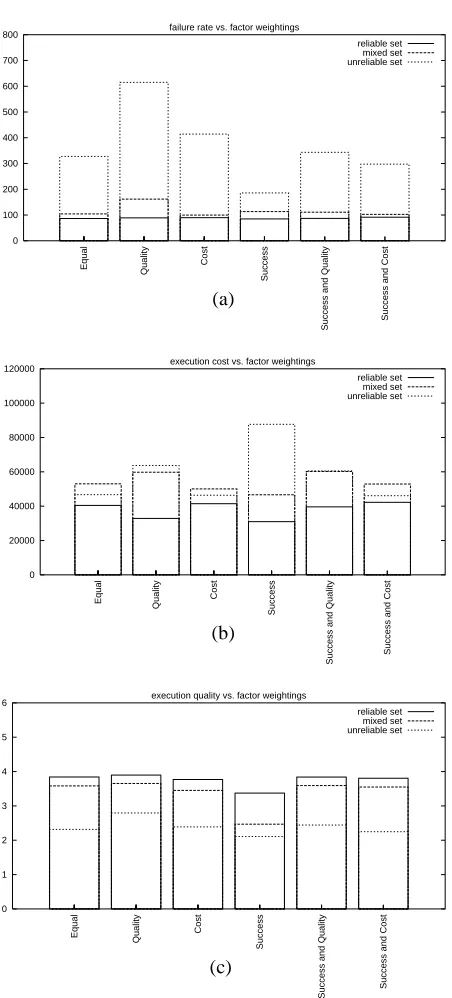
The effect of the factor weightings is shown in Figure 4, for the three environmental contexts introduced above. The upper graph (a) shows the failure rate, the middle graph (b) gives the execution cost, and the execution quality is shown in the lower graph (c). The weighting sets are indicated along the x-axis. It can be seen that the best results are obtained in a reliable environment, while agents in an unreliable context fare the worst. Furthermore, the effect of the factor weightings is reduced in in reliable contexts. As the context becomes less reliable, the influence of the weightings increases. In an unreliable context, the Success weighting gives the least failure rate, whilst the Quality and Cost weightings give the highest. The highest execution quality is given by the
Quality weighting, and the Success weighting performs noticeably worse. Similarly,
for unreliable contexts the Cost weightings give the least cost. However, in a reliable context, the Quality and Success weightings actually give a lower execution cost.
0 100 200 300 400 500 600 700 800
Equal
Quality
Cost
Success
Success and Quality
Success and Cost
failure rate vs. factor weightings
reliable set mixed set unreliable set
(a)
0 20000 40000 60000 80000 100000 120000
Equal Quality Cost
Success
Success and Quality
Success and Cost
execution cost vs. factor weightings
reliable set mixed set unreliable set
(b)
0 1 2 3 4 5 6
Equal
Quality
Cost
Success
Success and Quality
Success and Cost
execution quality vs. factor weightings
reliable set mixed set unreliable set
[image:14.595.194.420.119.618.2](c)
7
Conclusions
In this paper we proposed the notion of multi-dimensional trust, and demonstrated its use for task delegation. MDT provides a mechanism for agents to model the various facets of trust, and combine these with other factors when selecting a cooperative part-ner. Factor weightings enable agents to combine decision factors according to their current preferences. We have illustrated MDT using the trust dimensions of success, cost, quality and timeliness, although many others are possible. The validity and effec-tiveness of the MDT approach has been demonstrated in a Grid environment.
Ongoing work is concerned with investigating further approaches to combining trust factors, in particular the use of fuzzy logic and alternative multi-criteria decision making methods (e.g. those discussed in [16]). Future work also includes the incorpo-ration of recommendation-based trust, and the development of a semantics for trust to allow sharing of trust information.
References
[1] A. Abdul-Rahman and S. Hailes. Supporting trust in virtual communities. In Proc.
of the Hawaii Int. Conf. on System Sciences 33, 2000.
[2] F. Azzedin and M. Maheswaran. Integrating trust into Grid resource management systems. In Proc. of the Int. Conf. on Parallel Processing, pages 47–54, 2002.
[3] P. W. Bridgeman. Dimensional Analysis. Yale University Press, 1922.
[4] R. Buyya and M. Murshed. GridSim: A toolkit for the modelling and simula-tion of distributed resource management and scheduling for Grid computing. J. of
Concurrency and Computation: Practice and Experience, 14(13–15):1–32, 2002.
[5] C. Castelfranchi. Trust mediation in knowledge management and sharing. In C. Jensen, S. Poslad, and T. Dimitrakos, editors, Proc. of the 2nd Int. Conf. on
Trust Management, pages 304–318, 2004.
[6] C. Castelfranchi and R. Falcone. Principles of trust for MAS: Cognitive anatomy, social importance, and quantification. In Proc. of the 3rd Int. Conf. on Multi-Agent
Systems, pages 72–79, 1998.
[7] J. R. D. Dyson, N. Griffiths, H. N. Lim Choi Jeung, S. A. Jarvis, and G. R. Nudd. Trusting agents for Grid computing. In Proc. of the IEEE SMC Int. Conf. on Systems,
Man and Cybernetics, pages 3187–3192, 2004.
[8] D. Gambetta. Can we trust trust? In D. Gambetta, editor, Trust: Making and
Breaking Cooperative Relations, pages 213–237. Basil Blackwell, 1988.
[9] N. Griffiths and M. Luck. Coalition formation through motivation and trust. In
Proc. of the 2nd Int. Conf. on Autonomous Agents and Multi-agent Systems, pages
[10] T. D. Huynh, N. R. Jennings, and S. Shadbolt. Developing an integrated trust and reputation model for open multi-agent systems. In Proc. of the 7th Int. Workshop on
Trust in Agent Societies, pages 65–74, 2004.
[11] S. Marsh. Formalising Trust as a Computational Concept. PhD thesis, University of Stirling, 1994.
[12] S. Marsh. Optimism and pessimism in trust. In Proc. of the Ibero-American Conf.
on Artificial Intelligence, 1994.
[13] S. Marsh. Trust in distributed artificial intelligence. In C. Castelfranchi and E. Werner, editors, Artificial Social Systems, pages 94–112. Springer-Verlag, 1994.
[14] S. D. Ramchurn, C. Sierra, L. Godo, and N. R. Jennings. A computational trust model for multi-agent interactions based on confidence and reputation. In Proc.
of the 6th Int. Workshop of Deception, Fraud and Trust in Agent Societies, pages
69–75, 2003.
[15] J. Sabater and C. Sierra. REGRET: A reputation model for gregarious societies. In Proc. of the 1st Int. Joint Conf. on Autonomous Agents in Multi-Agent Systems, pages 475–482, 2002.
[16] E. Triantaphyllou. Multi-Criteria Decision Making Methods: A Comparative
Study. Kluwer Academic Publishers, 2000.
[17] B. Yu and S. M. P. An evidential model of reputation management. In Proc. of the
1st Int. Joint Conf. on Autonomous Agents in Multi-Agent Systems, pages 295–300,