http://wrap.warwick.ac.uk/
Original citation:
Hammond, Michael, 1956-, Reynolds, Lawrence J. and Ingram, Jennifer. (2011) How and why do student teachers use ICT? Journal of Computer Assisted Learning, Vol.27 (No.3). pp. 191-203.
Permanent WRAP url:
http://wrap.warwick.ac.uk/36446
Copyright and reuse:
The Warwick Research Archive Portal (WRAP) makes this work of researchers of the University of Warwick available open access under the following conditions. Copyright © and all moral rights to the version of the paper presented here belong to the individual author(s) and/or other copyright owners. To the extent reasonable and practicable the material made available in WRAP has been checked for eligibility before being made available.
Copies of full items can be used for personal research or study, educational, or not-for-profit purposes without prior permission or charge. Provided that the authors, title and full bibliographic details are credited, a hyperlink and/or URL is given for the original metadata page and the content is not changed in any way.
Publisher statement:
This is the accepted version of the following article: Hammond, Michael, 1956-,
Reynolds, Lawrence J. and Ingram, Jennifer. (2011) How and why do student teachers use ICT? Journal of Computer Assisted Learning, Vol.27 (No.3). pp. 191-203. which has been published in final form at http://dx.doi.org/10.1111/j.1365-2729.2010.00389.x
A note on versions:
The version presented here may differ from the published version or, version of record, if you wish to cite this item you are advised to consult the publisher’s version. Please see the ‘permanent WRAP url’ above for details on accessing the published version and note that access may require a subscription.
1
How and why do student teachers use ICT?
Hammond, M., Reynolds, L. and Ingram, J. (2011) How and why do student teachers
use ICT?, Journal of Computer Assisted Learning, 27, 3, 191 – 203.
Abstract
This paper examines how and why student teachers made use of ICT during a one
year initial teacher education (ITE) programme from 2008 to 2009. This is a mixed
methods study involving a survey (n = 340) of the entire cohort of student teachers
and a series of semi-structured interviews with a sample of the cohort (n= 21). The
study explored several themes including the nature of student teachers’ use of ICT;
variation in the use of ICT; support for, and constraints on, using ICT; and attitudes to
ICT and to teaching and learning more generally. It was found that nearly all teachers
made frequent use of ICT during their placements (internship) experience and that use
was dominated by the Interactive Whiteboard (IWB). More extended users of ICT
gave greater opportunity for pupil use of ICT while innovative users were defined by
the frequency with which they used ICT, the range of that use and the effort they
made in overcoming factors which discouraged use. ICT use was seen as emerging
from a mix of factors: chiefly student teachers’ access to ICT; their feeling of ‘self-efficacy’ when using ICT; and their belief in the impact of ICT on learning.
Mediating factors on ICT use included mentoring, training and support. Variations
within the use of ICT are discussed and explored in the light of the wider literature.
Keywords
2
Background
This paper reports on the nature of student (pre-service) teachers' use of ICT and their
reasons for using or not using it in their teaching. This topic is important as ICT
might offer benefits such as supporting personalised pathways; monitoring progress;
providing for ‘anytime anywhere’ learning; enabling independent and collaborative
learning; and developing new modes of learning (eg Davies, Hayward and Lukman,
2006; Underwood et al 2009). However, while there is great deal of teacher support
for using ICT in the classroom (in England see NFER 2008) the use of ICT appears
challenging for some, perhaps many teachers requiring a combination of access,
individual competence and general motivation (Becta, 2008).
Student teachers can be expected to encounter personal and environmental challenges
in developing their use of ICT and factors which encourage or discourage that use
(Barton and Haydn 2006; Kay, 2006; Hammond et al, 2009). At the individual level,
student beliefs and pedagogic orientation are important and there is a suggestion that
those with constructivist beliefs about teaching and learning may be more likely to
use classroom computers (Sang et al, 2010). In contrast, resistance to using ICT might
be explained by the absence of a belief in its having a positive impact on learning or a
belief that the use of ICT might even impact negatively (Russell et al, 2003; van
Brack, 2001) irrespective of students’ own use of technology. Other areas of
importance include the student teacher’s sense of self-efficacy or ‘confidence to perform specific tasks’ with respect to teaching in general (eg Smith, 2005) and skills
that are specific to ICT (Albion, 1999).
At a whole school level, access to ICT continues to be an important factor (Hammond
et al 2009; Selwood and Pilkington, 2005) alongside the technical support which
makes access realisable (Dexter and Rieldel, 2003). The wider culture of a department
or school, combined with the enthusiasm that existing members of staff display with
respect to using ICT in the classroom, will be a further influence (Almas and Nilsen,
2006; Barton and Haydn, 2006; Summers and Easdown, 1996). The role of a mentor,
or supervising teacher, in school is an important mediating factor (Dexter and Riedel,
2003). The mentor can act as a positive role model (Barton and Hadyn, 2006), though
3
(Mutton et al, 2006). The mentor is, of course, also an assessor and this is likely to
affect the focus on, or away from, ICT.
Student teachers’ engagement with ICT is worthy of further critical investigation as
there is an opportunity, noticed by Clift et al (2001), for new teachers to act as agents
of change when they start their teaching careers. In the case of ICT, younger student
teachers will have grown up with extended experience of using new technologies in
their daily lives (Simpson et al. 1999). However, the pedagogical application of ICT is
new for these teachers and the expectation of leading curriculum change might be
misplaced, or over optimistic. Whatever the case not enough is known about student
teachers during their training: What kind of use do they make of ICT? They are
assumed to view the use of ICT positively, is this true? Is use consistent across sectors
and subjects? Is using ICT a matter of access, belief or support? What constrains their
use of ICT?
Context
This research took place in a higher education institution (HEI) in England which
offers, in partnership with over 300 local schools, a one year programme of initial
teacher training to students studying to teach early years (children aged 3-7); primary
(aged 5-11) and seven secondary curriculum subjects (drama, economics and business
studies (EBS), English, history, information and communication technology (ICT),
mathematics, modern foreign languages (MFL), religious education (RE) and science)
within the 11-18 age range. The cohort being studied undertook training from
September 2008 to July 2009. This intake was broadly representative of the national
profile in age and its imbalance of females to males in the early years and primary
sectors and in certain secondary subject cohorts. The training provided by the
partnership has been assessed by Ofsted (the government inspection service in
England) as offering very good provision for its students. Within the HEI university
tutors have responsibility for planning the programme and modelling practice.
However, two thirds of the programme is undertaken in schools under the direction of
supervising teachers (hereafter subject mentors). Each school has a school mentor
with overall responsibility for all student teachers. As regards ICT, apart from a
general introduction to facilities, most ICT is modelled within taught secondary
4
primary and early years programmes. Subject mentors, alongside their teacher
colleagues, support students’ use of ICT in school and, in addition, most school
mentors will organise some generic training.
Methodology
This study set out to explore: the nature and scope of student teachers’ use of ICT; the
factors which lead them to use ICT; and the constraints on that use. In order to get a
broad picture, a survey of the entire cohort of students was undertaken, while to
explore their experiences in more depth a subset within the cohort were interviewed.
The survey covered nine themes: biographic details; access to ICT in school; support
for using ICT; constraints on using ICT; use of ICT; attitudes to ICT; attitudes to
professional development; general beliefs about teaching and learning. There were
opportunities for open comment but otherwise the survey mostly contained closed
questions, for example Likert and frequency of use scales. Where appropriate,
questions over the frequency of use were comparable to those within an NFER survey
of in-service teachers (NFER 2008) and the section on pedagogy used, with
permission, an inventory developed by Snider and Roehl (2007). The survey
contained questions about age, gender, age phase / subject taught. Responses were
entered into SPSS software and results aggregated and analysed using descriptive
statistics. Internal reliability was explored with Cronbach's alpha calculated at above
.75 for all sections of the questionnaire except one (that covering professional
learning) which is not discussed in the paper. Pearson’s chi square tests of association
were carried out and where significant are reported (see Appendix 1).
This survey was carried out at the end of the training programme after students had
completed an extended placement. Questionnaires were distributed after a debrief
session (primary and early years) and at the close of final tutorials (secondary). In this
sense participants were a ‘captive sample’ though it was made clear that there was no
obligation to complete all or any part of the survey. This was a long questionnaire
with over 150 items and it took most students over 15 minutes to complete. No empty
forms were returned but some questions were left blank due to what was almost
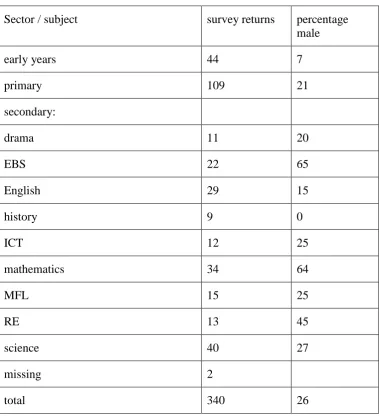
certainly a lack of time. There were 340 survey returns out of a possible 367 course
completers, these are broken down by subject and sector in Table 1. Missing from the
5
sickness, job interviews, or time in school to ‘make up’ due to earlier absence during
the placement. The mean age of those completing the survey was 26.2 years -
secondary subjects 26.2; early years 26.3 and primary 26.1 years. The overall median
age 24.0 and the mode was 22. The standard deviation was 6.17 years.
Insert Table 1 about here
The survey was followed by interviews with a sample of volunteer students (n = 21).
Due to a clash of commitments, the sample did not contain student teachers taking the
early years programme but it did contain primary teachers who had experiences of
teaching early years pupils and who had a commitment to teaching this age group.
This was not by design a strict quota sample but a range of experiences, and different
levels of commitment to ICT, were sought. The sub group contained nine primary
teachers, of whom two were male, and 14 secondary teachers (six male) and included
three EBS, mathematics and science teachers, two English, drama and MFL teachers
and one history teacher. Interviews were semi structured and lasted from 20 to 45
minutes, notes and transcriptions were coded and collated around themes of ease and
difficulty in using ICT; what helped / limited use of ICT; plans for using ICT in the
new school; associations made with ICT and pedagogy.
Data collection took place after students had completed all their assessment
requirements and members of the research team did not give questionnaires to, or
interview, the student teachers they had taught. All questionnaires were anonymised.
Findings (1) Student teachers and their use of ICT
Student teachers across all three sectors used ICT frequently with that use dominated
by the IWB. Nearly all routinely used the IWB to present prepared presentations and
as a shared space for notes and diagrams (‘boardwork’) during whole class teaching.
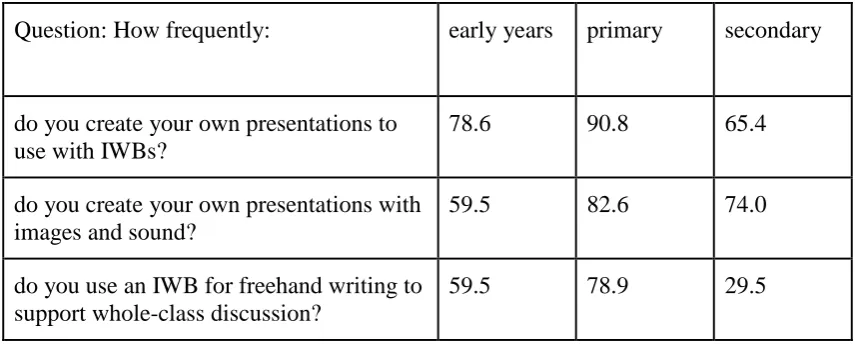
A key difference between sectors was that secondary students tended to carry out less
boardwork as shown in Table 2 - note in these and other tables data have been
aggregated for concise reporting. No other ICT tool was used as frequently as the
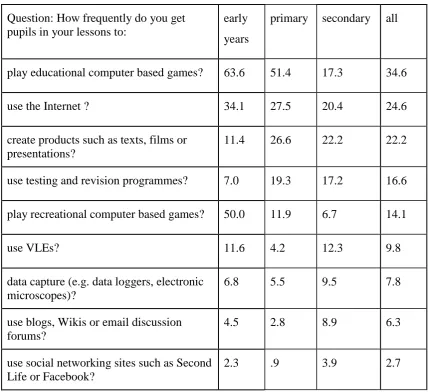
IWB. Primary and early years student teachers did use computer games in half or
more of lessons (Table 3) though it is not clear whether these games were played at
the IWB. Secondary teachers were much less likely to use computer games but much
6
Insert Tables 2, 3 and 4 about here
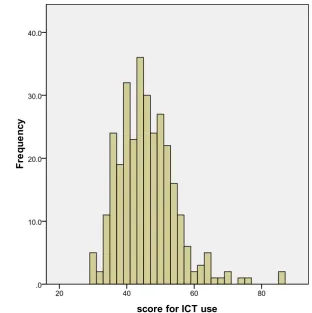
In order to explore variations in the frequency with which students reported using
ICT, a scoring system was introduced based on those (305) who had completed
responses to all 14 questions in which this was covered. For example, the use of the
IWB in most lessons scored 5; more than half of lessons 4; around half of lessons 3;
less than half 2; rarely or never scored 1. The full range of scores (14 - 70) were
recorded with a mean of 45.5, a median of 45 and mode of 44 and a standard
deviation of 8.6. Figure 1 shows that the scores approximated a normal distribution
with a long tail of high users and a short tail of low users. Of particular interest were
these ‘tails’ – the highest and lowest ten per cent. ICT student teachers were, not
surprisingly, the most likely to use ICT (nine appeared within the thirty most frequent
users) followed a long way back by four EBS student teachers. At the other end of
the scale mathematics, drama and RE, with seven, two and two students respectively,
were in proportion to size of intake more likely to be low users of ICT. Primary (with
four students) and early years (six) were over represented within the highest ten
percent of users and under-represented (three and four students respectively) within
the lowest. The data on frequency of use was then broken into lowest and highest
quartiles and used to band low users, mid range users and high users among the
cohort. This enabled tests of association to be made (Appendix A) and there was
found to be a significant association between secondary subject and frequency of ICT
(p< .001).
Insert Figure 1 about here
The raw data showed frequency of ICT use, the interviews explored types of use in
more depth. Some student teachers (ten using a best fit) explained they tended to
restrict their use of ICT to IWBs, or other projection devices. An important
opportunity offered by the IWB was to project prepared presentations – ones which
7
giving pupils opportunities for using software, including the IWB, for themselves but
only in a few lessons. Meanwhile others (seven as a best fit) gave examples of more
varied use of the IWB, for example to project interactive quizzes they had
downloaded, and were more ready to carry out ‘boardwork’. They sought
opportunities for pupils to use software for themselves, not only the IWB but general
purpose programmes, such as spreadsheets, Paint and Draw packages and word
processing software, as well as subject specific software such as dynamic geometry in
mathematics and data logging in science. Finally, there were six further examples of
students who had introduced activities which were unusual in the departments or
schools in which they worked. For example one secondary teacher had set up forums
within the school learning platform and had pupils create and share podcasts; another
had experimented with Wikis; and a history teacher had pupils create voiceovers to
clips of old newsreels. In a primary school a student teacher used design software to
help pupils to mock up toy vehicles they would like to see made and later set up a web
site for pupils to follow his progress in a charity international car ‘rally’. Another had
pupils act out and record role plays using Digiblu cameras – easy to use cameras with
very restricted storage - which this student teacher had bought herself.
Findings (2) Factors which affect the use of ICT
The factors which affect the use of ICT are reported in respect to personal factors;
access factors and other environmental factors.
Personal factors
Overwhelmingly student teachers believed the use of ICT was beneficial to teaching
and learning and this view was shared across subjects and sectors. Table 5 shows that
only three per cent disagreed with the idea that ICT made learning more effective and
only five per cent disagreed that pupils enjoyed lessons more when ICT was used.
The areas of most uncertainty regarding the use of ICT were the time taken to find
digital resources and its differentiated impact (items 8, 10 and 11 within Table 5).
Attitudes were broadly consistent across age, gender and sector though for reasons of
space these are not broken down in the table. It was found, not surprisingly, that those
with more positive attitudes to ICT tended to report more frequent use of ICT (p<
.001).
8
Insert Table 5 about here
In alignment with these positive attitudes student teachers had a high degree of
confidence in their ability to use ICT ‘effectively’ (Table 6). Again not surprisingly,
those who felt least self efficacy in respect to ICT were amongst the least frequent
users of ICT - 24 out of 27 reporting that they felt not very, or not all, effective in
using ICT were within the lowest use quartile regarding ICT use. There was a
significant association (p< .001) between self efficacy and frequency of use (see
Appendix A).
Insert Table 6 about here
Positive attitudes to ICT were confirmed within the interviews in which there was
repeated insistence that using ICT helped engage learners; could be used to support
clearer explanations; and allowed more innovative ways of working. Above all pupils
were seen as ‘liking’ ICT.
Wider associations made with ICT were then explored within the question ‘if all you
knew about teacher was that they used ICT, what could you say about the kind of
teacher he or she was?’ All, naturally, felt they needed more information and three
could not offer a response at all, but associations were made between ICT and
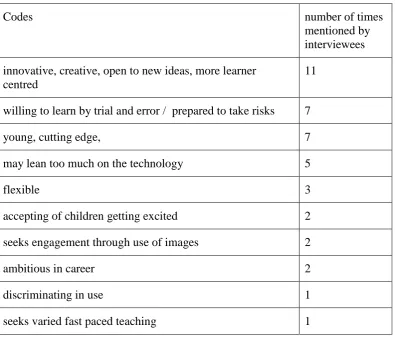
‘youthfulness’, innovation and willingness to take risks. The only less positive
associations were with using ICT for ‘its own sake’ or in an undiscriminating manner
(Table 7).
Insert Table 7 about here
In contrast, a further question was asked about teachers who did not use ICT. The
most frequent associations (12) made with these teachers were ‘being old fashioned’, ‘stuck in their ways’, ‘near retirement’ and ‘resistant to change’. Students did not
intend to be condemning about teachers who did not use ICT, the point was more that
9
The generational dimension re-emerged when students talked about their past use of
ICT. All interviewees made some mention of using ICT for learning within their
degree courses and in their training for teaching; nearly all used ICT for recreational
and social networking. As one put it ‘we have grown up with ICT and expect to use it’
(female primary) and another suggested that ‘we are the ICT generation’ (history
female secondary). These and similar comments were offered as an observation of
how things happened to be, they expected to use ICT day-to-day. None of the group
could be easily described as technophiles or ‘geeks’ though two did have particularly
advanced technical skills; one was, not surprisingly, the ICT teacher (male) while the
other (male primary) had developed these skills through recreational and vocational
activity.
Individual teaching style and view of subject
An attempt was made to explore student teachers’ views about pedagogy and its
impact on use of ICT. Of interest was the widespread agreement on the importance of
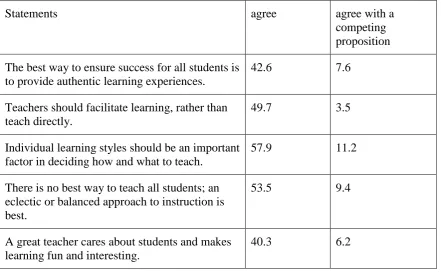
seeking to engage learners by responding to pupils’ ‘learning styles’; providing tasks which were meaningful for learners and ‘making learning fun’. There was, too, a
strong belief in eclectic modes of instruction (Table 8). Note students were asked to
choose between competing propositions, not simply agree or disagree with the
proposition. For example, 42 percent expressed a preference for authentic learning
against 7 per cent whose preference was for teaching skills and concepts systemically
and directly with the majority ‘balanced’ between these two propositions.
Insert Table 8 about here
Interviews reinforced this pragmatic and eclectic view of teaching. All recognised the
importance of ‘getting pupils on side’ and ‘having them wanting to learn’. Very few
associated the use of ICT per se with a particular stance on pedagogy though there
was some discussion over the nature of subject boundaries and the constraints of the
curriculum. For example infrequent users of ICT seemed to be held back by the
context in which they were working rather than pedagogical belief per se or a narrow
view of their subject. Two student teachers of mathematics explained they had
intended to use ICT more and had wanted to be more learner centred in their teaching
10
worries about both the behaviour of the class and the consequences of straying from
syllabus and textbook content. Student teachers of ICT as a subject, in contrast, did
not experience the same constraint, as one put it ‘obviously we use ICT, we are ICT
teachers’. EBS teachers also saw the use of ICT as inherent in teaching the subject
and gave as an example the use of spreadsheets for teaching financial modelling –
‘how else was I expected to do it?’. In addition teachers of both these subjects taught
vocational courses in which there was much less formal pen and paper exam
preparation and greater expectation on the submission of ICT products for assessment.
Primary teachers, too, taught ICT as a subject at times in their schools and had
attended several specialist sessions on the use of ICT, more than most secondary
teachers. However while all secondary teachers had a strong sense of subject, primary
teachers did not. They felt strongly that their focus was ‘on the child’ not the subject.
In contrasting the different sectors, one (female) student teacher explained she needed
to ‘work harder at engaging children than secondary subject teachers’ and felt she
would be more likely to use ICT than secondary colleagues because of this.
Access
Overall trainees tended to have good access to IWBs (Table 9) but less access to other
tools (Table 10). No other item of ICT was provided on such a scale as the IWB
though many teachers had access to one or more voice recorders, laptop or tablet
computers in their classroom. Nearly all schools were seen as having secure networks,
many had access to learning platforms or VLEs though this was more consistent in the
secondary sector (Table 10). There was a significant association between access and
level of use of ICT (p < .01).
Insert Tables 9 and 10 here
In interviews students said they were often surprised by the availability of resources
as this was on a larger scale than they recalled from their past schooling. One (female
primary) had a language specialism which enabled her to teach abroad for a period of
time during the year and she further noted ‘there was nothing there on the scale of
what we have here’. However the interviews also showed that the numerical data
concerning access needed to be treated with caution. Some students spoke about
11
grouping the children or daylight shone on the screen making any text difficult to
read. In one case the light bulb on a projector had gone and there ‘seemed no-one in charge to get it replaced’ (male primary). Most had access to computer rooms but spoke about difficulties of booking ahead or finding the move ‘disruptive’ to the
routines they had developed. Similar difficulties concerned the use of learning
platforms, for example in some cases it took several meetings, and some time passing,
before student teachers could secure user names. Two (one primary and one
secondary English) were denied access rights to the school VLE outright ‘due to the
Data Protection Act’.
Other environmental factors
In general, students considered the attitudes to the use of ICT among in-service
teachers to be more positive than negative though, as Table 11 suggests, not
overwhelmingly so. Nonetheless they were able to call on a wide range of support in
using ICT in school. This is shown in Table 12 though note that the data refers to
direct support for using ICT in the classroom and not the modelling of ICT in which
the impact of university tutors was reported as more influential. The table suggests
that informal support, from other teachers and peers, was particularly helpful. Also
noticeable was that the university tutor appeared to play a direct role in supporting
students in some schools, particularly in the early years sector where there appeared to
be more limited technical support and where attitudes to the use of ICT amongst staff
were less positive (Table 11). The picture is then a mixed one indicating an
environment in which ICT use was supported but not routinely so. There was a
significant association between level of support and use of ICT (p< .01).
Insert Table 11 and 12 about here
Interviews showed how support could influence use of ICT. Students felt that they
needed to be encouraged and some were looking for ‘permission’ to use ICT, in the
sense of conforming to expectations. They needed an external ‘push’ in addition to the
internal ‘pull’ – but this ‘push’ was sometimes missing. For example they spoke of
seeing models of ICT use at university but several (this was mentioned specifically by
12
activities in school. They could cite useful sources of support in school but the
expectations on them to use ICT was more, as one secondary teacher put it, ‘do as I say not as I do’. Another student explained that she had been told to ‘use ICT in your
lesson it will impress your visiting tutor’ (female primary) and while this provided an
encouragement, and a permission to use ICT, it did not provide the coaching or
modelling that she felt she needed. Seven students were asked the question as to
whether their use of ICT was as a result of their efforts or the environment in which
they were trained. Not surprisingly both factors were seen as important but three
stressed that they were proactive in their use of ICT and only one saw environment as
the more important.
Constraints on using ICT
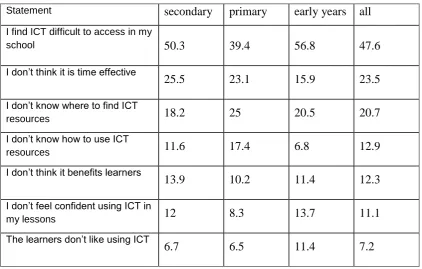
While there were sufficient conditions for nearly all student teachers to develop their
practice using ICT there were important constraints as Table 13 shows. The chief
problem was that of restricted access – this was significantly associated with
frequency of use (p< .001). Access concerns were followed, at a distance, by lack of
time, lack of knowledge of resources, lack of belief in the impact of ICT and low
sense of self-efficacy.
Insert table 13 about here
Discussion
The first question asked in this paper concerns the nature of student teachers’ use of
ICT. As seen, nearly all used the IWB and most gave pupils opportunities for using
ICT for themselves, though in some cases these opportunities were restricted. This is
broadly in line with survey findings for in-service teachers (eg Becta, 2008; NFER,
2008). However, student teachers in this survey appeared more likely than in-service
teachers to use ICT and, in particular, to use more recently introduced tools such as
learning platforms. Students were less likely than their in-service colleagues to view
other teachers as positive about the use of ICT because, it is argued, they had higher
13
Student teachers’ use of ICT was differentiated and three levels of that use can be
abstracted from the data. At a routine level use was dominated by the IWB with
limited opportunities for pupils’ ‘hands-on’ ICT. At an extended level greater
opportunities for ‘hands-on’ use of ICT were offered. At a further level – that of
innovative use - ICT was opened up opportunities not normally offered to pupils.
Introducing these three levels of use is helpful for understanding variation within this
and other cohorts of student teachers and for highlighting that even at a routine level
student teachers are regular users of ICT. The levels can further help in setting out
expectations of progression for student teachers though it should be made clear that
no necessary progression is implied. Student teachers may well continue to work
within one level unless something happens such as a change in access, a move to a
different school as they start their teaching career, or a powerful modelling of a tool
by a mentor. While these types of use relate to nature and frequency with which ICT
is used they should also recognise effort expanded. For example the use of an IWB is
routine in nearly all schools in England but the use of learning platforms is not
(Ofsted, 2009; BESA, 2009). Hence the student teacher using blogs, Wikis and indeed
podcasts, as well as the student providing online learning resources for out of school
access, would be working at an innovative level in many schools.
Notwithstanding their value, the levels do not properly consider a second dimension -
that of the quality of use. For example a student teacher may be working at a routine
level but be a particularly skilful and discerning user of an IWB. Here judgments
about ICT use are inextricably bound up with judgments about teaching and learning.
Such judgements will be contested and context bound with previous work (eg Mishra
and Koehler, 2006; Fisher, Higgins and Loveless, 2006) helpful in developing a more
rounded evaluation.
The second question posed in this study concerned the factors that result in student
teachers using ICT. The answer appears to be a mix of access; confidence in using
ICT; and a belief that ICT will impact on learning. This has been described as mix of
first order (environmental) and second order (individual beliefs and intentions) factors
(Becta 2003). Findings in this study support much of the literature cited earlier and
back up a study of a previous cohort at the same institution (author). The constraints
14
access; uncertainty as to impact; lower sense of self-efficacy. Findings are consistent
within both sets of data though the interview data provide a more detailed picture. For
example access was a key issue in use of ICT but when talking about their
experiences student teachers saw access as more than having the machines physically
present: access required procedures (such as routines for booking machines, for
checking equipment and replacing defective parts) and expectations (eg
encouragement from other teachers).
The interviews further help in exploring cause and effect when the student teacher is
deciding to use ICT. There is, for example, clearly an association between belief in
the value of ICT and the frequency with which ICT is used but they are strongly
interrelated. Student teachers explained they would quickly reconsider their beliefs
about the value of ICT if faced with adverse reactions on the part of pupils.
Further factors in the use of ICT are raised in the study. Support was important for all
student teachers though some could describe overcoming limitations in support in a
way that they could not overcome difficulties of access (except in the extreme case of
buying one’s own equipment). In this sense support appears more as an intervening or
mediating factor than a causal condition for the use of ICT. There was, too, a subject
dimension in that ICT and EBS teachers were more likely to use ICT. It is easy to
dismiss the experience of ICT teachers as special case, but the message here is
startlingly simple: if a goal of an educational system is to have teachers use computers
in the classroom then these teachers must be provided with access and work to a pupil
assessment process that assumes the use of ICT. There was, further, a sector
dimension in this study in that early years and primary students were more likely to
use ICT than secondary. More work needs carrying out here but a tentative
explanation is that teachers in the former sectors were less focused on printed texts,
felt more responsibility for developing ICT skills and were more receptive to using
ICT within game-like contexts.
A further line of investigation concerns an association between use of ICT and a
commitment to social constructivist pedagogy as suggested in the context of
in-service teachers (e.g. Ertmer, 2005; Gobbo and Girardi, 2001; Van Driel, Bulte and
Verloop, 2007) and discussed by Sang et al (2010) in respect to student teachers. The
15
teachers as committed to an exclusive or explicit social constructivist pedagogy,
rather they had a pragmatic and eclectic approach to teaching. The key tenet of social
constructivist pedagogy (a belief in authentic learning) was not found to be
significantly associated with the use of ICT (p>.05). Instead student teachers,
including innovative ones, seemed driven by strategic, though not superficial,
concerns in which the overriding aim was to engage pupils at affective and
behavioural levels. Nonetheless, pedagogical associations made about the use of ICT
do require further exploration. In particular the examples of innovative use given in
interviews typically involved a measure of handing over of an element of control to
pupils and opportunities for pupils to learn from each other. It may well be that these
examples carried more significance for pedagogical innovation than the student
teachers realised. This would not be surprising - this is a study of teachers at the start
of their careers who will undergo further professional development before their use of
ICT becomes discerning (Deaney, 2007).
Other factors to be considered in the use of ICT include age and gender. Age was a
consideration in that many student teachers had themselves grown up with extended
experiences of using ICT. It appeared that these experiences had given them a strong
sense of identity as an ICT user and left them with a ‘habitus’ (Greenfell, 1996) or
disposition to use ICT. However, age should be explored cautiously; older students
were not less likely to use ICT than younger ones (p>.05) and the challenge of
transferring knowledge of ICT into new contexts should not be underestimated.
Finally, gender might be expected to be a factor in student use of ICT (though see the
nuanced reporting of Markauskaite, 2006), but this was not apparent within either the
16
Appendix A: Associations with ICT use (Pearson’s chi square testing)
For reasons of space the full list of items tested against frequency of ICT use are not
reported, only ones for which there are significant associations or those otherwise
mentioned in the text.
item variable value df asymp. Sig (2
sided)
1 secondary subject grouped by
discipline (a)
20.787 4 .000
2 sector (early years; primary;
secondary)
34.181 4 .000
3 attitude to ICT (b) 48.483 2 .000
4 sense of efficacy (c) 26.217 2 .000
5 teacher access to ICT (d) 11.397 2 .003
6 support (e) 10.519 2 .005
7 access difficulty (f) 11.620 2 .003
8 age (g) 1.450 2 .484
9 gender 0.651 2 .722
10 authentic learning (h) 4.541 2 . 103
Notes
(a) Secondary subjects were grouped as business and technology (ICT and EBS);
language and communication (drama, English, history, MFL, RE); science (maths and
17
(b) Attitude to ICT: scores were calculated based on responses to seven items
covering beliefs that ICT allowed learning to be more relevant; more personalised,
more effective and more enjoyable. More / less positive groups of students were
categorised.
(c) Responses to the question ‘How effective do you feel you are using ICT to support
learning and teaching in the classroom?’ were conflated to group higher / lower self
efficacy students.
(d) Access: scores were calculated based on responses to seven items concerning
teacher access to cameras, video cameras, laptops, iPods, IWBs, PDAs, IWB and
laptops. Students with higher / lower access were grouped.
(e) Support: scores were calculated based on responses to eight items concerning level
of support from technicians, teaching support staff, mentors, tutors, resources, peers,
pupils and resources. More / less supported students were grouped.
(f) Responses to the question ‘I find ICT difficult to access in my school’ were used to
group higher / lower access students.
(g) Students were grouped as younger (aged 20 – 24) and older (25+).
(h) Responses to the question ‘The best way to ensure success for all students is to
18
References
Albion, P. (1999) in (eds) J. Price, J. Willis, D. Willis, M. Jost and S. Boger-Mehall,
Self-efficacy beliefs as an indicator of teachers' preparedness for teaching with
technology. Proceedings of Society for Information Technology and Teacher
Education international conference 1999Association for the Advancement of
Computing in Education pp. 1602-1608. Chesapeake, VA.
Almas, A. and Nilsen, A. (2006) in (eds) A. Mendez-Vilas, A. Solano Mart n, J.
Mesa Gonzalez, and J. Mesa Gonzalez, ICT competencies for the next
generation of teachers. Current Developments In Technology-Assisted
Education — Retrieved February 1, 2009, from
http://www.formatex.org/micte2006/book1.htm
Barton, R. & T. Haydn (2006) Trainee teachers’ views on what helps them to use
information and communication technology effectively in their subject teaching.
Journal of Computer Assisted Learning, 22, 257 - 282.
Becta (2003) What the Research Says About Barriers to the Use of ICT in Teaching.
Coventry: Becta.
Becta (2008) Harnessing Technology Review 2008: The role of technology and its
impact on education. Coventry: Becta.
Besa (2009) School Learning Platform Review, London: British Educational Suppliers
Association.
Clift, R. T., Mullen, L., Levin, J. and Larson, A. (2001) Technologies in contexts:
implications for teacher education. Teaching and Teacher Education. 17, 33-50.
Davies, C., Hayward, G. and Lukman, L. (2006) 14-19 and Digital technologies: A
review of research and projects. Bristol: Futurelab.
Deaney, R. & S. Hennessy (2007) Sustainability, evolution and dissemination of
information and communication technology-supported classroom practice.
Research Papers in Education. 22, 65–94.
Dexter, S. and Riedel, E (2003) Why improving pre-service teacher educational
technology preparation must go beyond the college walls. Journal of Teacher
19
Ertmer, P. (2005) Teacher pedagogical beliefs: The final frontier in our quest for
technology integration? Educational Technology Research and Development.
53, 25 - 39.
Fisher, T., Higgins, C and Loveless, A. (2006). Teachers as Learners with Digital
Technologies. Bristol: Futurelab.
Gobbo, C. and Girardi, M. (2001) Teachers' beliefs and integration of information and
communications technology in Italian schools. Technology, Pedagogy and
Education. 10, 63 - 85.
Grenfell, M. (1996) Bourdieu and Initial Teacher Education: A post-structuralist
approach. British Educational Research Journal. 22, 3, 287-303.
Hammond, M., Crosson, S., Fragkouli, E., Ingram, J., Wilder, P.,
Johnston-Wilder, S., Kingston, Y., Pope, M. and Wray, D. (2009). ‘Why do some student
teachers make very good use of ICT? An exploratory case study’. Technology,
Pedagogy and Education, 18, 59–73.
Kay, R. (2006) Evaluating strategies used to incorporate technology into preservice
education: A review of literature. Journal of Reasearch on Technology in
Education. 38, 4, 383-408.
Markauskaite, L. (2006) Gender issues in pre-service teachers' training: ICT literacy
in an Australian context. Australasian Journal of Educational Technology. 22,
1, 1-20.
Mishra, P. and M. Koehler (2006). Technological pedagogical content knowledge: A
framework for teacher knowledge. Teachers College Record. 108, 1017–1054.
Mutton, T., Mills, G. and McNicholl, J. (2006) Mentor skills in a new context:
working with trainee teachers to develop use the use of information and
communications technology in their subject teaching. Technology, Pedagogy
and Education. 15, 3, 337-352.
NFER (2008) Harnessing Technology: Schools Survey. Coventry: Becta.
Ofsted (2009) Virtual Learning Environments: an evaluation of their development in a
sample of educational settings. London: Ofsted.
Russell, M., Bebell, D., O'Dwyer, L. and O'Connor, K. (2003) Examining teacher
technology use. Implications for preservice and inservice teacher preparation,
20
Sang, G., Valcke, M., Braak, J.v., Tondeur, J. (2010) Student teachers' thinking
processes and ICT integration: Predictors of prospective teaching behaviors
with educational technology. Computers & Education. 54, 1, 103-112.
Selwood, I. and Pilkington, R. (2005) Teacher workload: Using ICT to release time to
teach. Educational Review. 57, 2, 163-174.
Simpson, M., Payne, F., Munro, R. and Hughes, S. (1999) Using Information and
Communications Technology as a pedagogical tool: who educates the
educators? Journal of Education for Teaching: International Research and
Pedagogy. 25, 247-262.
Snider, V. and Roehl, R. Teachers' beliefs about pedagogy and related issues.
Psychology in the School. 44, 873 - 886.
Summers, M. and Easdown, G. (1996) Information technology in initial teacher
training. Journal of Information Technology for Teacher Education. 5, 1,
155-172.
Underwood, J., Baguley, T., Banyard, P., Dillon, G., Farrington-Flint, L., Hayes, M.,
Hick, P., Le Geyt, G., Murphy, J., Selwood, I. and Wright, M. (2009)
Personalising Learning.Coventry: Becta.
Van Brack, J. (2001) Individual characteristics influencing teachers' class use of
computers. Journal of Educational Computing Research. 25, 2, 141-157.
Van Driel, J., Bulte, A. and Verloop, N. (2007) The relationships between teachers'
general beliefs about teaching and learning and their domain specific curricular
21
Sector / subject survey returns percentage male
early years 44 7
primary 109 21
secondary:
drama 11 20
EBS 22 65
English 29 15
history 9 0
ICT 12 25
mathematics 34 64
MFL 15 25
RE 13 45
science 40 27
missing 2
[image:22.595.86.466.87.504.2]total 340 26
22
Question: How frequently: early years primary secondary
do you create your own presentations to use with IWBs?
78.6 90.8 65.4
do you create your own presentations with images and sound?
59.5 82.6 74.0
do you use an IWB for freehand writing to support whole-class discussion?
[image:23.595.83.511.71.243.2]59.5 78.9 29.5
Table 2: Percentage of student teachers who used the IWB for different purposes in
23
Question: How frequently do you get pupils in your lessons to:
early
years
primary secondary all
play educational computer based games? 63.6 51.4 17.3 34.6
use the Internet ? 34.1 27.5 20.4 24.6
create products such as texts, films or presentations?
11.4 26.6 22.2 22.2
use testing and revision programmes? 7.0 19.3 17.2 16.6
play recreational computer based games? 50.0 11.9 6.7 14.1
use VLEs? 11.6 4.2 12.3 9.8
data capture (e.g. data loggers, electronic microscopes)?
6.8 5.5 9.5 7.8
use blogs, Wikis or email discussion forums?
4.5 2.8 8.9 6.3
use social networking sites such as Second Life or Facebook?
[image:24.595.83.513.68.460.2]2.3 .9 3.9 2.7
Table 3: Percentage of student teachers who used ICT for selected pupil activities in
half or more of lessons.
Question: How frequently: early years
primary secondary all
do you set homework which includes ICT?
9.5 20.4 36.7 27.8
do you create online resources for students to access?
28.6 24.8 23.6 24.6
Table 4: Percentage of student teachers who used online resources for students in half
[image:24.595.86.513.561.685.2]24
Statements strongly
agree
agree neither agree nor disagree
disagree strongly disagree
1 ICT makes learning more effective.
22 52 22 3 0
2
ICT is particularly useful in helping me to support the diverse learning needs of pupils.
19 53 24 5 0
3
Pupils enjoy lessons more when they use ICT than when they don’t.
21 45 27 5 2
4 ICT helps me to use a wider range of assessment tasks.
10 45 33 11 1
5 ICT helps attainment. 7 47 38 6 1
6 Using ICT in my teaching saves me time.
13 36 27 21 2
7 ICT resources can help in giving individualised feedback to pupils.
6 42 39 12 1
8 It is difficult to find the time to try out new digital learning resources.
7 40 28 20 4
9 ICT helps me to personalise the learning of each pupil.
5 39 43 12 1
10 ICT is not relevant for every subject.
10 28 24 30 7
11
It is easier to find relevant teaching materials in textbooks than on the internet.
[image:25.595.86.561.96.633.2]8 17 28 39 9
25
How effective do you feel you are using ICT to support learning and teaching in the classroom?
not at all effective
not very effective
quite effective
very effective
early years 0 2.5 78 19.5
primary 0 3.9 73.8 22.3
secondary 0.6 14.5 62.9 22
[image:26.595.83.535.71.249.2]all 0.3 9.2 68.6 21.8
Table 6: Student teachers reporting of self-efficacy in respect to the use of ICT,
reported as percentages.
Codes number of times
mentioned by interviewees
innovative, creative, open to new ideas, more learner centred
11
willing to learn by trial and error / prepared to take risks 7
young, cutting edge, 7
may lean too much on the technology 5
flexible 3
accepting of children getting excited 2
seeks engagement through use of images 2
ambitious in career 2
discriminating in use 1
[image:26.595.87.483.325.663.2]seeks varied fast paced teaching 1
Table 7: Frequency with which different associations were made with ‘the teacher
who uses ICT’. Total frequencies > 21 as more than one association was made by
26
Statements agree agree with a
competing proposition
The best way to ensure success for all students is to provide authentic learning experiences.
42.6 7.6
Teachers should facilitate learning, rather than teach directly.
49.7 3.5
Individual learning styles should be an important factor in deciding how and what to teach.
57.9 11.2
There is no best way to teach all students; an eclectic or balanced approach to instruction is best.
53.5 9.4
A great teacher cares about students and makes learning fun and interesting.
[image:27.595.85.527.72.344.2]40.3 6.2
Table 8: Percentage of student teachers expressing alignment with selected
propositions about teaching.
Question early years primary secondary all
In the teaching room or rooms you used most of the time was there a IWB or other display device?
[image:27.595.85.516.415.511.2]83.0 99.1 95.5 89.9
Table 9: Percentage of student teachers who had access to IWBs.
Question: in your recent placement schools was there
early years primary secondary all
secure access for ICT work?
90.9 98.2 92.9 94.3
access to school resources from home?
43.2 45.3 73.9 60.6
access to a VLE or learning platform?
28.6 40.6 68.2 54.3
Table 10: Percentage of student teachers who had access to storage, out of school
[image:27.595.86.514.543.665.2]27
Question early
years
primary secondary all
how many teachers are positive about the use of ICT in your school / department?
[image:28.595.88.512.72.139.2]38.6 54.1 51.9 50.9
Table 11 Percentage of student teachers who felt other teachers were positive or very
positive about the use of ICT.
Table 12: Percentage of student teachers finding a lot or a fair amount of help from
different sources.
Question: to what extent have you received help from the following when using ICT in school?
early years primary secondary all
other teachers 34.1 46.3 50.0 46.7
student teacher colleagues 47.7 37.1 46.4 43.6
university tutor 61.4 41.3 31.5 38.6
ICT technician 18.2 27.5 36.6 31.3
[image:28.595.86.496.246.371.2]28
Statement secondary primary early years all
I find ICT difficult to access in my
school 50.3 39.4 56.8 47.6
I don’t think it is time effective
25.5 23.1 15.9 23.5
I don’t know where to find ICT
resources 18.2 25 20.5 20.7
I don’t know how to use ICT
resources 11.6 17.4 6.8 12.9
I don’t think it benefits learners
13.9 10.2 11.4 12.3
I don’t feel confident using ICT in
my lessons 12 8.3 13.7 11.1
The learners don’t like using ICT
[image:29.595.84.507.89.358.2]6.7 6.5 11.4 7.2
Table 13: Percentage of students agreeing with selected statements about the use of
29