IT architectures in e-commerce: The effects of
modularity, integration and type of components
on e-service quality.
Author: Philipp Kögler
University of Twente P.O. Box 217, 7500AE EnschedeThe Netherlands
Several studies have examined the processes prevalent in offline retail firms and subsequently presented numerous reference models. Still only a few models consider the special case of electronic commerce where the supporting role of information systems has largely been neglected. The purpose of this paper is to provide a comprehensive overview of e-commerce processes with their underlying IT architectures and its impact on the service quality of web-shops. Data from surveys and a company visit were used to determine which business functions are directly performed in today’s e-commerce firms and how they are supported through various architectural components. Results indicate that e-commerce retailers selling exclusively online tend to perform fewer business functions than multi-channel retailers, supported through more standardized architectures which are often hosted on third party infrastructures. A reliable relationship between IT architectures and service quality measures could not be established in this paper but is recommended for further research.
Supervisor:
1. Prof. Dr. Jos Van Hillegersberg
Keywords
e-commerce, information systems, service quality, architecture, integration, cloud computing
Permission to make digital or hard copies of all or part of this work for personal use is granted without fee provided that copies are not made or distributed for profit or commercial advantage and that copies bear this notice and the full citation on the first page. To copy otherwise, or republish, to post on servers or to redistribute to lists, requires prior specific permission by the author and/or a fee.
5th IBA Bachelor Thesis Conference, July 2nd, 2015, Enschede, The Netherlands.
1.
INTRODUCTION
The World Wide Web has fundamentally changed the way businesses interact with customers to deliver their products and services. Traditionally potential customers searched for a physical shop, hoping to find the desired item and then making the purchase, representing simply a dyadic relationship between buyer and seller (Burt & Sparks, 2003) and requiring significant customer efforts, such as travelling to stores and searching for products. With the rise of the Internet, however, the marginal costs of information, communication and distribution began to decrease (FECTF, 2000) thereby strengthening the bargaining power of buyers and making electronic commerce (e-commerce) a preferred way of shopping for customers by means of increased product variety and convenience (Rohm & Swaminathan, 2004). Buyers are nowadays able to access a greater variety of products via online channels with little effort, enabling them to compare products and prices across different shops within minutes. This shift in power towards buyers has forced e-commerce firms to deal with increased price competition while handling higher customer service demands, increased product return rates and decreasing customer loyalty. Contrasting the classic retail view in which customers take their purchased items home, today’s online retailers are required to perform all delivery functions by themselves, creating roles for e.g. last-mile deliveries and return management. Today’s e-commerce customers are expecting state-of-the art order fulfillment, with rapid and reliable delivery. Rao, Griffis and Goldsby (2011) showed that failing to live up to order fulfillment promises by electronic retailers (e-tailers) can be detrimental to online sales, with out-of-stocks strongly correlating negatively with a consumer’s loyalty to a webshop. Ultimately many e-tail businesses have failed in the past primarily because of an inability to provide cost-effective order fulfillment to their customers (Fernie & Sparks, 2004). In the beginning of e-commerce retail companies relied mainly on monolithic and vertically integrated systems (Mulesoft, 2013), which constituted closed environments due to a lack of appropriate message exchange standards for open communication. Although electronic data interchange (EDI) provides a standard syntax for communication between business partners, it is seen as being too rigid in the way that it required negotiation between partners, performing only in one-to-one relationships and having no built-in interfaces (Chu, Leung, Van Hui, & Cheung, 2007). Also, setting up these systems requires substantial up-front investments in IT infrastructure, which made it unsuitable for small companies to adopt (Iacovou, Benbasat, & Dexter, 1995). Additionally, with e-commerce evolving over the years, enterprise ‘agility’ (van Oosterhout,, Waarts, & van Hillegersberg, 2006) started out to become an increasingly important aspect for maintaining competitive advantage in collaborative business networks. The ability of firms to respond to unexpected changes in its environment, i.e. changing customer requirements, technology advancements and legal changes, posed new challenges to its information systems. In fact van Oosterhout, Waarts and van Hillegersberg (2006) note that legacy systems are perceived as the key hindrance for achieving enterprise agility in IT architectures.
Cloud computing and SOA are seen as being able to overcome these issues with relative ease. With cloud computing, firms are able to dynamically scale their business functions, reduce infrastructure and maintenance costs and achieve faster time-to-market (Marston, Bandyopadhyay, Zhang, & Ghalsasi, 2011). Previously closed legacy systems can be opened up through Service Oriented Architectures (SOA) (Chou & Lee, 2008) providing, together with cloud computing, the means to create
agile IT architectures. The implementation of flexible communication standards, e.g. XML, and middleware further enhance the interoperability of diverse systems.
A lot of research has been conducted within the enterprise architecture domain and also several reference models exist in the literature (see e.g. Becker & Schütte, 2007, Frank & Lange, 2006). However, most of the research has focused on offline retailers and their architectures therefore providing a research gap in this domain. Moreover, IT specific aspects have largely been neglected in current reference architectures for retailers. Therefore, this paper seeks to assess the current IT architecture landscape in e-commerce retail firms and the way processes are supported through various IT components. In addition e-commerce websites are rated based on the e-S-QUAL scale by Parasumaran (2005) to ascertain a possible impact of architectures on service quality. The research question can be formulated as:
“How are current IT architecture’s supporting e-commerce processes and to what extent do modularity, integration and type of components have an impact on e-service quality?” This paper contributes to existing research in two ways: First, it provides an overview of the current business functions in e-commerce firms based on a thorough literature review. As stated earlier existing reference models in general target processes in offline retailers whereas this paper distinguishes from earlier research as it exclusively focuses on e-commerce retail firms. Second, a survey instrument is presented which helps researchers to assess IT architectures in e-commerce firms and their support to the various business functions. Specifically, the survey addresses three sub- questions:
1. What software tools are currently used to support the different business functions?
2. How are the various systems integrated within the architecture? And
3. What are solutions used to build the architectures? The first sub-question aims at determining which business functions are directly handled by e-commerce firms and to what extent the different functions are supported through various software tools. The second sub-question addresses the integration tools used to achieve interoperability between different components of the architecture, e.g. legacy systems and cloud applications, and the third sub-question addresses the choice of software solutions made by firms to build and host their architectures.
In the following section a literature review is conducted to (i) define the unit of analysis, (ii) describe the key processes/functions in an e-commerce firm and (iii) elaborate on the technologies available to build the architecture. The remainder of this paper is structured as follows: Section 3 describes the methodology for gathering the data, section 4 discusses the survey findings, section 5 provides answers to the (sub-) research questions and section 6 concludes with limitations and recommendations for further research.
2.
LITERATURE REVIEW
2.1
Definitions
As can be derived from the previous section the focus of this paper lays on the assessment of current IT architectures in an e-commerce (retail) context. In the following, definitions for both e-commerce retailer and IT architecture are given to describe the units of analysis.
2.1.1
E-commerce retailer
‘brick-and-click’ retailers (Gulati & Garino, 1999), and ‘pure-play’ retailers.
In the beginning of e-commerce it were mainly traditional store-based retailers with existing distribution networks, who used the Internet as an additional channel for selling their products (Agatz, Fleischmann, & van Nunen, 2008). Through the adoption of online channels these companies tried to generate additional sales while utilizing existing processes and thus encountering only minor cost increases. Potential risks, however, arise from channel conflicts, which may lead to ‘cannibalization’, i.e. limited net effects on sales due to competing distribution channels (cf. Webb, 2002).
The second category of e-commerce retailers is the ‘pure-play’ retailers. These companies generally have no physical shop network and thus benefit from the absence of set-up and accumulated sunk costs generally incurred in traditional store-based retailing (Clark & Wrigley, 1997). Pure-play e-commerce retailers exclusively sell via online channels and are often novices to their domain, hence sourcing missing capabilities from third party providers. A combined definition for this research may read as follows:
‘An e-commerce retailer is a retail business partially or exclusively selling via online channels to end-consumers utilizing existing processes and/or using third-party service providers to deliver its products and services.’
2.1.2
IT architecture
For the purpose of this research a firm’s IT architecture can be defined as ‘the fundamental organization of a system embodied in its components, their relationships to each other, and to the environment, and the principle guiding its design and evolution’ (IEEE, 2000).
2.2
Processes and Functions
In the following a literature review on the primary business functions prevalent in e-commerce firms is presented. Based on the e-commerce process distinction by Liu and Hwang (2004), consecutively three pre-trade, three trade and four post-trade functions will be discussed as proposed in the e-commerce Reference Architecture (ERA) by Aulkemeier, Schramm, Iacob and van Hillegersberg (n.d., appendix 1).
2.2.1
Marketing/Branding
Becker (2007) refers to marketing in a retail process perspective as ‘operative marketing’ where subtasks include updating customer master data, assortment/product planning, sales and turnover planning, and article lists. In general the purpose of the Marketing/Branding function can be described as a customer-oriented product assortment planning thus integrating into the pre-trade process where it helps customers to find the products they require (Liu & Wang, 2003). Information systems can support this function through the collection of more individualized data, which allows for refined segmentation and more accurate targeting of activities (Burt & Sparks, 2003).
2.2.2
Pricing/Selling
According to the definition of Zeithaml (1988) the price is “what is given up or sacrificed to obtain a product”. Although the definition is not strictly of monetary nature and addresses both, the buyer’s and seller’s side, this paper adopts the view of Wen-he and Wen (2014) that prices are given (by sellers) and thus customers assess the price of a product based on the value that is received (i.e. quality and property) and the amount of funds that need to be paid in return. Different pricing strategies apply in an e-commerce context (e.g. dynamic pricing), which, however, will not be discussed in this review as they are beyond the scope of this paper. Along with pricing, the selling function
includes subtasks such as customer query processing, customer offer processing, order record creation, order processing and support for sales representatives (Becker, 2007).
2.2.3
Customer Service/Customer Relation
Transactions in online retailing are conducted with spatial and timely distance between buyer and seller (Zheng, Lui, & Li, 2009) necessitating other means of communication than personal interaction in case of customer inquiries or exceptions from the regular transaction procedure (Aulkemeier, Schramm, Iacob, van Hillegersberg, n.d.). Duffy and Dale (2002) identified call centers as a key support feature in Ecommerce when integrated seamlessly into existing systems. Customers approach the call center agent who accesses the e-commerce firm’s database and helps resolve the conflict. Apart from traditional means of communication (telephone, fax, and postal mail) which need to be available at a website, also online communication channels (e-mail, chat rooms) are required for delivering customer service (Santos, 2003). Furthermore, the recent development of social media paved the way for social customer relationship management (sCRM), which helps firms to get closer to their customers and thereby bears the potential to increase revenues, reduce costs and promote efficiency (Heller Baird & Parasnis, 2011).
2.2.4
Supplier
Development/Procurement/Purchasing
Procurement in general can be distinguished into direct and indirect purchases, where direct purchases comprise the goods that will be sold to the customer and indirect purchases involve goods and services for internal use (Subramaniam & Shaw, 2002). From the e-commerce retail perspective examples for direct goods may be fashion, electronics, groceries, and books whereas indirect goods could be software licenses, computers, and office supplies. While many firms used to spend 50%-60% of their revenue on the purchase of goods and services, leveraging the Internet for procurement can create substantial cost benefits (Lucking-Reiley & Spulber, 2001). According to Burt and Sparks (2003) an internet-based supply chain may also enable firms to share best practices acquired with one supplier across the whole business network resulting in enhanced planning, faster and more reliable communication as well as more accurate forecasting and timely replenishment of supplies.
2.2.5
Accounts Payables/Payment
The main task of the accounts payable function is the payment of open invoices from suppliers. For payment firms may use automated processing tools, where invoices are directly passed on to the back office for payment, or manual reviews take place beforehand, during which a particular invoice is assigned to a cost entry position (Becker, 2007). Duffy and Dale (2002) note that the financial control process, which includes both the accounts payable and accounts receivable function, is ideally supported through one system to monitor incoming and outgoing cash flows.
2.2.6
Accounts Receivables/Collection
trusted e-commerce businesses for their online purchases. In the study by Ramanathan (2010), the payment process, as part of the pre-purchase service rating, exhibits strong correlation with customer loyalty (r = 0.845) thus indicating the importance of payment services as a facilitating factor for creating customer loyalty. Furthermore, since buyers and sellers in e-commerce do not interact personally during a transaction, concerns may arise that (i) on the buyer’s side products are not delivered despite the payment has taken place and (ii) on the seller’s side customers default on their payment when goods have already been delivered. To resolve this dilemma, Jiang and Song (2010) propose a third party payment (TPP) platform, where an intermediary keeps the buyer’s payment in virtual accounts until a receive note has been signed. Prominent examples of this TPP platform are PayPal in the U.S. and Alipay in China (Jiang & Song, 2010).
On a country level the preferred payment methods vary significantly (Ecommer Europe, 2012) and online retailers are therefore ought to offer the full set of payment services to their customers. Today, most e-commerce firms have outsourced their payment operations to Payment Service Providers (PSPs) in an effort to eliminate the need for building payment gateways to banks and credit card companies by themselves.
2.2.7
Goods receipt
In Becker’s (2007) reference model for retail enterprises the goods receipt function handles incoming goods from suppliers where key tasks are arrival planning, goods acceptance and order record before stocking.
2.2.8
Warehousing/Stockholding
The central issue related to warehousing in online retailing is product assortment. Inventories of physical stores usually carry significantly fewer products than those of online stores where the product assortment can be up to ten times larger (Metters & Walton, 2007). As a consequence the pick and pack operations during order fulfillment are more complex for e-commerce firms. Furthermore, providing reliable information to customers on the web-shop’s stock levels is difficult due to the vast number of different items that need to be managed. In traditional retailing customers know right away whether a certain item is available, while in e-commerce stock-outs may not be displayed and only encountered until a customer’s credit card has been debited (Duffy and Dale, 2002). In the study by Rao, Griffis and Goldsby (2011) a direct link was found between the availability of products and the customer’s loyalty to a webshop, stressing the need for well-organized warehousing/stockholding functions in e-commerce firms.
2.2.9
Order fulfillment/Goods Issue/Distribution
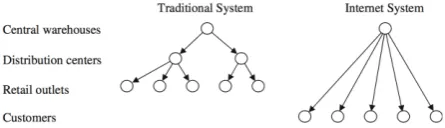
In e-commerce, order fulfillment is generally perceived as one of the most expensive and critical operations for sellers (Lummus & Vokurka, 2002). It is considered expensive since the logistics costs associated with “last mile” delivery are higher when compared to bulk deliveries in traditional retailing (Colla & Lapoule, 2012). A traditional retail system (Figure 1) builds on moving large quantities of product from central warehouses, to distribution centers and finally to retail outlets, whereas in e-commerce, typically small batches or even single products are delivered directly from a central warehouse to the customer’s doorstep – i.e. delivering the last-mile. Furthermore, the criticality of order fulfillment stems from the expectation of timely and complete delivery of ordered product that is crucial for customer loyalty and thus recurring business. Acquiring new customers in Ecommerce is 30-40% costlier than in offline channels (Reichheld & Schefter, 2000) and retailers are therefore dependent upon utilizing returning customers. Following the authors’ notion, Ramanathan (2010) showed that [image:4.595.314.537.113.177.2]efficiency (defined as on-time delivery, pre- and post purchase service ratings) is a significant moderator of logistics performance and customer loyalty.
Figure 1 Traditional versus Internet pure-play distribution strategies. Source: Metter and Walton (2007)
Also, a previous study by Kim, Jin and Swinney (2009) found that order fulfillment/reliability was the strongest predictor in creating e-satisfaction and e-trust and eventually e-loyalty, supporting the significance of order fulfillment in achieving e-commerce success.
2.2.10
Return Handling
In traditional retailing return rates lie in the range of 3%-5% with straightforward processes where customers return products in the same place they were initially bought (Metters & Walton, 2007). In e-commerce, however, return rates may be as high as 50% of sales requiring advanced logistics capabilities for return management (The Economist, 2013). According to Genchev, Glenn Richey and Gabler (2011) firms can create substantial value-added from well-structured revere logistics program, which will ultimately affect the bottom-line. From a customer perspective effective reverse logistics is measured as the time that is needed by the firm to credit the customer’s account after the product has been returned where delays can result in dissatisfaction and reduced probability of future transactions (Genchev, Glenn Richey & Gabler, 2011).
The return handling function may comprise tasks such as customer master data management, goods acceptance and restocking, as well as reimbursing customer accounts.
2.3
Technologies and Architecture
After having discussed the relevant business functions the following section provides a brief overview of the most important concepts that lie at the core of IT architectures in e-commerce firms. The selection is non-exhaustive and due to space constraints only represents concepts contained in the survey results.
2.3.1
Cloud computing
The concept of cloud computing is not new, but represents the next evolutionary step in distributed computing (Rimal, Jukan, Katsaros, & Goeleven, 2011) where firms move from large self-hosted systems to externally self-hosted ITC platforms and applications for delivering their business-critical operations (Research in Action, 2012). According to the study by Research in Action (2012) 78% of e-commerce firms already use cloud-services and investments in cloud technologies are the number one priority until 2017.
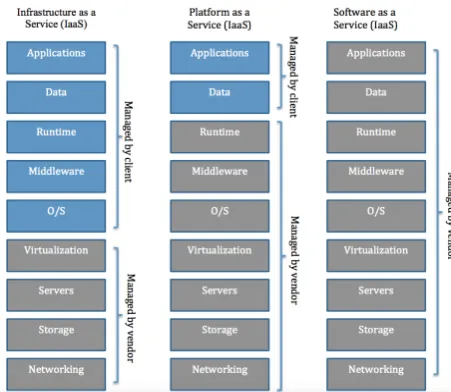
minimal management effort or service provider interaction”. Three delivery models are generally distinguished in cloud computing (Mell & Grance, 2011, Czernicki, 2011, figure 2):
(i) Software as a Service (SaaS), where the client does not manage the underlying infrastructure (e.g. network, operating systems, storage) or the applications in use (besides some limited user-specific configuration). In SaaS the cloud service is typically accessed through a client interface e.g. a web browser.
(ii) Platform as a Service (PaaS), where the client also does not manage the underlying infrastructure but runs a self-created or acquired application on the cloud system. And
[image:5.595.310.567.150.304.2](iii) Infrastructure as a Service (IaaS), where the client is provided with control over deployed applications, operating systems as well as middleware.
Figure 2 Cloud service models (Czernicki, 2011)
2.3.2
SOA and Web Services
Over the last decade IT systems have grown exponentially leaving companies with increasingly complex software architectures (Channabasavaiah, Holley, & Tuggle, 2003). Concepts based on EDIFACT to some extent allowed integration of heterogeneous systems but never became wide spread for a variety of reasons. The lack of standards and appropriate infrastructure such as middleware and networks required systems to be developed from scratch every time, resulting in high development costs, limited reusability and low adaptability to new technologies (Alonso, Casati, Kuno, & Machiraju, 2004).
The need for seamless integration among an endless variety of hardware, operating systems and middleware eventually led to the advent of service-oriented architectures (SOA) (Channabasavaiah, Holley, & Tuggle, 2003). SOA help reduce the complexities in IT systems by defining coarse grained services which can be easily aggregated and reused according to business needs (Alonso, Casati, Kuno, & Machiraju, 2004). Specifically, services are defined as self-contained modules, which provide standard functionality and are independent of the state or context of other services (Papazoglou & van den Heuvel, 2007).
MacKenzie et. al (2006) refer to SOA as a paradigm for organizing and utilizing distributed capabilities that may be
owned by different domains. Hence, by exposing internal operations as services through the Internet, i.e. Web Services, internal as well as external parties can access an organization’s information system (IS) using standard protocols (Alonso, Casati, Kuno, & Machiraju, 2004). Figure 3 illustrates a generic example for a service-oriented architecture of an e-commerce retailer based on web services:
Figure 3 Service-oriented architecture (own contribution, based on Federal Office for Information Security, n.d.) In this example a customer logs onto the retailer’s website to browse for a particular article. Once an item is chosen from the web-shop’s catalogue, the ‘check availability’ service is invoked which will query data on the current quantity in stock from the warehouse database. If the response is positive, the ‘issue quotation’ service provides the customer with a price, taking into account stock levels (leftover items may be discounted) and data from the customer database (as returning customers may be granted free shipping). If the price offer is accepted, the customer proceeds to the checkout where shipping and payment information (in this case credit card data) are entered. The ‘check order data’ service verifies the syntactical accuracy of the entered information and passes the credit card data on to an external service provider, where the ‘validate credit card data’ service is invoked. Upon approval of the transaction through the external service provider the ‘shipping’ service prompts the dispatch of the ordered items and the ‘master data service’ records the completed order in the customer database.
[image:5.595.63.289.266.462.2]thus running in an asynchronous fashion and allowing loose coupling of applications (Mulesoft, 2015).
In contrast, Extended Markup Language (XML) is a semi-structured language that uses tags to identify elements in documents with varying representations of data (Bernstein & Haas, 2008). It is perceived as offering a flexible standard for the exchange of information between trading partners via the Internet (Power, 2005) and comprises one of the core technologies for Web Services (Turban, Lee, King, McKay and Marshall, 2007). Electronic Data Interchange for Aministration, Commerce and Transportation (EDIFACT) on the other hand is a data standard that was mainly used by firms before XML to implement the concept of EDI (Nurmilaakso, 2008). Both, XML and EDI, may serve as a standard for inter-application communication thus eliminating the need for message transformation through a middleware component.
3.
METHODOLOGY
3.1
Conceptual Framework
This section seeks to describe the method of data collection, which was used to assess the IT architectures currently deployed in e-commerce firms. Building on the functions identified in the literature review a web survey instrument was constructed in Qualtrics and distributed via E-mail to gather data from e-commerce IT professionals on the various architectures. The main benefit of using a web survey method is the decreased costs for distribution, which, however, at the same time requires the target group to be familiar with Internet use (Kaplowitz, Hadlock & Levine, 2004). Since this paper exclusively focuses on online retailers, it is expected that the target group members had sufficient Internet experience to properly answer the survey questions at all times.
Research has shown that, among other factors, the length of a questionnaire has a significantly negative impact on the response rate of a survey (Heberlein and Baumgartner, 1978; Yammarino, Skinner, and Childers, 1991). According to Galesic and Bosniak (2009) this effect also holds for web surveys where additionally the quality of information tends to decrease towards the end of a questionnaire. Thus the focus during construction of this research survey was to (i) keep the completion time as short as possible and (ii) reduce the number of open questions towards the end of the questionnaire. The complete set of questions can be found in appendix 5.
The survey is structured into 3 blocks, which are going to be presented in the following.
3.1.1
Modularity
The set of questions in the first block seek to determine intra-organizational business functions and related support tools based on the findings in the literature review. Typically only multi-channel retailers perform all business functions in-house and therefore pure-players are likely to outsource costly operations such as order fulfillment or payment and collection to third party service providers.
Two questions are put forth to ask for functions that are directly performed by the firm and to determine the support of software systems to them. As a result a first picture of the architecture emerges by showing the degree of modularity inherent to the architecture and functional areas where software tools overlap.
3.1.2
Integration
The second block of questions focuses on the mechanisms for information integration and communication between applications at the e-commerce retailer. Various tools are available for integration (e.g. ESB, Integration Broker) and combined with the underlying technologies (e.g. Web Services,
EDI), type of communication (i.e. direct or via integration broker) and data standards (e.g. XML, EDIFACT) form the detailed architecture of an e-commerce retailer.
3.1.3
Type of components
The third block of questions seeks to determine how the architecture of a certain e-commerce retailer is built and hosted. In the literature review it was found that firms nowadays have the opportunity to run their operations on third party infrastructures, i.e. in the cloud, rather than building and maintaining their own systems. The decreased set-up and maintenance costs of cloud applications in combination with enhanced scalability make cloud technology equally attractive for large and small commerce retailers. Furthermore, young e-commerce retailers may rely to a greater extent on packaged software since solutions built from scratch, i.e. legacy systems, were mainly developed due to a lack of packaged software solutions in earlier days.
3.1.4
E-service quality
As stated in the introduction, this paper builds on the dimensions of the e-service quality scale by Parasuraman, Zeithaml and Malhotra (2005) to assess a potential impact of IT architectures on the service quality of webshops. This method was chosen as earlier approaches on measuring service quality (e.g. SERVQUAL by Parasuraman, Zeithaml and Berry, 1988) mainly focused on non-internet-based customer interaction, whereas the e-S-QUAL specifically acknowledges the customers experience in an online environment. In total 4 abstract dimensions are proposed by the authors, viz.:
1. Efficiency – the ease and speed of accessing and using the website.
2. Fulfillment – The extent to which the site’s promises about order delivery and item availability are fulfilled.
3. System availability – The correct technical functioning of the site.
4. Privacy – The degree to which the site is safe and protects customer information.
In order to gather data for the quality assessment without requiring prior shopping experience or a complete transaction at the retailer’s web-shop, several measures of dimension 2 and 4 were dropped. An overview of the entire range of measures proposed by Parasuraman, Zeithaml and Malhotra (2005) can be found in appendix 3. In line with the approach of the authors a 5-point Likert scale was used to rate the website’s services (1 strongly disagree – 5 strongly agree). Furthermore, instead of sampling a representative group of customers (as in Parasuraman, Zeithaml, & Malhotra, 2005) a single front-end survey was conducted by the author.
In Table 2 the different blocks are mapped onto the applicable e-S-QUAL dimensions, to detect if all survey blocks have been covered by the methodology.
integration mechanisms to correctly display information from multiple sources.
Table 1 e-S-QUAL dimensions per survey block (Parasuraman, Zeithaml, & Malhotra, 2005) Survey block
Dimension
Modularity Integration Type of components
Efficiency X X
System availability X X
Order fulfillment X X
Privacy X
The order fulfillment dimension is expected to be moderated by Modularity and Integration where the quality of service on the one hand is determined by the performance of underlying support tools and on the other hand by the seamless integration of these tools into the architecture. At last the privacy dimension is expected to be moderated by Modularity since certain business functions, if outsourced to third party providers, require exchange of sensitive customer data (e.g. for credit card validation in payment, see example in section 2.3.2).
4.
DISCUSSION
4.1
Survey responses
Data from in total three surveys and one company visit were used to gain insights on the processes and IT architectures currently deployed in e-commerce retail firms. From the sample three companies currently pursue a multi-channel strategy while one company sells exclusively online.
The following paragraph seeks to answer sub-question 1: What software systems are currently used to support the different business functions?
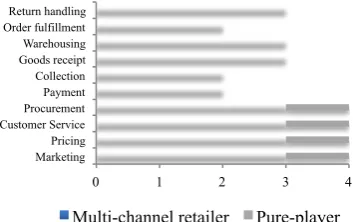
Starting with the processes it was found that the number of business functions performed by e-commerce retailers varies. Only two multi-channel retailers indicated that they handle the complete range of business functions in-house, whereas all companies (both multi-channel and pure-player) stated that they perform the pre-purchase process, i.e. Marketing, Pricing and Customer Service, and the procurement function in-house. From Figure 4 it can be seen that the pure-player did not handle any additional functions besides the ones performed by all e-commerce retailers.
Figure 4 Business functions handled by e-commerce retailers
Moreover, two firms directly handled the payment and collection function partially supporting the notion that e-commerce firms nowadays rely on third party payment providers to deliver their services. It is worth noting that two multi-channel retailers also directly handled the order fulfillment function while the third multi-channel retailer stated
during the company visit that plans to bring the order fulfillment function back in-house were to be realized in the near future. According to the designated IT architect the reasons for returning the order fulfillment function in-house are economies of scale (since multiple brands will be using the new group’s order fulfillment center) and enhanced monitoring of return flows.
In the survey six different support tools were mentioned to support the various business functions. Table 2 shows the number of observations per support tool.
Multiple distinct tools per function were admissible in this question and in total 34 observations have been recorded. From the data it can be seen that Enterprise Resource planning (ERP) tools provide the greatest functionality for e-commerce retailers in terms of supported functions. Furthermore, it was found that every member of the sample had an ERP system in place and used it to support at least two business functions. Two multi-channel retailers additionally used a financial management system (FMS) in combination with its ERP to handle the collection and payment functions. Only one company used a distinct warehouse management system (WMS) for warehousing/stockholding whereas the other two handled the same function using their ERP.
Table 2 Observations per support tool and underlying business functions
# Support tool Underlying business functions
18 ERP Marketing, Pricing, Customer Service,
Procurement, Payment, Collection, Goods receipt, Warehousing, Order fulfillment, Return handling
6 FMS Pricing, Procurement, Payment,
Collection, Goods receipt, Order fulfillment
3 WMS Goods receipt, Warehousing, Return
handling
4 CRM Marketing, Customer service
2 WEBTOOL Marketing, Customer Service
1 WEBSHOP Marketing
Continuing with the integration mechanisms, the following paragraph provides answers to sub-question 2: How are the various systems integrated within the architecture?
The technologies used for integration by the e-commerce retailers under study include ESB, Message Queue and FTP servers. Two Multi-channel retailers used Message Queue, one multi-channel retailer used an ESB and the pure player relied on FTP servers for integration. Three out of four respondents stated that they rely on Web Services to integrate the aforementioned support tools by either utilizing XML or REST. One company indicated that it is additionally using EDI, however, only for specific trade partners. Concerning external connection points of a system this firm was also the only one, which implemented an integration broker (using EDIFACT) rather than direct communication through the use of standards. The remaining three companies used direct communication to external systems implemented through electronic business XML (ebXML).
The last part of this section seeks to answer sub-question 3: What are solutions used to build the architectures?
When asked how the architecture was built, the majority (3 respondents) stated that it is using either a customized solution
0 1 2 3 4
Marketing Pricing Customer Service Procurement Payment Collection Goods receipt Warehousing Order fulfillment Return handling
[image:7.595.305.552.346.516.2] [image:7.595.59.236.555.666.2]built from components or a fully customized solution built from scratch. None of the respondents indicated that (commercial) packaged software was used and only the pure-player relied on a standard SaaS solution. While the adoption of cloud solutions appears to be low at first, the initial picture changes when looking at the way architectures are hosted. Three respondents indicated that they run at least one support tool in the cloud contrasting only one multi-channel retailer hosting the entire architecture on premise. Consistent with the findings from the previous question the most preferred delivery models for cloud applications are PaaS and IaaS rather than SaaS. Firms tend to prefer customized solutions over commercial ones such as SaaS or packaged software, which are often hosted on cloud infrastructures (Appendix 6).
4.2
E-service quality
Virtually all e-commerce retailers from the sample performed very well on the service quality assessment. Neither were the web-shops difficult to access/took excessively long to load nor did they crash during a simulated order scenario. It is evident that all components of the architecture worked reliably from a customer perspective. Despite the rather homogenous distribution of results, a difference that may be related to the business functions performed in-house was found in the order fulfillment dimension. The comparatively low service quality rating of the pure-player in the order fulfillment dimension derives from the above average delivery time that is stated at the web-shop. Every multi-channel retailer offered next-day delivery, while the pure-player indicated a delivery time between 3-4 working days. Possibly the pure-player has limited ability to improve the conditions of its order fulfillment since it is outsourced to a third party service provider.
The findings from the website service-quality assessment unfortunately provide no clear evidence on how well a certain architecture performs compared to another. The front-end survey approach taken in this paper for gathering data on website quality appears to produce results that only have weak explanatory power since the dimensions hardly relate to the architectural components. Although additional differences were discovered in load times which are potentially linked to the type of components, they are negligible considering Yen, Hu and Weng (2007) who found that customers are likely to abandon a website only after a maximum download time of 10 seconds.
5.
CONCLUSION
In this paper a survey instrument for researchers was presented to assess the IT architectures of e-commerce firms by looking at its modularity, integration and type of components. The main research question “How are current IT architecture’s supporting e-commerce processes and to what extent do modularity, integration and type of components have an impact on e-service quality?” was divided into three sub-questions addressed in the survey. Specifically, four conclusions can be drawn from the survey results.
First, multi-channel retailers and pure-player seem to differ in the number of business functions they perform. While multi-channel retailers often handle the complete range of business functions in-house, pure players tend to focus on the pre-purchase process and the procurement function. The reason may be that multi-channel retailers benefit from existing infrastructures and knowledge in the retail domain. Second, ERP systems were the core support tool for e-commerce processes since (i) every respondent indicated the use of such a tool and (ii) the ERP supported the widest range of business functions among all tools. Third, to achieve integration of the several components of the architecture most e-commerce retailers make use of middleware (such as ESB or Message
Queue) with Web Services either based on XML or REST as the preferred standard for communication. In the sample only one multi-channel retailer partially relied on EDI, supporting the notion that EDI is nowadays retreating from the e-commerce architecture landscape. Lastly, to varying degrees every e-commerce retailer in the sample adopted cloud technologies. Only one multi-channel retailer hosted the entire architecture on-premise while the remaining three used cloud infrastructures and/or applications.
The e-service quality assessment of the related websites was conducted to determine a possible impact of various architectural components on the e-service quality of websites. Based on the results no reliable relationship between a certain architectural composition and e-service quality could be established, however, areas of attention for service quality measurement in further research are pointed out in the following section.
6.
LIMITATIONS & FURTHER
RESEARCH
Several insights on the IT architectures of e-commerce retailers were presented in this paper; but researchers and practitioners are recommended to take the results with care. The sample size in this study was very low which qualifies the results to be treated at best as case study outcomes. Furthermore, differences in the architectures of e-commerce retailers may be attributable to varying product assortments, which should be researched separately in the future. Thus further research should focus on constructing a greater and more refined sample of e-commerce retailers to assess the various architectural components. It is also recommended to use telephone interviews for the architecture assessment rather than web-based surveys in order to avoid the possibility of dropout during the survey.
Regarding the e-service quality measurement it is evident that a single front-end survey approach at the retailer’s website yields insufficient results to draw reliable conclusions upon the impact of architectures on e-service quality. It is advised for future research that a survey is used which addresses customers who are experienced with shopping at a particular e-commerce retailer. This way all 22 measures of the E-S-QUAL can be considered and additionally the e-RecQUAL dimensions by Parasuraman, Zeithaml and Malhotra (2005) may contribute to the research of return handling with respect to IT architectures.
REFERENCES
Agatz, N. A., Fleischmann, M., & Van Nunen, J. A. (2008). E-fulfillment and multi-channel distribution–A review. European Journal of Operational Research, 187(2), 339-356.
Alonso, G., Casati, F., Kuno, H., & Machiraju, V. (2004). Web services (pp. 123-149). Springer Berlin Heidelberg.
Aulkemeier, F., Schramm, M., Iacob, M.-E., & van Hillegersberg, J. (n.d.). A service-oriented e-commerce reference architecture. Unpublished
Becker, J., & Schütte, R. (2007). A reference model for retail enterprises. Reference Modeling for Business Systems Analysis, 182-205.
Bernstein, P. A., & Haas, L. M. (2008). Information integration in the enterprise. Communications of the ACM, 51(9), 72-79. Czernicki, B. (2011). IaaS, PaaS and SaaS Terms Clearly
Explained and Defined. Retrieved from
Chandrasekar Subramaniam, M. J. S. (2002). A study of the value and impact of B2B e-commerce: the case of web-based procurement. International Journal of Electronic Commerce, 6(4), 19-40.
Channabasavaiah, K., Holley, K., & Tuggle, E. (2003). Migrating to a service-oriented architecture. IBM DeveloperWorks, 16.
Chu, S. C., Leung, L. C., Van Hui, Y., & Cheung, W. (2007). Evolution of e-commerce Web sites: A conceptual framework and a longitudinal study. Information & Management, 44(2), 154-164.
Clark, G. L., & Wrigley, N. (1997). Exit, the firm and sunk costs: reconceptualizing the corporate geography of disinvestment and plant closure. Progress in Human Geography, 21(3), 338-358.
Colla, E., & Lapoule, P. (2012). E-commerce: exploring the critical success factors. International Journal of Retail & Distribution Management, 40(11), 842-864.
Duffy, G., & Dale, B. G. (2002). E-commerce processes: a study of criticality. Industrial Management & Data Systems, 102(8), 432-441.
E-commerce Europe. (2012). Report Ecommerce Europe Online Payments 2012 (p. 13). Brussels.
Federal Office for Information Security (n.d.). SOA example scenarios. Retrieved from
https://www.bsi.bund.de/EN/Topics/OtherTopics/SOAsecurity/ Basics/Examplescenarios/examplescenarios_node.html Fernie, J., & Sparks, L. (Eds.). (2004). Logistics and retail management: insights into current practice and trends from leading experts. Kogan Page Publishers.
Force, E. C. T. (2000). Smoke on the Water. A Fire in the Sky. Electronic Commerce Foresight Panel, DTI, London.
Frank, U., & Lange, C. (2007). E-MEMO: a method to support the development of customized electronic commerce systems. Information Systems and E-Business Management, 5(2), 93-116.
Galesic, M., & Bosnjak, M. (2009). Effects of questionnaire length on participation and indicators of response quality in a web survey. Public Opinion Quarterly, 73(2), 349-360. González, L., & Ruggia, R. (2010, December). Towards dynamic adaptation within an ESB-based service infrastructure layer. In Proceedings of the 3rd International workshop on Monitoring, Adaptation and Beyond (pp. 40-47). ACM. Gulati, R., & Garino, J. (1999). Get the right mix of bricks & clicks. Harvard Business Review, 78(3), 107-14.
Heberlein, T. A., & Baumgartner, R. (1978). Factors affecting response rates to mailed questionnaires: A quantitative analysis of the published literature. American Sociological Review, 447-462.
Heller Baird, C., & Parasnis, G. (2011). From social media to social customer relationship management. Strategy & Leadership, 39(5), 30-37.
Iacovou, C. L., Benbasat, I., & Dexter, A. S. (1995). Electronic data interchange and small organizations: adoption and impact of technology. MIS quarterly, 465-485.
Jiang, C., & Song, W. (2010). An online third party payment framework in E-commerce. In 2010 2nd International Conference on Advanced Computer Control (Vol. 5, pp. 242-245).
Jula, A., Sundararajan, E., & Othman, Z. (2014). Cloud computing service composition: A systematic literature review. Expert Systems with Applications, 41(8), 3809-3824.
Kaplowitz, M. D., Hadlock, T. D., & Levine, R. (2004). A comparison of web and mail survey response rates. Public opinion quarterly, 68(1), 94-101.
Kim, J., Jin, B., & Swinney, J. L. (2009). The role of etail quality, e-satisfaction and e-trust in online loyalty development process. Journal of Retailing and Consumer Services, 16(4), 239-247.
Liu, D. R., & Hwang, T. F. (2004). An agent-based approach to flexible commerce in intermediary–centric electronic markets. Journal of Network and Computer Applications, 27(1), 33-48. Lummus, R. R., & Vokurka, R. J. (2002). Making the right e-fulfillment decision. Production and Inventory Management Journal, 43(1/2), 50-55.
Lucking-Reiley, D., & Spulber, D. F. (2001). Business-to-business electronic commerce. Journal of Economic Perspectives, 55-68.
Marston, S., Li, Z., Bandyopadhyay, S., Zhang, J., & Ghalsasi, A. (2011). Cloud computing—The business perspective. Decision Support Systems, 51(1), 176-189.
MacKenzie, C. M., Laskey, K., McCabe, F., Brown, P. F., Metz, R., & Hamilton, B. A. (2006). Reference model for service oriented architecture 1.0. OASIS Standard, 12.
Metters, R., & Walton, S. (2007). Strategic supply chain choices for multi-channel Internet retailers. Service Business, 1(4), 317-331.
Mell, P., & Grance, T. (2011). The NIST definition of cloud computing.
Mulesoft. (2013). Increasing E-commerce Agility(p. 3).
Mulesoft. Retrieved from:
http://www.mulesoft.com/lp/whitepaper/saas/ecommerce Mulesoft. (2015). Understanding Enterprise Application Integration - The Benefits of ESB for EAI. Retrieved from: https://www.mulesoft.com/resources/esb/enterprise-application-integration-eai-and-esb#broker-model
Nurmilaakso, J. M. (2008). EDI, XML and e-business frameworks: A survey. Computers in Industry, 59(4), 370-379. Papazoglou, M. P., & Van Den Heuvel, W. J. (2007). Service oriented architectures: approaches, technologies and research issues. The VLDB journal, 16(3), 389-415.
Pavlou, P. A. (2003). Consumer acceptance of electronic commerce: Integrating trust and risk with the technology acceptance model. International journal of electronic commerce, 7(3), 101-134.
Parasuraman, A., Zeithaml, V. A., & Malhotra, A. (2005). ES-QUAL a multiple-item scale for assessing electronic service quality. Journal of service research, 7(3), 213-233.
Parasuraman, A., Zeithaml, V. A., & Berry, L. L. (1988). Servqual. Journal of retailing, 64(1), 12-40.
Power, D. (2005). Supply chain management integration and implementation: a literature review. Supply chain management: an International journal, 10(4), 252-263.
purchase behavior. Journal of Operations Management, 29(7), 692-703.
Reichheld, F. F., & Schefter, P. (2000). E-loyalty. Harvard business review, 78(4), 105-113.
Research In Action. (2012). The Hidden Costs of Managing Applications in the Cloud (p. 2-4). Research In Action GmbH. Rimal, B. P., Jukan, A., Katsaros, D., & Goeleven, Y. (2011). Architectural requirements for cloud computing systems: an enterprise cloud approach. Journal of Grid Computing, 9(1), 3-26.
Rohm, A. J., & Swaminathan, V. (2004). A typology of online shoppers based on shopping motivations. Journal of business research, 57(7), 748-757.
Santos, J. (2003). E-service quality: a model of virtual service quality dimensions. Managing Service Quality: An International Journal, 13(3), 233-246.
The Economist (2013). Return to Santa – E-commerce firms have a hard core of costly, impossible-to-please customers. Retrieved May 24, 2015 from
http://www.economist.com/news/business/21591874-e- commerce-firms-have-hard-core-costly-impossible-please-customers-return-santa
Turban, E., Lee, J. K., King, D., McKay, J., & Marshall, P. (2007). Building e-commerce applications and infrastructure. In Electronic Commerce : A Managerial Perspective (1st ed., chapt. 18, p. 26). Prentice Hall.
Van Oosterhout, M., Waarts, E., & van Hillegersberg, J. (2006). Change factors requiring agility and implications for IT. European Journal of Information Systems, 15(2), 132-145. Webb, K. L. (2002). Managing channels of distribution in the age of electronic commerce. Industrial Marketing Management, 31(2), 95-102.
Wen-he, S., & Wen, H. (2014). A Dynamic Pricing Method for Goods in Competitive Ecommerce Market. International Journal of U-& E-Service, Science & Technology, 7(4). Xing, Y., Grant, D. B., McKinnon, A. C., & Fernie, J. (2010). Physical distribution service quality in online retailing. International Journal of Physical Distribution & Logistics Management, 40(5), 415-432.
Yammarino, F. J., Skinner, S. J., & Childers, T. L. (1991). Understanding mail survey response behavior a meta-analysis. Public Opinion Quarterly, 55(4), 613-639.
Yen, B., Hu, P. J. H., & Wang, M. (2007). Toward an analytical approach for effective Web site design: A framework for modeling, evaluation and enhancement. Electronic Commerce Research and Applications, 6(2), 159-170.
Zheng, H., Liu, L., & Li, Y. (2009). An information fusion-enabled third party e-commerce platform based on SOA. Journal of Software, 4(1), 50-57.
APPENDIX
Appendix 2 Service-oriented architecture with ESB (based on Federal Office for Information Security, n.d.)
Multi-channel
retailer 1 Multi-channel retailer 2 Multi-channel retailer 3 Pure-player It loads its pages
fast. (load time of index page on first visit in sec.)
4 (5,82s)
3 (6,61s)
4 (5,75s)
5 (4,23s)
The site is simple to use.
5 4 4 4
The site launches
right away. 5 5 5 5
The site does not
crash. 5 5 5 5
Pages do not freeze after I enter my order information.
5 5 5 5
The site makes items available for delivery within a suitable time frame.
5 5 5 3
It does not share
my personal
information with other sites.
5 5 5 5
Appendix 4 e-S-QUAL evaluation matrix
Appendix 5 Questionnaire Modularity
1. Please specify which processes are handled in-house: ¨ Marketing/Branding
¨ Pricing/Selling
¨ Customer Service/Customer Relation
¨ Supplier Development/Procurement/Purchasing ¨ Payment/Accounts Payable
¨ Collection/Accounts Receivable ¨ Goods Receipt
¨ Warehousing/Stockholding
¨ Order Fulfillment/Distribution/Goods Issue ¨ Return handling
2. Please specify which software tools are used to support the aforementioned processes. Integration
3. Please specify which mechanisms are used for integration purposes (e.g. Service Bus, Message Queue).
4. Please specify external connection points of your system and the related type of communication (direct vs. integration broker).
5. Please specify technologies used for integration purposes (e.g. Web Services, REST). 6. Please specify if data standards are used and if so the related type of standard. Type of components
7. Please specify solutions used to build your architecture ¨ Standard SaaS
¨ Customized SaaS
¨ Commercial (Customized) off the shelf package ¨ Customized solution built from components ¨ Fully customized solution built from scratch 8. Please specify how your solution is hosted.
¨ Software as a Service (SaaS) ¨ Infrastructure as a Service (IaaS) ¨ Platform as a Service (PaaS) ¨ On-premise
Support tool SaaS IaaS/PaaS On-premise
ERP - 2 2
FMS 1 1 -
WMS - 1 1
CRM 1 2 1
WEBTOOL 1 - -
WEBSHOP - 1 1
Total 3 7 4