Perceptions of Work Stress among
Employees: A Qualitative Study
[Master Thesis – University of Twente]
Student: Laura Thomas
Studentnumber: 1474820
First Supervisor: Dr. M. Radstaak
Second Supervisor: Dr. A. Sools
Preface
After starting my study of Psychology in September 2013, I was often confronted with both
distress and eustress. There were many assignments and exams that I had to learn for. Often,
I did not have the ability to accomplish learning on time. Sometimes I got lost in all the
demands placed on me. But at other times, I saw the beginning of a new module as a
challenge and experienced a feeling of “Yes, I can do it!” Being concerned with distress and
how to deal with it was always a topic of interest for me. In the last few years, I got more and
more occupied with mindfulness, which was also due to my study. That’s why I was very
interested for picking the notion of stress as a subject for my Master’s thesis.
I would like to thank the participants in this study first, because without their help, this
study would not have been realizable. Further, I would like to thank Dr. Mirjam Radstaak and
Dr. Anneke Sools for their good supervision of my thesis. I had always the opportunity to ask
for help if I needed to.
I devote this thesis to my parents and my boyfriend. They kept me strong through my
whole student life with their friendly ears, which actually ended up in receiving my Master’s
degree. They tried to support me not only in my student life, but in all other dimensions I
could think of. Further, I would like to thank my friends for always listening to my problems
concerning study life, even whether they were actual problems or not. Without you, finally
achieving my Master’s degree would not have been possible. You deserve my deepest
appreciation and gratefulness. This is to you.
Laura Thomas
Abstract
In times of a fast- paced society, especially employees are confronted with difficult conditions
like overwork, job insecurity or low levels of job satisfaction. Because of that, employees
experience more and more work stress. Stress in which there is an imbalance between
perceived demands and the available resources to cope with them is called distress. There is many existing literature providing models and explanations for the potential sources of
distress at work, but there is only little research focussing on the potential positive effects of
work stress, the so- called eustress. Eustress can be described as a positive and constructive stress response leading to growth, development and mastery. In order to get a better grasp of
what eustress and distress actually mean to employees, the research questions 1) Under which
circumstances do employee perceive eustress? 2) How do employees perceive eustress? 3)
Under which circumstances do employees perceive distress? 4) How do employees perceive
distress? have been formulated.
Semi- structured interviews were conducted on ten participants with a mean age of
36.3 years (SD=12.08) working in middle to higher education paid- jobs. Based on these
interviews, a coding scheme was generated while making continuous adjustments in both an
inductive and deductive approach containing the main topics experiences with eustress,
experiences with distress, work experience and demographics. The coding scheme was
applied to all semi- structured interviews.
The results on distress showed that workload, work pressure and time were the most
important perceptions contributing to distress. Further, some participants reported a chain
reaction, where one colleague perceives distress and transfers this distress to others.
Regarding eustress, the most important circumstances were accomplishment of tasks and
appreciation from customers or patients. When it comes to the experience of eustress and
distress, participants reported the same physical arousal, yet more negative reactions to
distress such as a lack of concentration or inner restlessness. Reactions to eustress were
described from a more positive perspective, like being more in focus or feeling more vital,
vigorous and productive. In conclusion, a circumstance leading to eustress or distress cannot
be seen as a single cause, but must rather be viewed in relation to other circumstances.
Although the same physical arousal to both kinds of stress as well as a lack of self- care were
reported, the behavioural and cognitive responses to eustress were described in more positive
terms than those of distress. Further research could focus on intensive longitudinal methods
combined with physical measurements to gain data over a longer period in order to get a
Table of contents
Preface ... 1
Abstract ... 2
Table of contents ... 3
1. Introduction ... 5
Stress ... 6
Distress and Eustress- Two different stress responses ... 8
Occupational Eustress Models ... 9
Research Questions ... 9
2. Methods ... 10
Participants ... 10
Materials ... 11
Procedure ... 12
Data analysis ... 12
3. Results ... 13
Coding Scheme ... 14
Research Questions ... 18
4. Discussion ... 25
Strengths and Shortcomings ... 29
Recommendations ... 30
Conclusion ... 31
5. References ... 31
6. Appendix ... 37
[5]
1. Introduction
Nowadays, occupational stress forms an enormous problem in various work fields. More and
more, employees have to face difficult conditions like “overwork, job insecurity, low levels of
job satisfaction and a lack of autonomy” (Bickford, 2005, p.6). The Fourth European Working
Conditions Survey (2005) stated, that 22 % of the European workers reported suffering from
stress. When employees perceive their work environment to be straining because it does not
fulfil their personal wishes, desires or abilities, the discrepancies may not only affect health
and wellbeing, but may result at the same time in a loss of productivity or absence from work
(Houtman et al., 1999). Alarming long-term effects on physical health must be paid attention
to, such as cardiovascular disease (Kivimäki et al., 2002), back ache, muscular pain and
fatigue (Nelson & Simmons, 2011). As it is often stated, physical and mental health are
distinct constructs, yet they go hand in hand and affect each other (Keyes, 2005). Because of
that, physical symptoms due to stress are caused by, or lead to, mental health problems, such
as severe anxiety, depression or a so-called “burnout” (Melchior, Caspi, Milne, Danese,
Poulton & Moffitt, 2008).
Employees show various symptoms and signs when continuously confronted with a
stressful environment (Bickford, 2005). However, not all symptoms occur at once, but appear
in different phases as reported by Annscheutz (1999). The first phase is more like a warning,
which has an emotional rather than physical nature. In this phase, feelings of emotional
fatigue, boredom or apathy may occur, followed from mild physical and emotional symptoms.
In the second phase, the consumption of drugs occurs more frequently and mental symptoms
worsen. The third phase is a severe stress reaction, which is often considered to be self-
destructive, occurring after five to ten years of ignoring the symptoms. These can be
described in various physical and mental health problems, such as asthma, heart conditions,
muscle tremors, agitation, severe depression, lowered self- esteem extreme chronic fatigue
and paranoia.
Focussing on the potential sources of occupational stress, Murphy (1995) composes a
typology of stressors especially in the workplace. These are, among others, the factors unique
to the job, role in the organization, career development, individual characteristics and
relationships at work. The American Psychological Association (APA, n.d.) found other
circumstances contributing to stress at work, such as low salaries, excessive workloads or few
opportunities for growth or advancement. The person- environment (P-E) fit (Lazarus &
[6]
values, goals or desires and his environment (Harrison, 1978) supports the notion of stress at
work.
Another model trying to explain the causes of occupational stress is the demand-
control- support model (Karasek, 1979). This model holds, that the tasks the employee has to
perform [job demands] and the perceived degree of control he holds over the job demands
[job control] account for the degree of stress at work. The highest amount of stress at work is
expected in situations with high demands and low control (Karasek, 1979). Although this
model appeared to be inconsistent in that it measured different kinds of demands and did not
address the individual characteristics of employees (Van der Deof & Maes, 1999), it was
broadened by more factors such as integrating resources, active coping, self- efficacy or social
support (Johnson & Hall, 1988).
As described in the upcoming section, there are two kinds of responses to stress; either
a negative one, or so- called distress, or a positive one, so- called eustress. Although Tomaka (1993) found out, that eustress, the positive stress response, leads to many positive outcomes
on both subjective and objective performance as well as on adaptive domains (Le Fevre et al.,
2003), only few investigations have been carried out on what eustress actually is (Kurpiyanov
& Zhdanov, 2014). Furthermore, eustress can prevent from psychological illness (Rosch,
1979) as from perceiving distress at work (Nelson & Simmons, 2011). Nelson and Cooper
(2007) state that eustress at work leads to more wellbeing in general, gratefulness for the little
things, growth and positive emotions. Therefore, examining how and under which
circumstances eustress and distress are experienced seems to be of big interest for this study
in order to get a better grasp of the whole construct of stress. Before addressing the concepts
of eustress and distress, the different components of stress in general need to be described in
more detail.
Stress
Hans Selye (1950) defined stress as “the non-specific response of the body to any demand for
change”. From the view of this interpretation, stress is by itself a neutral construct. In order to
get a better grasp of the notion of stress, the key factors of it have to be examined sufficiently.
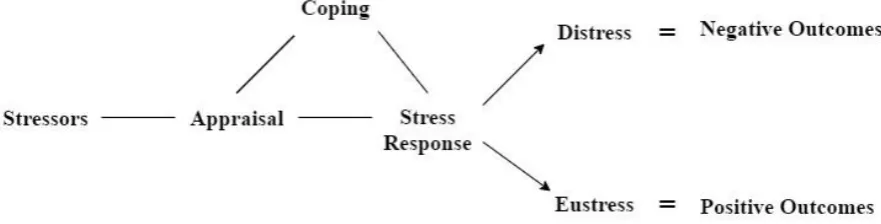
These are stressors, appraisal, coping and stress response as adapted from the Transactional Model of Stress by Lazarus and Folkman (1987).It is important to notice, that stress can lead
to both positive and negative stress responses as illustrated in Figure 1.
There are many situations for employees, which are perceived as straining. These
[7]
stressor, they either have a negative effect on the individual’s mood and wellbeing or lead to
growth and energy (Selye, 1974). Lazarus (1990) stated that stressors are a dynamic construct
composed out of individual and environmental factors that are constantly exposed to changes.
It is due to the individual’s cognitive appraisal, which events are perceived as stressful. The appraisal is dependent on the source, duration, controllability and the
desirableness of the situation (Le Fevre, Matheny & Kolt, 2003). Lazarus (1990) distinguishes
between primary and secondary appraisal. Primary appraisal refers to the examination of the
importance of the stressor, whereas secondary appraisal stresses the evaluation of what can be
done about the situation. This means, that the stressor is recognized, and thereafter interpreted
and evaluated. The appraisal determines how to react to a certain stressor.
Coping is referred to asa way to react to the stressor, both in a behavioural and emotional as well as cognitive manner. The main aim of coping is to reduce or even eliminate
distress (Lazarus & Folkman, 1984). Carver, Weintraub and Scheier (1989) distinguish
between two types of coping strategies. These are problem- focused coping and emotional-
focused coping. The former tries to solve a problem lying within the situation or managing the
stressor, whereas the latter aims at altering the emotional distress linked to the situation.
Problem- focused coping occurs more often when the individual perceives the efficacy to
change something about the stressor, whilst emotion-focused coping predominates when the
stressor is perceived to be enduring (Folkman & Lazarus, 1980).
The stress response is the actual reaction to the perceived stressor, which can be
perceived either as distress or eustress. Since it is very subjective, which situations are
perceived as stressors and because of the many different ways how to appraise and to cope
with these, there are many differences among individuals. These subjective cognitive factors
and situational factors determine differences in the stress response (Le Fevre et al., 2003). An
example of a stress response is the fight-or-flight reaction, first described by Cannon in 1929, which is a survival mechanism helping to react quickly to threatening situations. The
individual fights the threat or flees into safety. However, regarding physical arousal, the body
reacts to all stressors in the same way. Little amounts of everyday stressors keep this
mechanism activated and do not leave a chance for the mechanism to “turn off”, resulting in
[8]
Figure 1. The Transactional Model of Stress adapted from Lazarus & Folkman (1987)
Distress and Eustress- Two different stress responses
If stress occurs in large amounts the individual is not able to cope with, distress may occur,
which goes along with negative physical or mental health effects (Canadian Centre for
Occupational Health and Safety, 2000). In other words, distress is a negative stress response
emerging because of negative appraisal of the situation and insufficient coping strategies of
the individual. Although there is no clear definition of distress, a consent exists in that it
enacts an imbalance between perceived demands and the available resources to cope with
(Selye, 1974). Stressors at work that lead to distress are, among others, work overload, health
problems, balancing work and family, peer pressure or unemployment (Michie, 2002). Most
of the time, stress is linked with a negative image (Schafer, 1996), but in contrast to distress,
another type of stress leads to adaptive effects: eustress (Selye, 1976). Eustress occurs when
the stressor is appraised as positive and the individual is able to employ coping strategies in
order to prevent the emergence of distress. Quick et al. (1997) defined eustress as the positive
and constructive stress response essential to growth, development and mastery. Eustressed
employees are said to be more engaged at work, which means that they experience a great
amount of meaningfulness, manageability, hope and positive affect towards their job demands
(Simmons and Nelson, 2011). Because there are several familiar factors mentioned like self-
efficacy or satisfaction, further research is required to examine the indicators contributing to
eustress. Furthermore, experiencing eustress at work relates to better job performance,
increased psychological wellbeing and physical health (Simmons & Nelson, 2011). Because
of that, stressors do not always have to be associated to have a negative impact on health, but
[9]
Occupational Eustress Models
The Human Resource Development Eustress Model developed by Hargrove, Becker and
Hargrove (2015) offers a method for promoting the development of eustress in organizations
by focussing on preventing distress. Further, it tries to give a framework in how
organizational distress can be “converted from a threat into a source of energy with concomitant positive outcomes for employees and organizations” (Hargrove et al., 2015,
p.280). It entails practices “that can aid individuals in coping with challenges and promoting
eustress”, such as flexible scheduling, employee assistance programs or career management.
(Hargrove et al., 2015; p. 295). The authors of this model defined eustress as the positive
conceptualization of stress by referring to definitions of Selye (1987) and Quick et al. (1997),
which related eustress to positive emotions, such as hope and goodwill. The occupational
eustress model relies among others on the transactional model of stress focussing on appraisal
and coping as responsible for the stress response and the challenge hindrance framework.
An individual appraising a stressor as a challenge instead as a threat to both physical
and mental health is more likely to perceive the situation as eustress rather than distress.
Cavanaugh, Boswell, Roehling and Boudreau (2002) support this argument with their
Challenge Hindrance Framework (CHF), in that challenge- related stressors lead to positive outcomes, whereas hindrance- related stressors lead to negative outcomes. Challenge stressors can be defined as workplace demands, which are appraised as a challenge. These are, among others work pace, workload, job complexity and job responsibility (Podsakoff,
2007). With a positive appraisal, these kinds of stressors promote the accomplishment of tasks
and personal development.
Research Questions
Because there is only little research about what distress and eustress actually is, and due to the
striking positive effects eustress can offer, it is important to employ this construct in the
improvement of working conditions by generating an impression of what the constructs of
distress and eustress mean to employees as well as how they experience these. The ultimate
aim of this study is to investigate what differentiates the experience of distress from eustress
regarding when and how employees in different working fields perceive it. Therefore,
individual experiences will be analysed both inductively and deductively regarding
differences and commonalities regarding under which circumstances and how these types of
[10]
not necessarily dichotomous, it will be asked for both types of stress. The results of the study
may reduce the gap in the literature about perceptions of eustress and distress in a
work-related context. More insight into the aspects that differentiate eustress from distress may also
add value not only to employees, but also to employers, policy makers and intervention
designers trying to adapt working conditions and promote or generate eustress in order to
stimulate growth, development and mastery among employees. The research questions for this
study are:
1) Under which circumstances do employees perceive eustress?
2) How do employees perceive eustress?
3) Under which circumstances do employees perceive distress?
4) How do employees perceive distress?
2. Methods
Participants
Following an interview survey design, qualitative semi-structured interviews were conducted
with 10 German volunteers in June 2017. It was chosen to recruit the participants via
convenience sampling, which is the most economical and easiest sampling method for this
study (Ferber, 1977). All participants were people belonging to the social environment of the
researchers. The inclusion criteria were checked in personal conversations beforehand
containing an oral invitation before sending an invitation mail asking for participation and
contact details. Inclusion criteria of participation were that participants had to be employees in
paid jobs at least in a part- time job including not less than 30 working hours per week at the
day of data gathering. Furthermore, they had to be above 18 years of age. Employees who do
not perceive stress in their daily working lives were excluded from this study. These criteria
where chosen in order to guarantee that both working experience and experiences with
occupational stress are existent within the population. A wide range of working professionals
containing participants of different sex, age and profession have been recruited:
Five of the participants were female, whereas five were male. The participants had an
average age of 36.3 years (SD= 12.08), working in middle- to higher education jobs. One of them worked 30 hours per week in a part- time job, whilst nine participants were full- time
employees. Two of the participants worked as medical nurses in a psychiatric hospital, one
worked as a psychotherapist in a psychiatric hospital, another one as a childcare worker, the
[11]
as a chief executive officer, whilst two of the participants worked as recruiters. One
participant was employed as a technician for machine tools. Their work experience ranged
from 0.5 to 40 years, with an average of 15.65 working years (SD=14.12) and an average of 40.9 working hours (SD=6.86) per week. The vacation days per year ranged from 14 to 42. None of the volunteers dropped out.
Materials
It was chosen to conduct semi- structured interviews in order to give the participants freedom
for creativity in their responses (Longhurst, 2016). The interview contained open questions to
different topics covering experiences with eustress and distress, work experience and
demographics. The researchers generated these questions based on existing theoretical
insights about the topic rather broadly to avoid suggestive manipulation of the responses. In
the first section of the interview, an explanation of both distress and eustress based on earlier
literature research and the aim of this study were communicated to the participant and
checked for understanding. If the participant had no clear idea of these constructs, another
example of either distress or eustress was given. Distress was described as “When we talk
about “stress” in our daily lives, mostly we mean a negative, unpleasant perceived state of
tension, the so-called distress. Distress is defined by Hans Selye (1976) as a state of overload,
for example overextension at work, thus negative stress”. At the same time, eustress was
defined in the interview as “in how far straining situations become negative stress does
depend on the length of tension, as well as on the individual coping strategies and experiences
from earlier situations, but also on your perceived coping abilities, thus the perceived
self-efficacy. If the ability and skills are existent to manage the demands and if you have
the opportunity to release the physical and mental energies, then we talk about positive stress,
thus eustress.” In the second section, individual experiences with eustress and distress at
work were requested as well as the participants’ coping strategies, for example “How does
distress influence your daily life?” or “What do you personally do to reduce the effects
distress has on you?” In this way, it was possible to examine how the participants differentiate
individually between eustress and distress. The third section asked for reactions to both types
of stress by asking straight “How do you react to eustress/distress?” Suggestions asking for
different dimensions like “What happens to your body? Your thoughts? Your feelings? Your
behaviour?” served to clarify the question. The fourth section covered questions about the
participant’s profession and demographics in order to find differences in response patterns by
[12]
Procedure
Before starting with the semi- structured interviews, the study was approved by the Ethical
committee of the University of Twente. Because the native language of both interviewers and
interviewees was German, the interviews were conducted in German as well. Each of the two
researchers conducted five interviews respectively, with an average duration of 29 minutes
(SD= 7.30) per interview. The participants had the right to get the results of this study, but no further rewards or the like were given after completion of the interview. In order to test the
interview scheme, the researchers performed a pilot test with two individuals from their social
environments to check whether it contained ambiguities or mistakes in order to diminish
possible pitfalls. In fact, some minor adjustments have been made on the interview scheme,
like the formulation of some questions and an example of both distress and eustress has been
added to simplify the participants’ understanding of those constructs.
After recruiting the participants, individual appointments have been made for
conducting the semi- structured interviews, which were held at the participants’ workplace or
their homes in a quiet room with no possible disturbances. All interviews were recorded with
help of a smart phone. Before starting the interview, the participants were again given
information about the study and asked whether they wanted to participate by means of an
informed consent. The participants attended the interview on a voluntary basis and were free
to stop at any moment of the interview. Furthermore, the researcher and participant had a brief
small talk beforehand about the ethics and anonymity of this study in order to make the
participant more comfortable at actual data collection. After that, the actual interview was
conducted. After the end of the interview, the participant was given the opportunity to
evaluate the interview, ask questions and give some possible additions. At last, the participant
was asked whether he or she would like to get insight in the results of this study and could, if
desired, leave his e-mail address to be able to communicate the results.
Data analysis
In order to answer the research questions how and under which circumstances eustress and
distress are perceived, the responses obtained from the transcribed semi- structured interviews
were analysed and synthesized by labelling them with different codes with the help of the
coding program Atlas.Ti. Because the coding categories were created directly from the
responses, a conventional content analysis was performed employing a deductive and
inductive approach following iterative steps (Kondracki Wellman & Amundson, 2002). By
[13]
an overview of how many times an answer containing certain information was given as well
as how many circumstances were mentioned as a whole. Circumstances were for example
examined by asking for specific situations, for instance “Could you tell me about some
situations, in which you experienced distress?” How eustress and distress are perceived was
mainly examined by asking for reactions to both types of stress, for example “How do you
perceive eustress?” For both circumstances and how participants experience eustress and distress, the coding groups “Circumstances” and “Reactions” were created beforehand for
eustress and distress respectively.
Regarding the further generation of the coding scheme, the researchers read one of
their transcripts first. Thereafter, each researcher created initial codes based on the interviews
by means of a constant comparison to look for differences and commonalities in the
interviews. Then, the created coding schemes were merged in a deductive approach into one
coding scheme, resulting in the four main topics experience of eustress, experience of distress,
profession and work experience and demographic characteristics. After that, the researchers
coded one transcript each, thereby renaming, revising or creating new (sub-) codes, focussing
on open coding. Quotes containing single catchwords, for example the codes
“Accomplishment” or “Disturbances” were coded in vivo. Because of that, both an inductive
and a deductive approach were used to generate the final coding scheme.
Regarding the unit of analysis, or so- called “chunks”, the quotes where kept to a
minimal length to avoid redundant information not necessary to answer the research
questions, yet long enough to be able to grasp the essence as well as the context of the quote.
An example of a response not quoted was among others “Of course this was a stupid situation,
but it could be clarified afterwards and yes.” The amount of quotes was not predetermined.
Ultimately, the final code structure was applied to all interviews. The results were derived
from an inductive approach, trying to generate general statements and theories from the single
interviews. In order to promote the inter- coder agreement of the performed analysis, the
interviews were coded twice, by each researcher once respectively and are thus double coded
to ensure accordance among the researchers.
3. Results
This section is trying to provide an answer to the research questions “Under which
circumstances do employees perceive eustress/distress?” and “How do employees perceive eustress/distress?” The semi- structured interviews were analysed by reference to the
[14]
form. The quotes were translated into English in order to provide a better illustration of the
results. The impression was gained, that all participants felt free to answer the questions and
were not reluctant. Regarding the interview scheme, the participants understood the questions
well and answered in a way which was open and trying to offer help. Remarkable was that the
participants had different response patterns. Some of the participants were answering rather
emotional than factually, while others were not. However, two participants had no idea how to
answer the question “What do you personally do to enhance maintain the amount of
eustress?”
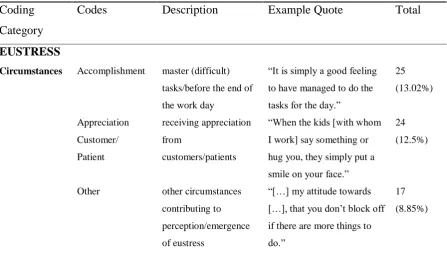
In order to get a general overview of the results, Table 1 can be consulted which
presents the coding scheme in terms of coding category, code, description, example quote, the
total amount of codes within the respective category and the corresponding percentage. Most
of the quotes were applicable to the code- groups Eustress and Distress. Because coding was a never-ending process, some codes where adjusted while coding. One example of this is the
code “Work Pressure”, which was often double coded with the code “Customers/Patients”,
“Colleagues” and “Disturbances”, resulting in the code group “Work Pressure”. Ultimately,
the findings derived from the quotes were used to answer the research questions.
[image:15.595.77.525.504.774.2]Coding Scheme
Table 1.
Overview of codes regarding eustress and distress with definition, example quote, frequency in total and percentage
Coding
Category
Codes Description Example Quote Total
EUSTRESS
Circumstances Accomplishment master (difficult) tasks/before the end of
the work day
“It is simply a good feeling
to have managed to do the tasks for the day.”
25 (13.02%) Appreciation Customer/ Patient receiving appreciation from customers/patients
“When the kids [with whom
I work] say something or
hug you, they simply put a smile on your face.”
24
(12.5%)
Other other circumstances
contributing to
perception/emergence
of eustress
“[…] my attitude towards […], that you don’t block off
if there are more things to do.”
17
[15]
Influence
Responsibility
Others
giving someone a
helping hand, affect
someone
“[…] it is like positive
stress. There were many
phone calls shortly after
each other in the last half
hour before closing time, but
I was able to help all
customers calling. That was
a good feeling to help those people.”
16
(8.33%)
New Challenges perceiving task as
challenge rather than
threat
“I try to see the daily things
that lie ahead as not so
negative, instead I think “There is something new
lying ahead, and we will
manage these things, together.”” 11 (5.73%) Appreciation Chief receiving appreciation from chief/colleagues
“My chief complimented me several times […] for my work.”
10
(5.21%)
Workload &
Planning
proper workload or
planning of tasks,
workweek or working
days
“[…] that you consciously
choose on which tasks you do when.”
10
(5.21%)
Rewards receiving material
incentives
“To receive appreciation for
my work in the form of a
compliment or a wage increase […]. It happens
rarely, that one gets
appreciated for his work, as well as financial […].”
7
(3.65%)
Long Term perceiving gratefulness
for the little things in
life/mindfulness
“You have to find for
yourself a smaller view for
the little things in daily life.
Because of that I think the
whole day is experienced in another way.”
7
(3.65%)
Leisure Time eustress through or in
leisure time
“I also experience eustress in
my leisure time, when I work as a football trainer.”
5
[16] Reactions Positive emotions experiencing positive
emotions, mood
changes
“I feel being in a better mood.”
23
(11.98%)
Enhanced
concentration
being able to
concentrate better,
being in focus
“I am more interested in all
kinds of things and I can
grasp clear thoughts. I am
faster in processing information.”
18
(9.38%)
Physical reactions physical reactions to
eustress
“[…] adrenaline level rises,
blood pressure rises, goose bumps everywhere.”
13
(6.77%)
Enhanced
physical energy
reporting to have more
energy, feeling more
balanced
“After a successful working
day, I have the energy to do
something else after work […].”
3
(1.56%)
Lack of self- care eating/drinking less,
not taking time- outs
“I would say I even drink
less when experiencing eustress.”
3
(1.56%)
Total 192
(100%)
DISTRESS
Circumstances
Circumsta nces
Workload lack of staff/too many
tasks
“[…] simple too much, an overload”
34
(15.18%)
Time too little time to
accomplish tasks
“When there are sudden
changes in workflows, for
example if a resident does
not cooperate or how you
want him to cooperate, you get in time pressure.”
28
(12.5%)
Work Pressure Work Pressure pressure from chief/colleagues
“After work, the phone rings at 6:30 a.m.: “Did you this,
did you that, can you do that?”
23
(10.27%)
Colleagues arguments/trouble with
colleagues
“There were 5 patients
staying over. In the
afternoon, my chief came in and asked, “What is
happening here?” and I was 14
[17]
trying to explain to her, but I had no chance […] Then she was like “Why didn’t you
accomplish this, others did it well.”
Customers/
Patients
arguments/demands of
customers/patients
“Everything is fast- paced;
everything has to be fast… I
want to order today and
tomorrow I want to have delivered the product.”
13
(5.8%)
Disturbances disturbances, which
hinder employee from
working
“The continue interruption at
work. I would rather finish
one task and then start with
the next one, but then
someone asks again, and
there is a phone call and
suddenly you have to do 5 tasks at the same time.”
10
(4.46%)
Uncertainty uncertainty, if
performance is
sufficient enough/
about tasks
“Am I doing it properly?” 13
(5.8%)
Responsibilities too many
responsibilities
“[…] when you want to
make some agreements or
talk about the distributions
of tasks. One colleague of
mine has isolated herself
once in a conversation with
our chief and referred to the
for her suitable amount of tasks and said, “I can’t take more than 2 [patients].”
12
(5.36%)
Reactions Physical reactions physical reactions to distress
“Stomach trouble or feelings of inner heat, insomnia”
23
(10.27%)
Loss of
productivity
not being able to
concentrate any longer
“When more tasks than time
are around and that is going
to be tight and then you can’t concentrate any longer,
even if you want to want to work longer […] you are knocked out anyway.”
13
[18]
Helplessness having no control over
the situation
“When you get the
impression you can’t do
anything about the situation.”
12
(5.36%)
Irritability feelings of irritability,
mood changes
“When I had a stressful
workday, I want to go home
be all alone at first to calm
down, just for a few
minutes, and then it gets better”.
11
(4.91%)
Dissatisfaction not being satisfied with
workload,
achievements
“If the pressure gets too
high, you will make
mistakes like forgetting to
measure the blood pressure of the patients.”
10
(4.46%)
Lack of self- care eating/drinking less,
not taking time- outs
“Of course I drink less when
being confronted with distress.”
8
(3.57%)
Total 224
(100%)
Irrelevant codes: 20*
* Note. Codes were irrelevant for this study
Research Questions
1) Under which circumstances do employees perceive eustress?
Participants reported that they experienced eustress at work from two times per week to every
workday. Coding categories relevant to answer the question as to under which circumstances
do employees perceive eustress were “Eustress Circumstances” containing the 11 sub-codes “Accomplishment”, “Appreciation Chief”, “Appreciation Customer/Patient”, “Contact To Customers/Patients”, “Influence Responsibility Others”, “Leisure Time”, “Proper
Workload/Planning”, “Rewards”, “New Challenges”, “Long Term” and “Others”. This
category covered circumstances promoting the emergence of eustress. Since not all quotes
were applicable to a sub-code, they were summarized in the sub-code “Other” (17 times).
The most frequently used code was “Accomplishment“(25 times) followed by
“Appreciation Customer/Patient” (24 times). One of the participants gave a definition of
[19]
intended workflows and tasks in a rhythm which is good for me”. Accomplishing tasks was
often related to high demands or a lack of time: “Sometimes, there are many things that I have
to do […], but I succeeded.” or “Despite the time pressure, I succeeded in writing the letters I ought to. I actually did a good job.” A strategy for the employees to accomplish tasks was to
plan things. The quotes belonging to this topic were coded under the sub-code “Proper Workload/Planning” (10 times): “This means, I have a long list and when I am finished with
one task, I can return to my schedule. By and by, the list gets shorter by applying a To-Do-
List.” By that, the employees have a greater feeling of control of the situation:
“When a new task is coming in which may leads to distress, one has to find ways in
order to keep the situation under control.”
Further, new tasks were perceived rather as a challenge than as a threat (New
Challenges; 11 times) by a few of the participants. Besides, applying this view to new tasks, the self- efficacy of the participants seems to have increased: “I have less fear of failure. I
would say that I have more confidence to accomplish things; that it is worth the effort.” The
second most frequently coded topic contributing to the emergence of eustress was
“Appreciation Customer/Patients”, which uttered itself in compliments and confirmation of
the customer or patient. Receiving appreciation by the chief or colleagues (“Appreciation Chief/Colleagues”; 10 times) played a minor role to the participants in contrast to the
appreciation by a customer or patient: “To put it in a nutshell, the reason for experiencing
eustress is the appreciation and compliments. It does not necessarily have to be the chief or
something. Being complimented by the patients and to notice, that the work is worth it is
already sufficient.”
Another way to receive rewards except from compliments are financial incentives.
These were coded as “Rewards” 7 times, thus a lot less important for the participants.
Nonetheless, some participants mentioned them as an option for enhancing eustress.
Helping or affecting someone, “to experience and to witness, maybe to change
someone’s life, to improve it” was coded 16 times (“Influence Responsibility Others”) and
therefore an important aspect in experiencing eustress for the participants as well. A
participant made a description of a situation, where she helped a patient:
“I experienced once, that one resident [of the residential home where she worked] had
something swallowed up, and as we found the reason what he actually swallowed up,
it was namely a currant bun, we ensured, that the bun came out again and thereafter,
[20]
In the long-term (“Long Term”, 7 times), participants reported to have a deeper sense for
trivialities. Another participant stresses the importance to share success with others: “[…] to
share such positive moments with others and not to keep them by yourself. One works every
day in a team, so this positive stress can be transferred to others.” Further, another aspect
reported by a participant was to reflect oneself and remember situations that went well:
“The reason why I experience this eustress is that I actively create these moments in which I experience eustress, thus I bethink a situation in which I succeeded.”
Although it was not explicitly asked for leisure time as promoting eustress, 5 times the code
“Leisure Time” was given, as some of the participants stressed the importance of it. They
reported either to enjoy doing some sports or spending time with family and friends.
Some circumstances that encourage the emergence of eustress were not applicable to
the sub- codes. Therefore, the sub- code “Other” was generated and coded 17 times. The most
frequently mentioned topic here covered contact and support from colleagues as well as a
good working climate: “I really like having contact with my colleagues and I want to get to
know more about their experiences or to learn something from my colleagues.” In addition, some participants talked about the importance of having a say in workflows: “I have worked
pretty much until closing time, but it’s done the way I wanted to do it. That’s positive stress
for me.”
To sum up, circumstances contributing to the emergence of eustress mentioned by the
participants can be described either in terms of an environmental circumstance or as an
attitude towards distress. The participants differentiated eustress from distress in that
circumstances perceived as distress could be altered by feelings of accomplishment and
appreciation from customers or patients or social support as an environmental circumstance or
having the attitude to see new tasks rather as a challenge than as a threat. Less important for
the participants were leisure time and financial incentives.
2)How do employees perceive eustress?
When it comes to the reactions upon eustress, the code group “Reactions” was created
containing the sub- codes “Positive emotions” (23 times), “Enhanced concentration” (18
times) “Physical reactions” (13 times), “Enhanced energy” (3 times) and “Lack of self- care”
(3 times). Experiencing positive emotions was an overarching topic present during the whole
section of the interview about eustress. Participants described their emotions when
[21]
emotions” 23 times). Concerning cognitive performance, which was coded as “Enhanced concentration” 18 times, one participant reported that he was not able to keep his mind off
something, thereby describing a state of being in total focus. Others described being interested
in much more: “I can focus more on things and work more concentrated”. The participants
described the physical effects (coded as “Physical reactions” 13 times) of eustress in positive
terms, such as for example “I feel more vital, vigorous and productive” although “the stress
symptoms are the same as to distress at first sight, you are tensed and an acceleration of the
vegetative system.” Furthermore, participants reported to be more energetic in that they more
often go out in their leisure time (coded as “Enhanced energy” 3 times). Behavioural reactions
to eustress were only coded three times as “Lack of self- care”, saying that reactions to both
eustress and distress are similar, since these are both straining situations: “I would say that I
probably drink less and eat less when I have both kinds of stress. Participants are more
energetic in that they more often go out in their leisure time, but on the other hand, one
participant notes that he treats himself after a long workday with some sweets or alcohol.
Overall, participants described reactions to eustress in positive terms. Participants
related especially positive emotions to the emergence of eustress and reported them during the
whole interview section about eustress. Almost even important for participants was an
enhanced productivity, which uttered itself in an increased concentration and increased task-
focus. Remarkable was, that a lack of self- care behaviour is described when experiencing
circumstances leading to eustress or distress respectively.
3) Under which circumstances do employees perceive distress?
In order to answer the research question under which circumstances employees perceive
distress, the code group “Distress Circumstances” containing the sub- codes “Time”,
“Colleagues”, “Customers/Patients”, “Workload”, “Responsibilities”, “Disturbances”, “Work Pressure” and “Uncertainty” were employed. Further, circumstances perceived as distress
were accelerating each other resulting in even more perceived distress. The participants stated
that they experienced distress pending on a daily basis.
The most frequently used codes regarding circumstances contributing to the
emergence of distress were “Workload” (34 times) and “Time” (28 times). One participant
described workload as “the demands overexert my temporal abilities and my abilities as a
[22]
Saturdays, just to have a clean work desk, not to fall in stressful situation on Monday again.”
Alternatively, “When the first faxes arrive in the early morning and you didn’t have a chance
to organize yourself for the day and then, the next tasks come in as well.”
“Time” played a crucial role for the participants as well, since “[...] you have a specific
workflow you have to stick to, so you have to stick to the schedule as well.” Five times, the
failure to accomplish something, may it be due to the time limit or the type of task demanded
was explored:
“When all of a sudden 6 or 7 intakes are coming, and we have to be absolutely
finished, because the doctor wants to see the patients for a talk, the responsible
therapist wants them for a talk, and we cannot accomplish this in the given time
frame.”
It is not only the workload and time, which provoke distress, but also the pressure at work
(coded as “Work Pressure” 23 times). Participants describe work pressure mainly in terms of
demands of others:
“I can’t say to a client that he shouldn’t build his house or that he shouldn’t open his business. I have to do it at times in which the client wants it; I don’t have any
influence on that.”
Because of work pressure, workload and conflicts with others, four participants put their
abilities into question. In response to the uncertainty and self- doubt the participants reported,
the code “Uncertainty” was created containing 13 quotes. One participants described
uncertainty as a sort of vicious circle:
“[…] that the work that I’m doing is not sufficient, self-doubts emerge, and when I get
feedback then, that the tasks were not settled as intended, or I get further requests, or
have to explain myself time and time again, then this is pressure from the exterior,
which led to further self- doubts and even more distress.”
Two others pointed out reasons in their personal development as evoking distress: “I have
difficulty in saying what I want to and what I don’t.” „And “What I am not able to yet is the
courage to decide things on my own.”
Much distress in relation with workload is reported to be due a lack of staff: “When
there is staff absent, the same amount of work has to be done by less staff.” On the other
hand, “When I have many appointments that week or it is a short week because of holidays or
[23]
situations with representatives: “[…]the more or the narrower the time schedule is or
representative situations join in, time pressure, appointments, then there is more distress.”
The participants also perceived incidents, which hindered them from working as
stressors contributing to distress. These incidents were coded as “Disturbances” 10 times in
total. One participant gave a description of disturbance in his daily working live in accordance
with the other participants even among working sector:
“[…] because you get disturbed at any time. Then there is a phone call, then you have
to interrupt your work, when you start again you have to think, “Where did I leave
off?” Then you have just started continuing with your work, then someone enters the
room and asks something stupid and you have to answer it.”
One other participant contributes disturbances to a lack of staff: “A reason for
disturbances and having to do many tasks at the same time is mainly due to the lack of
personnel. If we would have more personnel, then you can delegate much easier and the
stress- level would shrink.” Conflicts with colleagues were more often coded (14 times) than
conflicts with customers or patients (13 times). One participant noticed that most of the
conflicts arise due to other sources of stress, such as the distribution of responsibilities, the
comparison with others, or the workload the employees have to take themselves:
“I noticed that in our company the colleagues put stress on each other, they make one another responsible for the things that did not go well.”
Colleagues, which were already stressed out themselves, were prudent in accomplishing their
tasks, even though not concerning the workload of colleagues: “And then, the doctor calls and
asks where the patient is and I get pressure from all sides and all of my colleagues keep
saying “finish up, finish up, finish up!”.
Another reason why conflicts arise is the distribution of responsibilities: “[…] because
I am often made responsible for things for which I am actually not responsible for. And when
I do not process these tasks, I will experience stress again.” Therefore, the code
“Responsibilities” was coded 12 times. The participants handled responsibilities mainly in
two ways: The first group of participants was able to isolate themselves from workload and
responsibilities in order to not to get the distress out of control (7 codes), for example “[…]
and when things are left behind, then this is simply the case.” On the other hand, there were
participants taking their profession and the demands they have to fulfil very seriously (five
codes): “It is straining for me, because I take my profession serious and I want to fulfil
[24]
Conflicts with customers or patients played a minor role in evoking distress. Yet, the
code “Customers/Patients” was coded 13 times, covering topics from the fast-paced society to
demands. There is a difference between employees offering material products and employees
offering help. On the one hand, “you also receive the feelings of a patient, or feel empathy for them. That is burdensome as well.” Further, one participant claims the fast- paced society and
the demands of the customers as a circumstance contributing to distress: “the pressure on
behalf of the customers rises as well… I would say the time a machine takes to finish a task,
thus from order to delivery, they get shorter and shorter. The customer wants less time and
that is a load for the company as well as for the employees.”
To conclude, participants made a mixture of especially workload, time and work
pressure responsible for the emergence of distress. Though willing to work conscientiously,
all participants reported having too much tasks to accomplish in too little time with too little
personnel. Furthermore, they pointed out that there is a negative spiral among employees.
Often, work demands for one employee are said to be transferred to other employees in order
to relieve oneself, resulting in even more distress among the whole team. Others explained the
experienced distress by the fast- paced society, in which companies and customers demand
for steadily more performance in ever little time without hiring more staff.
4)How do employees perceive distress?
The code group “Reactions” was responsible for the ways how distress is perceived. This code group contained the sub- codes “Physical reactions” (23 times), “Loss of productivity”
(13 times), “Helplessness” (12 times), “Irritability” (11 times), “Dissatisfaction” (10 times)
and “Lack of self- care” (8 times). All of the participants described unpleasant physical
reactions (coded as “Physical reactions” 23 times), such as “inner restlessness, nervousness”
or being “more rushed, transpiring, restless sleep” resulting in “a tiredness, a loss of energy,
not being motivated, here and there physical pain, thus muscles hurt, sinews hurt, the head
hurts, thus headaches, or ear noises”. Further, two of them noticed a change in their vegetative systems: “Pulse rises, blood pressure increases”. Regarding cognitive performance, three participants reported a loss of concentration, coded as “Loss of productivity“13 times, though
[25]
inner conflict like “I cannot work more than I am able to”.” Participants pointed out, that they
are feeling more irritable (coded 11 times), having a bad mood and withdrawn when
experiencing distress, like one participant experienced a “guilty conscience and
disappointment because I’m getting more touchy and aggressive.” This goes often along with
difficulties in calming down after work, such as one participant stated in accordance with four
others: “I have difficulty to calm down after work because I often think about “What did I do today, did you check everything, and did you register everything.” Because of that, my work
accompanies me to a certain extent to my home.” When it comes to behaviour, three
participants stress the lack of self- care behaviour when experiencing distress, coded as “Lack
of self-care” 8 times: “Sometimes my self- care suffers; I drink less and eat less or eat more
sweets, which makes me unsatisfied on another dimension.” Alternatively, “Alcohol is an
opportunity to calm down, to relax with a glass of wine, to get tired.”
In conclusion, participants described the experience of distress mainly in negative
terms, which do not only have an effect on the participants during working hours. To put it
concisely from the view of the participants, distress affected concentration and productivity
the most, while having various negative physical effects like pain or insomnia. Another
important reaction to distress was a negative mood change. Noticeable was as well, that
participants described similar physical reactions and a lack of self- care behaviour to both
types of stress.
4. Discussion
The aim of this study was to examine under which circumstances eustress and distress occur
and how individuals react to them. Many circumstances evoking the emergence of eustress
and distress have already been examined in earlier research (e.g. Michie, 2002; Nelson &
Simmons, 2007). Participants stated to be confronted with distress a lot and described to alter
this experience by feelings of accomplishment or appreciation or having a more positive
attitude towards new tasks. Regarding the reactions to eustress, participants mainly stressed
the role of positive emotions when experiencing eustress as well as enhanced productivity,
having control over the situation, being more in focus or enjoying new challenges. When it
comes to the circumstances promoting the experience of distress, participants deemed a
mixture of workload, time and work pressure to be responsible in the emergence of distress
and reported to experience a negative spiral among colleagues, in which job demands are
transferred to other colleagues, leading to even more perceived distress due to the fast- paced
[26]
productivity and concentration, negative mood changes or physical symptoms like pain or
insomnia. When comparing the reactions to eustress and distress, the same physical sensations
have been reported as well as a lack of self- care behaviour.
Overall, non- material rewards, confirmation and a good working climate contributed
according to the participants to the emergence of eustress. Participants described that
circumstances perceived as distress could be altered by feelings of accomplishment,
appreciation from customers or patients, social support, or by having a more positive attitude
towards new tasks. Regarding circumstances contributing to the emergence of eustress, the
most reported one was accomplishment, thus finishing tasks. Achieving work goals is
reported to have an important influence on the emergence of eustress (Bakker and Demerouti,
2007). Together with circumstances stimulating growth, learning and development,
accomplishments are referred to as job resources promoting eustress as described in the job
demands- resources [JD-R] model (Bakker, Demerouti, de Boer & Schaufeli, 2003). Job
resources can compensate for the negative effects job demands can entail (Bakker and
Demerouti, 2007). The second most important circumstance for participants in experiencing
eustress was receiving appreciation from customers or patients, which is not described
explicitly in previous literature. The participants strived for confirmation of the customers or
patients in order to get to know if they are working in the right place. Another circumstance
deemed important for the emergence of eustress was social support from colleagues.
Participants liked sharing their accomplishments with others or spend time with colleagues in
their leisure time, which goes in line with earlier literature stressing social support as the most
important buffer against distress (Haines, Hurlbert & Zimmer, 1991) .
When it comes to the reactions to eustress, participants reported to be more in focus at
work when experiencing eustress. Research by Salanova et al. (2006) also stresses this focus,
described as flow, as an important part in the perception of eustress as well as savouring, which is described by all participants as to enjoy the little things at work. The former is
described as the ultimate eustress experience, a time zone in which individuals lose
themselves in activity and perceptions of time (Csikszentmihalyi, 1996), whilst savouring is
defined as actually “enjoy with appreciation this positive response to demands they
[employees] have to encounter at work” (Cooper, 2005; p. 74). It is not about just coping with
stressors, but rather about “enjoying certain types of eustressful stimuli” (Hargrove et al.,
2013, p.66). Furthermore, Salanova, Bakker and Llorens (2006) stressed, that work- related
flow deals with work absorption, work enjoyment and intrinsic work motivation.
[27]
experiences and positive emotions, which have been described by the participants during the
whole interview concerning eustress. These positive emotions broaden the individual’s
awareness, cognitions and are even able to undo the cardiovascular aftereffects of negative
emotions as stated by Fredrickson (2001) in her theories about the broaden- and undoing- effect. Resilience is an important aspect of positive emotions, in that it enables the individual to regenerate more quickly after a negative stressful event (Scheer & Withaar, 2013).
Furthermore, positive emotions even facilitate creativity and flexibility in that they enable the
individual to take different perspectives in order to achieve a goal and by that, promoting the
individual’s self-efficacy (Bandura, 1977). Over time, this broadened sense of creativity and
flexibility and their actual actions in practice build resources of help and knowledge in the
long- term; this is called the build-effect (Fredrickson, 2001). These resources can be applied in the future to deal with a stressor (Bohlmeijer, Bolier, Westerhof & Walburg, 2013) and
therefore increase the chance of growth of the individual. If this is the case, the individual
feels challenged, more optimistic and is more able to deal with setbacks when facing a
stressor (Bolier, 2012). This goes in line with the reported positive attitude towards new tasks.
When conducting the interviews, most of the participants had no clear idea how they could
promote their daily amount of experienced eustress. This may be due to the focus on distress
rather than eustress and that participants do not face up with eustress in their daily lives.
Regarding the JR-D model (Bakker et al., 2003); job demands promoting the
emergence of distress can be described in terms of work pressure, emotional demands, and
role ambiguity (Doi, 2005). The most important job demands in this study promoting distress
were Workload and Work Pressure. Research by Bickford (2005) pointed these circumstances out as well in that they play an important role in the emergence of distress. The participants
often mentioned Time as well, which was often related to Workload and Work Pressure, as supported by research from Kälvemark, Höglund, Hansson, Westerholm and Arnetz (2004).
Wallace (1997) supports the relation between time pressures, work pressure and work
overload in the emergence of distress. As a main reason for that, the participants reported a
lack of staff. When working conscientiously as many participants reported, it may be that they
simply needed more time to process than was actually scheduled. A lack of time to
accomplish tasks may thus also be due to an insufficient time management of the participants
in combination with a lack of staff. Circumstances, which are not elaborated directly in
[28]
participants, another circumstance evoking distress is the reciprocal impact stressors have on
employees, because of carrying Responsibilities further. If one employee perceives distress because he is not able to accomplish his own tasks, he transfers job demands to other
colleagues. By doing so, he tries to complete the remaining tasks in a proper way. This results
in a negative spiral, resulting in many employees experiencing distress. This negative spiral
can also be due to a poor task allocation, in which tasks are not distinct enough for employees,
so that misunderstandings and shoving aside from responsibilities may occur. Because of that,
arguments with Colleagues are to occur more frequently.
All participants described the reactions to distress in terms of a lack of concentration,
control and an imbalance as confirmed by Spector and Jex (1998). Most of them were aware,
that there is no actual difference in the physical sensations to the stressors responsible for the
emergence of distress and eustress, but described their reactions to them as different from
each other, which is in line with the stress mindset theory (Crum, Akinola, Martin and Fath,
2017). This theory differentiates between a stress- is-enhancing mindset and a stress- is-
debilitating mindset. The former holds the mindset that stress has enhancing consequences for
the individual, whereas the latter stresses the debilitating consequences, resulting in a loss of
performance and productivity or health and wellbeing. Both mindsets are related to shape the
stress response. Because of that, the perception and evaluation of a stressor determines the
stress response as reported earlier (Lazarus and Folkman, 1987). The participants described
the same physical arousal to both types of stress, but described their reactions to distress in a
more negative way. This goes in line with Hans Selye (n.d., p. 15), who states, “During both
eustress and distress the body undergoes virtually the same nonspecific responses to the
various positive or negative stimuli acting upon it.” However, the participants reported
physical reactions to distress twice as much as to eustress. Because of the many existing
models trying to explain the notion of distress and interventions trying to decrease distress,
the focus of psychology, media and organizations was mainly on distress instead of eustress
(Gable & Haidt, 2005). Hence, the participants did not occupy themselves with the effects
eustress has on their body and were thus little aware of the effects eustress can have.
Bakker and Demerouti (2007) state that job resources do not necessarily have to relate
to job demands, but that they are inherently important. Hence, different codes for the
circumstances contributing to distress and eustress were used. Since the participants were free
in formulating their answers and did not receive any suggestions, circumstances contributing
to distress mostly did not evoke eustress and the other way round according to the
[29]
opposite of eustress, but as something different. Although eliciting the same physical arousal,
distress and eustress are assumed to be different and distinct from each other (Selye, 1987).
Strengths and Shortcomings
One strong point of this study was the content the coding scheme covered. It particularly
offered a good overview about when eustress and distress are perceived as well as about
physical and mental reactions to both experiences. The participants of this study had no
further questions, they understood sufficiently what was asked from them, and were
motivated to contribute to the results, which actually represents the quality of the questions
asked and the relevance of this topic.
Since the sample consisted mainly of participants familiar with the concept of distress
and eustress because of their education, they were possibly aware of what the study was about
and therefore just tried to answer the research questions. Others may have responded in social
conformity, but since the participants came out of the researchers’ social environments and
did not receive any incentives for their attendance in the semi- structured interviews, their
motivation was of intrinsic nature (Ryan, 2000). Besides, all of them wanted to be informed
about the development and results of this study, which represents their motivation to
participate as well. The motivation of the participants was thus a strength of this study as well.
The coding scheme contained many circumstances retrieved from the participants as
from relevant current literature. Deleting codes, creating new codes and adjusting codes was a
task enduring for the whole period of data analysis and still, some adjustments should be
made. As mentioned earlier, there were different codes in the circumstances concerning
distress and eustress. For example, the code “Other” belonging to circumstances leading to
eustress is not created for distress and hence some answers not belonging to any other code
were left out. This point attracted attention not until the results were brought together and
seven codes were found about social support, for which no code was generated. Further, many
quotes regarding distress were double coded, because the codes were not delimited sufficient.
Especially Workload was double coded with Work Pressure.
Although the opportunity sample taken varied by age, it did not with regard to
education and socio- economic status (SES). All of the participants were high or at least
middle educated and thus worked in a higher profession. Because of that, employees working
in lower education jobs were not taken into account as well as employees having a lower SES,
resulting in a selection bias because the sample was conducted too unilaterally. Due to the