BACHELOR THESIS
EUROPEAN PUBLIC ADMINISTRATION
UNIVERSITY OF TWENTE
ENSCHEDE
ANNELIN KUIJTERS
S1594370
DR. VERONICA JUNJAN & DR. HARRY DE BOER
SECOND READER: PROF. DR. ARIANA NEED
PRIVACY OR SAFETY?
STAKEHOLDERS IMPLEMENTATION PROCESS OF THE PNR DIRECTIVE IN THE
NETHERLANDS
Table of Contents
1. Background ... 1
2. Theoretical framework ... 3
2.1. Conceptual framework ... 5
3. Data and documents ... 6
3.1. Conceptualization and operationalization ... 6
3.1.1. Power ... 6
3.1.2. Legitimacy ... 7
3.1.3. Urgency ... 8
3.1.4. Stakeholder’s effect on the implementation process ... 8
3.2. Research design ... 9
3.3. Data collection ... 10
4. Context ...12
4.1. Content of PNR directive ... 12
4.2. Description of the practice ... 13
5. Description and analysis ...15
5.1. Stakeholders involved in the implementation process in the Netherlands ... 15
5.1.1. Justice and Home Affairs (Justitie Binnenlandse Zaken (JBZ)) ...15
5.1.2. Airline/Travel agency ...16
5.1.3. Media ...18
5.1.4. Privacy organization ...18
5.1.5. Stakeholder’s effect on the implementation process ...20
5.1.6. Summary of section 5.1 ...21
5.2. Involved stakeholders affecting the implementation process in the Netherlands ... 22
5.2.1. Justice and home affairs (Justitie Binnenlandse Zaken (JBZ)) ...22
5.2.2. Airline/Travel agency ...23
5.2.3. Media ...24
5.2.4. Privacy organization ...24
5.2.5. Summary of section 5.2 ...25
6. Conclusion ...26
6.1. Results of the study ... 26
6.3. Policy recommendation ... 29
6.4. Discussion and recommendation for further research ... 29
7. List of references ...31
8. Annex ...35
8.1. Coding table ... 35
8.2. Interview protocol ... 36
Abstract
1
1.
Background
This paper will focus on the involved stakeholders of the implementation process of the European PNR directive in the Netherlands. It will be researched whether and how these stakeholders can affect the implementation process.
The PNR directive is a form of legislation that is decided upon by the European Union institutions and directed at the Member States. The Member states have to implement the directive into their domestic legislation within a set time frame. The way the Member States do this is not decided upon, the European Union leaves the
Member States free in how they implement the directive (European Law Monitor, 2017). The directive
concerning the PNR database implies that airlines are obliged to share their stored data on air passengers with national authorities in order to counter terrorism (Justice and Home Affairs, 2016).
Countering terrorism has already been high on the European agenda for a long time. Especially since the recent terrorist attacks in Paris, Brussels and London, the importance of the issue has been intensified. It was in
February 2011 when the European Commission firstly initiated a proposal concerning the collection of passenger information. This first proposal, however, was rejected by the Civil Liberties Committee of the European
Parliament in 2013. Due to the continuing threats to the European Union’s internal security and the terrorist attacks in Paris in January 2015, the PNR proposal gained considerable interest again. The European Council asked the Parliament and the Council of Ministers to finalize the proposal and after many three-way debates, in April 2015 the European institutions agreed on a final text and directive (Justice and Home Affairs, 2016). The directive states the following: “The objectives of this Directive are, inter alia, to ensure security, to protect the life and safety of persons, and to create a legal framework for the protection of PNR data with regard to their
processing by competent authorities” (EUR-Lex, 2017). Article one of the directive states:
1. “This Directive provides for: (a) the transfer by air carriers of passenger name record (PNR) data of passengers
of extra-EU flights (b) the processing of the data referred to in point (a), including its collection, use and retention
by Member States and its exchange between Member States.
2. PNR data collected in accordance with this Directive may be processed only for the purposes of preventing,
detecting, investigating and prosecuting terrorist offences and serious crime” (EUR-Lex, 2017).
2
implementation process (Council of the European Union, 2016). As of May 2017, the Netherlands is already processing PNR data and is working on establishing a Passenger Information Unit (PIU) (Monroy, 2016). For processing PNR data, this unit is to be established in every Member State. The PIU is designated to process the PNR data for the governmental bodies that have the competence to prevent, investigate and prosecute terrorist offenses. The PIU’s are also responsible for the exchange of PNR data between the Member States and Europol (van der Steur, 2016). Europol is based in The Hague and is responsible for notifying Member States of criminal offences, coordinating investigations and reinforcing actions of the national law enforcement authorities (EUR-lex, 2016).
A European directive, by definition, leaves freedom for the individual Member State on how to reach the prescribed goal (European Union, 2017). This means that Member States are given the freedom to interpret the directive in their own way. The implementation process therefore depends on how the national governments design and organize it. These designs can differ per Member State due to different domestic priorities, different administrative systems and possibly by influential stakeholders. For stakeholders, their own interests and stakes might weight more than the intended goal of the European Union. The given freedom to the Member States can lead to misuse of power and possible misinterpretation by national authorities and stakeholders.
In order to get a better insight in how a European directive is addressed at national level the following question is proposed in this research: which stakeholders are involved at the Dutch national level in the implementation of the European PNR directive and in which ways can these stakeholders affect this implementation process?
This research question will be answered with the following two sub-questions:
1. Which stakeholders are involved in the implementation process in the Netherlands?
2. In which ways can the involved stakeholders affect the implementation process in the Netherlands? This research will provide a unique interim insight in the implementation process in the Netherlands. The paper starts with a section that discusses stakeholder theories and definitions, the theory of the salience model and ends with a conceptual framework. Section three will explain and defend the methodology that is used for this research and is followed by a section concerning the context. In this section, the reader is extensively introduced to what is written in the directive and how this is expected to work out in practice. The paper continues with the data analysis, which is divided into two sub-questions. The first sub-question aims for mapping which
stakeholders are involved in the implementation process. In question two the characteristics of the, in sub-question one, designated stakeholders will be graphically depicted. Based on these findings, patterns in
3
2.
Theoretical framework
The research aims for describing which stakeholders are involved in the implementation process of the European PNR directive in the Netherlands and how they can affect this process. The research is therefore focusing on a public reform that has passed the talk and decision stage and is currently in the practice stage. Organizations and authorities now have to implement the policy in their daily operational routine (Pollitt & Bouckaert, 2011). After this stage, usually the outcomes and results of the public reform can be measured.
A European directive is initiated by the Commission and decided upon by the European Parliament and the Council. In this process amendments can be made and at any time both Parliament and the Council can block the proposed legislation. The Commission consults parties like non-governmental institutions and representatives of civil society (European Union, 2017), however, “network governance, being based on the concept of multi-organizational cooperative behaviors for the delivery of public services” (Veronesi & Keasey, 2009, p. 2) sounds
like a “more effective and inclusive form of governance” (Veronesi & Keasey, 2009, p. 2) than the “rigid bureaucratic top-down approaches and the dominance of a restricted group of interests” (Veronesi & Keasey,
2009, p. 2).
As Pressman and Wildavsky argue, often programs fail because too little effort and time was spent on the implementation process. They state that it is mistaken that the implementation process is only a technical matter that can be sorted out later as long as the program is sound (Warren, 1974, p. 1090). The main objective of a policy is to alter social behavior and this is a complex process (Sabatier & Mazmanian, 1979, p. 481). There are many different barriers to be identified, such as resource barriers concerning material or financial aspects, institutional barriers such as bad communication and cooperation between levels of government, legal barriers and social barriers like different interests of the involved stakeholders. A policy is not easily accepted when it affects stakeholders’ interests. When the measure is hurting a stakeholder, the acceptance declines (Hanzl, Meschik, & Sammer, 2003). In other words, stakeholder involvement influences the operational goals (File, et al., 2016) and “contributes to the quality of the service provided” (Veronesi & Keasey, 2009, p. 2).
4
working. Stakeholders, like street-level bureaucrats, might for instance develop simplifications and routines so that their tasks can be fulfilled with less difficulty (Lipsky, 1969, p. 12).
[image:7.612.56.242.250.406.2]There is much consent on what can be qualified as stakeholder, it can be a person, group, organization, neighborhood or society (Mitchell, Agle, & Wood, 1997, p. 855). Stakeholders “can affect or are affected by” (Freeman, 2010, p. 52) implementing a policy. Responsiveness to stakeholders explain a large portion of bureaucratic behavior. The actions of the stakeholders reflect their needs, whereas the success of the action shows the salience of their position (Yang & Callahan, 2007). The salience model (figure 1) developed by Mitchell, Agle and Wood uses three parameters for the categorization of stakeholders, power, legitimacy and urgency.
FIGURE 1 SALIENCE MODEL
Power means how much the stakeholder can do, legitimacy is defined as the level of authority and involvement on the project and urgency as the time for responding to their expectations (Sharma, 2010). The model gives an indication of which stakeholders really count and which stakeholders most energy should be spend on.
Power plays an important role in how much attention a stakeholder should be given. “The possession of resource power makes a stakeholder important to managers” (Mitchell, Agle, & Wood, 1997, p. 863). Power can be
controlled by using forms of incentives and regular monitoring (Mitchell, Agle, & Wood, 1997, p. 863). However, power is not the only factor that explains the role of a stakeholder, also stakeholders that do not have much power can affect processes. “Illegitimacy results in isomorphic pressures” (Mitchell, Agle, & Wood, 1997, p. 864) on stakeholders that do not operate within the accepted norms, with mortality of the stakeholder as a possible direct result. Finally, urgency also attributes to the influence of a stakeholder. The perception of attention “adds a catalytic component to the theory of stakeholder identification” (Mitchell, Agle, & Wood, 1997, p. 864). When the
5
With the help of the salience model, different categories of stakeholders can be identified. Stakeholder’s effect on the implementation process can be clarified with the help of the three parameters power, legitimacy and urgency. The better these categories of stakeholders are managed the bigger the chance that these stakeholders cooperate effectively and successfully in the implementation process. In the next section, the conceptual framework and the expectations based on the theoretical framework will be depicted and formulated.
2.1.
Conceptual framework
[image:8.612.55.564.207.541.2]Now the theoretical framework has been formulated, the involved concepts can be depicted in a conceptual diagram.
FIGURE 2 CONCEPTUAL FRAMEWORK
Power, legitimacy and urgency are the independent variables that all three have a positive relationship with the dependent variable: stakeholder’s effect on the implementation process. The salience model contains three equally sized circles with the same amount of positions for every parameter, therefore the three independent variables are expected to have an equal amount of influence on the dependent variable. The following expectations can be formulated:
Expectation 1: the higher the level of power of a stakeholder, the bigger the stakeholder’s effect can be on the implementation process.
Stakeholder's
effect on the
implementation
process
Power of
stakeholders
Legitimacy
of actions of
stakeholder
Urgency of
6
Expectation 2: the higher the level of legitimacy for a stakeholder, the bigger the stakeholder’s effect can be on the implementation process.
Expectation 3: the higher the level of urgency for a stakeholder, the bigger the stakeholder’s effect can be on the implementation process.
3.
Data and documents
3.1.
Conceptualization and operationalization
Before the methodology part, it is necessary to start with clarifying the three major concepts used in the research. In this section power, legitimacy and urgency will be conceptualized and operationalized. In order to apply the salience model, the three concepts power, legitimacy and urgency will be ranked with either high or low for every stakeholder.
3.1.1. Power
Power, as stated in the theoretical framework, is defined as how much the stakeholder can do. To what extent do the stakeholders have capacities to affect the implementation process.
When determining the power of a stakeholder, it is important to know what their task is and how important this task is for a successful implementation. If this task is crucial than the stakeholder has the capacity to change the speed of the process and so the successfulness of the implementation relies on the stakeholder. This makes the stakeholder powerful (Riley, 2009).
Also, the power of the stakeholder can be determined by the extent to which other stakeholders listen to and get influenced by the dissatisfaction of the stakeholder. If a stakeholder makes clear to national government that certain implementation measures are impossible or inefficient, to what extent is this taken into account. In other words, power “is the extent to which a party has or can gain access to coercive (physical means), utilitarian (material means) or normative (prestige, esteem and social) means to impose their will” (Morphy, 2017).
It should be taken into account that next to the fact that whether a stakeholder has a lot of power, it should also have the desire to use it. For this research the focus is on the ability of the stakeholder and not on the
desirability. In the end, the data is plotted in a salience model and based on this it is stated what potential threats the stakeholder can evoke, not what they desire to evoke.
7
implementation of the PNR directive? If the answer to this questions is yes, it can be assumed that the
stakeholder is powerful enough to be listened to. In the interview three to four questions are posed concerning the level of power of a stakeholder. The final question concerning the parameter power is about the perception of the interview on the level of power. It is asked whether they can rank it from 1 up and till 10. In this way their observation can be compared to the observation of the researcher.
3.1.2. Legitimacy
Some stakeholders are not very powerful, but still influential because the claims they make are legitimate. The definition for legitimacy is taken from Suchman, legitimacy “is a generalized perception or assumption that the actions of an entity are desirable, proper, or appropriate within some socially constructed system of norms,
values, beliefs, and definitions” (Suchman, 1995, p. 574).
Legitimacy of the stakeholders ‘action measures whether the stakeholder is acting within the scope of written and unwritten rules about his or her rights to act. It measures whether the stakeholder is operating according to the law and whether the actions of the stakeholder are justified. In the Netherlands, values like freedom, equality, justice, solidarity, respect and tolerance are generally accepted and desirable (kritischehouding.nl, 2017). When a person or an action deviates from this it gets noticed. An action not deviating from the norm will not stand out and will be perceived as normal and usual by the majority of the people. Actions that provoke reactions from public or other stakeholders are cases that refer to social standards that are being exceeded (Van Belle, 2015).
Legitimacy is the most abstract and vague concept of the three. It is a concept that can be interpreted in many different ways. In this research the following questions will for instance be asked in the interview: to what extent did the actions of your organization in the implementation process evoke any reactions, critique or resistance?
8
have a different connotation in English than in Dutch, the language the interview questions were posed in. In the interview two to three questions are posed that give an indication of the level of legitimacy.
3.1.3. Urgency
The concept urgency is based on two attributes, firstly time sensitivity and secondly criticality. Time sensitivity implies the extent to which a delay in the execution of the task of the stakeholder is unacceptable. (Cummings & Patel, 2009, p. 109). In other words “the degree to which a stakeholder claims call for immediate attention” (Morphy, 2017). Criticality implies the level of importance of executing the task and the time for responding to their expectations. So urgency has to do with prioritizing and agenda setting. When an issue is prioritized and high on the agenda of a stakeholder, it can be assumed that the issue is urgent for the stakeholder.
The questions asked in the interviews are also based on these two attributes. A question that concerns time sensitivity is for instance: when did your organization start with her tasks in the implementation process? When this is early in the implementation phase, it might indicate that the issue is urgent for the stakeholder.
An example of a question that concern criticality is: how high is the implementation of the tasks of your
organization on the agenda? In total between two to three questions are asked concerning urgency. As with the other two concepts, the final question is about the perception of the individual. The interviewee is asked to rate the urgency of the tasks in the implementation process.
3.1.4. Stakeholder’s effect on the implementation process
The dependent variable, stakeholder’s effect on the implementation process, is defined as the extent to which the stakeholder can influence and change the implementation process. When a stakeholder can exercise a change in the implementation, it implies that the stakeholder can affect the process. When a stakeholder is only capable of thinking along during the process, it is assumed that the effect that the stakeholder has is very limited. A stakeholder that talks and discusses with other stakeholders is assumed to have mediate effect on the implementation process and a stakeholder that can decide is assumed to have big effect on the implementation process (Rijksoverheid, 2017).
The dependent variable, stakeholder's effect on the implementation process, will be measured with the help of categories. During the research a distinction will be made between three different categories, based on the capacity to engage. Category one: stakeholders that can join in thinking, category two: stakeholders that can join the conversation and category three: stakeholders that can join the decision-making. In other words,
9
3.2.
Research design
The research will formulate an answer to the research question via a case study method. This research design is chosen because it allows for collecting in-depth data on a complex social phenomenon (Yin, 2009, p. 4).
The goal is understanding the roles of the involved stakeholders in the implementation process of the European PNR directive. A case study safeguards “the richness of the phenomenon and the extensiveness of the real-life context” (Yin, 2009, p. 2). The case study method allows for retaining holistic knowledge of individual and group
behavior, organizational processes and international relations (Yin, 2009, p. 4). This type of data is needed in order to analyze the possible effects of the involved stakeholders properly.
The research will be conducted with the help of a stakeholder analysis. This model makes it possible to depict the data in a more structured way. It helps in understanding the behavior and intentions of the stakeholders. A stakeholder analysis on an implementation process can facilitate in analyzing the effectiveness of policies (Varvasovszky & Brugha, 2000, p. 338). In this model it is possible to depict the relative importance of
stakeholders, together with their interests and perception of power, urgency and legitimacy. In section 5.2. the content of the stakeholder tables are colored red, orange and green. This is done to give a clear overview on whether or not the positive relationship between the independent variables and the dependent variable could be confirmed. Red data represents a low score, orange data a mediate score and green data a high score. At the end of the section, another stakeholder table summarizes which of the formulated expectations have come true. This research is aiming for an in-depth analysis rather than a general broad analysis, therefor one specific
country was chosen, the Netherlands. It is researched whether for the case of the Netherlands, the theory applies or not, therefore the setting of the research is the Netherlands. Within this setting, the focus will be on the stakeholders that have an interest in the implementation process of the European PNR directive.
Besides the stakeholder table, the data will be processed with the help of the salience model. This model will be used in the second sub-question. This model was chosen because it makes it possible to classify the stakeholders and it gives an insight in how to treat them accordingly. When the qualitative data is translated into more numerical data, for instance it is classified whether the power of a stakeholder is high or low, it can be used for the salience model. The higher the parameters, the closer the position of the stakeholder will get to the core of the model. The salience model will be depicted in a Venn diagram. Each of the three attributions, power,
10
Stakeholders that are depicted in the core score high on all three parameters, so these stakeholders weight heaviest and deserve a lot of attention. Stakeholders that are in the dangerous area, score high on power and urgency but low on legitimacy, this means that these stakeholders are to be viewed closely because they might jeopardize the process of implementation. Dominant stakeholders should be carefully managed, but are at the same time positioned under the core group. Dependent stakeholders will not have much power in the project, so less attention should be paid to them. Latent stakeholders have low legitimacy and urgency, however they have high power so they should definitely be considered. Discretionary stakeholders have high legitimacy so regularly updates on the progress should be shared with them to keep them satisfied. Demanding stakeholders are often on the foreground and want lots of attention, since they score low on power and legitimacy this attention is not always deserved (Usmani, 2017).
Lack of this model is that no nuance can be made between these two, the level of power, legitimacy and urgency is either high or low. The salience model functions in such a way that only high and low can be processed. When a stakeholder scores mediate on one of the parameter it is impossible to depict this in the salience model. This will be solved with the help of the text. It will be extensively argued where the assessment of high or low was based on and whether this was very evident or not.
3.3.
Data collection
The aim is to collect qualitative primary data via conducting interactive semi-structured interviews and via available communication of stakeholders. For instance a letter from the Minister of Security and Justice to the Second Chamber is published online and can function as a source of information. During the interviews,
questions about driving forces, resource power, interests and tasks in the implementation process will be posed. After the interview it should become clear what competences, like influencing, communication, relationship management, conflict management and social networking, the stakeholder features (Scott, 2016).
As discussed in the theoretical framework, a stakeholder is someone that can affect or is affected by the implementation of the policy. Based on this definition, the interviewees were selected. In total, about sixty different people and organizations were approached of which about forty to fifty reacted. Of those who did react, six reacted positively to the request and were available for research. The six interviewees represented four different stakeholders, the JBZ Committee (Justice and Home Affairs /Justitie en Binnenlandse Zaken), airlines/travel agencies, media and privacy organizations. The airlines/travel agencies have a crucial
responsibility and position in the implementation process, therefore the analysis of this stakeholder is based on interviews with three different airlines/travel agencies. It can be questioned why the Dutch citizen is not
11
indirectly by posing questions to the stakeholders that concern legitimacy. This answers whether the actions of the stakeholders are in the interest of society and so in the interest of the Dutch citizen. In this way the Dutch citizen is indirectly also taken into consideration in this research. Moreover, the media as a stakeholder indirectly represents the public opinion as well.
The Interview questions are structured in such a way that all the three parameters power, legitimacy and urgency are mentioned. Some separate questions are asked concerning the effect the stakeholder can have on the implementation process. Firstly some introducing questions are posed, followed by specified questions for each of the three parameters. The introducing and more broad questions were posed to provide a broader image of the implementation of the PNR directive and to collect information on the effect the stakeholder can have in this. The data collected from the first part of the interviews is partly processed in the context section of this research and partly in the data analysis section. The more specific questions about power, legitimacy and urgency are posed to collect information for the data analysis section only. For every parameter, it is asked what the interviewee’s personal perception is on the level of power, legitimacy and urgency. This makes it possible to compare the perception of the interviewee with the perception of the interviewer and so create a more
objective judgement. Also, the interviews are conducted in Dutch because it is the native language of all interviewees. In this way, the risk of misinterpretation is minimized. Consequently, the transcripts will be in Dutch as well, after it has been checked and approved by the interviewees, the data will be used and translated into English.
12
The time of analysis is from May till half July 2017. This research is an interim analysis since the implementation of the PNR directive started in April 2016 and formally ends in May 2018. The goal of the interim analysis is to, based on the collected data, position the stakeholders in the salience model and discuss how their positions can affect the implementation process. In this way this research supports in the transparency of the implementation process and ultimately in safeguarding security.
4.
Context
4.1.
Content of PNR directive
This section describes what the PNR directive entails and what the current state of the implementation process is in the Netherlands at the moment of analysis, June 2017. The aim of this section is to provide a clear but broad picture of the implementation process. In the data analysis section a more in-depth analysis will be given for every stakeholder.
After the “Stockholm Programme: An open and secure Europe serving and protecting the citizens” (EUR-Lex, 2016), the European Commission called to introduce a proposal for the use of PNR data. During this program it was concluded that the European Union should aim for a “comprehensive and effective Union Disaster
Management: reinforcing the Union’s capacities to prevent, prepare for and respond to all kinds of disasters”
(EUR-Lex, 2010) and “a Europe of responsibility, solidarity and partnership in migration and asylum matters” (EUR-Lex, 2010). This assembly took place in 2010, the aims that were formulated there were crucial for the eventual approval of the PNR directive in 2016.
In this section, the content of the PNR directive is discussed. To start with, according to the directive, airlines in Member States are obliged to provide national authorities with PNR data to counter (cross-border) terrorism. It is not the airlines that are in charge of processing PNR data, the directive implies that Member States set up a specific entity called a Passenger Information Unit. This unit has the task to collect, preserve and guard the PNR data (EUR-Lex, 2016).
In the directive two different methods of data transfer are distinguished, the push and the pull method. The pull method entails that the national authority that asks for the PNR data, can access the reservation system of the airline and copy the desired PNR data. The push method entails that the airline transfers the desired PNR data to the national authority that requested it. The latter one, the push method, is mandatory for all airlines (EUR-Lex, 2016).
13
opinion are prohibited from being stored. The same applies for data that reveals information on someone’s sexual life or health. In this way infringement of European Fundamental Rights are prevented (BBC News, 2016). Timothy Kirkhope, UK Conservative Member of European Parliament (MEP), said “the amount of information gathered from an individual was much less than, say, when you open a clubcard account with a local
supermarket" (BBC News, 2016).
Worldwide 39 countries ask for Advance Passenger Information (API) before they permit approval for the airplane to land. This type of information, can differ per country, but it provides different information than the PNR data. API data is the so called machine-readable part of a passport, the bottom two lines. Mostly, API data is covered by the type of travel document, number of travel document, name, birthdate, nationality and country where the travel document was provided. This data is mainly used by border control and aims to counter illegal migration. Also, missing or suspected people can be traced with the help of API data. PNR data, however, includes more detailed information on for instance payment method and travel companionship. This type of data is usually collected by travel agencies and transport companies. This happens when someone books a trip or when someone checks in. Investigation agencies use this type of data to check for suspicious patterns. Based on experiences with for instance drug and human traffickers, certain profiles have been created. The system can automatically monitor whether someone is onboard who fits this profile. Based on this, investigation agencies can for instance further interrogate this person (Autoriteit Persoonsgegevens, 2017).
Since PNR data entails more sensitive information than for instance API data, more risks are involved with saving this type of data. An example is for instance when someone needs extra help for his illness or disability, this will reveal something about the person’s health situation or when someone wants to eat Halal or Kosher, this will reveal information about the person’s religion (Autoriteit Persoonsgegevens, 2017). Due to this sensitivity, PNR data can only be stored for five years and after six months the data has to be depersonalized (Europese Raad, 2016). From that point on, only with the intervention of a judge it would be possible to get access to the PNR data (Respondent 2, l. 126-127). The EU is spreading this information also with third countries. The EU has PNR exchange agreements with Canada, Australia and the Unites States of America, however, the PNR directive forbids non-EU countries from spreading this data to other non-EU countries (BBC News, 2016).
Finally, a big part of the directive entails guidelines for the national implementation process. This part will be discussed in the next section.
4.2.
Description of the practice
Since the 24th of May 2016, the directive was adopted and the implementation in the European Member States could begin. Member States now have to integrate the directive into their own laws, regulations and
14
Member State. Some already have a workable PNR system, others are in the final stage and some are working on the basis now. Also, the method of implementing varies across the Member States, some start with providing a legal basis for saving PNR data, others focus on the technical infrastructure first (European Commission, 2016, p. 4).
In November 2016, the European Commission published an implementation plan for the Member States (European Commission, 2016). In June 2017, the Second Chamber of the Netherlands is still working on a bill which will soon be proposed to the Second Chamber (Tweede Kamer der Staten-Generaal, 2017, p. 2) . After the Second Chamber has accepted the bill, also the First Chamber has to give its consent. Not only the Chambers have a say in this process, also the involved Ministry, Ministerial Council and Council of State have to give their advice and approval. Only when this is done, the bill can be adopted as law which ensures a legal basis for the complete execution of the implementation plan (respondent 4, l 252-268).
As already mentioned, every Member State will have to set up an Passenger Information Unit (PIU). This unit is in charge of processing PNR data. Also, the units are responsible for the exchange of PNR data between the Member States, with Europol and under special conditions with third countries outside the European Union. The PIU should be equipped with proper technical infrastructure that makes the storage and processing of the data possible and according to the requirements of the PNR directive. The personnel of the unit should be staffed sufficiently so that they can perform their duties properly. This can for instance be done by providing adequate trainings (European Commission, 2016, p. 3).
The EU Commission is responsible for guiding the Netherlands and the other Member States through the process of implementation. Their job is to actively support and follow the progress in the Netherlands and other Member States. During the implementation process, the EU Commission will organize regular meetings with the Member States and Europol. The aim is to meet once every three months and to function as a platform for Member States to discuss how the implementation is proceeding and what difficulties they face. An example that is given in the implementation plan document is a Netherlands-led pilot project on collecting PNR data (European Commission, 2016, p. 5). This project will be discussed and analyzed in these meetings, so everyone can benefit.
15
procedure (Respondent 3, l. 135-140). In other words, “The business world as a front porch for the government” (Respondent 4, l. 104-106). Airlines and travel agencies, are already collection the data for their own commercial purposes and now have to hand this over to the government as well (Respondent 4, 106-115). The PNR data should be send to the country of arrival forty hours before the airplane leaves and after the boarding procedure (Respondent 3, l. 141-145).
Since it is made clear what the PNR directive looks like, the focus of the rest of the paper will be on the stakeholders that are involved in the implementation of this directive and on how they can affect the implementation process. The next section provides descriptions of the positions of the stakeholders and an analysis on what their positions mean for the implementation process.
5.
Description and analysis
5.1.
Stakeholders involved in the implementation process in the Netherlands
In this section, sub-question one is addressed. An extensive description and analysis of the involved stakeholders in the Netherlands is made. Firstly, the JBZ Committee is a stakeholder that is responsible for the political
practices, Dutch laws and regulations that need to be made to create the basis for a successful Dutch
implementation of the directive. Secondly, the airlines and travel agencies. They are the institutions that possess the PNR data and are obliged to transfer this data to the government. Thirdly, the side of the privacy
organization will be analyzed, their task is to secure and maintain the privacy of people. Finally, the media is a stakeholder as well. The media plays a role in creating and shaping the public opinion and can so function as the voice of the Dutch citizens and acts “as watchdog to protect public interest against malpractice” (Roy, 2015).
5.1.1. Justice and Home Affairs (Justitie Binnenlandse Zaken (JBZ))
The JBZ Committee is part of the Council of the European Union and consists out of the Ministers of Justice and/or Home Affairs of all the Member States. The JBZ Committee meets about six times in a year. Depending on the subject and the importance attached to it, the Netherlands can be represented by the Minister of Security and Justice, Minister of Home Affairs, State Secretary for Security and Justice or a high official. The JBZ Committee is responsible for policy fields that concern for instance crime, asylum, migration, Schengen and Visa. Furthermore, the Committee discusses cooperation at customs controls, the Schengen Information System (SIS) and police and judicial cooperation (Europa Nu, 2017).
The input for the Dutch representatives in the European JBZ Committee comes from the national JBZ Committee in the First and Second Chamber. In the notes from the First and Second Chamber it can be seen what is
16
Chamber is working on designing a bill. Once this bill gets approved, it will be presented to The State Council, who will provide the JBZ Committee and the Chambers with advise (Tweede Kamer der Staten-Generaal, 2017, p. 3). The level over power of the Dutch JBZ Committee can be considered high when compared to other Dutch stakeholders. The JBZ Committee can advise the Minister to disagree with the PNR directive at EU level. Also the JBZ Committee has the position to follow the (European) development first handed. They can follow it and indicate whether they agree or disagree with the direction the negotiations and implementation is going (Respondent 2, l. 50-55).
When assessing the legitimacy of this stakeholder, it should be taken into account that the JBZ Committee is either directly (Second Chamber) or indirectly (First Chamber) chosen by the citizens. In other words, they are public representatives and reflecting the democratic majority (Respondent 2, l. 220-225). So almost by definition they represent what is desired by society and therefore socially accepted. Also, the stakeholder indicated that not a lot of reactions, resistance or critique were received. “We did not receive any correspondence in the sense of what are you doing” or “we disagree with the input of the Committee” (Respondent 2, l. 212-214). The lack of
critique and complaints suggests that the level of legitimacy of the JBZ Committee can be considered high. For the JBZ Committee the PNR directive is an issue that has been on the agenda frequently. “Of course
interrelationships are made between the already existing anti-terrorist policies and new anti-terrorist policies. At
the moment, there is a pile-up of anti-terrorist policies, so we first want to implement the policies that we
already have properly. Because every time a new attack was committed, a new policy proposal was made. When
this E-file is compared to other E-files, the PNR issue is definitely one that is discussed intensively (Respondent 2,
l.183-197). The above information suggests that the urgency of the PNR directive for the JBZ Committee scores high.
5.1.2. Airline/Travel agency
The airline/travel agency is an important stakeholder in the implementation process. The airlines/travel agencies are receiving the PNR data directly from vacationers, business travelers, businesses that plan flights for their employees and any other person that is flying to and from Europe and to non-EU countries the EU has PNR agreements with. In other words, this stakeholder administers the PNR data. This procedure was already happening before the introduction of the PNR directive. In the PNR directive it is stated that airlines/travel agencies may not be obliged to ask additional information from the passenger, it is about transferring the already collected PNR data. Also, for the sake of clarity and to prevent the airline/travel agency from any more costs, it should be clear for the airlines/travel agencies where the PNR information should be send to
17
The Member States should take all the necessary measures in order to make sure the airlines/travel agencies are able to fulfill their responsibilities. Airlines/travel agencies that do not meet the requirements on the transfer of PNR data, should be imposed with sanctions such as fines (Publicatieblad van de Europese Unie, 2016, p. 3). The level of power of this stakeholder differs per stage of the directive. The airlines/travel agencies have been invited to meetings and consultancies during the design phase of the directive (Respondent 3, l. 49-52), however in the implementation process this stakeholder has little power. They can only do what the government asks from them otherwise there will be sanctions (Respondent 3, l. 61-64). They do not have power over which information they want and they do not want to share. The level of power that the airlines/travel agencies have in the implementation process can therefore be considered low.
For the parameter legitimacy, this stakeholder scores high. None of the three interviewed airlines/travel
agencies indicated that they received many reactions, critique or resistance about the consequences of the PNR directive. “We do not experience passengers making difficulties about giving personal information” (Respondent 5, l. 77). “It is important that the government informs the public about what is being done in order to guarantee privacy and that for instance the PNR data is only stored for a certain period of time” (Respondent 3, l. 75-78). In
that way we do not have to do it, we are only one party in this process (Respondent 3, l. 81-82). Even though not
all the airlines/travel agencies are happy with the consequences of the PNR directive, they all do follow the written rules. “We are only facilitator, this is definitely not a choice of ourselves, it only costs us money” (Respondent 3, l. 101-102). Since the airlines represented in this research did not experience much critique or resistance from the public, it cannot be proven that the actions are not socially desirable. For this stakeholder it is assumed that legitimacy is high.
For the airlines/travel agencies, the PNR directive is an issue that is on the agenda, however not extremely high. “It brings along a lot of rules that’s what makes it complex and important” (Respondent 3, l. 105-106). The airlines/travel agencies were already collecting the data before the introduction of the PNR directive, so for this stakeholder nothing changes in their communication to the passengers. Also, airlines/travel agencies do not experience positive commercial consequences, possibly only the negative. “We want to cooperate, however we do not have the impression that it is an effective measure” (Respondent 3, l. 117-118). It feels like the
airlines/travel agencies only cooperate to prevent financial consequences from not following the directive. In a way airlines/travel agencies are also benefitting from more safety, however “in our company it is not a dynamic issue. I do inform the management about the developments etc. but furthermore, for us, it is simply executing, so
it is a matter of following the obligations. This is mainly something the technical staff is working on and that’s it,
18
5.1.3. Media
The media is a stakeholder that can influence the process of policy making in different ways and stages. Whereas in, for instance, the policy decision stage the media can be very persuasive, the function of the media in the implementation phase is primarily informative. For 22% the media provides a description of the
administration and 39% is providing alerting the public to any arisen problems (Fischer, 1991). Particularly the latter part is an issue that can affect the implementation process and other involved stakeholders. Media has always been an important tool in informing the bigger public and shaping the public opinion. Since the
introduction of the World Wide Web and the rise of electronic media, every common man is able to express his or her information through websites, blogs and any form of social media (Roy, 2015). “The danger of this is that media can bring news from different perspectives and all claim to tell the truth. We end up with different
perspectives on what the exact truth is. This especially occurs since this is a directive. With a European regulation
the media can only report what is in it, a directive leaves room for the media to give their own interpretation.
Independent from the kind of media, it is clear that the media is always looking for some kind of sensation and is
not so much focused on the core of the problem. Also, it may not be expected from the media to know all the ins
and outs on this very complex matter” (Respondent 1, l.211 -229). The information that is provided by the media
is therefore not necessarily legitimate and socially desirable. Journalists and people can only include information to their preferences and exclude information that contradict their statement. This also gives us information on how powerful the media can be. In any liberal democracy, a government that controls all the media information can escape from her accountabilities and will have an intense amount of influence on how her actions are perceived. In other words, the media is very powerful in checking the government and its influence over the Dutch citizens (Lynch, 2012). Active reporting can shape the eventual policy outcome and so media can
stimulate a change in the policy process (Christian, 2013). Therefore it can be concluded that media scores high on power and low on legitimacy.
The PNR directive is a topic that many journalists write about. “It is a hot issue among Dutch journalists. As long as terrorist attacks in Europe are a hot issue, the PNR directive will be a hot issue as well. In this time of
globalization and working in clouds, citizens have not much eye on what happens with their data anymore. Big
companies like Google, Amazon and Facebook store more data than we know. This directive will have direct
consequences for the Dutch citizens, making it an issue that is high on the journalistic agenda” (Respondent 2,
l.267- 282). Based on the above mentioned information, it can be concluded that the media scores high on the urgency of this issue.
5.1.4. Privacy organization
For every piece of legislation in the Netherlands, Privacy Impact Assessments (PIA’s) need to be done
19
privacy of the involved people (the people from who the personal data is processed). Secondly, it is tested what the risks are for the involved and for the organizations involved. Finally, it is tested whether there is another possible approach with the same goals, that has less consequences for the privacy of the involved. A PIA makes sure that there are less consequences for surveillance and enforcement, better quality of the data, more privacy awareness, more trust from people on how their personal data is processed in respect to their privacy and better communication on privacy and the protection of personal data. The Dutch government is obliged to do a PIA when developing a new piece of legislation (Autoriteit Persoonsgegevens, 2017). During the designing phase of the PNR directive, privacy is indeed taken into account. “The directive has been highly criticized in the
European Parliament, especially by privacy jurists. Sophie in ‘t Veld is a famous Dutch MEP who really fought for
the privacy side (Respondent 6, l. 46-49). It means that the privacy side of the story is indeed represented in the
designing phase of the directive and legislation, but what do privacy organizations have to say during the implementation process?
Privacy is primarily executed in politics. Parties like D66, SP and GroenLinks for instance generally do value
privacy, but you should not expect much privacy from parties like VVD and CDA (Respondent 4, l. 303-306). In
other words, politics is in power and decides how much input privacy organizations have. During this
implementation process, privacy organizations and experts are hardly asked for their advice (Respondent 4, l. 295-300). “Even Theresa May (British Prime Minister at the time of conducting the research) said that the Human Rights Act should be changed in the United Kingdom in order to better fight against terrorism”
(Respondent 4, l. 309-312). In other words, even human rights such as privacy are deprioritized when it comes to security and safety. “It did go up and down, however once there was another attack again, unfortunately we have had a lot in the past period of time, you saw privacy deprioritizing. Then it was like, privacy really are you
kidding me, you cannot seriously think about privacy when we talk about security and real human lives”
(Respondent 6, l. 64-86). The power of privacy organizations is minimal in the implementation process and therefore this parameter is considered low.
In assessing the legitimacy of the privacy organizations, it should be taken into account that the action of the stakeholder should be socially desirable. Are the actions of the privacy organizations also according to the unwritten rules and for the sake of society? It is arguable, but based on the conducted interviews this parameter is scored low. This was decided due to the reason that “in the consideration privacy or security, many people are willing to give up some privacy” (Respondent 6, l. 51-52). Privacy is for many a far from their bed show, many
people think I am not a terrorist so I have nothing to hide. In the Netherlands we do not value privacy highly, we
all have open curtains and a little rope in the mailbox. As Wim Sonneveld once said: “the position of Mien’s sofa
and her dresser with plastic roses”. We all look inside other’s houses, we are a country with people living very
20
Interviewees indicated that it is a bit of a different story with consumers, employees and entrepreneurship, but the average Dutch citizen is less worried about privacy (Respondent 4, l. 337-339). In other words, when companies approach privacy organizations for their expertise it is more legitimate than when the government does, because in this case the Dutch citizen maybe does not want to prioritize their privacy above their safety. “Of course there is a scary side on this as well. Once the government has a big database and a strange figure comes to power and wants to use the data for other purposes, it is a big risk. We should take these risks into
account, but many people do not do it’ (Respondent 6, l. 52-57).
Finally, the urgency of the privacy organizations. “In the Netherlands, there are not so many NGO privacy organizations, so organizations that are really activists. What you do see a lot, are organizations that work with
the subject privacy in practice” (Respondent 4, l. 391-393). “Privacy officers within big companies do prioritize
the subject privacy” and work hard to get this issue on the company agenda (Respondent 4, l. 400-406). Still the
PNR directive specifically is not an issue that has high urgency within the privacy world. “Before you approached me, I had never heard of it before” (Respondent 4, l. 414). “Terrorism is a hot issue now, especially for the media
however not so much for the privacy side. Again then it is the consideration privacy versus fighting against
terrorism, privacy will lose” (Respondent 4, l. 421-424). The urgency of the PNR directive for this stakeholder is
therefore considered low.
5.1.5. Stakeholder’s effect on the implementation process
In the previous sections, the level of the independent variables for every stakeholders are described. In this section a closer look will be taken at the dependent variable. It will be described what kind of effect every stakeholder can have on the implementation process. This will be done with the help of the three categories as described in the operationalization of the dependent variable in section 3.1.4.
21
The media can do more than only thinking along. The media has a huge effect in the creation of the public opinion. “The media is influential in the implementation process. Especially because it is a very diffuse process and a very diffuse matter, the media can bring it as if it is the truth” (Respondent 1, l. 211-214). Also, many
people have access to it, however this stakeholder is not able to join the decision-making. Therefore this stakeholder fits, like airlines/travel agencies, in category two, joining the conversation.
The privacy stakeholder is not very capable of changing the implementation process. They are not even asked to join the conversations. They do think along with the process but once they are really against a rule they should first find enough supporters (Respondent 4, l.389-391). “In the Netherlands, there are not so many NGO privacy organizations. The privacy organizations that we have in the Netherlands are small and representing only a few
people” (Respondent 4, l. 388-389). Most organizations are, like us, working with consultants and law firms”
(respondent 4, l. 391-394). So this stakeholder can be placed in category one, thinking along.
The next section will provide a table with a clear overview of all the information on the variables discussed in the previous sections.
5.1.6. Summary of section 5.1
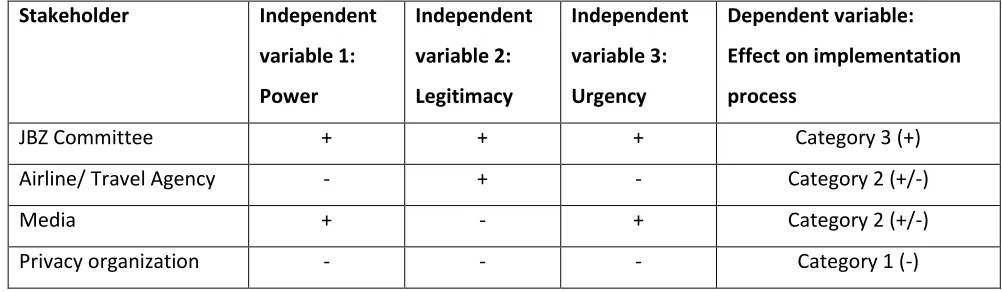
Based on the descriptions that are given in the previous sections for every stakeholder, a stakeholder table could be made that depicts the assessments of the independent variables and the dependent variable.
Stakeholder Independent
variable 1:
Power
Independent
variable 2:
Legitimacy
Independent
variable 3:
Urgency
Dependent variable:
Effect on implementation
process
JBZ Committee + + + Category 3 (+)
Airline/ Travel Agency - + - Category 2 (+/-)
Media + - + Category 2 (+/-)
[image:24.612.54.555.426.572.2]Privacy organization - - - Category 1 (-)
TABLE 1 OVERVIEW PARAMETERS + = high, - = low, category 1 = can join the thinking, category 2= can join the conversation, category 3= can join the decision-making
22
stakeholder scores, contrary to the JBZ Committee, low on all three parameters. Also, their effect on the implementation is no more than thinking along, therefore this stakeholder fits into category one.
The table provides an overview and summary of the descriptions. In the next section, an analysis on how every stakeholder can influence the implementation process will be made.
5.2.
Involved stakeholders affecting the implementation process in the Netherlands
In the previous section, the information on the parameters power, legitimacy and urgency have been discussed for all the involved stakeholders and so provided an answer to sub question one. This section is going to provide an answer to sub question two and analyses the ways in which the involved stakeholders can affect the
implementation process.
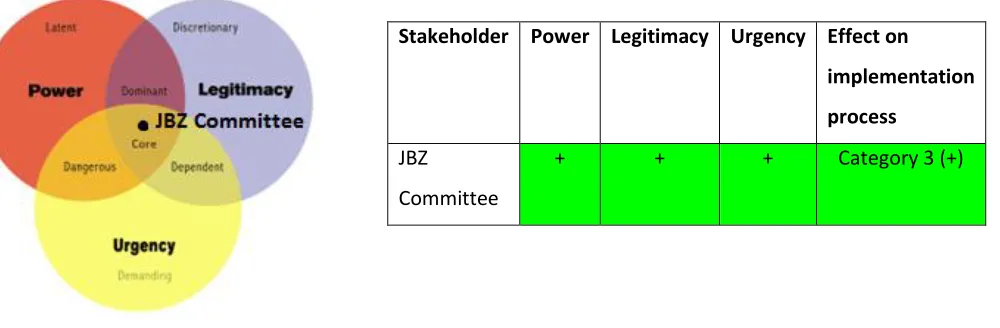
Every paragraph will first show a small part of the table from 5.1.6., so the reader is reminded of the input for the salience model. In the table the data that was rated high are colored green, the data that are rated low red and the data that are rated mediate are colored orange. The three categories on how the stakeholder’s can affect the implementation process and the classified position based on the salience model, will provide information on the ways the involved stakeholders can affect the implementation process in the Netherlands. Section 5.2.5. will described what this means for the expectations that were formulated based on the theoretical framework.
5.2.1. Justice and home affairs (Justitie Binnenlandse Zaken (JBZ))
Based on the description in section 5.1.1. of the JBZ Committee, this stakeholder can now be positioned in the salience model.
[image:25.612.65.565.500.664.2]
FIGURE 3 SALIENCE MODEL - JBZ COMMITTEE
The JBZ Committee can be placed in the core area, because all three parameters are rated high (green data). By definition, if a stakeholder both possesses power and legitimacy, they are a member of the dominant coalition.
Stakeholder Power Legitimacy Urgency Effect on
implementation
process
JBZ
Committee
23
Once the stakeholder also claims that the issue is urgent, the stakeholder’s position enters the core and deserves priority (Mitchell, Agle, & Wood, 1997, p. 26). This stakeholder possesses all the three parameters, meaning that this stakeholder has the highest saliency. Stakeholders that are positioned in the core are highly involved stakeholders that deserve priority and close attention, because this stakeholder is expected to have big effect on the process (Usmani, 2017). This coincides with the observation on the dependent variable. This stakeholder is the only stakeholder that fit in category three and can join in making decisions on this issue (green data). Other stakeholders have to listen to this stakeholder and should keep this stakeholder as a friend. The high level of power can be controlled for by using forms of incentives and regular monitoring (Mitchell, Agle, & Wood, 1997, p. 864).
5.2.2. Airline/Travel agency
[image:26.612.24.595.336.501.2]Based on the information provided in section 5.1.2. the airline/travel agency stakeholder can also be linked with a characteristic from the salience model.
FIGURE 4SALIENCE MODEL – AIRLINE/TRAVEL AGENCY
This stakeholder is positioned in the light blue area. The stakeholder airline/travel agency is seen as a
discretionary player. This means, that this stakeholders possesses the parameter legitimacy (green data) but not possesses power and urgency (red data). Because of the absence of power and urgency, this stakeholder is not always actively involved in the process. Examples of discretionary stakeholders in other situations are nonprofit organizations, schools and hospitals who receive donations (Mitchell, Agle, & Wood, 1997, p. 23). The
airlines/travel agencies are no key player in the implementation process and should not be taken into
consideration as much as the stakeholders that have more power. The information on the dependent variable showed more or less the same, this stakeholder is not as powerful as the JBZ Committee. This stakeholder actually has to listen to the decisions made by, among others, the JBZ Committee. This stakeholder can only join
Stakeholder Power Legitimacy Urgency Effect on
implementation
process
Airline/ Travel Agency
24
the conversation (orange data). In order to keep this stakeholder satisfied and to minimize negative influence on the implementation process, this stakeholder should be given regular states updates (Sharma, 2010).
5.2.3. Media
[image:27.612.51.568.195.380.2]The data of section 5.1.3. on the parameters power, legitimacy and urgency for the media is again provided in the table. This stakeholder can now be positioned in the salience model.
FIGURE 5 SALIENCE MODEL – MEDIA
The media can be placed in the dark orange area, meaning that it can be a dangerous player. This stakeholder has power and the PNR directive is urgent (green data), but does not act legitimate (red data). Dangerous players can be coercive and violent. An example from a dangerous player within an organization would be “a very senior person trying to force his/her views on the outcome, without really being a part of it” (Sharma, 2010).
In the most extreme situation, political terrorists who use bombings for instance can be considered dangerous stakeholders as well, for this research a political terrorist is not considered a stakeholder. A dangerous type of stakeholder operates outside the bounds of legitimacy and can damage other stakeholders involved (Mitchell, Agle, & Wood, 1997, p. 26).
This stakeholder can join the conversation (orange data), but cannot join in making decision. If a dangerous player that does not possesses legitimacy can join in the decision-making this could have noticeable
consequences for the legislation that is made. To minimize the disturbance this stakeholder can give during the implementation process, this stakeholder needs to be “appropriately engaged and satisfied” (Sharma, 2010).
5.2.4. Privacy organization
Based on the descriptions in section 5.1.4. the privacy organization can be positioned in the salience model.
Stakeholder Power Legitimacy Urgency Effect on
implementation
process
25
FIGURE 6 SALIENCE MODEL – PRIVACY ORGANIZATION
For the privacy organization all parameters were rated with the lowest assessment (red data). As can be seen in figure six, this stakeholder therefore cannot be positioned in one of the circles. This stakeholder falls outside the salience model and is to be considered a non-stakeholder (Morphy, 2017). This, however does not mean that this organization has nothing to do with the implementation process. Because it was said that this stakeholder does think along (red data). Only, this stakeholder should not be considered as much as the stakeholders that do fit into the circles of the salience model. Stakeholders should avoid spending too much time and effort with non-stakeholders, simply because their influence on the implementation process is very limited (Sharma, 2010).
5.2.5. Summary of section 5.2
The table beneath indicates for which stakeholders the expectations based on the theoretical framework came true. Underneath the table, the findings will be analyzed. The goal is to explain and clarify why the expectations did or did not came true and to what extent this can be stated with certainty.
Stakeholder Independent
variable 1:
Power
Independent
variable 2:
Legitimacy
Independent
variable 3:
Urgency
Dependent variable:
Effect on implementation
process
JBZ Committee + + + Category 3 (+)
Travel agency/ airline - + - Category 2 (+/-)
Media + - + Category 2 (+/-)
[image:28.612.60.555.493.641.2]Privacy organization - - - Category 1 (-)
TABLE 2 EXPECTATIONS Green text = expectation came true, orange text = expectation came true without certainty
The expectations formulated based on the theoretical framework was, the higher the independent variable, the higher the dependent variable.
Stakeholder Power Legitimacy Urgency Effect on
implementation
process
Privacy organization
26
The JBZ Committee scores the highest on the independent variables and also on the dependent variable. The same applies for the privacy organization, they score lowest on the independent variables and also on the dependent variable. In other words, for these two stakeholders, expectations one, two and three came true and are therefore colored in green.
The media and the airline/travel agency score mediate on the dependent variable and both score mediate on the independent variables. Therefore, the data suggests that also for these two stakeholders expectations one two and three came true, however, not with the same certainty as with the JBZ Committee and the privacy organization.
The next section will discuss in more detail which conclusions can be drawn based on this research and what these conclusions can mean for theory and practice.
6.
Conclusion
6.1.
Results of the study
Since the information on the dependent variables and the independent variable have been described and analyzed, a conclusion based on these findings can now be made. Firstly, a short summary of the thesis will be provided, followed by an answer to sub-questions one and two, which will lead to an answer to the research question. Finally, the theoretical and practical implications will be mentioned, recommendations for further research will be given and limitations of this research will be discussed.
In this research a close look was taken at the involved stakeholders of the implementation process of the PNR directive in the Netherlands. The question that this research tried to answer is which stakeholders are involved at the Dutch national level in the implementation of the European PNR directive and in which ways can these
stakeholders affect this implementation process? This answer is provided with the help of two sub-questions.
Section 5.1 provided an answer to sub-question one: which stakeholders are involved in the implementation process in the Netherlands? The four stakeholders that are involved in the implementation process and
27
legitimacy and low on power and urgency. Both media and airline/travel agency scored mediate on the effect they have on the implementation process. Finally, the privacy organization scored low on power, legitimacy and urgency and could be placed in the category that has the least effect on the implementation process.
Section 5.2. provided an answer to the second sub-question: in which ways can the involved stakeholders affect the implementation process in the Netherlands? The position of the, in sub-question one described,
stakeholders are analyzed. The JBZ Committee has the highest effect on the implementation process and can be placed in the core area of the salience model. This indicates that the stakeholder has the highest saliency and that the stakeholder should be treated accordingly in order to not disturb the process. The parameters are high and the effect the JBZ Committee has on the implementation process is high as well. For this stakeholder it can be concluded that the expectations came true and that there is indeed a positive relationship between the parameters power, legitimacy and urgency and the effect the stakeholder can have on the implementation process.
The same applies for the privacy organization. This stakeholder scored low on all three parameters and fits into the category that has the lowest effect on the implementation process. This means, that the positive
relationship between the independent variables and the dependent variable is, again, confirmed. This stakeholder has very limited effect on the implementation process and is therefore considered a non-stakeholder. This implies that it is not worth to spend too much time and effort on this stakeholder because their influence is minimal.