BPMN Plus:
A Modelling Language for
Unstructured Business
Processes
Zaharah Allah Bukhsh
BPMN Plus:
A Modelling Language for
Unstructured Business Processes
Zaharah Allah Bukhsh
S1305131
[email protected]
Master of Science in Computer Science,
Faculty of Electrical Engineering, Mathematics and Computer Science,
University of Twente,
Enschede, The Netherlands.
19
thAugust, 2015
Graduation Committee:
Dr. Ir. Marten J. van Sinderen, University of Twente
Dr. N. (Klaas) Sikkel, University of Twente
Acknowledgement
This thesis concludes the end of my two year process of obtaining a Master degree at the University of Twente. Last two years have been full of challenges and new experiences. I have learnt new knowledge, adopted a different way of working, and become accustomed to different weather. This research report is the result of seven months dedication and efforts that I have spent in BiZZdesign, Enschede.
This thesis wouldn’t be possible without the support, guidance and time from a lot of people. It is my pleasure to mention some of them here. I would like to express my deepest gratitude to my thesis supervisors Dr. Marten van Sindheren and Dr. Klass Sikkel from University of Twente, and Dr. Dick Quartel from BiZZdesign, for their guidance, helpful feedback, and support. Their useful input, critical questions and advice pointed me towards the right direction and helped me to acquire a better and clearer view on business process modelling languages.
I would like to pay my thanks to my teachers from The Islamia University of Bahawalpur, Bahawalnagar Campus, Pakistan for their encouragement to pursue Master in a Euro-pean university. Moreover, their support and trust in me bring a lot of confidence and kept me motivated during my studies.
I owe a special thanks to my friends, especially Anastasia Maria Krisnawati and Shu Cheng for their time, feedback and backing me up after each setback. Without them, last seven months wouldn’t have been so fun and memorable.
I would like to thank my parents for their unconditional love, endless efforts and loads of prayers. I am thankful to my brother and sister for being an emotional support for me. I owe a special thanks to my sister Faiza for being a constant support in my studies and being an inspiration in my life. Moreover, I want to thank my brother-in-law for his continuous “encouragement”.
Last but not least, I would like to thank the reader of this thesis for their interest in my research. I hope, my thesis results in an insightful journey for you as it was for me.
Executive Summary
In this competitive business era, efficient resource utilization is the priority for a business for their long term survival. This is achieved by an efficient management of business processes using various techniques and methods. The process support paradigm consists of a set of methods and techniques for the management of business processes. On the spectrum of process structuredness, a business process can be broadly categorised as structured and unstructured. Structured business processes are sets of ordered activities that are repetitive and predictable while the activities of unstructured business processes are context dependent, which make them hard to predict.
Management of structured business processes is the topic of research for both academia and industry, where academia focuses on the development of methods and techniques while industry focuses on the development of tools. However, with the shift from routine to knowledge work, the focus on management of unstructured business processes is increasing. Moreover, unstructured processes are goal-oriented and require flexibility during their execution. Therefore, this research is aimed to investigate the techniques to model and manage unstructured processes without limiting their run-time flexibility.
To achieve the goal of the research, process support paradigms, i.e. business process man-agement and case manman-agement, are assessed on the basis of their support to manage unstructured business processes. These process support paradigms are analysed with the help of software tools, Bizagi and Cognoscenti, by implementing an unstructured business process and evaluating it using process management aspects such as process modelling, data modelling, user roles, and business rules specifications. Furthermore, the capabilities of Business Process Model and Notation (BPMN) and Case Manage-ment Model and Notation (CMMN) is analysed by modelling an unstructured business process. This has enabled us to identify limitations of BPMN and CMMN. For example, BPMN does not provide the run-time flexibility for process execution, while the CMMN is unable to depict the structured process. This analysis led us to define requirements for the modelling of unstructured business processes.
BPMN Plus is an extension of BPMN standard that is proposed in this research on the basis of the requirements set for the modelling of unstructured business processes. BPMN Plus provides a set of concepts and constructs that are aimed to model unstruc-tured processes without limiting their run-time flexibility. The use of BPMN Plus is demonstrated with the help of an example of a knowledge-intensive admission process.
Acknowledgement iii
Executive Summary iv
Contents v
List of Figures viii
List of Tables x
Abbreviations xi
1 Introduction 1
1.1 Motivation . . . 2
1.2 Research Goals . . . 3
1.3 Research Questions . . . 4
1.4 Research Methodology . . . 6
1.5 Document Structure . . . 8
2 Theoretical Framework 10 2.1 Key Concepts . . . 10
2.1.1 Business Process . . . 10
2.1.2 Business Process Spectrum . . . 12
2.1.3 Unstructured Business Processes and Different Terminologies . . . 14
2.2 Management of Unstructured Business Processes . . . 15
2.2.1 Business Process Management (BPM) . . . 15
2.2.2 Case Management (CM) . . . 18
2.3 Modelling of Unstructured Business Processes . . . 21
2.3.1 Business Process Model and Notation (BPMN) . . . 21
2.3.2 Case Management Model and Notation (CMMN) . . . 22
2.4 Summary . . . 23
3 An Experiment to Compare BPM and CM 24 3.1 Experiment . . . 25
3.1.1 Context . . . 25
3.1.2 Hypothesis . . . 26
3.2 Experiment Setup . . . 26
3.3 Experiment Execution . . . 29
3.3.1 Insurance Claim Process with Bizagi (BPM) . . . 29
3.3.2 Insurance Claim process with Cognoscenti (CM) . . . 31
3.4 Results of Experiment . . . 32
3.5 Summary . . . 35
4 Exploring BPMN and CMMN for Unstructured Business Processes 36 4.1 Business Process Modelling . . . 36
4.2 Modelling Unstructured Business Process with BPMN . . . 37
4.2.1 Modelling an Unstructured Process Using BPMN Basic . . . 38
4.2.2 Modelling an Unstructured Process Using BPMN Extended . . . 42
4.3 Modelling an Unstructured Process with CMMN . . . 44
4.4 Comparison of BPMN and CMMN . . . 47
4.5 Summary . . . 51
5 Representational Requirements of Unstructured Business Processes 53 5.1 Characteristics of Unstructured Business Processes . . . 54
5.2 Requirements of Unstructured Business Processes . . . 56
5.2.1 Application Scenario . . . 56
5.2.2 Process Specification . . . 57
5.2.3 Activities Specification. . . 58
5.2.4 Data Specification . . . 62
5.2.5 Business Rules Specification. . . 63
5.2.6 Goal Specification . . . 63
5.2.7 Knowledge Workers’ Specification . . . 64
5.3 BPMN and Conformance to Requirements . . . 66
5.4 Summary . . . 68
6 Extending BPMN for Unstructured Business Processes 70 6.1 BPMN Plus . . . 70
6.1.1 BPMN Core . . . 71
6.1.2 Process . . . 72
6.1.3 Activity . . . 73
6.1.4 Data . . . 75
6.1.5 Performer . . . 76
6.1.6 Event . . . 78
6.1.7 Gateway. . . 79
6.1.8 Goal . . . 80
6.2 BPMN Plus Notations . . . 80
6.2.1 Lane . . . 80
6.2.2 Activity . . . 81
6.2.3 Event . . . 84
6.2.4 Goal . . . 84
6.2.5 Business Rule . . . 85
6.2.6 Gateway. . . 85
6.2.7 Sequential Flow. . . 86
6.2.8 Data . . . 86
6.2.9 Performer . . . 87
6.3.1 BPMN Plus Application Example . . . 88
6.3.2 Comparison of BPMN Plus with BPMN . . . 90
6.3.3 Comparison of BPMN Plus with CMMN . . . 93
6.3.4 Modelling Benefits of BPMN Plus . . . 95
6.4 Summary . . . 96
7 Validation of BPMN Plus 97 7.1 Assessment Criteria and Validation Method . . . 97
7.2 Validation Outcomes . . . 99
7.2.1 Market Trend . . . 99
7.2.2 Limitations of BPMN . . . 100
7.2.3 Usefulness . . . 101
7.2.4 Ease of Understanding . . . 103
7.2.5 Correctness . . . 104
7.2.6 Applicability . . . 105
7.3 Recommendations for Improvement of BPMN Plus . . . 105
7.4 Personal Reflection and Summary . . . 106
8 Conclusions and Recommendations 109 8.1 Answers to Research Questions . . . 109
8.2 Contributions . . . 111
8.2.1 Theoretical Contributions . . . 111
8.2.2 Practical Contributions . . . 112
8.3 Limitations . . . 113
8.4 Recommendations for Future Research . . . 114
A Business Process Implementation 115
B Interviews Transcripts 121
1.1 Engineering and Design Cycle . . . 6
1.2 Thesis Outline . . . 9
2.1 Business Process Spectrum . . . 12
2.2 Business Process Management Lifecycle . . . 16
2.3 Architecture of Business Process Management [1] . . . 18
2.4 Core Principles of Case Management . . . 19
2.5 Architecture of Case Management . . . 20
4.1 Process Model of Insurance Claim Process Using BPMN Basic . . . 39
4.2 Process Model of Insurance Claim Process Using BPMN Extended . . . . 43
4.3 Case Model of Insurance Claim Process Using CMMN . . . 45
4.4 Definition and Execution of BPMN Model . . . 48
4.5 Definition and Execution of CMMN Model . . . 48
5.1 Requirements (framework) for Unstructured Business Processes . . . 56
6.1 BPMN Core Adopted from BPMN Specfication 2.0 [2] . . . 71
6.2 Process Class Diagram . . . 72
6.3 Activity Class Diagram . . . 73
6.4 Task Class Diagram . . . 75
6.5 Data Class Diagram . . . 75
6.6 Process and Data Class Diagram . . . 77
6.7 Performer Class Diagram . . . 77
6.8 Event Class Diagram . . . 78
6.9 Gateway Class Diagram . . . 79
6.10 Goal Class Diagram . . . 80
6.11 Lane Shape . . . 80
6.12 Activity Shape . . . 81
6.13 Sub-Process Shape . . . 81
6.14 Collaborative Activity Shape . . . 81
6.15 Call Activity Shape. . . 82
6.16 Decision Activity Shape . . . 82
6.17 Human Activity Shape . . . 82
6.18 Optional Activity Shape . . . 83
6.19 Required Activity Shape . . . 83
6.20 Re-execute Activity Shape . . . 83
6.21 Undo Activity Shape . . . 84
6.22 Standard and User Event Shape . . . 84
6.23 Timer Event Shape . . . 84
6.24 Goal Shape . . . 85
6.25 Business Rule Shape . . . 85
6.26 Gateways Shape . . . 86
6.27 Sequence Flow Shape. . . 86
6.28 Data Shape . . . 87
6.29 Performer and Role Shape . . . 87
6.30 Process Model of Admission Process using BPMN Plus . . . 88
6.31 Process Model of Admission Process Using BPMN Basic . . . 90
6.32 Process Model of Admission Process Using BPMN Extended . . . 92
6.33 Process Model of Admission Process Using CMMN . . . 94
A.1 Process Model . . . 115
A.2 Data Model . . . 116
A.3 User Form (Register Insurance Claim Request) . . . 116
A.4 Business Rules . . . 117
A.5 User Roles. . . 117
A.6 Work Portal View(from Customer Profile) . . . 118
A.7 Case Model . . . 118
A.8 User Profiles . . . 119
A.9 Task Assignment . . . 119
A.10 Document Management . . . 120
3.1 Difference between BPM and CM . . . 33
4.1 Comparison of BPMN and CMMN Modelling Constructs . . . 49
5.1 BPMN and Conformance to Requirements . . . 69
7.1 Assessment Criteria and Validation Questions . . . 99
7.2 Summary of Interview Session . . . 108
CM CaseManagement
BPM Business ProcessManagement
DMN Decision Model and Notations
OMG Object Management Group
GSM GuardStageMilestone
CMS CaseManagementSuite
CFC ControlFlow Complexity
MCC McCabe’sCyclomaticComplexity
BPMN Business ProcessModel and Notation
CMMN CaseManagementModel and Notation
AIIM Assosiation fpr Information and Image Management
BPMS Business ProcessManagementSuite
et. al. et alii (and others/collaborators)
e.g. exampligratia (for example)
i.e. id est (that is)
cf. confer (consult)
Introduction
Evolution of business and customer requirements are key drivers of business information
technology. Business information systems are able to provide the efficiency as well as
assist the business in adopting the optimum solutions, draw attention to the delays and
bottlenecks, and predict future efforts. A business has a number of business processes,
which need to be continuously monitored and optimized. Process support paradigm is
an umbrella of techniques and methodologies that facilitates the management of business
processes. The examples of such methodologies are business process management, case
management, lean management, and six sigma. Many tools provide the support to these
methodologies where the business process is planned, modelled and executed.
Traditionally, business processes are classified into external processes, management
pro-cesses, and support processes. This classification is based on the ‘type of task’ performed
by these processes. However, there is another classification of business processes that is
based on ‘way’ the processes are planned and performed. Such processes include
struc-tured and unstrucstruc-tured business processes. Since, business processes are not similar
in nature; they require different treatments and one methodology could be better in
treating one type of process as compared to other methodology.
Therefore, the focus of this study is to analyse the process support paradigms and process
modelling languages to investigate their capability to deal with unstructured business
processes.
The structure of this chapter is as follows: the motivation to conduct this research study
is provided in Section1.1. Research goals, research questions and research methodology
are presented in Section 1.2,1.3, and1.4respectively. Finally, Section 1.5provides the
structure of this thesis.
1.1
Motivation
Structured business processes have ruled the business process world for centuries.
How-ever, according to a recent survey by Association for Information and Image
Manage-ment (AIIM) [3], 51% of companies indicate that more than half of their process are
unpredictable and unstructured in nature. Such processes are dealt in an ad-hoc
man-ner by manually capturing the process related data and stakeholders’ communication
through e-mails, phone calls, sticky notes, and other informal means. These processes
take many unexpected paths based on available data and contextual information. Thus,
such processes are difficult to define and model.
In management of business processes, there has been a successful shift from manual
processing (paper-based approach) to the automated execution of processes
(workflow-based approach). Business Process Management (BPM) is an approach that extends
the workflow-based approach in process modelling, process analysis, and process
execu-tion [4]. The purpose of BPM is to enhance the overall visibility of processes among IT
and business people. In BPM, the processes are well-structured in nature.However, on
the other side, there are unstructured business processes where planning of tasks and the
order of activities is difficult to predict and model at design-time. Van Der Aalst et.al.
proposed the case handling as a new paradigm to deal with such type (unstructured
nature) of processes [5]. Data is the main driver of the process flow of unstructured
processes.
Case handling, also called case management, is defined as advance BPM where the focus
is on processing ‘case’, which require the collection of data and collaborative activities
by many knowledge workers to reach to the conclusions [6]. The notion of case can
be understood from medical and legal departments where a case belongs to a specific
patient or client. At the processing of cases, data are collected and decisions are made by
knowledge workers. But, the required data, course of action, involved parties, and final
outcome cannot be predicted in advance. For example, in a process of dispute handling
be predicted even after the start of the dispute handing process. A knowledge worker
needs to analyse the situation and possible solution steps. Dealing the unstructured
business processes in structured way limits the knowledge-worker’s freedom into
pre-defined activities and flows. In this research, the term ‘case’ is referred to unstructured
business process.
Unstructured business processes is not a new concept. Companies adopt different
methodologies to deal with unstructured business processes in a structured way [7].
For instance, insurance claim processing was quoted as an example of structured
busi-ness process in BPM [8] while now it is used as an example of unstructured business
process [9]. Case management as a new concept, with its advertised vendor solutions,
pushes the companies to reconsider their approach of dealing with unstructured
busi-ness processes. For companies, there is a need to analyse the benefits of modelling and
managing the unstructured business processes. The initial step includes the focus on
process modelling languages to model and communicate the unstructured business
pro-cesses properly. Therefore, the motivation of this research is to study the unstructured
business processes to find suitable ways for their modelling and management. This study
provides the insights into the capabilities of existing process management approaches
from methodology and modelling perspective. The capabilities of BPMN and CMMN
is mainly assessed to model the unstructured business processes.
1.2
Research Goals
The goal of this study is to investigate the process support paradigms and process
mod-elling languages to understand their capabilities for the management of the unstructured
business processes. We are particularly interested to investigate the possibilities to model
the unstructured business processes in a flexible manner.
The objective of this study is
“To investigate the way through which the unstructured business processes can
be modelled and managed without limiting their run-time flexibility.”
• To investigate the methodological differences between BPM and CM.
• To investigate whether the current process management paradigms (e.g. BPM)
are able to support the unstructured business processes.
• To study the capabilities of BPMN apart from its commonly used notations.
• To study the capabilities of CMMN to model an unstructured business process.
• To investigate the difference between the CMMN and BPMN modelling standards.
• To study the characteristics of unstructured business processes.
1.3
Research Questions
The main research question of this research is as follows:
Main RQ: How can unstructured business processes be modelled and managed in a flexible manner?
To answer the main research question, four subresearch questions are formulated. These
subresearch questions allows us to refine our literature search and set the base to answer
the main research question.
1. What are the differences between structured and unstructured business processes?
This question is considered to understand the basic difference between structured
and unstructured processes in business. The answer to this question will provide
the basic background knowledge to understand the purpose and discussion of this
research study.
2. What are the differences between BPM and CM in dealing with unstructured
business processes?
• What is Business Process Management (BPM)?
• What is Case Management (CM)?
The purpose of these questions is to study the approach of BPM and CM. The
answer to these questions will provide the insight about differences between the
process management approach of BPM and CM. To compare BPM and CM , an
experiment is planned.
3. What are the capabilities of existing modelling notations to deal with unstructured
business processes?
• What are the capabilities of BPMN?
• What are the capabilities of CMMN?
• What are differences between BPMN and CMMN?
• How are the process models of BPMN and CMMN different in their
express-ibility?
The purpose of these questions is to investigate the capabilities of process modelling
notations to deal with unstructured business processes. The reason to investigate
the capabilities stemmed from the fact that the capabilities of a modelling language
is not utilised completely and its use is remained confined to a subset of concepts,
which are well known. According to Zur Muehlen and Recker [10], less than 20%
of BPMN vocabulary is regularly used in academia and industry. The reason
to consider BPMN is because it is one of the widely adopted process modelling
language. While, CMMN is considered because it is the only available modelling
standard that is targeted to model the undefined and not so repeatable set of
activities of business processes. Moreover, both modelling notations, BPMN and
CMMN, are proposed by OMG, which means the deficiencies of one modelling
language is expected to be fulfilled by the other. BPMN and CMMN are compared
to gauge their support for modelling unstructured business processes.
4. How to model an unstructured business process while providing run-time
flexibil-ity?
• What are the modelling requirements of an unstructured business process?
• How to model an unstructured business process flexibly?
The purpose of this question is to investigate the modelling needs of an
to extend a modelling notation that is capable of modelling unstructured process
without limiting its run-time flexibility. The practical usefulness of newly
pro-posed modelling notation is investigated by demonstrating it with the help of an
example. Moreover, the proposed modelling notation is validated by conducting
interviews with experienced practitioners.
1.4
Research Methodology
Practical problems and knowledge problems are two main types of research problems [11].
The difference between the current state of artefact and how stakeholders want it to be
from the class of practical problems. The other class of research problem is knowledge
problem that is the difference between current knowledge of stakeholders and what they
want to know. In other words, practical problems, investigate, design, and improve the
artefact or certain aspects of it, while knowledge problems analyse the current state of
[image:17.596.90.480.412.694.2]knowledge to analysis its usefulness for stakeholders.
The research questions of this study belong to the class of practical problems. Wieringa [12]
has proposed an engineering cycle as a research methodology to answer the practical
problems. The steps of engineering cycle are presented in Figure 1.1. In addition to
main steps, a related check-list is defined with each step. The check-list points provide
the guidance throughout the research process.
For this research, only a part of engineering cycle, i.e. design cycle is implemented.
Design cycle does not include the final implementation phase of the engineering cycle.
In the following, the explanation about the adopted design cycle for this research is
provided.
Problem Investigation: In this first step, the research problem is investigated and
reasons for problem consideration is provided. As mentioned in Section 1.1, companies
are encountering with increased number of unstructured business processes. These
un-structured business processes are dealt in an ad-hoc manner, which results into manual
process processing and unstructured process data. In order to have firm understanding
of underlying problems, in-depth literature studies will be performed regarding BPM
and CM as process support paradigms and BPMN and CMMN as process modelling
languages.
Treatment Design: In this step, the available design treatment(s) are analysed and the
new treatment is designed to solve or mitigate the identified problems. In this research,
the available design treatments are BPM and CM, as process support paradigms, and
BPMN and CMMN as modelling languages. To assess the process management
method-ology of BPM and CM, a experiment is planned. A comprehensive business process will
be implemented on BPM and CM based software tools. Apart from process management
methodology, the process modelling languages, which are BPMN and CMMN will be
assessed in order to gauge their support for modelling an unstructured business process
flexibly. The capabilities of BPMN and CMMN is planned to be assessed by
mod-elling a sample unstructured business process. Modmod-elling of an unstructured business
process with BPMN and CMMN will assist us in tracing their limitations. Based on
modelling limitations of both languages, the requirements to model an unstructured
business process will be derived. To fulfil the modelling requirements of unstructured
business processes, an extension to BPMN modelling standard will be proposed. BPMN
1. BPMN is one of most popular modelling language that has been widely adopted
in business due to its rich and expressive modelling constructs.
2. It is expected that the modelling concepts and constructs of BPMN will be able to
fulfils many derived requirements of modelling an unstructured business process
in flexible manner, thus requiring only few new constructs as extension.
3. With an extension to BPMN, it will be possible to model the structured and
unstructured part of a business process.
The extended BPMN will be named as BPMN Plus. The extension of BPMN will
have some new concepts and constructs while some modification in existing concepts
of BPMN can also be made. The demonstration of BPMN Plus will be performed by
modelling a sample unstructured business process.
Design Validation: In this final step, the proposed treatment design can be validated
with the help of case studies, client’s feedback, experiments, and interviews. The
pro-posed artefact of this research, which is BPMN Plus, is planned to be validated by
conducting semi-structured qualitative interviews with three experienced practitioners
of BiZZdesign. These interviews will provide us with interesting insights about the
BPMN Plus with respect to its practical usefulness.
It is important to notice that the feedback provided by interviewees and practical use
of BPMN Plus can initiate another research cycle. However, the scope of this thesis is
limited to execution of design cycle only once.
1.5
Document Structure
The structure of this thesis is depicted in Figure1.2. From a formal research perspective,
there are four major parts of this thesis. In background part, Chapter 1 provide
moti-vation of this research along with research objectives, research questions, and research
methodology. The theoretical background of this study is defined in Chapter 2, which
discusses the main terminologies and concepts. The available solutions are described in
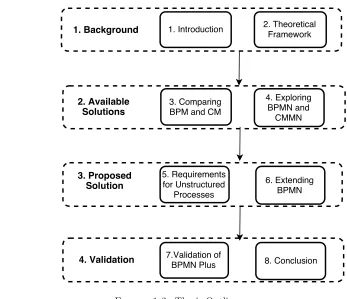
Figure 1.2: Thesis Outline
to understand the methodological difference of BPM and CM for dealing an
unstruc-tured business process. Chapter 4 provide the analysis of popular modelling notations
to investigate their capability to model an unstructured business process.
In third part, an artefact is proposed to deal with unstructured business processes. In
Chapter 5, the requirements to model the unstructured business processes are
identi-fied. Chapter 6 define the proposed extension to existing modelling standard BPMN.
The proposed requirements and extension to BPMN is demonstrated with the help of an
example application. In validation part, BPMN Plus is validated by conducting
inter-views with experienced practitioners. The validation settings and results are provided
in Chapter 7. Lastly, Chapter 8 provides the answers to research questions following
Theoretical Framework
In this chapter, the theoretical background of this research is defined. Some parts of this
chapter are taken from an internal report conducted for the sake of literature study [13].
Section2.1introduce the key concepts of this research. These concepts include the
def-inition and discussion of general terminologies that are used throughout this document.
An overview of current literature regarding the management and modelling of
unstruc-tured business processes is provided in Section 2.2 and 2.3 respectively. The summary
of this chapter is given in Section 2.4.
2.1
Key Concepts
2.1.1 Business Process
A process is a procedure which consists of a set of activities that produce a certain
outcome either in a form of product, service or a decision. The notion of process can
be understood from our routine actions. Buying grocery, cooking food, getting ready
for work are examples of a process which further consist of a number of small activities.
The concept of process in business was first introduced by Adam Smith in 1776 which
was mainly focused on division of labour [14]. Even after centuries, a standard definition
of business process don’t exist. Here, some definitions are quoted to set the base for this
research.
Michael Hammer and James Champy define the business process as
“Collection of activities that take one or more kinds of input and create an output
that is of value to the customer” [15]
According to this definition, a process must have input(s) that will produce certain
outcome. The aspect of “collection of activities” doesn’t define any ordering among
activities.
Davenport defines the business process as
“A structured, measured set of activities designed to produce a specific output for
a particular customer or market. It implies a strong emphasis on how work is done
within an organization. A process is thus a specific ordering of work activities
across time and space, with a beginning and an end, and clearly defined inputs
and outputs: a structure for action. . . ” [16]
As compared to Hammer and Chumpy definition [15], the Davenport definition [16]
implies certain condition on a process to be specified as a business process. According
to him, a business process is required to be detailed which answers “how work is done”
with structured, ordered and measured set of activities.
In the Open Group’s Archimate specification, business process is defined as
“A behaviour element that groups behaviour based on an ordering of activities.
It is intended to produce a defined set of products or business services” [17].
The concept of definition suggested by OpenGroup [17] is similar to the Davenport
definition [16] which suggests the ordering of activities as an integral part of the business
process.
According to OMG’s Business Motivation Model (BMM) specification,
“Business processes realize courses of action. Courses of action are undertaken to
ensure that the enterprise makes progress towards one or more of its goals” [18].
The definition provided in the OMG BMM specification is very generic in nature. Based
as a business process. Similar to Hammer and Clampy definition [15] the ordering of
activities and their structuredness are not a central part of a process.
It is worth noticing that the each of the considered definitions differs in its context and
scope while having certain aspects in common. By context, we mean, “business process”
term is used in identifying, specifying, modelling, analysing and improving the regular
occurring business operations. In any of these contexts, the purpose of process is to
provide certain outcome either by following structured and ordered set of activities or
by an unstructured collection of activities.
2.1.2 Business Process Spectrum
A business perform different business operations on daily basis. These business
opera-tions are also defined as business process which help the business to achieve its
objec-tive. The nature of business process vary by its associated participants, resources, and
its interaction with computer systems [19]. The classification of business process was
first provided by Mccready [20] where the process are defined as ad-hoc, administrative
and production. Van der Aalst et. al. proposed a slightly different business process
classification, which are tightly framed process, loosely framed process, ad-hoc framed
process and un-framed process [21]. Here, the business process classification proposed
[image:23.596.171.386.518.735.2]by Kemsley is discussed [22].
Figure 2.1provides the view of the business process spectrum based on process level of
structuredness. On the top of the spectrum in Figure2.1, there arestructured processes
in which the sequence of activities can be predicted and planned before the real-time
exe-cution of process. These processes are application-centric that are easy to automate and
are repeatable in nature. Such process can be modelled completely with roles, real-time
events, ordered set of activities and their possible flow of data. With process model, a
process can be further analysed, optimized, monitored and executed. A fully automated
structured process is able to communicate with other systems as well as can take
ac-tions based on pre-programmed condiac-tions and events. The regular occurring processes
are examples of structured process, e.g. order placement, customer registration, salary
payments.
The complex scenarios of business require the structured processes to be able to deal with
accidental and unpredictable situations. Structured processes with ad-hoc exceptions is an example of such processes where activities are not performed in real-time as it was
planned in design-time. The ad-hoc exception of the process include the alternative
order of activities execution, adding or removing of activities, varying time, occurring
of message or manual events. The common reason of such exception are contextual
triggers, changed customer requirements, and process related data. It is difficult to
model such processes as real-world situations cannot be predicted in advance. The
example of structured process with ad-hoc exceptions are lost of order delivery, financial
services transactions, etc.
Moving away from structured processes spectrum, Unstructured process with pre-define fragments are those processes which cannot be anticipated and defined in advance how-ever some parts of the process can be predicted. For instance, in customers complain
services the process to register customer complain and to provide response are
struc-tured, but the required activities to deal with customer complaints can vary for each
customer complain.
On the other extreme, there areUnstructured processes, as its name implies, are difficult to define and model as the exact course of activities are unknown at design-time. The
focus of unstructured process is on available and emerging data, real-time events and
knowledge of knowledge workers. Thus, a process is said to be unstructured if its
making skills from one or more knowledge workers to solve the problem at hand. The
example of such process is claim handling, loan approvals, accounts payable, customer
service, and travel requests.
In a nutshell, business processes can be broadly categorised into structured and
unstruc-tured processes. Strucunstruc-tured processes are also said to be activity-centric as the focus
is to perform an activity by executing a number of small tasks. On the other hand,
unstructured processes are unpredictable, flexible and non-repeatable. Data and human
collaboration are integral parts of unstructured process execution.
2.1.3 Unstructured Business Processes and Different Terminologies
During literature study, different terminologies for unstructured processes are noticed.
These terminologies refer to the similar concept of business process as being
unpre-dictable, context depend and require human collaboration. The possible reason for
many terminologies is because of different process support paradigms that are used for
process management.
In the following, each of these terminology that provide the concept of unstructured
processes is discussed.
Case The notion of the case is adapted from legal and medical field where each case tend
to be different than the other. OMG defined the case as ‘a proceeding that involves
actions taken regarding a subject in a particular situation to achieve a particular
outcome’ [23]. The actions taken vary from collection of data, making decisions
and involving other knowledge workers. Unstructured business processes are most
commonly referred as case due to case management process support paradigm (see
Section2.2.2).
Knowledge-Intensive Process The process highly rely on available data and
knowl-edge of knowlknowl-edge workers/process manager to take process related actions. Vacul´ın
et. al. define the knowledge intensive process as business process whose conduct
and execution is highly dependant on knowledge workers performing different tasks
and taking decisions [24]. These processes require a substantial level of flexibility
Dynamic/Declarative Process These processes don’t follow the design-time defined
structure of business process, but tend to change with respect to certain process
instance requirement. Such process are declarative in nature which means that
process related information is not defined in detail at design-time.
Person-to-person process The involved stakeholders play the primary role in the
execution of process [19]. Such process requires the human intervention in the
form of task execution, making decisions, and regulating process flows.
Each of the discussed terminology refers to same process related concepts, i.e. the
process is unpredictable and dynamic in nature, it requires the design-time and run-time
flexibility, data and knowledge workers are its primary focus and each process instance
tend to be differ than the other. To avoid confusion with different terms, we will be
using the termunstructured business process to refer to a dynamic, knowledge-intensive, collaborative business process.
2.2
Management of Unstructured Business Processes
In this section, two process support paradigms are discussed. These paradigms are
referred as process support paradigms because they facilitate the management of business
processes by providing the set of methods, techniques and tools.
2.2.1 Business Process Management (BPM)
Business Process Management (BPM) is one of the most popular process support paradigm.
The purpose of BPM is to innovate, maintain and optimize the business process by
defin-ing, modelling and automating it. BPM integrates the business process, information,
IT, and human resources, thus aligning the organization’s code assets [25]. Initially,
BPM was mainly focused on automation of business process, but the advancement of
technology enables the BPM with capabilities of process analysis, optimization and
management. The most basic activities of BPM are modelling, enactment, analysis and
management [4]. In process modelling, the core activities, user roles, and control flow of
The graphical model of the process, not only defines the process in a concrete
man-ner, but it enables discussion among business stakeholders for the further refinement,
optimization and management of the process. While, an automated business process
re-sults in increased efficiency and reduced cost. The enactment of process model provides
the results which can be further analysed and managed by process managers. These
days, many BPM Suites (BPMS) provide the platform for process modelling, process
execution and process analysis.
Since BPM paradigm has been evolving for years, it possesses many definitions
pro-vided by researchers. Johan Nelis et. al. define the business process management as,
“the achievement of an organization’s objectives through the improvement, management
and control of essential business processes” [26]. While, according to Weske, “business
process management includes concepts, methods, and techniques to support the design,
administration, configuration, enactment, and analysis of business processes” [27].
Ac-cording to John Jeston’s definition [26], BPM constitute of those activities that perform
process improvement while according to Weske’s definition [27] the techniques and
meth-ods that are used to perform the process design, administration, analysis and
improve-ment are all part of BPM. The activities of BPM strictly depend on used techniques,
methods, and sometimes BPMS, so one can say that definition provided by Weske [27]
represent the today’s BPM.
Figure2.2provides the continuous improvement lifecycle of BPM. On design step,
[image:27.596.188.374.546.729.2]busi-ness processes are surveyed based on their technical and organisational environment [27].
The design phase allows the process engineer to analyse and go through the daily
occur-ring processes of business. The business process is designed into collection of activities,
real-time events and control logic. Based on process design, process is modelled in
graphical form. Process modelling languages provide the notations for representation
of activities, events and control logic. Such notations make the process model easier to
read and generally understandable for the business stakeholders.
For software engineers, the process model acts as a requirement specification document
for the implementation and automation of business process. Once the process is
imple-mented, it can be executed as process instances. The execution of processes requires
continued monitoring. The process events and activities require human intervention
for triggering process events and for completion of the task. Process execution also
provides insights into the resource utilizations, task efficiency and possible bottlenecks.
Such analysis report provides the chances for process optimization.
Different process support techniques are used for optimization of process. Lean
man-agement and six sigma are examples of such techniques in which waste of resources is
eliminated as much as possible, so the assets can be utilized into effective manner.
Architecture of Business Process Management
To provide an overview of process modelling and process execution from the
perspec-tive of BPMS, Figure 2.3 is adopted from Weber et. al. [1]. Main focused aspect of
BPM lifecycle is process modelling. All the subsequent steps of BPM are dependent on
the process model. The steps of process monitoring and process optimization are not
depicted in Figure2.3.
Once the process is modelled and ready for execution, the end-user can access the process
through the electronic forms. As soon as, end user initiates the process, the process
instance is created in the process execution engine. The entire process instance will
follow the process model that is defined by the process engineer on design-time. However,
end user can only view that part of the process that is assigned to him. The limited
view over process is known as context tunnelling. Context tunnelling is explained as the
“tunnelling the vision of end-users on the design-time specific tasks and activities without
the consideration of real-time contextual information of process” [5]. Moreover, it is
worth noticing that process execution and business related data are strictly separated.
Figure 2.3: Architecture of Business Process Management [1]
process model while the data is dealt as the second class citizens. Because of separation
of process and data, each process instance has a limited view on in and out flow of
business data.
2.2.2 Case Management (CM)
Case management is a process support paradigm that facilitates the management of
unstructured business processes in a flexible way. It facilitates the government, banking,
insurance companies, and legal firms in capturing the complex customer interactions.
Case management as a paradigm for business process support was proposed by Van
der Aalst et. al. in 2003 [28]. He explained the difference between BPM and case
management as BPM focus on what ‘should’ be done in a business process while the
later one is about what ‘can’ be done [28].
IBM defined case management as, “it is a goal-oriented process where people must make
real-time, complex decisions with changing information, often working interactively with
others inside or outside of their organizations to obtain the most effective outcome” [6].
Case management as paradigm facilitate the knowledge workers in decision making,
data capturing, and employing the tacit knowledge to respond to unique and changing
In case management, the process instance is referred as a case. The case can be defined
as “collection of tasks, actions, processes, and content in support of a specific business
process” [30]. Data and actions of knowledge workers are the centre of focus that drive
the whole process. Addition or modification of data can change the course of activities
and case final outcome.
Case management is broadly categorised into two types: production case management
and adaptive case management [31]. In production case management, each process
instance can have many variations. Due to the unpredictability and varying nature, it
is not possible to define a single fixed process. Yet, the other possible solutions to deal
with cases are known and can be taken. The knowledge worker is continuously involved
in analysing the case need and providing the appropriate solutions. In adaptive case
management, there is need of constant innovation. The knowledge workers are involved
in inventing the solution to cases that don’t exist before.
In this research, the main concept of case management is studied. Discussion on different
types of case management and their characteristics is out of the scope of this study.
Figure 2.4 provide the core principles of case management. A case is goal-oriented in
nature as the goal of the case is known in advance, but the course of action to reach the
goal is unknown until the case is at-hand. Case management is required to be adaptive
as the end users are not process engineers, but the knowledge workers who are required
to take complex decisions based on available data and real-time events. The adaptive
ability of case management paradigm suites the unstructured business process as the
structure of the process cannot be predicted at design-time. Moreover, the
knowledge-intensive business process requires the collaboration from many knowledge workers. The
knowledge workers have to collaborate to reach to the final decision.
Architecture of Case Management
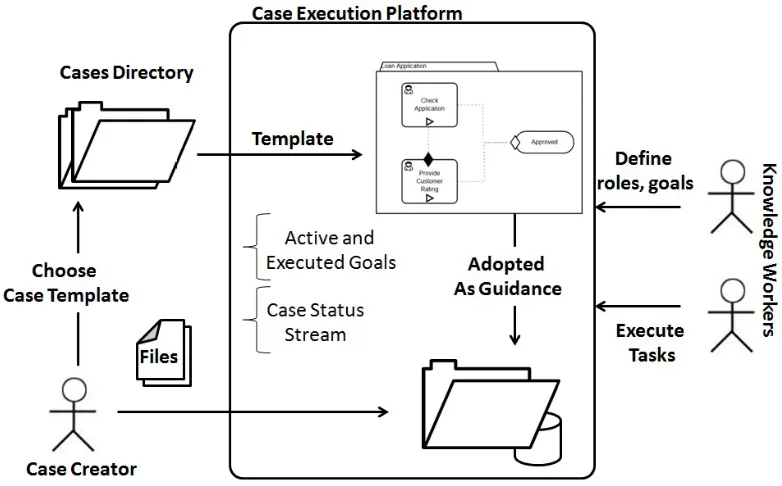
Figure 2.5 provides the architecture of case management. The architecture of case
management is defined based on its execution on Case Management Suite (CMS). In
case management, case model is not defined as the ordered set of activities like process
model, but all those tasks that can be executed during case processing are modelled.
In case execution, case creator first analyses the nature of the case at hand. If the similar
case model already exists in cases directory, then it is adopted as a template. However,
it is worth noticing that the adopted case model is used as a guidance tool to solve the
case which is not necessarily be followed in case execution. The central focus part in
case execution is the case folder. In contrast to BPM architecture (see Figure 2.3), all
the relevant data in case is contained in case folder which is easily accessible by case
creator and other knowledge workers. Every knowledge worker of the case, based on their
[image:31.596.83.474.495.738.2]permission levels, can add, delete or modify the content of the case. However, the focus
on data can also cause the data dependency. The unavailability of particular content
can halt the processing of case. Considering the case requirement during execution,
knowledge worker can add or edit goals, invite more knowledge workers, extends case
due deadlines, request new data and can view the status of the overall case.
2.3
Modelling of Unstructured Business Processes
For this research, BPMN and CMMN are selected to assess their capability for modelling
unstructured business processes. The reason to consider BPMN is because it is one of the
widely adopted process modelling language in academia and in industry. While, CMMN
is selected because it is specifically targeted for modelling those business processes which
are unpredictable in nature. Moreover, CMMN and BPMN are proposed by OMG, which
means the deficiencies of one modelling language is expected to be fulfilled by the other.
The brief introduction of BPMN and CMMN is provided in the following Sections.
2.3.1 Business Process Model and Notation (BPMN)
BPMN is a graphical modelling notation that promises to model the ‘end-to-end’
busi-ness process. The goal of BPMN is ‘to provide a notation that is readily understandable
by all business users, from business analysts to technical developers’ [32].
BPMN was initially proposed by Business Process Management Initiative (BPMI).
Later, as a result of organizational merges, it is adopted by the OMG. BPMN
ver-sion 2.0, released in 2011, provide very rich set of modelling notations. Three BPMN
diagrams were introduced with the name ofprocess,choreography andcollaboration [2]. Process diagram describes the sequence of activities flow that perform a business
pro-cess. Choreography diagram shows the interaction among the business people who are
responsible to perform activities. While, the collaboration shows the interaction among
inter and intra-organizations’ processes.
The focus of this research is to assess the modelling language for unstructured business
processes. Hence, the scope is limited to process diagrams of BPMN only. For business
process modelling, various concepts with their associated notations are proposed in
demonstrate the activities, real-time events, conditions, sequential flows, data objects
and many other related concepts. Exploiting these rich notations, BPMN process model
is able to depict the extensive real world business process in a graphical model form.
The detailed description of BPMN as process modelling language can be found in [2]
and [32].
2.3.2 Case Management Model and Notation (CMMN)
Case Management Model and Notation (CMMN) is, a very recent modelling standard,
proposed in January 2014 by OMG. CMMN, as a graphical modelling notation, promises
to model the a case or unstructured business process in a way that can express their
essential run-time flexibility [23]. Usually, an unstructured business process is managed
and directed by a single or group of knowledge workers. These knowledge workers are
responsible to plan the task sequence, take decisions and require ad-hoc collaborations
all on the run-time [33].
According to Grudzinka [34], business artefact laid the foundation for CMMN. Referring
to Bhattacharya et. al., he defined the business artefact as ‘a business entity that is used
to store the information to a given process context’ [35]. The business artefacts have
a complete lifecycle with clear states from start to its completion. Each particular
state of business artefact informs the knowledge worker/process manager about how
far a business entity is for its completion. Guard-Stage-Milestone (GSM) approach
was introduced to capture the information model of business entities as well as their
states [36]. It is believed that the proposed CMMN is influenced by GSM [23,34].
From the modelling perspective, the core elements of CMMN are defined into three
types. Case model element introduces the notion of the case as a main container which constitute every related element. Information model element consist of case files that contains all the case related data. Final and most important element isplan model ele-ments. The elements that belong to plan model are particularly visible on case model. It includes events, milestones, plan items, sentry, task, and planning table. The description
of each of these elements with their notation can be found in standard specification of
CMMN [23]. As discussed in Section2.1.3, we will refer to case model as an unstructured
2.4
Summary
This chapter provides the introduction to key concepts and terms that will be used
throughout this research. In addition to business process definition, the structuredness
level of business processes is discussed. On the structuredness spectrum, a business
pro-cess can be structured, structured with ad-hoc exceptions, unstructured with pre-defined
fragments or unstructured. Moreover, various terms that refer to the concept of
unstruc-tured process is also discussed. Additionally, BPM and CM along with their software
architecture are briefly explained. In the end, a brief background and introduction to
An Experiment to Compare BPM
and CM
In this competitive era, efficient use of business assets is a basic need for an organization
for their survival. Effective resource utilization will benefit the business in terms of
enhanced profit, reduced response time and low cost. The business employs various
methods, techniques and methodologies to optimize their business operations.
Due to various types of process, process support and process improvement paradigms; an
organization has to make a decision on which process support paradigm is more useful
in dealing with a particular type of business processes. In this chapter, two process
support paradigms are compared to better understand their strengths and weaknesses
in managing unstructured business processes.
For comparison purpose, an experiment is conducted. The experiment will help us
understand about which process support paradigm is more efficient and easy to use for
implementing and maintaining an unstructured business process. Moreover, results of
experiment will provide us the insights in process management approach of BPM and
CM.
Section3.1introduces the experiment’s purpose and hypothesis. Experiment setup and
experiment execution details are provided in Section3.2and3.3respectively. Results of
the experiment are discussed is in Section3.4. Section3.5concludes the chapter with a
summary.
3.1
Experiment
As discussed in Chapter2, BPM and CM are process support paradigms with difference
in focus. An experiment is planned to assess and compare the capabilities of BPM and
CM. The approach of the experiment is adopted from Weber et. al. [1]. The purpose
of this experiment is to understand the methodology of BPM and CM by practically
executing a comprehensive business process. Moreover, it is also aimed to access, which
process support paradigm is more efficient and easy to use for implementing and
main-taining an unstructured business process.
BPM is well established paradigm for handling and atomizing the business processes
through Business Process Management Suites (BPMS). BPMS is a software platform
that facilitates the modelling, enactment and execution of business process [37]. These
suites define and model the business process and provide an executable process
appli-cation. On the other end, CM facilitate the management of unpredictable business
processes through Case Management Suite (CMS). CMS is a software tool that provides
the features to initiate the unstructured business process, set process related goals, assign
task to knowledge workers and define deadlines.
Based on Goal/Question/Metric method template [38], the goal of this experiment is
defined as follows:
“Analyse ‘unstructured business process’ for the purpose of ‘comparing process
support paradigms’ with respect to their ‘ effort of implementing unstructured business
process’ from the point of view of ‘end-users (process engineer/knowledge workers)”’.
3.1.1 Context
Business adopts various process support paradigms to better manage business processes.
In the past, for the efficient execution of process, a business process is designed and
at-omized. However, with unstructured business processes, the atomization is not an option
as the process can’t be completely defined at design-time. To deal with unstructured
processes efficiently, business stakeholders have to make a decision on which process
support paradigm is more appropriate. The possible question by business stakeholders
“Which process support paradigm is suitable for managing unstructured business processes”?
For some business stakeholders, the unstructured business processes can be handled with
BPM as the capabilities of BPM are underutilized. While, for others the BPM is unable
to provide the flexibility to business process and there is need of a new paradigm to
manage unstructured business processes.
3.1.2 Hypothesis
Based on the purpose and context of experiment, the following hypotheses are derived.
Null Hypothesis: There is no difference in process support methodology of BPM and
CM while dealing with unstructured business process.
Alternative Hypothesis: There is a significant difference between process support
methodologies of BPM and CM while dealing with unstructured business process.
3.2
Experiment Setup
In this section, the setup of the experiment is formally introduced by defining subject,
the object of study, factor and factors level, and threats to validity.
The explanation of each aspect is provided as follows:
1. Subject: The purpose of this experiment is to understand the BPM and CM
methodological differences while dealing with an unstructured business process.
Consid-ering the purpose of this experiment, the subject of this experiment is only one researcher
who is also responsible for experiment setup as well as for experiment execution.
2. Object of Study: The object of study is an unstructured business process of
insurance claim. The reason to consider the insurance claim process as the object of this
experiment is due to the fact that an insurance claim process is quoted as an example
of structured process [4] as well as an unstructured process[39].
In the insurance claim process, each claim request is usually different than the other
mirrors, to an accident involving police, medical reports, witness reports and may be
another insurance company as well. Since, the combinations and permutations of such
real-time events are hard to predict, it is difficult to define the process model completely
at design-time.
Following is the descriptions of insurance claim process [8].
Description of Insurance Claim Process: The insurance claim request starts when the insurance holder submits the claim request to the insurance company. Once
the request is received, theclaim handler checks whether the claimer is a current policy holder of the company or not. If the claimer is not a current policy holder
of the company, the claim request is rejected. If, in case, the claimer claims to
own a policy type for which he is not paying premiums, the claimer is requested
to make necessary changes in provided data. If the claimer is the policy holder
of a company the claim request is registered and handed over to investigation manager. Investigation manager investigate the provided data for its accuracy and completeness. Moreover, he is also responsible to collect further relevant
data. Depending on claim request, the data collection activity can require the
decisions and data from many stakeholders e.g. police, hospital, traffic controller,
auto repair, and witnesses. Once the data is collected, theinvestigation manager
needs to make a decision on whether the collected data is enough to make the
final claim decision. In case, the collected data is not enough, more data will be
requested. Otherwise, the claim process is handed-over todecision maker. Further analysis of claim request is performed based on the collected data. Considering
the nature of the claim, a single person can make a decision or a panel need to
collaborate to reach to the final decision. The claim settlement is made only if the
claim is accepted otherwise the claimer is informed about the rejection of claim
and the claim process is closed.
3. Factors and Factor levels: The factor or independent variable of this experiment is
process support paradigm with two factor level which are BPM and CM. Bizagi modeller
and Bizagi Studio [40] is selected as BPMS to analyse the BPM capabilities. According
to Gartner magic quadrant[41], Bizagi is one of a visionary vendor of BPMS. As a CMS,
Cognoscenti software tool is used. Cognoscenti [42] is one of few CMS that is available
4. Response Variable: The response or dependant variable of this experiment is
‘effort of implementing an unstructured process’. The usage effort will be measured by
implementing an insurance claim process on BPM based tool Bizagi and then on CM
based tool Cognoscenti.
5. Analysis: Analysis procedure provides the design of the analysis process of
experi-ment. Based on the goals and response variable of experiment, the analysis design can
be a mathematical model, a statistical measurement or a simple checklist of tasks. In
this experiment, it is difficult to quantitatively gauge the effort of implementing
unstruc-tured business process as well as to assess the differences between BPM and CM process
management methodology. Hence, certain aspect of process management is proposed
for analyses purpose. These process management aspects include (a) process/case
mod-elling, (b) data management (c) business rules specification (d) user roles specification
(e) process/case progress view (f) process/ case control (g) activities execution and (h)
process/case setup effort.
6. Threats to Validity: For any experiment, there are some aspects that can
influence the final outcome of the experiment. Few threats to validity for this experiment
are as follows:
1. In this experiment, it is planned to access the difference in methodology of BPM
and CM based on their software suites. However, the features provided by certain
software platform can influence the results of this experiment.
2. The experiment has very limited subjects, i.e. only one researcher. The knowledge
of researcher about BPM and CM can influence the final results.
3. The object of this study i.e. insurance claim process can have possible biases for
one process support paradigm over the other.
To mitigate the effect of these threats, some additional steps are performed. For example,
Bizagi provide the functionality of process modelling while Cognoscenti lack this feature.
To bring balance of functionality between both platforms, Microsoft Visio stencil was
created and used for modelling the case using CMMN. The second threat of validity is
mitigated by presenting the results of experiment to two experienced BPM practitioners
mitigated by carefully selecting a business process, which is mentioned as an example of
structured and unstructured business process in [4] and [39] respectively.
3.3
Experiment Execution
In this section, the steps of execution of process are defined. Implementation of the
insurance claim process can be broadly divided into design-time planning and run-time
execution. In design-time planning of the process, the process is defined and modelled.
While, in run-time the process instance is created as a result of process initiations. In
the following sections, implementation of the insurance claim process is discussed with
Bizagi and Cognoscenti software suites.
3.3.1 Insurance Claim Process with Bizagi (BPM)
For processing of insurance claim process in Bizagi, process modelling is first and most
integral part of the process management lifecycle. Based on process model, data model,
business rules, user roles and electronic forms are designed. After the deployment of
designed process, the process can be accessed on work portal of Bizagi. On work portal,
a process instance can be initiated.
Process Planning (Design-time):
Process Model: In management of business process, first step is process modelling. Pro-cess modelling provides insights and understanding of business proPro-cess to business
stake-holders. The process model specifies the tasks, roles, events and control logic. In
Ap-pendix A, Figure A.1 shows the process model of the insurance claim process based
on BPMN. This process model also specifies the milestones of the process into claim
registration and claim processing. BPMN doesn’t provide a concept of milestone, but it
is specified by Bizagi modeller.
Data Model: After the process modelling, the next step is to model the data. The pur-pose of data modelling is to specify the process entities, their attributes and relationship
between entities. Data modelling also specify the focus of process on data. Figure A.2
request is the central entity of data model which defines the information that is required
for a claim request.
Forms Design: The attributes of entities are further used in designing the forums for each user task. The user forms are targeted to the roles defined on the lanes of the
process model. The forums are used to get data from the user as well as to provide the
data to users. Based on the capabilities of the platform used, a file or number of files
can be uploaded and downloaded by different process users. FigureA.3 in AppendixA
shows the electronic forms for the customer to provide the claim request information.
Business Rules: After the forums are designed, the business rules are defined. Business rules specify the control logic of process execution. In the process model, business rules
are defined on the outgoing edges of gateways. The rules defined for the insurance claim
process are shown in Figure A.4in AppendixA.
Performers: As process model have already defined the roles, these business rules are further assigned for each task in this step. The tasks can be assigned based on the
orga-nization’s structure, location of a person, and skills of a person. Role definition provides
the ownerships of activity to certain person. Figure A.5 in Appendix A demonstrates
the roles defined for each lane in the process model. Some roles are based on user id,
e.g. customer, while others are based on the position of the person in organization e.g.
investigation manager.
Process Execution (Run-time):
Execution: In run-time, the customer initiates the process by filling the electronic form of insurance claim. Figure A.6in Appendix Ashows the customer form in work portal.
The claim handler receives the data provided by customer and analyse it. The request is
either approved or rejected. If the request is approved, the investigation manager receive
a task of investigation and collect claim data. Once the task is completed, the remaining
tasks are assigned to decision makers who will either accept the claim or reject it. Note
the script based tasks on the process model, these tasks will be performed by systems
or applications automatically and doesn’t require human intervention.
Different BPMS provides various features on defining and designing of business process.

![Figure 2.1: Business Process Spectrum [22]](https://thumb-us.123doks.com/thumbv2/123dok_us/9810276.482235/23.596.171.386.518.735/figure-business-process-spectrum.webp)