AN EMPIRICAL COMPARISON OF THE PERFORMANCE OF
CLASSICAL POWER INDICES
DENNIS LEECH
No 563
WARWICK ECONOMIC RESEARCH PAPERS
An Empirical Comparison of the Performance of Classical Power
Indices*
by
Dennis Leech
University of Warwick
October 2001
(Forthcoming
Political Studies
, 2002)
(Warwick Economic Research Paper Number 563)
Dennis Leech, Department of Economics, University of Warwick, Coventry, CV4 7AL, United Kingdom.
Tel: (+44)(0)24 7652 3047. Fax: (+44)(0)24 7652 3032 Email: [email protected]
Abstract: "An Empirical Comparison of the Performance of Classical Power Indices," by Dennis Leech, University of Warwick
Power indices are general measures of the relative a priori voting power of individual members of a voting body. They are useful for both positive and normative analysis of voting bodies particularly those using weighted voting. This paper applies new algorithms for computing the rival Shapley-Shubik and Banzhaf indices for large voting bodies to shareholder voting power in a cross section of British companies. Each company is a separate voting body and there is much variation in ownership between them resulting in different power structures. Because the data are incomplete, both finite and “oceanic” games of shareholder voting are analysed. The indices are appraised, using reasonable criteria, from the literature on corporate control. The results are unfavourable to the Shapley-Shubik index and suggest that the Banzhaf index much better reflects the variations in the power of shareholders between companies as the weights of shareholder blocs vary.
Introduction: The Measurement of Voting Power
Many organisations have constitutions for their governance based upon systems of voting in which
different members possess different numbers of votes. There are various reasons for designing voting
bodies in this way. International organisations like the Council of the European Union have adopted
weighted voting systems in order to combine the simplicity of majority voting with a need to ensure
populations of different sizes in different countries are represented appropriately. International economic
organisations such as the Bretton Woods institutions allocate votes to members on the basis of their
financial contributions rather than their populations but the same principle of weighted majority voting is at
the centre of their governance. Likewise a joint stock company allocates votes at company annual meetings
and proxy votes to members in accordance with their financial commitment in share ownership.
In all these cases the rationale for the allocation of different voting weights to different members is
the idea that this is also an allocation of voting power. It is the popular view that voting weight equates to
voting power and indeed in many academic discussions of the voting systems in political organisations
writers often refer to voting weights as power. For example the United States has about 18 percent of the
voting weight in the International Monetary Fund and World Bank, and is often described as having 18
percent of the voting power1. In fact, in terms of its share of influence over the decisions taken by votes
among the members, its power may be quite different from 18 percent. In general the number of votes a
member casts bears little relation to the power that those votes represent. A member's power actually
depends not only on its own voting strength but also on the complete configuration of votes allocated to all
the other members as well. In order to measure power it is necessary to calculate a power index that takes
A power index measures each member's relative influence over decision making in the sense of its
ability to use its vote to change a coalition of others from one which is losing to one which satisfies the
majority requirement and wins. The number of times it can do this is expressed as a proportion of the
number of voting outcomes that can occur, treating each outcome equally; this is usually expressed in
probabilistic terms with voting outcomes assumed to be random and equally probable. Outcomes are
defined in terms of dispositions of individuals on one side or the other in a general vote without reference to
preferences. A power index therefore measures the power of individuals in an a priori sense within a
particular voting system with given distribution of weights among members and majority requirement. It
cannot predict the result of any particular vote but can be useful in helping understand or design a voting
body in terms of the relative voting power of different members. (Good overviews of the field are
Felsenthal and Machover, 1998; Straffin, 1994; Lucas, 1983).
This approach to the measurement of voting power is limited by the fact that different probability
models for treating the outcomes of votes have been proposed. This has led to two different "classical"
indices being defined, the Shapley-Shubik index, and the Banzhaf index (Shapley and Shubik, 1954,
Banzhaf 1965). These indices give results which differ, sometimes substantially, when applied to the same
data, and both sets are often presented side by side with the final choice being left to the reader. The
resulting ambiguity has led to the power indices approach lacking credibility which has undoubtedly
hindered its wider use for understanding and designing voting bodies such as those of the European Union.
The properties of the indices have been compared in theoretical terms against various criteria but
the question of which is better is still an open question. Answering it is fraught with methodological
independent evidence on the distribution of power in the particular voting body with which to compare the
results for the indices. However this is very rarely available.
One area of application where there is a certain amount of independent evidence is shareholder
power in companies. Case studies of actual firms and market experience have created a body of evidence
on the relations between the structure of share ownership and the real power that particular shareholdings
represent. It is therefore possible to identify firms in which a large shareholder is so powerful as effectively
to be in control and whose power index one might reasonably expect to be very large. In others a large
shareholding might be powerful if the other shares are widely held in many small holdings, but not powerful
if they are held in larger blocks. Thus by looking to see how the distribution of share ownership in a cross
section of companies varies and relating this to the corresponding power indices, it is possible to test the
power index approach and also compare the different indices.
This paper computes power indices for shareholders in a large sample of British companies and
tests them against suitable criteria in terms of how they are likely to behave as patterns of ownership vary
across companies2. The results do not give any reason to reject the Banzhaf index but the results for the
Shapley-Shubik index do not satisfy the criteria. The paper therefore leads to a definite conclusion: that the
Shapley-Shubik index is not a suitable measure of power in this case.
The paper is organised as follows. First the power indices are defined in general terms and the
comparative theoretical literature discussed. There is then a discussion of the methodological problems of
testing them, a description of the methodology of this study, followed by a description of the criteria to be
used. Next the data set is described before the power indices are defined precisely taking into account the
nature of the data available. Because shareholding data is inevitably incomplete for each company - there
be computed, even in principle, for the full voting body. This problem of incomplete data is dealt with by
considering two cases that can be regarded as extremes. In the first case, the unobserved shareholdings
are taken as being held in as few hands as possible; this defines a finite “game” with hundreds of players
where ownership is relatively concentrated. In the other case, the unobserved shareholdings are taken to
be held by an infinity of players each holding an infinitesimal share; this defines an “oceanic” game. For
each case, both indices are calculated for the players whose shareholdings are actually observed and the
results appraised in the light of the criteria that have been defined.
General Definition of Power Indices and Theoretical Comparisons
The model underlying the measurement of voting power is a game played by n players who
co-operate by forming coalitions3 by simply casting their votes; that is, they vote for or against a motion in a
hypothetical meeting. Coalitions may be winning or losing according to the rules of decision making in the
meeting and each member’s power is then measured by his or her ability to influence the outcome by
changing a coalition from losing to winning by voting with it rather than against it, an effect referred to
henceforth as a swing. A power index is calculated for each player by considering each possible coalition
of which he or she is not a member and evaluating the number of swings. The indices are not described in
full detail here but in a later section after the discussion of methodology and the description of data because
the form of the data available affects the precise nature of the games studied and their computational
details. Before that I consider some theoretical aspects of the indices' comparative properties which have
been discussed in the literature.
The classical power indices are derived from fundamentally different conceptions of the relationship
between voting and power. The Shapley-Shubik index is derived as a special case of the Shapley value in
general n-person game divide up the spoils of victory among themselves by a process of bargaining, each
player's share reflecting his or her contribution. The value is the expected value of the game to each player
with respect to a model of random coalition formation and a characteristic function reflecting the payoff
received by each coalition. The Shapley-Shubik index is a special case of this in which the characteristic
function specialises to having a value of either 1 or 0, according to whether the coalition wins or loses.
Thus the assumption is that a winning coalition always has the same total value of 1 to be divided out
among its members according to their respective power. On the other hand, the Banzhaf index has no such
association with bargaining.
This led to the proposal that different kinds of power might actually be measured by the different
indices (Felsenthal, et al., 1998). The Shapley-Shubik index is associated with "office-seeking" behaviour
in which the process of constructing a winning coalition to attain power is accompanied by bargaining over
how the spoils of office are to be distributed. The Banzhaf index has been associated with "policy-seeking"
behaviour where winning a vote means controlling the actions of the organisation; the consequences of
winning are in the nature of a public good, of which each member receives a fixed benefit, which cannot be
redivided after bargaining among members of the winning coalition. This distinction becomes one between
power as a prize, P-power, measured by the Shapley-Shubik index, and power as influence, I-power,
appropriately measured by the Banzhaf index. In their book, however, Felsenthal and Machover express
some scepticism about the concept of power as a prize (Felsenthal and Machover, 1998).
In his seminal paper, Coleman (Coleman, 1971) made a detailed critique of the realism of the
behavioural assumptions behind the Shapley-Shubik index. He argued against an approach derived from a
bargaining model on the grounds that policy-seeking behaviour is by far the more usual. He made two
argued that there is little basis for the assumption that basic voting outcomes should be thought of as
different orderings of players along a continuum. This assumption is the basis of the uniqueness property of
the Shapley-Shubik index because it ensures that in any vote taken there is precisely one player whose
contribution is pivotal. However it means that coalitions with different numbers of members are assigned
different probabilities. A coalition with t members (in a game with n players) which player i can join to
make it winning has a weight, in the definition of the index, of t!(n-t-1)!/n!. This expression is at its largest
when t is very small or very large and at its smallest when t is in the middle of its range. This means that a
coalition with a very few or a very large number of members dominates in the calculation of the index. It is
not intuitively clear why this should be when the basic idea is to measure the ability of a player to change
losing to winning and the size of coalition might seem to be irrelevant.
The second criticism Coleman made is of the idea that the Shapley value can be adapted to give a
measure of power by assuming a special form for the characteristic function, 1 for a win and 0 otherwise.
This is a quantitative representation of qualitative outcomes, the distinction between 0 and 1 representing
the distinction between losing and winning, without any attempt at attaching any further value to those
events. It is not appropriate therefore to treat these particular values assigned in this way as if they were
actual quantities to be divided among members. Yet that is what this approach does. Moreover it assumes
that the same amount, represented by 1, is available to the winning coalition each time there is a vote. But
for each vote the consequences are different and fundamentally incommensurable and this is not captured
by this simple form of the characteristic function. As Coleman put it: "The action is ordinarily one that
carries its own consequences or distribution of utilities, and these cannot be varied at will, i.e. cannot be
split up among those who constitute the winning coalition. Instead, the typical question is the determination
of whether or not a given course of action will be taken, that is, the passage of a bill, a resolution, or a
from first representing a qualitative event in quantitative form in the characteristic function then interpreting
that as a pure quantity to be distributed in the definition of the value/index.
Other important theoretical comparisons of the indices are by Roth (Roth, 1977), who showed
that differences between them can be interpreted as reflecting different attitudes towards risk, Straffin
(Straffin, 1977), who characterised them in terms of probabilistic voting with different mechanisms for
choosing the voting probability. Felsenthal et al. (Felsenthal et al., 1998) compare the indices in terms of a
number of suggested theoretically desirable properties and conclude with some reservations about the
Shapley-Shubik index.4
The Empirical Methodology
Most of the comparisons of power indices have been theoretical discussions of their foundations or
properties. This section and the next describe the essentially empirical methodology used in this paper.
In order to test the performance of an index it is necessary to compare the value it assigns to a
player's power with an independent measure of the actual power the player has. If, say, an index for a
player were equal to 0.75, then if independent evidence suggested that that player might be able to swing
about three quarters of votes, then we would be inclined to accept the index as empirically useful. On the
other hand if the player were known to have virtually no power, or to be so powerful as to be a virtual
dictator, then we would be inclined to reject it. If, when assessing the comparative performance of two
indices, one of them gave results different from the independent evidence and the other gave results which
were not inconsistent with it, this would lead to rejection of the former and the non-rejection of the latter.
often or sometimes inconsistent with the independent evidence, while those obtained for the other index
were never shown to be inconsistent with it, then this would suggest a clear preference for the latter and
rejection of the former. The difficulty with this approach is that independent evidence of the type required is
hard to gather because it is difficult to observe power empirically.
The general question of studying power is discussed at length by Morriss (Morriss, 1987). He
argues, firstly, that power cannot be observed directly and that any evidence must be used in indirect ways;
"there is no easy mechanical way of establishing how much power someone has and the connection
between the assertion that someone has power and the evidence for it is often complex and subtle."
Secondly, the interpretation of observed data depends on a theory of social processes. Thirdly, he argues
that power should best be studied using a variety of approaches within a regime of what he calls
"methodological tolerance"; specifically he maintains that research into power should not be confined to the
use of "hard" evidence.
Morriss suggests that there are five general approaches to gaining evidence about power that
should be used in conjunction with each other:
(1) Experiments;
(2) Thought Experiments: considering the obvious;
(3) Natural Experiments: looking at naturally occurring situations in the real world;
(4) Consulting Experts: getting others to conduct experiments; consulting practitioners whose opinions might be informed by practically gained evidence;
(5) Resource-based Approaches: looking to the resources of players to give indications of power.
The approach adopted in this paper is a combination of (3) natural experiments, (4) the opinions of
experiments might be appropriate to situations where the conclusion is obvious, for example, where one of
players has all the power and is a dictator, or where all players obviously have equal power despite
different weights. But in these situations there is not a problem of choice of power index and so thought
experiments have little to contribute to the main problem being considered.
Resource-based approaches involve examining the resources on which power is based, for
example, using relative sizes of armed forces to compare military power of different countries. In the case
of weighted voting the weights are the resources and power is monotone in a player’s weight. But the
numerical value of the power index depends also on the weights of all other players. Where player 2 (with
the second-largest weight) has a large weight then player 1 (the largest player) is likely to have a smaller
power than where player 2 has a smaller weight, although not in every case, depending on the full
constellation of weights of all players; however player 1 is never less powerful than player 2.
Natural experiments are important in non-experimental social science where empirical research is
largely based on passive observation of naturally occurring situations. The appraisal of the performance of
power indices can be based on such data. One approach would look at a given voting body such as a
legislature over a period of time and relate the variation of power indices for parties or voting blocks to
independent indicators of the real disposition of power5. It would need to take account of other factors in
the political process such as personalities of politicians and also of changing circumstances over time
however which would be hard to control for.
Another approach studies a cross section of otherwise similar voting bodies with different
structures in terms of weights and relates the indices to independent information on power. This is the
approach adopted here using information from studies of company control by large shareholders through
as case studies to indicate when there is control of the company by a particular identified shareholder and
when the company is not so controlled. This evidence on company control is taken as indicating a power
index that is very close to unity; how this varies in practice is the basis of the appraisal criteria.6
It is sometimes suggested that use be made of statistics of voting at company annual general
meetings and in proxy voting to measure the power of shareholders. The argument is that the more
powerful shareholders will be seen as determining the outcomes of more votes and observation of the
frequency with which this occurs will provide a direct test of the power index. However power is not
exercised in such an overt manner at company meetings; they are in any case often not well attended, at
least partly because of this. Many fund managers with substantial holdings have tended to avoid voting as a
matter of policy and either back incumbent management or use their influence to bring pressure behind the
scenes. Their a priori voting power is nevertheless real and an important determining factor in the firm's
governance. Power is important at the agenda-setting stage outside the company meeting and may not be
observed directly or even at all. A powerful shareholder may be able to effectively control the company
through informal contact with management on the basis of a common perception of the power represented
by the shareholder's large voting weight. Proxy votes however can provide evidence on power but they are
too infrequent to be a source of simple statistical data. They have provided useful evidence however which
informs the appraisal criteria described in the next section.
The question arises as to whether it is appropriate to model shareholder voting in terms of power
indices. Power indices are about the measurement of a priori voting power whereas shareholders are
usually regarded as solely interested in one issue: maximising the value of their investment. If there were to
be a vote on the simple question of whether an action should be taken which unambiguously increased the
expected that such questions would never be put. Where votes are taken it is likely that the question is one
of fundamental uncertainty where the consequences are unknown, such as between one proposed
restructuring or merger and another, both of which are advocated by their proponents as being in the best
long term interests of shareholders, or between two nominees for a director's position. Many such cases
occur where the shareholders have the ultimate responsibility for making the decision.
Where the approach clearly cannot be applied is to a situation in which the question to be decided
is the division of the profits among the shareholders, since that might lead to the absurd inference that a
large minority shareholder, whose power is close to 1, is so powerful as to be able to expropriate the
majority. The context therefore is a company whose shares are publicly traded in which powerful
shareholders are prevented from being able to appropriate private benefits of control by high standards of
corporate governance. This assumption means that the concept of power here is policy-seeking rather than
office-seeking because the distribution of the benefits of winning a vote are fixed.
Appraisal Criteria in Terms of Shareholder Voting Power
An important study of power in real-world weighted voting games was the analysis of the
ownership and control of large American corporations in the 1920s by Berle and Means (Berle and
Means, 1932). They showed that the ownership of most corporations had become widely dispersed
among a very large number of shareholders. The principal shareholdings of many large corporations were,
in percentage terms, very small indeed, in many cases less than 1 percent of the voting stock. From this
Berle and Means inferred that in these cases no shareholder was sufficiently powerful to be able to
exercise much influence over the company through voting at company meetings or in proxy votes and that
Not all companies had such dispersed ownership, however, some retaining a majority controlling
shareholder, some having a large minority shareholder who was dominant and others were controlled by a
legal device, such as a pyramidal structure or dual class shares, rather than through the sheer size of a
shareholding voting block. Berle and Means defined a typology of control by which they attempted to
classify every corporation. It is not necessary to describe this fully for present purposes, merely to confine
attention to the voting power represented by a large holding of ordinary shares. The key distinction Berle
and Means made was between a company with a substantial minority shareholding which was very
powerful in voting terms and one without such a dominant shareholding. They deemed a minority
shareholder to have "working control" if it had "sufficient stock interest to be in a position to dominate a
corporation through their stock interest", and "…the ability to attract from scattered owners proxies
sufficient when combined with their substantial minority interest to control a majority of the votes at the
annual elections. Conversely, this means that no other stockholding is sufficiently large to act as a nucleus
around which to gather a majority of the votes". This definition corresponds to that of a voting weight with
a very large power index.
Berle and Means used case studies to examine voting power in the former case by considering
proxy voting. They used two sorts of evidence to examine if a minority shareholder had enough votes to be
in effective control: whether a minority shareholder had been able to win a proxy fight with a minority of
shares; and cases of stable ownership structures in which a minority shareholder was demonstrably in
control without explicit voting taking place, based on information from press reports and elsewhere to
determine control. In other cases they used information from others, in the form of what they called "street
knowledge" - that is Wall Street knowledge obtained from stockbrokers and others -which is a version of
Morriss' approach of asking experts. Berle and Means were very careful in their research into voting
indirectly. They decided on the basis of their case studies that the dividing line between a shareholding
being sufficiently large to have working control through voting and the complete separation of ownership
and control was about 20 percent of the voting capital, although this could vary, in some cases the figure
being rather less. We would therefore require of a suitable index that in most cases where there is such a
shareholding it assign a very high power to it, and the firm to be classifiable as minority controlled.,
although we might also expect there to be exceptions.7
Another, more recent, source of indirect information about the voting power of large shareholders
is the opinion of practitioners in the world of corporate finance who may be using substantial amounts of
their own money, or at least of their clients' money, to back their judgements (and whose reputations and
careers certainly depend on them). This is another form of "asking experts". One manifestation of this is in
the listing rules of the London Stock Exchange (the so called Yellow Book) - which are based on a body
of opinion widely accepted by its members - which use, as a formal definition of a controlling shareholding
,one which controls 30 percent or more of the votes at a company meeting.8 Another authority which uses
the twenty percent rule as the basis of ownership control is the recent extensive study by La Porta et. al.
(1999) who state simply, without giving any other authority: "The idea behind using 20 percent of the votes
is that this is usually enough to have effective control of the firm."
This is the basis of the method used here. Minority control in the Berle and Means sense is
identified with a very high value of the power index, close to 1, for the largest shareholder, player 1. Using
the insights of Berle and Means it is possible to suggest some reasonable criteria which the indices should
satisfy. These are as follows.
Appraisal Criteria
(2) The power index for player 1 should vary as the weights for players 1 and 2 (w1 and w2) vary between companies. It should increase with w1 and is likely to decrease as w2 increases.
(3) The power index for player 1 should almost always be close to 1 whenever the weight for player 1 is above 30 percent.
(4) The power index for player 1 should often be close to 1 whenever the weight for player 1 is between 20 percent and 30 percent.
(5) The power index for player 1 should sometimes be close to 1 whenever the weight for player 1 is between 15 and 20 percent.
(6) The power index for player 1 is virtually never close to 1 when the weight is less than 15 percent.
Notation
It is assumed that a company has n shareholders whose individual holdings (voting weights) are
denoted w1, w2, ...,wn, where 0 < wi < 0.5 for all i and
∑
wi =1. For convenience I assume the weightsare ordered in decreasing order of size, so that: wi > wi+1 for all i. Votes are taken with a decision rule in
terms of a quota q > 0.59. Sometimes it is necessary to refer to the collective size of a group of players
with the largest weights. This is represented by sj, where sj = wi i≤j
∑
, the collective weight of the largest jplayers.
Voting outcomes are defined in terms of coalitions which are represented by subsets of the set of
all players, N = {1, 2, . . , n}. All members of a subset are assumed to cast all their votes in the same way.
Let the total combined voting weight of all players in a subset T be w(T); that is w(T) = wi i∈T
∑
. If T is aThe power indices are defined in terms of swings: losing coalitions which become winning when a
particular player joins. Thus a swing for player i is a losing coalition, Ti, such that q - wi = w(Ti) < q.
The Data Set: Share Ownership in Large British Companies
The data consists of ownership data on a cross section of 444 large British companies, mostly
taken from the Times 1000. For each company all shareholdings above 0.25 percent of the voting equity in
1985 or 1986 were collected.10 The number of such large shareholdings observed varies in the sample
between a minimum of 12 and a maximum of 56, with a median of 27. The equity shares represented by
these observed shareholdings vary between 19 percent and 99 percent, the median being 66 percent. The
dataset is therefore both detailed and fairly comprehensive in giving a picture of British firms.11
The data are summarised in Table 1. The table shows the distribution of the size of the largest
shareholding, w1, and also the joint distribution of w1 with the second-largest holding, w2, in order to
indicate the variation in patterns of concentration of ownership in the sample. This variation makes it ideal
for the study. Some 49 companies have relatively concentrated voting structures with w1 greater than 30%,
but in the great majority of cases w1 is less than 30 percent. There is also a wide range of variation in the
size of w2 given w1. For example in the group of 85 companies where w1 is between 20% and 30%, w2 is
less than 10% in 38 cases, between 10% and 20% in a further 38 cases and greater than 20 % in 9 cases;
Table 1 The Data: The Largest Holding versus the Second Largest (Number of Companies)
w1
<5% 5-10% 10-20% 20-30% 30-40% 40-50% Total
41 144 125 85 30 19 444
<5% 41 46 15 12 2 2 118
5-10% 98 73 26 10 9 216
10-20% 37 38 11 5 91
20-30% 9 4 2 15
30-40% 3 1 4
w2
40-50% 0 0
The Problem of Incomplete Data
Information collected about company ownership is necessarily incomplete because of the very
large number of shareholders there are in a typical large public company. Normally only the observations
on a few of the largest shareholdings are easily available to researchers and in any case this is often all that
is used in discussions of ownership and control12. It is, however, central to the approach adopted here that
the power of the largest shareholder depends not only on its own size but also on the dispersion of the
other, smaller holdings and it is necessary explicitly to deal with these in the way in which the indices are
defined and computed. This incompleteness in the data therefore gives rise to important issues in deciding
The solution adopted here is to calculate two sets of indices, on two different assumptions about
the unobserved weights - corresponding to two extremes of “concentrated” and “dispersed” ownership –
both of which are arithmetically feasible given the observed data. The details are as follows. For any
company the largest k shareholdings are observed and there is no information about the remaining n-k
holdings except that they are all smaller than wk. Nor is n known, or needed; although the total number of
shareholders could in principle be collected, it would add very little to the analysis. Two limiting cases are
defined: the “dispersed” case where wi is assumed, for i > k, to be vanishingly small, and the number of
shareholders to be infinite; and the “concentrated” case where n is taken to be as small as possible
consistent with the observed data. The former is referred to as limiting case D (Dispersed) and the latter as
limiting case C (Concentrated).
For limiting case C it is necessary to adopt a value for n in the finite game. If wk is the smallest
weight observed in the data, then all the non-observed weights are no greater than wk. The most
concentrated pattern of ownership occurs when they are all equal13 to wk. Then the corresponding value of
n, call it n', is defined as:
n' = g + k + 1
where g is the largest integer less than (1-sk)/wk.
Let wi = wk for all i = k+1, ... , n'-1 and wn' = 1 - sk – gwk.
The Shapley-Shubik Index
The Shapley-Shubik index for a finite game is an n-vector
γ
.
The indexfor player i,γ
i is definedas:
γ
i =t!(n−t−1)! n!
Ti
∑
i = 1, . . . , n (1)where the summation is over all swings for player i, Ti, t is the number of members of Ti, and n the number
of members of N. It has a probabilistic interpretation as the probability of a swing for player i when the
coalitions are formed by random orderings of the players, the term inside the summation being the
probability of Ti occurring.
The direct evaluation of expression (1) is not feasible when n is large since it requires finding all
subsets of N which are swings for each i: even for limiting case C the typical values of n are of the order of
300 or more and searching over all subsets of N would be prohibitively demanding of computer time. The
values of
γ
i are calculated in the two limiting cases using different approximation algorithms. For limitingcase C I employ the method described in Leech (1998). This provides a very good approximation for this
large finite game. For the limiting case D I assume an oceanic game and follow the approach of Shapley
and Shapiro, 1978.
The idea of an oceanic game seems to fit the current context very well: it is a game in which there
are a finite number, m, of “major” players with fixed voting weights, and a very large number (in the limit an
ocean of “non-atomic” players) with very small numbers of votes. Then as n goes to infinity the power
index for player i converges on the value:
γ
i = u s(1−u)m−s−1du
a b
∫
S⊆Mi
where M = {1, 2, . . , m}, the set of major players, Mi = M - {i},
a = median(0, (q-w(S))/(1-w(M)), 1), b = median(0, (q-w(S)-wi)/(1-w(M)),1). In expression (2) the
summation is taken over all subsets S of Mi and u is the dummy variable of integration. This expression is
not difficult to evaluate requiring only a minor extension of the algorithm14
.
The Shapley-Shubik index is found, for the finite game in case C, for every player with weights w1
to wk, n' -k-1 players with weights wk and player n' with weight wn' = 1 - sk - (n'-k -1)wk and it sums to
unity over all the n' players. For the oceanic game in case D, it is found for the m major players with
weights w1 to wm, the indices summing to unity over all players. Here m=5. 15
The Banzhaf Index
The Banzhaf index is based on the idea of counting the number of swings in relation to all the
possible voting outcomes, but the model of coalition formation underlying it is different from that associated
with the Shapley-Shubik index, in that each coalition is given the same weight regardless of its size. That is,
the way swings are counted in the index is different. The probability of any subset of N, say Ti, assuming
random coalition formation, is now 21-n rather than t!(n-t-1)!/n!. The probability of a swing for player i can
then be written then:
β
i' = 21-n 1 Ti∑
i = 1, . . ., n (3)The summation is taken over all swings for player i. This is the Absolute (or Non-normalised) Banzhaf
measure and it cannot be directly interpreted as giving a distribution of power among the players (as is
conventionally a requirement for power indices) since in general it does not sum to unity. Introducing a
β
i =β
i'/ βi' i∑
(4)gives an index which does have this property but lacks the probability interpretation. This is the Normalised
Banzhaf index16.
Computation of the Banzhaf index is easier than that of the Shapley-Shubik index. The algorithm
for it described in Leech (1998) can be used for both limiting cases. Limiting case C is the finite game with
n' players as described above. For limiting case D it is necessary to compute the values for the oceanic
game. Banzhaf indices for oceanic games were studied by Dubey and Shapley (1979) who showed that
under suitable conditions they can be obtained as the Banzhaf indices for the modified, finite game
consisting only of the major players M with weights w1, w2, . . , wm and quota q - (1-w(M))/2. 17 These
indices are obtained by applying the same algorithm to this modified game. Here the set of major players
M can be taken as all the observed shareholders, M={1,2, . . . , k}. The results obtained are somewhat
more sensitive than the Shapley-Shubik indices to which limiting case is assumed.
Results for Illustrative Companies
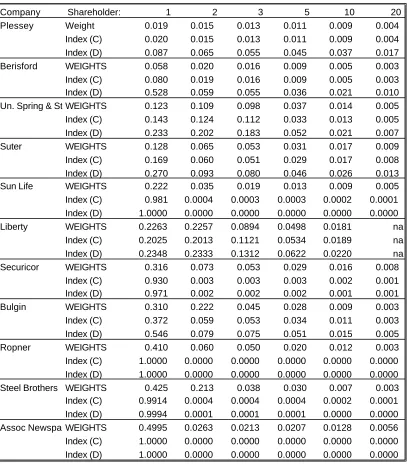
Tables 2 and 3 present power indices for some illustrative companies. The firms have been
selected to span the range of variation in the first two shareholdings. Plessey has the most dispersed
ownership with w1 under 2% and Associated Newspapers is just short of being majority controlled. Two
firms have been selected from each range of values for w1:10–20%, 20–30%, 30–40%, 40-50%; these
have relatively large and small values for w2. Power indices are given for representative shareholders.
Table 2 shows the Shapley-Shubik indices. The index for case C assumes an extreme in which all
shareholders. For the most widely owned company, Plessey, for example, the voting game which is used
as the basis of these indices is one with only 344 players. Case D assumes an oceanic game with 5 players
with finite weights, 18 and the remaining votes widely dispersed among an ocean of infinitesimal holdings.
For Plessey this consists of the five largest weights ranging from 1.94 percent to 1.05 percent, totalling
6.87 percent, and the remaining 93.13 percent distributed among the oceanic players.
The conclusions from Table 2 are, first, that despite the assumptions and methods of calculation
used being so completely different for the two cases, the two sets of results are remarkably close.
Secondly, the indices are relatively insensitive to the inequality in the data. Sun Life and Liberty, for
example, both with w1 around 22%, but very different values of w2, 3.46% against 22.57%, have very
similar results. The power of player 1 falls from 28% in Sun Life to just under 25% in the case of Liberty: it
might expected that the fact that the second-largest shareholding in Liberty was almost equal to the largest
to have a profound effect. The third implication is the general insensitivity of the indices to the largest
holding w1. Although in every case power is more unequally distributed than ownership, the difference is
never great. In terms of the appraisal criteria, where a large power index for player 1,
γ
1, would beexpected, as in Securicor or Ropner, it remains very far below 1. This pattern is typical of the whole
sample and indicates that the Shapley-Shubik index seriously understates the power of the largest
shareholder in such cases. The conclusion is that the Shapley-Shubik index fails to satisfy criteria (1), (3)
and (4).
Table 3 shows the corresponding Banzhaf indices for the same 11 illustrative companies.19 These
are always greater for limiting case D than for case C. Their values are sensitive to differences in ownership
structure and vary considerably. Where ownership is dispersed as in the case of Plessey, power is almost
a shareholder with more than 40% having working control, the index reflects this. In other cases the
Banzhaf index gives a richer variety of power distributions in response to differences in ownership
structure.
A comparison of Sun Life and Liberty, for example, reveals a sensitivity of the index to the size of
the second largest shareholding that the Shapley-Shubik index lacks. Shareholder 1 with a 22% weight in
Sun Life has a Banzhaf power index of at least 98%, implying working control. In Liberty, however, both
the largest two holdings are above 22% which must mean that player 1 is hardly more powerful than player
2. The Banzhaf index reflects this. A similar finding emerges for companies with a top shareholding of
between 30 and 40 percent. A 31% shareholder in Securicor where there are no other large owners has
over 93% of the voting power. On the other hand a similar-sized stake in Bulgin would have less than 55%
of the voting power because of the presence of a large second shareholder with 22%. These results are
entirely plausible in conforming with the appraisal criteria. The Banzhaf index generally is not in conflict with
Table 2 Shapley-Shubik Indices for Illustrative Firms
Company Shareholder: 1 2 3 5 10 20
Plessey Weight 0.019 0.015 0.013 0.011 0.009 0.004
Index (C) 0.020 0.015 0.013 0.011 0.009 0.004
Index (D) 0.020 0.015 0.013 0.011
Berisford Weight 0.058 0.020 0.016 0.009 0.005 0.003
Index (C) 0.061 0.020 0.016 0.009 0.005 0.003
Index (D) 0.061 0.020 0.016 0.009
Un. Spring & Steel Weight 0.123 0.109 0.098 0.037 0.014 0.005
Index (C) 0.134 0.117 0.103 0.036 0.014 0.005
Index (D) 0.135 0.118 0.104 0.036
Suter Weight 0.128 0.065 0.053 0.031 0.017 0.009
Index (C) 0.143 0.067 0.054 0.031 0.017 0.009
Index (D) 0.144 0.067 0.055 0.031
Sun Life Weight 0.222 0.035 0.019 0.013 0.009 0.005
Index (C) 0.283 0.033 0.017 0.012 0.008 0.004
Index (D) 0.284 0.033 0.017 0.012
Liberty Weight 0.2263 0.2257 0.0894 0.0498 0.0181
Index (C) 0.2475 0.2465 0.0894 0.0460 0.0162
Index (D) 0.2486 0.2475 0.0922 0.0460
Securicor Weight 0.316 0.073 0.053 0.029 0.016 0.008
Index (C) 0.448 0.059 0.043 0.023 0.013 0.006
Index (D) 0.451 0.059 0.043 0.023
Bulgin Weight 0.310 0.222 0.045 0.028 0.009 0.003
Index (C) 0.356 0.174 0.049 0.028 0.009 0.003
Index (D) 0.355 0.172 0.049 0.029
Ropner Weight 0.410 0.060 0.050 0.020 0.012 0.003
Index (C) 0.676 0.029 0.025 0.011 0.007 0.002
Index (D) 0.680 0.028 0.025 0.011
Steel Brothers Weight 0.425 0.213 0.038 0.030 0.007 0.003
Index (C) 0.616 0.055 0.035 0.028 0.006 0.002
Index (D) 0.618 0.052 0.035 0.028
Assoc Newspapers Weight 0.4995 0.026 0.021 0.021 0.013 0.006
Index (C) 0.9839 0.0003 0.0003 0.0003 0.0003 0.0002
Table 3 Banzhaf Power Indices for Illustrative Firms
Company Shareholder: 1 2 3 5 10 20
Plessey Weight 0.019 0.015 0.013 0.011 0.009 0.004 Index (C) 0.020 0.015 0.013 0.011 0.009 0.004 Index (D) 0.087 0.065 0.055 0.045 0.037 0.017 Berisford WEIGHTS 0.058 0.020 0.016 0.009 0.005 0.003 Index (C) 0.080 0.019 0.016 0.009 0.005 0.003 Index (D) 0.528 0.059 0.055 0.036 0.021 0.010 Un. Spring & SteelWEIGHTS 0.123 0.109 0.098 0.037 0.014 0.005 Index (C) 0.143 0.124 0.112 0.033 0.013 0.005 Index (D) 0.233 0.202 0.183 0.052 0.021 0.007 Suter WEIGHTS 0.128 0.065 0.053 0.031 0.017 0.009 Index (C) 0.169 0.060 0.051 0.029 0.017 0.008 Index (D) 0.270 0.093 0.080 0.046 0.026 0.013 Sun Life WEIGHTS 0.222 0.035 0.019 0.013 0.009 0.005 Index (C) 0.981 0.0004 0.0003 0.0003 0.0002 0.0001 Index (D) 1.0000 0.0000 0.0000 0.0000 0.0000 0.0000 Liberty WEIGHTS 0.2263 0.2257 0.0894 0.0498 0.0181 na
Index (C) 0.2025 0.2013 0.1121 0.0534 0.0189 na Index (D) 0.2348 0.2333 0.1312 0.0622 0.0220 na Securicor WEIGHTS 0.316 0.073 0.053 0.029 0.016 0.008
Index (C) 0.930 0.003 0.003 0.003 0.002 0.001 Index (D) 0.971 0.002 0.002 0.002 0.001 0.001 Bulgin WEIGHTS 0.310 0.222 0.045 0.028 0.009 0.003 Index (C) 0.372 0.059 0.053 0.034 0.011 0.003 Index (D) 0.546 0.079 0.075 0.051 0.015 0.005 Ropner WEIGHTS 0.410 0.060 0.050 0.020 0.012 0.003 Index (C) 1.0000 0.0000 0.0000 0.0000 0.0000 0.0000 Index (D) 1.0000 0.0000 0.0000 0.0000 0.0000 0.0000 Steel Brothers WEIGHTS 0.425 0.213 0.038 0.030 0.007 0.003 Index (C) 0.9914 0.0004 0.0004 0.0004 0.0002 0.0001 Index (D) 0.9994 0.0001 0.0001 0.0001 0.0000 0.0000 Assoc NewspapersWEIGHTS 0.4995 0.0263 0.0213 0.0207 0.0128 0.0056 Index (C) 1.0000 0.0000 0.0000 0.0000 0.0000 0.0000 Index (D) 1.0000 0.0000 0.0000 0.0000 0.0000 0.0000
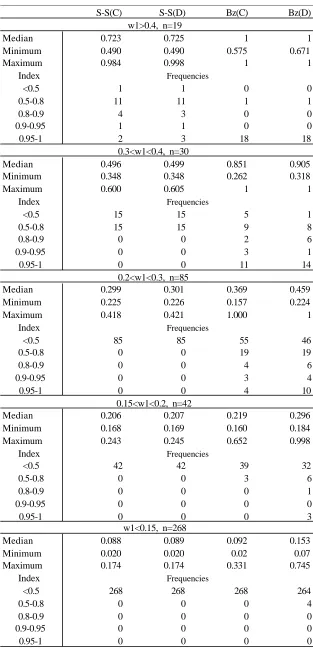
Power Indices for the Largest Shareholder in the Complete Sample
Table 4 gives the power of the largest shareholder according to both versions of each index for all
the companies. Companies have been classified according to the appraisal criteria by the size of the largest
and in 268 cases (more than half) the largest voting weight is below 15 percent. Nevertheless there is
enough variation to compare the performance of the indices.
The Shapley-Shubik index does not meet the appraisal criteria. Only in 3 or 4 cases out of 19
where the largest holding is above 40 percent is it above 0.9, while the Banzhaf index exceeds 0.95 in all
but one case20. A similar pattern is observed for the 30 companies where w1 is between 30 and 40
percent: the Shapley-Shubik index is never above 0.8 and in half the cases it is below 0.5; the Banzhaf
index varies considerably but in at least 11 cases it is greater than 0.95. For the group with w1 between 20
and 30 percent, the Shapley-Shubik index is never above 0.5 while the Banzhaf index varies from 0.15 to
1. When the largest shareholding is less than 20 percent only the oceanic Banzhaf index is ever close to 1.
Figure 1 plots the respective power indices for the largest shareholding separately for each index.21
Figure 1(a) shows the plot for the Shapley-Shubik index to be close to a simple functional relation. The
scatter is in fact bounded above by the function w1/(1-w1) which is well known to be the value of the index
for player 1 in an oceanic game with only one major player with weight w1 (Shapley and Shapiro, 1978).
Where the index is less than this value it is due to large weights for the other players. However the fact that
power is almost always relatively low and that it exceed 90% in only 3 or 4 companies means that this
index fails to satisfy the criteria.
Figures 1(b) and (c) show the equivalent plots for the two limiting Banzhaf indices. Here there is
much more variation consistent with the view that the index may be capturing well the effect of different
ownership structures. There is very little effect up to about 15%, the index increasing with w1, but after that
power varies widely for a given value of w1. These results suggest that shareholdings between 20 and 30
percent can be said to have voting control in many cases but equally not in many others. Most (but not all)
Table 4: Power Indices for Player 1, All Companies
S-S(C) S-S(D) Bz(C) Bz(D)
Median 0.723 0.725 1 1
Minimum 0.490 0.490 0.575 0.671 Maximum 0.984 0.998 1 1
Index
<0.5 1 1 0 0
0.5-0.8 11 11 1 1
0.8-0.9 4 3 0 0
0.9-0.95 1 1 0 0
0.95-1 2 3 18 18
Median 0.496 0.499 0.851 0.905 Minimum 0.348 0.348 0.262 0.318 Maximum 0.600 0.605 1 1
Index
<0.5 15 15 5 1
0.5-0.8 15 15 9 8
0.8-0.9 0 0 2 6
0.9-0.95 0 0 3 1
0.95-1 0 0 11 14
Median 0.299 0.301 0.369 0.459 Minimum 0.225 0.226 0.157 0.224 Maximum 0.418 0.421 1.000 1
Index
<0.5 85 85 55 46
0.5-0.8 0 0 19 19
0.8-0.9 0 0 4 6
0.9-0.95 0 0 3 4
0.95-1 0 0 4 10
Median 0.206 0.207 0.219 0.296 Minimum 0.168 0.169 0.160 0.184 Maximum 0.243 0.245 0.652 0.998
Index
<0.5 42 42 39 32
0.5-0.8 0 0 3 6
0.8-0.9 0 0 0 1
0.9-0.95 0 0 0 0
0.95-1 0 0 0 3
Median 0.088 0.089 0.092 0.153 Minimum 0.020 0.020 0.02 0.07 Maximum 0.174 0.174 0.331 0.745
Index
<0.5 268 268 268 264
0.5-0.8 0 0 0 4
0.8-0.9 0 0 0 0
0.9-0.95 0 0 0 0
0.95-1 0 0 0 0
w1>0.4, n=19
w1<0.15, n=268
Frequencies
0.2<w1<0.3, n=85
0.15<w1<0.2, n=42
Frequencies
Frequencies
Frequencies
Frequencies
Conclusions
This paper has reported on an exercise in the use of voting power indices to measure formal
shareholder voting power in a large sample of companies, with a view to comparing the performance of the
two "classical" power indices. The criteria by which the indices have been appraised are based on
independent analyses of shareholder voting power related to the separation of ownership and control. New
accurate algorithms for computing power indices in large finite voting bodies and oceanic games have been
applied.
The Shapley-Shubik index fails most of the appraisal criteria. The power index for the largest
shareholder is almost never as high as independent evidence suggests it should be given the distribution of
voting weights. Even when there is a dominant shareholder with at least 40 percent of the votes it is a lot
less than 1. The index converges slowly to 1 as the largest shareholder’s votes increase to a majority. The
index is never very large in the important group of companies where the largest shareholder is above 20
percent, a case often regarded as having practical working control
.
On the other hand, the results obtainedfor the Banzhaf index did not fail to satisfy the appraisal criteria. The conclusion is that the Shapley-Shubik
References
Banzhaf, J. (1965), “Weighted voting doesn’t work: a mathematical analysis,” Rutgers Law Review, vol. 19, 317-343.
Berle, A.A. and G.C. Means (1932), The Modern Corporation and Private Property, New York: Harcourt, Brace and World, Inc. Revised Edition, 1967.
Brams, S. J. (1988), "Are the Two Houses of Congress Really Coequal?" ch. 8, pp 125-41, in B. Grofman and D. Wittman (eds.), The Federalist Papers and the New Institutionalism: NewYork, Agathon Press.
Coleman, J. S. (1971), “Control of collectivities and the power of a collectivity to act," in Lieberman, ed., Social Choice, Gorden and Breach, 277-287; reprinted in J.S.Coleman (1986), Individual Interests and Collective Actions, Cambridge University Press.
Dubey, P. and L. S. Shapley (1979 ), “Mathematical properties of the Banzhaf power index,” Mathematics of Operations Research, 4,no. 2, May, 99-131.
Felsenthal, D. S. and M. Machover (1998) ,The Measurement of Voting Power, Edward Elgar.
--- W. Zwicker (1998), "The Bicameral Postulates and Indices of A Priori Voting Power," Theory and Decision, 44, 83-116.
Gambarelli, G. (1994), "Power Indices for Political and Financial Decision Making: A Review," Annals of Operational Research, 51, 165-173.
Holler, M. (1982), "Party Power and Government Function," in M.J.Holler (ed.), Power, Voting and Voting Power, Wurzburg, Physica-Verlag.
La Porta, R., Florencio Lopez-de-Silanes, Andrei Shleifer and R.W. Vishny, (1999) "Corporate Ownership around the World," Journal of Finance, vol. 32, 3(July): 1131-50.
Leech, D. (1988), "The Relationship between Shareholding Concentration and Shareholder Voting Power in British Companies: a Study of the Application of Power Indices for Simple Games," Management Science, Vol.34, No.4, April 1988, 509-527.
--- (1990), "Power Indices and Probabilistic Voting Assumptions," Public Choice, vol.66, pp.293-9.
--- (2002a), "Designing the Voting System for the Council of the European Union", Public Choice, forthcoming.
--- (2002b), "Shareholder Voting Power and Ownership Control of Companies", Homo Oeconomicus, forthcoming.
---(2002c), “Shareholder Voting Power and Corporate Governance: A Study of Large British Companies”, Nordic Journal of Political Economy, vol 27(1), forthcoming.
--- (2002d), "Voting Power in the Governance of the International Monetary Fund", Annals of Operations Research, Special Issue on Game Practice, forthcoming.
--- and J. Leahy (1991), "Ownership Structure, Control Type Classifications and the Performance of Large British Companies," Economic Journal, vol. 101, No. 6, 1418-37.
London Stock Exchange (1993), The Listing Rules, (The Yellow Book).
Lucas, W F (1983), “Measuring Power in Weighted Voting Systems,” in S Brams, W Lucas and P Straffin (eds.), Political and Related Models, Springer.
Milnor, J. W. and L. S. Shapley (1978), “Values of large games II: Oceanic Games,” Mathematics of Operations Research, vol. 3 ,no. 4, Nov., 290-307.
Morriss, P. (1987), Power: A Philosophical Analysis, Manchester University Press, Manchester, UK.
Pohjola, M (1988), "Concentration of Shareholder Voting Power in Finnish Industrial Companies," Scandinavian Journal of Economics, vol. 90, no. 2, pp.245-53.
Rapaport, A. (1998), Decision Theory and Decision Behaviour, 2nd ed.,Macmillan.
Riker, W. H. (1959), "A Test of the Adequacy of the Power Index," Behavioral Science, 4, 120-131.
Roth, A.E. (1977), “Utillity Functions for Simple Games," Journal of Economic Theory, vol.16, pp. 481-489.
Rydqvist, K. (1986), The Pricing of Shares with Different Voting Power and the Theory of Oceanic Games, Economic Research Institute, Stockholm School of Economics.
Shapley, L.S. (1953), "A Value for n-Person Games," in Contributions to the Theory of Games, vol. II, H.W.Kuhn and A.W.Tucker, eds., Ann. Math. Studies 28, Princeton University Press, Princeton New Jersey, 307-17.
--- (1961), "Values of Large Games III: A Corporation with Two Large Stockholders," RM-2650, The Rand Corporation, Santa Monica.
--- and N. Z. Shapiro (1978) “Values of large games, A Limit Theorem," Mathematics of Operations Research, Vol. 3. No. 1, pp1-9.(Formerly Values of Large Games, I: a Limit
--- and M. Shubik (1954), “A method for evaluating the distribution of power in a committee system,” American Political Science Review, 48, 787-792.
Straffin, Philip D. (1977), “Homogeneity, Independence and Power Indices,” Public Choice, vol. 30, pp.107-118.
Figure 1. Power Indices for Player 1 vs Weight: All Companies
Figure 1(a)
Shapley-Shubik Index: Limiting Case C
0% 10% 20% 30% 40% 50% 60% 70% 80% 90% 100%
0 0.1 0.2 0.3 0.4 0.5 0.6
[image:34.596.111.551.220.475.2]Figure 1(b)
Banzhaf Index: Limiting Case C
0% 10% 20% 30% 40% 50% 60% 70% 80% 90% 100%
0 0.1 0.2 0.3 0.4 0.5 0.6
w1
Figure 1(c)
Banzhaf Index: Limiting Case D
0.0 0.1 0.2 0.3 0.4 0.5 0.6 0.7 0.8 0.9 1.0
0 0.1 0.2 0.3 0.4 0.5 0.6
[image:35.596.113.549.117.683.2]1
Though given that it requires an 85 percent majority for important decisions in the IMF, it actually has the power of veto. The inference is often drawn from this that it therefore has complete control but this is an over-simple inference since veto power is not control; the latter implies also the power to get ones own proposals agreed. Analysis of the voting system used by the IMF, based on the methods and results of the current paper, is in Leech, 2002d. An analysis of the system of qualified majority voting in European Council of Ministers is in Leech, 2002a.
2
It is of course possible to make the comparison using artificial data but it is felt that it gives much greater relevance by using real data containing real world complexity. Previous empirical applications of power indices to study shareholder voting power include Leech, 1988; Pohjola, 1988; and Rydqvist, 1986; there are also several papers by Gambarelli, (see Gambarelli, 1994).
3
The term coalition is used here to denote simply a group of players who vote in the same way on a particular ballot whether by prior arrangement or not. In politics the term is used for a more permanent arrangement where a group of members usually involving several parties make a prior agreement to vote together repeatedly.
4
See also Rapaport, 1998, for a good account of the comparative theoretical properties of the indices.
5
Previous empirical tests of power indices include: Riker, 1959; Holler; 1982; Brams 1988. Riker studied the French National Assembly over 1953-4, looking at migrations of members from one party to another; his test was to use the Shapley-Shubik index to measure the power of the parties, assuming party discipline, and to see whether the deputies who migrated increased their power thereby. The results were negative. Holler tested the Banzhaf index using the Finnish parliament between 1948 and 1979 comparing the index with measures of real power such as participation in government. Brams found support for the Banzhaf over the Shapley-Shubik index as a measure of the relative power of the US House and Senate using data on the outcomes of legislative disagreements between them.
6
Voting by shareholders in the corporation has always been seen as an application of power indices. It was discussed at length in the seminal paper by Shapley and Shubik (1954), and developed in a subsequent paper by Shapley (1961), of which a condensed version was subsequently included as an appendix to Milnor and Shapley (1978)
7
Such would be where there are two or three very large holdings which would potentially control the company together but their rivalry, detected by the power index, prevents one of them having working control.
8
(London Stock Exchange, 1993). Presumably this should be interpreted as being either a single shareholder with 30 percent facing a large dispersed group of small shareholders, or two or more large shareholders and relatively fewer small shareholders. In the former case the power index would be close to 1 and in the latter case the number of player is so small that a controlling block can easily be formed.
9
It is conventional in the theoretical literature to require q=0.5 to guarantee a unique decision, and that the voting game is "proper". (Strictly the number in this inequality should be slightly greater than 0.5.) In all the empirical work I take q = 0.5, which amounts to assuming that important decisions require a simple majority, which is the normal case with company meetings. There are exceptions to this, however, with some special decisions requiring a supermajority, but it is a broadly satisfactory assumption. In general ordinary decisions taken at company AGMs such as election of directors and passing of resolutions about the direction of the firm and which we might regard as bound up in the ordinary notion of control, are taken by simple majority. Games where q>0.5 are not considered in this paper.
10
The source and method of construction of the data set are described in Leech and Leahy, 1991. Companies with a majority shareholder were left out. The data can reasonably be regarded as representing beneficial shareholdings, since details of nominee holdings and names and addresses were used to identify ultimate owners and create blocks owned by linked or related individuals or institutions. There might remain a very slight underestimation of the true concentration of ownership to the extent this information was incomplete.
11
12
For example much international empirical work is based on ownership stakes greater than 5% and in Britain greater than the legally declarable level of 3%.
13
Strictly slightly smaller than wk.
14
The algorithm combines the direct enumeration of the index with an approximation based on assuming the minor players vote probabilistically. It requires dividing players into an arbitrary number of major players and minor players, the latter being treated by an approximation. See Leech (1998). If it is assumed that the number of major players in the computation is the same as the number of major players in the oceanic game, expression (2) is easily found.
15
The value 5 for the number of finite players in this game was chosen for reasons of computational speed in calculating indices for all 444 firms but has little effect on the values obtained for the Shapley-Shubik indices. By changing the value of this number and re-calculating for the small sub-sample of companies reported here I have found the results to be practically invariant to the number of finite players.
16
Felsenthal and Machover (1998) reserve the use of the term "power index" to one which is normalised. In this paper the same usage is employed and the comparison of properties is between the Normalised Banzhaf index and the Shapley-Shubik index.
17
This result depends on the quota q. For certain values of q the power indices are zero in the limit (the "pitfall" points where the number of minor player swings become so numerous that the Banzhaf indices for major players go to zero). However in the cases studied here, with q always equal to w(N)/2, this problem does not arise.
18
See footnote 15.
19
The oceanic Banzhaf indices are found for all the observed weights, not just five.
20
This is the M and G Group in which w1=0.43 and w2=0.32, the top two shareholders between them holding 75% of the
voting weight.
21