
Agile versus waterfall methods : differences in knowledge networks and performance in software engineering teams
37
0
0
Full text
(2) Foreword I am pleased to present to you my master thesis: ‘Agile versus waterfall methods: differences in knowledge networks and performance in software engineering teams’. This study has started at the request of the ICT division of the RDW, the Dutch Vehicle Approval and Information organisation, to indicate success factors of their cross-functional teams. Hopefully, this research contributes to the improvement of their teams and will contribute to the field of Educational Science and HRD. This master thesis is the result of five months of research. Months full of learning experiences, full of energy and enthusiasm, and sometimes, full of difficulties. Especially in the first month, it was difficult to find a topic that covered both the interests of the RDW and the requirements of the University of Twente, while still being feasible. Performing a final project in an external environment means combining academia with daily practice, which more often than not is a challenge. However, considering that the organization RDW gave me a lot of freedom and confidence, as did my supervisor at the University of Twente, Ruth van Veelen, I was able to overcome this challenge and combine both processes. Many brainstorm sessions later, I found a topic that fulfilled both the RDW’s and the University of Twente’s needs, as well as my own interests. As a result of this combination of practice and science, I did not only optimize my academic skills as a researcher, I was also able to develop myself as a young professional within the organization. I am therefore truly thankful for all the learning opportunities I had at both the University of Twente and the RDW. Therefore, I would like to take this opportunity to specifically thank a number of people. First of all, I want to thank my supervisors in this project. Ruth van Veelen, thank you for your never ending enthusiasm and friendliness, for preventing me to get lost, and for your ability to help structuring and defining research. Your expertise and creativity have helped me more than once in writing this thesis. It was truly a pleasure working with you. I also want to express thanks to Marijn Wijga, for the feedback you have given me and the critical notes you made to my methodology. You allowed me to further improve my thesis, thank you. I would also like to thank my supervisors within the RDW: Saskia Postma and Harm de Mooij. Without your support and time I could not have realized this thesis. You were always there when I needed to brainstorm about the focus of the study or when I had questions. Moreover, you believed in me and even gave me an opportunity to develop myself within the organisation. I look forward to remain working with you. Second, I would like to thank all my colleagues at the RDW for their collegiality and support. In particular, I would like to thank those of you who have directly helped me in my thesis by filling out the questionnaire or participating in interviews. Without your contributions, I would not have had anything to write about in the first place, so thank you for that. Last, but not least, I want to thank my family, friends, and Lars for believing in me during my master and final project. Thank you all, for being there when I needed you, for believing in my capacities when I doubted them, and for listening to me even when you were not familiar with the topics. An additional thank you is in place for all those of you who helped me forget my thesis outside of ‘office hours’ through diners, coffees, or the occasional glass of wine. To all of you, your never ending support meant the world to me. Anouk Westendorp Groningen, January 2016.
(3) Abstract In modern society knowledge has become the most important resource for economic success, especially in knowledge-intensive organisations like software engineering. To optimally use knowledge in organisations, many software engineering organisations are organized in crossfunctional teams. However, successful realization of knowledge networks varies between crossfunctional teams. Nowadays, most software engineering teams use either an ‘agile’ or ‘waterfall’ method to collaborate in teams with high expertise diversity and product complexity. Differences in their knowledge networks are not studied yet. The current research focused on the ICT division of the Dutch organisation RDW and the quality of knowledge networks (i.e., transactive memory system and knowledge sharing) among its software engineers. Specifically, the three research questions were: (1) “Do knowledge networks, knowledge boundaries, dual identity (i.e., profession x team identification), and team performance differ between employees who work agile versus waterfall?”, (2) “What is the relationship pattern between knowledge boundaries, dual identity, knowledge networks, and team performance?”, and (3) “Is there a difference in the relationship patterns between knowledge boundaries, dual identity, knowledge network, and team performance, between employees who work agile versus waterfall?”. To investigate this, a single case study based on a cross-sectional, correlational research design was employed. From the 146 RDW employees who work in software engineering cross-functional teams, 81 employees participated in an online survey. Data was quantitatively analysed using T-tests and structural equation modelling. As expected, agile teams had a stronger knowledge network compared to waterfall teams. Moreover, knowledge boundaries related negatively to transactive memory system, and transactive memory system in turn related positively to team satisfaction and perceived team productivity. Thus, this research confirms the potential of agile methods in establishing stronger knowledge networks in teams and the importance of low knowledge boundaries in teams. Keywords: Transactive memory system, knowledge sharing, dual identity, knowledge boundaries, cross-functional software teams..
(4) Table of contents Chapter 1:. Introduction ..................................................................................................................... 5. 1.1. Problem statement ................................................................................................................... 5. 1.2. Objective of the study.............................................................................................................. 6. 1.3. Context of the study ................................................................................................................ 6. 1.4. Overview ................................................................................................................................. 7. Chapter 2:. Conceptual framework .................................................................................................... 8. 2.1. Agile software engineering...................................................................................................... 8. 2.2. Knowledge sharing in cross-functional teams ......................................................................... 9. 2.3. Transactive Memory System ................................................................................................. 10. 2.4. Knowledge networks ............................................................................................................. 11. 2.5. Knowledge boundaries .......................................................................................................... 11. 2.6. Dual identity .......................................................................................................................... 12. 2.7. Team performance ................................................................................................................. 13. 2.8. Research questions ................................................................................................................ 14. Chapter 3:. Method........................................................................................................................... 15. 3.1. Research design ..................................................................................................................... 15. 3.2. Participants ............................................................................................................................ 15. 3.3. Measures................................................................................................................................ 15. 3.4. Procedure ............................................................................................................................... 17. 3.5. Data analysis.......................................................................................................................... 18. Chapter 4:. Results ........................................................................................................................... 19. 4.1. Descriptive statistics and preliminary analysis ...................................................................... 19. 4.2. Parametric tests...................................................................................................................... 21. Chapter 5: Discussion ............................................................................................................................ 24 5.1. Conclusions ........................................................................................................................... 24. 5.2. Additional insights ................................................................................................................ 25. 5.3. Limitations of the present study and recommendations for future research .......................... 26. 5.4. Practical implications ............................................................................................................ 27. 5.4. General conclusion ................................................................................................................ 28. Literature ............................................................................................................................................... 29 Appendices ............................................................................................................................................ 32 Appendix A – Survey questions ........................................................................................................ 32 Appendix B – Retained items after factor analysis ........................................................................... 36.
(5) Chapter 1: Introduction 1.1. Problem statement. Modern society is rapidly changing, due to economic, social and technological renewals. In the past few decades, the Industrial Society has gradually been replaced by the Knowledge Society: A global economy driven by knowledge and creativity, advanced by new digital technology and globalization (Qureshi & Nair, 2015). As a consequence, an organisation’s available knowledge is considered one of the most strategically important resources for economic success. To effectively manage this resource, optimal knowledge sharing is crucial (Van den Hooff & de Leeuw van Weenen, 2004). Knowledge sharing is especially essential in knowledge-intensive organisations that have to keep up with technological renewals, such as software engineering organisations (Menolli, Cunha, Reinehr, & Malucelli, 2015). One of those organisations is the context of this study, the Dutch Vehicle Approval and Information organisation RDW. To deal with the flexible and innovation-based working climate, software engineering organisations such as the RDW increasingly implement agile methods, as opposed to the traditional waterfall method for projects. Agile development teams use short development iterations and daily meetings, with an intention of encouraging knowledge sharing and delivering successful products (Chau & Maurer, 2004). The waterfall method on the other hand, uses a more sequential development process in which team members hand over finished parts of the product for their colleagues to complete (see Figure 2). Since 2013 the RDW is in a transition towards agile working. This creates a situation in which agile and waterfall projects operate side-by-side. This offers the opportunity to investigate differences between these two methods in a software engineering context. Both agile and waterfall development teams need to complete complicated, non-routine projects, which usually requires team members from different disciplines to use each other’s knowledge and expertise. To develop a software product a team would, for example, need expertise from an engineer, a tester, an architect, and an administrator. To integrate these different expertise domains, the RDW and other organisations often use cross-functional teams. The expertise diversity found in such cross-functional teams ideally offers multiple advantages for competitiveness, such as higher team learning, inter-disciplinary knowledge sharing, and improved performance (e.g.: Ehrhardt, Miller, Freeman, & Hom, 2014; Van Der Vegt & Bunderson, 2005). However, managing a group of professionals from different disciplines to work together is a challenging task and many projects are delayed or cancelled because of communication and coordination breakdowns (Hsu, Shih, Chiang, & Liu, 2012). In order to reduce breakdowns and to profit optimally from the large pool of knowledge in cross-functional teams, it is important that strong knowledge networks are built between people. In other words, not only should people actively contribute their expertise to the team by sharing knowledge, they should also be aware of ‘who knows what’. The ability of group members to coordinate this known expertise located in the team and to use each other’s knowledge to accomplish collective goals is called a Transactive Memory System (TMS; Liao, Jimmieson, O’Brien, & Restubog, 2012). A well-functioning TMS can help cross-functional teams to improve knowledge sharing and to optimally use their expertise diversity. Nevertheless, TMS’s can still be impeded by communication or coordination breakdowns. These breakdowns can be caused by knowledge boundaries. Knowledge boundaries arise because of different knowledge backgrounds of the team members, leading to different interpretations or miscommunication because of the use of jargon (Kotlarsky, van den Hooff, & Houtman, 2015). In contrast to knowledge boundaries, a factor of cross-functional teams that is expected to improve the processes of TMS and knowledge sharing is that of a strong dual identity with both the profession and the team. Professional identity motivates people to make an effort to demonstrate their expertise, whereas team identity motivates people to make an effort in sharing knowledge because of a shared common identity and attachment to the group (Liao, O'Brien, Jimmieson, & Restubog, 2015). Together, it can be expected that this allows a team to utilize unique competences of the different. 5.
(6) disciplines while simultaneously utilizing the strong dedication of members to the team in order to achieve set goals.. 1.2. Objective of the study. Three goals have been set for this study. The first goal of this study is to determine whether differences exist in the strength of knowledge networks (i.e., TMS and knowledge sharing) and performance between cross-functional teams that work agile and those who work with the traditional waterfall project method at the RDW. The second goal is to investigate whether knowledge boundaries and a dual identity (professional and team) have an influence on TMS and knowledge sharing behaviours of software engineers in cross-functional teams. The third goal is to investigate whether strong knowledge networks have a positive influence on team performance in the software teams. Team performance is in this study measured based on team satisfaction and perceived team productivity as assessed by team members. The final aim is to arrive at an advice that helps the RDW in optimizing software engineering cross-functional teams, based on the study outcomes.. 1.3. Context of the study. The context of this study is the RDW, the Dutch Vehicle Approval and Information organisation. This is a public authority that originates in 1949 and has tasks in the licensing of vehicles, registration, information provision, and issuing of documents. The RDW is a nondepartmental public body, funded by fees. It performs tasks on behalf of the Ministry of Infrastructure and the Environment. The minister supervises how the RDW functions and is also responsible for appointing the board of directors. De RDW is organized in a board of directors with staff departments (e.g.: HR and communication) and three divisions: Vehicle Technology, Registration and Information, and ICT. This study focuses on the ICT division. The ICT division is focused on software engineering and delivers ICT solutions to the RDW and partners. The RDW employs approximately 1400 people, from which 240 work at the ICT division. Aside from internal employees, the ICT division also hires yearly around 100 external employees. The amount of external employees depends on the size of the project portfolio. The average age of RDW employees is 48.90 years, which is also representative for the ICT division. The ICT division can be divided in four different clusters; Advice & Architecture, Projects, Continuity, and Management & Organisation. The cluster Advice and Architecture is responsible for the arranging and guarding of the ICT-architecture and advices customers about ICT. The Cluster Projects takes care of the execution of determined software engineering projects, both for external customers and the internal organisation. Continuity takes responsibility for the administration of projects and delivers service to customers (for example in the form of SLA’s, service level agreements). The last cluster, Management & Organisation, has different responsibilities such as finance, security, audit, control, and quality management. Within the ICT division the vision ‘The ICT division is solid, innovative, and interesting to work for’ is leading. The mission statement is: ‘The ICT division would like to fulfil the fundamental needs of modern ICT facilities for the RDW, in order to support and renew RDW processes and services’. The RDW is structured as a matrix organisation and uses cross-functional teams for the majority of projects. This results in a situation in which individual employees have to report to multiple managers. For instance, a software architect has to report both to the team leader of his software architect team and to the team manager of the cross-functional project team he is currently working in. Moreover, the diversity of types of teams leads to differences in leader-team structures. Team A for example, is self-organising and uses agile and does therefore not have a direct manager. This team does however have direct contact with the customer. Team B on the other hand, has a team leader who manages the team and the team does not have direct contact with the customer. On average, the cross-functional teams consist of ten team members. Employees do not work exclusively in one team, some are asked to contribute their expertise in multiple (cross-functional) teams. Since 2013 two new cross-functional teams were composed and started working with - facets of - the agile way of working. In the year that followed, those two teams have learned to develop. 6.
(7) software products in an agile manner and have determined the methods and rules that worked in their environment. Within that same year, two other teams were started and also joined the agile transition. This means that a situation has arisen in which both project methods, agile and waterfall, exist next to each other and that a choice has to be made about whether agile becomes the standard or not. Until now, no decisive choice has been made about the direction that will be taken in the coming years when it comes to the method of future software projects.. 1.4. Overview. In the following chapter, chapter 2, the theoretical framework of this study will be described. In this theoretical framework, the variables of the study will be explained as well as their relations. Chapter 3 will explain the method used in this study, including the instruments and procedure. The results of this study will be presented in chapter 4, and will be discussed in chapter 5. This last chapter will also include suggestions for future research and guidelines for HRD practitioners in software engineering organisations.. 7.
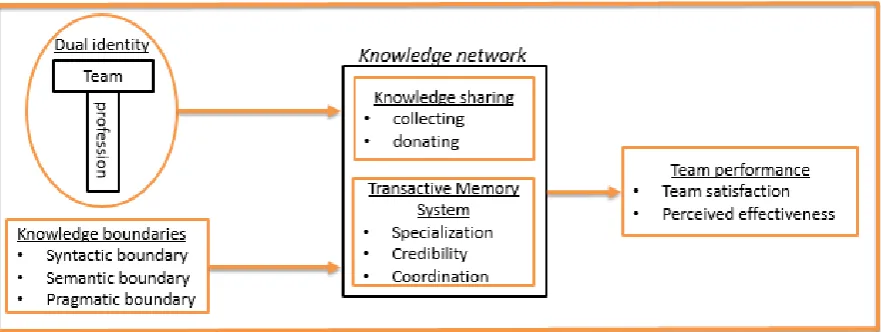
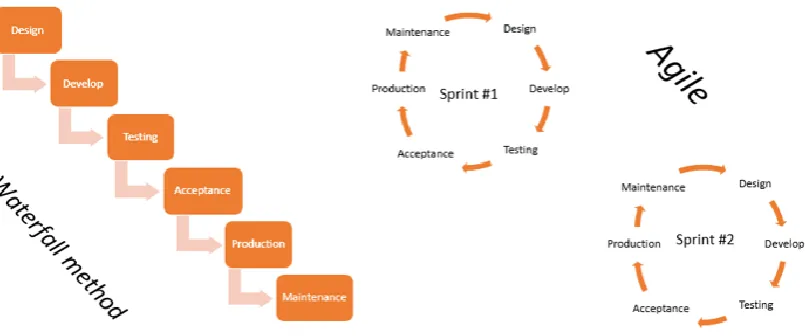
(8) Chapter 2: Conceptual framework In this conceptual framework the variables of the research and their relations will be described. This concerns the variables agile working, knowledge sharing, transactive memory system, dual identity, knowledge boundaries, and team performance. The expected relations between the variables of the present study are visualized in the following conceptual model (Figure 1):. Figure 1: Conceptual model of knowledge networks and team performance, influenced by dual identity and knowledge boundaries. 2.1. Agile software engineering. To develop software, engineers use several elements: design, development, testing, acceptance, production, and maintenance. The way these elements are structured in the engineering process depends on the project method. Traditionally, software engineers use the waterfall method, which treats the elements as sequential parts of a process. This means that an engineer can only proceed to the next step, if the previous one has been finished. This way of working can lead to miscommunication due to indirect and long communication paths (Chau & Maurer, 2004). As a consequence, the software system often does not meet the customer needs, or mistakes and changes can only be detected relatively late in the process. Since 2001, a trend towards new software development methods arose to address this problem: agile development (Larman, 2004). The agile method consists of the same building blocks as the waterfall method, though implements each part of the cycle in short iterations (Dingsøyr, Nerur, Balijepally, & Moe, 2012). The differences between the agile and waterfall method can be seen in Figure 2. Conboy (2009) exemplifies agile software development as a continued readiness to “rapidly or inherently create change, proactively or reactively embrace change, and learn from change while contributing to perceived customer value (economy, quality, and simplicity), through its collective components and relationships with its environment” (p. 340). In other words, agile working aims to add value to both customers and the process itself, while continuously learning and improving. Agile is an umbrella term for several development methods, such as Extreme Programming (XP), SCRUM and Kanban (Turk, France, & Rumpe, 2014). Each different form has its own rules and habits, yet all share the ground principles of the agile body of thought. The principles of agile development are noted down in the agile manifesto: “Individuals and interactions Working software Customer collaboration Responding to change. over over over over. processes and tools comprehensive documentation contract negotiation following a plan. That is, while there is value in the items on the right, we value the items on the left more.” (Larman, 2004, p. 28). 8.
(9) Figure 2: Waterfall versus agile working. By using short development iterations, agile processes divide the complete software system in smaller products. This can be compared with baking a pie: One does not start with the crust, followed by the filling and topping, but instead starts by making one slice, including crust, filling and topping. At the end of every iteration (or ‘sprint’) each project team shows the customer what ‘slice’ of the product the team has developed this time and demonstrates a working variant of this product. This assures several benefits. First, the project team and customer can change the direction of development, which also means that they can flexibly adapt to possible software bugs or changing technologies. Second, changes or wishes of the customer can be implemented during the development process. Lastly, all ICT experts of the team are involved during each phase of the project (Larman, 2004). Research has shown that this iterative development method is correlated with lower risk, higher productivity, and lower defect rates than in waterfall projects (MacCormack, Verganti, & Iansiti, 2001). The agile method does however also have disadvantages. First of all, the end user or customer of the product has a big role within the process, which is not always desired by these end users because it means a time investment. Second, the agile method documents far less than traditional methods (Sharma, Sarkar, & Gupta, 2012). Even though this is an advantage at first, this also means that it is harder for an external developer to join the team at a later stage, because not every detail has been documented. The absence of documented knowledge has also an influence on the type of knowledge present in the team, this becomes even more tacit. Lastly, the flexibility of the process can be very frustrating for the developers or can lead to wastage of resources because of constant changing requirements (Sharma et al., 2012). This frustration about the flexible process makes it challenging to enthuse team members to adopt the agile method as opposed to their familiar waterfall method.. 2.2. Knowledge sharing in cross-functional teams. Knowledge sharing comprises the exchange of (task) information and know-how to help others and to collaborate, in order to solve problems or develop new ideas (Sheng Wang & Noe, 2010). Multiple authors (e.g.: Ardichvili, Page, & Wentling, 2003; Weggeman, 2000) stress that knowledge sharing consists of two processes, namely a knowledge source and a knowledge receiver. Van den Hooff and de Leeuw van Weenen (2004) define these two processes as knowledge donating and knowledge collecting. Knowledge donating is about actively communicating one’s intellectual capital, whereas knowledge collecting means consulting colleagues about what they know (Van den Hooff & de Leeuw van Weenen, 2004). To encourage knowledge sharing between different disciplines and different departments, organisations often turn to the use of cross-functional teams (Ehrhardt et al., 2014) and consequently increase functional diversity in teams (Van Knippenberg, De Dreu, & Homan, 2004). Cross-functional teams (also: multidisciplinary or matrix teams) “comprise a group of people representing a variety of departments, disciplines, or functions, whose combined effort is required to achieve the team’s. 9.
(10) purpose” (Sijun Wang & He, 2008, p. 753). Such team diversity in function expertise can have both positive and negative effects on group performance (Van Knippenberg et al., 2004). The collaboration of different disciplines ideally offers multiple advantages for competitiveness, such as team creativity, higher team learning, inter-discipline knowledge sharing, and improved performance (Ehrhardt et al., 2014). The thinking behind why functional diversity leads to advantages is that diverse teams are more likely to possess a broader range of knowledge, skills, opinions, and perspectives on the task at hand that are distinct and non-redundant (Van Knippenberg et al., 2004). However, managing a group of professionals from different disciplines to work together to achieve a common goal is a challenging task and many projects are delayed or cancelled because of communication and coordination breakdowns (Hsu et al., 2012). Possibly, the agile method gives opportunity to profit optimally from expertise diversity and to prevent breakdowns in projects. Characteristics of agile working, such as more frequent (face-to-face) contact, and a focus on change and learning can supposedly increase knowledge sharing in the team (Chau & Maurer, 2004).. 2.3. Transactive Memory System. In order to profit optimally from the large pool of knowledge diversity in cross-functional teams, it is important that strong knowledge networks are built between its members. In other words, not only should people actively contribute their expertise to the group, they should also be aware of ‘who knows what’. The ability of group members to coordinate this known and trusted expertise located in the team is called a Transactive Memory System (TMS) (Liao et al., 2012). A TMS is defined as a set of information in a group, possessed by several group members combined with a shared awareness of who knows what within this group (Wegner, Giuliano, & Hertel, 1985). In a team, a TMS is built on three pillars: Specialization, coordination, and credibility (Lewis, 2003). Specialization refers to the level of differentiation of knowledge that team members possess. Coordination refers to the efficiency of a team in processing knowledge while working together. To be able to coordinate knowledge, members need not only to have specialized knowledge yet also integrated knowledge: overlapping knowledge of members and awareness of this overlap present in the team (Kotlarsky et al., 2015). Finally, credibility refers to the extent to which team members rely on and trust other members’ knowledge (Lewis, 2003). A well-functioning TMS enables team members to divide the cognitive labour regarding the encoding, storing, and retrieving of knowledge from different expertise areas (Kotlarsky et al., 2015; Zhang, Hempel, Han, & Tjosvold, 2007). That is, individual team members can develop deeper expertise in specialty areas, while the labour for learning and remembering relevant team knowledge is then divided among all team members and access to others’ task-relevant information is ensured (Lewis, 2003). By doing so, the members of a team can create a knowledge system that is bigger and more complicated than any of the individual participants’ own memory systems, which allows a team to increase effectiveness (Zhang et al., 2007). Besides that, a TMS can facilitate task and knowledge coordination, by enabling its group members to plan more sensibly and assign tasks to the people with most expertise, because members know more about each other’s expertise (Liao et al., 2012; Peltokorpi, 2008). Several studies (e.g.: Chen, Li, Clark, & Dietrich, 2013; Hsu et al., 2012; Ryan & O’Connor, 2013) have demonstrated the specific applicability of TMS in IT teams to improve performance, communication and knowledge sharing. To arrive at a well-functioning TMS however, team members need to know where knowledge is located, trust this knowledge and each have specialist knowledge to contribute. It is expected that the different characteristics of agile and waterfall methods lead to differences in their ability to establish well-functioning TMS’s. To start with, agile methods include more frequent moments of contact and more intense collaboration, compared to waterfall methods. As a result, it is proposed that team members can more easily learn who knows what when an agile method is used. For example, the daily meet-ups that are part of agile methods provide visibility of one’s work to the rest of the team. Through this, team members’ awareness of who has worked on or is knowledgeable about specific subjects (Chau & Maurer, 2004). Moreover, frequent and meaningful contact helps build trust within teams (Robert, Denis, & Hung, 2009), improving the credibility part of a TMS.. 10.
(11) 2.4. Knowledge networks. In the present study, knowledge networks is used as an umbrella term covering TMS and knowledge sharing. TMS can be seen, together with knowledge sharing, as the basis for knowledge networks between team members in cross-functional teams. With its three pillars (specialization, credibility, and coordination), the shared information pool and the knowledge of ‘who knows what’ within the team, TMS can be seen as the cognitive part of knowledge networks within teams. TMS provides the cognitive paths of knowledge depth and credibility for such a network. The enactment of knowledge networks is seen in knowledge sharing behaviours of team members. It is expected that both the cognitive part and enactment of knowledge networks can be improved trough agile methods. As mentioned before, several characteristics of the agile method, such as frequent contact, a focus on learning, and intense collaboration, may improve knowledge networks in cross-functional teams. However, since no prior research was found on differences in knowledge networks between agile and waterfall workers, this part of the study is exploratory in nature.. 2.5. Knowledge boundaries. Since cross-functional teams exist of team members with different knowledge backgrounds, communication problems can arise because of so-called knowledge boundaries (Kotlarsky et al., 2015). Knowledge boundaries are impediments in communication because of differences in terminology, interpretation, or interests. According to Carlile (2002), at the boundaries between different professional disciplines, three different forms of knowledge boundaries can emerge. The first form is syntactic, which results from differences in jargon between individuals. The second is semantic, which is related to different interpretations across different disciplines. The last form is pragmatic, which is caused by differences in interests of the different team members. These boundaries can disturb the processes of donating and collecting knowledge (Kotlarsky et al., 2015). Knowing what kind of boundary is causing impediments to communication can help the organisation in establishing communication patterns that resolve the problem at hand. For instance, when communication problems are caused by differences in interests and values, than creating a common language is not going to solve this, as tension related to incongruent goals will remain (Kotlarsky et al., 2015). To illustrate the different boundaries, imagine a cross-functional team with four members: Tom, a software coder; Michael, also a software coder; Anne, a software tester; and Alex, a software designer. When Tom would donate his knowledge about a new software coding technique to Anne while using this code-specific jargon, Anne will not be able to collect the knowledge. Anne does not understand all the words Tom uses and is therefore unable to understand the information transferred to her, due to a syntactic boundary. In the case that Michael would want to donate knowledge about how he wants to improve the efficiency of the software product to Anne, she might interpret the concept of efficiency differently. Because of this difference in interpretation the information is not completely and correctly transferred, due to a semantic boundary. Finally, when Anne would want to donate her knowledge of increasing software security to Alex, he might not collect this knowledge because of a pragmatic boundary simply because he has different interests. He wants to improve the usability and this might be in conflict with the interests of a software tester. It is expected that in software development teams with experts from different IT backgrounds, knowledge networks will be impeded as a result of knowledge boundaries. Boundaries can make it hard to retrieve knowledge from the TMS, especially when boundaries emerge between the various disciplines in the team (Kotlarsky et al., 2015). Besides that, development of the aforementioned integrated knowledge of a TMS can be hindered by knowledge boundaries. Since the integration of specific knowledge domains is important to create a shared coordination (‘who knows what’) within a TMS and because team members need to be able to access and understand the knowledge within TMS, it is hypothesized that knowledge boundaries have a negative influence on TMS in cross-functional teams. Likewise, it is hypothesized that knowledge boundaries complicate the sharing of knowledge in the team. This means that software engineers who experience many boundaries, will have lower scores on knowledge sharing and TMS.. 11.
(12) + 2.6. Hypothesis 1: Syntactic, semantic, and pragmatic knowledge boundaries between members of a cross-functional team are negatively related to knowledge sharing and TMS.. Dual identity. Members of cross-functional teams may have different ways of viewing themselves in relation to their work (Van Dick, Wagner, Stellmacher, & Christ, 2004). If someone were to ask the team members to describe themselves, person A might say ‘I am a software designer’, whereas person B might describe himself as ‘a member of team X’. This process of describing oneself as part of a group (either the team or the profession) is explained in the Social Identity Theory (SIT; Tajfel & Turner, 1979). According to this theory, and the closely related Self-Categorization Theory (Turner, Hogg, Oakes, Reicher, & Wetherell, 1987), people form their social identity based on what they have in common with the group and on what makes them different from other groups, through a process of categorization (‘we’ versus ‘them’; Turner et al., 1987). For example, when employees feel like they have similar goals and ideas compared to their team members and when they attach emotional significance to the membership of a certain team, they identify with that team (Van Der Vegt & Bunderson, 2005). Professional identification on the other hand is the degree to which people identify themselves with the profession that they practice and its typical characteristics (Bartels, Peters, de Jong, Pruyn, & van der Molen, 2010). SIT originated in social psychology (Tajfel & Turner, 1979), though received attention in organisational research when Ashforth and Mael (1989) first pointed out the potential value of this theory in understanding organisational processes. Several researchers have devoted research in this area (e.g.: Ashforth, Harrison, & Corley, 2008; Ellemers, De Gilder, & Haslam, 2004; Hogg & Terry, 2000) and some specifically in light of diversity in teams (e.g.: Hofhuis, van der Zee, & Otten, 2012; Mitchell, Parker, & Giles, 2011; Wenzel, Mummendey, & Waldzus, 2007). As mentioned before, cross-functional teams have the capacity to increase knowledge networks and team performance, yet do not always successfully profit from this capacity. According to the existing literature (Hofhuis et al., 2012; Wenzel et al., 2007), SIT and the process of social categorization can have both positive and negative effects on group diversity. On the one hand, social categorization processes can lead to intergroup biases (Hofhuis et al., 2012) which in turn can lead to negative group processes such as silo-working. Silo-working is caused when the members from the same discipline are seen as ‘we’ and the members from the cross-functional team are seen as ‘them’ (Liao et al., 2015). That is, the testers of a team for example, only stick with other testers in the team and do not cooperate or share knowledge with the other members with other specialties. On the other hand, identification with social groups provides meaning for the self and makes individuals motivated to behave and think in a way that is consistent with the way in-group members would typically behave and think (Liao et al., 2015). Likewise, group members consider their group and its members more positively than other groups and their members (Turner et al., 1987). In an attempt to exploit positive identity effects and to discard negative identity effects in diverse teams, Hofhuis et al. (2012) advice to create a situation in which people are able to create a dual identity; a situation in which both the overarching identity and subgroup identity are psychologically relevant at the same time. Translated to a matrix organisation, it is important that engineers do not only feel connected to the group from cross-functional project team they are currently working in, though also to the department (profession) they belong to (Ford & Randolph, 1992). Therefore, in cross-functional teams, employees who are able to identify with their profession or discipline, while simultaneously identifying with their team as an overarching group, are more likely to be able to deal with problems associated with diversity. Both identification behaviours are important for effectiveness of expertise diversity. It is therefore important for team members to express a dual identity. An individual displays a dual identity when both components, team identity and professional identity, are scored high (Hofhuis et al., 2012). In doing so, team members are not only willing to give emphasis to their expertise, yet also to contribute to the team with their expertise (Liao et al., 2015). The positive effects of both a team identity and a professional identity have already been demonstrated by Liao et al. (2015), though not yet in an interaction in a dual identity. This dual identity is expected to optimize the advantages of both identification behaviours, the team can now. 12.
(13) utilize unique competences of the different disciplines while simultaneously utilizing the strong dedication of members to the team. Furthermore, employees with a dual identity offer an additional advantage to agile teams. Within agile teams, it is important that team members are able to become a so-called ‘T-shaped’ professional (Boer, Wijnands, Bruns, & Bruggink, 2015). T-shaped means specialized in the own discipline (vertical), yet also able to perform in other disciplines when necessary (horizontal; Barile, Franco, Nota, & Saviano, 2012). This is specifically advantageous in agile methods, since this way of working relies on intense cooperation and short development iterations (Larman, 2004). This requires team members to assist colleagues in their task when time is short. Besides that, close collaboration can be improved when team members are able to think about shared problems, even when this is not within their own field of expertise. Being able to think or act outside of the own expertise, is the horizontal stroke of being T-shaped. Potentially, software engineers with a strong dual identity are the T-shaped software engineers within the organisation who commit both vertically and horizontally to the organisation’s goals. Specifically, professional identity can be seen as the vertical stroke (motivation to keep up with developments within the own discipline and keep specialized), whereas team identity can be seen as the horizontal stroke (motivation to perform outside of the own discipline for the sake of the team). When an individual is successful in developing a dual identity, knowledge sharing behaviours and TMS development can be expected to increase in cross-functional teams. First of all, identification with the team can be expected to lead to better coordinated and organized group action, because the shared sense of ‘we-ness’ can motivate group members to better address the information provided by their group members (Liao et al., 2012). Second, employees might feel more comfortable sharing knowledge with group members they feel attached to than with others, because in-group members are evaluated as more trustworthy, honest, cooperative, and valuable to the group than outgroup members (Kane, Argote, & Levine, 2005). Third, team members with a strong professional identity are generally extra motivated to make an effort because good performance gives emphasis to their expertise. This also stimulates professionals to perform optimally in cross-functional teams, since it gives a podium to demonstrate the importance of one’s expertise (Molleman & Rink, 2015). Moreover, when team members feel motivated to demonstrate one’s expertise their team members might be more likely to trust this expertise, leading to more credibility within the TMS. Having a dual identity is therefore expected to utilize the advantages of both identification behaviours together. This means that is assumed that team members who display a dual identity, score higher on TMS and knowledge sharing than team members who do not display a dual identity.. + 2.7. Hypothesis 2: A strong dual identity (profession x team) is positively related to knowledge sharing and TMS of software engineers in cross-functional teams.. Team performance. When levels of dual identity are high and the levels of knowledge boundaries are low, it is expected that knowledge networks will improve. Improvement of knowledge networks is important, since knowledge is seen as one of the most strategically important resources for success (Van den Hooff & de Leeuw van Weenen, 2004). Indeed, effective knowledge sharing is found to be associated with higher organisational performance (e.g.: Argote & Ingram, 2000; Law & Ngai, 2008; Sher & Lee, 2004). Other studies, such as Faraj and Sproull (2000), found that better expertise coordination leads to better team performance. When specifically investigating the influence of a well-established TMS, Zhang et al. (2007) confirmed a positive relationship with team performance. In line with these results, it is expected that knowledge networks are positively related to performance. This study focuses on performance of the team, which is measured by perceived team effectiveness as indicated by team members, and satisfaction of team members.. +. Hypothesis 3: Knowledge sharing and TMS in cross-functional software engineering teams is positively related to team performance.. 13.
(14) 2.8. Research questions. In the present study, the focus is on differences in the strength of knowledge networks (i.e., TMS and knowledge sharing) and performance between cross-functional teams that work agile and those who work with the traditional waterfall project method at the RDW. Additionally, the relation between knowledge boundaries and a dual identity (professional x team), and TMS development and knowledge sharing behaviours of software engineers in cross-functional teams is investigated. Subsequently, the relation between knowledge networks and team performance examined. By doing so, it is aimed to further extent findings about knowledge networks in cross-functional teams. A complete overview of the research questions leading the study and the aforementioned hypotheses is presented in Table 1. Table 1 Research Questions and Hypotheses of the Present Study Research question Hypothesis RQ1: Does a difference in the level of perceived knowledge sharing, Considering that not much is known yet about the influence TMS, knowledge boundaries, dual of agile methods, this question is more exploratory in identity, and team performance exist nature. between software engineers who work in agile teams versus waterfall teams?. RQ2: What is the influence of knowledge boundaries and a dual identity, on knowledge networks (knowledge sharing and TMS), and subsequently on perceived team performance (productivity and satisfaction) among software engineers in cross-functional software teams?. RQ3: Is there a difference in the relationship pattern between knowledge boundaries, dual identity, knowledge networks, and team performance, between software engineers who work in an agile team versus waterfall team?. H1: Syntactic, semantic, and pragmatic knowledge boundaries between members of a cross-functional team are negatively related to knowledge sharing and TMS. H2: A strong dual identity (profession x team) is positively related to knowledge sharing and TMS of software engineers in cross-functional teams. H3: Knowledge sharing and TMS in cross-functional software engineering teams is positively related to team performance.. Considering that not much is known yet about the influence of agile methods, this question is more exploratory in nature.. 14.
(15) Chapter 3: Method 3.1. Research design. A cross-sectional case study was set up to analyse the differences between the agile and waterfall methods on knowledge networks in the context of a Dutch software engineering organisation. The study had a correlational design. This design was suitable for the current research, especially because of the exploratory nature, since it made it possible to discover patterns between variables. Besides that, the cross-sectional nature of the study allowed to describe the current state of affairs. The variables and their expected relationships are depicted in Figure 1. Input variables were use of the agile method (yes/no), dual identity, and knowledge boundaries, process variables were knowledge sharing and TMS, and the output variables were team productivity and team satisfaction.. 3.2. Participants. In total, 146 employees of the ICT division from the RDW, distributed over 22 teams, were approached to fill out a questionnaire. In total 81 employees, distributed over 18 teams, completed the survey. This resulted in a response rate of 55.50%, meaning that over half of the target population was included in the sample. The majority of the participants was male (97%). The average age was M= 43.79 (SD= 9.45) ranging from 26 to 62 years. On average, participants had M= 10.54 (SD= 8.85) years of work experience at the company, ranging from 1 to 34 years. The majority of the participants was highly educated (either professional university (N= 53) or academic university (N= 10)). Vocational education was relatively underrepresented (N= 15). The distribution of age, education and gender resembled approximately the same distribution as the working population at the ICT division of the RDW. Each existing software engineering discipline as present at the ICT division of the RDW was included in the sample, except for data architect. Software engineers (35%) and application administrators (11%) were a majority in the sample, which is in line with the target population. From the 18 teams included in the sample, four teams formally used an agile method (SCRUM). Yet in the sample 54 participants indicated to work with the agile method and 27 participants indicated not to work with the agile method. Thus, here there is an inconsistency between the target population, consisting of only four out of the 22 teams participating in a pilot with agile working, and the sample. Agile workers are a minority in the population, yet a majority in the sample.. 3.3. Measures. Data was collected through an online survey with 86 questions. The questionnaire started with questions regarding gender, year of birth, educational degree, job category, and work experience. These general questions were followed by questions about the team background, most importantly of which whether and how long they work with the agile method. Subsequently, questions were asked about the variables knowledge boundaries, team identification, professional identification, TMS, knowledge sharing, team satisfaction, and team performance. The complete questionnaire as sent to the employees can be found in Appendix A. The content validity of items to measure each variable was explored with an exploratory factor analysis using oblimin rotation. The goal was to investigate whether the factor structures as explained in the theory could be confirmed in the current data. Direct oblimin was chosen as extraction method, because particularly with psychological measures it is to be expected that the factors will correlate (Field, 2009). Before each factor analysis, Kaiser-Meyer-Olkin’s measure of sampling adequacy was assessed and had to be above .70 in order to proceed with factor analysis. Bartlett’s test of Sphericity had to be significant (p <.001), indicating that the correlations between variables are overall significantly different from zero (Field, 2009). Subsequently, the structure matrix of the performed factor analysis was interpreted and items that cross-loaded on more than one factor were discarded. If items were discarded, a subsequent factor analysis was performed in order to investigate the structure matrix again. After the process of investigating items and performing factor analyses, items that loaded together on one factor were assessed on reliability using Cronbach’s alpha. The different measures will be explained in the following paragraphs and the scales as used in further analyses can be found in Appendix B.. 15.
(16) Dual identity Professional identity was measured with six items, rated on a Likert-scale (1; totally disagree to 5; totally agree), which were adapted from Van Dick et al. (2004). An example question was “I like working as a [name of profession]”. An exploratory factor analysis was performed using oblimin rotation, to investigate whether an expected one-factor structure could be found in the data. Results demonstrated that, contrary to initial expectations, two factors could be extracted from the six items, both with an Eigenvalue > 1.00, explaining in total 71.03% of the variance. This second factor consisted of two items and was unreliable (α= -.22). Both items were therefore discarded. In a second factor analysis, the four other items still loaded on one factor, explaining in total 68.81% of the variance. Reliability of the scale professional identity with four items was high, α= .84. Team identity was also measured with six items, rated on a Likert-scale (1; totally disagree to 5; totally agree), which were adapted from Van Dick et al. (2004). An example question was “I like working for my team”. An exploratory factor analysis was performed using oblimin rotation, to investigate whether an expected one-factor structure could be found in the data. Results showed that indeed one factor could be extracted from the six items, with an Eigenvalue > 4.00, explaining in total 70.80% of the variance. Reliability of the scale was good, α= .91. In light of consistency however, since the scale professional identity consisted of four items, it was decided to proceed with the same four items in the team identity scale. Reliability of the scale did not change after discarding these items and proved to be high, α= .91. Dual identity was measured with the product term of each employee’s score on team identity and professional identity (e.g., participant #1’s mean score on team identity multiplied by his/her mean score on professional identity; Hofhuis et al., 2012). Knowledge boundaries Knowledge boundaries were measured with ten items, rated on a Likert-scale (1; totally disagree to 5; totally agree) and were adapted from Kotlarsky et al. (2015). Three items measured syntactic knowledge boundaries (e.g., “when I communicate with my team members, I often have problems understanding what is relevant and what is not”), four items semantic knowledge boundaries (e.g., “my team members and I have a different understanding of our project goals”), and three items pragmatic knowledge boundaries (e.g., “it is hard to come to a joint solution with my project team”). A series of exploratory factor analysis was performed using oblimin rotation, to investigate whether the initial three-factor structure could be found in the data. Results demonstrated that, as opposed to the expected three-factor structure, a two-factor structure could be extracted from the ten items, with Eigenvalues > 1.00, explaining in total 64.34% of the variance. Two cross-loading items were discarded. In this new two-factor structure the original items measuring semantic knowledge boundaries were clustered in both the syntactic and pragmatic knowledge boundary factor. Indeed, inspection of the content of these items confirmed their conceptual connection to either syntactic or pragmatic knowledge boundaries. The semantic item ‘my team members and I have a different interpretation of the meaning of things’ for example, could also be explained as an item measuring syntactic boundaries (differences in understanding because of miscommunication). Therefore, as opposed to Carlile’s (2004) theory of knowledge boundaries, this study focused on two kinds of boundaries, labelled: interpretative knowledge boundaries (syntactic) and sentiment-related knowledge boundaries (pragmatic). Reliability of both the interpretative boundaries (five items) and sentiment-related boundaries (three items) scale was sufficient, respectively α= .89 and α= .79. Knowledge boundaries as a whole (both interpretative and sentiment-related) had a reliability of α=.85. Knowledge network Knowledge sharing was measured with sixteen items, rated on a Likert-scale (1; totally disagree to 5; totally agree) and were adapted from Van den Hooff and Huysman (2008). Eight items measured knowledge sharing within the department/expertise domain (e.g., “When I need certain knowledge, I ask my colleagues who are also [name of profession] about it”), and eight items knowledge sharing within the cross-functional team (e.g., “When I need certain knowledge, I ask my. 16.
(17) team members about it”). Aside from this distinction between team and department, Van den Hooff and Huysman (2008) make another distinction between knowledge donating and knowledge collecting. While an exploratory factor analysis using oblimin rotation confirmed a 4-factor structure, the distinction between collecting and donating as described by Van den Hooff and Huysman (2008) could not be found. Inspection of the structure matrix showed that two items belonging to knowledge sharing within the team had to be discarded. To keep both scales consistent the same items from knowledge sharing within the department were deleted. Since the distinction between departmental and team knowledge sharing was found, we proceeded with the scales knowledge sharing department (α= .86) and knowledge sharing team (α= .77). Transactive Memory System was measured with fifteen items, rated on a Likert-scale (1; totally disagree to 5; totally agree) and were adapted from Lewis (2003). Five items measured specialization (e.g., “I know which team members have expertise in specific areas”), five items coordination (e.g., “we accomplished the task smoothly and efficiently”), and five items credibility (e.g., “I trusted that other members’ knowledge about the project was credible”). An exploratory factor analysis was performed using oblimin rotation, to investigate whether the initial 3-factor structure could be found in the data. Results indicated that not three, but five factors could be extracted from the fifteen items, from which all had an Eigenvalue > 1.00, explaining in total 65.92% of the variance. Closer inspection of the structure matrix and a series of factor analyses finally resulted in an item set of seven items loading on two different factors; four items measured coordination and three items measured credibility, see Appendix B. Both factors had an Eigenvalue > 1.00, explaining in total 61.35% of the variance. Reliability of the scale credibility was α= .84, and reliability of the scale coordination was α= .77. The scale Transactive Memory System (both coordination and credibility) had a reliability of α= .80. Team performance Team satisfaction was measured with seven items, rated on a ten-point-scale (1; my team performs really badly on this item to 10; my team performs excellent on this item). Items were retrieved from an organisation’s internal key performance indicator and included questions such as “I like working for this team”. An exploratory factor analysis was performed using oblimin rotation, to investigate whether an expected one-factor structure could be found in the data. Results confirmed the existence of one factor in the data, with an Eigenvalue > 4.00, explaining in total 65.04% of the variance. Reliability of the scale was good, α= .90. Team productivity was determined with four questions, rated on a Likert-scale (1; totally disagree to 5; totally agree) and were adapted from Smith and Barclay (1997). An example item was “from a performance perspective, our team has been effective”. An exploratory factor analysis was performed using oblimin rotation, to investigate whether an expected one-factor structure could be found in the data. Results confirmed an one-factor structure, with an Eigenvalue > 2.00, explaining in total 58.20% of the variance. Reliability of the scale was good, α= .75.. 3.4. Procedure. After having received approval from the UT ethical committee to conduct this study, all team managers were asked for their permission to approach team members. With approval from both the UT ethical committee and the team managers, the survey was pilot tested. Eight employees volunteered to pilot test and together filtered out several misspellings and items that were unclear, which was used to finalize the questionnaire. Additionally, in the pilot test all questions were initially mandatory, which meant that participants could not skip questions. It was noted however, that this felt uncomfortable and that it made some participants hesitate about closing the questionnaire as a whole. Moreover, remarks were made that the sum of age, education, team and profession could still be traced back to individual employees and thus violated the feeling of anonymity, which is especially important in an IT environment. As a result of these remarks, the choice was made to make the majority of questions voluntary, meaning that participants could skip questions if they felt the need to. This was also made clear at the beginning of the questionnaire. Only the questions about team and profession. 17.
(18) were made mandatory, because these were input for subsequent questions. As a result of this choice, the dataset did contain some missing data. At the start of data collection, 146 employees were approached individually by email (in Dutch) with a request to fill out a questionnaire. Questions as used in this questionnaire can be found in Appendix A. Only employees who had a daily task in software development and who worked in a cross-functional team have been approached. Employees were free in choosing when and how they wanted to fill out the questionnaire, although they were asked to fulfil it within the two-week timeframe. On average, participants needed 15 minutes to complete the questionnaire. There was no reward for participating; participants were however invited to attend an informal mini seminar at the end of the research period to be informed about the results and to have the possibility to discuss results. The questionnaire was made available to employees via a link to the online survey tool Qualtrics. The link was active for two weeks and a reminder was sent via email after the first week. After clicking this link, participants landed on an informed consent page. This page informed participants about the goal of the study, time estimation of filling out the questionnaire, and guaranteed complete anonymity. It was also explained that participants could not retrieve individual results or answers, because of the anonymous manner of data collection. After accepting the informed consent form by clicking “I agree” after the statement “I have read the abovementioned information and I have no further questions”, participants could access the questionnaire. Answering “I do not agree” lead to abortion of the survey. At the end of the survey, participants were given the opportunity to place comments about the questionnaire or the research. On that same page, contact info about the researcher was provided, so that participants were able to contact in case of questions.. 3.5. Data analysis. In order to answer the research questions, several steps were taken to explore and analyse the data. First descriptive statistics and correlations were calculated and investigated. Second, an independent sample t-test was used to test the differential effects of the agile method relative to waterfall on knowledge networks. Third, structural equation modelling (SEM) was used to test the model depicted in Figure 1, using the graphical interface of AMOS. SEM was performed to obtain maximum likelihood estimates and a chi-square measure to assess the model’s goodness of fit. To obtain an acceptable fit, the model had to meet the following criteria: The χ2-measure should be nonsignificant and its value divided by the degrees of freedom should be less than 3, RMSEA< .06, and TLI and CFI above .95 (Hu & Bentler, 1999). Fourth, a chi-square difference test for group differences was performed to investigate differences in relationship patterns between employees who use the agile method and employees who still use the waterfall method. All data was analysed on the individual level. Nevertheless, it should be noted that the individual participants of the study were nested within teams. Being part of the same team can create a statistical dependency that violates the assumption of independence of observations (Baldwin, Murray, & Shadish, 2005). However, the context of the study made it hard to analyse data on group level. First of all, team members within teams differed a lot from each other, including in their experience with the agile method or their duration of team membership. Second, the boundaries of teams were fuzzy since several employees had multiple group memberships. This means that individuals were partly involved in more than one cross-functional team at the same time. Third, the small amount of teams created a power issue. Considering that the present study included 6 variables, at least 60 teams would have been needed to achieve sufficient power (ratio 1 to 10; Tanaka, 1987). Consequently, and in line with Kotlarsky et al. (2015) and Jarvenpaa and Majchrzak (2008), all variables were conceptualized and analysed at the individual level. Besides this, the current research made no use of appraisals from team leaders or customers. Again, this choice was made because the teams differed too much in their team structure and team compositions were fuzzy. Combined with the analysis on individual level, it seemed most logical to measure team performance by asking the team members themselves how they perceived this in their team.. 18.
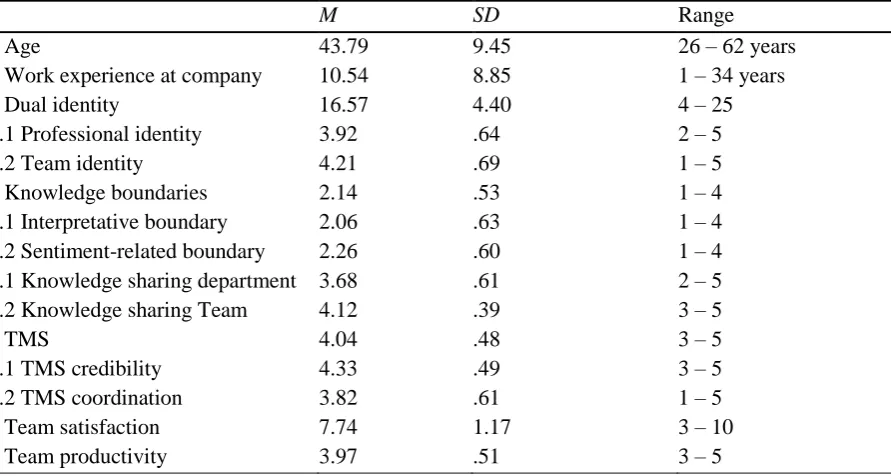
(19) Chapter 4: Results The purpose of this study was to analyse the influence of the agile working method and knowledge networks in the context of a Dutch software engineering organisation. Input variables were ‘agile/waterfall processes’, dual identity, and knowledge boundaries. Process variables were knowledge sharing and TMS. Finally, the output variables were team productivity and team satisfaction. The following section starts with preliminary analyses and subsequently describes the results of the research questions using inferential statistics.. 4.1. Descriptive statistics and preliminary analysis. This study investigated two groups, based on their working method (either agile or waterfall). Table 2 shows an overview of the means and standard deviations for each continuous variable. Overall, results in Table 2 show relatively high mean scores (above the midpoint of the scale) on most variables. This indicates for example that software engineers involved in this study feel strongly connected to their team, that they share a lot of knowledge and that they are highly satisfied with their team. Identification with both the profession and team are around 4.00, which is quite high. Dual identity is also relatively high, indicating that software engineers at the RDW score high on both identities. The variables measuring knowledge boundaries showed relatively low scores (below the midpoint (3.00) of the scale), indicating that employees within the ICT division of the RDW do not experience many knowledge boundaries. Interestingly, the level of sentiment-related boundaries is higher than the level of interpretative boundaries (Msentiment-related =2.26, Minterpretative =2.06, t (80) = -2.72, p= .008). In other words, miscommunication within teams at the RDW arose more often because of differences in goals and interests of the different team members than because of misunderstanding of what the other has said. Table 2 Summary of means, standard deviations, and range of all continuous variables in the model (N= 81) M SD Range 1 Age 43.79 9.45 26 – 62 years 2 Work experience at company 10.54 8.85 1 – 34 years 3 Dual identity 16.57 4.40 4 – 25 3.1 Professional identity 3.92 .64 2–5 3.2 Team identity 4.21 .69 1–5 4 Knowledge boundaries 2.14 .53 1–4 4.1 Interpretative boundary 2.06 .63 1–4 4.2 Sentiment-related boundary 2.26 .60 1–4 5.1 Knowledge sharing department 3.68 .61 2–5 5.2 Knowledge sharing Team 4.12 .39 3–5 6 TMS 4.04 .48 3–5 6.1 TMS credibility 4.33 .49 3–5 6.2 TMS coordination 3.82 .61 1–5 7 Team satisfaction 7.74 1.17 3 – 10 8 Team productivity 3.97 .51 3–5. 19.
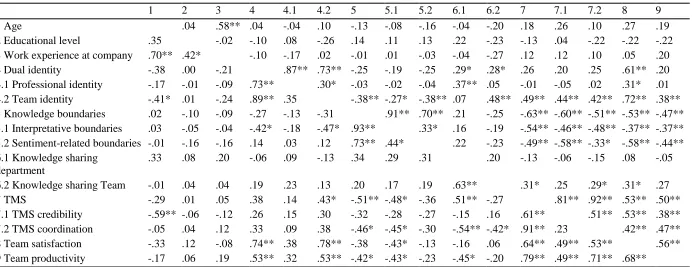
(20) Table 3 Pearson Correlations for all measures. Above the Diagonal the Correlations for Employees who work agile (N= 54) are presented, below the Diagonal Correlations for Employees who work Waterfall (N= 27) are presented 1. 2 .04. 3 4 .58** .04 -.02 -.10 -.10 -.21 -.09 .73** -.24 .89** -.09 -.27 -.04 -.42* -.16 .14 .20 -.06. 4.1 -.04 .08 -.17 .87**. 4.2 .10 -.26 .02 .73** .30*. 5 -.13 .14 -.01 -.25 -.03 -.38**. 5.1 -.08 .11 .01 -.19 -.02 -.27* .91**. 5.2 -.16 .13 -.03 -.25 -.04 -.38** .70** .33*. 6.1 -.04 .22 -.04 .29* .37** .07 .21 .16 .22. 6.2 -.20 -.23 -.27 .28* .05 .48** -.25 -.19 -.23 .20. 1 Age 2 Educational level .35 3 Work experience at company .70** .42* 4 Dual identity -.38 .00 4.1 Professional identity -.17 -.01 4.2 Team identity -.41* .01 .35 5 Knowledge boundaries .02 -.10 -.13 -.31 5.1 Interpretative boundaries .03 -.05 -.18 -.47* .93** 5.2 Sentiment-related boundaries -.01 -.16 .03 .12 .73** .44* 6.1 Knowledge sharing .33 .08 .09 -.13 .34 .29 .31 department 6.2 Knowledge sharing Team -.01 .04 .04 .19 .23 .13 .20 .17 .19 .63** 7 TMS -.29 .01 .05 .38 .14 .43* -.51** -.48* -.36 .51** -.27 7.1 TMS credibility -.59** -.06 -.12 .26 .15 .30 -.32 -.28 -.27 -.15 .16 7.2 TMS coordination -.05 .04 .12 .33 .09 .38 -.46* -.45* -.30 -.54** -.42* 8 Team satisfaction -.33 .12 -.08 .74** .38 .78** -.38 -.43* -.13 -.16 .06 9 Team productivity -.17 .06 .19 .53** .32 .53** -.42* -.43* -.23 -.45* -.20 Note: ** Correlation is significant at the .01 level (two-tailed); * Correlation is significant at the .05 level (two-tailed). 20. 7 .18 -.13 .12 .26 -.01 .49** -.63** -.54** -.49** -.13. 7.1 .26 .04 .12 .20 -.05 .44** -.60** -.46** -.58** -.06. .31*. .25 .29* .81** .92** .51** .23 .49** .53** .49** .71**. .61** .91** .64** .79**. 7.2 .10 -.22 .10 .25 .02 .42** -.51** -.48** -.33* -.15. 8 .27 -.22 .05 .61** .31* .72** -.53** -.37** -.58** .08. 9 .19 -.22 .20 .20 .01 .38** -.47** -.37** -.44** -.05. .31* .53** .53** .42**. .27 .50** .38** .47** .56**. .68**.
(21) Results of Table 3 showed that several interesting differences between agile and waterfall engineers can be found in the relationship between variables. The correlation between age and credibility (from TMS) for instance, seemed strongly negative in the waterfall sample (r= -.59), while positive in the agile sample (r= .26). This difference can however also be attributed to differences in sample sizes. Therefore, Fisher’s z transformation for comparing correlation coefficients was used. Outcomes showed that this difference is significant (z= 3.81, p<.001). Differences also exist in the relation between TMS and team productivity between both samples (ragile= .50, rwaterfall= .79, z= -2.11, p=.017) and in the relation between sentiment-related knowledge boundaries and team satisfaction between both samples (ragile=.-.58, rwaterfall=-.13, z= -2.15, p=.016). In sum, the results from the preliminary analyses strengthened the expectation that differences exist between agile and waterfall workers and encouraged to continue with the parametric tests.. 4.2. Parametric tests. The purpose of this study was to analyse the influence of the agile working method and knowledge networks in the context of a Dutch software engineering organisation. Therefore, T-tests and structural equation modelling were used. However, to use these kinds of parametric tests, the dependent variable should be at interval level and should be normally distributed. Since the dependent variables team satisfaction and team performance were measured with respectively a Likert-scale and a ten-point scale, the interval level condition was met. Inspection of the histogram showed that the distribution of team satisfaction was bell-shaped and skewed to the left, with a kurtosis value of 2.63. The Kolmogorov-Smirnov test scored significant: p= .03, confirming non-normality. With regard to team productivity, inspection of the histogram showed that the distribution was bell-shaped, with a kurtosis value of -.25. The Kolmogorov-Smirnov test scored significant: p <.001, confirming nonnormality. Since the sample size is larger than 40 however, the Central Limit Theory allowed us to continue with the tests (Field, 2009).. 4.2.1 Research question 1: agile versus waterfall working To test whether differences between both working methods were significant an independent samples t-test was conducted. Levene’s test concerning equal variances was non-significant for all variables, except for the variable team satisfaction. Homogeneity is therefore not assumed for team satisfaction. As can be seen in Table 4, the t-test showed significant differences between employees who work agile and those who work waterfall on sentiment-related knowledge boundaries, knowledge sharing, TMS, and team satisfaction. In line with hypothesis 1, the results showed that software engineers who worked in agile teams shared significantly more knowledge and had a stronger TMS in their team than software engineers who worked in traditional waterfall teams. Moreover, those who worked agile indicated less sentiment-related knowledge boundaries compared to those who worked in the waterfall method, and experienced more team satisfaction.. 21.
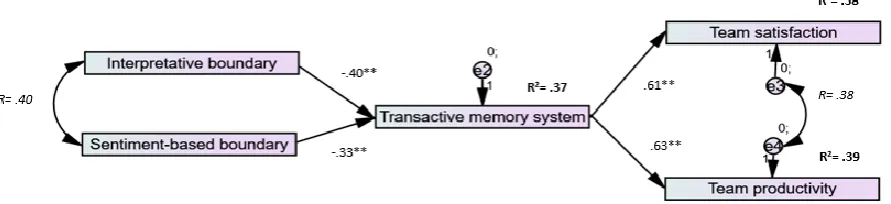
(22) Table 4 An Overview of Means and Standard Deviations for each Model Variable per Project Method and Significant Differences Agile Waterfall Variable M (SD) M (SD) df T p-value 1. Dual Identity 16.84 (4.15) 16.02 (4.93) 77 .78 .441 2. Knowledge Boundaries 2.05 (.46) 2.31 (.61) 79 -2.10 .039 2.1 Interpretative Boundary 2.00 (.56) 2.19 (74) 79 -1.28 .204 2.2 Sentiment-related Boundary 2.14 (.55) 2.51 (.65) 79 -2.65 .010 3. Knowledge Sharing Team 4.23 (.34) 3.92 (.40) 79 3.57 .001 4. Knowledge Sharing Department 3.62 (.65) 3.80 (.51) 76 -1.25 .216 5. TMS 4.14 (.43) 3.84 (.51) 79 2.74 .008 5.1 TMS Credibility 4.41 (.46) 4.16 (.50) 79 2.26 .027 5.2 TMS Coordination 3.93 (.51) 3.60 (.73) 79 2.34 .022 6. Team Satisfaction 8.01 (.85) 7.21 (1.49) 34.87 2.58 .014 7. Team Productivity 4.03 (.48) 3.84 (.54) 78 1.57 .121 Note: M= mean; SD= standard deviation; df= Degrees of freedom. 4.2.2 Research question 2: Relationship pattern between knowledge boundaries, dual identity, knowledge network, and team performance To test whether or not the expected relationship pattern existed between knowledge boundaries, dual identity, knowledge networks, and team performance, structural equation modelling was performed with use of AMOS. The expected relations as depicted in the hypothesized model (Figure 1) were estimated in Model 1. The hypothesized model did not obtain good fit, χ2= 51.08, p= <.001, df= 8, RMSEA= .26, TLI= .13, CFI= .75. Results on the parameter estimates indicated that several paths were non-significant, including dual identity to knowledge sharing, dual identity to TMS, and knowledge sharing to both team satisfaction and team productivity. One by one, non-significant paths were deleted, provided that the model stayed theoretically meaningful. This resulted in a path model (Model 2, see Figure 3) that did not include the variables dual identity and knowledge sharing. The remaining variables still had the same paths as hypothesized before. This model obtained good fit, χ2= 3.31, p= .508, df= 4, RMSEA= .00, TLI= 1.02, CFI= 1.00. Results on the parameter estimates showed that all paths were significant (p <.05).. Figure 3: Path model of Model 2 with standardized maximum likelihood estimates and squared multiple correlations. Note: ** Estimate is statistically significant at the .01 level (two-tailed) In line with hypothesis 2, the model proves that sentiment-related boundaries (β= -.33, t= 3.36, p<.001) and interpretative boundaries (β= -.40, t= -4.12, p<.001) are negatively related to TMS. Due to the non-significant paths that were omitted, the expected relation between dual identity and knowledge network from hypothesis 3 could not be confirmed. Confirming hypothesis 4, the model gives statistical evidence that TMS is positively related to team satisfaction (β= .61, t= 6.91, p<.001). 22.
Figure
+2
Related documents
(2005) Determining a diagnostic dose for imidacloprid susceptibility testing of field- collected isolates of cat fleas (Siphonaptera: Pulicidae). (2004) Efficacy of
Keywords: Middlemarch , Dorothea Brooke, Will Ladislaw, Victorian marriage,
The initial statistical analyses of the dataset were descriptive and included: frequencies, rates, means, and standard deviations of the cohort’s demographics (age, gender,
The potential establishment of a “Global Degree” is a concise and innovative proposal that will revolutionise international higher education and at the same time blend
Persons unnecessary to the food establishment or retail food store/market operation are not allowed in the food preparation, food storage, or warewashing areas, except that
For male farmers, the coefficients of land area allocated to maize production, access to credit, participation in field days, household size, number of livestock
By identifying and understanding the interdependencies between Resources, Preference of users and Utilization of users, Utility based User Preference Resource
for your efforts to start a smooth tournament season. Becker continued the success of tournament season. Teams from across the state packed the fieldhouse on March 24 - 25.
