http://www.scirp.org/journal/ijg ISSN Online: 2156-8367
ISSN Print: 2156-8359
Solid Waste Management Challenges in Urban
Areas of Ghana: A Case Study of Bawku
Municipality
Nang Biyogue Douti1*, Samuel Kojo Abanyie1, Steve Ampofo1, Senyo Komla Nyarko2
1Faculty of Applied Sciences, University for Development Studies, Department of Earth and Environmental Sciences, Navrongo
Campus, Navrongo, Ghana
2Wastelandfills Company Ltd., Koforidua, Ghana
Abstract
This study was conducted in the Bawku Municipality of the Upper East, Ghana, with the view to assessing the factors that impede the management of solid waste. Questionnaires were submitted to 150 randomly selected households, while face-to-face semi-structured interviews were conducted with the mu-nicipal Waste Management Department and a private waste management company, Zoomlion Ghana Ltd. Data collected included components of solid waste generated, waste collection, transportation and final disposal methods, the challenges confronting waste management institutions, and respondents᾽ knowledge and perceptions of the waste management system and their atti-tudes towards it. Components of wastes generated were organic waste, paper waste and plastics. Factors that adversely affected waste collection and trans-portation systems were the inadequate supply of waste collection containers, the existence of a weak waste transportation system and a low patronage of the door˗to˗door collection method. The study showed that the municipal landfill did not meet the required standard. The results also revealed the lack of public awareness on issues regarding waste and lack of a participatory ap-proach that makes the people an active stakeholder in the waste management system. This situation accounted for indiscriminate disposals of waste by most respondents who viewed the issue of waste management as the exclusive re-sponsibility of the local government. The study further showed that the waste management institutions were faced with financial difficulties, understaffing and poor logistics and nature of roads, and social constraints. The study therefore suggests the development of a strategic plan for efficient waste management which revolves around these findings.
Keywords
Solid Waste Management, Urban Areas, Developing Countries, Ghana
How to cite this paper: Douti, N.B., Ab-anyie, S.K., Ampofo, S. and Nyarko, S.K. (2017) Solid Waste Management Challenges in Urban Areas of Ghana: A Case Study of
Bawku Municipality. International Journal
of Geo- sciences, 8, 494-513. https://doi.org/10.4236/ijg.2017.84026
Received: November 26, 2016 Accepted: April 15, 2017 Published: April 18, 2017
Copyright © 2017 by authors and Scientific Research Publishing Inc. This work is licensed under the Creative Commons Attribution International License (CC BY 4.0).
1. Introduction
In countries around the world, one major environmental problem that con-fronts municipal authorities is solid waste disposal [1]. The high increase in human population, its associated increase in urbanization and increase in economic activities has made the negative impact of solid waste management very noticeable in towns and cities around the world [2]. In developing coun-tries in particular, the waste produced by burgeoning cities is overwhelming local authorities and national governments alike [3] [4] as accumulations of waste outstrip its control.
Several studies indicate that much of the municipal solid waste from develop-ing countries is generated from households (55% - 80%), market areas (10% - 30%), and institutions among others [5] [6] [7]. Research has further indicated that wastes from these sources are highly heterogeneous in nature and have variable physical characteristics depending on their sources [8].
Despite the present concern of governments, organizations and individuals about solid waste management in Africa, it is still faced with more serious solid waste management problems with its accompanying negative health and envi-ronmental consequences [9]. Thus, the priority of a waste management system must always be the provision of a cleansing service which helps to maintain the health and safety of citizens and their environment [10]. It is therefore an unde-niable fact that for humans to safeguard, control and promote the environment there must be some appropriate facilities for solid waste management. For in the absence of such facilities solid waste management will pose significant health problem [11].
under-stand the factors that impede its efficiency.
2. Materials and Methods
2.1. Study Area
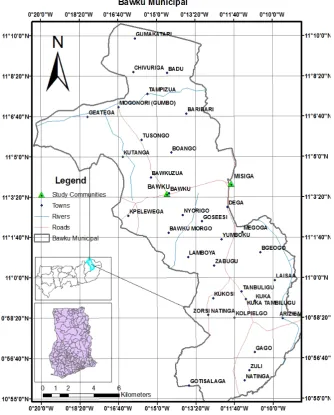
The Bawku Municipality with its administrative capital at Bawku is one of the 13 Metropolitan, Municipal and District Assemblies (MMDAs) in the Upper East Region of Ghana. It is located at the north eastern corner of the region having an international boundary with Burkina Faso to the north, and other districts such as the Binduri district to the west, Garu-Tempane district to the south and Pusiga district to the east. It lies approximately between latitudes 11˚10'29.796"N and 10˚28'48.016"N and longitudes 1˚34'25.375"W and 0˚2'1.952"E (Figure 1).
[image:3.595.208.543.302.718.2]As with the rest the Upper East Region, the Bawku Municipality is part of the Savannah Agro-climatic zone of the country characterized by a unimodal rainfall regime of a pronounced dry (November - April) and wet seasons (May - October).
The two seasons are influenced by two oscillating air masses. First is the warm, dusty and dry Harmattan air mass, which blows from the north easterly direc-tion across the whole municipality from the Sahara Desert. From May to Octo-ber marks the wet season characterised by a deep tropical maritime convection currents which provide the municipality with rains [17]. The single rainfall pat-tern has a mean annual rainfall figures ranging between 855 and 1269 mm [18].
The vegetation is mainly of the Sudan Savanna type consisting of open Sa-vannah characterized by short scattered drought-resistant trees and grasses that gets burnt by bushfire or scorched by the sun during the long dry season. Soils in the municipality are generally of the savannah ochrosol type [17].
The Municipality is regarded as the commercial hub of the Upper East Region due to its strategic location and its proximity to the eastern Burkina Faso and Northern Togo as well as easy crossing into Mali and Niger. The state of envi-ronmental conditions in the municipality is improving, however, a lot more needs to be done [17].
2.2. Research Approach and Data Collection
A mixed methods research strategy, i.e. a research paradigm integrating both quantitative and qualitative research methods [19], was used for the collection and analysis of data in this study. The body of information collected included both secondary and empirical data. Secondary data were elicited from a critical literature review of scholarly articles on solid waste management and from gov-ernment and private institutions namely, the Bawku municipal assembly’s Town and Country Department, the Environmental Health Office/Waste Management Department, a private waste management company Zoomlion Ghana Limited, the Ministry of Food and Agriculture (MoFA) and the Upper East Regional of-fice of Ghana Statistical Service.
The set of empirical data was generated through field work using question-naires survey, face-to-face semi-structured interviews, and on-site visits of households, communal container collection sites, dumpsites, and landfill sites. This body of primary data was supplemented with information obtained from field observations. The data collected from these techniques were in connection with the methods used to collect and transport domestic solid waste, factors contributing to improper solid domestic waste management, and the conse-quences of improper waste management on health and the environment.
to the dumping site and the distance and time covered to dispose of waste at the skip sites, the waste collection method and frequency at which household wastes were collected, and the subscription for household solid waste collection by the waste management company Zoomlion Ghana Limited. The other aspects of the data collected were related to respondents’ involvement in educating household on SWM/sanitation, their perception of who is responsible for maintaining their surroundings clean, and the importance of work of the waste management per-sonnel in the municipality. The questionnaires administered also included ques-tions about the respondents᾽ preparedness to make land available for construc-tion of solid waste disposal sites in the municipality, and their percepconstruc-tion of the effectiveness of waste management in the area.
Data collected from the interview technique were elicited from the following stakeholders: the Waste Management Department (WMD) and Environmental Health and Sanitation Unit (EHSU) of the municipality, the Zoomlion Company Limited, and the assemblymen (elected personalities of the communities in the municipalities who represent the people of the localities at the Municipal As-sembly) of the area. The information collected from these key stakeholders in-cluded the types and quantity of waste generated in the municipality, the mode and frequency of waste collection in the area, and the level of provision of skips and dustbins in the area. The other aspects of the data collected were related to existing solid waste management practices in the municipality, the availability of needed resources for managing waste, and the challenges encountered in man-aging solid waste in the municipality. In addition to these data collection ap-proaches, on-site visits of households, commercial areas, communal container collection sites, and dumpsites were carried out with the view to identifying the waste generation, collection, transportation, and disposal aspects of the whole waste management system in the municipality so as to provide a complete and cross-checked/reliable set of data to the research questions that guided the whole study.
2.2.1. Procedure Used for Sampling Households
assis-tants and respondents, minimising errors and non˗response rate, and ensuring reliability and validity of data collected.
2.2.2. Data Processing and Analysis
Administered questionnaires were examined to check completeness, accuracy and consistency of responses in order to detect and eliminate errors. The data acquired from the study were analysed with MS-Excel and the Statistical Package for the Social Sciences (SPSS) software version 21.0.
3. Results and Discussions
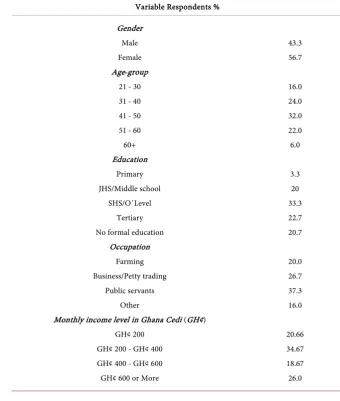
[image:6.595.195.536.343.745.2]3.1. Demographic and Social Characteristics of Respondents The study results as displayed in Table 1 indicate that the majority of the household respondents were females (56.3%) as against 43.3% of males. This is an indication that more women are directly involved in household waste issues than men. This finding is consistent with previous research which established that in solid waste management, especially in developing countries, women play
Table 1. Profile of respondents.
Variable Respondents %
Gender Male Female Age˗group
21 - 30 31 - 40 41 - 50 51 - 60 60+ Education
Primary JHS/Middle school
SHS/O᾽Level Tertiary No formal education
Occupation Farming Business/Petty trading
Public servants Other
Monthly income level in Ghana Cedi (GH¢) GH¢ 200
GH¢ 200 - GH¢ 400 GH¢ 400 - GH¢ 600 GH¢ 600 or More
43.3 56.7
16.0 24.0 32.0 22.0 6.0
3.3 20 33.3 22.7 20.7
20.0 26.7 37.3 16.0
a decisive role; and that waste management in households is basically a woman’s job in these countries because they are directly concerned with household chores, [22] [23] [24]. Besides, this study result points to the fact that women play a pivotal role in waste collection in the Bawku municipality, hence the need to get them fully integrated in the development and successful implementation of a strategic plan for effective solid waste management and promotion of envi-ronmental quality in the area. Moreover, the data contained in Table 1 further indicate that the overwhelming majority (72%) of respondents were in the age˗bracket of 21 - 50 years; this shows that besides being females, majority of respondents have what it takes in terms of energy and doggedness to play a pro-active role in issues relating to participatory solid waste management projects in the Bawku Municipality. This finding therefore calls for the need to devote a crucial role to women in the management and control of urban environment in the Municipality.
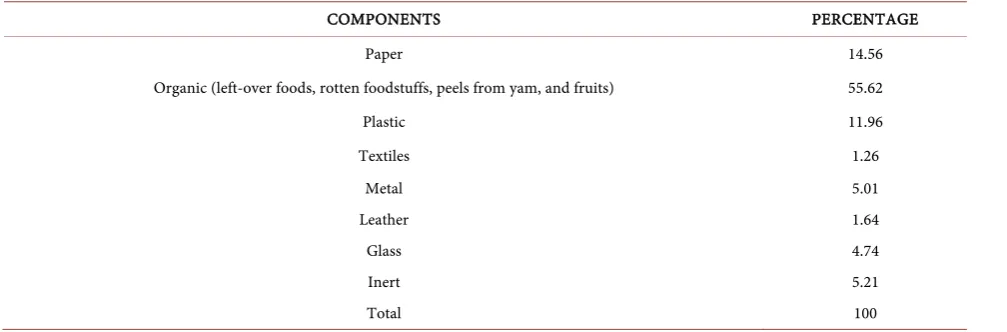
3.2. Components of Solid Waste Generated in the Municipality Table 5 shows the findings on the major components of the municipal waste stream. The data contained therein are consistent with previous reports on solid waste characterization in Metropolitan, Municipal, and District Assemblies in Ghana as published by [25] [23] and [26]. These results are also in line with pre-vious research which indicates that the highest component of wastes generated in developing nations consist of organic materials [23]. The considerable pro-portion of plastics in the municipal waste stream could be explained by the in-creasing use of plastic products in packaging and by the fact that plastics are also being used in Ghana as stretched high density polyethylene (HDPE) in sachet water packaging, polyethylene terephthalate (PET) bottles for bottling drinks and water, low density polyethylene (LDPE) and polystyrene (PS) as bags [25]. From the data it appears that the sizable fraction of plastic waste is an indication of the fact that with the setting up of many plastic industries in Ghana, the gen-eration of plastic waste is likely to increase over time thereby rendering the cur-rent challenges regarding plastic waste management in the country severe. The study also revealed that Management Department of the Municipal Assembly and Zoomlion Ghana Limited lacked quantitative data on the amount of waste generated in the municipality. This finding substantiates earlier studies which established that the required fundamental statistics on household waste are lacking in developing countries [27]; and that Ghana is no exception of this data deficit problem [25]. Hence, this situation calls for an in-depth assessment of the quantitative aspect of solid waste being generated in Metropolitan, Municipal and District Assemblies in the country.
3.3. Respondents’ Knowledge and Perceptions of the Waste Management System in the Municipality
Table 2. Respondents᾽ perceptions of the waste management system in the Municipality.
Variable Respondents %
Level of accessibility to information on solid waste management (SWM)/sanitation in the Municipality Access to information
No access to information
Means by which information on solid waste management/ sanitation was obtained Parents/relatives
School Mass media Health/sanitation workers
Respondents’ involvement in educating household on SWM/sanitation Respondents educate their households on sanitation/SWM Respondents do not educate their households on sanitation/SWM
Respondents’ perception on who is responsible for managing waste and maintaining the surroundings clean Every individual
The Bawku Municipal Assembly (BMA) Both inhabitants and the BMA
Other
Respondents’ perception of the importance of work of the waste management personnel in the Municipality Work carried out by waste management personnel is important
Work carried out by waste management personnel is not important
Respondents’ preparedness to make land available for construction of solid waste disposal site in the Municipality Respondents are prepared
Respondents are not prepared
Reasons for respondents’ unpreparedness to make land available for construction of solid waste disposal site in their neighbourhood
Fear of disease outbreak and pollution
Method of collection of household waste in the Municipality Door˗to˗door collection by Zoomlion
Shared container (skip) Other
Person responsible for conveying household solid waste to the dumping site Household mature people
Household children Door˗to˗door collectors
Other
Time used by respondents to dispose of their wastes at skip sites 5 - 10 minutes
11 ˗ 15 minutes 16 - 20 minutes 21 - 25 minutes More than 25
Availability of communal containers (skips) in communities Skips are available
Skips are unavailable
Continued
Shared container (skip) Zoomlion dump site
Open space Other
Respondents’ perception about the distance between the nearest skip and their houses The distance is convenient
The distance is inconvenient
Respondents’ perception of the effectiveness of waste management in the Municipality Waste management is effective
Waste management is ineffective
Type of storage receptacles used by households for storing waste Used basket/bucket without cover
Used basket/bucket with cover22 Plastic bin without cover
Plastic bin with cover Other
Frequency at which households dispose of their waste Once in a week
Twice in a week Every two weeks
Other
16.67 38 10.66
10
31 69
33.33 66.7
30
14.67 14 19.33
45.33 32.67 2 20
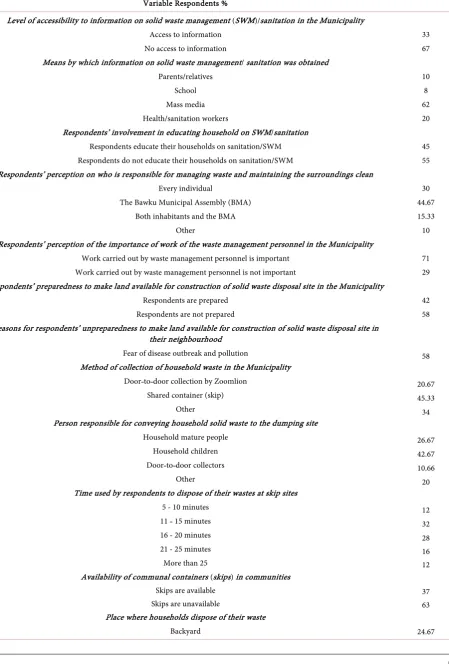
lo-cal authorities, and that the public is not expected to contribute [31]. Hence, the study finding re-echoes the need for public awareness and strong community participation in issues relating to waste management and environmental quality in the municipality. Indeed, several authors have buttressed this argument by indicating that the operational efficiency of solid waste management depends upon community awareness and the active participation of both the municipal agency and the citizens [32]. The ensuing inference is that, the lack of a partici-patory approach in addressing problems relating to waste management and sanitation in the Bawku Municipality could trigger societal apathy for contrib-uting towards finding solutions to these problems [33] [34]. This point is under-pinned by findings in this study (Table 2) which showed that 58% of respon-dents were not prepared to make land available for construction of solid waste disposal sites in the municipality for fear of disease outbreak and pollutions. This attitude could be attributed to the perception that the environmental con-trol systems and evaluation of the real impacts of solid waste management in developing countries are lacking [35] [36]. Once more, this situation supports the need for public consultation and education on health hazards associated with domestic solid waste disposal sites in the municipality and the remedial meas-ures and mechanisms put in place by municipal waste management institutions to minimise them. This approach would allay the concerns of the people and lessen their opposition to establishing waste disposal sites in the area.
3.4. Waste Collection System and the Attitudes of the People towards It
management institutions leading to skips overflowing with waste and the entire locations strewn with piles of refuse. The problem associated with these insani-tary and unsightly scenes is that these unattended wastes were scattered back across the urban space through the wind whose action becomes severe particu-larly during the harmattan months of December to February and the period co-inciding with the onset of rains. The data contained in Table 2 also indicated that 44.67% of respondents stored the household wastes within their house premises in buckets, baskets and bins devoid of protective covers for four to seven days before dumping them. This situation, coupled with the insanitary conditions associated with waste collection and untimely removals of communal containers, could lead to the proliferation of disease-carrying pests and create grounds for serious public and environmental health hazards as previously re-ported by [14]. This argument is buttressed by a study conducted by [23] which indicates that a high percentage of workers who handle refuse, and of individuals who live near or on disposal sites, are infected with gastrointestinal parasites, worms, and related organisms; and that contamination of this kind is likely at all points where waste is handled. The same study also reported that these dis-ease-carrying pests can transmit various pathogenic agents such as amoebic and bacillary dysenteries, typhoid fever, salmonellosis, various parasitoses, cholera, yellow fever, plague, and others.
be-devilled the waste collection and disposal system in the Bawku Municipality that two thirds of the sample of respondents perceived the waste management in the area as ineffective.
3.5. Waste Transportation and Final Disposal Methods in the Bawku Municipality
disease carrying pests. This observation is in consonance with the study finding which showed that 58% of respondents were not prepared to make land available for construction of final disposal sites in the municipality for fear of disease out-break and pollutions.
3.6. Waste Management Institutions in the Municipality and Factors Militating against Their Efficiency
Table 3. Composition of technical staff of waste management institutions in Bawku Municipality.
Institution Personnel Qualification Number available Number needed
Zoomlion
Coordinator BA Social Sciences 1 1
Supervisor ‟A” level Certificate 3 9
Mechanics Technician II 2 10
Drivers Motor Vehicle Technician II 2 12
General Workers BECE 343 1000
WMD/EHSU
Director MA Environmental Management 1 1
Principal Environmental Health Officers Diploma Environmental Health 7 10
Technical Supervisors Certificate 5 10
Supervisors Certificate 11 18
General Workers BECE 15 40
[image:14.595.55.545.324.469.2]Source: WMD and Zoomlion Ghana Ltd, 2014.
Table 4. Equipment base of waste management institutions (WMD and Zoomlion).
Equipment WMD (number
available)
Number needed by WMD
ZoomLion (number available)
Number needed by Zoomlion
Total available
Total needed by WMD and Zoomlion
Dustbins 40 500 100 1000 140 1500
Skips 11 30 20 50 31 80
Motor tricycles 40 36 120 36 160
Graders 1 3 2 1 5
Skip Loaders 1 3 2 6 3 9
Compaction trucks 2 2 4
Bulldozers 1 3 1 1 4
Source: WMD and Zoomlion Ghana Ltd, 2014.
Table 5. Major components of solid waste generated in the Bawku Municipality.
COMPONENTS PERCENTAGE
Paper 14.56
Organic (left-over foods, rotten foodstuffs, peels from yam, and fruits) 55.62
Plastic 11.96
Textiles 1.26
Metal 5.01
Leather 1.64
Glass 4.74
Inert 5.21
Total 100
Source: Field survey, 2015.
[image:14.595.55.559.512.678.2]These arguments are buttressed by previous authors who reported that in de-veloping countries, SWM is often under-funded due to a combination of inade-quate resources from municipal tax revenues, insufficient user fees, and the mismanagement of funds [43] [44]. As displayed in Table 3 and Table 4 the study results showed that the Waste Management and Environmental Health Department of the Municipal Assembly and Zoomlion Ghana Limited were be-devilled by understaffing (limited number of workers especially lack of technical staffs) and poor logistics (lack or inadequate number of trucks, skips, litter bins, graders and bulldozers) in the delivery of their services. With regard to the social constraints that exacerbate the problems faced by waste management institu-tions in the municipality, the following impediments were pointed out by the Waste Management Department of the Municipal Assembly and Zoomlion Ghana Ltd:
• Bad perceptions and attitudes of majority of residents vis-à-vis the municipal waste management system.
• Indiscriminate disposal of waste by most residents.
• Lack of law enforcement to punish offenders who practised indiscriminate waste disposal.
• Employing people who do not have the required qualification, and difficulty in disciplining non-performing staffs due to political interferences.
functioning SWM systems [43] [47]. The interviewees of the Waste Management Department/Environmental Health and Sanitation Unit and Zoomlion Ghana Ltd also bemoaned some political influences in the recruitment of their employ-ees which compelled them to employ people who lacked the required profes-sional qualification and skills and further precluded them from taking discipli-nary sanctions against non-performing employees. These facts are supported by findings from previous research which indicate that in developing countries, po-litical jostling for power means that local authorities base decision-making on the interests of their parties [47]; and that government bodies maintain inflated workforces for political reasons, which consume much-needed funds [47].
4. Conclusions and Recommendations
The results of this study indicate that the waste management system in the Bawku Municipality is bedevilled by many challenges which need to be ad-dressed holistically so as to achieve the core objectives of waste management i.e. the protection of public health and the quality of the environment. The key findings regarding these challenges are as follows:
1) The functioning of the waste management system in the Municipality was se-riously handicapped by the lack of public awareness on issues regarding waste management and the lack of a participatory approach that makes the people of the area an integral and active stakeholder in waste management decision-making process and activities. This situation has led a good majority of the people in the Municipality to develop bad perceptions and attitudes vis-à-vis the municipal waste management system, particularly by disposing of their wastes indiscriminately and by perceiving waste management as the exclusive responsibility of the local government.
2) The waste management in households was chiefly women’s job. This is an indication that women play a pivotal role in waste collection and should therefore be given a status of key stakeholder in the development and imple-mentation of a strategic plan for successful solid waste management and promotion of environmental quality in the area.
3) The study revealed the lack of quantitative data on the volume of waste gen-erated in the Municipality. This situation adversely affects the short-term and long-term planning of waste management in the area, particularly in terms of mobilising the required financial resources and logistics so as to ensure the waste management system and efficiency keep pace with the future volumes of waste stream.
4) A good majority of households used improper waste storage receptacles in the form of buckets, baskets and bins without lids to store waste. This situa-tion poses serious public and environmental health hazards as the uncovered wastes served as proliferation grounds for disease vectors.
of the door˗to˗door collection which was deemed unaffordable by majority of residents and the poor nature of roads which hindered the waste collection ser-vices. These challenges greatly accounted for the indiscriminate disposal of waste in the Municipality and the low performance rating of the waste man-agement system which was perceived by majority of households as inefficient. 6) The municipal landfill which was located about three kilometres away from
the Bawku Township in Misiga did not meet the required standard. The landfill site had no cell planning and proper waste compaction, and there was no regular cover of waste with clay or soil to reduce odours and keep out pests. The facility had no leachate and gas collection systems, and was readily accessible by scavengers. This situation posed serious public health hazards to residents in the area and neighbouring communities.
7) The two main institutions in charge of managing solid waste in the Munici-pality i.e. the Municipal Waste Management Department and the private company Zoomlion Ghana Limited were faced with financial difficulties, understaffing and poor logistics, and social constraints including political in-terferences in the recruitment of the workforces. These factors seriously handicapped the performance of the waste collection, transport and disposal services and the efficiency of the whole system of managing waste.
The findings on the factors that adversely affect the waste management system in the Bawku Municipality could feed into the development of an all-inclusive strategic plan for effective solid waste management in the Municipality.
References
[1] Pacione, M. (2005) Urban Geography: A Global Perspective. 2nd Edition, Routedge, Taylor & Francis Group, London and New York.
[2] Anomanyo, D.E. (2004) Integration of Municipal Solid Waste Management in Ac-cra, Ghana: Biofactor Treatment Technology as an Integral Part of the Management Process. Presented to Lund University, Sweden.
[3] Tacoli, C. (2012) Urbanization, Gender and Urban Poverty: Paid Work and Unpaid Care Work in the City. International Institute for Environment and Development, United Nations Population Fund, London, UK.
[4] Yousif, D.F. and Scott, S. (2007) Governing Solid Waste Management in Mazate-nango, Guatemala: Problems and Prospects. International Development Planning
Review, 29, 433-450. https://doi.org/10.3828/idpr.29.4.2
[5] Nabegu, A.B. (2010) An Analysis of Municipal Solid Waste in Kano Metropolis, Nigeria.Journal of Human Ecology,31, 111-119.
[6] Nagabooshnam, J.K. (2011) Solid Waste Generation and Composition in Gaborone, Botswana, Potential for Resource Recovery. Master Thesis, Department of Man-agement Engineering, Linkoping University, Sweden.
[7] Okot-Okumu, J. (2012) Solid Waste Management in African Cities—East Africa, Waste Management—An Integrated Vision. InTech.
[9] Freduah, G. (2004) Problems of Solid Waste Management in Nima, Accra. Univer-sity of Ghana, Legon.
[10] Cooper, J. (1999) The Challenges of Environmental Management in Urban Areas. Aldershot and Vermont, Ashgate.
[11] Songsore, J., Nabila, J.S., Yangyuoru, Y., Amuah, E., Bosque-Hamilton, E.K., Etsi-bah, K.K., Jan-Eric, G. and Jacks, G. (2005) State of the Environmental Health Re-port of the Greater Accra Metropolitan Area (GAMA). Ghana University Press, Accra.
[12] Mensah, A. and Larbi, E. (2005) Solid Waste Disposal in Ghana. WELL FACT SHEET Regional Annex.
[13] Hardoy, J.E., Mitlin, D. and Statterthwaite, D. (2001) Environmental Problems in an Urbanizing World: Finding Solutions in Cities in Africa, Asia and Latin America. 2nd Edition, Earthscan, London and Stirling, VA.
[14] Oteng-Ababio, M., Argurello, J.E.M. and Gabbay, O. (2013) Solid Waste Manage-ment in African Cities: Sorting the Facts from the Fads in Accra, Ghana. Habitat
International, 39, 96-104.
[15] Owusu-Sekyere, E., Osumanu, I.K. and Yaro, J.A.D. (2013) Landfill in the Kumasi Metropolitan Area of Ghana. International Journal of Current Research, 2, 87-96. [16] Ampofo, S., Sackey, I. and Ampadu, B. (2016) Landscape Changes and
Fragmenta-tion Analysis in a Guinea Savannah Ecosystem; Case Study: Talensi and Nabdam Districts of the Upper East Region, Ghana. Journal of Geography and Geology,8, 41-54.https://doi.org/10.5539/jgg.v8n1p41
[17] (GSS) Ghana Statistical Service (2012) 2010 Population and Housing Census: Dis-trict Analytical Report. Bawku Municipality.
[18] Adugbire, S.A., Kuma, J.S., Suglo, R.S. and Nartey, R.S. (2010) Community-Based Management of Boreholes in the Talensi-Nabdam District in the Upper East Re-gion, Ghana: Problems and Solutions. European Journal of Scientific Research, 46, 643-653.
[19] Bryman, A. (2008) Social Research Methods. 3rd Edition, Oxford University Press, Oxford.
[20] Nordtest (1995) Solid Waste, Municipal: Sampling and Characterization. Nordtest method NT, Finland.
[21] Gomez, G., Meneses, M., Ballinas, L. and Castells, F. (2008) Characterization of Ur-ban Solid Waste in Chihuahua, Mexico. Waste Management, 28, 2465-2471. [22] Scheinberg, A., Muller, M. and Tasheva, E.L. (1999) Gender and Waste: Integrating
gender into Community Waste Management: Project Management Insights and Tips. Urban Waste Expertise Programme (UWEP) Working Document 12, Gouda, the Nederlands.
[23] UNEP (United Nations Environment Programme) (2005) Solid Waste Manage-ment. Vol. I.
http://www.unep.or.jp/ietc/publications/spc/solid_waste_management/Vol_I/Binde r1.pdf
[24] Eugene, A., Günter, B. and Lilian, N. (2013) The Evolving Role of Women in Sus-tainable Waste Management in Developing Countries—A Proactive Perspective?
International Conference on Integrated Waste Management and Green Energy
En-gineering (ICIWMGEE’2013),Johannesburg, South Africa, 15-16 April 2013.
[26] Ahmed, S.A. and Ali, M. (2004) Partnerships for Solid Waste Management in Devel-opingCountries: Linking Theories to Realities. Habitat International, 28, 467- 469. [27] Buenrostro, O., Bocco, G. and Vence, J. (2001) Forecasting Generation of Urban
Solid Waste in Developing Countries—A Case Study in Mexico. Journal of the Air
& Waste Management Association, 51, 86-93.
https://doi.org/10.1080/10473289.2001.10464258
[28] World Bank (2004) Social Assessment and Public Participation in Municipal Solid Waste Management.
http://siteresources.worldbank.org/INTUSWM/Resources/463617-1202332338898/s ocialassesstoolkit.pdf
[29] WHO (2005) Management of Solid Health-Care Waste at Primary Health-Care Centres. www.who.int/water_sanitation_health/publications/manhcwm.pdf [30] Songsore, J. and McGranaham, G. (1993) Environment, Wealth and Health:
To-wards an Analysis of Intra-Urban Differentials within the Greater Accra Metropoli-tan Area. Stockholm, Sweden. Stockholm Environmental Institute.
[31] Vidanaarachchi, C.K., Yuen, S.T.S. and Pilapitiya, S. (2006) Municipal Solid Waste Management in the Southern Province of Sri Lanka: Problems, Issues and Chal-lenges. Journal of Waste Management, 26, 920-930.
[32] Lilliana, A., Guerrero, G.M. and William, H. (2012) Solid Waste Management Challenges for Cities in Developing Countries. Waste Management, 33, 220-232. [33] Sharholy, M., Ahmad, K., Vaishya, R.C. and Gupta, R.D. (2007) Municipal Solid
Waste Characteristics and Management in Allahabad, India. Journal of Waste
Management, 27, 490-496.
[34] Moghadam, M.R.A., Mokhtarani, N. and Mokhtarani, B. (2009) Municipal Solid Waste Management in Rasht City. Iran Journal of Waste Management, 29, 485-489. [35] Matete, N. and Trois, C. (2008) Towards Zero Waste in Emerging Countries—A
South African Experience. Journal of Waste Management, 28, 1480-1492.
[36] Asase, M., Yanful, E.K., Mensah, M., Stanford, J. and Amponsah, S. (2009) Com-parison of Municipal Solid Waste Management Systems in Canada and Ghana: A Case Study of the Cities of London, Ontario, and Kumasi, Ghana. Journal of Waste
Management, 29, 2779-2786.
[37] Twumasi, A.S. and Akwasi, K.E. (2014) Solid Waste Management in Urban Areas of Ghana: Issues and Experiences from Wa. Journal of Environment Pollution and
Human Health, 2, 110-117.
[38] Ogawa, H. (2005) Sustainable Solid Waste Management in Developing Countries.
http://www.gdrc.org/
[39] Zeiss, C.A. (1998) Sitting Waste Disposal Facilities in Host Communities: Impacts and Acceptance. PhD, JWA.
[40] World Bank (1996) Urban Environmental Sanitation Project Staff Appraisal Report.
http://documents.worldbank.org/curated/en/797301468770981963/Ghana-Urban-E
nvironmental-Sanitation-Project
[41] Burntley, S.J. (2007) A Review of Municipal Solid Waste Composition in the United Kingdom. Journal of Waste Management, 27, 1274-1285.
[42] Sujauddin, M., Huda, M.S. and Rafiqul Hoque, A.T.M. (2008) Household Solid Waste Characteristics and Management in Chittagong, Bangladesh. Journal of
Waste Management, 28, 1688-1695.
[43] Coffey, M. and Coad, A. (2010) Collection of Municipal Solid Waste in Developing Countries. UN-HABITAT, Malta.
Sour-cebook for Policy Makers and Practitioners: EAWAG/SANDEC.
[45] Schübeler, P. (1996) Conceptual Framework for Municipal Solid Waste Manage-ment in Low-Income Countries. In: Wehrle, K. and Christen, J., Eds., UNDP/
UNCHS/World Bank/SDC Collaborative Programme on Municipal Solid Waste
Management in Low-Income Countries,SKAT, St. Gallen, Switzerland.
[46] Wilson, D.C., Araba, A., Chinwah, K. and Cheeseman, C.R. (2009) Building Recy-cling Rates through the Informal Sector. Journal of Waste Management, 29, 629- 635.
[47] Henry, R.K., Yongsheng, Z. and Jun, D. (2006) Municipal Solid Waste Management Challenges in Developing Countries—Kenyan Case Study. Journal of Waste
Man-agement, 26, 92-100.
Submit or recommend next manuscript to SCIRP and we will provide best service for you:
Accepting pre-submission inquiries through Email, Facebook, LinkedIn, Twitter, etc. A wide selection of journals (inclusive of 9 subjects, more than 200 journals)
Providing 24-hour high-quality service User-friendly online submission system Fair and swift peer-review system
Efficient typesetting and proofreading procedure
Display of the result of downloads and visits, as well as the number of cited articles Maximum dissemination of your research work
Submit your manuscript at: http://papersubmission.scirp.org/