Munich Personal RePEc Archive
A Romanian approach of the program
"Employee of the month"
Armean, Bianca and Baleanu, Virginia and Irimie, Sabin
Ioan
University of Petrosani, Romania, University of Petrosani, Romania,
Politehnica University of Timisoara, Romania
January 2012
Online at
https://mpra.ub.uni-muenchen.de/50254/
A Romanian Approach of the Program "Employee of the
Month"
Bianca ARMEAN1
Virginia BĂLEANU2
Sabin Ioan IRIMIE3
ABSTRACT
Work motivation was and remained a "hot topic" for management and organizational behavior studies, as well as a major concern for practice of Human Resource Management. While such studies have evidenced a lot of factors of intrinsic and extrinsic motivation having different influences on different people, the motivating practices within organizations were long time focused on common extrinsic motivators such as usual rewards (in the form of money or promotion to higher grades/functions) and threat of punishment. However, during the past few decades more and more organizations worldwide became interested to use some forms and tools of intrinsic motivation for their employees, including recognition programs.Our paper aims to present and discuss how a Romanian organization developed and implemented such a program, based on the popular U.S. organizational practices of contests type "Employee of the Month". Particularly, the study focuses on the specificity of this approach which combines elements of intrinsic and extrinsic motivation, and also attempts to sketch a "profile of the winner employee", based on statistical analysis of data for people who benefited the awards through the program application during 2008-2011.
KEYWORDS:work motivation, job satisfaction, organizational performance.
JEL CLASSIFICATION: J28, L25, M12, M52
1. THE PROGRAM “EMPLOYEE OF THE MONTH” – A MODERN APPROACH TO MOTIVATION POLICY OF HUMAN RESOURCE
Motivation is a cornerstone for understanding human behavior (Beck, 2000; Weiner, 1989), with many subtle implications difficult to anticipate, especially if we refer to people as employees in organizations. According to Huczynski and Buchanan ”motivation can be regarded as a broad concept which includes preferences for particular outcomes, strength of effort (half-hearted or enthusiastic), and persistence (in the face of barriers). ... These are the factors which a manager has to appreciate in order to motivate employees to behave in organizationally desirable ways” (Huczynski & Buchanan, 2007, p. 242). International literature of management and organizational behavior reveals a multitude of motivational factors which can have different influences on different people, both as concerning their performance and their satisfaction at work (i.e. Locke & Latham, 2004; Ramlall, 2004;
1
University of Petrosani, Romania, [email protected]
2
University of Petrosani, Romania, [email protected]
3
Steel & Konig, 2006). There is a large consensus about the clear distinction between intrinsic and extrinsic motivators, as well as a quite familiar perception of the incentives commonly used within organizations making a distinction between financial and non-financial motivation practices. Among the latter, maybe the most popular are the so-called recognition programs covering and the type of program presented in the follows.
The "Employee of the Month" (E-OM) program is a practice of individual recognition of an employee by the company in which they works, for its outstanding contribution in a well-defined time range (e.g. previous calendar month). It may be viewed as a modern approach of motivation policy in Human Resources Management (HRM), being implemented at first by some U.S. large companies (mainly international chains such as McDonald's or Pizza Hut) and public institutions (Copolovici, http://www.copolovici.ro/). Until now it does not have a well-defined correspondent in Romania, documentation and research in the field being quite few and without a specific direction of implementation or use.
The program may take various forms, through various stages and counting both supporters and vehement objectors. While in some companies it is a very popular form of motivation, in others, E-OM is just a joke, a popularity contest aimed for “fawning” employees (Heathfield, http://humanresources.about.com/od/rewardrecognition/). As a method of non-financial motivation, it is admittedly natural for it to imply an emotional side, sensitiveness and, as so, to bear some certain functionality risks. It works usually for a simple reason: some people need competition and challenges. And by offering these things, it will bring a more pleasant climate in the company (Marin, 2009). The secret however lies in its perfect adaptation to the business’s specifics and to its organizational culture.
There are many ways to assimilate E-OM, and the differences can already be seen at the primary stage of naming the program (some company’s keep the original name, but others opt for alternatives like "5 stars Employee"). The variations may continue with the selection criteria and, not least, with rewarding methods. Although was developed initially as a non-financial solution related to intrinsic motivation of employees (through specific recognition rewards such as “Thank you” notes, certifications or awarded titles, pins or engraved plates, etc.), the program can also be financially adapted with cash prizes or objects. (Rujoiu, 2011)
2. ADVANTAGES AND RISKS OF THE PROGRAM
Gained benefits from the implementation are defined by the purpose and objectives of the program (http://www.lorainccc.edu/Faculty+and+Staff/emp/), that’s aiming to:
recognize and highlight the merits of the best performing employees who, by their actions and behavior, meet standards of excellence in work;
reward those employees who, through their individual exemplary achievements also bring contribution to the performances of some complementary job areas, outside their direct activity and expertise;
recognize the efforts of those employees, who have inspired and supported the performance and achievements of other employees;
reward employees who demonstrate a positive work attitude toward their colleagues, partners or customers, and serve as a role model for others;
reward commitment to quality, initiative, acceptance and implementation of additional tasks or responsibilities for the good of the company.
the company's top manager, certification of title, financial awards, objects, trips, internal or external popularization etc. Indirectly, at company level, it encourages competition, individual performing, ambition, but also creates a pleasant climate that encourages employee development. Used in a different form -"Team of the Month"- can improve group performance and team work.
The problems regarding “E-OM” are usually related to implementation. But even if the actual mode of implementation is improved, there may be situations where the method is seen as "unfriendly" and individualistic, resulting in "group division", and thus a failure in terms of employee performance recognition.
The main elements of "high risk" in program functionality are (Heathfield, http://humanresources.about.com/od/rewardrecognition/qt/reward_criteria.htm):
Selection criteria for "Employee of the Month". If they are vaguely defined or absent, the winner will not know the exact reason of his nomination or which is the encouraged behavior that should be continued and sustained. Moreover, such a situation will cause dissatisfaction and demotivation in the work group, dividing it, or leading to the isolation of the selected employee. Clear definition of the criteria, preferably measurable, is the key to resolve the situation.
Transparent nomination. The chosen employee must meet the established selection criteria, so that his/hers nomination is clear to all. Most organizations fail to establish clear, recognizable and measurable criteria, so that the reasons for selecting an employee are vague to others. In these organizations, jokes like "it must be your turn" or the efficient labeling as “fawning" are very common, and reduce the power of the program to recognize and reward performance.
The option for a single employee and excluding from the race of other "valid" persons for nomination. Usually a single employee is chosen, although the criteria are met or sometimes even overcome by more persons, so that each of them deserves the award. Such a situation will cancel the “reason to be” of the contest. The solution is of course to recognize all qualified employees for obtaining the prize and eventually, future improving of the selection criteria.
Beyond those situations, however, it should be kept in mind that there is no universal recipe for motivation, any method adopted, whether financial or not, with its strengths and weaknesses, will just respond to the needs of certain groups of employees.
The following are concrete results of the implementation of the program in a Romanian company with its advantages and disadvantages.
3. RESULTS OF A STUDY ON THE APPROACH OF THE PROGRAM IN A ROMANIAN ORGANIZATION
The series of “Employee of the Month” contests (named as “E-OM”, approximate translation “The Man”) started in S.C. DCT S.R.L. in January 2008, as part of the internal HR project "Loyalty, rewarding and retaining employees of DCT-Deva", and expanded further in other companies of the group.
Three stages can be identified in the evolution of the contest:
I. E-OM Deva: January 2008-June 2009
18 editions
Five participating entities: production departments A, B, C, D and Maintenance Department Deva
Prize: gift vouchers worth 100 RON
Diploma of Excellence
Popularization at the company’s notice boards and newspaper
Additional prize for three consecutive nominations: household items or a trip for two days, worth 300 RON.
II. E-OM Deva-Timişoara: July 2009-June 2010
12 editions
Eight participating entities: production departments A, B, C, D, E and F, Maintenance Deva, Maintenance Timişoara
Prize: gift vouchers worth 200 RON
Award ceremony conducted by the General Manager or a Deputy Director
Diploma of Excellence
Popularization at the company’s notice boards and newspaper (extended also to Timişoara plant)
Additional prize for three consecutive nominations during the calendar year: household items worth 500 RON.
III. E-OM Holding: July 2010-December 2011
18 editions
Ten participating entities: production departments A, B, C, D, E, F, G and H (4 production areas Deva, 2 per Timişoara and Craiova), Maintenance department of the Holding, Support Department Holding (technical, finance, administrative, etc.)
Prize: gift vouchers worth 400 RON
Award ceremony conducted personally by the C.E.O. of the Group
Diploma of Excellence
Popularization at the company’s notice boards and newspaper (extended at Group level)
Additional prize for three consecutive nominations during the calendar year: household items worth 1000 RON.
Criteria for selecting winning employees remained constant over time:
Fulfilling full duties consistently and at company standards
Compliance with all applicable Health and Safety, Emergencies and Environment regulations
Zero administrative sanctions during the last year
Zero quality problems or client reclamations in the last year
Zero days sick leave, unauthorized absence or leave without salary in the last semester
Ability to perform assigned duties without being controlled or directed by the chief supervisor
Involvement in integration and workplace training for new employees
Multiple qualifications (ability to conduct workplace complementary activities, as defined in the job description), ability to replace, if necessary and in the best conditions, colleagues from other workplaces
Initiative, suggestions for improving the workplace, attending business optimization projects.
3.1. Registered results 2008-2011
The contest, launched in January 2008 for employees of DCT-Deva and then extended at the Group level as we presented above, has registered in the 4 years of "running" a number of 366 awarded employees, with the following distribution (see Figure 1)
DCT-Deva: 234 employees (63.93%)
DCT-Timişoara: 84 employees (22.95%)
Figure 1. Number of employees awarded per each company
Of all winners, 20 are no longer employed in the Group, 8 of them reaching retirement age. By reference to the average number of employees existing in each of the Group’s companies, were awarded at least once: 39% of employees at DCT-Deva, 42% of employees at DCT-Timisoara and 24% of employees at DCT-Craiova. The highest number of awards was given in 2011 (Figure 2), since the entire Group entered in the program, continuing to run without to be influenced by internal or external economic situation (“the financial crisis”), or by the possible "pessimistic state of mind" of the organizational climate.
Figure 2. Evolution of the number of employees awarded in 2008-2011
The data per each company were statistically analyzed (following the distribution of selected employees by age, gender and seniority) in order to determine possible existing patterns of the nominees selection, or so called “winner profiles”. The main results are presented and discussed in the follows.
E-OM Deva
By looking at the data of the 219 winners that continue to work in the company, we can build the sketch of "E-OM Deva": male, age over 36 and, most likely, with an experience of over 20 years in the company.
Selection premises:
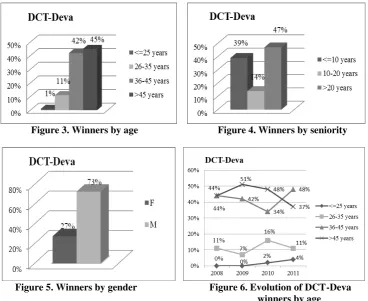
[image:6.595.159.438.328.479.2]employees below 25 years were quite involved in their work to be awarded (Figure 3).
Regarding seniority in the company (Figure 4), the number of employees involved in the program shows some interesting variation: 39% of the winners are relatively new employed (less than 10 years); only 14% between 10 and 20 years and 47% are working for more than 20 years in the company. So, the data show two situations: on the one hand a natural predisposition towards opting for experienced employees, and on the other hand, a substantial interest for the newest members of the organization, so that the program manages not only to retain new employees, but it also encourages loyalty (reducing staff turnover in this segment).
73% of those selected were male and 27% female (Figure 5). Relating however to the gender structure of the employees from Deva, the percentage of the winners is similar, meaning that 16% of all employed women and 14% of male employees of DCT-Deva were nominated at least once E -OM.
Figure 3. Winners by age Figure 4. Winners by seniority
[image:7.595.114.483.244.545.2]
Figure 5. Winners by gender Figure 6. Evolution of DCT-Deva winners by age
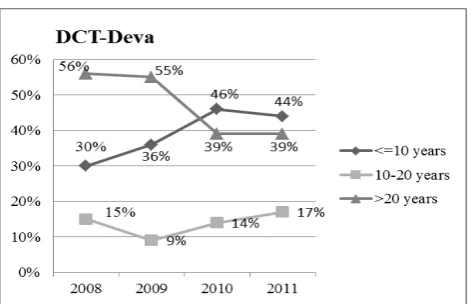
Figure 7. Evolution of DCT-Deva winners by seniority
Figure 8. Evolution of DCT-Deva winners by gender
E-OM Timişoara
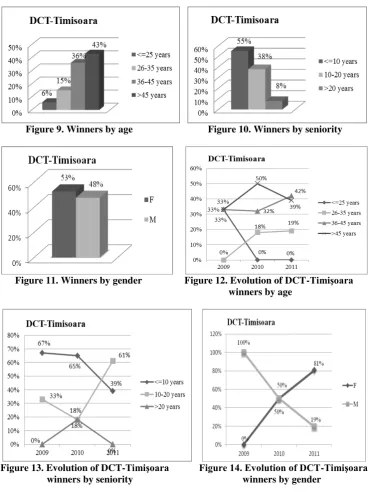
The program started in the DCT-Timişoara in July 2009. Through the 30 editions of program were awarded 80 employees, who still work in the company. Analyzing the available data represented in the Figures 9-11, we can "approximate" a profile of "E-OM-Timisoara": although difficult to clearly specify the gender, E-OM is more likely female (53% winners), over 36 years old (79%) and relatively new employed in DCT, having less than 10 years activity (55% of awarded). As concerning the evolution in time (Figures 12-14), appears a kind of "elimination" of the young workers (under 25) in the favor of the middle-aged group (26-45). Also, seems to appear a "forced entry" of the segment of 10 to 20 years seniority, likely to be explained by the withdrawal of the most experienced employees, with over 20 years of activity. The significance of this change can be related to a desire to invest in the new employees and encourage their development in the company, with the expectancy to trigger and/or strengthen their loyalty. Likewise remarkable is the upward evolution of the awarded ladies at the expense of the gentlemen’s, as opposite to DCT-Deva.
E-OM Craiova
Figure 9. Winners by age Figure 10. Winners by seniority
Figure 11. Winners by gender Figure 12. Evolution of DCT-Timişoara winners by age
Figure 13. Evolution of DCT-Timişoara Figure 14. Evolution of DCT-Timişoara winners by seniority winners by gender
younger than 25, or between 26 and 35 years. A comparison of the data recorded in 2010-2011 would provide a very poor overview of the evolution in time for the profile of "E-OM Craiova". However, female employees aged 36-45 begin to dominate the activity through performance and involvement (Figures 15-18).
[image:10.595.115.481.116.413.2]
Figure 15. Winners by age Figure 16. Winners by gender
Figure 17. Evolution of DCT-Timişoara Figure 18. Evolution of DCT-Timişoara winners by age winners by gender
4. CONCLUSIONS
The E-OM profile as resulted from our study on the three companies of the Romanian Group analyzed show that the age of the winner is most probably over 36 years, distributed almost equally between two groups (36-45 and over 45). Thus, motivation policy applied through this program seems to focus on the groups of more life-experienced employees, who are prone to engagement and loyalty toward the company, rather than the younger ones (more eager for novelty and change). On the other hand, it seems that gender and seniority of employees are not viewed as criteria of differentiation in the selection of candidates for the E-OM. Regardless the above presented facts, it should be noted that practically no motivational program may run successful in the same way forever (either it is one financial, non-financial, or mixed). Beyond theoretical assumptions and practical possibilities, creating an effective and sustainable program of motivating employees implies a continuous effort to find right balance between individual and organizational needs.
ACKNOWLEDGEMENTS
European Social Fund – Investing in people.”
REFERENCES
Beck, R.C. (2000). Motivation: theories and principles. 4th ed. Upper Saddle River, NJ: Prentice Hall.
Copolovici, V., (n.d.). Capitolul XIX. Employee of the month, Retrieved May 5, 2012, from http://www.copolovici.ro/blog/povesti-marinaresti/capitolul-xix-employee-of-the-month/
Heathfield, S.M. (n.d.). Employee of the Month in Human Resources Guide. Retrieved March 25, 2012, from http://humanresources.about.com/od/rewardrecognition/g
/employee_month.htm
Heathfield, S.M. (n.d.). Employee of the Month Recognition. Ban Employee of the Month Recognition in Human Resources Guide. Retrieved March 27, 2012, from http://humanresources.about.com/od/rewardrecognition/qt/reward_criteria.htm
Huczynski, A. A. & Buchanan, D. A. (2007). Organizational Behaviour. 6th ed. Harlow: FT Prentice Hall.
Locke, E. A. & Latham, G. P. (2004). What should we do about motivation theory? Six recommendations for the twenty-first century. Academy of Management Review, 29
(3), 388-403
Lorain County Community College (2012). Keys to Excellence. Employee of the Month Program. Retrieved May 3, 2012, from http://www.lorainccc.edu/Faculty+and+Staff/ emp/
Marin, C. (2009, September 18). Zece moduri în care puteţi creşte moralul angajaţilor.
NewsChannel. Retrieved June 22, 2012, from http://www.newschannel.ro/stiri/zece-moduri-in-care-puteti-creste-moralul-angajatilor/
Ramlall, S. (2004). A review of Employee Motivation Theories and their Implications for Employee Retention within Organizations. Journall of American Academy of Business, Cambridge, 5 (1/2), 52-63
Rujoiu, M., (2011). Teambuilding la birou – 82 Exemple practice de Motivare non financiara, Extreme Training, Retrieved from http://www.traininguri.ro/ro/wp-content/uploads/2011/05/tipstricks-motivare-nonfinanciara-varianta-finala.pdf
Steel, P. & Konig, C. (2006).Integrating Theories of Motivation. Academy of Management Review, 31(4), 889-913