Munich Personal RePEc Archive
A Conditional Value-at-Risk Based
Portfolio Selection With Dynamic Tail
Dependence Clustering
De Luca, Giovanni and Zuccolotto, Paola
University of Naples Parthenope, University of Brescia
August 2013
A Conditional Value-at-Risk Based Portfolio Selection
With Dynamic Tail Dependence Clustering
Abstract
In this paper we propose a portfolio selection procedure specifically
designed to protect investments during financial crisis periods. To this
aim, we focus attention on the lower tails of the returns distributions
and use a combination of statistical tools able to take into account the
joint behavior of stocks in event of high losses. In detail, we propose to
firstly cluster time series of stock returns on the basis of their lower tail
dependence coefficients, estimated with copula functions, and secondly to
use the obtained clustering solution to build an optimal minimum CVaR
portfolio. In addition, the procedure is defined in a time-varying context,
in order to model the possible contagion between stocks when volatility
increases. This results in a dynamic portfolio selection procedure, which
is shown to be able to outperform classical strategies.
Keywords: Copula functions, Tail dependence, Time series clustering.
1
Introduction
In the multivariate analysis of financial returns, the association between
ex-tremely negative values has recently become a hot topic of research due to the
recent financial crisis.
Basic portfolio theory suggests that it is not desirable to hold in portfolio
simultane-ous drop of them could generate a considerable reduction of the value of the
portfolio. However, a more refined analysis might reveal that a measure of the
total association between the returns of two assets does not always provide a
measure of the actual association between the lowest returns of the same assets.
This implies that some popular measures of association, such as the correlation
coefficient, the Kendall’s tau and so on, do not always ensure the desired
de-gree of diversification of a portfolio. On the other hand, an effective measure
of the relationship between extremely low returns of two assets is the lower tail
dependence because it is built taking into account the behavior of the lower tail
returns, and ignoring both the central returns and the upper tail returns.
Moreover, the selection of assets with a low association between extremely
low returns to compose a portfolio could be made difficult by the high number
of assets available on the market.
In order to find an efficient way for selecting assets to form a portfolio keeping
as low as possible the association between extreme negative returns, De Luca
and Zuccolotto (2011, 2012) have proposed a multi-step procedure consisting of
four steps:
(a) the estimation of the lower tail dependence coefficients of all the possible
pairs of assets;
(b) the clustering of the assets according to the coefficients into groups
char-acterized by high lower tail association;
(d) the choice among all the possible portfolios according to a specified
crite-rion.
In this paper, in order to take into account our focus on extreme events the
choice among all the possible portfolios composed of assets belonging to
differ-ent clusters is made minimizing the Conditional Value-at-Risk (Rockafellar and
Uryasev, 1997) rather than the variance or other dispersion measures. Moreover,
we follow the idea that the lower tail dependence is not time-invariant, but has
its own dynamics. As a result, the clustering of the assets is time-varying, and
the possible portfolios one can compose also change over time. This approach is
motivated by the recurring and erratic movements of the financial markets that
can dramatically shed light on the limitations of the traditional static analyses.
The paper is organized as follows. In Section 2 the definition of lower tail
dependence is given and a conveniently flexible time-varying copula model is
proposed. Section 3 presents a clustering procedure based on the estimated
lower tail dependence coefficients in a dynamic context, while Section 4 explains
how to exploit it to compose a portfolio. In Section 5 a case study allows the
comparison of two strategies of portfolio selection, named A and B. Strategy A
is based on a stable clustering solution obtained summarizing all the solutions
obtained at the T times of observations. Strategy B uses at each time the
one-step-ahead forecast of the dissimilarity matrix to determine the clustering
solution, so it is inherently dynamic. A comparison with other portfolio selection
rules, such as the Markowitz mean-variance model, is discussed. Finally, Section
2
Dynamic tail dependence coefficients
The tail dependence is a measure of association between extremely low or high
values. Let us provide some details in the bivariate case. Given two variables,
Y1 and Y2 and their respective distribution functions F1(Y1) and F2(Y2), the
lower tail dependence coefficient is defined as
λL= lim
u→0+P(F1(Y1)< u|F2(Y2)< u)
that is the probability thatY1 assumes an extremely low value, given that an
extremely low value has already occurred toY2.
On the other hand, if the interest is focused on very high values, the upper
tail dependence coefficient is defined as
λU = lim
u→1−
P(F1(Y1)≥u|F2(Y2)≥u)
that is the probability thatY1 assumes an extremely high value, given that an
extremely high value has occurred toY2.
In a parametric approach these probabilities are model-dependent, that is
the choice of a model for the bivariate set of data implies or neglects non-null
tail dependence coefficients. A bivariate Gaussian model is a typical example
of model which does not admit any tail dependence. Therefore, this parametric
hypothesis is valid only if the assumption of no association between extreme
values is reasonable.
In the analysis of bivariate financial returns, the inadequacy of the Gaussian
paradigm is widely acknowledged. The tails of the empirical univariate
empirical bivariate distributions show an association among extreme values not
encountered in the bivariate Gaussian distribution.
A more complex but flexible way of describing a set of bivariate data is the
use of a copula function. A bivariate copula function is defined as a function
C : [0,1]2 → [0,1] such that the joint distribution function F(y
1, y2) can be
written as
F(y1, y2) =C(F1(y1), F2(y2))
for ally1,y2(see Nelsen, 2006).
The flexibility of the copula functionC allows us to model the joint density
separating the marginal distributions from the dependence structure.
In this case, it is easy to show that the tail dependence coefficients can be
written in terms of the copula function. In particular, the lower tail dependence
coefficient is given by
λL= lim
u→0+
C(u, u)
u
while the upper tail dependence coefficient is
λU = lim
u→1−
1−2u+C(u, u)
1−u .
Given the wide variety of copula functions, one can select a function with no
tail dependence, or a function with only one tail dependence (lower or upper)
or a function which admits both tail dependence in a symmetric or asymmetric
way. In the analysis of financial returns, an association between extreme values
is usually detected in both the tails. So, a natural choice is a fairly general
Joe-Clayton copula function (Joe, 1997) meets this basic requirement and is
easily estimable. In the bivariate case, the Joe-Clayton copula function is given
by
C(u1, u2) = 1− {1−[(1−(1−u1)κ)−θ+
(1−(1−u2)κ)−θ−1]−1/θ}1/κ, (1)
where ui represents the distribution function of the i-th variable. The
Joe-Clayton copula depends on two parameter, θ > 0 and κ ≥1. The lower and
upper tail dependence coefficients are determined by, respectively,θandκ, that
is
λL= 2−
1
θ
and
λU = 2−2
1
κ.
A time-invariant copula involves constant tail dependence. However,
finan-cial markets constitute a dynamic context exposed to many different stresses.
As a result the constancy of tail dependence could be a restrictive assumption.
In this work we relax this hypothesis, proposing a time-varying Joe-Clayton
copula function. In particular, as our interest lies in the lower tail, that is in
the relationship between extremely negative returns, we propose a time-varying
model only for the parameterθ, driving the lower tail dependence coefficient,
while κ is kept constant. Moreover, we assume that the dynamics ofθ is
af-fected by the past volatility of the market. In particular, denoted θt and σt,
the time-varying Joe-Clayton copula is given by
C(u1t, u2t) = 1− {1−[(1−(1−u1t)κ)−θt+
(1−(1−u2t)κ)−θt−1]−1/θt}1/κ, (2)
and
∆θt=α(σt−1−γ). (3)
The interpretation ofγ is surely interesting. It can be seen as a threshold.
Whenα >0, if the volatility at timet−1 is over the threshold, then an increase
ofθis expected, that is ∆θt>0. Viceversa, ifσt−1is under the threshold, then
∆θt<0. When the parameterαis negative, an opposite mechanism works.
Equation (3) can be written as
∆θt=ω+ασt−1
whereω=−αγ and finally
θt=ω+θt−1+ασt−1.
Then, the time-varying lower tail dependence coefficient is obtained as
λLt= 2−1/θt. (4)
3
Dynamic time-series clustering
3.1
The clustering procedure
In this paper we refer to the clustering procedure proposed in De Luca and
dissimilarity measure defined as
δ({yit},{yjt}) =δij =−log(ˆλL), (5)
where {yit}t=1,...,T and {yjt}t=1,...,T denote the time series of returns of two
assetsiandj, and ˆλL is their estimated tail dependence coefficient.
Given the time series of the returns ofpassets, the clustering procedure is
composed of two steps. In step 1, starting from the dissimilarity matrix ∆ =
(δij)i,j=1,...,p, anoptimalrepresentation of theptime series{y1t}, . . . ,{ypt}asp
pointsy1, . . . ,yp in Rq is found by means of Multidimensional Scaling (MDS).
The termoptimalmeans that the Euclidean distance matrixD= (dij)i,j=1,...,p,
with dij =kyi−yjk, of the ppoints y1, . . . ,yp in Rq has to fit as closely as
possible the dissimilarity matrix ∆. The extent to which the interpoint distances
dij “match” the dissimilarities δij is measured by an index calledstress, which
should be as low as possible. The algorithm of MDS works for a given value
of the dimensionq, which has to be given in input. So, it is proposed to start
with the dimensionq= 2 and then to repeat the analysis by increasing quntil
the minimum stress of the corresponding optimal configuration is lower than a
given threshold ¯s. In step 2, theppointsy1, . . . ,yp in Rq are clustered using a
k-means algorithm.
The clusters obtained with this procedure are composed of assets
character-ized by high tail dependence in the lower tail. De Luca and Zuccolotto (2011,
2012) show that the clustering solution obtained with this procedure can be
effectively exploited for portfolio selection. The basic idea consists of avoiding
possible extreme losses. So, we should select assets by imposing the restriction
that each asset belongs to a different cluster. This protects the investments from
parallel extreme losses during crisis periods, because the clustering solution is
characterized by a moderate lower tail dependence between clusters.
3.2
The dynamic clustering procedure
Through the copula function described in Section 2 we obtain time-varying
estimates of the tail dependence coefficients. Given two time series of financial
returns {yit}t=1,...,T and {yjt}t=1,...,T, let ˆλLt be their lower tail dependence
estimate at time t. The dissimilarity measure (5) between the two series can
then be computed for each timetas
δij,t=−log(ˆλLt). (6)
On the whole, given the time series of returns ofpassets, we get time-varying
(p×p) dissimilarity matrices
∆t= (δij,t)i,j=1,...,p;t=1,...,T. (7)
So, we can sequentially apply the clustering procedure described in Section 3.1
to the matrices ∆t,t= 1, . . . , T, thus obtaining a different clustering solution at
each timet. The groups composition is dynamically adapted to the variations
due to the changes in the copula function parameter. The dynamics of the
clustering solutions can be inspected in different ways: the overall discordance
between the clustering at time t−1 and that at time t can be measured by
(Rand, 1971). Alternatively, we could examine the patterns of some pairs of
assets (same cluster/different cluster) we are interested to.
Finally, the dynamic of the whole period can be summarized by computing,
for each pair of assetsij, the index
bij = 1−
PT t=1Iij,t
T (8)
where Iij,t is the indicator function which equals 1 if stock i and stock j are
assigned to the same cluster at timetand 0 otherwise. The indexbij denotes the
fraction of the total clustering solutions with stocksiandjbelonging to different
clusters, a generalization of the widely used Simple Matching distance, due to
Sokal and Michener (1958). So, we can perform a clustering algorithm using the
distance matrixB= (bij)i,j=1,...,p, in order to summarize theT dynamic cluster
solutions. The final clustering solution obtained using the distance matrix B
will be calledOverall Dynamic Clustering(ODC).
4
Portfolio selection
In our idea, the main challenge of clustering is the possibility to use it for
build-ing a portfolio able to protect investments durbuild-ing periods when extreme losses
could occur simultaneously for many stocks, due to contagion phenomenons.
As pointed out in the Introduction, in this paper we improve the method
proposed in De Luca and Zuccolotto (2011, 2012) firstly by using a portfolio
se-lection procedure focused on extreme events, coherently with the tail dependence
over time.
About the first point, we propose to build portfolios by optimizing
Conditional-Value-at-Risk (CVaR), a measure of risk defined by Rockafellar and Uryasev
(2000) as the expected loss exceeding Value-at Risk (VaR) and better fitting
in our context, where the focus is on the tails of the probability distributions.
In the literature, CVaR is also called Mean Excess Loss, Expected Shortfall,
or Tail VaR. LetY = (Y1, . . . , Yp)′ be a multiple random variable with
prob-ability densityf(Y), describing the returns of passets at a given time t, and
w= (w1, . . . , wp)′,w1+. . .+wp= 1, a vector of weights of thepassets in a
port-folioP(Y,w). The loss associated to P(Y,w) is given byL(Y,w) =−w′Y.
For a given probability level β ∈ (0,1), VaRβ and CVaRβ are defined
respec-tively as
VaRβ= min{α∈R: Ψ(w, α)≥β}
CVaRβ=
Z
L(Y,w)≥VaRβ
L(Y,w)f(Y)dY
(1−β)
where
Ψ(w, α) =
Z
L(Y,w)≤α
f(Y)dY.
In order to identify the set of weights w minimizing CVaRβ for a given β,
Rockafellar and Uryasev (2000) define the following objective function
S(w,VaRβ) = VaRβ+
Z
Y∈Rp
[−w′Y−VaRβ]+f(Y)dY
(1−β)
where [a]+ = awhen a > 0 and [a]+ = 0 otherwise. Given the time series of
yt = (y1t, . . . , ypt)′ be the vector of p observations at time t. The objective
functionS(w,VaRβ) can then be approximated using data as
ˆ
S(w,VaRβ) = VaRβ+
T
X
t=1
ut
T(1−β) (9)
whereut= max{−w′yt−VaRβ; 0}. We have to compute the values ofw and
VaRβ that minimize function (9), subject to the following linear constraints:
• w1+. . .+wp= 1;
• w′¯y ≥y
min, where ¯y= T−1PTt=1yt and ymin is the minimum allowed
expected return for the portfolioP(Y,w);
• ut≥0 andw′yt+ VaRβ+ut≥0 for t= 1, . . . , T.
The problem can be solved with linear programming. Further details about
portfolio optimization with minimum CVaR objective can be found in
Rockafel-lar and Uryasev (2000) and Krokhmalet al. (2002).
So, we propose the following two strategies for clustering based portfolio
selection:
1. Use time series of price returns ofpstocks at time 1, . . . , T;
2. fit each time series with a proper univariate model accounting for possible
autocorrelation and heteroskedasticity;
3. using thei.i.d.residuals of the marginal models, estimate the parameters
of all the bivariate time-varying copula functions (a total of 0.5p(p−1)
4. compute theT dissimilarity matrices ∆t= (δij,t)i,j=1,...,p;t=1,...,T
accord-ing to (7).
Strategy A
(5A) Determine the ODC clustering solution descibed above, using the distance
matrixB= (bij)i,j=1,...,p, withbij computed by (8). Letkbe the number
of clusters;
(6A) for a fixedβ, build all the possible Minimum CVaR Portfolios composed by
kstocks not belonging to the same cluster of the ODC clustering solution;
(7A) select the Minimum CVaR Portfolio with the lowest CVaR value.
Strategy B
(5B) At timeT, compute the one-step-ahead forecast of the dissimilarity matrix
∆T+1 and determine the clustering solution for timeT+ 1 using the
two-step procedure described in section 3.1. Letkbe the number of clusters;
(6B) for a fixedβ, build all the possible Minimum CVaR Portfolios composed
by k stocks not belonging to the same cluster of the clustering solution
determined in the previous step;
(7B) select the Minimum CVaR portfolio with the lowest CVaR value.
The fundamental difference between strategy A and B lies in the nature of
the clustering solution employed to determine the composition of the candidate
all the clustering solutions obtained at the T times 1, . . . , T, while strategy B
uses the specific instantaneous clustering solution determined at time T + 1.
Thus, strategy A is based on a stable clustering solution and the corresponding
portfolio does not need to be frequently updated, while strategy B is based on
clustering solutions that can potentially change every day, and frequent revision
is then recommended. The choice between the two strategies depends on the
state of the market: strategy B can be useful during periods with high instability.
5
Case study
In this case study we analyse the time series of the daily price returns of the
p = 24 Italian stocks which have been included in FTSE MIB index during
the whole period from January 3, 2006 to October 31, 2011 (T = 1481). We
firstly estimate the marginal models of the p time series by fitting data with
univariate Student-t AR-GARCH models, in order to take into account the
possible presence of autocorrelation and heteroskedasticity. Then the copula
function is estimated using the distribution functions computed on the i.i.d.
residuals of the marginal models.
5.1
Estimation of dynamic tail dependence coefficients
For each pair of standardized residuals, the time-varying Joe-Clayton copula
function (2) has been estimated using equation (3) for modellingθt.
The copula density has been maximized using a routine written in Gauss
The estimates for the 276 pairs of residuals can be summarized as follows:
(a) the estimates ofωrange from -0.0027 to approximately 0; in 235 cases out
of 276 the estimate is negative;
(b) the estimates of αrange from -0.0756 to 0.2125; in 234 cases out of 276
the estimate is positive;
(c) the estimates of κrange from 1.0387 to 1.8898.
We have then computed the time-varying lower tail dependence coefficients
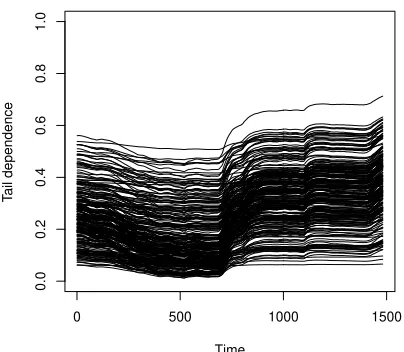
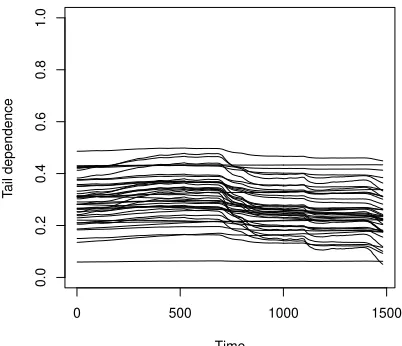
according to (4). Figure 1 gives a rough summary of the dynamics of the 234
estimated coefficients characterized by a positiveα, while Figure 2 contains the
dynamics of the remaining 42 coefficients with a negativeα.
The analyzed period is characterized by low volatility in the first half, then,
at the end of 2008 a peak in the volatility is observed, followed by an uncertain
period with a swing of volatility. This is reflected in the dynamics of the (lower)
tail dependence. For the pairs with an estimated positiveα(the majority), the
tail dependence is weaker in the first half, grows up rapidly at the end of the
2008, then its increase is slow until the end of the period (October 2011). In
a very few cases, and only for the last part of the period of observation, the
tail dependence coefficient is greater than 0.60. In general, the range of the
coefficients is wide. At the beginning of the sample period (January 2006) the
coefficients approximately range from 0.05 to 0.55, before the crisis from 0.01
to 0.50, at the end (October 2011) from 0.05 to 0.70. For the remaining pairs
0 500 1000 1500
0.0
0.2
0.4
0.6
0.8
1.0
Time
T
[image:17.595.199.401.153.329.2]ail dependence
Figure 1: Dynamics of the lower tail dependence of the 234 pairs with positive
α.
presents very small changes also in correspondence of the peaks of the volatility.
The coefficients range from 0.05 to 0.50.
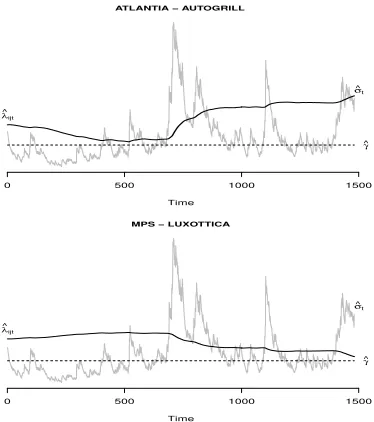
Moreover, we report two cases characterized by a different sign ofα. The
former is the pair ATLANTIA-AUTOGRILL presenting a positiveα, the
lat-ter the pair MPS-LUXOTTICA characlat-terized by a negative sign ofα. Figure
3 depicts the estimated time-varying lower tail dependence coefficients of the
two pairs, ATLANTIA-AUTOGRILL (top) and MPS-LUXOTTICA (bottom),
with the estimated one-lagged volatility of the market superimposed and the
estimated thresholds ˆγ. We can observe that when the volatility is below the
0 500 1000 1500
0.0
0.2
0.4
0.6
0.8
1.0
Time
T
[image:18.595.199.400.287.460.2]ail dependence
Figure 2: Dynamics of the lower tail dependence of the 42 pairs with negative
0 500 1000 1500
ATLANTIA − AUTOGRILL
Time
γ
^
λ
^ ijt
σ^t
0 500 1000 1500
MPS − LUXOTTICA
Time
γ
^
λ
^ ijt
[image:19.595.215.402.244.455.2]σ^t
Figure 3: Lower tail dependence coefficient at timet and market volatility at
timet−1 for the pairs ATLANTIA-AUTOGRILL (top) and MPS-LUXOTTICA
0 500 1000 1500
0.0
0.2
0.4
0.6
0.8
1.0
ATLANTIA − AUTOGRILL (tail dependence)
Time
λ
^ijt
0 500 1000 1500
0.0
0.5
1.0
1.5
ATLANTIA − AUTOGRILL (dissimilarity)
Time
δ
[image:20.595.200.413.125.231.2]^ijt
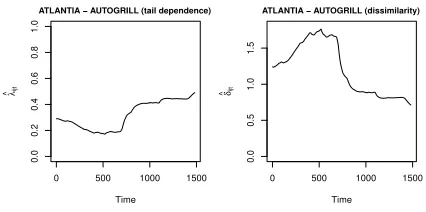
Figure 4: Lower tail dependence coefficient (left) and dissimilarity index (right)
for the pair ATLANTIA-AUTOGRILL.
tends to decrease, on the other hand, when the volatility exceeds the threshold
the same coefficient tends to increase. In particular, in correspondence of the
middle highest peak of the volatility and, in the second part of the sample
pe-riod, of the other two peaks, the coefficient shows more pronounced increases.
For the pair MPS-LUXOTTICA, the opposite behavior is observed.
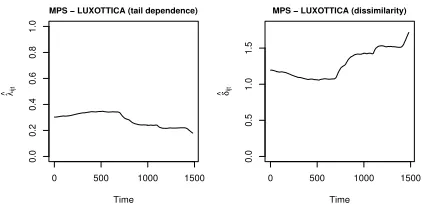
Finally, Figure 4 depicts the lower tail dependence coefficient (left) and the
dissimilarity index (right) of the pair ATLANTIA-AUTOGRILL. In Figure 5
the same graphs are reported for the pair MPS-LUXOTTICA.
5.2
Dynamic clustering
After the estimation of the 0.5p(p−1) = 276 bivariate copula functions, the
sequence of the estimated time-varying (p×p) dissimilarity matrices ∆t =
(δij,t)i,j=1,...,p;t=1,...,T is computed as in (7). By sequentially applying the
clus-tering procedure described in Section 3.1 to the matrices ∆t, t = 1, . . . , T, we
0 500 1000 1500
0.0
0.2
0.4
0.6
0.8
1.0
MPS − LUXOTTICA (tail dependence)
Time
λ
^ijt
0 500 1000 1500
0.0
0.5
1.0
1.5
MPS − LUXOTTICA (dissimilarity)
Time
δ
[image:21.595.201.413.125.231.2]^ijt
Figure 5: Lower tail dependence coefficient (left) and dissimilarity index (right)
for the pair MPS-LUXOTTICA.
Computations are carried out using the R functionsisoMDSfor MDS,kmeans
andcclustfork-means clustering.
From an operative point of view, since the k-means clustering solutions can
be different from one run to another of the algorithm, at each timetthe following
procedure is used for each value of k, k = 1, . . . , K, where K is fixed by the
researcher and denotes the maximum reasonable number of clusters. In this
case study we have fixed the valueK= 10.
Firstlykmeansis executed 8 times with the Hartigan-Wong algorithm
(Har-tigan and Wong, 1979).
Then, the centroids of the solution with the highest ratio of the variance
between over the total variance are used as optimal initial values for cclust
which, in its turn, is executed 3 times and the best solution is chosen according
to the same criterion of the highest ratio of the variance between over the total
variance.
number of clusters is selected as the most voted by the following indices (for
a comprehensive review, see Dimitriadou et al., 2002): RL (Ratkowsky and
Lance, 1978), SS (Scott and Symons, 1971), FR (Friedman and Rubin, 1967),
DB (Davies and Bouldin, 1979), SSI (Dolniˇcaret al., 1999).
For each pair of stocksij, at each timetwe record the valueIij,t = 1 if the
two stock belong to the same cluster andIij,t= 0 otherwise. Figure 6 shows the
scatterplots ofIij,t againstσt−1 fori=Atlantiaand j all the other 23 stocks
(solid lines denote a kernel smoothing showing the basic average patterns).
For low levels of volatility the pattern is sometimes wavering, but when
volatility increases, the pairs tend to be more stably assigned either to the same
or to a different cluster, as a result of the stronger tail dependence characterizing
some pairs of stocks during high volatility periods. Similar graphs are obtained
for the other pairs of stocks. Finally, the ODC clustering solution is determined
by applying a hierarchical algorithm (Ward linkage) to the distance matrix
B= (bij)i,j=1,...,p withbij computed by (8). The obtained cluster dendrogram
is displayed in Figure 7, withk= 5 clusters selected.
5.3
Portfolio selection
In this section we show the results of portfolio selection according to the two
ATLANTIA
0.01 0.03 0.05
0.0 0.2 0.4 0.6 0.8 1.0 AUTOGRILL
0.01 0.03 0.05
0.0 0.2 0.4 0.6 0.8 1.0 MPS
0.01 0.03 0.05
0.0 0.2 0.4 0.6 0.8 1.0 ENEL
0.01 0.03 0.05
0.0 0.2 0.4 0.6 0.8 1.0 ENI
0.01 0.03 0.05
0.0 0.2 0.4 0.6 0.8 1.0 FIAT
0.01 0.03 0.05
0.0 0.2 0.4 0.6 0.8 1.0 FINMECC
0.01 0.03 0.05
0.0 0.2 0.4 0.6 0.8 1.0 FONDIARIA
0.01 0.03 0.05
0.0 0.2 0.4 0.6 0.8 1.0 GENERALI
0.01 0.03 0.05
0.0 0.2 0.4 0.6 0.8 1.0 INTESA
0.01 0.03 0.05
0.0 0.2 0.4 0.6 0.8 1.0 LOTTOMAT
0.01 0.03 0.05
0.0 0.2 0.4 0.6 0.8 1.0 LUXOTTICA
0.01 0.03 0.05
0.0 0.2 0.4 0.6 0.8 1.0 MEDIOBANCA
0.01 0.03 0.05
0.0 0.2 0.4 0.6 0.8 1.0 MEDIOLANUM
0.01 0.03 0.05
0.0 0.2 0.4 0.6 0.8 1.0 MEDIASET
0.01 0.03 0.05
0.0 0.2 0.4 0.6 0.8 1.0 PIRELLI
0.01 0.03 0.05
0.0 0.2 0.4 0.6 0.8 1.0 BPM
0.01 0.03 0.05
0.0 0.2 0.4 0.6 0.8 1.0 SAIPEM
0.01 0.03 0.05
0.0 0.2 0.4 0.6 0.8 1.0 SNAM
0.01 0.03 0.05
0.0 0.2 0.4 0.6 0.8 1.0 STM
0.01 0.03 0.05
0.0 0.2 0.4 0.6 0.8 1.0 TELECOM
0.01 0.03 0.05
0.0 0.2 0.4 0.6 0.8 1.0 TERNA
0.01 0.03 0.05
0.0 0.2 0.4 0.6 0.8 1.0 UBI
0.01 0.03 0.05
[image:23.842.196.412.192.560.2]0.0 0.2 0.4 0.6 0.8 1.0 UNICREDIT
MEDIOBANCA FONDIARIA UNICREDIT
UBI BPM MPS
INTESA
SAIPEM
STM
A
UT
OGRILL
LUXO
TTICA FIA
T
PIRELLI SNAM TERNA ENEL ENI
MEDIOLANUM GENERALI MEDIASET FINMECC TELECOM ATLANTIA LO
TT
OMA
T
0
1
2
3
4
5
Cluster Dendrogram
Hierarchical clustering − Ward method
[image:24.595.200.399.135.316.2]Height
Figure 7: ODC clustering solution
5.3.1 Strategy A
Starting from the ODC clustering solution of Figure 7 with n1 = 7, n2 = 6,
n3= 4, n4 = 3,n5 = 4, where ni is the number of stocks belonging to cluster
i, we can build a total number of n1n2n3n4n5 = 2016 possible portfolios of
k= 5 stocks using the criterion of selecting stocks not belonging to the same
cluster. For each of these 2016 possible selections, we estimate the weights of the
Minimum CVaR Portfolio using returns at times 1, . . . , T and we finally select
the solution which exhibits the lowest CVaR value (Table 1). Computations are
carried out by solving the linear programming problem described in Section 3.2,
using the R packageRglpk.
Table 1: Minimum CVaR Portfolio based on ODC
Stock Mediobanca Luxottica Snam Generali Atlantia
weights 0.0796 0.1634 0.6759 0 0.0811
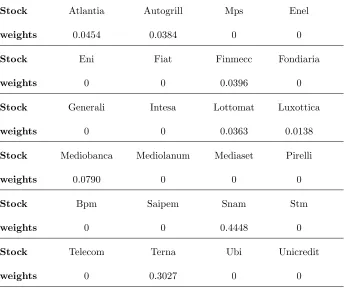
Portfolio and the Minimum CVaR Portfolio using the returns at times 1, . . . , T
of all thep= 24 stocks (Tables 2 and 3). Computations for Markowitz portfolios
have been carried out using the R packagefPortfolio.
The three portfolios (Markowitz minimum variance Portfolio, Minimum CVaR
Portfolio, Minimum CVaR Portfolio based on ODC) exhibit a quite similar
structure, the one based on ODC being the most parsimonious, as it requires
investment on 4 stocks, while the other two results composed by 8 and 6 stocks,
respectively. A barplot of the weights of the stocks in the three portfolios is
displayed in Figure 8.
Finally we check the performance of the three portfolios with an
out-of-sample perspective, in the period from November 1, 2011 to December 20, 2011,
that is at timesT+ 1, . . . , T+ 36. The Minimum CVaR Portfolio based on ODC
tends to outperform the other two (Figure 9).
5.3.2 Strategy B
As pointed out in Section 3.2, portfolios built according to strategy B usually
need to be frequently rebalanced, as they rely on instantaneous clustering
solu-tions. In this case study we decide to update the portfolio composition every 5
days. So, for the out-of-sample period from November 1, 2011 to December 20,
Table 2: Markowitz minimum variance Portfolio
Stock Atlantia Autogrill Mps Enel
weights 0.0454 0.0384 0 0
Stock Eni Fiat Finmecc Fondiaria
weights 0 0 0.0396 0
Stock Generali Intesa Lottomat Luxottica
weights 0 0 0.0363 0.0138
Stock Mediobanca Mediolanum Mediaset Pirelli
weights 0.0790 0 0 0
Stock Bpm Saipem Snam Stm
weights 0 0 0.4448 0
Stock Telecom Terna Ubi Unicredit
Table 3: Minimum CVaR Portfolio
Stock Atlantia Autogrill Mps Enel
weights 0.0750 0 0 0
Stock Eni Fiat Finmecc Fondiaria
weights 0 0 0.0392 0
Stock Generali Intesa Lottomat Luxottica
weights 0 0 0 0.0705
Stock Mediobanca Mediolanum Mediaset Pirelli
weights 0.0884 0 0 0
Stock Bpm Saipem Snam Stm
weights 0 0 0.3913 0
Stock Telecom Terna Ubi Unicredit
ATLANTIA AUTOGRILL MPS ENEL ENI FIAT FINMECC FONDIARIA GENERALI INTESA LOTTOMAT LUXOTTICA MEDIOBANCA MEDIOLANUM MEDIASET PIRELLI BPM SAIPEM SNAM STM TELECOM TERNA UBI UNICREDIT
Minimum CVaR Portfolio based on ODC Minimum CVaR Portfolio
Markowitz minimum variance Portfolio
Weights
[image:28.595.201.411.183.589.2]0.0 0.1 0.2 0.3 0.4 0.5 0.6
0 5 10 15 20 25 30 35
−20
−15
−10
−5
0
2011: November, 1 − December, 22
Retuns with respect to October
, 31
[image:29.595.198.404.144.334.2]Markowitz minimum variance Portfolio Minimum CVar Portfolio Minimum CVaR Portfolio based on ODC
Figure 9: Portfolio returns, Strategy A compared with classical portfolios
7),T+ 10 (November 14),T+ 15 (November 21),T+ 20 (November 28),T+ 25
(December 5),T+ 30 (December 12),T+ 35 (December 19). At the end of day
T+hwe estimate the dissimilarity matrix for the following day, ∆T+h+1. In
order to lighten the computational burden, the estimates of the tail dependence
coefficients are computed using parameters estimated up to time T and price
returns up to timeT+i. In other words, we only update the information about
the realized returns, and do not compute new estimates for the parameters of
the involved statistical models. The dissimilarity matrix ∆T+h+1is then used to
cluster thepstocks using the two-step clustering procedure described in Section
3.1. Letkbe the number of clusters and n1, . . . , nk their sizes, we can build a
selecting stocks not belonging to the same cluster. For each of these (n1·. . .·nk)
possible selections, we estimate the weights of the Minimum CVaR Portfolios
using returns at times 1, . . . , T+hand we finally select the solution which
ex-hibits the lowest CVaR value. The corresponding portfolio is then invested for
the following 5 days, i.e. at timesT +h+ 1, . . . , T+h+ 5. At the end of day
T+h+ 5 the procedure is repeated and a new portfolio is built for investing
during the following 5 days. The obtained portfolios are summarized in Table
4. In the short analysed period we do not observe appreciable changes in the
composition of the portfolios, as the dynamic clustering in the out-of-sample
data is fairly stable.
Also in this case, the returns of this investment strategy are compared to the
returns of two competitors: a Markowitz minimum variance Portfolio and the
Minimum CVaR Portfolio built using all thep= 24 stocks and renewed every
5 days (Figure 10). The proposed strategy tends to outperform the other two.
Due to the substantial stability in the portfolios updated every 5 days, the
returns deriving from the two proposed investment strategies, A and B, are
very close each other (Figure 11). So, in this case study, the Minimum CVaR
Portfolio based on ODC outperforms even the competitors (Markowitz minimum
variance and Minimum CVaR) rebalanced every 5 days, which also suffer of
Table 4: Minimum CVaR Portfolios rebalanced every 5 days
Time: T (October 31), k= 4
Stock Mediobanca Luxottica Snam Atlantia
weights 0.0796 0.1634 0.6759 0.0811
Time: T+ 5 (November 7), k= 4
Stock Mediobanca Luxottica Snam Atlantia
weights 0.0398 0.1746 0.7100 0.0756
Time: T+ 10 (November 14), k= 4
Stock Mediobanca Luxottica Snam Atlantia
weights 0.0505 0.2009 0.7056 0.0430
Time: T+ 15 (November 21), k= 4
Stock Mediobanca Luxottica Snam Atlantia
weights 0.0380 0.1977 0.7082 0.0561
Time: T+ 20 (November 28), k= 4
Stock Ubi Luxottica Snam Atlantia
weights 0 0.2187 0.7507 0.0306
Time: T+ 25 (December 5), k= 4
Stock Mediobanca Luxottica Snam Atlantia
weights 0.0417 0.1784 0.7039 0.0760
Time: T+ 30 (December 12), k= 4
Stock Mediobanca Luxottica Snam Atlantia
weights 0.0239 0.1972 0.7032 0.0757
Time: T+ 35 (December 19), k= 4
Stock Mediobanca Luxottica Snam Atlantia
0 5 10 15 20 25 30 35
−20
−15
−10
−5
0
2011: November, 1 − December, 22
Retuns with respect to October, 31
[image:32.595.198.404.147.338.2]Markowitz minimum variance Portfolio (updated every 5 days) Minimum CVar Portfolio (updated every 5 days) Clustering−based Minimum CVar Portfolio (updated every 5 days)
Figure 10: Portfolio returns, Strategy B compared with classical portfolios
0 5 10 15 20 25 30 35
−20
−15
−10
−5
0
2011: November, 1 − December, 22
Retuns with respect to October, 31
Minimum CVaR portfolio based on ODC
Clustering−based Minimum CVar Portfolio (updated every 5 days)
[image:32.595.197.405.424.617.2]6
Discussion
In this paper we have proposed two portfolio selection strategies based on a
dynamic clustering of the time series of returns observed for a set of candidate
stocks. The dissimilarity matrix on which the stocks are clustered is derived from
their lower tail dependence coefficients, estimated by means of copula functions
with time-varying parameters. Thanks to this dissimilarity measure based on
lower tail dependence, time series are clustered according to a similar behavior
in event of extremely low returns, so that we propose, as a basic criterion, not
to include in the portfolio stocks belonging to the same cluster. As a portfolio
selection procedure, we propose to optimize the Conditional-Value-at-Risk, as
this is consistent with the approach focused on extreme events.
The main advantages of the proposed method are:
• the time-varying copula functions model the relationship between lower
tail dependence coefficients and the volatility of the market, so as to take
into account contagion phenomenons;
• the diversification of the portfolio is strongly driven by the association
of returns in the lower tail of their joint distribution, and this protects
investments during financial crisis periods;
• the time-varying dissimilarity matrix results in a dynamic clustering
solu-tion which allows us a frequent portfolio rebalancement, if necessary.
A case study with real data from the Italian Stock Market during a financial
classical alternative methods. As future research, a criterion could be developed
to decide which of the two strategies should be used in a given period and to
automatically switch from one to another when it is the case. Furthermore,
the procedure could be refined in order to take into account the upper tail
dependence, which would allow us to take the best from bulls, while protecting
from bears.
References
[1] Davies, D.L., and Bouldin, D. W. (1979), ”A Cluster Separation Measure”.
IEEE Transactions on Pattern Analysis and Machine Intelligence, 1,
224-227.
[2] De Luca, G., and Zuccolotto, P. (2011), ”A Tail Dependence-based
Dissim-ilarity Measure for Financial Time Series Clustering”.Advances in
Classi-fication and Data Analysis, 5, 323-340.
[3] De Luca, G., and Zuccolotto, P. (2012), ”Time Series
Cluster-ing on Lower Tail Dependence”. Proceedings of MAF2012, 2012:
maf2012.unive.it/viewpaper.php?id=101.
[4] Dolniˇcar, S., Leisch, F., Weingessel, A., Buchta, C., and Dimitriadou, E.
A. (1998), ”Comparison of Several Cluster Algorithms on Artifcial Binary
Data Scenarios from Tourism Marketing”.SFB Adaptive Information
Sys-tems and Modeling in Economics and Management Science, Working Paper
[5] Dimitriadou, E., Dolniˇcar, S., and Weingessel, A. (2002), ”An Examination
of Indexes for Determining the Number of Clusters in Binary Data Sets”.
Psychometrika, 67, 137-159.
[6] Friedman, H. P., and Rubin, J. (1967), ”On Some Invariant Criteria for
Grouping Data”.Journal of the American Statistical Association, 62,
1159-1178.
[7] Hartigan, J. A., and Wong, M. A. (1979), ”A K-means Clustering
Algo-rithm”. Applied Statistics, 28, 100-108.
[8] Joe, H. Multivariate Models and Dependence Concept. Chapman & Hall,
New York, 1997.
[9] Krokhmal, P., Palmquist, J., and Uryasev, S. (2002), ”Portfolio
Optimiza-tion with CondiOptimiza-tional Value-at-Risk Objective and Constraints”Journal of
Risk, 4, 43-68.
[10] Nelsen RB.An Introduction to Copulas. Springer-Verlag, New York, 2006.
[11] Rand WM. ”Objective Criteria for the Evaluation of Clustering Methods”.
Journal of the American Statistical Association, 1971; 66:846-850.
[12] Ratkowsky DA, Lance GN. ”A Criterion for Determining the Number of
Groups in a Classifcation”.Australian Computer Journal; 1978; 10:115-117.
[13] Rockafellar RT, Uryasev S. ”Optimization of Conditional Value-at-Risk”.
[14] Scott AJ, Symons MJ. ”Clustering Methods Based on Likelihood Ratio
Criteria”.Biometrics, 1971; 27:387-397.
[15] Sokal RR, Michener CD. ”A Statistical Method for Evaluating Systematic