ISSN Online: 2327-4379 ISSN Print: 2327-4352
The Exact Rational Solutions to a Shallow
Water Wave-Like Equation by Generalized
Bilinear Method
Minzhi Wei, Junning Cai
School of Information and Statistics, Guangxi University of Finance and Economics, Nanning, China
Abstract
A Shallow Water Wave-like nonlinear differential equation is considered by using the generalized bilinear equation with the generalized bilinear deriva-tives D3,x and D3,t, which possesses the same bilinear form as the standard
shallow water wave bilinear equation. By symbolic computation, four pre-sented classes of rational solutions contain all rational solutions to the result-ing Shallow Water Wave-like equation, which generated from a search for polynomial solutions to the corresponding generalized bilinear equation.
Keywords
Rational Solution, Generalized Bilinear Equation, Shallow Water Wave Equation
1. Introduction
In recent years, numerous scientists committed to the research of water waves, the shallow water wave can not only describe the freedom of the shallow surface under the gravitational influence of one-way transmission, but also produce on the bottom of the deep sea. The most important of the shallow water wave in the ocean is tsunami, which generated by the huge initial disturbance, such as earthquake, leading to the large wavelength and small height ocean wave. Therefore, the wave solutions, especially the rational solutions to nonlinear dif-ferential equations have attracted more and more attentions in the worldwide. What’s more, rogue wave solutions play an important role in rational solutions, which describe significant nonlinear wave phenomena in oceanography [1]. Wronskian formulation or the Casoratian formulation ([2]-[6]) usually deal with integrable equations to find their rational solutions in the literature, such as KdV, Boussinesq, KP, Schrodinger Toda equations and Shallow water wave
equ-How to cite this paper: Wei, M. and Cai, J.N. (2017) The Exact Rational Solutions to a Shallow Water Wave-Like Equation by Generalized Bilinear Method. Journal of Applied Mathematics and Physics, 5, 715-721.
https://doi.org/10.4236/jamp.2017.53060
Received: February 17, 2017 Accepted: March 28, 2017 Published: March 31, 2017
Copyright © 2017 by authors and Scientific Research Publishing Inc. This work is licensed under the Creative Commons Attribution International License (CC BY 4.0).
http://creativecommons.org/licenses/by/4.0/
ations [7]-[11]. In recent years, increasingly nonlinear differential equations are studied through the generalized bilinear equation with the generalized bilinear derivatives, for examples, KdV-like equation [12], Boussinesq-like equation [13]
and KP-like equation [14].
Rational solutions to the non-integrable (3 + 1)-dimensional KP I [15] [16]
and KPII [17] are also considered by different approaches. In particular, rational solutions to the (3 + 1)-dimensional KP II have been transformed into a problem of finding rational solutions to the good Boussinesq equation.
In this article, we introduce a Shallow Water Wave (SWW)-like nonlinear differential equation in terms of a generalized bilinear differential equation of Shallow Water Wave type using three generalized bilinear differential operators
3,x
D and D3,t. We will search for polynomial solutions to the corresponding
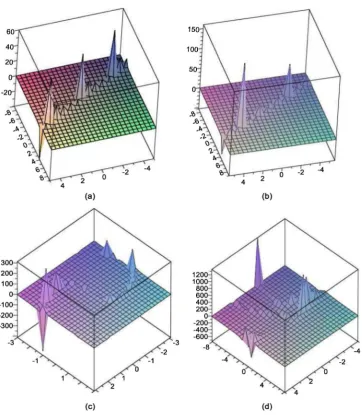
generalized bilinear equation by Maple symbolic computation and generate four classes of rational solutions to the resulting Shallow Water Wave-like equation. Four particular rational solutions will be plotted to exhibit different distributions of singularities.
2. A SWW-Like Differential Equation
Let us consider a generalized bilinear differential equation of SWW type:
(
3 2)
3, 3, 3, 3, 3,
2
2 2 6 6 2 2 0.
x t t x x
xt x t xx xt xxt x xx x
D D D D D f f
f f f f f f f f f f f
− + ⋅
= − − + + − = (2.1)
This is the same type bilinear equation as the SWW equation [10][18][19]
(
3 2)
0,
x t t x x
D D −D D +D f⋅ =f (2.2)
with the corresponding nonlinear differential equation
3 3 d 0.
t xxt t x x t x
u −u − uu + u
∫
∞u x u+ = (2.3)The above differential operators are some kind of generalized bilinear diffe-rential operators introduced in [20][21]:
( ) (
)
( ) ( )( ) (
)
( )
, , , , 0 0 0 0 , , , , , m np x p t
m n
p p x x t t
m i i n j j
m n
i j
p p m i i n j j x x t t
i j
m n i j
m n
i j
p p m i
i j
D D f f
f x t f x t
x x t t
m n
f x t f x t
i j x x t t
f x t
m n
i j x
α α α α α α ′= ′= − − − − ′= ′= = = + − − − = = ⋅ ∂ ∂ ∂ ∂ ′ ′ = + + ′ ′ ∂ ∂ ∂ ∂ ∂ ∂ ∂ ∂ ′ ′ = ∂ ∂ ′ ∂ ∂′ ∂ = ∂ ∂
∑∑
∑∑
( )
, , , 0.i j
n j i j
f x t
m n
t x t
+ − ∂ ≥ ∂ ∂ (2.4)
where s p
α is computed as follows:
( )
( )( )
1rps , mod ,
s
p s rp s p
α = − = (2.5)
it is necessary to point out that
, , 0.
i j i j
p p p i j
α α ≠α + ≥
2 3 4 5 6 3 1, 1, 1, 1, 1, 1.3 3 3 3 3
α = − α = α = α = − α = α =
and thus
3, 3,
3
3, 3,
2 2
3,
2 2 ,
6 6 ,
2 2 .
x t xt x t
t x xx xt xxt x
x xx x
D D f f f f f f
D D f f f f f f
D f f f f f
⋅ = −
⋅ = − +
⋅ = −
In the case of p=2, which is the Hirota case, the following equations are true:
2, 2,
2 2
2, 3
2, 2,
2 2 ,
2 2 ,
2 6 2 ,
x t xt x t
x xx x
t x xxxt xx xt xxx t
D D f f f f f f
D f f f f f
D D f f f f f f f f
⋅ = −
⋅ = −
⋅ = + −
which generates the standard bilinear SWW equation [18].
Motivated by the introduction on a general Bell polynomial theory [20], a de-pendent variable transformation is adopted:
(
)
2 ln ,
x
u= f
(2.6)
and then can directly show that the generalized bilinear Equation (2.1) is linked to a SWW-like scalar nonlinear differential equation
2
3 3 1
0,
2 2 2
t x xt x t t
u +u + uu − u u + u u = (2.7)
from the generalized bilinear Equation (2.1). Through the transformation (2.6), the following equality can be deduced:
(
3)
3, 3, 3, 3, 2
2
3 3 1
,
2 2 2
x t t x
t x xt x t t
D D D D f f
u u uu u u u u
f
− ⋅
= + + − + (2.8)
and thus, f solves (2.1) if and only if u=2 ln
(
f)
x presents a solution to theSWW-like Equation (2.7).
In [21][22], transcendental functions: exponential functions and trigonome-tric functions have been considered to find the resonant solutions for genera-lized bilinear equations. In the next section, we would like to consider finding the rational solutions for SWW-like Equation (2.7), which generated from poly-nomial solutions.
3. Rational Solutions
By symbolic computation with Maple, we look for polynomial solutions, with degree of x and t being less than 3:
3 3 , 0 0
,
i j i j
i j
f c x x
= =
=
∑∑
(3.1)where the ci j, ’s are constants, and present 4 classes of polynomial solutions to
the generalized bilinear Equation (2.1), based on the powers of x, the solutions
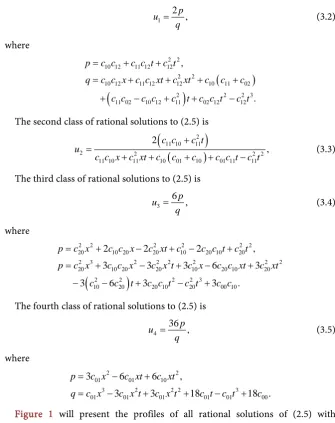
transformation (2.4). We list those classes of rational solutions as follows. The first class of rational solutions to (2.5) is
1 2 , p u q
= (3.2)
where
(
)
(
)
2 2 10 12 11 12 12
2 2
10 12 11 12 12 10 11 02
2 2 2 3
11 02 10 12 11 02 12 12 ,
. p c c c c t c t
q c c x c c xt c xt c c c
c c c c c t c c t c t
= + +
= + + + +
+ − + + −
The second class of rational solutions to (2.5) is
(
)
(
)
2 11 10 11
2 2 2 2
11 10 11 10 01 10 01 11 11 2
, c c c t
u
c c x c xt c c c c c t c t
+ =
+ + + + − (3.3)
The third class of rational solutions to (2.5) is
3 6 , p u q
= (3.4)
where
(
)
2 2 2 2 2 2
20 10 20 20 10 20 10 20
2 3 2 2 2 2 2 2
20 10 20 20 10 20 10 20
2 2 2 2 3
10 20 20 10 20 00 10
2 2 2 ,
3 3 3 6 3
3 6 3 3 .
p c x c c x c xt c c c t c t
p c x c c x c x t c x c c xt c xt
c c t c c t c t c c
= + − + − +
= + − + − +
− − + − +
The fourth class of rational solutions to (2.5) is
4 36 , p u q
= (3.5)
where
2 2
01 01 10
3 2 2 2 3
01 01 01 01 01 00
3 6 6 ,
3 3 18 18 .
p c x c xt c xt
q c x c x t c x t c t c t c
= − +
= − + + − +
Figure 1 will present the profiles of all rational solutions of (2.5) with
2 2
,
i j
c = +i j .
4. Concluding Remarks
We took a SWW-like nonlinear differential equation into consideration by the generalized bilinear equation of SWW type. Furthermore, we constructed two classes of rational solutions to the resulting SWW-like equation. A kind of gene-ralized bilinear differential operators, which introduced in [20] [21] is the key instrument. It is an interesting work to search if there exists any Wronskian so-lutions and multiple type soso-lutions to the SWW-like nonlinear Equation (2.5). At the same time, a speculation is raised, in which the four classes of rational solutions in Equations (3.2)-(3.5) would contain all rational solutions to the SWW-like nonlinear Equation (2.5), generated from polynomial solutions to the generalized bilinear Equation (2.1) with the transformation (2.4).
[image:4.595.202.538.102.526.2]Figure 1. Pictures of the all rational solutions of (2.5) with 2 2 ,
i j
c = +i j .
ations and their resonant solutions was considered in [23]. Their rational solu-tions, which include singular and non-singular wave solusolu-tions, rogue and high-er-order rogue wave solutions will be a very interesting topic in generalized tri-linear differential equations in the future.
Acknowledgements
This work is supported by Guangxi College Enhancing Youths Capacity Project (KY2016LX315) and Guangxi University of Finance and Economics Youth Pro-gresss Project (2016QNB22).
References
[1] Muller, P., Garrett, C., Osborne, A. and Waves, R. (2005) Oceanography, 18 66-75.
https://doi.org/10.5670/oceanog.2005.30
So-ciety, 357, 1753-1778.https://doi.org/10.1090/S0002-9947-04-03726-2
[3] Zhang, Y.J. (1996) Wronskian-Type Solutions for the Vector K-Constrained KP Hrerarchy.Journal of Physics A, 29, 2617-2626.
https://doi.org/10.1088/0305-4470/29/10/037
[4] Hirota, R., Ohta, Y. and Satsuma, J. (1988) Wronskian Structures for Soliton Equa-tions. Progress of Theoretical Physics Supplement, 94, 59-72.
https://doi.org/10.1143/PTPS.94.59
[5] Matveev, V.B. (1992) Genernalized Wronskian Formula for Solutions of the KdV Equations: First Applications. Physics Letters A, 166, 205-208.
[6] Clarkson, P.A. and Mansfield, E.L. (1994) On a Shallow Water Wave Equation.
Nonlinearity, 7, 975.https://doi.org/10.1088/0951-7715/7/3/012
[7] Nimmo, J.C. and Freeman, N.C. (1983) Rational Solutions of the Korteweg-De Vries Equation in Wronskian Form. Applied Physics Letters, 96, 443-446.
[8] Yuasa, F. (1987) Backlund Transformation of the Two-Dimensional Tada Lattice and Casorati’s Determinants. Journal of the Physical Society, 56, 423-424.
[9] Hirota, R. (1986) Soliton of the Classical Boussinesq Equation and the SPH Boussi-nesq Equation: The Wronskian Technique. Journal of the Physical Society, 55 2137-2150.https://doi.org/10.1143/JPSJ.55.2137
[10] Chen, D.Y. (2006) Introduction to Solitons. In: Liu, Y.Q., Hu, C. and Dai, J., Eds.,
Journal of Applied Mathematics and Physics. Science Press, Beijing.
[11] Bagchi, B.S. and Das, A. (2010) Ganguly, New Exact Solutions of a Generalized Shallow Water Wave Equation. Physica Scripta, 82, Article ID: 025003.
https://doi.org/10.1088/0031-8949/82/02/025003
[12] Zhang, Y. and Ma, W.X. (2015) Rational Solutions to a KdV-Like Equation. Applied Mathematics and Computation, 256, 252-256.
https://doi.org/10.1016/j.amc.2015.01.027
[13] Shi, C.G. and Zhao, B.Z. and Ma, W.X. (2015) Exact Rational Solutions to a Boussi-nesq-Like Equation in (1+1)-Dimensions. Applied Mathematics Letters, 48, 170- 176.
[14] Zhang, Y.F. and Ma, W.X. (2015) A Study on Rational Solutions to a KP-Like Equa-tion.Zeitschrift für Naturforschung A, 70, 263-268.
https://doi.org/10.1515/zna-2014-0361
[15] Sinelshchikov, D.I. (2010) Comment on: New Exact Traveling Wave Solutions of the (3+1)-Dimensional Kadomtsev-Petviashvili (KP) Equation. Communications in Nonlinear Science and Numerical Simulation, 15, 3235-3236.
[16] Khalfallah, M. (2009) New Exact Traveling Wave Solutions of the (3+1) Dimen-sional Kadomtsev-Petviashvili (KP) Communications in Nonlinear Science and Numerical Simulation, 14, 1169-1175.
[17] Ma, W.X. (2011) Comment on the 3+1 Dimensional Kadomtsev-Petviashvili Equa-tions. Communications in Nonlinear Science and Numerical Simulation, 16, 2663- 2666.
[18] Hirota, R. (2004) The Direct Method in Soliton Theory. Cambridge University Press, Cambridge.https://doi.org/10.1017/CBO9780511543043
[19] Guo, Y.C. (2008) An Introduction to Nonlinear Partial Differential Equation, Tsinghua University Press, Beijing.
[20] Ma, W.X. (2011) Generalized Bilinear Differential Equations. Journal of Nonlinear Science, 2, 140-144.
Polynomials. Reports on Mathematical Physics, 72, 41-56.
[22] Zheng, H.C., Ma, W.X. and Gu, X. (2013) Hirota Bilinear Equations with Linear Subspaces of Hyperbolic and Trigonometric Function Solutions. Applied Mathe-matics and Computation, 220, 226-234.
[23] Ma, W.X. (2013) Trilinear Equations, Bell Polynomials, and Resonant Solutions.
Frontiers of Mathematics in China, 8, 1139-1156.
https://doi.org/10.1007/s11464-013-0319-5
Submit or recommend next manuscript to SCIRP and we will provide best service for you:
Accepting pre-submission inquiries through Email, Facebook, LinkedIn, Twitter, etc. A wide selection of journals (inclusive of 9 subjects, more than 200 journals)
Providing 24-hour high-quality service User-friendly online submission system Fair and swift peer-review system
Efficient typesetting and proofreading procedure
Display of the result of downloads and visits, as well as the number of cited articles Maximum dissemination of your research work
Submit your manuscript at: http://papersubmission.scirp.org/