A New Method for Fastening the Convergence of Immune
Algorithms Using an Adaptive Mutation Approach
Mohammed Abo-Zahhad1, Sabah M. Ahmed1, Nabil Sabor1, Ahmad F. Al-Ajlouni2
1Electrical and Electronics Engineering Department, Faculty of Engineering, Assiut University, Assiut, Egypt; 2Communication En-gineering Department, Hijjawi Faculty for EnEn-gineering Technology, Yarmouk University, Irbid, Jordan.
Email: [email protected]
Received December 28th,2010; revised November 29th, 2011; accepted December 12th, 2011
ABSTRACT
This paper presents a new adaptive mutation approach for fastening the convergence of immune algorithms (IAs). This method is adopted to realize the twin goals of maintaining diversity in the population and sustaining the convergence capacity of the IA. In this method, the mutation rate (pm) is adaptively varied depending on the fitness values of the
so-lutions. Solutions of high fitness are protected, while solutions with sub-average fitness are totally disrupted. A solution to the problem of deciding the optimal value of pm is obtained. Experiments are carried out to compare the proposed
approach to traditional one on a set of optimization problems. These are namely: 1) an exponential multi-variable func-tion; 2) a rapidly varying multimodal function and 3) design of a second order 2-D narrow band recursive LPF. Simula-tion results show that the proposed method efficiently improves IA’s performance and prevents it from getting stuck at a local optimum.
Keywords: Adaptive Mutation; Immune Algorithm; Convergence; Traditional Mutation
1. Introduction
Finding an appropriate set of parameter values for evolu- tionary algorithms (EAs) has been a longstanding major challenge of the evolutionary computation community. Such difficulty has directed researchers’ attention to- wards devising an automated ways of controlling EAs parameters [1]. Immune Algorithm (IA) is one of re- cently EAs that based on the mechanism of the amalga- mation between antigen and antibody in biologic immune system [2]. IAs have been used widely and successfully in many computational intelligence areas including medi- cal data processing, biomedical and satellite image pro- cessing, spectrum analysis and design of digital filters [3-6]. The performance of IAs depends on many factors, such as selection schemes and control parameters. In spite of the research carried out up to date, there are no general rules on how the control parameters of IA can be selected. In literature [5-8], the choice these parameters is still left to the user to be determined statically prior to the execu- tion of the IA. Mutation rate (pm) is considered to be one
of the most sensitive control parameters that an immune algorithm works with. This is due to the fact that it in- creases the diversity in population. The choice of muta- tion rate is essentially a tradeoff between conservatism and exploration [9].
In this paper we investigate an efficient technique for
multi-modal function optimization using IAs. We rec- ommend the use of adaptive probability of mutation to realize the twin goals of maintaining diversity in the population and sustaining the convergence capacity of the IA. In adaptive mutation approach, the value of m
is varied depending on the fitness values of the solutions. The fitness values of the solution in relation to an objec- tive function to be optimized. During each generation, the fitness of each solution is evaluated, and solutions are selected for reproduction based on their fitness. Selection embodies the principle of survival of the fittest. Good solutions are selected for reproduction while bad solu- tions are eliminated. The goodness of a solution is de- termined from its fitness value. The adaptation probabi- lity of mutation provides a solution to the problem of choosing the optimal value of the probability of mutation in IA.
p
2. Problem Definition
The global optimization problem is considered as [10, 11]:
minimize subject to
d
F x y x Y x l x u
(1)
where, F x
is the objective function, y x
is the op- timizing function and is the desired function. The
vector d
Y x
, , ,i N
1, ,2 x x x
li, , l
x x
N
1, , ,l2
is a variable vector and
and 1 2 N de-
fine the feasible solution space. Since the IAs mimic the antigen-antibody reaction of the immune system in mammals. The antigen and the antibody in the IA are equivalent to the objective function and the feasible solu- tion for a conventional optimization method, respec- tively. The antibodies (chromosomes) population is gen- erated either by using binary coding representation or real coding representation. In the binary coding represen- tation, each variable (gene) is encoded as a binary string and the resulting strings are concatenated to form single antibody [12]. However, in the real coding representa- tion, each antibody is encoded as a vector of floating point numbers (i.e.
l l u
u u, ,, ,ui ,u
i i i i
x l u l , where
0,1 is a random value), with the same length as the vector of decision variables. This representation is accurate and efficient because it is closest to the real design space, and the string length represents the number of design vari- ables. The hyper-mutation mechanism of the clonal pro- liferation and mutation mechanism play a critical role in creating diverse antibodies based on minimization of the difference between the optimizing and desired functions. The diversity is measured between the antibodies, and it is increased to prevent local optimization during the op- timal search [6].In optimizing functions, it is important that the IA should be able to converge to the optimal value in as few generations as possible. The convergence speed heavily depends on its main control parameters: population size, replication rate, mutation rate, clonal rate and hyper- mutation rate [13]. Mutation rate is considered to be one of the most sensitive control parameters that an immune algorithm works with, because it increases the diversity in population to prevent the solution to get stuck at a lo- cal optimal value during the optimization search. So, the adaptive mutation approach is considered here.
3. Adaptive Mutation Approach
Mutation alters one or more genes (unknown variables) depending on the mutation rate. For a given antibody
1, , , , , , ,2 i k N
X x x x x x , if the gene xi is selected
for mutation depending on mutation rate m and the
other xk is randomly selected to join in, the resulting off-
spring antibody becomes
p
1, , ,2 i, , k, , N
X x x x x x ,
where the new gene xi is x i
1
xixkp
and β
is selected randomly in the range [0,1]. The choice of
m is essentially a tradeoff between conservatism and
exploration [9]. It has been well established in IA litera- ture [8] that when the value of m is selected nearby
the range of [0.02, 0.05], the time spent on searching is relatively short and the searching process is stable as well as the search efficiency is better [13]. In the proposed approach, we aim at achieving this trade-off between conservatism and exploration in a different manner, by varying the m adaptively in response to the fitness va-
lues of the solutions; m is increased when the popula-
tion tends to get stuck at a local optimum and is de- creased when the population is scattered in the solution space. So, it is essential to be able to identify whether the IA is converging to an optimum solutions or it diverges. The average of fitness value ( av
p
p
p
f ) of the population in relation to maximum fitness value (fmax) of the popula-
tion is used to detect the conversance of IA. fmax fav
is likely to be less for a population that has converged to an optimum solution than that for a population scattered in the solution space. Therefore the difference in the maximum and average fitness values (fmaxfav) is used
as a yardstick for detecting the convergence of IA. The value of m is varied depending on the value of
max av
p
f f to prevent premature convergence of the IA to a local optimum. Since m has to be increased when
the IA converge to a local optimum, m will have to be
varied inversely with max av
p
p
f f . The expression that we have chosen for pm is of the form:
1
1
, 0 1
av
k
p k
fmax f
m
p
p
(2)
From Equation (2), it can be noticed that m do not depend on the fitness value of any particular solution, and have the same value for all the solutions of the popu- lation. Consequently, solutions with high fitness values as well as solutions with low fitness values are subjected to the same levels of mutation. When a population con- verges to a globally optimal solution (or even a locally optimal solution), m increases and may cause the dis- ruption of the near-optimal solutions. To overcome this problem and to preserve good solutions of the population
m should have lower value for high fitness solutions
and higher value for low fitness solutions. While the high fitness solutions aid in the convergence of the IA, the low fitness solutions prevent the IA from getting stuck at a local optimum. The value of m should depend not only on max av
p
p
f f , but also on the fitness value f of the solution. The closer f is to fmax, the smaller should be, i.e., m should vary directly as max m
p
p f f . So, the
expression in Equation (2) is modified to become:
max max
1 , 0 1 1
av f f k f f m
p k
Note that m is zero for the solution with the maxi-
mum fitness. Also m 1 for a solution with p
p k f fav.
For solutions with sub-average fitness values (i.e. f < fav), m might assume value larger than 1.0. To prevent the
overshooting of m beyond 1.0, we also have the
fol-lowing constraints,
p
p
2, if m
p k f fav (4) where, 0k21
For convenience, the expression for pm is given as:
1 max max
2
, if
, if
av av
m
av
k f f f f f f
p
k f
f (5)
The values of 1 and 2 are in the range [0,1] and are
selected to prevent the IA from getting stuck at a local optimum. For solutions with sub-average fitness the search space is searched for the region containing the global optimum solution. Such solutions need to be com-pletely disrupted, and for this purpose the value of k2 is
selected to be 0.5. But, the value of 1 is selected by 1/L
as state in [14], where L is the encoding string length.
k k
k
4. Experiments
This section presents the three experiments that we have conducted to compare the performance of the adaptive and traditional mutation approaches on IA. For this pur- pose we have employed three test problems with varying complexities.
Experiment 1: This experiment considers the optimi-
zation of the exponential function shown in Figure 1 and
described by the following Equation [13]:
90 i i i
y x a
x (6)with the following desired specified values Y xd
at x=
0,1, 2,3 , 20
.
34 4 5
6 6 7
7 7 8
8 8 9
9
0 01, 0 01, 3 83, 4 79, 758 33, 9 0021 10 , 5 7237 10 , 5 7237 10 , 9 2998 10 , 2 8368 10 , 7.6281 10 , 1.8563 10 , 4.165 10 , 8.7358 10 , 1.7309 10 , 3.2667 10 , 5.9104 10 , 1.0306 10 , 1.7397 10
d
Y x . . . . . .
. . .
.
, 2.8528 10 , 4.5587 10 9 9
Experiment 2: This experiment considers the rapidly
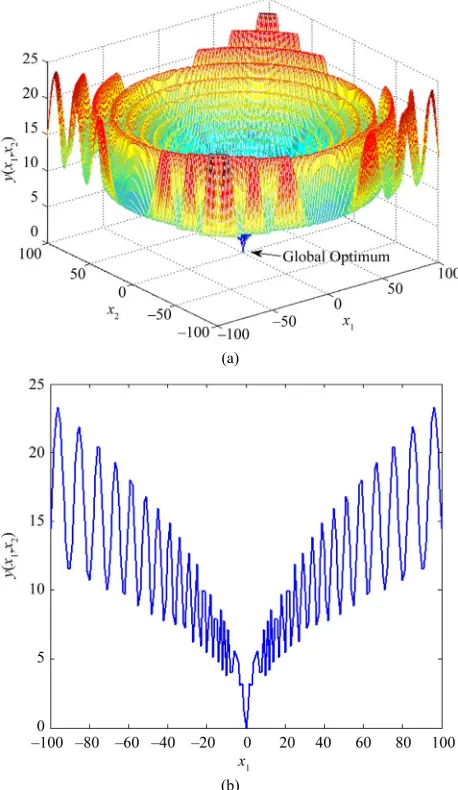
varying multimodal function of two variables described by Equation (7). This function is symmetric about the origin with the barrier height between adjacent minima approaching zero as the global optimum is approached and is considered in [15] to test the performance of adap- tive genetic algorithm. Figure 2 illustrates the function
[image:3.595.308.534.88.270.2]
1, 2Figure 1 Desired specifications of the function y(x) (experi-ment 1).
(a)
(b)
Figure 2. The function y(x1,x2) (experiment 2). (a) Bi-dimen-
sional plot; (b) Uni-dimensional plot.
[image:3.595.308.537.313.708.2]1
1
100 x 100
and 100x2100.
2 2
0.25 2
2 2
0.1
1, 2 1 2 sin 50 1 2
y x x x x x x
(7)
Experiment 3: This experiment considers the design of
a second order 2-D narrow-band recursive LPF with magnitude and group delay specifications. The specified magnitude Md
1, 2
is shown in Figure 3 [7,13]. Namely, it is given by Equation (8) with the additional constant group delay d1d25 over the passband2 2 1 2 0.1π
and the design space is [-3 3]. To solve this problem, the frequency samples are taken at
π 0, 0.02, 0.04, , 0.2, 0.4, , 1
i
in the ranges
1
π π
[image:4.595.316.525.87.242.2] , and π 2π.
Figure 3. Desired amplitude response Md
1, 2
of the 2-D narrow-band LPF (experiment 3).
2 2
1 2
2 2
1 2 1 2
2 2
1 2
1.0, for 0.08π
, 0.5, for 0.08π 0.12π
0.0, for 0.12π
d
M
(8) Table 1. The values of mutation rate for all experiments.
Mutation rate Experiments variables (L)Unknown Adaptive
mutation approach
Traditional mutation approach
Experiment 1 10 0.1 0.1
Experiment 2 2 0.5 0.5
Experiment 3 15 0.07 0.07
5. Results and Discussion
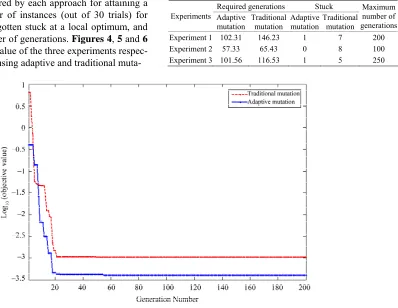
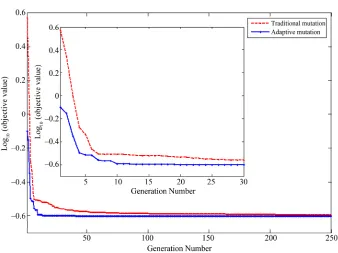
For the three experiments [16] considered, the program implementation for each chosen approach is run 30 times. The population size is set to 100 for all experi- ments and the values of mutation rate for all experiments are given in Table 1. Table 2 gives the average number
of generations required by each approach for attaining a solution, the number of instances (out of 30 trials) for which the IA have gotten stuck at a local optimum, and the maximum number of generations. Figures 4, 5 and 6
show the objective value of the three experiments respec-tively that obtained using adaptive and traditional muta-
Table 2. Comparison between adaptive and traditional mu-tation approaches for IA.
Required generations Stuck Experiments Adaptive
mutation
Traditional mutation
Adaptive mutation
Traditional mutation
Maximum number of generations
Experiment 1 102.31 146.23 1 7 200
Experiment 2 57.33 65.43 0 8 100
Experiment 3 101.56 116.53 1 5 250
[image:4.595.307.539.306.381.2] [image:4.595.140.538.416.724.2]Figure 5. The objective values of experiment 2.
Figure 6. The objective values of experiment 3.
tion approaches. From Table 2 and Figures 4, 5 and 6
can be noticed that the adaptive mutation approach im-proves the performance of the IA and give better results than traditional mutation approach.
6. Conclusion
In this paper, we adopt an efficient adaptive mutation approach to provide a solution to the problem of finding
the optimal value of pm for immune algorithms. In this
approach, the value of pm is varied depending on the fit-
ness values of the solutions. The proposed approach de- creases the value of pm for high fitness solutions to
sus-tain the convergence capacity of the IA and increases the value of pm for low fitness solutions to maintain diversity
[image:5.595.127.465.343.596.2]the proposed mutation approach efficiently improves IA’s performance.
REFERENCES
[1] F. Vafaee and P. C. Nelson, “A Genetic Algorithm That Incorporates an Adaptive Mutation Based on an Evolu-tionary Model,” International Conference on Machine Learning and Applications, Miami Beach, 13-15 Decem-ber 2009, pp. 101-107. doi:10.1109/ICMLA.2009.101 [2] W. Zhang and Y. Liu, “Reactive Power Optimization
Based on PSO in a practical Power System,” Proceedings of the International Multi-Conference of Engineers and Computer Scientists, Vol. 2, 2008.
[3] M. Abo-Zahhad, S. M. Ahmed, N. Sabor and A. F. Al- Ajlouni, “Design of Two-Dimensional Recursive Digital Filters with Specified Magnitude and Group Delay Char-acteristics Using Taguchi-based Immune Algorithm,” In-ternational Journal of Signal and Imaging Systems Engi-neering, Vol. 3, No. 3, 2010, pp. 222-235.
doi:10.1504/IJSISE.2010.038018
[4] V. Cutello, G. Nicosia, M. Romeo and P. S. Oliveto, “On the Convergence of Immune Algorithm,” IEEE Sympo-sium on Foundations of Computational Intelligence, Hono- lulu, 1-5 April 2007, pp. 409-415.
[5] J. T. Tsai, W. H. Ho, T. K. Liu and J. H. Chou, “Im-proved Immune Algorithm for Global Numerical Opti-mization and Job-Shop Scheduling Problems,” Applied Mathematics and Computation, Vol. 194, No. 2, 2007, pp. 406-424. doi:10.1016/j.amc.2007.04.038
[6] J. T. Tsai and J. H. Chou, “Design of Optimal Digital IIR Filters by Using an Improved Immune Algorithm,” IEEE Transactions on Signal Processing, Vol. 54, No. 12, 2006, pp. 4582-4596. doi:10.1109/TSP.2006.881248
[7] J. T. Tsai, W. H. Ho and J. H. Chou, “Design of Two-Di-mensional Recursive Filters by Using Taguchi Immune Algorithm,” IET Signal Process, Vol. 2, No. 2, 2008, pp. 110-117.
[8] G. Zilong, W. Sun’an and Z. Jian, “A Novel Immune Evolutionary Algorithm Incorporating Chaos Optimiza-tion,” Pattern Recognition Letter, Vol. 27, No. 1, 2006, pp. 2-8. doi:10.1016/j.patrec.2005.06.014
[9] R. Myers and E. R. Hancock, “Genetic Algorithm Pa-rameter Sets for Line Labelling,” Pattern Recognition Letters, Vol. 1827, No. 11, 1997, pp. 1363-1371.
doi:10.1016/S0167-8655(97)00111-6
[10] R. Danchick, “Accurate Numerical Partials with Applica-tions to Optimization,” Applied Mathematics and Com-putation, Vol. 183, No. 1, 2006, pp. 551-558.
doi:10.1016/j.amc.2006.05.083
[11] J. T. Tsai, T. K. Liu and J. H. Chou, “Hybrid Taguchi- Genetic Algorithm for Global Numerical Optimization,”
IEEE Transactions on Evolutionary Computation, Vol. 8, No. 4, 2004, pp. 365-377.
doi:10.1109/TEVC.2004.826895
[12] Z. Michalewiz, “Genetic Algorithm and Data Structure,” 3rd Edition, Springer-Verlag, Berlin, 1996.
[13] M. Abo-Zahhad, S. M Ahmed, N. Sabor and A. F. Al- Ajlouni, “The Convergence Speed of Single-And Multi- Objective Immune Algorithm Based Optimization Prob-lems,” Signal Processing: An International Journal (SPIJ), Vol. 4, No. 5, 2010, pp. 247-266.
[14] G. Ochoa, “Setting the Mutation Rate: Scope and Limita-tions of the 1/L Heuristic,” Proceedings of the Genetic and Evolutionary Computation Conference, Morgan Kau- fmann, 9-13 July 2002, pp. 315-322.
[15] M. Srinivas and L. M. Patnaik, “Adaptive Probabilities of Crossover and Mutation in Genetic Algorithms,” IEEE Transactions on Systems, Vol. 24, No. 4, 1994, pp. 656- 667.
[16] M. Abo-Zahhad, S. M. Ahmed, N. Sabor and A. F. Al- Ajlouni, “Digital Filters Design Educational Software Based on Immune, Genetic and Quasi-Newton Line Search Algorithms,” International Journal of Innovation and Learning, Vol. 9, No. 1, 2011, pp. 35-62.