ISSN Online: 2164-2753 ISSN Print: 2164-2745
DOI: 10.4236/jasmi.2018.83003 Sep. 7, 2018 25 Journal of Analytical Sciences, Methods and Instrumentation
Performance Evaluation of the Thick Pinhole
Gamma Rays Diagnostic System
*
Hongwei Xie, Jinchuan Chen, Linbo Li, Qiang Yi
Institute of Nuclear Physics and Chemistry, China Academy of Engineering Physics, Mianyang, China
Abstract
The diagnostic methods for the profile of the radiation source were estab-lished at first based on the pinhole imaging principle. In this paper, the rela-tionships among various parameters of the gamma-rays crammer such as the modulation transfer function (MTF), the noise power spectrum (NPS), the signal-noise ratio (SNR) and the detective quantum efficiency (DQE) are de-veloped and studied experimentally on the cobalt radiation source. The image diagnostic system is consisting with rays-fluorescence convertor (YAG crys-tal), optical imaging system, MCP image intensifier, CCD camera and other devices. The spatial resolution of the modulation transfer function (MTF) at 10% intensity was measured as 1 lp/mm by knife-edge method. The quantum of the measurement system is about 150 under weak radiation condition due to the single particle detection efficiency of the system. The dynamic range was inferred preliminarily as about 437. The required radiation intensity was calculated using the experiment result for the SNR = 1, 5, 10, respectively. The theoretical investigation results show that the radiation image with SNR
= 1 can be only obtained when the pinhole diameter is 0.7 mm, object dis-tance and image disdis-tance are both 200 cm, and the radiation intensity is about 1.0 × 10¹² Sr−1⋅cm−2.
Keywords
Gamma-Ray Camera, Pinhole, YAG, MCP Image Intensifier, CCD, MTF, NNPS
1. Introduction
The γ(neutron)-rays camera based on the pinhole imaging principle are widely
*1) Sponsered by: National Natural Science Foundation of China (Contract No. 11005095, 11305155). 2) About the author: Hongwei Xie (1966), male, associate professor, master of science, mainly engaged in the study of image diagnostics of pulse radiation source.
How to cite this paper: Xie, H.W., Chen, J.C., Li, L.B. and Yi, Q. (2018) Performance Evaluation of the Thick Pinhole Gamma Rays Diagnostic System. Journal of Analyt-ical Sciences, Methods and Instrumenta-tion, 8, 25-36.
https://doi.org/10.4236/jasmi.2018.83003
Received: May 9, 2018 Accepted: September 4, 2018 Published: September 7, 2018
Copyright © 2018 by authors and Scientific Research Publishing Inc. This work is licensed under the Creative Commons Attribution International License (CC BY 4.0).
http://creativecommons.org/licenses/by/4.0/
DOI: 10.4236/jasmi.2018.83003 26 Journal of Analytical Sciences, Methods and Instrumentation
used in the diagnostics of the radiation sources [1]. The diagnostic method based on MCP image intensifier, due to its performance in image intensification and shutter time gating, is also widely used in the study of imaging diagnostics of the pulse radiation source and weak radiation sources [2] [3]. The system consists of rays-fluorescence convertor (YAG crystal), optical imaging system, MCP image intensifier, CCD camera and other devices. Radiation imaging quality is not only dependent on the quality of the imaging system, but also on other various fac-tors, e.g., the incident flux of the γ-rays, the detecting efficiency of the γ-rays, energy conversion efficiency and quantum gain of the photographic system, etc. On the other hand, imaging based on radiation source combined with thick pinhole is an ideal method of nondestructive detection with high spatial resolu-tion. Point radiation source is ideal to be used in the nondestructive detection as the size of the radiation source is the critical factor for the spatial resolution, while it’s challenging to decrease the source size during the implementation of the system hardware. However the spatial resolution of the thick pinhole imag-ing is determined by the aperture of the pinhole, which can be reduced to im-prove the spatial resolution. In addition, this method for nondestructive detec-tion will not be restricted by the source size.
Generally, performance of the imaging diagnostic system is calibrated with three main technical specifications: the modulation transfer function (MTF) [4], the noise power spectrum (NPS) [5] [6], and the detective quantum efficiency (DQE) [7] [8]. MTF is a universally accepted standard to calibrate the spatial resolution of the system. NPS, reflecting of the effects of the noise on the image quality, could present the difference of the image quality under different condi-tions of frequency spectra. DQE is used to reflect the detecting efficiency of the imaging diagnostic system to the γ-ray transmittance from the radiation source. Among the above-mentioned three specifications, there should be certain inhe-rent relationships. In the case of the diagnostics of the high energy radiation sources, due to the relatively intense penetration effects of the γ-rays, the edge method becomes the major method to determine the MTF, which is represented by the Fourier Transform of the linear spread function (LSF). As for the NPS, it is resulted from the Fourier Transform of the image under the conditions of the flat field effects. The noise power spectra are different under different irradiation conditions. Another performance of the NPS is that it could be used to provide other parameters such as the signal-noise ratio (SNR). Finally in dealing with the DQE, it is related with such parameters as the detecting efficiency and quantum gain during the signal transmission [9]. The fluorescence gain of the scintillator is more than 103 photon/MeV [10]. At the same time, the quantum gain of the
MCP imaging intensifier is also higher than 103 photon/photon. Thus, the
quantum gain becomes an important factor affecting the image quality of the high-gain imaging diagnostic system.
DOI: 10.4236/jasmi.2018.83003 27 Journal of Analytical Sciences, Methods and Instrumentation γ-rays camera. Meanwhile, the effects of these parameters upon the image quali-ty are evaluated and studied experimentally.
2. Basic Principles of Pinhole Imaging with Gamma Rays
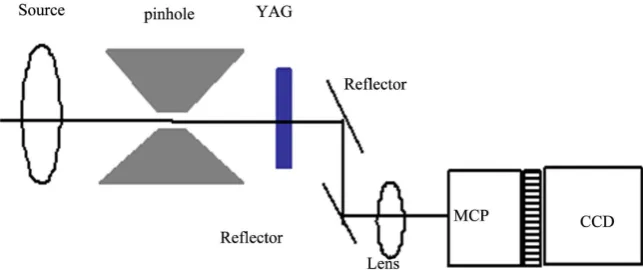
The schematic diagram of the basic principle of the thick pinhole imaging with the γ-rays is given in Figure 1. The process could roughly be interpreted as fol-lows. Firstly, the radiation source is imaged onto the imaging plane (YAG) by
γ-rays. YAG crystal is used to convert the γ-rays into the fluorescence image. Then the fluorescence image is imaged onto the incident plane of the MCP im-age intensifier through the optical imaging system and conversion system. Fi-nally, the intensified image is recorded by CCD device, and the MCP and CCD
are coupled with fiber plate. Thus, the major two parts of the system are γ-rays imagines system and the image recording system. Besides, a copper reflector with an efficiency of over 95% is placed in a 45˚ angle with γ-rays direction to reflect the fluorescence image, as well to avoid direct γ-rays irradiation onto the
MCP image intensifier and CCD camera. The specially developed imaging sys-tem could provide an amplification factor of 5:1 and a light collection efficiency of over 95%. The MCP image intensifier was manufactured by Proxitronic Co. Ltd. with a spatial resolution of over 37 lp/mm. The amplification factor of the fiber plate used to couple the MCP and CCD is 1.5:1, providing a stable and re-liable recording system.
3. Theoretical Modeling
3.1. Pinhole Imaging System
Suppose the detection efficiency of the γ-rays in the scintillator is Φ, and that the interactions of the γ-rays and the scintillator are abiding by the Gaussian distri-bution, then the fluctuated noise distribution induced by the detection efficiency would be Φ , and accordingly the SNR of the signal input would be
SNR= Φ. Another major factor to affect the quantum efficiency is the
com-monly called Swank coefficient, the energy distribution of the secondary elec-trons induced by the interactions of the γ-rays and the scintillator. Due to the fact that the γ-rays camera used in the experiment has a high gain and good de-tection efficiency for single particle, the effects of Swank coefficient on the image quality was excluded during our data analysis.
According to the pinhole imaging principles, the detection efficiency on the scintillator imaging plane after the thick pinhole imaging with the γ-rays could be given in the following equation [11]:
(
)
(
)
2
2 exp
π 1 1
4
D t
L M
φ µ
Φ = ⋅ ⋅ ⋅ − −
(1)
where: φ is the output intensity of the γ-rays from the radiation source; D is the
DOI: 10.4236/jasmi.2018.83003 28 Journal of Analytical Sciences, Methods and Instrumentation
Figure 1. The schematic diagram of the thick pinhole imaging with γ-rays.
SNR into Equation (1), we have the following equation to express the relation-ship between the SNR and the radiation source intensity:
(
)
(
)
(
)
2
2 2
4
π 1 exp in
LM
SNR
D t
φ
µ
=
− − (2)
Again, based on the definition DQE[12], we would have the following equa-tion:
( )
out 2in
SNR DQE f
SNR
=
(3)
Substitute Equation (2) into Equation (3), the relationships among the radia-tion source intensity, DQE and SNR are obtained as follows:
(
)
(
)
(
)
( )
2 2
2
4 1 exp
out
LM SNR
DQE f
D t
φ
π µ
= ⋅
− − (4)
As indicated in Equation (4), in dealing with a given imaging diagnostic sys-tem, a radiation source with a corresponding intensity is necessary for a desired image quality to fulfill the experimental requirements or to get an ideal image under a certain SNR condition.
3.2.
DQE
of Image Recording System
The image of the radiation source is recorded in CCD, where, the signal intensi-ty for each of the pixels is Np =Φ⋅Ad/np, where Ad is the corresponding area on
the scintillator of np pixels. The system gain is related to MTF(f), and the output signal could be given in the following:
( )
out p
S = ⋅G MTF f N⋅ (5)
where, G is the signal gain with a 0 spatial frequency. The CCD signal output is constrained by the NPS of the system. And the noises of the CCD recording sys-tem are coming from three sources. The first source is the detection uncertainty of the scintillator detector. For example, in the case of the Gaussian distribution, where the detection uncertainty is Np , and the gained noise distribution of
DOI: 10.4236/jasmi.2018.83003 29 Journal of Analytical Sciences, Methods and Instrumentation
output from the CCD device should be σnn = G⋅MTF(f)⋅ Np . The second source is the uncertainty of the transmission gain of the γ-rays G. Namely, if the detection uncertainty of the γ-rays for each of the pixels is Np , the
cor-responding noise would be σnp = G N⋅ p . Finally, the third source is the dark
current in the recording system, interpreted as σnd = nr⋅te (nr is the dark charges
in a unit time and te is the exposure time). Thus, the corresponding noise dis-tribution for each of the pixels could be obtained as follows:
( )
2 2 2nn np nd
NPS f =
σ
+σ
+σ
(6)( )
(
2 2( )
)
( )
2p r e
NPS f = N ⋅ G MTF f⋅ +G + n t (7)
And the SNR of the CCD output signals is given in the flowing:
( )
( )
( )
(
2 2)
( )
2p out
p r e
G MTF f N SNR f
N G MTF f G n t
⋅ ⋅
=
⋅ ⋅ + + (8)
Suppose the input signals are in the Gaussian distribution, and the SNR of the input signals could be as follows:
in d p p
SNR = Φ ⋅A n = N (9)
Then, according to Equation (3), the DQE for the CCD imaging recording system should be:
( )
( )
( )
(
)
( )
2 2 2 2 2 pp r e
G MTF f N DQE f
N G MTF f G n t
⋅ ⋅
=
⋅ ⋅ + + (10)
Again, in the case of an ideal scientific-level CCD whose dark charges could be reasonably negligible, Equation (10) could be well rewritten into:
( )
( )
( )
(
)
2
2 1
G MTF f DQE f
G MTF f
⋅ =
⋅ + (11)
Substitute Equation (11) into Equation (4), the relationships among the radia-tion source intensity, MTF, quantum gain and output SNR could be given in the following:
(
)
(
)
(
)
(
( )
( )
)
2 2 2
2 2 1 4 1 exp out
SNR G MTF f LM
G MTF f
D t φ π µ ⋅ ⋅ + = ⋅ ⋅
− − (12)
Based on the careful deduction mentioned above, the relationships among the radiation source intensity, SNR, quantum gain and MTF could be well estab-lished. And in dealing with a given system and image SNR, the necessary inten-sity of the radiation source could also be determined.
4. Analyses on Major Parameters
4.1. Quantum Gain (
G
)
DOI: 10.4236/jasmi.2018.83003 30 Journal of Analytical Sciences, Methods and Instrumentation
0, MTF(0) = 1. And the quantum gain is decreased gradually with the increasing spatial frequency. While the MTF is related with the gains of multiple compo-nents of the system, including the γ-ray-fluorescence convertor, the optical im-aging system, the MCP image intensifier and the CCD device, etc. however, in the actual calculations, the gain at f = 0 is common used as the standard.
The quantum gain mainly consists of the flowing components: Φ (the acting efficiency between the γ-rays and the scintillator); Gγ (the number of the fluo-rescence lights induced by each of the activated detected particle); εl (the
fluorescence efficiency of the imaging system); εMCP (the DQE of the MCP
image intensifier); MMCP (the gain of the MCP image intensifier); εtap (the penetration rate between the MCP fluorescence screen and CCD); εCCD (the quantum efficiency of CCD device). Other factors that affect the quantum gain include parameters of the simulated conversion systems inside the CCD de-vice. Finally, the quantum gain of the system could be given in the following equation:
l MCP MCp tap CCD
G= ΦGγε ε M ε ε (13)
The following are some specifications of the equipments or devices used in the experiment. The quantum gain of YAG crystal is about over 1.5 × 10³/MeV. The
optical imaging system was deliberately processed with a fluorescence efficiency of over 1%. The MCP image intensifier with conductive matrix could provide a quantum efficiency of about 45%. The coupling efficiency of the fiber plat for
MCP image intensifier and CCD device are about 70%. The quantum efficiency of the backward photosensitive CCD device is more than 90%. The scientif-ic-level CCD could provide a 16bit transmission in a digital conversion mode of 6e/ADU. After all, the image recording system, as a whole, could provide a sa-tisfactory performance in the single particle detection of γ-rays, and could be used for the image diagnostics of the weak radiation sources.
4.2. Modulation Transfer Function (
MTF
)
As mentioned above, the system consists of a thick pinhole, YAG crystal, MCP
image intensifier, CCD camera and other devices. According to the law of the
MTF transference, the system MTF could be given in the following equation:
( )
( )
P( )
YAG(
MCP)
MCP(
CCD)
CCDMTF f =MTF f ⋅MTF f ⋅MTF f M⋅ ⋅MTF f M⋅ (14)
dif-DOI: 10.4236/jasmi.2018.83003 31 Journal of Analytical Sciences, Methods and Instrumentation
ferent. For example, the MTF measurement of MCP image intensifier and CCD
device could be made with slit method and point source method, by which the
MTF could be obtained from LSF. Meanwhile, for the YAG scintillator under the
γ-rays irradiation, the MTF could be obtained mainly with edge method. Nota-bly, there are some other factors to affect the MTF that could not be negligible, such as the dispersion effects of the secondary γ-rays and the fluorescent lights in the scintillator.
Besides the experimental measurement, the MTF of the detector could also be provided by mathematical algorithm. For example, generally, the following could be obtained from calculation, such as the effects of the fiber plate structure on the MCP image intensifier, the effects of the CCD pixel size on the image re-cording, the effects of the lens size on the optical spatial resolution, and the spa-tial resolution of the pinhole imaging system, etc. And for the separated devices, the MTF could be obtained from the following equation:
( )
sin(
π)
π fD MTF f
fD
= (15)
where: f is the spatial resolution; D is the size of any one of the following items, including the size of the pinhole aperture, the size of the CCD pixel, the diame-ter of the lens, the spatial resolution of the fiber plate, etc. The MTF of the image diagnostic system is the total sum of the MTFs of all the devices, which is given in Equation (14). As for the thick pinhole imaging system, except the MTF of the pinhole imaging system, the MTFs of all the devices that compose the image system could be determined experimentally.
4.3. Effects of
SNR
on Image Quality
In the radiation imaging diagnostics, in order to get the radiation image worthy of analysis especially the image reflecting the evolution of the spatial intensity, the output image should have to have a certain SNR. For example, in the case of a relatively intense radiation source, the output image is generally required to have a SNR of bigger than 5 to contain the effects of the noise upon the image quality. Again, since the SNR is mainly depending on the detection efficiency of the γ-rays for the scintillator, the scintillator with relatively bigger thickness is common used to provide better detection efficiency. This is the reason for the widely application of the fiber array scintillators in the ICF experiments. How-ever, such schemes for a higher SNR work but with a compromise of a lower spatial resolution, because the spatial resolution is limited by the fiber scintilla-tor.
5. Experiment and Measurement Data
5.1. Measurement of Background Noise
effi-DOI: 10.4236/jasmi.2018.83003 32 Journal of Analytical Sciences, Methods and Instrumentation
ciency on the scintillator of the cosmic γ-rays as well. The maximum signal of the system was 65,535. The integral time for the measurement of the background noise was 1000 s. And the average signal obtained was 2000, indicating a SNR of 30 in comparison with the 65,535 saturated signals. Actually in our experi-ment, the recording time of the system in the radiographic imaging process is only 2 ms, a so short time with little effect negligible on the image quality.
5.2. Experimental Measurement of
MTF
With a cobalt radiation source, the edge method was to measure the system
MTF. The radiation source was a 0.7 cm × 45 cm rod, shielded with a lead slit collimator (5 mm × 50 mm in size and 200 mm in thickness). In this way, the size of the radiation source was confined within a range 5 mm in width. A tungsten edge collimator (10 cm in thickness) was placed tightly contacting the scintillator to shield the γ-rays and to provide the edge image appropriate for analysis. Then, a laser beam about 2 mm in diameter was introduced as the fun-damental beam, which would pass throng the collimator center and irradiate onto the scintillator perpendicularly. The tungsten collimator was placed on a rotator. The best edge image could be obtained by rotating the rotator and mon-itoring the edge images. With this image, the linear spread function (LSF) could be obtained. And the MTF could be available after Fourier transformation.
In the case of a thick pinhole 0.7mm in aperture size, the relative intensities with different frequencies could be calculated according to Equation (15) (Figure 2). As shown, the maximal resolution of the image recording system was about 1.5 lp/mm, basically same with that of the thick pinhole imaging system.
5.3. Quantum Gain
DOI: 10.4236/jasmi.2018.83003 33 Journal of Analytical Sciences, Methods and Instrumentation
5.4. Output
SNR
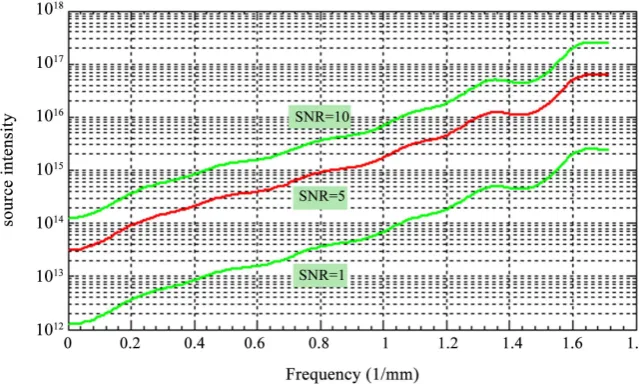
During the experiments, considerable measurements were made, including those of the MTF, quantum gain and the related noise power spectra. Based on the experiments, a relatively keen insight and deep understanding of the image cha-racteristics were obtained. The minimal radiation intensity required for various
[image:9.595.233.515.272.372.2]SNR conditions could be calculated in accordance with Equation (12). And the radiation source intensity varies with various frequencies. Thus, in order to get a radiation image appropriate for analysis, the SNR is generally required to be higher than 5. Equation (12) was used for the calculation of the radiation inten-sities in various frequency conditions, whose results are given in Figure 5. As indicated in the results, a higher SNR could be available with higher radiation source intensity.
Figure 2. (a) The edge image measured with cobalt radiation source; (b) The
[image:9.595.301.448.420.544.2]MTF of the pinhole imaging system experimentally measured.
Figure 3. The radiation image under a single particle action.
[image:9.595.285.462.575.704.2]DOI: 10.4236/jasmi.2018.83003 34 Journal of Analytical Sciences, Methods and Instrumentation
Figure 5. The schematic diagram of the relationship among the radiation source intensity, the SNR and the spatial frequency.
6. Data Analysis
6.1. Effects of
DQE
on Image Quality
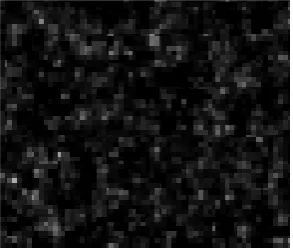
The DQE of the image diagnostic system is mainly dependent on the probability of the interaction between the γ-rays and the scintillator. The spurious speckle effects in the image are mainly due to the energy of the secondary electrons and fluorescent efficiency. And size of the speckles is determined by the electronic transmission distance (i.e. the fluorescent dispersion). Each of the interacting spot would be considered as a spot light source, and the total sum of the spots would reflect the image intensity. Due to the spurious speckle effects and their distribution, under a weak radiation condition, the image intensity would not be changed linearly with the change of the radiation intensity.
The deliberately designed optical imaging system is characterized in a high light collection efficiency, high DQE and optical gain in the optoelectronic sys-tem. The thermal noise of the electronic system is so little and could be neg-lected. The system could have good detection efficiency for a single photon to capture each of the fluorescent light induced by the interaction between the scintillator with the secondary electron. The quantum gain in the optimal condi-tions could be as high as about 150. In dealing with maximal image intensity of about 65,535, the dynamic range of the quantum gain of the imaging system was within about 437. Thus the requirements for the image diagnostics with rela-tively small uncertainty could be well fulfilled.
6.2. System
MTF
The image recording system mainly consists of the YAG scintillator, the MCP
DOI: 10.4236/jasmi.2018.83003 35 Journal of Analytical Sciences, Methods and Instrumentation
method. And the MTF of the system would be the total sum of the all the MTFs
of the components. However, due to measurement conditions for the each of component varies from each other, the total MTF of the system would be ob-tained with big uncertainty. In this extent, the edge method could not be used for the direct measurement of the MTF of the imaging system. In our experi-ment, the edge collimator was placed on the rotator to monitor the evolution of the image quality. Due to limited experimental conditions, the monitoring was made only for a range from −5˚ to 5˚. During this process, image quality was found with little change, which should be another implication that the fluores-cent dispersion should be a major cause for the image degradation. And the flu-orescent dispersion is then composed of the dispersion effects in the scintillator and the defocusing effects of the optical imaging system. In order to get higher light collection efficiency, the spatial resolution of the optical imaging system has to be decreased. In this context, the spatial resolution might not be as good as expectation. As compensation, the high light collection efficiency could pro-vide fairly good results in the image diagnostics especially in dealing with the weak radiation conditions with special requirements. The spatial resolution of the thick pinhole imaging system could not be measured in certain conditions, which could be obtained mainly based on the theoretical design and related theoretical calculation.
7. Conclusion
The principle of the using pinhole imaging to obtain the radiation source profile was introduced in this paper. The image diagnostic system consisted of a pin-hole, a YAG scintillator, a optical imaging system, a MCP image intensifier and a
CCD device. The relation of the signal transmission process, DQE, NPS, quan-tum gain, SNR of the system and the source intensity was analyzed. The main con-clusions were as follows, 1) The MTF at 10% of the system was about 1 LP/mm; 2) As the single-particle detection efficiency of the system, the stray speckle image would be observed under low radiation intensity, based on which the quantum gain of the system could be obtained as about 150; 3) As well the single-particle detection efficiency, the effect of the secondary gamma ray and fluorescence to the spatial resolution would totally submerged in the quantum fluctuation caused by the stray speckle; 4) Based on the established relation of the DQE, quantum gain, SNR and the source intensity, the minimum source intensity re-quired under different SNRs was calculated.
Conflicts of Interest
The authors declare no conflicts of interest regarding the publication of this pa-per.
References
Imag-DOI: 10.4236/jasmi.2018.83003 36 Journal of Analytical Sciences, Methods and Instrumentation
ing for Inertial Confinement Fusion. Review of Scientific Instruments, 74, 2690-2694. [2] Yates, G.J. and King, N.S.P. (1997) High-Frame-Rate Intensified Fast Optically
Shuttered TV Cameras with Selected Imaging Applications. SPIE Conference Pro-ceedings, Vol. 2273, 26-149.
[3] Vartsky, D. (2009) Signal and Noise Analysis in TRION—Time-Resolved Integra-tive Optical Fast Neutron Detector, Soreq NRC, Yavne 81800. Journal of instru-ment, 2, 1-18.
[4] Xiang, C.C. and Chen, X.H. (2010) MTF Measurement and Imaging Quality Evalu-ation of Digital Camera with Slanted-Edge Method. Proceedings of SPIE, Photonics Asia, Vol. 7849, Beijing, 5 November 2010,78490A.
https://doi.org/10.1117/12.869937
[5] Park, H.-S. and Kim, H.-J. (2008) Measurements and Evaluation of the Image Noise Power Spectrum for Computed Radiography. 2008 IEEE Nuclear Science Sympo-sium Conference Record, Dresden, 19-25 October 2008, 4378-4383.
https://doi.org/10.1109/NSSMIC.2008.4774252
[6] Miévillea, F.A., Bolardbm G., et al. (2011) 3D Noise Power Spectrum Applied on Clinical MDCT Scanners: Effects of Reconstruction Algorithms and Reconstruction Filters. SPIE Medical Imaging, Vol. 7961, Orlando,79610E.
[7] Lubinsky, A.R. and Zhao, W. (2008) Screen Optics Effects on DQE in Digital Radi-ography: Spatial Frequency Effects, Proceedings of SPIE, Medical Imaging 2008:
Physics of Medical Imaging, Vol. 6913, San Diego, 18 March 2008, 69134F.
https://doi.org/10.1117/12.772973
[8] Park, H.-S. and Kim, H.-J. (2010) Effects of Image Processing on the Detective Quantum Efficiency. SPIE Medical Imaging, Vol. 7622, San Diego, 23 March 2010, 76220M.
[9] Gang, G.J. and Zbijewski, W. (2012) Theoretical Framework for the Dual-Energy Cone-Beam CT Noise-Power Spectrum, NEQ, and Tasked-Based Detectability In-dex. Proceedings of SPIE, SPIE Medical Imaging, Vol. 8313, San Diego, 23 February 2012, 83131J.https://doi.org/10.1117/12.911817
[10] Mah, D. and Rawlinson, J.A. (1999) Detective Quantum Efficiency of an Amorph-ous Selenium Detector to Megavoltage Radiation. Physics in Medicine & Biology, 44, 1369-1384. https://doi.org/10.1088/0031-9155/44/5/320
[11] Xie, H.W., Peng, T.P., Xu, Z.P. and Chen, F.X. (2011) Thick Pinhole Design Applied to High Energy γ-Ray Source Radiographic Diagnostics. Nuclear Electronics & De-tection Technology, 31, 143-147.