ISSN Print: 2162-5999
DOI: 10.4236/ojsst.2018.83005 Aug. 1, 2018 49 Open Journal of Safety Science and Technology
Iterative Design of Impact-Damping Gloves for
Safer Boxing
Paul Perkins
1,2, Alex Jamieson
1, Geordie Ferguson
3, Wayne Spratford
1, Allan Hahn
1,4,51University of Canberra, Australian Capital Territory, Australia 2Boxing Australia Limited, Canberra, Australia
3Stellen Studio, Canberra, Australia
4Queensland Academy of Sport, Brisbane, Australia 5Griffith University, Brisbane, Australia
Abstract
Design methods were employed over a 5-year period to develop boxing gloves capable of substantially buffering impact forces delivered to an opponent, thereby permitting safer boxing. Multiple concepts were explored, with so-phistication of prototypes gradually increasing. The protypes underwent both quantitative laboratory testing and qualitative evaluation in the field. The laboratory testing methods were evolved over time to enhance test reliability and ecological validity. Feedback from the laboratory and field trials was highly instrumental in guiding the process of glove development. It was even-tually found that, compared to standard boxing gloves, pneumatic gloves with sealed bladders were effective in reducing peak impact forces and peak rates of force development when impact magnitudes were low to moderate but not when they were high. By contrast, pneumatic gloves incorporating a bladder enabling air exchange with the external environment were protective across the entire range of impact magnitudes likely to be encountered in boxing. These gloves are configured differently from standard gloves in terms of the positioning of the fist relative to the glove padding, but now have close visual resemblance to standard gloves. The aesthetics of the gloves have proven critical to their acceptance. Wearer comfort is also vital and, although we ex-tensively pursued the concept of thumbless gloves, we finally deemed it nec-essary to include separate thumb compartments to accommodate user advice. There is scope for further glove refinement, but recent experience indicates that the latest version is currently sufficient for use in modified boxing pro-grams that emphasise safety, with such targeted contextual sufficiency realis-ing a fundamental aim commonly associated with projects employrealis-ing the de-sign approach. Small batches of the gloves have recently been manufactured to cater for modified boxing programs.
How to cite this paper: Perkins, P., Jamieson, A., Ferguson, G., Spratford, W. and Hahn, A. (2018) Iterative Design of Im-pact-Damping Gloves for Safer Boxing. Open Journal of Safety Science and Technology, 8, 49-97.
https://doi.org/10.4236/ojsst.2018.83005
Received: June 8, 2018 Accepted: July 29, 2018 Published: August 1, 2018
Copyright © 2018 by authors and Scientific Research Publishing Inc. This work is licensed under the Creative Commons Attribution International License (CC BY 4.0).
DOI: 10.4236/ojsst.2018.83005 50 Open Journal of Safety Science and Technology
Keywords
Boxing Safety, Modified Boxing, Pneumatic Boxing Gloves, Protective Equipment for Boxing, Sport Design
1. Introduction
Boxing has a presence in almost every nation throughout the world [1]. It has been included in all but one Summer Olympic Games since 1904, but has been subject to criticism on medical, ethical, legal and sociological grounds [2]. In 2003, a paper published in the British Columbia Medical Journal included the following:
“In boxing, the ultimate achievement is to knock somebody out. And to knock somebody out is to injure his or her brain … Every year we read of some poor boxer who collapses and dies after a boxing bout as a result of repeated blows to the head. Moreover, we know … that blows to the head have a cumulative and devastating effect. Twenty years on and the commonly referred to condition of being punch drunk (is) all too easy to recognise … slurred speech, unsteady legs, lapses of memory, violent tendencies and the general appearance of having had a few too many” [3].
A decade later, the eminent neurologist and geneticist John Hardy expressed the view that:
“Boxing is a special case. No other sport has the express goal of causing injury to the brain. That is certainly the aim of professional boxing. Even in amateur boxing blows to the head are crucial … No doubt I will be called a killjoy for es-pousing the view that boxing should be banned … I would return the charge: nothing can be more killing of joy than personality changes, violence, substance abuse and dementia” [4].
relat-DOI: 10.4236/ojsst.2018.83005 51 Open Journal of Safety Science and Technology
ing to head or neck injuries [20].
Legal experts have argued that boxing consists of activities that in other con-texts would constitute criminal assault and have raised issues relating to the le-gitimacy of participant consent [21] [22] [23]. Sociologists have claimed that boxing has negative effects by overtly glamorising and rewarding violent
con-duct [24] and is exploitative of vulnerable young people [25] [26].
There is potential to address objections to boxing through modifications to the rules and equipment. Common suggestions include removal of the head and neck from the target area [21] [27] [28] and the development of gloves capable of substantially reducing impact forces delivered to an opponent [28]. Consid-erable doubts have been expressed as to whether the boxing community would ever be amenable to such changes [3], since it is believed that the visual, emo-tional and cultural appeal of the sport to that community is largely tied to its in-herent risks [29]. This belief is partially supported by the fact that since the 1890s, there have been more than 20 patents lodged for gloves aimed at mark-edly decreasing impact forces, but none has led to widespread or sustained adoption of a new glove design [30].
Nevertheless, a few modified boxing programs emphasising participant safety have recently emerged in Australia [31] and elsewhere [32]. After many years of coaching conventional amateur boxing, the first author of this paper spent five years running a modified boxing program at a Police Community Youth Club (PCYC) in Canberra. A survey of long-term participants in that program re-vealed that they placed high value on safety [33]. This stimulated subsequent ef-forts to progressively incorporate various safety procedures, including design, development and deployment of impact-damping gloves. The intent was to produce gloves that would not only reduce injury risks but would also be attrac-tive to users in the modified boxing setting and augment the appeal of the modi-fied boxing concept. Although we entertained a vague hope that our work might eventually provide impetus for exploration of similar ideas in the conventional boxing context, our focus was entirely directed toward creating gloves that would be enthusiastically taken up in the modified boxing situation. The pur-pose of this paper is to outline the progress made.
2. Overview of Approach
The project was pursued through an iterative design process incorporating a se-ries of quantitative scientific experiments and the use of various techniques to obtain qualitative feedback. Approval was provided by the Human Research Ethics Committee of the University of Canberra.
ar-DOI: 10.4236/ojsst.2018.83005 52 Open Journal of Safety Science and Technology
tefact and evaluation of its field performance [34], they are not the fundamental elements of the design process, since the latter is directed primarily toward crea-tion of value rather than determinacrea-tion of facts [36]. Creation of value can con-sist in finding a satisfactory solution to the problem rather than necessitating achievement of an optimal solution [37]. Unbiased consideration of multiple possible solutions is seen as vital, although questions have been raised concern-ing the extent to which this typically occurs [38], and it has been proposed that in practice design is often somewhat conjectural, with initial rapid conjecture on what is likely to work guiding subsequent design requirements and constraints [39]. It has been argued that the core challenge of design is the parallel develop-ment of an artefact and its way of working [36], as opposed to use of a sequential or linear approach. Cross [40] suggests that in design the relationship between problem and solution is “commutative”, implying that the order in which they are addressed need not be fixed. Hatchuel [41] notes that the design process in-corporates a concept of “expandable rationality” since the very act of pursuing a solution to a problem can lead to conceptual expansions. He sees social interac-tion as a critical component of design.
There is debate as to whether design is a specialised branch of science or a dis-tinct epistemological entity. It has been argued that while science is primarily hypothesis driven, the design process is outcome-driven [42] [43]. Science can be seen as focused on a search for universal truths, whereas design is directed toward context-specific invention and often has aesthetic components [44]. Cross [40] contends that method is vital to science but not to design, since de-sign outcomes are intended to be situation-specific, not universally repeatable.
Mahdjoubi [42] questions the popular belief that most innovation stems from scientific research and argues that, historically, non-linear design approaches initiated by a desire to create effective solutions to real-world practical problems have been a prolific source of innovation across numerous fields. He further contends that while science can be useful in guiding the design process, there are also cases in which design approaches provide a stimulus for scientific endeav-our [42].
We started this project with a clear goal in mind. We investigated several glove designs that we believed might enable attainment of that goal, and gradu-ally honed our thinking. Our ability to build upon prior designs for im-pact-damping gloves was limited by a dearth of information on their practical effectiveness. Only one of those designs has undergone published scientific as-sessment [45]. Since we were also quite restricted in terms of the financial and other resources available for glove development, we operated with a high degree of self-sufficiency in attempting to develop a solution that would meet the spe-cific needs of our modified boxing initiative.
DOI: 10.4236/ojsst.2018.83005 53 Open Journal of Safety Science and Technology
2.1. Initial Attempt to Reproduce Pneumatic Gloves
The one scientifically assessed glove aimed at impact damping was produced by a Finnish physician, Lyderik Löfgren, more than 60 years ago [45]. Like many earlier designs, it incorporated an air-filled bladder in place of standard glove padding. Laboratory testing showed that, compared to conventional gloves, it substantially reduced acceleration of a struck mass attached to a pendulum. An effort to reproduce that glove seemed a logical starting point for our work, al-though inability to locate relevant drawings made it a challenging task. After discussion with engineers from RMIT University (Melbourne), we initially en-gaged an external consultant to manufacture a few pairs of pneumatic gloves with characteristics resembling those described by the original inventor. The ex-ternal consultant was an enthusiastic modified boxing participant with a strong background in technological innovation. He approached the glove development with zeal and during the second half of 2013 produced some early prototype gloves that contained open-cell foam in place of standard glove padding. The surfaces of the foam were coated with rubber. There was a valve that allowed air to be pumped into or extracted from the foam structure to adjust its internal air pressure. As an additional feature evidently not included in the original pneu-matic gloves, a small hole was made in the rubber coating to permit air release from the foam structure upon impact, in keeping with a concept patented by Carrillo [46]. The form of the pneumatic gloves was quite similar to that of standard gloves (Figure 1).
Within three months of commencement of the project, the air-containing foam was tested against standard glove padding at the laboratories of Swinburne University of Technology in Melbourne. The testing consisted of dropping sam-ples of the different materials from selected heights on to a Kistler load cell that measured the impact profiles. Additionally, an INSTRON system was used to enable impact force measurements when the different samples were accelerated to known velocity over a set distance. The air-filled foam was tested both with the air hole open and occluded. The experimental set-up is shown in Figure 2.
DOI: 10.4236/ojsst.2018.83005 54 Open Journal of Safety Science and Technology
Figure 2. Equipment set-up for drop-weight and INSTRON testing of prototype gloves and air-filled foam materials.
The drop-weight and INSTRON tests produced highly repeatable results for any particular material. The prototype foam structure was softer than standard glove padding. The peak impact force produced when it was attached to a mass of 2.076 kg and dropped from a height of 0.7 metres on to a load cell was lower than that measured when the same procedure was applied to the standard pad-ding and to a standard intact boxing glove. The situation was reversed, however, when the drop-weight test was performed from a starting height of 1.1 metres, presumably because the prototype material became quite hard once its maximum deformation had occurred. Similar findings were obtained from the INSTRON testing, which indicated that the prototype material offered a protective effect only up to a peak impact force of ~500 Newtons (N), beyond which point the standard glove padding performed better. The air hole that had been included in the proto-type structure had almost no effect in reducing the peak impact force, since the time to peak force was too short for any substantial air release to occur.
Despite these initially disappointing findings, it was recognized that it should be possible to ‘tune’ the shape of the force curve and reduce the peak value by changing the air pressure inside the prototype structure and either increasing the size of the air release hole or incorporating a series of holes. Some doubt arose however, as to whether enough tuning could occur to provide protective effects up to the very much higher peak forces—perhaps as high as 8000 N [47]—that reportedly can be generated by boxers.
DOI: 10.4236/ojsst.2018.83005 55 Open Journal of Safety Science and Technology
2.2. Alteration of Fist Position Relative to Glove Padding
With the endeavour to produce effective pneumatic gloves at least temporarily on hold, focus was directed to another idea that had arisen during initial discus-sion as to how impact buffering might be achieved. This idea concerned the pos-sibility of reducing peak impact forces through alteration of the positioning of the fist relative to the main section of glove padding. We initially conducted some informal trials amongst ourselves by sparring with standard boxing gloves but employing a novel fist position within the gloves. Based on our subjective impressions of the effect, a decision was made to further explore the concept. With assistance from the Brisbane-based company HART Sport Pty Ltd., proto-type gloves were produced that required the whole closed fist to be placed into the compartment beyond which the fingers would usually extend (in contrast to the normal process of placing an open hand into the glove and then closing the fist). The portion of the glove that would otherwise contain the fingers was therefore left free, increasing both the thickness of padding in front of the knuckles and the scope for that padding to flex upon impact.
The new gloves were manufactured in vibrant red and blue colors to maximise their visual appeal. After informal tests in training settings, they were used in a 7-bout modified boxing event held at the Canberra PCYC in March 2014 (Figure 3). All but one of the contestants subsequently completed an anonymous on-line survey. There was unanimous agreement that the gloves reduced impact forces compared with standard gloves. Four athletes indicated that the degree of impact buffering was substantial, eight considered it moderate, and one thought it slight. Four athletes said that they did not enjoy using the prototype gloves, whereas three greatly enjoyed the experience. The remaining six athletes were neutral. Four athletes were either satisfied or very satisfied with the comfort of the gloves, five were neutral, three were unsatisfied and one was very unsatisfied.
In consideration of the formal feedback, and of casual comments subsequently
DOI: 10.4236/ojsst.2018.83005 56 Open Journal of Safety Science and Technology
made by the trial participants, we perceived that we were still far from realizing our over-riding project goal.
3. Highly Deformable Gloves
We noted the ability of air-containing party balloons to buffer impact forces as a result of their high elasticity and deformability and imagined that there might be potential to develop boxing gloves embodying these characteristics. It seemed possible that a balloon-like structure contained in a compartment much more elastic than standard glove leather or vinyl could form the “padding” of the glove, with the whole fist positioned behind it in a manner consistent with that tried in the above HART Sport gloves.
With the emergence of this concept, the project moved into a new phase in which we began constructing prototype gloves ourselves rather than arranging for established manufacturers to implement designs. As a first step, we evaluated several different air bladders with a view to finding one that was reasonably bal-loon-like but resistant to bursting when exposed to high impact forces.
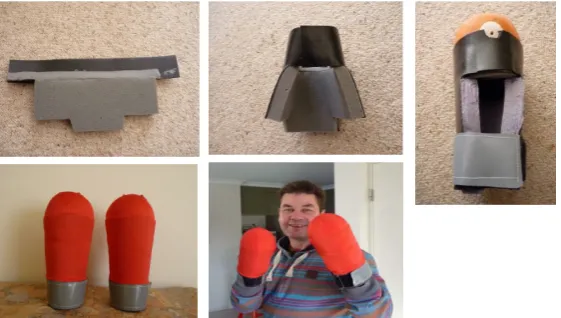
On advice from HART Sport, we eventually selected a Size 1 latex soccer ball bladder manufactured by Enkay [India]. We then cut off the end-section (i.e. the finger section) of a standard training glove and replaced it with a sewn-on, stretchable lycra bag with a sealable opening for insertion of the bladder, which could then be inflated.
A second lycra bag could subsequently be pulled over the whole complex to confer stability and shape and to enclose the thumb, effectively making the glove thumbless as has been recommended by medical authorities [48] [49]. The con-struction process is illustrated in Figure 4.
DOI: 10.4236/ojsst.2018.83005 57 Open Journal of Safety Science and Technology
In initial play amongst ourselves, the new gloves seemed subjectively to be have greater impact-buffering capacity than our previous prototypes. We pro-duced multiple pairs in red and blue colors, and in April 2014 they were used at modified boxing (Box’ Tag) [31] events in Sydney and Melbourne, with the Melbourne event being part of the Australasian Police & Emergency Services Games. There were mixed reactions from the contestants. Negative comments on the “look” and “feel” of the gloves were common. On the other hand, all 22 of the Sydney competitors and 11 of 14 Melbourne competitors perceived that the gloves reduced impact forces, with the majority rating the reduction as large. There were some reports that, when impacts were forceful, the bladders could occasionally ‘turn under’, causing impact to be made with only slightly padded knuckles. In later investigation of possible reasons for these reports, it became clear that inappropriate positioning of the hand within the glove (particularly through extension of the fingers) could lead to the bladder being pulled down-ward into a position entailing a risk that it would not be the first point of contact with the opponent. To overcome this problem, we subsequently produced “in-ner” gloves that prevented finger extension.
During the ensuing months, the gloves were occasionally used for sparring sessions held as part of the modified boxing program at the Canberra PCYC. Some positive responses were received, particularly from junior and female ath-letes and the parents or guardians of program participants, but the athath-letes never actively sought employment of the gloves and it was evident that, overall, a pre-ference for standard gloves remained.
In December 2014, the prototype low-impact gloves were employed for a modified boxing competition that formed part of a Draft Camp held at the Aus-tralian Institute of Sport (AIS) in Canberra for athletes interested in transferring into conventional boxing from other sports. Each of seven athletes interviewed after the competition thought that the gloves were either extremely effective or quite effective in reducing impact forces. Particularly salient were the following comments from two experienced boxing coaches who were present at the event: Coach 1: “The gloves helped in achieving tonight’s intended purpose. It was possible to assess the movement abilities of the athletes without exposing them to significant risk. To evaluate the potential of the athletes for boxing, it will still be necessary to see how they react to taking a solid punch, but tonight the gloves were central to a useful game. I think that when the big boys were involved and there were some power punches, the bladders sometimes bent under allowing the knuckles to make contact, so there are perhaps some design issues that need further attention. For kids, though, the gloves already could be great in allowing safer learning of boxing skills.”
DOI: 10.4236/ojsst.2018.83005 58 Open Journal of Safety Science and Technology
beginners, especially kids.”
These comments were interpreted as suggesting that, although ongoing work was required, we were tracking quite well toward the development of gloves that could be suitable for a modified, low-risk form of boxing.
Examination of the gloves after the AIS Draft Camp revealed that some had been damaged, presumably due to the occurrence of harder punching than that typically associated with modified boxing. The most common form of damage was tearing of the lycra bag sewn on to the glove, but stitching was also broken on a few outer bags. In one case, stitching was torn away across virtually the whole area of attachment of the inner lycra bag to the glove under-surface, meaning that the lycra bag was no longer performing its intended function of stabilisation and bladder positioning. It seemed probable that when bladders were greatly compressed, the ability of the lycra to stretch to accommodate later-al expansion was exceeded. This implied a necessity to either search for lycra or other material with more elasticity or impose some structural limit on the scope of lateral bladder compression, even though the latter solution would presuma-bly also reduce the magnitude of impact force buffering.
4. Refinement of Highly Deformable Gloves
At the beginning of 2015, we gave considerable further thought to possible rea-sons for reports that buffering of impacts by the prototype gloves combining the bladders and lycra covers occasionally seemed to fail. Displacement of the spherical bladder from its intended position was recognized as one likely cause of the problem. It was also apparent that even when the bladder was in position, hooked punches (as opposed to straight punches) could sometimes result in the opponent being contacted by the back of the glove in the area behind the blad-der, meaning that protection afforded by the bladder would not occur.
DOI: 10.4236/ojsst.2018.83005 59 Open Journal of Safety Science and Technology
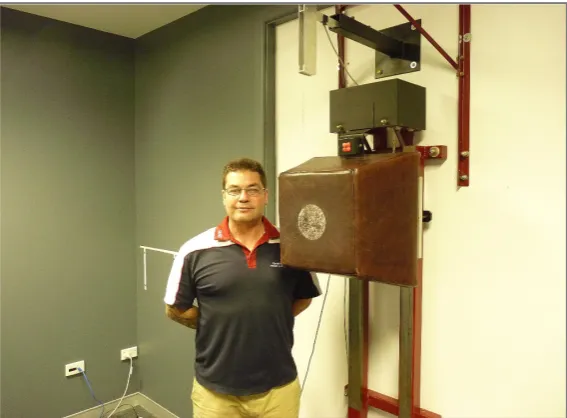
[image:11.595.228.518.219.415.2]of a wall-mounted force plate covered by a pad with a thickness of 290 mm in-cluding a leather covering, multiple foam layers, two layers of plywood board and a 20 mm thick aluminium plate to which the load cell was attached. The pad had a frontal surface of 330 mm square and at the point of maximum width it was 460 mm square. The aluminium plate at the back of the pad was 350 mm square. The apparatus, which is shown in Figure 6, incorporated a two-beam laser system that enabled measurement of pre-impact glove velocities. The beams were positioned 44 mm apart and very close to the target area of the pad.
Figure 5. Prototype low-impact gloves with additional foam added to perimeter of glove to increase protection against impacts delivered with a part of the glove other than the bladder. The white areas at the top of the gloves are electrically conductive patches that formed part of automated scoring technology used in Box’ Tag [50].
[image:11.595.231.515.484.693.2]DOI: 10.4236/ojsst.2018.83005 60 Open Journal of Safety Science and Technology
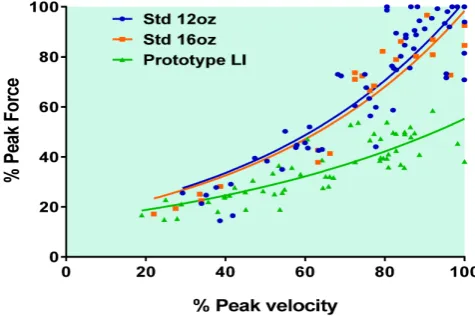
To enable data for the three individuals to be included in a single analysis de-spite individual differences in the levels of force that could be generated, each peak force reading was converted to a percentage of the personal highest peak force reading recorded on the day, and the same procedure was adopted for pre-impact glove velocities. A plot of percentage force against percentage
veloci-ty (Figure 7) suggested that the prototype gloves yielded substantial impact
[image:12.595.254.492.312.470.2]buf-fering effects across almost all the observed glove velocity range. It was also true, however, that very high glove velocities were seldom attained when the type gloves were used. This may be explained partly by the fact that the proto-type gloves were ~4 - 5 cm longer than the standard gloves, meaning they would have tended to travel over less distance before contacting the target. The de-crease in distance could be expected to limit the time available for glove accele-ration, hence lowering the velocity eventually reached. It is also possible, though, that some aspect of the form or comfort of the gloves caused the subjects to be slightly more tentative.
Figure 7. Comparison of performance of the prototype low-impact glove (Prototype LI) against that of conventional 12oz and 16oz gloves in initial “punch integrator” tests.
Although the test results were encouraging, the aesthetics of the gloves re-mained unsatisfying. We attributed this partly to the makeshift and rudimentary nature of our manufacturing process (e.g. the use of kitchen scissors and scalpels to cut foam to required shapes). We took the gloves to a modified boxing event in Sydney, where they were used in two bouts between junior males. In that context, they looked unacceptably large. During the remainder of the event, we showed the gloves to numerous attendees. Although there was interest in what we were trying to achieve, the appearance of the gloves drew broad criticism, and one adult female participant in the Sydney program commented that regardless of the im-pact-buffering capabilities of the gloves, she “would not be seen dead wearing them”. It was evident that further thought concerning glove design was necessary.
5. A Breakthrough: Building of Gloves around Bladders
us-DOI: 10.4236/ojsst.2018.83005 61 Open Journal of Safety Science and Technology
ing commercially available training gloves as a base and adapting them to enable accommodation of a bladder, we should focus on the bladder as the core element of our approach and work out how best to build a glove around it. In retrospect, this decision constituted a major advance in the project. It reduced material costs as the need to purchase training gloves was eliminated, and it also removed constraints as to how various glove components could be arranged as part of the assembly process.
Initially, cardboard cut-outs of a glove “frame” were produced to enable expe-rimentation that culminated in determination of optimal shape and dimensions. Once the characteristics of the frame had been finalized, a cut-out consisting of 0.5 mm thick rubber was made. Velcro “hook” material was then sewn on to the bottom section of the frame. To one side of it, a strip of elastic was sewn. To the other, a section of Velcro “loop” material covered with grey ripcord fabric was attached. The frame was then flipped over and a rectangular section of 2 cm thick open cell foam was glued to most of its surface. A triangular strip of the same open cell foam was glued to the rubber and the upper surface of the rec-tangular strip. The outer ends of the rubber frame were then brought together to create a circular, slanted cradle for the bladder. A notch was cut in the frame to provide access to the bladder valve. After placement and inflation of the bladder, a lycra bag was pulled over the whole unit. The elastic and Velcro materials formed a secure wrist strap (Figure 8).
[image:13.595.240.521.533.692.2]The glove made in this way had all the features of the previous prototype but its outer surface was smooth and it was much shorter and sleeker. It elicited a positive reaction from participants in the modified boxing program at the Can-berra PCYC and, with help from an Industrial Design student from the Univer-sity of Canberra, a few minor improvements were made in response to their feedback. The impact-buffering effects of the glove were subjectively perceived as substantial. Consequently, several pairs of the gloves were produced to permit more comprehensive field trials. It was found that after delivery of multiple moderately forceful impacts, creasing of the glove frame began to occur close to
DOI: 10.4236/ojsst.2018.83005 62 Open Journal of Safety Science and Technology
the bottom of the bladder. This area of the frame obviously would be subject to considerable compressive and shear forces during impact.
Investigation of the cause of the creasing problem suggested that it could be due partly to a tendency for the triangular section of foam forming the bladder cradle to become separated from the main (rectangular) section of the glove padding. We therefore made some new prototypes in which the foam element consisted of a single piece, instead of two pieces glued together. We also added a second layer of rubber to the glove frame to increase overall frame strength.
We showed the prototype gloves to colleagues at the University of Canberra and they opined that, in view of the progress made, the time had come to involve a professional industrial designer in the ongoing glove development.
6. Further Key Enhancements - Greater Visual Resemblance
to Conventional Boxing Gloves and More Robust
Construction
In June 2015, a small Canberra-based industrial design business, Stellen Studio, was commissioned to assist with the project. Its Principal recommended that to maximize the appeal of our prototype gloves to potential users, attention should be directed to increasing their visual resemblance to standard boxing gloves. Over the following month, he made several new prototypes consistent with this recommendation (Figure 9). They incorporated no lycra. In each case, the entire glove surface consisted of kangaroo leather, which although less elastic than ly-cra, has several advantages over bovine leather in that for any given thickness it has much greater tensile strength, is more resistant to stitch tearing, feels softer, is more abrasion-resistant and is less prone to uptake of sweat [53] [54] [55]. Pleating of the joins between the upper and palm sections of the glove meant that there was still reasonable scope for lateral bladder deformation. A port on the under-surface of each glove allowed for inflation and deflation of the bladder with the glove remaining fully intact.
The new prototypes were introduced to participants in the modified boxing program at the Canberra PCYC and the reaction was highly positive. Although the gloves were functionally quite similar to our previous version, they were immediately perceived as superior and there were numerous comments to the effect that we were now “really getting somewhere”.
Several pairs of the gloves were made and used in a series of specially orga-nized sparring sessions at the Canberra PCYC. It was found that the gloves seemed to work best when the air pressure within the bladder was only slightly above ambient atmospheric pressure. A Ross Brown model KPCh low-pressure gauge with a range of 0 - 10 kPa was used to measure bladder air pressure before and after each bout and showed that the bladder valves were resistant to leakage.
DOI: 10.4236/ojsst.2018.83005 63 Open Journal of Safety Science and Technology
Figure 9. The first prototype low-impact gloves made by Stellen Studio, Canberra, Aus-tralia, with mechanism for easy inflation and deflation incorporated.
could therefore predispose to wrist injury. Several athletes indicated that the spherical nature of the bladder could lead to unusual and unexpected glove con-tact characteristics and that this too might entail risk of injury to the person deli-vering the contact. There were occasional complaints that the gloves could rotate on the fist during impact.
To address the potential wrist and glove issues, changes to the wrist strap of the gloves were made, particularly in relation to its width. Also, in October 2015, a hemispherical bladder was produced and incorporated into new glove proto-types. The new shape was achieved by using a slightly larger bladder (Enkay In-dia Size 2 soccer ball bladder), then cutting off the its lower third and sealing the hole with a truck tyre patch. The changes enhanced the structural and functional stability of the gloves as well as their visual appeal (Figure 10), and the interest of Canberra PCYC athletes in using the gloves became greater and more sus-tained than ever before.
At the beginning of 2016 the gloves were used at another AIS Draft Camp for potential boxers. Each of seven aspirants completed two rounds of modified boxing against a former Australian champion amateur boxer. The feedback fol-lowing the session was very positive. The Coordinator of the Draft Camp ad-vised that the coaches thought the session was “fantastic” and really provided them with an indication of the skill level of the athletes. One of the scientists supporting the camp noted that it was great to be able to gain that indication without need to place the athletes at risk of being hurt.
DOI: 10.4236/ojsst.2018.83005 64 Open Journal of Safety Science and Technology
Figure 10. Low-impact gloves with hemispherical bladder, improved wrist support and inclusion of new leather sections providing the gloves with the appearance of having thumb compartments.
keep their fists tightly clenched, but it was recognized that this might have been because the inner gloves that we provided were too small. There was also an im-pression that the gloves were not tight enough around the wrists. Two athletes advised that they occasionally felt the gloves bend when they delivered hooks or uppercuts. The former national champion boxer, who used the gloves conti-nuously for 14 rounds, said that he found them comfortable throughout, but thought they could be improved by incorporating still larger wrist straps. Ex-amination of the gloves after the session showed that they stood up very well to the stresses, with no damage or deterioration evident.
Shortly after the AIS camp, we conducted another experiment in which three individuals struck the punch testing apparatus at the AIS. Each delivered 10 maximal punches to the wall-mounted, padded force plate with both left and right hands, and with each of three different glove types—prototype low-impact gloves with a bladder pressure of 2.0 kPa, conventional 10oz (Std 10oz) gloves and conventional 16oz (Std 16oz) gloves. The order in which the glove types were used was varied between individuals. Within each set of 10 punches, the interval between punches was 20 - 30 seconds. The intra-subject interval be-tween sets was 15 - 20 minutes.
One of the participants in the experiment was a male former Australian ama-teur boxing champion, another was a female participant in the modified boxing program at the Canberra PCYC, and the third was a 64-year old male who is one of the authors of this paper.
DOI: 10.4236/ojsst.2018.83005 65 Open Journal of Safety Science and Technology
Figure 11. Effect of glove type on peak force recorded on punch integrator by three dif-ferent subjects. Each column represents the highest single reading recorded from 10 at-tempts.
older male participant, the prototype low-impact gloves reduced peak impact force by 22% - 31% compared with Std 10oz gloves. For the former national champion boxer, who generated much higher absolute peak force levels, there was a reduction of ~15% for the left [non-dominant] hand but almost no reduc-tion (1.5%) for the right hand.
The findings were interpreted as suggesting that while the prototype low-impact gloves could substantially reduce peak forces associated with even moderately heavy impacts, they became ineffective when impacts when were very heavy, presumably because maximum compression of the bladder had been approached. A need was apparent, however, for a testing method less dependent on human factors and more suitable for allowing quantitative assessment of the gloves across a wide range of controlled impact magnitudes.
7. Progression in Glove Evaluation
In accordance with standard practice, we had used a pendulum system to check the calibration of the AIS punch-testing apparatus. This entailed releasing a steel pendulum arm with a length of 1 metre and a mass of 9.4 kg from a horizontal position so that a hammer on the end of the arm struck the centre of the force plate padding when the arm reached the vertical position. It was known that for the particular apparatus this process should yield a peak force reading of ~1,500 N. It occurred to us that adapting the pendulum to enable fitting of different glove types to its hammer end could provide a means for enabling repeatable evaluation of the influence of the gloves on peak impact forces.
DOI: 10.4236/ojsst.2018.83005 66 Open Journal of Safety Science and Technology
frame supporting the pendulum arm so that the swivel point of the arm could be further away from the target, such that the arm with mechanical fist and glove attached would still be vertical when impact to the target occurred. Additionally, the position of the swivel point had to be adjustable to cater for different glove lengths.
There was a requirement for the mechanical fist to be designed in a way that allowed its insertion into gloves to properly simulate real-world practice for dif-ferent glove types. This meant that it had to cater for conventional gloves to be put on with fingers extended, and the fist subsequently clenched, and for proto-type low-impact gloves to be put on with the fist already in the clenched position. With assistance from a Senior Technical Officer at the University of Canberra, we designed a mechanical fist with the necessary characteristics and arranged for a local engineering company to build it to our specifications. The device is shown in
Figure 12.
At the same time a new pendulum arm was produced that had a mass of 5.54 kg and provided for screw attachment of the mechanical fist at one end (at 90˚ to the shaft of the arm) and for placement and securing of extra masses behind the fist on the other side of the shaft. A metal sleeve was manufactured to enable ex-tension of the frame providing the swivel point for the pendulum. The sleeve incorporated a series of holes to cater for alteration of the swivel point.
The first tests with the new method (see Figure 13) produced some valuable data. When we used the pendulum arm with no additional weight added, the mean peak force (±standard deviation) for eight releases of a Std 10oz glove from a horizontal position was 1241 ± 8 N, and in a repeat test involving 14 re-leases it was 1247 ± 9 N. Under the same conditions, a prototype low-impact glove with a bladder pressure of 2.0 kPa gave a mean peak force of 997 ± 19 N, a reduction of ~20%. With 5 kg of weight added to the pendulum, the mean peak force for 12 releases of the Std 10oz glove was 1878 ± 17 N. For the prototype low-impact glove (also across 12 releases) it was 1249 ± 26 N, a reduction of 33.5%.
DOI: 10.4236/ojsst.2018.83005 67 Open Journal of Safety Science and Technology
Figure 13. First tests involving use of a pendulum apparatus with attached mechanical fist for glove testing. The photograph shows a prototype low-impact glove contacting the pad covering the wall-mounted force plate.
The variability in peak force measurements associated with any given condi-tion was very much less than in our prior human trials. Nevertheless, some problems were encountered in the conduct of the experiment. The fit of the me-chanical fist into the gloves was sub-optimal, necessitating minor modification of the gloves to ensure achievement of the desired fist position within them. The bar for addition of masses to the pendulum proved to be slightly too small in diameter and had to be taped to prevent the 5 kg mass used in the trial from moving. With the heavier impacts the prototype low-impact glove seemed first to deform and then “buckle under”. This was perhaps because the centre of mass of the mechanical fist was somewhat below the long axis of the “wrist”—a situa-tion differing from the real world. Most importantly of all, it proved difficult to maintain the mechanical fist in a fully clenched position inside the Std 10oz glove, preventing continuation of the experiment to include very high impact magnitudes.
To address the shortfalls of the initial mechanical fist, a new one was designed and built by a Melbourne-based team consisting of an engineer and an aircraft mechanic. It incorporated a ratchet system for clenching the fist and locking it firmly in the clenched position. The mass of the fist was distributed around the long axis of the unit rather than being largely below it (Figure 14). The pendu-lum was modified to increase the robustness of its connection to the fist.
In February 2016, a trial entailing use of the new mechanical fist was con-ducted (Figure 15). Initially, we compared a Std 12oz glove to a prototype low-impact glove with the bladder inflated to a pressure of 2.0 kPa. Both gloves were new. In each case, a 10 kg mass was attached to the pendulum and the glove was successively released to travel through arcs of 15˚, 30˚, 45˚, 60˚ and 75˚ as measured using a digital goniometer (Imex EL Series EL-20). There were 20 releases per glove per pendulum arc.
The results of the experiment are shown in Table 1.
DOI: 10.4236/ojsst.2018.83005 68 Open Journal of Safety Science and Technology
Figure 14. A conventional glove attached to the new mechanical fist, with the fist locked into the clenched position through use of a ratchet mechanism.
Figure 15. Glove testing using the pendulum apparatus, the new mechanical fist and the wall-mounted force plate at the Australian Institute of Sport. The digital goniometer used to measure pendulum release angles can be seen on the pendulum shaft.
Table 1. Effect of glove type and pendulum arc on peak impact force. For each condition, mean peak force for 20 trials is shown, along with the associated standard deviation.
Pendulum Arc Std 12oz glove Low-impact glove Prototype % Reduction In Peak Force
15˚ 249 ±3 N 190 ± 4 N 23.7
30˚ 541 ± 7 N 394 ± 8 N 27.1 45˚ 927 ± 19 N 675 ± 7 N 27.2 60˚ 1344 ± 14 N 1038 ± 34 N 22.8 75˚ 1772 ± 11 N 1567 ± 31 N 10.7
temporary repairs implemented. The repairs involved stabilizing the pendulum mounting bar at its outer end to take the pressure off the support frame.
DOI: 10.4236/ojsst.2018.83005 69 Open Journal of Safety Science and Technology
above and a 10 kg added mass was again employed.
The results of this follow-up experiment appear in Figure 16. In terms of the peak forces recorded with the various pendulum arcs, the Std 10oz, 12oz and 16oz gloves and the cheap recreational 10oz glove were virtually indistinguisha-ble from one another. The readings for the prototype low-impact gloves were 15.9%, 19.9%, 22.3%, 12.7% and 6.3% lower than the mean value for the other four glove types for the pendulum arcs of 15˚, 30˚, 45˚, 60˚ and 75˚ respectively. The differences between the Std 12oz glove and the prototype low-impact glove were less than those observed earlier, due to the peak force readings being slightly lower for the former and slightly higher for the latter. This may have been due to subtle changes introduced by the repairs to the pendulum support structure, and highlights the potential for research outcomes to be influenced by seemingly minor adjustments to experimental apparatus. Nevertheless, the general trend that we had observed in the earlier experiment was essentially con-firmed, with the low-impact glove producing considerable reductions in impact force when impact forces were low to moderate but showing diminished effec-tiveness at higher impact forces.
We began to wonder whether the protective effect of our prototype low-impact glove was being influenced by the relationship between the pre-impact velocity and the effective mass of the striking object. Figure 17 shows that, even for the best-case scenario associated with our addition of a 10 kg weight to the pendu-lum arm used with the AIS punch testing system, fitting of a curve to the rela-tionship between peak force measured with the Std 12oz glove and the reduction in peak force achieved with the low-impact glove suggested that the protective effect would fall below 20% when the peak force for the Std 12oz glove exceeded ~1453 N and would disappear altogether at 2053 N. However, protective effects considerably exceeding these predictions were observed in our earlier experi-ments involving the addition of only a 5 kg weight to the pendulum or human delivery of maximal punches.
DOI: 10.4236/ojsst.2018.83005 70 Open Journal of Safety Science and Technology
Figure 17. Effect of Low-Impact Glove on % peak force reduction as a function of peak force magnitude. The solid line joins observed data points. The dotted line is a curve fit-ted to the data through a second-order polynomial regression equation.
Release of our 1-metre long pendulum to travel through an arc of 75˚ resulted in a pre-impact velocity of ~3.8 m∙sec−1 and addition of a 10 kg mass to the pen-dulum provided a total effective mass of ~18.5 kg, whereas Walilko et al. [56] have reported that the peak pre-impact glove velocity attained by seven elite boxers av-eraged 9.14 m∙sec−1 and the effective mass averaged only 2.9 kg. It seemed rea-sonable to imagine that vastly different approaches to generation of impact forces might affect impact contact times and the ability of specific structures to buffer the forces. We therefore perceived a need to develop a laboratory-based glove testing method that was more closely aligned to real-world conditions.
8. A Step toward Greater Ecological Validity
en-DOI: 10.4236/ojsst.2018.83005 71 Open Journal of Safety Science and Technology
sured accuracy of the drop heights.
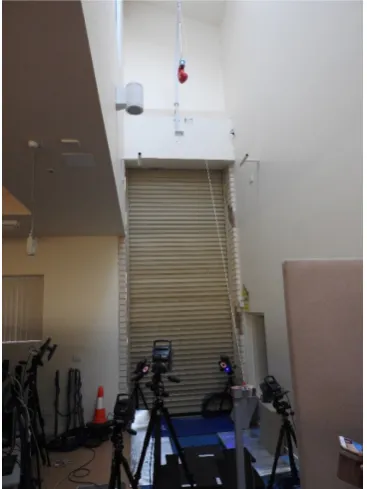
The mechanical fist employed in our final pendulum experiments was mod-ified so that a high-tensile steel rod could be securely screwed into it at the end opposite that designed to receive the gloves. At the other end of the rod was a hook for attachment of the cord. With the rod incorporated, the mechanical fist had a mass of 3.046 kg which was close to the 2.9 kg found to be the average ef-fective mass associated with maximal punches delivered by elite boxers [56]. A photograph of the experimental configuration appears in Figure 18.
A pilot trial with the new drop testing system was conducted in early April 2016. A Std 10oz boxing glove and a prototype low-impact glove with a bladder pressure of 2.0 kPa were each dropped ten times on to the force plate from heights of 1, 1.5, 2, 2.5 and 3 metres. The force plate was unpadded and its out-puts were monitored at a rate of 3000 Hz using Kistler Bioware software run on a standard PC. Throughout the testing session, known masses were regularly placed on the force plate to check the accuracy of the force plate readings. The results of the pilot trial are shown in Figure 19.
[image:23.595.281.465.460.705.2]We were greatly surprised by the magnitudes of the peak force readings, with the conventional glove producing a mean peak force reading of more than 3000 N even when the drop height was only 1 metre. This finding was considered due to the absence of protective padding over the force plate and the resultant lack of “give” in the target. It served to emphasize the importance of target characte-ristics in the determination of peak force readings. Detailed analysis of the da-ta revealed that, at the higher drop heights, rise in force readings was so rapid that a sampling rate of 3000 Hz was insufficient to ensure precise identification of peaks. The most important finding, though, was that while the prototype
DOI: 10.4236/ojsst.2018.83005 72 Open Journal of Safety Science and Technology
low-impact glove substantially reduced peak forces associated with drop heights of 1, 1.5 and 2 metres and still offered some protection at 2.5 metres, there was no protective effect at 3 metres. Since the peak forces with a drop height of 3.0 metres were in the vicinity of 12,000 N which is far above the level reportedly generated by boxers [47], the real-world implications of the finding were un-clear. Even so, examination of force curves was undertaken and revealed that al-though the low-impact glove always served to delay the onset of rapid increase in force, the shape of the curves beyond that onset became progressively more sim-ilar for the two glove types as drop height increased. At 3 metres, the shapes were very similar indeed (Figure 20).
This suggested that the low-impact glove had reached a point of maximum bladder compression beyond which it began to act like a conventional glove. In view of the insights gained from the pilot work, it was resolved that in subsequent
Figure 19. Effect of drop height on mean peak impact force recorded with prototype low-impact and standard 10oz boxing gloves dropped on to an unpadded force plate.
Figure 20. Force-time curves for standard 10oz and prototype low-impact gloves
DOI: 10.4236/ojsst.2018.83005 73 Open Journal of Safety Science and Technology
drop testing some padding should be placed over the force plate and the sam-pling rate should be increased. Critically, a decision was also made to develop a new prototype glove that permitted occurrence of some air release from the bladder when pressure within the bladder became high. This meant a return to the first idea that we had explored, but now with a different glove configuration, different materials, and insights gained in the intervening period. It was rea-soned that capacity for some air release should decrease the rate of pressure build-up, thereby changing the effect of heavy impacts on the shape of the force curve and yielding lower peak force readings.
9. A New Prototype Glove Incorporating Air Release
It was clear that any glove incorporating a bladder with capacity for air release during impact would need to also have a mechanism for rapid return of the air following impact release. We mooted the possibility of achieving this through inclusion of separate one-way valves for air outflow and inflow, as described in the patent registered by Carrillo [46], but eventually settled on a solution that we considered simpler and less susceptible to failure.
In our design there was a single hole in the bladder. The bladder was provided with a resilient, elastic internal “skeleton” that could collapse under conditions of high internal pressure during impact but would immediately recover its shape thereafter, with the recovery causing the internal bladder pressure to fall tempo-rarily below the ambient pressure, so driving air inflow. With this approach, no valves were required.
Figure 21 shows our first prototype of the new bladder. The internal skeleton
consisted of a “ball” of high-density, medium-firmness open cell foam (Joyce Foam Products HR 36 - 140), which was placed inside the bladder prior to seal-ing with the truck tyre patch. A hole was then made in the bladder and a plastic tube with an internal diameter of 10 mm was inserted. The area around the in-sertion was then sealed.
The next step was manufacture of a new prototype glove containing the mod-ified bladder, which was positioned in a way that allowed location of the air vent on the palmar surface of the glove (Figure 22).
10. Comparison of Gloves through Drop Testing
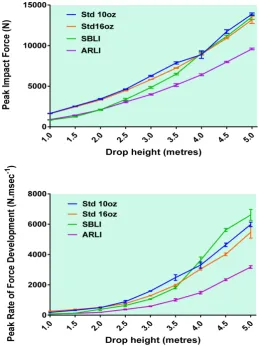
In late April 2016, we conducted a study in which the drop testing apparatus was used to compare a Std 10oz glove, a Std 16oz glove, a prototype low-impact glove with a sealed bladder (SBLI), and the new prototype low-impact glove with air release capability (ARLI).
DOI: 10.4236/ojsst.2018.83005 74 Open Journal of Safety Science and Technology (a) (b)
Figure 21. Construction of bladder for new prototype low-impact glove with capability for air release. The Size 1 soccer ball bladder in panel a was cut cross-sectionally at the point indicated by the black line. The foam skeleton was then inserted and the unit was sealed with a truck tyre patch (panel b). A port allowing air release and reuptake was then added.
Figure 22. Prototype low-impact glove allowing movement of air between glove bladder and external environment. The port for air exchange can be seen on the front surface of the glove.
EVA 75 material (Ultralon Foam Group, Sydney, Australia) with a guaranteed Shore A durometer hardness rating of 30 - 35, which is at the upper end of the range for healthy human skin but well below the level for human bone [58][59]. Outputs from the force plate were sampled at 10,000 Hz. The results are summa-rized in Figure 23.
[image:26.595.316.430.263.441.2]DOI: 10.4236/ojsst.2018.83005 75 Open Journal of Safety Science and Technology
largest increase in peak force over any running period of 0.5 msec, then doubling the result to obtain a reading in N∙msec−1. With the ARLI glove, the reduction in peak rate of force development relative to the Std 10oz glove was ~60% at drop heights up to and including 3.5 metres and 55%, 50% and 47% at drop heights of 4, 4.5 and 5 metres respectively. The SBLI glove was nearly as effective as the ARLI glove in decreasing the peak rate of force development at 1 and 1.5 metres, but its effectiveness then progressively reduced, and at 4, 4.5 and 5 metres it produced readings exceeding those for the Std 10oz and Std 16oz gloves.
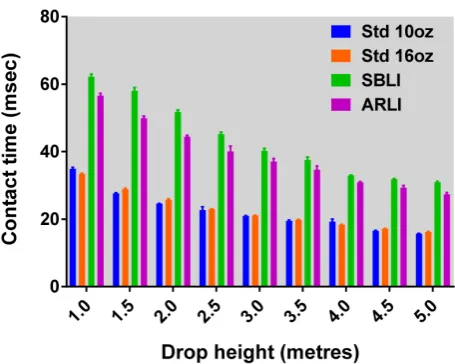
Both pneumatic gloves increased contact times between glove and target
(Figure 24), allowing distribution of impact energy over a longer period.
It is evident, however, that when impact energy was high, air within the sealed bladder of the SBLI glove approached and perhaps even reached maximum compression, causing the glove to become hard and peak force to then undergo rapid increase.
[image:27.595.245.505.309.656.2]In Figure 25, force-time curves are presented for each of the different gloves
DOI: 10.4236/ojsst.2018.83005 76 Open Journal of Safety Science and Technology
Figure 24. Force plate contact times for different glove types and drop heights. Each bar represents a mean value for five glove drops that produced the highest peak impact forces within a series of 10 drops. Standard deviations for the five drops are also shown.
Figure 25. Force-time curves for different glove types at selected drop heights. Note that the scale on the vertical axis differs between the three panels.
at drop heights of 1, 3 and 5 metres. Each curve relates to the glove drop that produced the third highest peak force reading from 10 drops under the specified condition (i.e. the median peak force from the highest five readings obtained). The trend evident in the Figure is representative of that observed across all nine drop heights. The impact-damping capacity of the SBLI glove eventually ‘bot-tomed out’ as drop height increased, while that of the ARLI glove was main-tained.
[image:28.595.212.543.309.505.2]DOI: 10.4236/ojsst.2018.83005 77 Open Journal of Safety Science and Technology
11. Experimentation with Hole Pattern for Air Exchange and
Importance of Bladder Foam Density
It was evident that in an air-release glove intended for field use, there could be no projection of an air pipe beyond the palmar surface of the glove. After consi-dering various possibilities for a more practical air transport pathway, we pro-duced some bladders that each incorporated six small air openings rather than a single larger one, with the openings extending only to the glove surface. Effort was made to ensure that their total cross-sectional area was similar to that of the air channel in our original ARLI glove. There was an obvious need to test the ef-fectiveness of the new arrangement. We also wanted to determine the extent to which characteristics of the foam forming the bladder skeleton could influence the performance of the glove when the nature of the air openings was held con-stant.
To enable achievement of the above dual purposes, we manufactured three new ARLI gloves, all with the six-hole system for air exchange. In one of these gloves, the bladder contained a relatively soft, high-density open cell urethane foam (Dunlop HR 36 - 80). In another, a relatively firm high-density open cell urethane foam (Dunlop HR 38 - 200) was employed. The firm open cell ure-thane foam was incorporated also into the third of the new gloves, but as a series of small blocks or “crumbs” rather than as a single, hemispherical piece. It was reasoned that use of crumbed foam would increase the total air content of the bladder and that this might positively influence the impact-damping qualities of the glove.
In June 2016, we conducted an experiment in which the three new gloves were compared, and in which our original ARLI glove and a Std 10oz glove were also included for reference purposes. The gloves used in the experiment are pictured
in Figure 26. The Std 10oz glove had a mass of 278 g and the original ARLI
glove had a mass of 298 g. The gloves with the soft open cell urethane foam, firm open cell urethane foam and crumbed firm open cell urethane foam had masses of 264 g, 288 g and 241 g respectively.
Each glove was dropped on to the force plate 10 times from heights of 1, 2, 3, 4 and 5 metres. The force plate was again covered with a mat of EVA 75 foam with a thickness of 25 mm. The Std 10oz glove was tested first, followed by the original air-release glove (Original ARLI), then the gloves with bladders consist-ing of the soft high-density open cell urethane foam (Soft Foam), a sconsist-ingle piece of firm high-density open cell urethane foam (Firm Foam) and multiple pieces of firm high-density open cell urethane foam (Crumbed Foam). For each glove, the initial drop height was 3 metres, followed by 4, 5 and 2 metres and finally 1 metre. Figure 27 shows the peak impact forces recorded.
DOI: 10.4236/ojsst.2018.83005 78 Open Journal of Safety Science and Technology
Figure 26. Gloves used in testing the effects of a new pattern of air openings and varia-tion in foam characteristics of the bladder skeleton on the impact damping performance of ARLI gloves.
Figure 27. Effect of glove type and drop height on peak impact force. Each point repre-sents the average of the highest five readings from 10 drops under the specified condition and the bars show standard deviations of the five readings. The force plate sampling rate was 10,000 Hz.
glove, although the latter was associated with slightly lower readings at all drop heights. Peak impact forces observed with the Original ARLI glove were ~43%, 40%, 35%, 32% and 32% less than those for the Std 10oz glove at drop heights of 1, 2, 3, 4 and 5 metres respectively. This was consistent with the findings of our earlier testing.
[image:30.595.266.485.284.436.2]DOI: 10.4236/ojsst.2018.83005 79 Open Journal of Safety Science and Technology
Figure 28. Force-time curves for different glove types and drop heights. Each curve re-lates to the trial producing the third highest peak impact force from a series of 10 drops.
protective than the Soft Foam glove when the air release hole pattern was con-trolled, it seems likely that the soft foam allowed too much air release during the initial glove deformation phase.
DOI: 10.4236/ojsst.2018.83005 80 Open Journal of Safety Science and Technology
for any of the other gloves. This is highlighted also in Figure 29. At a drop height of 1 metre, the mean peak rate of force development for the Soft Foam glove was similar to that of the other low-impact gloves, but at all other drop heights it yielded values considerably higher than them, presumably because the characteristics of the foam allowed relatively rapid compression. The means for the Original ARLI glove were ~58%, 68%, 61%, 51% and 49% less than those for the Std 10oz glove at drop heights of 1, 2, 3, 4 and 5 metres respectively. For the Firm Foam and Crumbed Foam gloves, increases in the values as a function of drop height occurred almost in parallel with those for the Original ARLI glove, although the values were consistently a little higher.
In Figure 30, contact times between glove and force plate are presented. At
[image:32.595.266.481.280.456.2]each drop height, contact times for the four prototype low-impact gloves were inversely related to the firmness of foam in the bladder. The fact that the Soft
Figure 29. Peak rates of force development for various combinations of glove type and drop height. The curves are based on mean values for five drops that produced the high-est five peak impact force readings out of 10 drops. The bars show the standard deviations for the five readings.
[image:32.595.251.493.528.669.2]DOI: 10.4236/ojsst.2018.83005 81 Open Journal of Safety Science and Technology
Foam glove always had the longest contact times among the low-impact proto-types, but also produced the highest peak impact forces and peak rates of force development at drop heights of 3 metres and above, indicated that optimization of protective effect depends on more than just maximizing contact time. Use of glove materials that prevent maximum glove compressibility from being ap-proached either too rapidly or too slowly is evidently also important. In our ex-periment, the performance of the Soft Foam glove appeared to be limited by the latter factor. On the other hand, the slightly diminished performance of the Firm and Crumbed Foam gloves relative to the Original ARLI glove may have been attributable to their shorter contact times, with the latter likely resulting from difference in the air opening arrangement, a small difference in foam firmness, or both.
Calculated areas under the force-time curves, calculated by the trapezoid me-thod, are shown in Figure 31. Overall, the values for the Std 10oz, Original ARLI and Firm Foam gloves were quite similar. The most striking finding was that the Crumbed Foam and Soft Foam gloves, which had the lowest masses, tended to produce the highest values. The reasons for this are unclear, but it is possible that the lesser amount of material in these gloves reduced their capacity to store some of the impact energy.
[image:33.595.251.497.518.671.2]In sum, the findings of the experiment led us to infer that a six-hole system for air ingress and air egress could be incorporated into our pneumatic gloves without substantially compromising protective performance relative to that ob-tained when a single larger air channel was employed. This was considered im-portant in terms of the aesthetics of a glove product. The experiment also dem-onstrated a potential for negative consequences from any attempt to use overly soft foam to constitute a glove bladder skeleton intended to reduce the force of initial glove impact. Finally, it showed that when hole pattern and foam density were held constant, the use of crumbed foam to form the bladder skeleton of-fered no advantage over the use of a single, custom-shaped foam piece, meaning
DOI: 10.4236/ojsst.2018.83005 82 Open Journal of Safety Science and Technology
that any effect of the crumbed foam in increasing the overall air content of the bladder was inconsequential.
12. Another Field Trial
In July 2016, a Sydney-based club that had been running a combined boxing and modified boxing (Box’ Tag) program for more than a decade and had partici-pated in previous testing and assessment of glove prototypes expressed interest in conducting a field test with the latest low-impact gloves. For this purpose, eight new pairs of ARLI gloves (four red and four blue) were manufactured and provided to the club. Over the following month the gloves, samples of which are shown in Figure 32, were used in a series of sparring sessions, particularly by junior athletes but also by others.
The Head Coach of the club provided us with written and verbal feedback during the trial and with additional verbal comments at its end. He indicated that the club members believed that the gloves looked smart and “worked really well” in terms of impact force reduction but perceived them as feeling “strange” and somewhat uncomfortable. There were specific complaints relating to a ten-dency for the gloves to rotate around the wrists during impacts and several ath-letes felt that the fist was too tightly constrained, with consequent inability to obtain even partial relief from the muscular effort required to maintain the fist in a fully clenched fist position. There were two reports of hand cramps after several rounds of sparring. Additionally, the Head Coach intimated that after using the prototype gloves during a couple of sparring sessions, the junior ath-letes began to request that they be allowed to return to “real gloves”.
[image:34.595.257.491.547.708.2]The major recommendation for improvement of the low-impact gloves was that they should have a separate thumb compartment, since this would both provide an anchor point to prevent glove rotation and decrease the volume of the hand needing to be contained in the main fist compartment. It was also sug-gested that the width of the gloves should be increased. An encouraging outcome of the exercise was advice from the club that it would be keen to take part in fu-ture glove trials.
DOI: 10.4236/ojsst.2018.83005 83 Open Journal of Safety Science and Technology
Throughout the whole process of our development of low-impact glove pro-totypes, we had quite regularly heard the opinion that a separate thumb com-partment was needed, but had resisted it because of statements from medical authorities concerning the potential merits of thumbless gloves as a means for reducing injuries [48] [49] and also because incorporation of a thumb compart-ment would increase the complexity and cost of glove production. In the after-math of the Sydney trial, however, it became clear to us that a positive response to the feedback could be crucial to glove uptake.
13. Production of a Prototype Glove with a Thumb
Compartment
In September 2016, our first prototype air-release glove with a thumb compart-ment was produced (see Figure 33). The location of the thumb compartment relative to the main section of the glove had to be a little different from that typ-ical of conventional gloves, because of the different placement of the remainder of the hand within the glove. Several other new features were also introduced. A horizontal “bar” made of cloth was inserted into the main glove compartment to help guide the hand into the required closed fist position. Instead of leather, a breathable and more flexible webbed material was used to construct the front section of the glove. Combined with the removal of the thumb from the main glove compartment, this was designed to greatly reduce any feelings of con-straint of the hand. It also removed the need to incorporate specific air passages into the front section of the glove, since air released from and returning to the glove bladder could easily pass through the webbed material. Visual resemblance to a conventional glove was therefore increased.
[image:35.595.293.453.523.703.2]Over the following few weeks, we showed the new prototype glove to various members of the local boxing community, and produced some further proto-types embodying adjustments based on their comments and recommendations. The primary adjustments related to ensuring that the thumb could be held in a
DOI: 10.4236/ojsst.2018.83005 84 Open Journal of Safety Science and Technology
comfortable, natural and safe position. As we progressed, we received majority feedback that the new glove was a substantial improvement on the previous ver-sion.
While the development of the new glove was occurring, we were advised that a consortium of organizations led by Boxing Australia Limited [the entity re-sponsible for administration of amateur boxing in Australia] had obtained a grant to introduce a modified boxing program into a number of schools and other institutions in northern India. The grant included an allocation for manu-facture of 60 pairs of low-impact gloves to support the program. We consulted with the Indian partners in the program as to whether thumbed or thumbless gloves should be provided and highlighted the arguments for both options. They expressed a strong preference for the gloves with thumb compartments, on the grounds that similitude to conventional gloves would be likely to facilitate ac-ceptance.
Before initiating a small production run of the new gloves, we needed to en-sure that they would be as effective as the prior air-release gloves in providing impact protection.
14. Laboratory Testing of the Thumbed Glove
Initial laboratory testing of the prototype ARLI glove with the separate thumb compartment was carried out at the University of Canberra in December 2016. The glove was compared with both a Std 10oz glove and a thumbless ARLI glove. Again, a drop testing protocol was employed, with each of the three glove types being dropped on to the force plate 10 times from heights of 1 to 5 metres, with the first drop height being 3 metres, followed by 2, 1, 4 and 5 metres. The thumbed ARLI glove was tested first, then the Std 10oz glove and finally the thumbless ARLI glove. The force plate was covered by a new mat consisting of EVA 75 material with a thickness of 25 mm.
[image:36.595.252.495.531.682.2]The peak impact forces recorded with the different glove types are shown in
Figure 34.