An Investigation on the Effect of Migration Strategy on
Parallel GA-Based Shortest Path Routing Algorithm
Salman Yussof*, Rina Azlin Razali
Department of Systems and Networking, College of Information Technology, Universiti Tenaga Nasional, Kajang, Malaysia
Email: *[email protected]
Received January 20,2012; revised February 18, 2012; accepted March 15, 2012
ABSTRACT
Genetic algorithm (GA) is one of the alternative approaches for solving the shortest path routing problem. In previous work, we have developed a coarse-grained parallel GA-based shortest path routing algorithm. With parallel GA, there is a GA operator called migration, where a chromosome is taken from one sub-population to replace a chromosome in another sub-population. Which chromosome to be taken and replaced is subjected to the migration strategy used. There are four different migration strategies that can be employed: best replace worst, best replace random, random replace worst, and random replace random. In this paper, we are going to evaluate the effect of different migration strategies on the parallel GA-based routing algorithm that has been developed in the previous work. Theoretically, the migration strategy best replace worst should perform better than the other strategies. However, result from simulation shows that even though the migration strategy best replace worst performs better most of the time, there are situations when one of the other strategies can perform just as well, or sometimes better.
Keywords: Parallel Genetic Algorithm; Shortest Path Routing; Migration Strategy
1. Introduction
Routing in a computer network refers to the task of find-ing a path from the source node to the destination node. Given a large network, it is very likely that there is more than one path for each source-destination pair. The task of a routing algorithm is to find the least-cost path among all the paths available for a particular source-destination pair. There are two types of routing algorithm used in the Internet nowadays, which are the link-state routing algo- rithm and the distance-vector routing algorithm [1].
Even though the link-state and distance vector routing algorithms are well-established in the Internet, the quest for shortest-path routing algorithm is far from over. In re- cent years, there are many researchers who came up with new shortest path routing algorithms that are based on nature-inspired optimization techniques such as genetic algorithm [2,3], neural networks [4], particle swarm opti- mization [5,6] and ant colony optimization [7]. These nature-inspired algorithms have several advantages over the traditional link-state or distance-vector routing algo- rithms. For example, a shortest-path routing algorithm based on genetic algorithm (GA) has the advantage of being more scalable and is insensitive to variations in network topologies with respect to route optimality [3].
Another work by [8] also shows that a GA-based routing algorithm is more robust in an environment where the network parameters can easily change. These advantages make these nature-inspired algorithms attractive to be used in wireless and mobile environment such as a mo- bile ad-hoc network (MANET).
However, these algorithms do have their disadvantages. For example, a GA-based routing algorithm may not be fast enough for real-time computation [3]. In previous work, we have proposed a shortest-path routing algo- rithm based on coarse-grained parallel genetic algorithm (PGA) with the goal to improve its performance [9]. Through simulation, it has been shown that the use of PGA is able to improve the performance of GA-based routing algorithm as long as the network size and the number of population are large enough.
The performance of a GA-based shortest path routing algorithm can vary depending on the choice of GA pa- rameters used in the algorithm. There are many parame- ters in GA that can be fine-tuned to get an optimum re- sult such as the genetic encoding, fitness function, popu- lation size, maximum iteration, the selection scheme, crossover rate and mutation rate. With coarse-grained PGA, there is another GA operation involved called mi- gration. In implementing migration, there are two GA parameters that need to be considered. These two para-
meters are the migration rate and the migration strategy. Migration rate specifies how often migration is to be per- formed, while migration strategy defines how the chro- mosomes involved in the migration operation are chosen.
In this paper we are studying the effect of various mi- gration strategies on the parallel GA-based shortest path routing algorithm proposed in [9]. There are not many re- searchers who pay attention to migration strategies, even though they agree that improvement can be achieved if a different migration strategy is applied to their algorithm [10]. One researcher who has done a study specific to migration strategy is Cao Yijia [11]. Cao studied to effect of migration strategies in a parallel GA algorithm deve- loped to solve the economic dispatch problem. Even though there is no concrete conclusion, it does provide an idea on the difference in results when using different migration strategies.
The rest of the paper is organized as follows. In Sec- tion 2, the overview of GA and PGA is given. The mi- gration operation and the migration strategies are also described in this section. In Section 3, the parallel GA- based shortest path routing algorithm proposed in [9] is described. Section 4 presents the experiment performed and its result. The paper is then concluded in Section 5.
2. Parallel Genetic Algorithm
2.1. Introduction to Genetic Algorithm
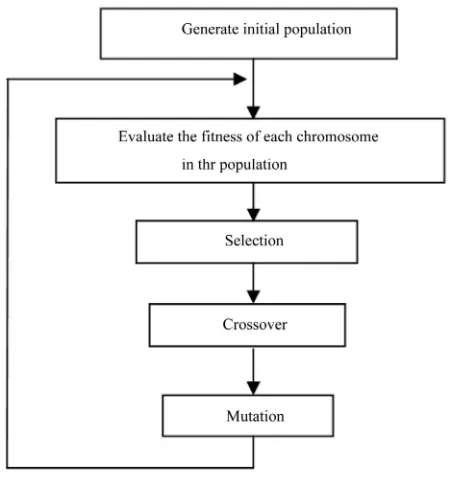
GA is a multi-purpose search and optimization algorithm that is inspired by the theory of genetics and natural se- lection [12]. The problem to be solved using GA is en- coded as a chromosome that consists of several genes. The solution of the problem is represented by a group of chromosomes referred to as a population. During each iteration of the algorithm, the chromosomes in the popu- lation will undergo one or more genetic operations such as crossover and mutation. The result of the genetic ope- rations will become the next generations of the solution. This process continues until either the solution is found or a certain termination condition is met. The idea behind GA is to have the chromosomes in the population to slowly converge to an optimal solution. At the same time, the algorithm is supposed to maintain enough diversity so that it can search a large search space. It is the combi-nation of these two characteristics that makes GA a good search and optimization algorithm. The general outline of GA is shown in Figure 1.
2.2. Introduction to Parallel Genetic Algorithm
[image:2.595.310.535.85.325.2]GA is generally able to find good solutions in reasonable amount of time. However, as they are applied to harder and bigger problems, there is an increase in the time re- quired to find adequate solutions. As a consequence, there have been multiple efforts to make GA faster and one of
Figure 1. General outline of GA.
the promising options is to use parallel implementation [13]. In PGA, there are multiple computing nodes. The task of each computing node depends on the type of pa- rallel GA used. There are four major types of PGAs which are master-slave GA, coarse-grained GA, fine- grained GA and hierarchical hybrids.
In master-slave PGA, one computing node will be- come the master and the other computing nodes will be- come the slaves. The master node will hold the popula- tion and perform most of the GA operations. However, the master can assign one or more computing-intensive tasks to the slaves. This is done by sending one or more chromosomes to the slaves and the master would then wait for the slaves to return their results.
In coarse-grained PGA, the population is divided among the computing nodes and each computing node executes GA on its own sub-population. To ensure that good solu- tions can be spread to other nodes, the nodes can occa- sionally, with certain probability, exchange chromo- somes with each other. This exchange is called migration and it involves a node sending a chosen chromosome to other nodes. The other nodes would then replace a chro- mosome in their population with the one received. Which node is chosen to be migrated or replaced would depend on the migration strategy used.
cute a genetic operation, a computing node will have to interact with its neighbors. Since the neighborhood over- laps, eventually the good traits of a superior individual can spread to the entire population. Fine-grained GA has a large communication overhead due to the high fre- quency of interactions between neighboring nodes.
The final type of PGA is the hierarchical hybrid which is structured in two levels. For example, at the higher le- vel, the algorithm operates as a coarse-grained GA while at the lower level the algorithm operates as a fine-grained GA. A hierarchical PGA combines the benefits of its components and it has better potential than any of the single implementation of the algorithm alone [13].
2.3. Migration Operation
Migration is a genetic operation commonly used in coarse- grained PGA [13]. In coarse-grained PGA, each com- puting node has its own sub-population that evolves in- dependently and in isolation. As compared to the serial GA, this would result in low diversity of the population because different sub-populations do not interact with each other. Migration is an operation that can be used to increase the sub-population diversity by having the com- puting nodes to share their results with each other. It is commonly performed as the last operation in each itera- tion. Migration involves having each computing node sending one of its chromosomes to the other nodes. At the same time, each computing node will receive mi- grated chromosomes from the other nodes. The received chromosome can replace one of the chromosomes cur- rently in the sub-population. The frequency of execution for the migration operation is called the migration rate.
To implement migration, a migration strategy must be chosen. Migration strategy defines which chromosome should be chosen to be migrated from the source sub- population and which chromosome should be replaced by the migrating chromosome in the receiving sub-popu- lation [13]. The source sub-population can choose to send the best chromosome or a random chromosome. On the other hand, the receiving sub-population can choose to replace the worst chromosome or a random chromo- some. Based on this, there are a total of four possible migration strategies: best replace worst, best replace ran- dom, random replace worst, and random replace random. Theoretically, the strategy best replace worst seems to be the best because it allows the distribution of high-fitness chromosomes to replace low-fitness chromosomes. In fact, this is the migration strategy used in many PGA implementations.
3. Parallel GA-Based Shortest Path Routing
Algorithm
In [9], we have proposed a coarse-grained PGA for the
shortest path routing problem. In the proposed algorithm, the computation is executed by a group of computing nodes. Each computing node will randomly create its own sub-population, and execute GA on its sub-population. The GA computation will be executed until the sub- population converges or the number of maximum itera-tion has been achieved. Each node will then pass its best result to a special node called the collector node. The col-lector node will then choose the best result from all the results received to become the output of the algorithm.
The pseudocode below outlines the operation of each computing node.
Randomly initialize the sub-population
While the population has not converged and the maxi-mum number of iteration has not been reached
Evaluate the fitness of each chromosome in the sub- population
Create the mating pool which consists of all the chro-mosomes in the current sub-population
Perform crossover operation Perform mutation operation Perform migration operation End_while
Send the best chromosome to the collector node
The collector node has the special task of collecting the best chromosome from all the computing nodes and choosing the best one as the output of the algorithm. This task is outlined in the pseudocode below.
While the best chromosomes from all computing nodes have not been received
Receive chromosomes from computing nodes End_while
Find the best chromosome among the received chro-mosomes
Present the chromosome as the shortest path found by the algorithm
3.1. Genetic Encoding
A communication network can be modeled as a directed graph G (N, E), where N is the set of nodes representing routers and E is the set of edges connecting the links that connect between the routers [1]. Each edge (i, j) is as- sociated with an integer representing the cost of sending data from node i to node j and vice versa.
mosome contains a loop and in network routing, any loop should be eliminated.
3.2. Initial Sub-Population
In the beginning, the sub-population is filled with chro-mosomes that represent random paths. Even though the paths are random, they are supposed to be valid paths, where the chromosomes consist of a sequence of nodes that are in the path from sender to receiver. The number of chromosomes generated for each sub-population, Sn,
depends on the total population size and the number of computing nodes, as depicted in Equation (1):
n P S
N
(1)
where, Sn represents the sub-population size of the nth
node, P represents the total population size and N repre-sents the total number of computing nodes.
The algorithm used to generate the random paths is given in the pseudocode below.
Start from the source node
While the destination node is not reached Randomly choose a neighboring node If the chosen node is not yet visited
Mark the node as the next node in the path Move to this node
Continue End_if
If all the neighboring nodes have been visited Move back to the previous node
End_if End_while
3.3. Fitness Function
Each chromosome in the population is associated with a fitness value that is calculated using a fitness function. This value indicates how good the solution is for a par- ticular chromosome. This information is then used to pick the chromosomes that will contribute to the forma- tion of the next generation of solution. The fitness func- tion used in the proposed algorithm is defined as follows:
1
i i
f
c (2)
where, fi represents the fitness value of the ith
chromo-some and ci represents the total cost of the path
repre-sented by the ith chromosome. This would give a higher fitness value for shorter paths.
3.4. Selection
Selection is used to choose the parent chromosomes for the crossover operation. The selection scheme used in the
nament size, s = 2. In this selection scheme, a parent for the crossover operation is selected by randomly choosing two chromosomes from the population. The one with the higher chromosome between the two will be selected as a parent. To select two parents, this operation is performed twice.
algorithm is the pairwise tournament selection with tour-
3.5. Crossover
ed on the two parent chromosomes
Y Z]
where n node
C G H I T U Z]
Thes e new
m
3.6. Mutation
e produced by the crossover operation
]
where iving
Crossover is perform
selected using the selection scheme described above. Crossover is only performed if one or both chromosomes chosen have not yet mated. To ensure that the paths ge- nerated by the crossover operation are still valid paths, the two chromosomes selected must have at least one com- mon node other than the source and destination nodes. If more than one common node exists, one of them will be randomly chosen with equal probability. The chosen node is called the crossover point. For example, assume that we have the following parent chromosomes:
Parent chromosome 1 = [A B C G H I X Parent chromosome 2 = [A K L M I T U Z] , A and Z are the source node and destinatio respectively. In this example, the common node is node I. Therefore, crossover operation will exchange the first por- tion of chromosome 1 with the second portion of chro- mosome 2 and vice versa. As a result, the following child chromosomes will be generated:
Child chromosome 1: [A B
Child chromosome 2: [A K L M I X Y Z] e two chromosomes would then becom embers of the population. For a population of size n, the crossover operation must be performed n/2 times to generate n child chromosomes.
Each chromosom
has a small chance to be mutated based on the mutation probability, pm for all the experiments, the value for pm is
set to 0.05. For each chromosome that is chosen to be mutated, a mutation point will be chosen randomly, with equal probability, among the intermediate nodes in the path from sender to receiver (i.e., the sending and re- ceiving node cannot be chosen as the mutation point). Once the mutation point is chosen, the chromosome will be changed starting from the node after the mutation point and onwards. For example, assume that the follow- ing chromosome has been chosen to be mutated:
would become like this:
Mutated chromosome: [A C E F G x1 x2 x3 ··· Z]
T ath
fr
3.7. Migration
ed by choosing a chromosome from
4. Experiment and Analysis
e are four different
4.1. Experiment Setup
the previous section has been he mutated chromosome now contains a new p om G to Z where xi is the ith new node in the path. The
new path is generated randomly; the same way as the paths in the initial population is generated.
Migration is perform
the local sub-population and then sends it to the other computing nodes. At the same time, the node should also check whether there is any chromosome migrated from the other computing nodes. If a migrated chromosome is received, it will replace one of the chromosomes in the local sub-population. The rule to determine which chro- mosome should be chosen to be migrated or replaced depends on the migration strategy used.
As mentioned in Section 2.3, ther
types of migration strategy which are best replace worst, best replace random, random replace worst, and random replace random. To evaluate the performance of the four migration strategies in the proposed parallel GA-based shortest path routing algorithm, an experiment has been conducted. The performance metric used to measure the performance is accuracy, where accuracy is defined as the percentage of the shortest paths returned by the algo- rithm that are actually shortest paths (as obtained from Dijkstra’s algorithm). A higher accuracy would indicate that the migration strategy used is better.
The algorithm described in
implemented as a C++ program which runs on an MPI cluster. There are two types of network used in the simu- lation, the n × n mesh network and the Waxman network [14]. The Waxman network is a random graph where the existence of link between two nodes, i and j, is defined by the following probability:
,
exp i j
ij , 0 , 1
p
L
(3)
where, di,jis the distance between the two nodes and L is
result reported here is averaged over 50 runs. For ea
4.2. Results and Discussion
presented in Figures 2-
een the be
tion stra- te
d
the maximum inter-nodal distance in the topology. A larger value of would generate a graph with higher density and a smaller value of increases the density of short edges relative to longer ones. In all the experiments, the values for both and are set to 0.2 and 0.1 respec- tively. However, to avoid having disconnected nodes, each node must be connected to at least one other node. The network topologies used are 10 10 mesh network
15 15 mesh network, 100-node Waxman network and 225-node Waxman network. Each link in the network is given a randomly generated cost value, ck(i, j) ~ uniform
(1,20). The population size used in this experiment is 5000, and this population is evenly distributed among nine computing nodes. The value for the migration rate is 0.1.
The
ch run, a new network with a new set of link metrics is randomly generated using different seeds. For the Wax-man network, this also means that a different network topology is generated on each run. In each run, a total of 1000 source-destination pairs are randomly chosen and the shortest path for each of them is computed.
The results of the experiment are
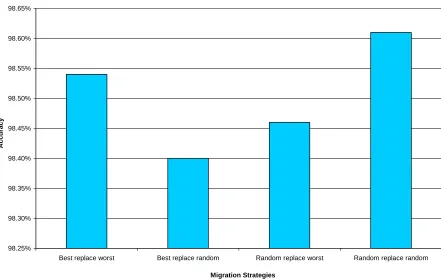
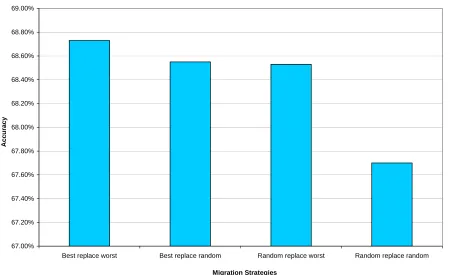
5, where each figure presents the result for a particular network topology. As expected, the best replace worst strategy tends to give relatively higher accuracy com-pared to other migration strategies. However, this stra- tegy is not necessarily dominant. It does give the best result in 10 10 mesh network (Figure 2), 100-node Waxman network (Figure 4) and 255-node Waxman network (Figure 5). However, in 15 15 mesh network (Figure 3) the result of this strategy comes second after the random replace random strategy. In fact, in all net- work topologies used in this experiment, there is one or more of the other migration strategies that perform al- most as good as the best replace worst strategy.
Table 1 shows the difference in accuracy betw st and the worst result for each network topology. It also shows the standard deviation between the results of the four migration strategies for each network topology. Based on this, it can be seen that even though there are differences in performance between the migration strate- gies, the differences is very low. The difference in accu- racy between the best and the worst strategy is only be- tween 0.11% and 0.31%. This conclusion can also be drawn from the standard deviation where the standard deviation of the four migration strategies is very low for all network topologies used in this experiment.
The small difference between the four migra
10x10 Mesh Network
99.60% 99.62% 99.64% 99.66% 99.68% 99.70% 99.72% 99.74% 99.76% 99.78%
Best replace worst Best replace random Random replace worst Random replace random
Migration Strategies
Accu
rac
[image:6.595.78.519.102.381.2]y
Figure 2. Performance of the four migration strategies in 10 10 mesh network.
15x15 Mesh Network
98.25% 98.30% 98.35% 98.40% 98.45% 98.50% 98.55% 98.60% 98.65%
Best replace worst Best replace random Random replace worst Random repla
Migration Strategies
Ac
cur
a
c
y
ce random
[image:6.595.79.520.438.718.2]100-node Waxman Network
96.10% 96.15% 96.20% 96.25% 96.30% 96.35% 96.40% 96.45% 96.50% 96.55% 96.60% 96.65%
Best replace worst Best replace random Random replace worst Random replace random
Migration Strategies
A
cc
u
[image:7.595.76.528.106.390.2]racy
Figure 4. Performance of the four migration strategies in 100-node Waxman network.
255-node Waxman Network
67.00% 67.20% 67.40% 67.60% 67.80% 68.00% 68.20% 68.40% 68.60% 68.80% 69.00%
Best replace worst Best replace random Random replace worst Random replac
Migration Strategies
Accu
racy
e random
[image:7.595.77.528.440.715.2]le 1. Statistics o
Difference between the
best and the worst Standard deviation
Tab f experimental results for each network
topology.
Network topology
result
10 × 10 mesh 0.11% 0.000471699
15 × 15 mesh 0.21% 0.000917878
100-node Waxman 0.31% 0.001463728
255-node Waxman 0.2% 0.004605341
rger search space. However, the algorithm may take
ts a study on the effect of migrat
REFERENCES
[1] J. F. Kurose a ter Networking: A
and the Sizing of
la
longer time to converge. The best replace worst strategy has a high selection pressure while the other strategies which contain a random element have a lower selection pressure. Therefore, even though the best replace worst strategy should perform well most of the time, the other strategies may also perform well for a large network with many alternative paths, where the search space is larger. In our experiment, this is evident in the result of 15 × 15 mesh networks where the random replace random strat-egy outperforms the best replace worst stratstrat-egy.
5. Conclusion
This paper presen ion strategies on the performance of a coarse-grained parallel GA-based shortest path routing algorithm. There are four migration strategies that have been evaluated which are best replace worst, best replace random, random replace worst and random replace random. Simulation result shows that best replace worst strategy does provide the best result most of the time. However, there are situations where the other strategies can perform just as well as, or even better than, the best replace worst strategy. It is also shown that the difference in performance between the best and the worst strategy is very low.
nd K. W. Ross, “Compu
Top-Down Approach Featuring the Internet,” 4th Edition, Addison-Wesley, Boston, 2007.
[2] M. Munetomo, N. Yamaguchi, K. Akama and Y. Sato, “Empirical Investigations on the Genetic Adaptive Rout-ing Algorithm in the Internet,” Proceedings of the Con-gress on Evolutionary Computation, Seoul, 27-30 May 2001, pp. 1236-1243.
[3] C. W. Ahn and R. S. Ramakrishna, “A Genetic Algorithm
for Shortest Path Routing Problem
Populations,” IEEE Transactions on Evolutionary Com-putation, Vol. 6, No. 6, 1999, pp. 1-7.
[4] W. Liu and L. Wang, “Solving the Shortest Path Routing Problem Using Noisy Hopfield Neural Networks,” Inter-national Conference on Communications and Mobile Com- puting, Kunming, 6-8 January 2009, pp. 299-302.
doi:10.1109/CMC.2009.366
[5] H. A. Mukhef, E. M. Farhan and M. R. Jassim, “General-ized Shortest Path Problem in Uncertain Environment Based on PSO,” Journal of Computer Science, Vol. 4, No. 4, 2008, pp. 349-352.
[6] M. Yusoff, J. Ariffin and A. Mohamed, “A Discrete Par-ticle Swarm Optimization with Random Selection Solu-tion for the Shortest Path Problem,” International Con-ference of Soft Computing and Pattern Recognition, Paris, 7-10 December 2010, pp. 133-138.
doi:10.1109/SOCPAR.2010.5685867
[7] A. A. A. Zakzouk, H. M. Zaher and R. A. Z. El-Deen, “An Ant Colony Optimization Approach for Solving Shortest Path Routing Problem with Fuzzy Constraints,” 7th International Conference on Informatics and Systems, Cairo, 28-30 March 2010, p. 1.
[8] S. Yussof and H. S. Ong, “A Robust GA-based QoS Routing Algorithm for Solving Multi-Constrained Path Routing Problem,” Journal of Computers, Vol. 5, No. 9, 2010, pp. 1322-1334. doi:10.4304/jcp.5.9.1322-1334
[9] S. Yussof, R. A. Razali and H. S. Ong, “An Investigation of Using Parallel Genetic Algorithm for Shortest Path Routing Problem,” Journal of Computer Science, Vol. 7, No. 2, 2011, pp. 206-215.
doi:10.3844/jcssp.2011.206.215
[10] S.-C. Lin, E. D. Goodman and W. F. Punch, “Investigat-ing Parallel Genetic Algorithms on Job Shop Schedul“Investigat-ing Problems,” Lecture Notes in Computer Science, Vol. 1213, 1997, pp. 383-393.
[11] Y. J. Cao, “Application of Parallel Genetic Algorithms to Economic Dispatch—Effects on Routing Strategies on Algorithms’ Performances,” Automation of Electric Po- wer System, Vol. 26, No. 13, 2002, pp. 20-24.
[12] D. E. Goldberg, “Genetic Algorithm in Search, Optimiza-tion and Machine Learning,” Addison-Wesley, Boston, 1989.
[13] E. C. Paz and D. E. Goldberg, “Efficient and Accurate Parallel Genetic Algorithms,” Kluwer Academic Publica-tions, Dordrecht, 2001.
[14] B. M. Waxman, “Routing for Multipoint Connections,”