Applied Mathematics, 2011, 2, 1297-1302
doi:10.4236/am.2011.210180 Published Online October 2011 (http://www.SciRP.org/journal/am)
Optimal Implementation of Two FIFO-Queues in
Single-Level Memory
Elena A. Aksenova, Andrew V. Sokolov
Institute of Applied Mathematical Research, Karelian Research Center, Russian Academy of Sciences, Petrozavodsk, Russia
E-mail: [email protected], [email protected]
Received November 19, 2010; revised January 11, 2011; accepted January 18, 2011
Abstract
This paper presents mathematical models and optimal algorithms of two FIFO-queues control in single-level memory. These models are designed as two-dimensional random walks on the integer lattice in a rectangular area for consecutive implementation and a triangle area for linked list implementation.
Keywords:FIFO-Queues, Random Walks, Markov Chains, Consecutive Implementation, Linked List Implementation, Paged Implementation
1. Introduction
Let two stacks grow towards each other in the shared memory of size m. D. Knuth set the task of constructing a
mathematical model of this process [1]. In [2-6] a mathe- matical model of the process was constructed as two- dimensional random walk in a triangle with two reflecting and one absorbing barriers. In [7-8] we consider the problem of one and two stacks managing in two-level memory. This paper proposes mathematical models and optimal algorithms of two FIFO-queues control [9]. These data structures are often used in control and automation systems.
In the case of single-level memory, several allocation methods of FIFO-queues in the memory may be used [1]. The first method (Garvic’s algorithm) is the consecutive allocation of one queue after another. In this case we have memory losses due to the fact that when any queue over-flow, other queue can have free memory units. The linked list implementation is the second method. In this case any number of lists can coexist inside a shared area of memory until the list of free memory isn’t exhausted. On the other hand, this method requires an additional link field for each element. The third method is storage of elements in the linked lists of fixed size pages. In this case we have memory losses of the first and the second types.
On the basis of proposed models the methods of queues implementation are compared, the optimality criterion— maximizing of the average number of operations, per-formed with queues until memory overflow. Execution
time of each operation is constant and it isn’t included in the optimality criterion. However, it is important to take into account the specific of hardware and software in the queues implementation methods. In [1] provides such time assessment of element insertion in the stack. When consecutive implementation is used, it equals 12 cycles, and when linked list—it equals 17 cycles. For the opera-tion of element deleopera-tion this assessments are equal ap-proximately.
2. Consecutive Implementation of Two
FIFO-Queues
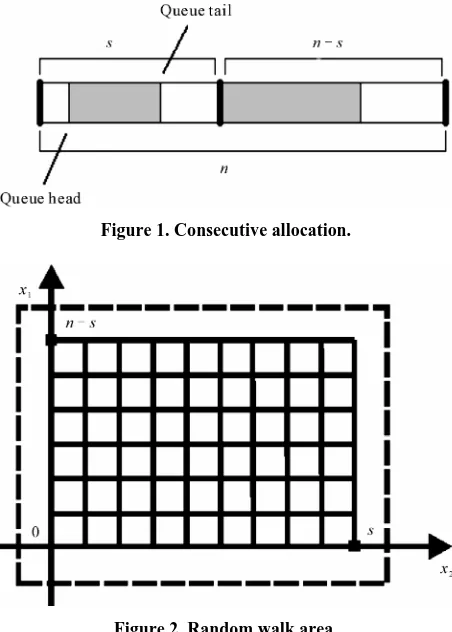
Assume that we want to work with two consecutive cir-cular FIFO-queues in the single-level memory of size m.
Denote the insertion and deletion probabilities of the elements in the first queue by p1 and q1, in the second
queue—by p2 and q2, the probability of operation which
doesn’t change the queue length (for example only read-ing)—by r, where p1 + q1 + p2 + q2 + r = 1. Denote the
current lengths of queues by x1 and x2, the length of
memory, separated to the first queue—by s, to the second
queue—by n-s (Figure 1). The value n = m – 2 is the total
maximal size of two queues, because one memory ele-ment remains free [1] for the circular realization of FIFO- queue.
As a mathematical model we have two-dimensional random walk on the integer lattice in the bounded area 0 ≤x1< s + 1, 0 ≤x2< n – s + 1 (Figure 2) with the tran-
Figure 1. Consecutive allocation.
Figure 2. Random walk area.
upward, q2—downward, r—to remain on the place. The
random walk begins at the state x1 = x2 = 0, where the
lines x1 = –1 and x2 = –1 are reflecting barriers, the lines
x1 = s + 1 and x2 = n – s + 1—absorbing barriers. The
problem is to choose the value s so that the expectation of
the random walk time, until the absorption occurs, would be maximal. Number the points of walk area top-down and right to left beginning by 0. These points correspond to the nonrecurring states of the Markov chain [10]. We have (s + 1) (n – s + 1) such states.
The tasks are solved with the apparatus of absorbing Markov chains. The proposed algorithm of states num-bering makes possible to estimate the transition matrix, corresponding to the Markov chain.
Theorem 2.1 At the given states numbering, memory size m and value s the matrix Q has the structure:
,
k k k k
k k z z
k k k k
k k k k
A B
C Q
A B
C A
1, where
1
1 ,
z s n s k n s
the submatrixes have the structures:
2 2
2
2 2
,
k k
p A
r q
p r q
1
1 ,
k k
q
B
q
1
1 ,
k k
p
C
p
the submatrix Ak k has the same structure as Ak k , but value q1 is added to the each element of the main
diago-nal.
The Proof is based on the mathematical induction me-thod.
3. Linked List Implementation of Two
FIFO-Queues
For linked list implementation it is enough to have one- linked list of elements (Figure 3). Each queue element
consists of two memory units of the same size. The first unit contains stored information and the second unit contains a pointer to the following element of list.
Denote the current lengths of queues by x1 and x2, the
pointers to the first queue elements—by F1 and F2, the
pointers to the last queue elements—by R1 and R2.
As-sume that m is divisible by 2. In such queue implementa-tion m/2 memory units are spent for the pointers, m/2
memory units are spent for the stored information. As a mathematical model we have two-dimensional random walk on the integer lattice in the region 0 ≤x1 + x2 < m/2
+ 1, where the border x1 + x2 = m/2+1 is an absorbing
barrier (it means that the overflow of some queue occurs), the borders x1 = –1 and x2 = –1—are reflecting barriers (it
means that the underflow of some queue occurs) (Figure 4).
The random walk begins at the state x1 = x2 = 0.
Nec-essary to find an average time of random walk until the absorption occurs. It is denoted by T. Then we should
compare it with the average time of consecutive and paged implementation.
4. Paged Implementation of Two Queues
In this way the queues are implemented as a linked list of the same size pages. The page size equals x memory units.
Assume that m is divisible by x, and then the number of
[image:2.595.366.488.79.238.2] [image:2.595.58.246.601.691.2]E. A. AKSENOVA ET AL. 1299
[image:3.595.299.539.69.496.2]Figure 3. Linked list implementation.
Figure 4. Random walk area.
x – 1 memory units of each page are used for the
infor-mation storing and one unit is used for the pointer storing (Figure 5). Also, assume that a control algorithm of free
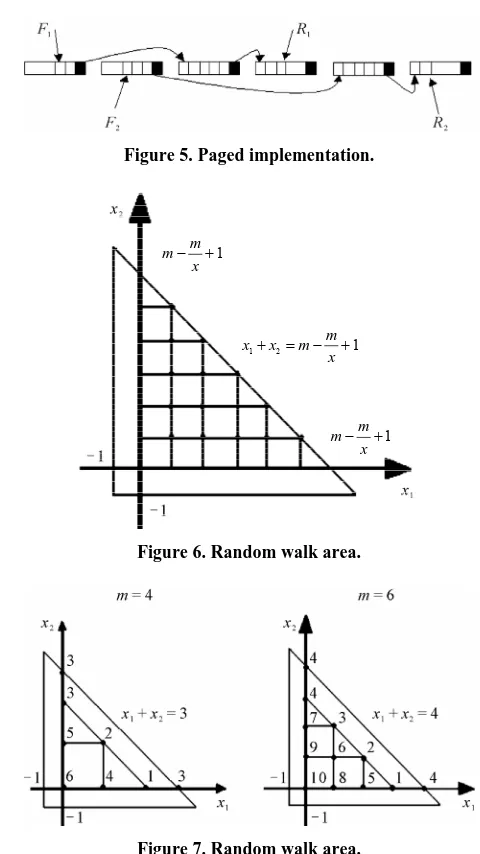
page list exists. The algorithm gives new page to the overflowing queue. If the page, which contains a queue beginning, becomes empty, that this page returns to the free page list. If the free page list is empty and the tail page of some queue overflows, the queue overflow occurs. Notice, if x = 2, it is the linked list implementation, i.e.
possible to consider the linked list implementation of queues as a special case of the paged implementation.
Denote the current lengths of queues by x1 and x2, the
pointers to the first queue elements—by F1 and F2, the
pointers to the last queue elements—by R1 and R2. As a
mathematical model we have two-dimensional random walk on the integer lattice in the region 0 ≤x1 + x2 < m –
m/x + 1, where the border x1 + x2 = m – m/x + 1 is an
absorbing barrier, the borders x1 = –1 and x2 = –1 – are
reflecting barriers (Figure 6). The random walk begins at
the state x1 = x2 = 0.
The task is to find an average time of random walk. Examine the process of random walk as a finite uniform Markov chain. Let’s number the nonrecurring states so like it is presented on the picture below (Figure 7), i.e.
bottom-up, from the left to the right. Determine the scheme of random walk with the probabilities of transi-tions so: p1—to the right, q1—to the left, p2—upward,
q2—downward, r – to remain on the place. The number of
memory units without pointers equals n = m – m/x. Then
the number of the nonrecurring states of Markov chain
Figure 5. Paged implementation.
1
m m
x
1
m m
x
1 2 1
m x x m
x
Figure 6. Random walk area.
Figure 7. Random walk area.
equals (n + 1) (n + 2)/2.
Examine the transition probability matrix Q, describing
transitions from the nonrecurring states to the nonrecur-ring ones. At the given numbenonrecur-ring the matrix Q has a block structure. Obviously, that the matrix structure of the linked list implementation coincides with the matrix structure of the page implementation.
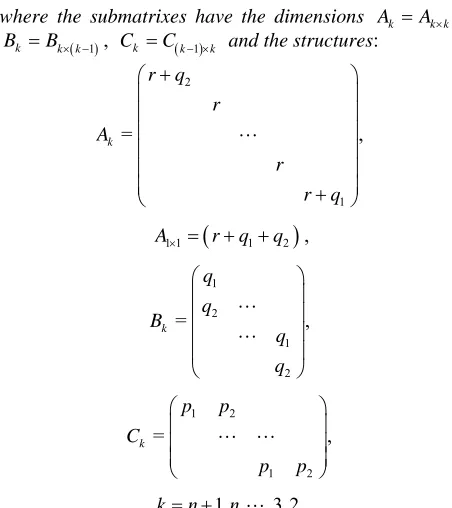
Theorem 4.1At the given states numbering, memory size m and value s the matrix Q has the structure:
1 1
1
2 2 2 1
1 2 1 2
,
k k k k k
z k
A B
C A B
Q C
A B
C r q q
1
2
[image:3.595.72.278.76.344.2] [image:3.595.335.509.628.706.2]k k k
, and the structures: 1
k k k
B B Ck Ck 1k
2 1 = k r q r A r r q ,
1 1 1 2
A r q q ,
1 2 1 2 = , k q q B q q 1 2 1 2 = , k p p C p p
1, , ,3, 2.
k n n
The Proof is based on the mathematical induction me-thod.
Denote by F(x) the average number of memory units,
which actually used for stored data, if overflow occurs. Let’s suppose that pages stored the queue beginning and the queue end, are half-filled, if the overflow occurs. The number of these pages equals 3. Then F(x) = m – m/x –
3(x – 1)/2, m > 0, x > 0. Lets find a maximum of F(x). The
derivative F'(x) =m/x2 – 3/2=0, the root x* = 6m/3.
The second derivative F''(x) = –2m/x3 < 0, m > 0, x > 0,
then x* is the maximum of F(x). Consider the values x
and x a optimal page size, because the
mathe-matical model is discrete. s an
5. Decision of the Task
For decision of the task we shall find the fundamental matrix N = (I – Q)–1 [10], where I is an unitary matrix. In
the cases of linked list and page implementations we work with the general resource of the memory. It implies that when the overflow of some queue occurs, all memory units are filled. Indeed, page, which contains the queue beginning, can’t be filled fully. In this case another queue can’t use this page, but pages, which contains its begin-ning and end, are not filled fully too. The overflowed queue can’t use these pages. Actually the random walk occurs in smaller volume of the memory. So the calcu-lated average time is the upper estimate for real random walk time. It is denoted by Tmax. Also, possible to compute
the lower estimate of real random walk time if consider that when the overflow of some queue occurs, pages,
the beginning and the end of another queue, are stored on one unit.
Then consider the random walk in triangular area 0 ≤x1
+ x2 < m – m/x + 1 for the upper estimate, and 0 ≤x1 + x2
< m – m/x – 3(x – 2) + 1 for the lower estimate, where the
summand 3(x – 2) is three pages, which stored on one unit.
Notice that the linked list implementation hasn’t such losses. For any memory size m we define when the
ran-dom walk area for the linked list implementation is less than the random walk area for the page implementation in the case of lower estimate of the average time. Consider the inequality m – m/x – 3(x – 2)> m/2, m > 0, x > 2.
If x is an arbitrary page size, get 2 < x < m/6, i.e. the
random walk area in the case of linked list implementation is always less than the random walk area in the case of paged implementationfor lower estimate, if x satisfies the
inequality above. Therefore, if 2 < x < m/6, the average
time of random walk until absorption in the case of linked list implementation is less than in the case of paged im-plementationfor thelower estimate.
If x = 6m/3, then m – 3 6m + 12 > 0. Get 24 < m < ∞, i.e. for m > 24 at x = 6m/3 the random walk area in
the case of linked list implementation is always less than the random walk area in the case of paged implementation for lower estimate. Therefore, for m > 24 at x = 6m/3
the average time of random walk until absorption in the case of linked list implementation is less than in the case of paged implementationfor thelower estimate.
6. Results of Numerical Experiments
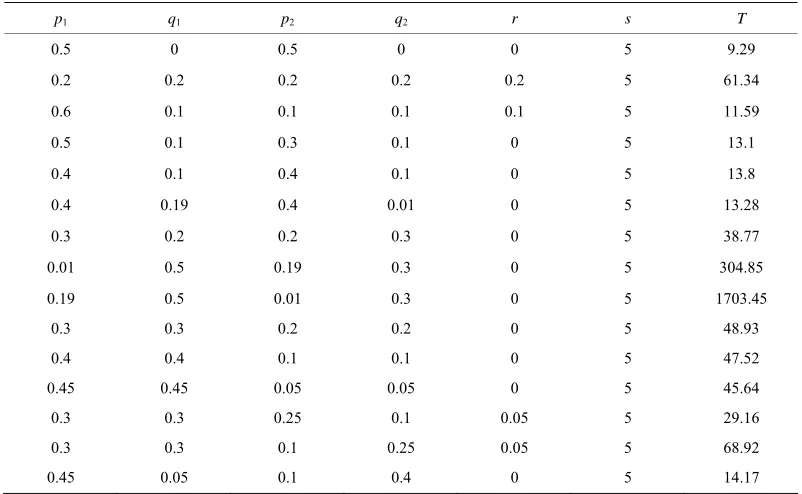
For this problems solution the algorithms and computa-tional programs in C++ were developed. Numerical re-sults are presented in Tables 1-2. The average time of the
random walk is presented in Table 1 for memory size m =
12 in the case, when each consecutive circular FIFO- queue has the same size of memory. In Table 2 the
av-erage time is presented for different queues implementa-tions. In the case of consecutive implementation the memory is divided optimally depending on queues probabilities. In the first five columns there are the queues probabilities, in the following three columns there is the average time of the random walk for A1—consecutive
implementation, A2—paged implementation, A3—linked
list implementation. The column s is the memory size,
assigned to the first queue in the case of consecutive im-plementation. The column, corresponding to the paged implementation, contains the optimal page size x and the
average time of random walk. Obviously that at the page size x = 2 the average time of random walk for the page
[image:4.595.57.283.77.331.2]E. A. AKSENOVA ET AL. 1301
Table 1. The average time for a consecutive implementation of the queues, when the memory is divided equally.
p1 q1 p2 q2 r s T
0.5 0 0.5 0 0 5 9.29
0.2 0.2 0.2 0.2 0.2 5 61.34
0.6 0.1 0.1 0.1 0.1 5 11.59
0.5 0.1 0.3 0.1 0 5 13.1
0.4 0.1 0.4 0.1 0 5 13.8
0.4 0.19 0.4 0.01 0 5 13.28
0.3 0.2 0.2 0.3 0 5 38.77
0.01 0.5 0.19 0.3 0 5 304.85
0.19 0.5 0.01 0.3 0 5 1703.45
0.3 0.3 0.2 0.2 0 5 48.93
0.4 0.4 0.1 0.1 0 5 47.52
0.45 0.45 0.05 0.05 0 5 45.64
0.3 0.3 0.25 0.1 0.05 5 29.16
0.3 0.3 0.1 0.25 0.05 5 68.92
[image:5.595.97.498.95.342.2]0.45 0.05 0.1 0.4 0 5 14.17
Table 2. The average time for different methods of implementation of queues.
A1 A2 A3
p1 q1 p2 q2 r
s T x Tmax Tmin T
0.5 0 0.5 0 0 5 9.29 3 9.0 6.0 7.0
2 0.2 0.2 0.2 0.2 5 61.34 3 73.33 35.76 46.81
0.6 0.1 0.1 0.1 0.1 8 16.31 3 15.57 10.12 11.92
0.5 0.1 0.3 0.1 0 6 13.81 3 13.84 8.93 10.56
0.4 0.1 0.4 0.1 0 5 13.8 3 13.91 8.97 10.61
0.4 0.19 0.4 0.01 0 4 13.44 3 13.65 8.8 10.41
0.3 0.1 0.2 0.3 0.1 6 42.87 3 32.84 25.998 23.94
0.01 0.5 0.19 0.3 0 1 1590.3 3 1353.63 292.27 497.81
0.19 0.5 0.01 0.3 0 8 23720.14 3 28498.54 1541.23 4091.91
0.3 0.3 0.2 0.2 0 5 48.93 3 59.13 28.83 37.74
0.4 0.4 0.1 0.1 0 7 55.16 3 63.61 30.96 40.57
0.45 0.45 0.05 0.05 0 7 65.5 3 69.51 33.72 44.25
0.3 0.3 0.25 0.1 0.05 4 29.2 3 32.38 18.8 23.15
0.3 0.3 0.1 0.25 0.05 7 97.46 3 113.88 49.31 67.5
0.45 0.05 0.1 0.4 0 8 21.46 3 20.86 13.45 15.91
Tmax and the lower estimate Tmin for the average time of
random walk.
7. Conclusions
It is possible to draw a conclusion from numerical results,
that for linked implementation of the queues, when size of the page x = 2, the average time of random walk before
characteristics of the queues the linked list implementa-tion can be better than the page implementaimplementa-tion.
Comparing the average time of the random walk for consecutive and paged implementations, notice that the average time for consecutive implementation is basically less than the upper estimate Tmax for paged
implementa-tion. However, for some probabilistic characteristics of the queues the average time for consecutive implementa-tion is greater than the upper estimate Tmax for paged
implementation. Also, for practice it can be interesting to analyze the consecutive implementation of the queues, when the memory isn’t divided optimum depending on probabilistic characteristics of the queues, but simply— fifty-fifty. It is logically, when we don’t know probabil-istic characterprobabil-istics of the queues beforehand. Then as a mathematical model we have two-dimensional random walk on the integer lattice in the square 0 ≤x1< m/2, 0 ≤
x2 < m/2, but for the linked list implementation we have
two-dimensional random walk on the integer lattice in the triangular area 0 ≤x1 + x2 <m/2 + 1. As can be seen from
comparison of the lines with numbers 3, 8, 9, 15 in the
Table 1 and in the Table 2, the consecutive implementa-
tion can be worse than linked.
Though greater part of the triangular area lies inside the square and only two states (m/2, 0) and (0, m/2) are
ab-sorbing for the square, but nonrecurring for the triangle, for some probabilistic characteristics of the queues it is enough that the average time of the random walk in the triangle became greater than in the square. For example, in line 3 we have a situation, when the insertion in the first queue occurs with high probability p1 = 0.6, but all rest
probabilities is alike. In this case the consecutive imple-mentation is worse than linked. Obviously, this occurs because greater part of the random walk paths is absorbed in the point, which lies outside of absorbing borders of the square, but is absorbing state for the triangle.
[1] D. E. Knuth, “The Art of Computer Programming,” Vol. 1, Addison-Wesley, Reading, 2001.
[2] A. V. Sokolov, “About Storage Allocation for Imple- menting Two Stacks,” Automation of Experiment and Data Processing, Petrozavodsk, 1980, pp. 65-71 (in Rus-
sian).
[3] A. C. Yao, “An Analysis of a Memory Allocation Scheme for Implementation of Stacks,” SIAM Journal on Computing, Vol. 10, 1981, pp. 398-403.
doi:10.1137/0210029
[4] P. Flajolet, “The Evolution of Two Stacks in Bounded Space and Random Walks in a Triangle,” Lecture Notes in Computer Science, Vol. 233, 1986, pp. 325-340.
doi:10.1007/BFb0016257
[5] G. Louchard, R. Schott, M. Tolley and P. Zimmermann, “Random Walks, Heat Equation and Distributed Algori- thms,” Journal of Computational and Applied Mathema- tics, Vol. 53, No. 2. 1994, pp. 243-274.
doi:10.1016/0377-0427(94)90048-5
[6] R. S. Maier, “Colliding Stacks: A Large Deviations Analysis,” Random Structures and Algorithms, Vol. 2,
No. 4, 1991, pp. 379-421. doi:10.1002/rsa.3240020404
[7] E. A. Aksenova, A. A. Lazutina and A. V. Sokolov, “Study of a Non-Markovian Stack Management Model in a Two-Level Memory,” Programming and Computer Software, Vol. 30, No. 1, 2004, pp. 25-33.
doi:10.1023/B:PACS.0000013438.25368.b4
[8] E. A. Aksenova and A. V. Sokolov, “Optimal Manage- ment of Two Parallel Stacks in Two-Level Memory,”
Discrete Mathematics and Applications, Vol. 17, No. 1,
2007, pp. 47-56. doi:10.1515/DMA.2007.006
[9] E. A. Aksenova, A. V. Sokolov and A. V. Tarasuk, “About Optimal Allocation of Two FIFO-Queues in the Bounded Area of Memory,” Control Systems and Infor- mation Technologies, Vol. 3, No. 22, 2006, pp. 62-68 (in
Russian).